Tag Archives: story

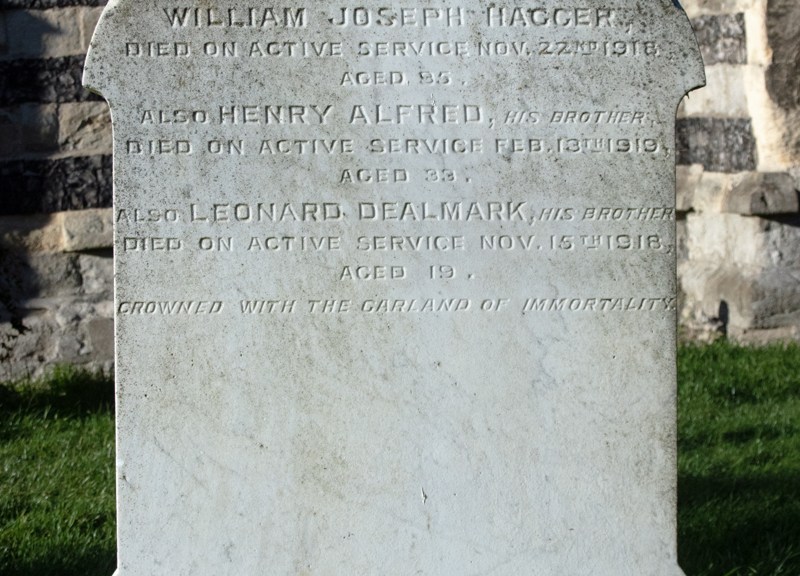
Driver William Hagger

Driver William Hagger

William Joseph Hagger was born in the spring of 1885, one of thirteen children to William Henry Hagger and his wife Emily Ann. The family lived on the Isle of Grain in Kent, where William Sr worked as a labourer in the local cement works.

William Jr was evidently keen to travel. On the 1901 census he is listed as a navyman on HMS Lion, a training vessel in Devonport, Plymouth.

His First World War records state that he officially joined the Royal Navy in 1906, travelling to West Africa as an Able Seaman. While there, he contracted a fever, and was invalided out of the service the following year.

William married Esther Elizabeth Reed in May 1909; by the 1911 census, she was living in Northfleet, Kent, working as a cartridge maker for the local arsenal. William himself is not recorded at the same property, and I have been unable to locate him at this point.

He next appears on the enlistment papers for the Royal Engineers. He joined up very early in the war – December 1914 – and after his training, Driver Hagger embarked for the Western Front in August 1915.

While serving, it seems that his previous affliction resurfaced, and William was dogged by colds and coughs. In the autumn of 1916, he was admitted to a field hospital with haemoptysis (coughing up blood), eventually returning to his unit three months later.

Driver Hagger’s health was fair until, in October 1917, his unit was gassed; he was sent back to England and hospitalised in Aldershot, and this time was discharged from the army six months later.

It seems that William did not recover from his illness and passed away on 22nd November 1918. He was 33 years old.

William Joseph Hagger lies at peace in a quiet corner of St Helen’s Churchyard, in Cliffe, North Kent.


William’s gravestone also acts as memorial to two of his brothers, Henry and Leonard.


Henry Alfred Hagger was born two years after William. He was also keen to make a name for himself, emigrating to California, and working as a streetcar conductor in Oakland. Initially declaring himself exempt from draft as he had a wife to support, he subsequently joined the British Columbia Regiment on 31st July 1917.

Henry was attached to the Forestry Depot of the Canadian Expeditionary Force, who were to be shipped to Europe to harvest trees for use on the Western Front. However, at the point of his medical – in September 1917 – he was discharged as unfit for active service due to his asthma.

Henry Hagger died on 13th February 1919, presumably of his lung condition. He is buried in Ross Bay Cemetery in British Columbia.


Leonard Dealimark Hagger was born in 1899. He enlisted as soon as he was able to, just short of his 18th birthday. Joining the York & Lancaster Regiment, he was posted in 1918.

His battalion saw some of the fiercest of the battles in the closing months of the war – Estaires, Messines, Bailleul, Kemmel Ridge, Scherpenberg, Selle, Valenciennes – and it is likely that Leonard was involved in some of these engagements.

Private Hagger was wounded in the closing weeks of the war, and passed away in a hospital in Liege, Belgium on 15th November 1918. He had just turned 19 years of age.

Private Leonard Hagger lies at peace in the Robermont Cemetery in Belgium.
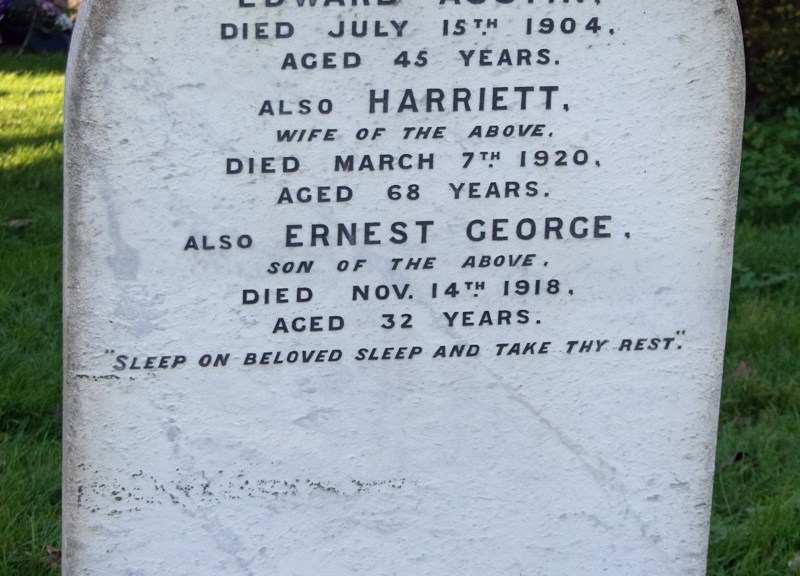

Private Ernest Austin

Private Ernest Austin

Ernest George Austin was born in early 1888, one of four children – all boys – to Edward Austin and his wife Harriett. The Austin family lived in the village of Cliffe, in the North Kent countryside, where Edward was a carpenter.

Ernest’s older brother Edward worked as a telegram messenger when he left school, and Ernest followed suit, becoming a postman by the time of the 1911 census. The four boys all lived with their now-widowed mother, their father having died seven years earlier.

Duty soon called, however, and Ernest enlisted in July 1916, joining the Army Service Corps. After training in England, he was shipped overseas that autumn.

Private Austin was discharged from the army just over a year later, and the medical report from that time sheds a lot more light onto this young man’s life:

Father [Edward] died of “consumption”.

Has had a chronic cough since a boy. Developed tubercle of lung in 1907. Went to Chile same year, where all symptoms disappeared. Put on weight and lost his cough completely. Returned to England and joined Army July 1916.

Has been in Mesopotamia three months. Cough has returned. Lost weight. Night sweats. Admitted to [military hospital] with sore throat; TB found present.

Admitted to this hospital 14th June 1917 with above symptoms. High temperature, evidence of infection.

In my opinion, the relighting of a latent infection is entirely attributable to active service in Mesopotamia.

Private Ernest Austin’s medical board record, 23rd Jun 1917

Ernest had been hospitalised in the Cumballa War Hospital, Bombay. He was sent home and ultimately discharged from active service on 8th October 1917.

Demobbed, Ernest married Antoinette Gurton at the start of 1918. The marriage was to be short-lived, however, as Ernest appears to have finally succumbed to his illness less than a year later.

Private Ernest Austin passed away on 14th November 1918. He was 31 years old. He lies at rest in the graveyard of St Helen’s Church in his home village of Cliffe, Kent.


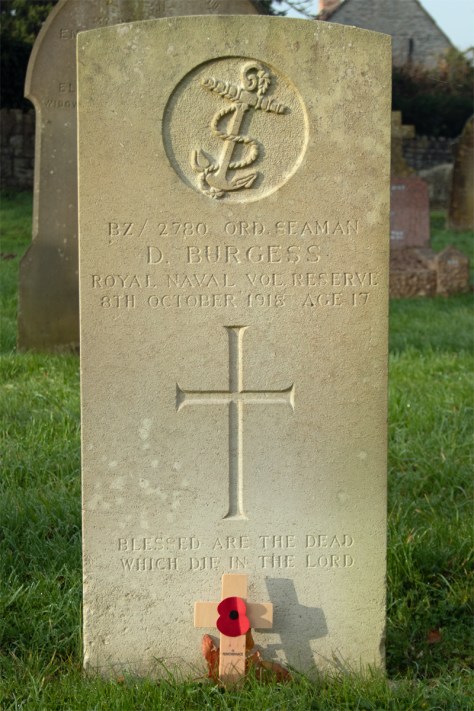
Ordinary Seaman Donald Burgess

Ordinary Seaman Donald Burgess

Donald Burgess was born in 1901 in the village of Queen Camel in Somerset. His father, Frank Luther Burgess was the local schoolmaster, and he and his wife Frances has four children, all sons.

By the time of the 1911 census, Donald and his three brothers – Claud, Wilfred and William – were all at school, and Frank was, by now, the village headmaster.

Donald seems to have volunteered as soon as his age allowed. He joined the Royal Naval Voluntary Reserve in September 1918, and was stationed at HMS Victory in Crystal Palace. He was training to become a wireless operator, but his time there seems to have been cut cruelly short.

Ordinary Seaman Burgess contracted pneumonia and was admitted to the 4th London General Hospital in nearby Camberwell. Sadly, he succumbed to the condition and passed away on 8th October 1918, after just a few weeks’ service. He was just 17 years of age.

Donald Burgess lies at rest in sight of his father’s school, in the graveyard of St Barnabas Church.


Private Edward Carver

Private Edward Carver

Edward Carver is one of those soldiers whose details have been lost in the mists of time.

From the information I have been able to gather, Edward was born in Kent in 1887, although I have been unable to track down his parents or any firm census records.

Edward married Violet Ethel Caroline Belsey in April 1918 and enlisted in the Royal West Kent (Queen’s Own) Regiment, although he later transferred to the Labour Corps. I have nothing to confirm, however, in which order these three events happened.

The Army Register of Soldier’s Effects records that Private Carver died at home – Chestnut Street in Sittingbourne – and confirms that this was on 20th November 1918, around six months after he and Violet married.

Nothing in contemporary media suggests that his passing was unusual, so it can only be assumed that something like pneumonia or influenza was the cause of his death. (It might also had had something to do with his transfer of regiments, although, again, I have nothing to confirm that this might be the case.)

Edward Carver lies at rest in the churchyard of St Mary the Virgin in Newington, Kent. He was 31 years old.


As an aside, Edward’s widow, Violet, married an Arthur Beaumont in December 1919, and the couple went on to have two children.


Saddler Tom Rawlings

Saddler Tom Rawlings

Tom Hallett Walter Rawlings was born in 1896, the eldest of six children (and only son) to Walter and Jane Rawlings. Dorset-born Walter had worked as a carpenter and a groom, and Tom had joined him as a stable lad by the time of the 1911 census.

By the time he enlisted in July 1915, Tom’s work with all things equine helped land him a role in the Royal Army Service Corps as a Saddler. His role was backed up as he had previously been apprenticed to Ernest Cottle, a saddler in Blandford, Dorset.

Initially he worked on the Home Front, but he was posted to France as part of the British Expeditionary Force in January 1916, as part of the 1st Company.

Saddler Rawlings’ time overseas was brief; within three months of being shipped overseas he had contracted phthisis (also known as tuberculosis), and he was sent home for treatment on 22nd April 1916.

His health reached the point where he was discharged as being medically unfit on 12th June, and within a matter of weeks, Tom has passed away.

Tom Hallett Walter Rawlings died on 20th June 1916; he was 19 years old. He lies at rest in the cemetery of his home town, Sherborne.


Tom’s father Walter also entered the army as worked in the Royal Army Service Corps. While records of his military career are not immediately evident, it seems that he survived the war, although he may have been discharged in 1919 having fallen ill with malaria.


Lance Corporal Harold Russell

Lance Corporal Harold Russell

Harold Stanley Russell was born in 1895, the third of six children to carpenter Henry Russell and his wife Mary. The family lived in Sherborne, Dorset, and this is where Harold grew up; by the time of the 1911 census, he was working as a hairdresser in the town.

While Harold’s military records are not readily available online, his last few weeks can be determined through the local press of the day.

He enlisted in the Dorsetshire Regiment in the summer of 1915, but was attached to the Wiltshire Regiment when battalions went to France in May 1916.

Lance Corporal Russell’s Lieutenant wrote to his parents to report on Harold’s injury:

[He] was wounded by a bomb on the morning of July 28th while on duty in the trenches. “At the moment of writing I do not know if it is a very serious case, but I do know he will lose the use of his left hand. He was a most popular fellow, and always willing to do his part nobly with a brave heart, and nothing grieved me more than to see him in pain. His wants were immediately attended to, and I suppose by now he is under treatment in the hospital. He is being well cared for, and the authorities will let you know how he is progressing.

Western Gazette, Friday 4th August 1916

A week later, the newspaper reported an update:

Lance-Corporal Harold Russell… is now at the Leicester Military Hospital in a critical condition. His parents were telegraphed for on Friday last, and visited him. They found he had been very seriously wounded by a bomb whilst on duty in the trenches in France. His injuries are in the chest and right arm, while his left hand has been amputated. [He] was acting platoon-sergeant at the time he was wounded, and had taken part in three battles. After being wounded he walked one and a-half miles to the dressing-station, but afterwards collapsed. His parents returned to Sherborne on Tuesday as he was slightly better, but were telegraphed for again on Wednesday.

Western Gazette, Friday 11th August 1916

The day of the second article, Lance Corporal Harold Russell lost his fight for life, dying in a Military Hospital in Leicester. He was just 21 years old.

The next week, the young soldier featured in the newspaper again, with an 80-line report on his funeral being featured on the Roll of Honour page.

Harold Stanley Russell lies at rest in the cemetery of his home town, Sherborne.


Private Gilbert Drew

Private Gilbert Drew

Gilbert Victor Drew was born in Dinder, Somerset in 1898, the youngest of the eight children of James and Theresa Drew, a groom/coachman and laundress respectively.

Gilbert initially enlisted in the West Somerset Yeomanry on 11th December 1915, serving on the Home Front.

Private Drew then transferred to the 1st Battalion of the Somerset Light Infantry and was shipped overseas as part of the British Expeditionary Force on 1st August 1916.

He first reported to a medic in mid-November 1916; his records pick up the story from there:

First noticed he was passing a larger quantity of water than usual and was also feeling very thirsty.

2nd December 1916, caught influenza and was sent to England. Thirst has been great and urine very large in quantity since November. General condition good. Passes from 14 to 17 pints of urine each 24 hours – large quantity of sugar contained. No evidence of other disease. No improvement since admission.

Result of AS[?] Prolonged strain – especially during Somme offensive.

Medical Records

Private Drew was discharged from the army on 3rd February 1917 as “no longer physically fit for war service” due to diabetes.

Gilbert Victor Drew died on 1st July 1917; he was just 19 years of age. He was buried in the graveyard of the Church of St Michael in his home village of Dinder, Somerset.

He was one of six villagers to fall during the Great War.

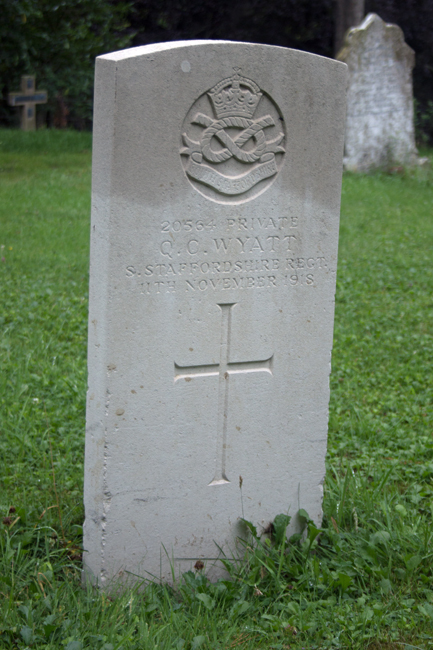
Private Quinton Wyatt

Private Quinton Wyatt

Quinton Charles Wyatt was born in the Gloucestershire town of Northleach in 1893 to William and Elizabeth. His mother died when he was a toddler, leaving William to look after Quinton and his older sister Agnes.

By the time war was declared, Quinton was working as a farm labourer and waggoner in the Gloucestershire village of Hampnett.

Quinton enlisted in the 8th Battalion of the South Staffordshire Regiment on 22nd November 1915. Appointed Lance Corporal just two months later, he was posted to France in March 1916.

Neglect of duty in June meant that Lance Corporal Wyatt was demoted to Private four months later. His battalion was caught up in a German gas attack in the autumn of 1917, and he was injured; ultimately, he was medically discharged from the Army on Boxing Day 1917.

Quinton Charles Wyatt finally succumbed to his injuries on 11th November 1918 – Armistice Day. He was 25 years old.

He is buried in St Mary’s churchyard in the village of Charlton Mackrell in Somerset.

Private Roberts Hallett

Private Roberts Hallett

Private Roberts Pretoria Hallett was born in the summer of 1900, to Frank – a shepherd from Charlton Adam in Somerset – and Emily, who came from the neighbouring village of Charlton Mackrell. Roberts (the correct spelling) was the youngest of eleven children.

Roberts was just twelve when his father died, and, when war came, he enlisted in Taunton, along with his brothers, Francis and William.

Private Hallett was assigned to the 5th Battalion Royal Warwickshire Regiment. While his records don’t identify exactly when he saw battle, by the last year of the war the battalion would have been involved in the fighting in northern Italy.

What we can say for certain is that he was shipped home at some point towards the end of the war. He was admitted to the No. 1 Northern General Hospital in Newcastle-upon-Tyne in October 1918. Private Hallett’s records show that he died “of disease” on 16th October.

Roberts Pretoria Hallett lies at rest in the churchyard of St Mary’s in his home village of Charlton Mackrell, Somerset.


The Great War was not kind to Emily Hallett: having lost her husband in 1912, her son William died while fighting in India in 1916 and that is where he was buried. Her other son Francis died in the Third Battle of Ypres in June 1917 and lies at rest in Belgium.

Roberts Hallett, therefore, is the only one of the three brothers to be buried local to her.

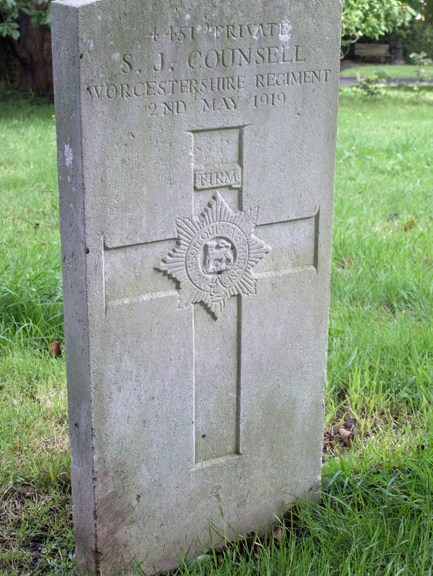
Private Stanley Counsell

Private Stanley Counsell

Stanley John Counsell was born in September 1896 to George and Ellen, farmers in Glastonbury.

The youngest of five children, Stanley was an apprentice carpenter by the time he enlisted with his brothers Lawrence and Wilfred.

Private Counsell joined the Worcestershire Regiment in 1915 and was sent into action in France in September 1916.

He suffered medically during the war, succumbing to tonsillitis and diarrhoea during his time in France. A bout of tuberculosis in late 1918 saw Stanley shipped back to the UK and admitted to a hospital in Newcastle-upon Tyne.

The end of the Great War came and went, and Stanley was finally discharged from the army in March 1919, as no longer medically fit for war service.

On 2nd May 1919, less than six weeks after being discharged, Private Stanley Counsell passed away. He was 23 years old and was a victim not of the war, but of the subsequent influenza pandemic, which killed 250,000 people in the UK alone.

Stanley John Counsell lies at peace in the cemetery of his home town, Glastonbury.