Tag Archives: Welch Regiment

Serjeant James Barrington

Serjeant James Barrington

James Barrington was born in Westminster, Middlesex, on 1st June 1890. One of twelve children, his parents were Alfred and Hetty Barrington. Alfred worked in a soap factory, and the family seemed to move around: the 1891 census found them living in rooms at 3 Charles Buildings, St Martin-in-the Fields, while a decade later there were at 6 Lyric Place in Kennington, Surrey.

With so many mouths to feed, Alfred and Hetty were keen to get their children to work. The 1911 census found James working as a cowman on a farm in Mathry, Pembrokeshire, which must have come as a huge culture shock.

James soon settled in, however, and, on 9th November 1912, he married Elizabeth Thomas, the daughter of a labourer from nearby. The couple had a daughter, Hilda, who was born the following February.

When war broke out, James was called upon to play his part. There is little concrete information about his service, but he was assigned to the Welch Regiment, as was attached to the 18th (Service) Battalion (2nd Glamorgan). He had attained the rank of Sergeant by the summer of 1917.

Sergeant Barrington’s unit fought in some of the key battles of the early stages of the conflict, including the Battle of the Ancre in 1916, and the German retreat to the Hindenburg Line the following spring. It was during fighting on the Western Front that summer, though, that he was wounded, and medically evacuated to Britain for treatment.

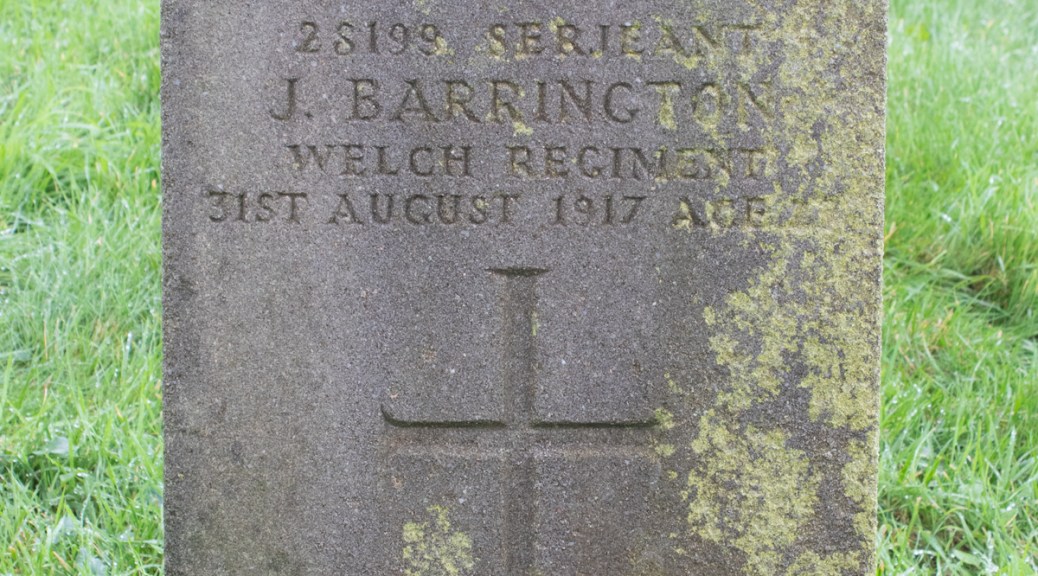
James was admitted to a hospital in London, but his wounds would prove too severe: he passed away on 31st August 1917, at the age of 27 years old.

The body of James Barrington was taken back to Wales for burial. He was laid to rest in Mathry Church Cemetery, not far from where his widow still lived.
Private James Morse

Private James Morse

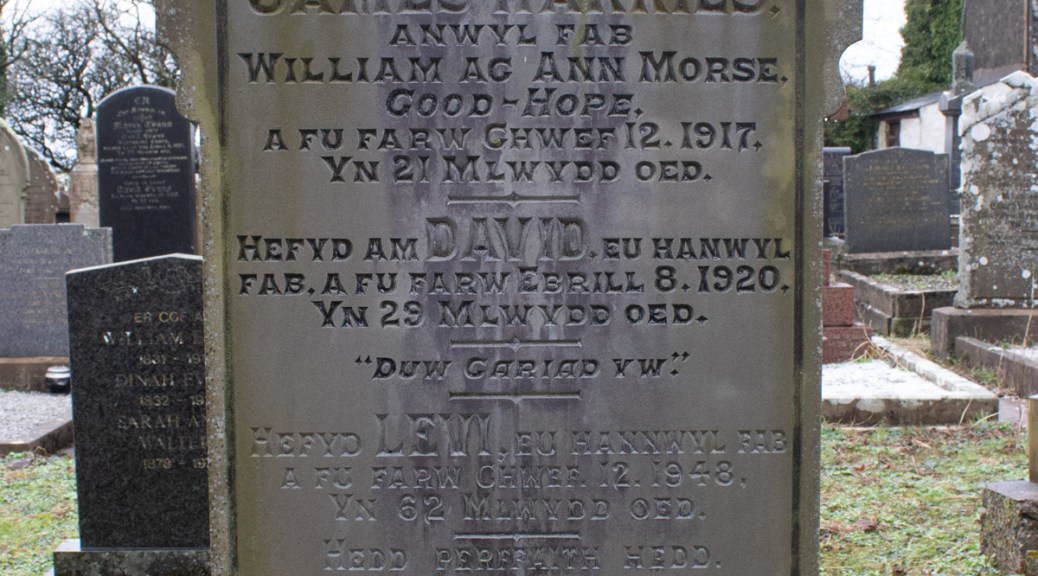
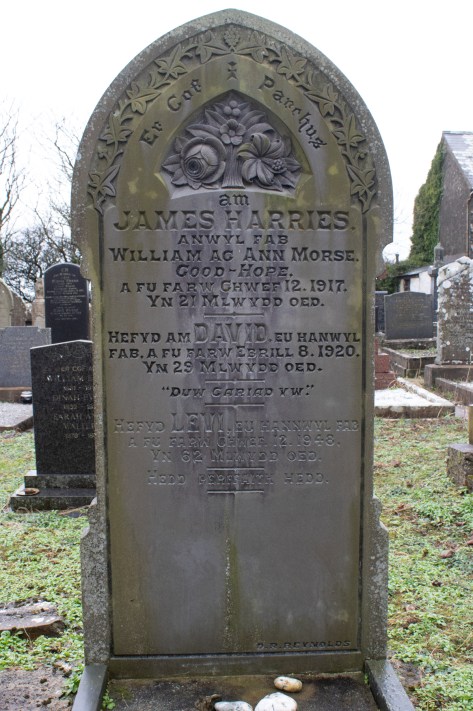
James Harries Morse was born in the autumn of 1895 in Llanwnda, Pembrokeshire. One of eleven children, his parents were agricultural labourer William Morse and his wife, Ann.

James’ schooling was completed early, and he was soon found work to keep him occupied. The 1911 census recorded him as being a cattle boy for the James family, living in on a farm not far from his family home.

When war broke out, James was keen to play his part. Details of his military service have been lost to time, but it is clear that he enlisted as a Private in the Welch Regiment, and was assigned to the 3rd (Reserve) Battalion. It’s not possible to identify where or for how long he served, and the only other documents available relate to his passing.

James Harries Morse died of disease on 12th February 1917: he was just 21 years of age. His body was taken back to Pembrokeshire for burial, and he was laid to rest in the family plot in Pencaer (Harmony) Baptist Burial Ground, not far from his parents’ home.


Private Arthur Charles

Private Arthur Charles

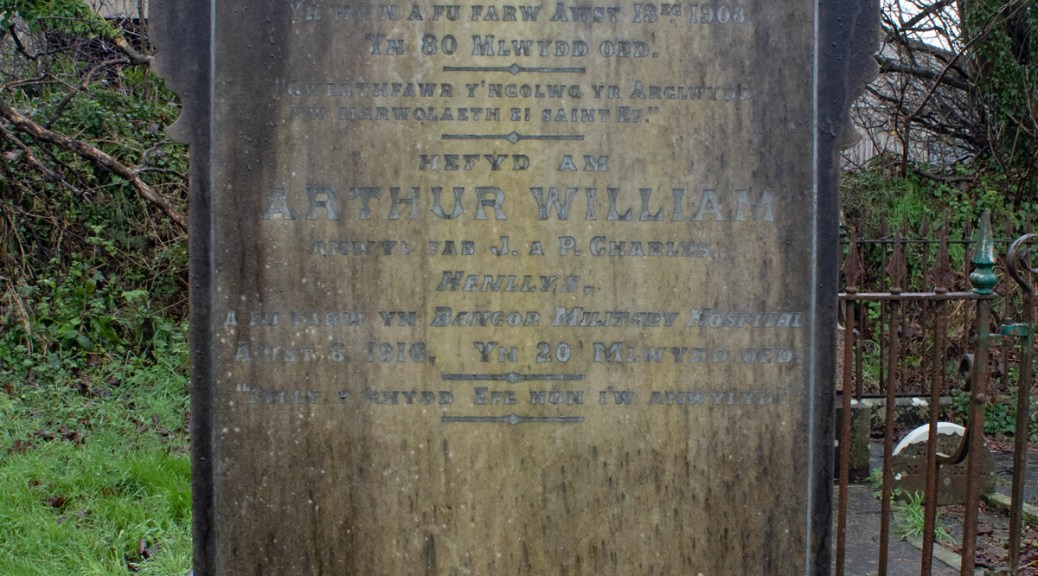
Arthur William Charles was born in Llanrhian, Pembrokeshire, in the summer of 1896. The middle of eleven children, his parents were Joseph and Phoebe Charles.

The 1901 census recorded Joseph as being a butcher and innkeeper in the village, but by the time of the next poll, the family were split. Joseph and Phoebe were now noted as being farmers, living with five of their children plus two servants at Henllys Farm. Arthur, meanwhile, was living with two of his sisters on his brother Thomas’ farm in Mathry. At 14 years of age, he was noted as being a farmer’s son, working on a farm.

When war broke out, Arthur was called upon to play his part. His service papers are long since lost, but he had enlisted in the Welch Regiment by the spring of 1916. Assigned to the 20th (3rd Rhondda) (Reserve) Battalion, he was sent to Bangor, Gwynedd, for training.

Tragically, however, Private Charles’ time there was not to be a lengthy one. He contracted cerebrospinal meningitis, and passed away on 6th August 1916: he was 20 years of age.

The body of Arthur William Charles was taken back to Pembrokeshire for burial. He was laid to rest in the Mathry Congregational Churchyard in Rehoboth.


Private Arthur Charles
(from ancestry.co.uk)

Private Henry Yard

Private Henry Yard

Henry George Yard was born on 25th October 1884 in the Somerset village of Burnham-on-Sea. The second of seven children, his parents were John and Elizabeth Yard. John was a railway porter, but Henry chose a different route, becoming a mason’s labourer.

Henry’s work took him to South Wales, where he took up a position as a pit mason. The 1911 census recorded him as boarding in a six-roomed house in Abertillery, Monmouthshire. From the document there can be no mistaking that this was a mining community. The head of the household for 70 New Gladstone Street was 28-year-old Albert Francis, colliery banksman. He lived there with his wife, Martha, who was fifteen years older than him, and her three children: William, Herbert and Horace.

Martha had been married previously, to coal miner Walter Mutter. Both had been born in Somerset, and had come to South Wales like so many other families, because of the work. Walter died at the beginning of 1909, leaving his widow to raise three children on her own. It seems likely that this is where Albert stepped up: it was not unknown for mine workers to support each other in times of dire need. He married his former colleague’s widow in the autumn, securing a future for her and her family.

According to the census record, the Francis family had one other boarder and all but Martha and Horace worked in the local colliery in one way or another.

There seemed to have been money in Henry’s career move, as it set him up to marry Gertrude Coombes on 6th August 1912. She was a gardener’s daughter from Berrow in Somerset, and eight years younger than her husband. The couple married at St Mary’s Church, Berrow, and appeared to settle back in South Wales. They went on to have two children: Gertrude, who was born the following year, and Daisy, who came along in 1916.

When war came to Europe, Henry was called upon to play his part. He enlisted in October 1915, and was initially assigned to the 3rd Battalion of the Welch Regiment. His service records show that he was 5ft 6ins (1.68m) tall, and weighed 133lbs (60.3kg). He was noted to be of good physical development, although dental treatment was required.

Private Yard transferred to the Machine Gun Corps at some point, and by the autumn of 1916 was sent to Greece. He remained there for nearly two years, but became dogged by malaria in later months there. Initially coming down with the condition in August 1917, he spent the remainder of the war in and out of hospital as attacks of the condition came and went.

Initially returning to home soil and placed on reserve status, Henry was eventually discharged on medical grounds at the end of 1918. He returned to the family home. He was not to be there for long, however: debilitated by malaria, Henry passed away in Bedwellty on 23rd March 1919, at the age of 34 years old.

With strong family connections in Somerset, Gertrude took her husband back there to be laid to rest. Henry George Yard was buried in the tranquil graveyard of St Mary’s Church in Berrow.


Private Henry Yard
(from ancestry.co.uk)

Private George Stevens

Private George Stevens

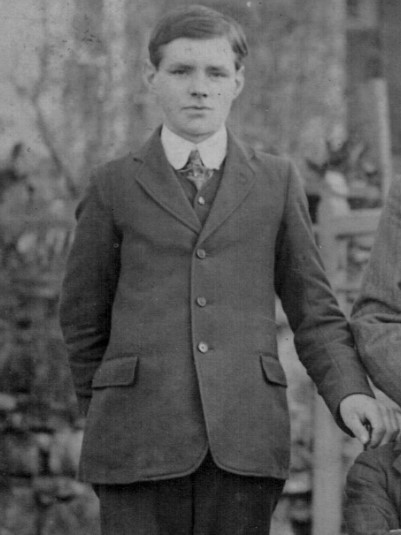
George Henry Stevens was born in Winscombe, Somerset, in the spring of 1869. The oldest of four children, his parents were blacksmith Joseph (or John) Stevens and his wife, Eliza.

When he finished his schooling, George found work as a collier. In 1893, he married a woman called Maria, and went on to have three children: Edward, Mary and Charlie. By 1900 the family had moved to South Wales for his work. They settled in Llanwonno, Glamorganshire, and went on to have three more children: John, Cyril and George Jr.

By 1911, George and Maria had been married for eighteen years. George was working as a repairer for the colliery, while Edward had followed his father into the mines.

When war came to Europe’s shores, George stepped up to play his part. He enlisted in the Welch Regiment, and was assigned to the 1st/5th Battalion. While his full service records no longer exist, his troop served in Gallipoli during 1915, so it is possible that he spent times overseas.

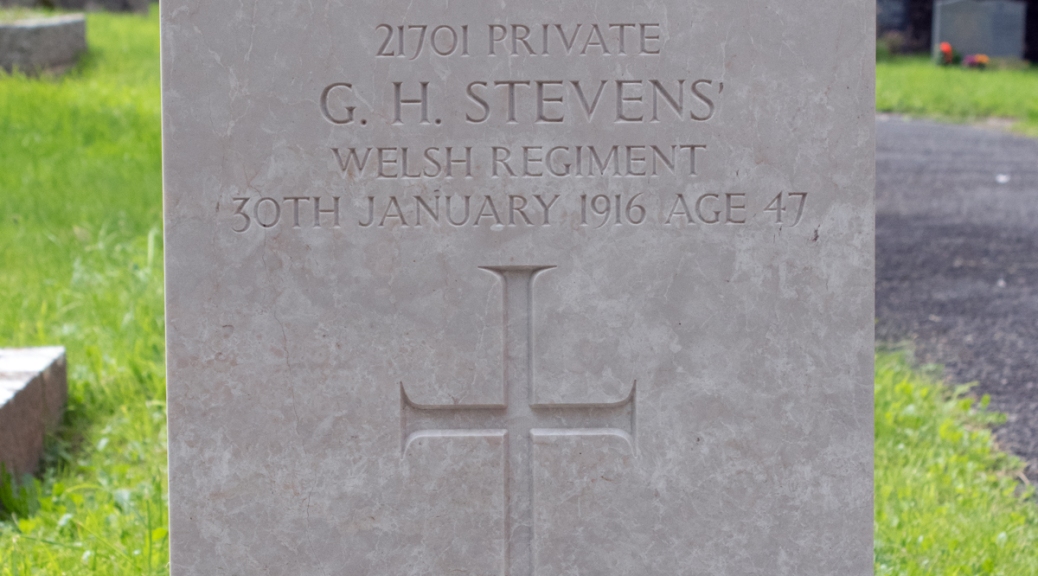
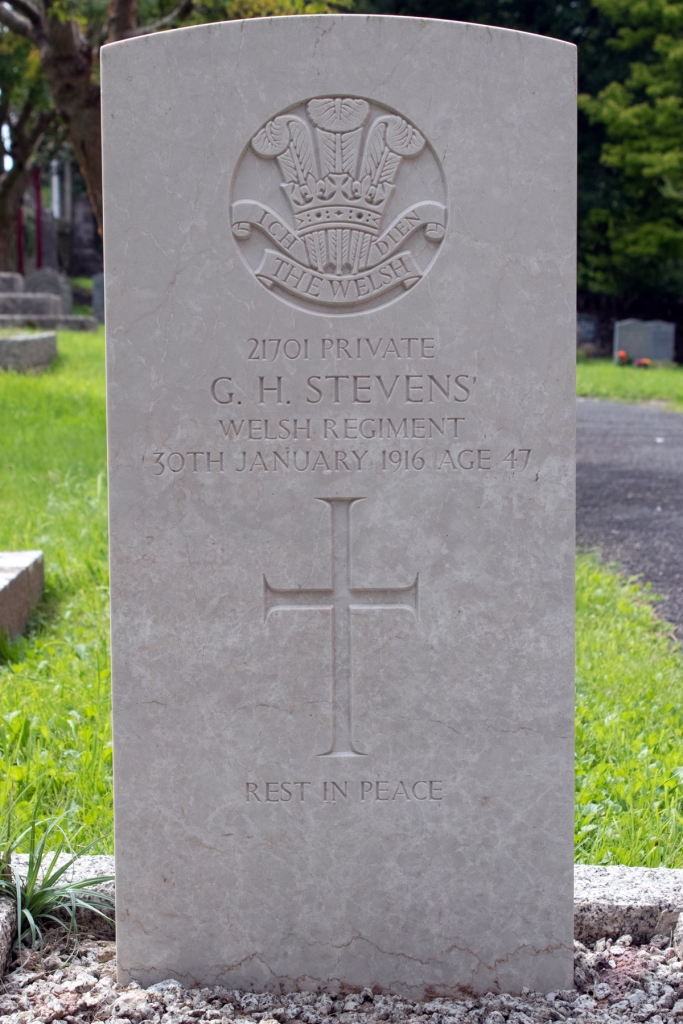
By January 1916, however, Private Stevens was back in Britain, and had become unwell. Again, little specific information remains, but he passed away on 30th January 1916, having fallen into a diabetic coma. He was 47 years of age.

George Henry Stevens was brought back to Somerset for burial. He was laid to rest in the graveyard of Holy Trinity Church in Cleeve, where Maria had moved back to with the family when her husband went to war.


Serjeant George Collins

Serjeant George Collins

Details of the lives of those who fell during the Great War can be limited by the documentation that is available more than a century later. Based on what remains, the life of George Collins would have been technical and sparse.

From the formal documents that remain, it is possible to determine that he was born in Bath, Somerset, in 1870 or 1871, and his father was farmer Oliver Collins.

George married Florence Lydyard on 25th January 1896 at the parish church in Bathampton. George was listed as a cellarman, while Florence was noted as being the daughter of George Lydyard, an agent.

The 1901 census found the couple living at the Liberal Club in Bath, which they were both managing. The couple had had a son, George Jr, who was born in 1898, and were employing a servant to help with the daily chores.

The 1911 census shows that George had left the club behind, and was employed as a gymnastic instructor. He and Florence now had four children: Mona, who was 14 (and who didn’t appear on the previous census); George; and twins Marjorie and Dorothy, who were born on 5th July 1904.

The limited military documentation confirms that George enlisted in the North Somerset Yeomanry by October 1917. He was assigned to the 2nd/1st Battalion, which was a mounted division that became a cyclist unit. The troop was based on home soil throughout the war and, depending on when he joined, George could have served anywhere from Northumberland to East Anglia or Southern Ireland.

These details, while uncovering something of George’s life, remain as clinical as the engraving on his headstone. With Serjeant Collins, it is a newspaper article on his passing that adds humanity to his life:

Many friends in Bath will regret to hear that Sergeant George Collins died on Saturday at the Bath War Hospital, where he had been an inmate for seven weeks, suffering acutely from gastritis. Deceased, who was a Bathonian by birth, when a youth joined the Welsh Regiment, and served for seven years in the 1st Battalion… He returned to Bath 21 years ago, and became a drill and physical instructor to several schools… whilst he also instructed evening classes at Guinea Lane and St Mary’s Church House. Being a Reservist he was called upon for the South African War, and Sergeant Collins rejoined his old regiment in 1899. He was wounded and invalided home… When he recovered from his wounds, Sergeant Collins resumed his work as an instructor at schools, and continued to act in that capacity until 1915. Though 44 years of age and not liable for military service, he very patriotically rejoined; he entered the North Somerset Yeomanry and became a drill instructor. He had not been abroad in this war, but had served in several places with the 2/1st NSY. The fatal illness became very pronounced in January when on leave, and he was not able to rejoin his unit. Sergeant Collins was a fine boxer, and became middle-weight champion of the Army when serving with the 1st Welsh. His experience as a trainer was often in request locally, and he had acted in that capacity to the most successful Avon Rowing Club crews. Deceased leaves a widow, one son, and three daughters. His only boy, Sapper George Collins, Wessex [Royal Engineers], has been serving at Salonika since 1915.

Bath Chronicle and Weekly Gazette: Saturday 13 April 1918

Beyond the staid, formal documents is a life well lived. Serjeant George Collins was 47 or 48 years old when he passed on 5th April 1918; the army record noted the cause of his death as a cerebral haemorrhage. His body was laid to rest in the graveyard of St Mary the Virgin Church, Bathwick, overlooking the city he loved.


Private Griffith Hughes

Private Griffith Hughes

Griffith Hughes was born in Llanberis, in modern day Gwynedd, in 1893. Sadly, there is little information about his early life, and records mention his mother – Margaret – but no father. The 1901 census records Griffith as living with his grandmother, Ann Hughes.

Ten year later, the two are living in a two-up, two-down cottage – 19 Snowdon Street, Llanberis – with Griffith’s aunt, Ann’s daughter Jane, and her husband, Thomas. Griffith is earning money by now, working as a slate dresser at one of the local quarries.

War was coming to Europe by this point, and Griffith was called upon to play his part. He initially enlisted in the Welch Regiment as a Private, although he seems to have transferred across to the South Wales Borderers during his service.

Private Hughes’ time in the army was spent on home soil, although he earned the Victory and British Medals for his service. He remained in the army through to the end of the war and beyond until, on 15th August 1919, he was medically discharged. He had developed tachycardia, and this was having an impact on his life.

When Griffith left the army, he was based in Lancashire, and was living in the village of Bryn, to the south of Wigan. He remained in the area for the next year, his health sadly deteriorating. Admitted to the cottage hospital in nearby Pemberton, he passed away from his heart condition on 18th September 1920. He was just 27 years old.

Griffith Hughes was brought back to Wales for burial. He was laid to rest in the quiet graveyard of St Peris Church, in his home village of Llanberis.


Second Lieutenant Francis Wakeford

Second Lieutenant Francis Wakeford

Francis Reginald Steele Wakeford was born in the summer of 1893 in Penarth, Glamorgan. The middle of five children, his parents were Herbert – who was a master printer – and Mary Wakeford. When he left school, Francis became a stockbroking clerk, but when war broke out, he was quick to ensure he played his part.

Initially enlisting in the Royal Engineers, he was attached to the Glamorgan Yeomanry. By the time he was sent to France, however, he had been assigned to the Lancashire Fusiliers.

After eighteen months of fighting, in the spring of 1918, Second Lieutenant Wakeford transferred to the Royal Air Force and gained his wings. “During six months’ flying he had many encounters with enemy airmen, many of whom he brought down, and was also in several bombing raids over Germany.” [Western Mail: Monday 30th December 1918]

When the Armistice was declared, Francis returned to Wales. He has been suffering from an ongoing illness, and this was to be to what he was to succumb. Second Lieutenant Wakeford passed away in Cardiff on Christmas Day, 25th December 1918. He was just 25 years of age.

Francis Reginald Steele Wakeford was laid to rest in the graveyard of St Augustine’s Church in his home town of Penarth.


Second Lieutenant Wakeford (from findagrave.com)

Francis’ grave also commemorates the passing of his only brother, Charles Herbert Stanley Wakeford.

Four years Francis’ senior, Charles had enlisted in the 24th (Pembroke and Glamorgan Yeomanry) Battalion of the Welch Regiment. As the war moved through its final year, Lieutenant Wakeford found himself caught up in the fierce fighting of the Second Battles of the Somme.

Charles was killed on 7th September 1918, aged 28 years old. He was laid to rest in Tincourt British Cemetery, in Picardie, France. He is also commemorated on the family grave in St Augustine’s Church, Penarth.


Private Charles Tucker

Private Charles Tucker

Charles Wilfred Tucker was born in the summer of 1898 in Penarth, Glamorgan. He was the oldest of four children to Wilfred and Elizabeth Tucker, restaurant owners on Windsor Terrace in the centre of the town.

Little information is available about Charles’ early life. When war broke out, he enlisted in the Welch Regiment, before transferring to the Machine Gun Corps at some point during the conflict. In the autumn of 1919, Private Tucker was put on furlough while waiting to be demobbed, and he returned home.

Sadly, it was while here that Charles contracted pneumonia, and it was from the lung condition that he was to pass away. He breathed his last on 30th October 1919, at the age of just 21 years old.

Charles Wilfred Tucker was laid to rest in the family grave in St Augustine’s Churchyard in his home town of Penarth.


Private Wilfred Follett

Private Wilfred Follett

Wilfred Alson Follett was born in the spring of 1898, and was the second of eight children to Robert and Ellen (known as Nellie) Follett. Robert was a scavenger (or street cleaner) for Chard council, and it was in this Somerset town where his and Nellie’s young family were raised.

Lace making was the predominant industry in the area, and it was for local employer Boden & Co.’s Old Town Mills that Wilfred worked when he finished school. The 1911 census recorded him as being a threading boy in the factory.

War was coming to Europe, however, and Wilfred was keen to play a part. Sadly, full details of his military service are lost to time, but he had enlisted by the spring of 1917, initially joining the Somerset Light Infantry. He soon transferred across to the Welch Regiment, however, and was assigned to the 10th (Service) Battalion.

Private Follett was sent to the Western Front at the start of July 1917, and was soon caught up in the thick of the action at Ypres. He came through the Battle of Pilkem, but was injured at the fighting in Langemark. His wounds were severe enough for him to be evacuated to England for treatment, and he was admitted to a hospital in Bradford, Yorkshire.

Robert was sent for, but sadly did not arrive in time to see Wilfred before he passed away from his injuries. He died on 20th August 1917, at the tender age of just 19 years old.

Wilfred Alson Follett was brought back to his home town for burial. He was laid to rest in Chard Cemetery.