Tag Archives: Wiltshire

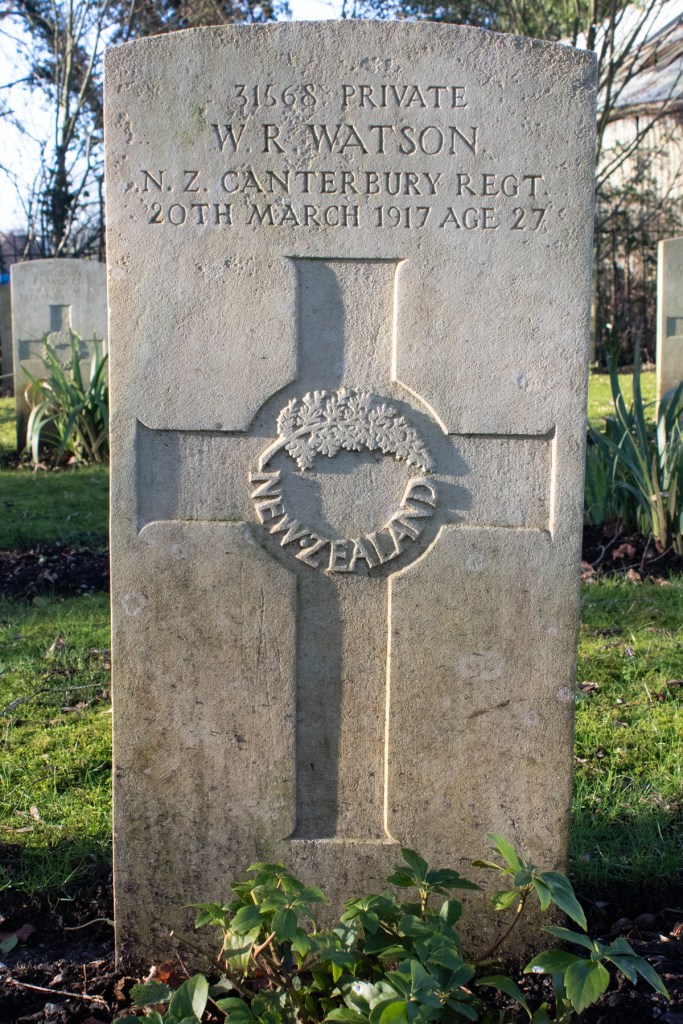
Private Walter Watson

Private Walter Watson

Walter Robert Watson was born in Wai-Iti, to the south of Nelson, New Zealand, on 12th November 1889. The third of four children, his parents were Edward and Eliza Watson.

When he finished his schooling, Walter found farming work, and this is what he was doing when, in the spring of 1916, he married Beatrice Godbaz. By this point war was raging across Europe, and it seems likely that the couple exchanged vows ahead of his departure for the conflict.

Walter joined up on 26th July 1916, and, as a Private, was assigned to the New Zealand Canterbury Regiment. His service records show that he was 6ft (1.83m) tall and 161lbs (73kg) in weight. A Methodist by religion, he had fair hair, blue-grey eyes and a fair complexion.

Private Watson’s unit departed for Britain on 15th November 1916. Leaving from Wellington on board the SS Tahiti, the journey would take nearly three months. The Canterbury Regiment arrived in Devonport, Devon, on 29th January 1917, and from there the unit moved to their camp on the outskirts of Codford, in Wiltshire.

Walter was feeling every mile of the journey by this point. He contracted lobar pneumonia, and was admitted to the No. 3 New Zealand General Hospital on the outskirts of the camp. The condition was to prove fatal: Private Watson passed away on 20th March 1917, at the age of just 27 years old.

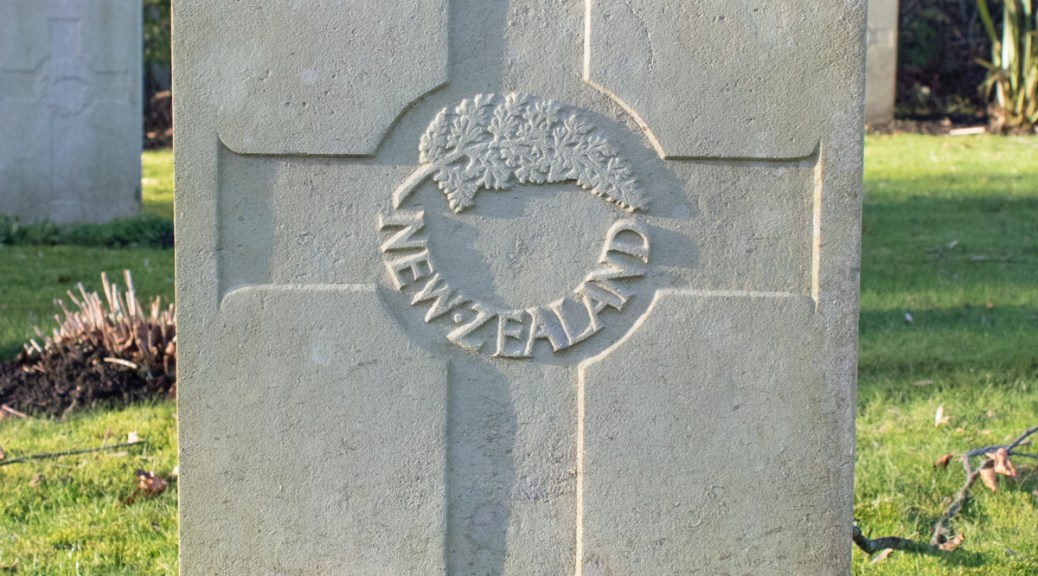
Walter Robert Watson was laid to rest in the ANZAC graveyard extension to St Mary’s Church in Codford.


Private Walter Watson
(from findagrave.com)

Walter’s younger brother, Herbert, had taken a different path in life. Also a farmer, he had volunteered in the 12th Nelson Regiment. When war broke out, he was one of the first to enlist, joining the Canterbury Mounted Rifles on 15th August 1914.

By December that year, his unit had left New Zealand and arrived in Egypt. On the subsequent journey to Britain, Herbert became unwell, and he was admitted to the General Hospital in Gibraltar with dysentery. The condition would prove his undoing, and Trooper Herbert Watson passed away on 30th August 1915, at the age of just 24 years old.

Herbert Percy Watson was buried in Gibraltar’s North Front Cemetery.
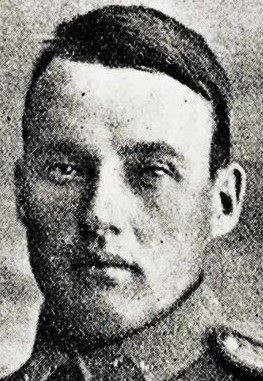

Trooper Herbert Watson
(from findagrave.com)

Private Frederick Browning

Private Frederick Browning

Frederick Henry Browning was born on 19th March 1884, and was the third of five children to John and Elizabeth Browning. Born in Dunedin, New Zealand, there is little information about his early life, but as he grew up, he found work as a blacksmith.

When war broke out in Europe, Frederick was working for JS Collins at the Mountain Hotel in Queenstown. By this point he had also spent three years in military service, working for the Ambulance Brigade in Nelson, at the northern tip of South Island.

Frederick stepped up to play his part, enlisting on 22nd August 1916. His service documents show that he was 5ft 7ins (1.7m) tall, and weighed 153lbs (69.4kg). A Methodist, he had black hair, brown eyes and a dark complexion.

Attached to the New Zealand Otago Regiment, Private Browning was sent to Trentham, on the North Island, for training. An asthmatic, he spent two weeks in hospital with the condition in October 1916. On 30th December 1916 his unit departed for Europe on board the SS Athenic, a White Star Line ship conscripted for troop use at the start of the war.

Frederick’s asthma returned on the journey, and he spent a further week of the journey in his sick bed. The Athenic docked in Devonport, Devon, on 3rd March 1917, and Private Browning was sent straight to the town’s military hospital, his lung condition once again affecting him.

It would not be until 14th March that Frederick eventually re-joined his unit, who were based in a camp just outside the Wiltshire village of Codford. His health was really struggling, however, and he came down with a bout of pneumonia. On 24th March he was admitted to the No. 3 New Zealand General Hospital near the camp, but the condition was to get the better of his weakened body. Private Browning passed away on 31st March 1917, at the age of 33 years old.

The body of Frederick Henry Browning was laid to rest in the ANZAC graveyard extension of St Mary’s Church, Codford, not far from the base he had so briefly called home.


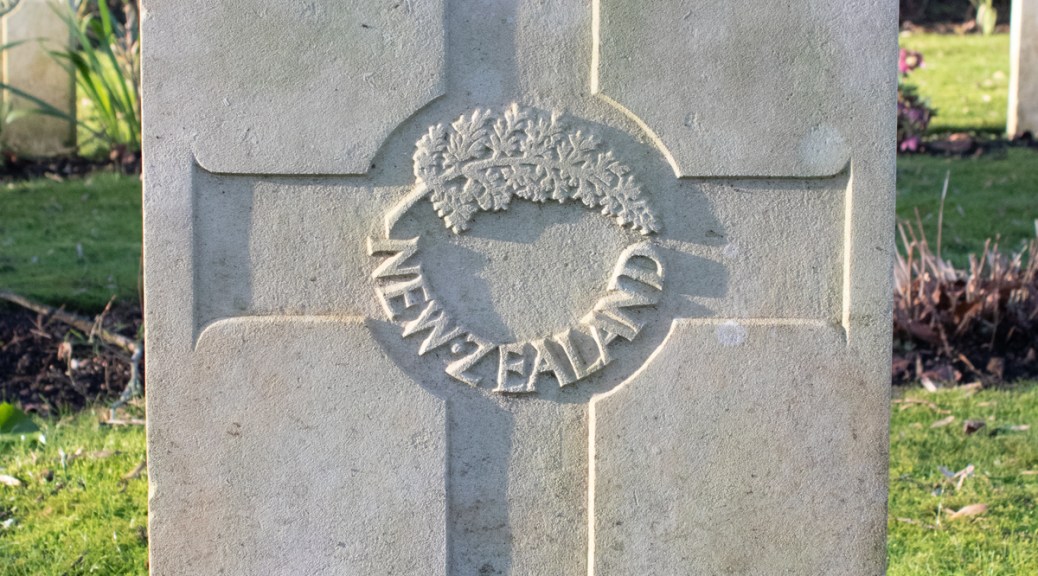
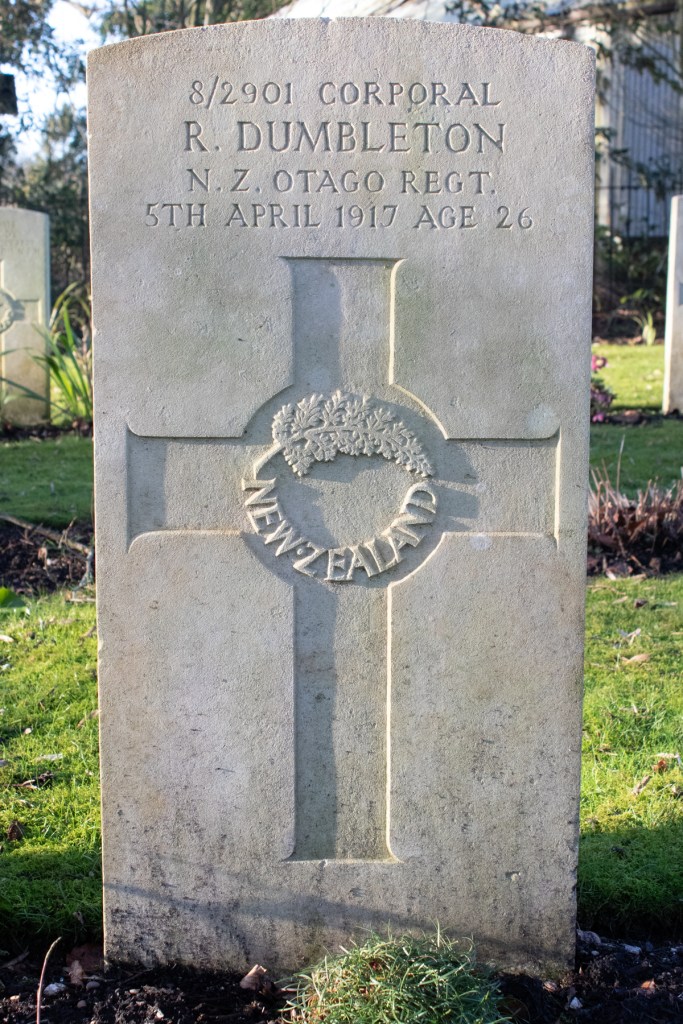
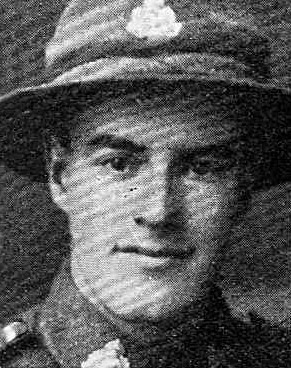
Corporal Ronald Dumbleton

Corporal Ronald Dumbleton

Ronald Dumbleton was born in Pukeuri Junction, New Zealand, at the end of 1890. His parents were William and Lucy, but about his early life, there is very little information.

When he finished his schooling, found work as a telegraphist and, by the time war broke out, he was employed at the Oamaru Post Office. This employment fitted in perfectly with his hobby as a volunteer in the Signal Company.

Ronald enlisted in the Otago Regiment of the New Zealand Infantry on 13th June 1915. His service records show that he was 5ft 8ins (1.73m) tall and weighed 140lbs (63.5kg). An Anglican by faith, he had black hair, dark eye and a dark complexion.

Assigned to the 7th Battalion, Private Dumbleton’s unit set sail for Europe towards the end of the year and, after a few weeks in Egypt, Ronald arrived in Britain in March 1916. His previous military service stood him in good stead. On 8th July 1915 he was promoted to Lance Corporal, and just six weeks later he had made full Corporal.

In April 1916, Ronald arrived in France. Transferred to the 1st Battalion, he would remain overseas for six months. Caught up in the fighting at the Somme, he was injured in his left arm and shoulder and medically evacuated to Britain for treatment. Corporal Dumbleton was admitted to the 1st Southern General Hospital in Birmingham, and remained there for a month.

In November, Corporal Dumbleton transferred to a hospital in Hornchurch, Essex. He then seems to have been moved to the ANZAC base near Codford, Wiltshire, for his ongoing recuperation. He was given two weeks’ leave in January 1917, returning to the base towards the end of the month.

At this point, Ronald’s trail goes cold. He remained based in Codford, possibly as he was not yet fit enough to re-join his unit on the Western Front. While in camp, however, he fell ill, passing away on 5th April 1917. He was 26 years of age.

Thousands of miles from home, Ronald Dumbleton’s body was laid to rest in the extended graveyard of St Mary’s Church in Codford, not far form the base which he had called home.


Corporal Ronald Dumbleton
(from findagrave.com)

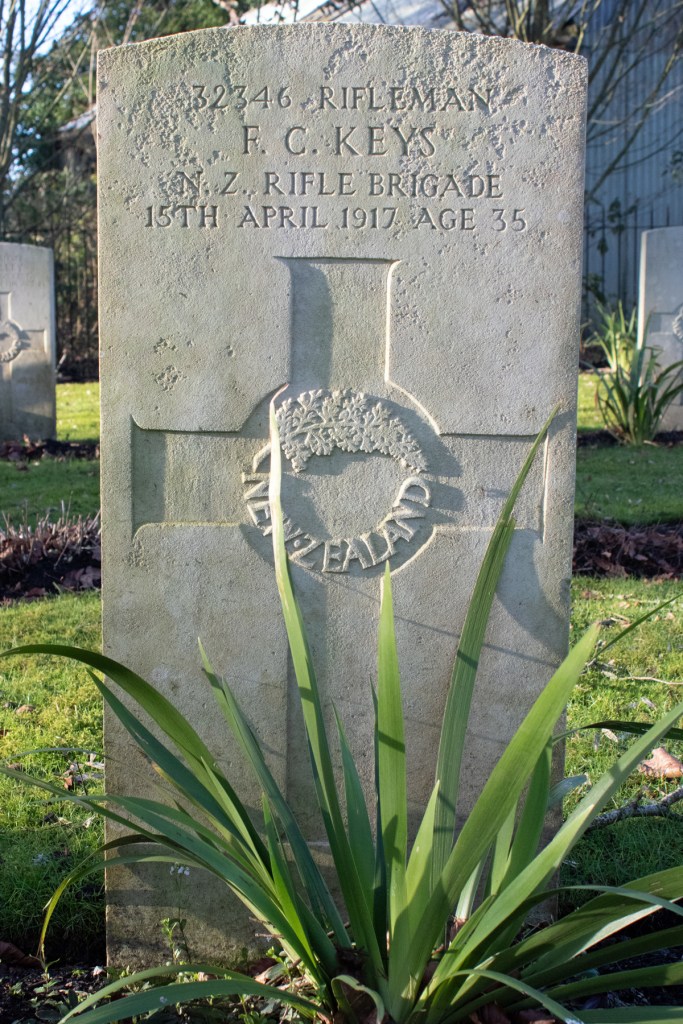
Rifleman Frederick Keys

Rifleman Frederick Keys

Frederick Charles Keys was born in Dunedin, New Zealand on 15th January 1882. The third of eight children, his parents were Benjamin and Annie Keys.

There is little information about Frederick’s early life. When he finished his schooling, it is likely that he found work as an agricultural labourer, and this is the job he was doing when war broke out.

As so many of his countrymen were to be, Frederick was called upon to serve his empire. He signed up in Christchurch on the country’s South Island, enlisting on 27th July 1916. He have his job as a farm hand, and his address as Silver Grid, a boarding house and billiard saloon on the city’s Manchester Street.

Frederick’s medical report confirms that he was 5ft 6ins (1.68m) tall and weighed 136lbs (61.7kg). He had fair hair, blue eyes, and a fair complexion. He was noted as being a very suitable man for the army.

Assigned to the New Zealand Rifle Brigade, Rifleman Keys embarked for Europe from Wellington on 15th November 1916. Two-and-a-half months later, his ship – the Tahiti – arrived in Devonport, Devon, and the New Zealand troops marched on to their final destination, the ANZAC camps just outside Codford, Wiltshire.

Frederick would spend the next few months training in the camp, although his time there was not without incident. On 31st March 1917, he was docked two days’ pay for ‘being in a crowd some members of which were gambling’. It is not clear whether Frederick himself was gambling, but given his last residence in New Zealand, it is unlikely that he wasn’t immune to chancing the odds.

Two weeks later, Rifleman Keys was admitted to the 3rd New Zealand General Hospital near the camp. He was suffering from pleurisy, but any treatment was to prove too late. He passed away from the condition on 15th April 1917: he was 35 years of age.

Frederick Charles Keys was laid to rest in St Mary’s Churchyard, Codford, in a new extension added for the fallen ANZAC troops.


Private Francis Holland

Private Francis Holland

Francis Arthur Holland was born in Maryborough, Victoria, Australia, the fifth of seven children to Matthew and Elizabeth. Details of his early life are lost to time, although a later document confirms his date of birth as 19th July 1887.

Matthew died in 1901, and the New South Wales Police Gazette of 16th February 1910 included a request seeking a missing person:

Francis Arthur Holland, 22 years of age, 6feet high, about 13 stone weight, dark complexion; a sleeper-getter or labourer. Inquiry at the instance of his brother, James Holland, Bradshaw’s College, 250 Flinders-street, Melbourne, Victoria.

The 2nd March edition of the same publication noted that Francis had been found.

By 1916, Francis had moved to New Zealand, and was working as a bushman at the Grosvenor Hotel, New Plymouth. It was while here that he was called upon to serve in the war, and he enlisted on 29th June 1916 in Trentham, North Island. His service records confirm his height, and give his weight as 174lbs (78.9kg). It also noted that he had brown hair, hazel eyes and a fair complexion. He had a scar across the based of his right foot, and another on the left side of his throat.

Private Holland was assigned to the New Zealand Auckland Regiment, and his unit spend the next few months training. On 22nd September 1916, Francis was promoted to the rank of Lance Corporal, but reverted to his previous rank just a matter of weeks later. On 11th October, his unit boarded a ship and set sail for Europe.

Francis arrived in Plymouth, Devon, on 29th December, and set off for France just over a month later. His unit would serve on the Western Front, and, within a matter of months, Private Holland was admitted to field ambulance hospitals twice, for an undisclosed illness in May 1917, and a sprained ankle in June.

This second injury led to a transfer to Britain, and from here on in Francis’ health become more and more impacted. Admitted to hospital in London, he developed tonsillitis and, as he was recovering from this, he was moved again, this time to the ANZAC military camp near Codford, Wiltshire.

While in the camp hospital, it was determined that Private Holland was suffering from a heart infection, endocarditis. Sadly, his health had been tested to the limits by this point, and this was the condition to which he would succumb. Francis passed away on 6th September 1917, at the age of 30 years old.

Having been born in Australia, emigrated to New Zealand and fought on the Western Front, Francis Arthur Holland was now thousands of miles from wherever he might call home. He was laid to rest in the extension to St Mary’s Churchyard in Codford, not far from the camp in which he had spent his last days.


Private Francis Holland
(from findagrave.com)

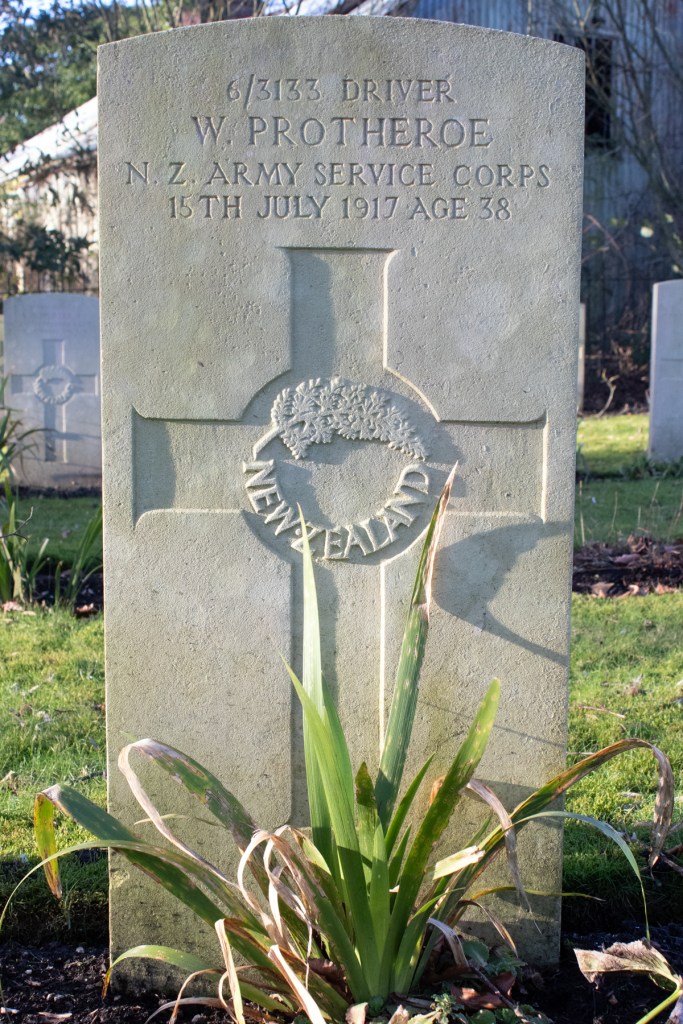
Driver William Protheroe

Driver William Protheroe

William Protheroe was born in Rangiora, New Zealand, on 3rd January 1878. One of eleven children, his parents were Welsh-born Alexander Protheroe and his English wife, Mary.

There is little concrete information about William’s early life, but later documentation gives his trade as ‘traveller’, and confirms his marriage to Elizabeth Marshall in 1906, although she had passed away by the summer of 1915.

When the Empire was called upon to support Britain in the First World War, William stepped up to play his part. He enlisted on 14th June 1915, and was initially assigned to the Canterbury Infantry Regiment. His service records confirm that at 36 years of age, he was 5ft 9.5ins (1.77m) tall, and weighed 156lbs (70.8kg). William had brown hair, grey eyes and a fair complexion.

After his initial training, William was sent to Europe. On 18th November 1915, he arrived in Suez, and it was here that he transferred to the New Zealand Army Service Corps as a Driver. By the following spring he was on the move again, and he arrived in France in May 1916.

Driver Protheroe was dispatched to a field hospital, as he had contracted influenza, but was well enough to re-join his unit after a few weeks. December 1916 proved eventful for William. He was admitted to hospital in Wimereux, France, the records for the time confirming that he was suffering from rheumatism. Intriguingly, a corresponding entry advises that ‘Soldier was on duty at time of accident and in no way to blame.’

Medically evacuated to Britain, William was admitted to the No. 1 New Zealand General Hospital in Brockenhurst, Hampshire. He spent the month of January 1917 there, before moving to the ANZAC camp near Codford, Wiltshire.

Driver Protheroe would remain in Codford for the next few months. His health was still causing some concern, however, and he was admitted to the camp hospital on 30th June. William was suffering from nephritis, and this was the condition to which he would ultimately succumb. He passed away on 15th July 1917, at the age of 39 years old.

William Protheroe was laid to rest in the graveyard extension of St Mary’s Church, Codford, Wiltshire, alongside fallen colleagues from his regiment.


Private Andrew Wishart

Private Andrew Wishart

Andrew Anderson Wishart was born in Mokoreta, New Zealand, on 9th July 1896. The fourth of eight children, his parents were George and Agnes Wishart.

There is little information available about Andrew’s early life, but when he completed his schooling, he found work in the local sawmills, not an uncommon trade for the rural southern part of the country. In his spare time, he enlisted in the cadets, and had spent a year with them when he stepped up to join the war effort.

Andrew signed up on 19th November 1915, and was assigned to the 1st Battalion of the New Zealand Otago Infantry Regiment. His service records show the mad he had become: he gave his age as 20 years old (he was, in fact, only 19), he was 5ft 10.5ins (1.79m) tall and weighed 166lbs (75.3kg). He was initially trained near Wellington, and seemed to enjoy his freedom, as he spent a month in hospital in Trentham, suffering from gonorrhoea.

Private Wishart’s battalion set out from Wellington on 1st April 1916, arriving in Suez a month later. After three weeks’ pause in Egypt, his unit continued on to France, disembarking in Etaples on 28th May, and heading for the Western Front. Andrew soon found himself in the thick of the action.

The 1st Battalion was heavily involved at the Somme in the summer of 1916, and Private Wishart was not to come out unscathed. He was wounded on 30th September, and evacuated for treatment, first to Rouens, then to Britain. Wounded in the left thigh, he was admitted to the 1st New Zealand Hospital in Brockenhurst, Hampshire, and would end up spending two months there.

In December 1916, Private Wishart moved to the ANZAC camp in Codford, Wiltshire. He remained on site for the next few months, although this time was not without incident, as he was admitted to the camp hospital for with venereal disease once more.

Andrew returned to camp on 10th April 1917, but his health seems to have been impacted. He became jaundiced, and was once again admitted to the camp hospital. Atrophy of the liver was identified, and the condition would prove too severe for his body to recover from. He died on 10th July 1917, the day after his 21st birthday.

Andrew Anderson Wishart was laid to rest in the extension to St Mary’s Churchyard in Codford, Wiltshire, not far from the base he had called his home.


Andrew’s younger brother James had also enlisted in the Otago Regiment when war broke out. As a Private, he was assigned to the 2nd Battalion, his path followed a similar one to that of his older sibling. He was killed in action on the Western Front on 15th November 1916, aged just 18 years old.

Private James Wishart is buried in the Cité Bonjean Military Cemetery in Armentieres.

Private James Wishart
(from findagrave.com)

Sapper Charles Salisbury

Sapper Charles Salisbury

Charles Salisbury was born in Helensville, New Zealand, on 23rd June 1885. The fifth of six children, his parents were James and Sarah Salisbury.

Little information is available about Charles’ early life, but by his 20s he had found work as a linesman, working his way up to foreman. In April 1914 he married Nora Fiori: the couple settled in Onehunga, and had two children: Pauline had been born in 1907, and sister Catherine followed in 1911.

When war broke out in Europe, the British Empire called upon its own to step up and serve. Charles enlisted on 9th April 1916, joining the 15th Division of New Zealand Signallers, itself part of the New Zealand Engineers. His service records show that he was 31 years of age, 5ft 9ins (1.65m) tall and weighed 154lbs (69.9kg). He was noted as having dark hair, blue eyes and a dark complexion.

Sapper Salisbury’s unit left Wellington for Britain on 28th July 1916. The voyage on board the ship Waitemata took ten weeks, Charles setting foot on solid ground again in Devonport, Devon, in October. From there the battalion moved to its base near Codford, in Wiltshire.

Charles would spend the next six months in camp, presumably in preparation for a move to the continent. Sadly for Charles, however, he was not to see any action away from Britain. On 27th May 1917 he was admitted to the camp hospital, suffering from a cerebral haemorrhage: he died the following day. Sapper Salisbury was 31 years of age.

Charles Salisbury was laid to rest in the newly consecrated ANZAC extension to St Mary’s Churchyard in Codford, not far from the troops encampment.


Sapper Charles Salisbury
(from findagrave.com)
Private Harry Gurd

Private Harry Gurd

Harry John Gurd was born in the Wiltshire parish of Berwick St John in the spring of 1881. He was one of three children to dairyman Ebenezer Gurd and his wife, Elizabeth.

Details of Harry’s early life are fragmented, but by the time of the 1911 census, he had moved to West Sussex, and was working as a gardener. The document confirms that he had married Alice three years before, and that they were living in North End, Findon. By this point, the couple had three children: Alice, Ronald and Walter, and they would go on to have another daughter, Hester, in 1913.

Harry stepped up to play his part when war was declared. Full details of his service have been lost, but it is evident that he enlisted by December 1917 at the latest and, as a Private, joined the Army Veterinary Corps. He was initially attached to the 15th Veterinary Hospital, but transferred across to the Labour Corps, joining the 695th Company.

In the summer of 1918, Private Gurd fell ill. He was admitted to hospital, but his condition – a duodenal ulcer – was to prove fatal. He passed away on 25th June 1918, at the age of 37 years old.

The body of Harry John Gurd was brought back to Sussex for burial. He was laid to rest in the graveyard of St John the Baptist Church, Findon, the village that had become his home. When Alice died in the summer of 1958, she was buried alongside Harry: husband and wife reunited after forty years.


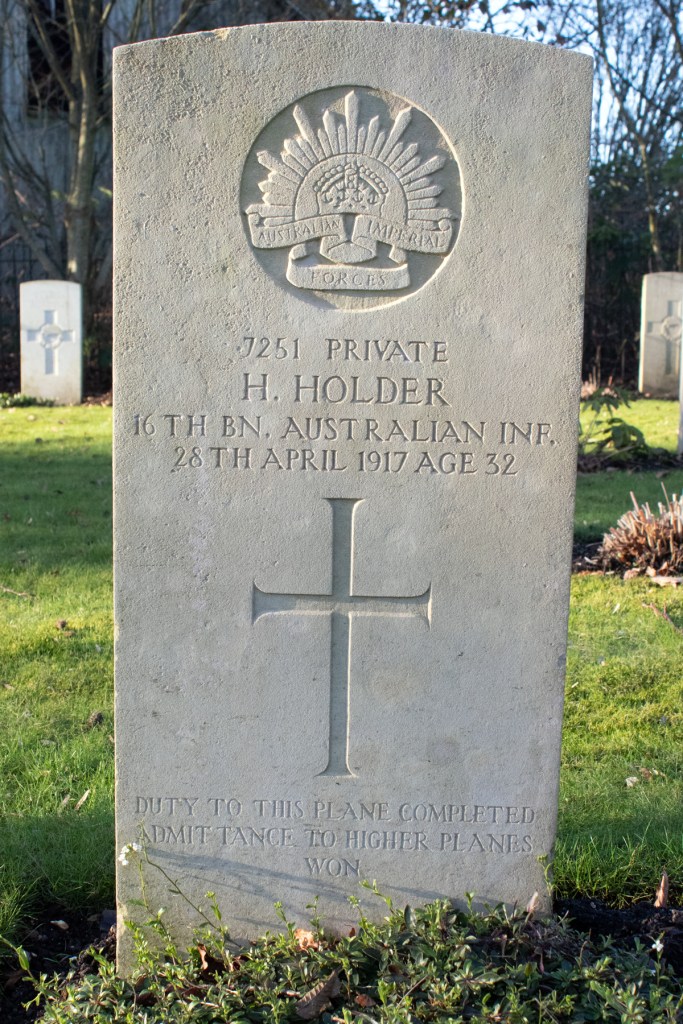
Private Harry Holder

Private Harry Holder

Harry Holder was born in the village of Ludgvan, Cornwall, in the summer of 1885. The oldest of fourteen children, his parents were Harry and Grace Holder. Harry Sr was a market gardener, and his oldest son was to follow in his footsteps.

By the time of the 1911 census, the Holders had moved to Cheltenham, Gloucestershire. Settling in a seven-room house in Leckhampton Road, the household of eleven people had six wages coming in, split between market gardening for the men and floristry for the women.

The following year, Harry Sr took his family on the long journey to Australia for a new life. They found work on a farm near Perth, and Harry Jr was employed as an agricultural labourer when war broke out. When the call came, he stepped up to play his part and his service records suggest that he had spent four years in the territorial army back in Britain. Harry had been turned down for service because of the state of his teeth just a month before trying to enlist again. The second time, however, he was successful, and he joined the Australian Imperial Force on 13th September 1916.

Private Holder’s medical report confirmed the man he had become. At 31 years of age, he was 5ft 10.5ins (1.79m) tall, and weighed 140lbs (63.5kg). A Roman Catholic, he had brown hair, blue eyes and a fresh complexion.

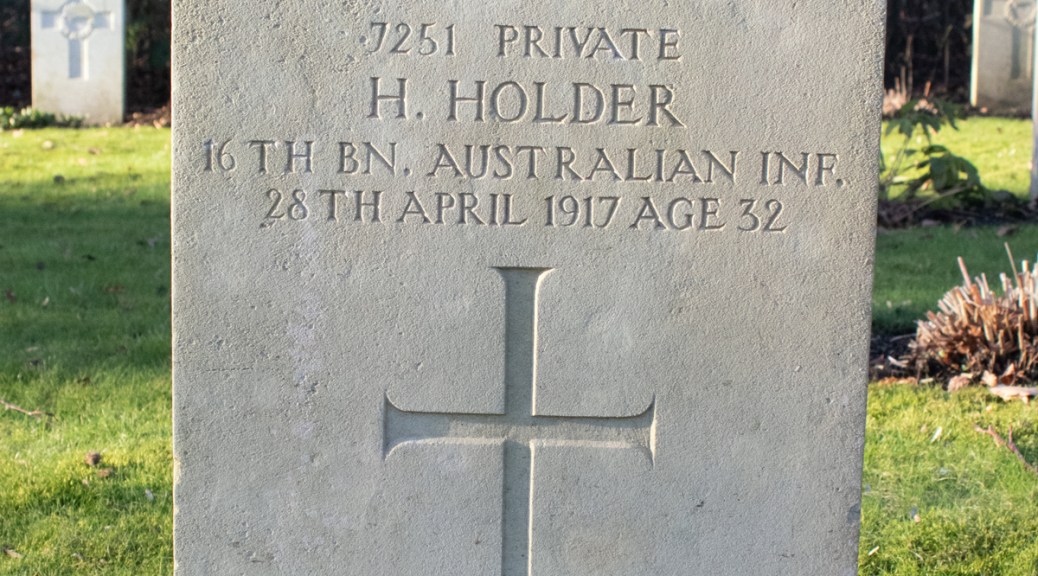
Assigned to the 16th Battalion of the Australian Infantry, Private Holder’s unit departed from Fremantle on 21st January 1917, travelling no board the ship Miltiades. Just under two months later, on 27th March, Harry arrived back in Britain, docking at Devonport, Devon, before moving with his battalion to a camp on the outskirts of Codford, Wiltshire.

A significant proportion of the ANZAC troops became unwell within weeks of arriving at the camp, and Harry was not to avoid illness. On 27th April he was admitted to the barracks’ hospital with cerebrospinal meningitis, but the treatment was to prove too little, too late. Private Holder died on 28th April 1917: he was 31 years of age.

Harry Holder was laid to rest in a new extension to St Mary’s Churchyard in Codford, close to the base where he had breathed his last.


Private Harry Holder
(from findagrave.com)