Tag Archives: wound

Serjeant Frank Ely

Serjeant Frank Ely

Frank Harold Ely was born in November 1889, and was the oldest of four children. His parents were coal porter Frank Ely and his wife, Florence. They were both born in Kent, and raised their family in their home town of Faversham.

When Frank Jr left school, he found work as a bottler, but he had his eyes set on bigger adventures. In January 1908, at the age of 18, he enlisted in the 1st Battalion of the Rifle Brigade. His service records show that he was 5ft 5.5ins (1.66m) tall and weighed 109lbs (49.5kg). Rifleman Ely had brown hair, grey eyes and a fair complexion. He was also noted as having a scat on his right knee.

Rifleman Ely’s early service was wholly territorial, but not without incident: in 1909 he was treated for tonsillitis, two years later, he received treatment for syphilis.

He was also not one to toe the line. In August 1911, he was reprimanded for not appearing at the 6:30am parade. On 9th March 1912, he was severely reprimanded for ‘improper conduct in town, at about 11:35pm’. On 25th September 1913, he was reprimanded once again, this time for irregular conduct – using the officers’ latrines.

When war came to Europe, the Rifle Brigade were soon in the thick of it. On 26th August 1914, Frank was wounded in the hand during fighting at Ligny, France, and was then captured and held as a prisoner of war in Hamelin until the spring of 1918.

Moved to the Netherlands, Rifleman Ely was finally released after the Armistice was signed, and returned to England on 19th November 1918. He was demobbed the following March, but re-enlisted within weeks, was given the rank of Serjeant and was due to be shipped to India to continue his service.

However, while at an army camp in Aldershot, Frank contracted pneumonia. The struggles the previous few years had had on his health proved too much for him, and, on 26th August 1919 – five years to the day that he had been shot and captured – Serjeant Ely passed away. He was 40 years of age.

Frank Harold Ely was brought back to his home town for burial. He was laid to rest in Faversham Borough Cemetery.


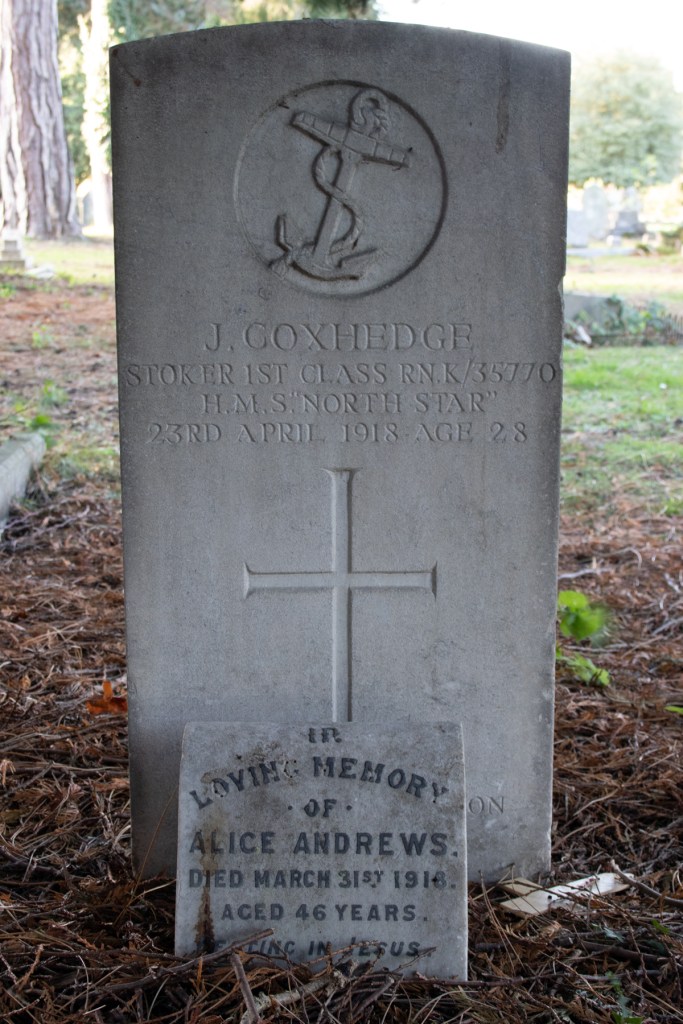
Stoker 1st Class John Coxhedge

Stoker 1st Class John Coxhedge

John Coxhedge was born on 28th October 1889 in Faversham, Kent. It seems that he and his siblings were brought up by an aunt and uncle, Mr and Mrs John Hodge, although why this was the case is lost to time. John attended Davington School, to the north of the town, and, for four years, was a chorister at his local church.

When a youth, [John] went to America and worked in some steel works, but after a year or so he returned home, and for a while prior to joining the Navy he was working at the Cotton Powder Works.

Faversham News: Saturday 27th April 1918

John married a woman called Louisa, and they went on to have five children. He enlisted in the Royal Navy as a Stoker 2nd Class on 21st August 1916. His service records show that he was 5ft 6ins (1.68m) tall, had fair hair, hazel eyes and a fresh complexion.

After his initial training at HMS Pembroke, the Royal Naval Dockyard in Chatham, Kent, Stoker Coxhedge was assigned to the boom defence vessel HMS Wallington. He served on board for nine months, gaining a promotion to Stoker 1st Class, before returning to HMS Pembroke.

While back in Chatham, in the summer of 1917, he would have been involved in the German Air Raid on the Dockyard. Unlike dozens of his colleagues, however, he seems to have escaped unscathed.

On 3rd October 1917, Stoker Coxhedge was given another assignment, this time at HMS Attentive, the Dover Patrol. In April 1918, the patrol was involved in some raids on Ostend and Zeebrugge. The local newspaper again picked up John’s story:

No operation in the present war, distinguished though it has been all along by the indomitable heroism of the sons of Britain, has so thrilled the Empire as that of last week – an exploit, which, as has been remarked, recalls some of the undying deeds of the days of Drake and Nelson.

Stoker Coxhedge… was one of the crew of a vessel detailed for covering duty. This vessel got on a sandbank and could not get off, and so in the brilliant light of star shells, which made the night as bright as day, it became a target for the enemy’s guns and a heavy fire was concentrated upon it. It was during this fire that Stoker Coxhedge was badly wounded. Later he, with others of the ship’s complement, was transferred to another vessel, and his death took place in hospital ashore.

Faversham News: Saturday 4th May 1918

John Coxhedge had died of his injuries on 23rd April 1918. He was 28 years of age. He was laid to rest in Faversham Borough Cemetery, not far from where his widow and family lived.


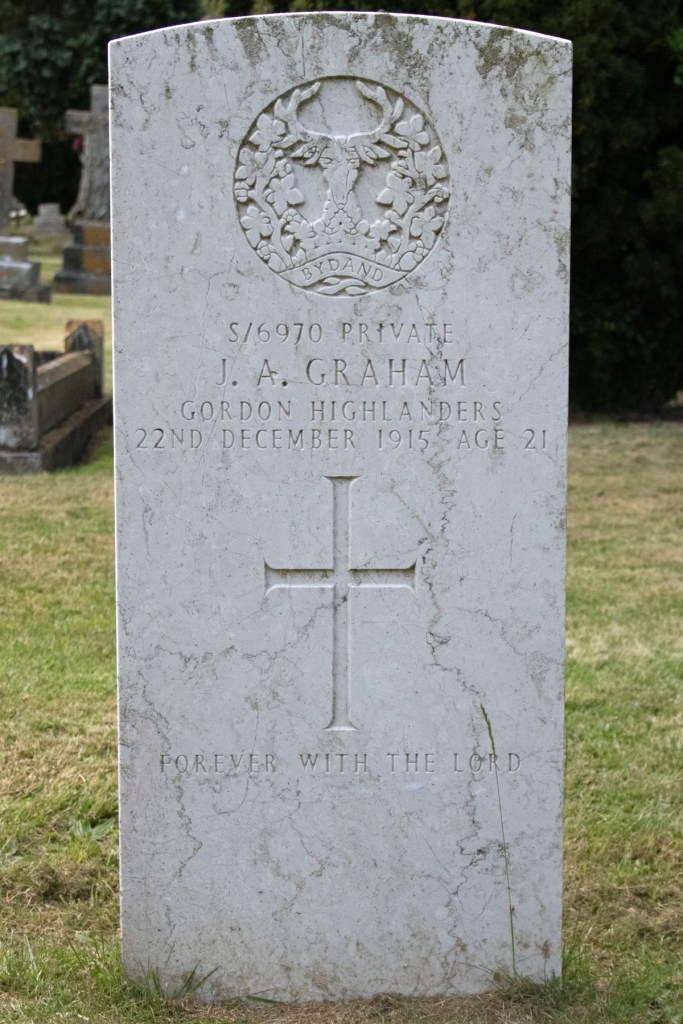
Private Joseph Graham

Private Joseph Graham

Joseph Aitken Graham was born in Kirkmichael, Dumfries, in 1894 and was the son of James and Bella Graham. There is little detail about his early life, but by the time war broke out, he was working with his father as a ploughman.

Joseph enlisted in November 1914, joining the 2nd Battalion of the Gordon Highlanders as a Private. His medical report records that he was 5ft 9.5ins (1.77m) tall, weighed 145lbs (65.8kg), had grey eyes, brown hair and a fresh complexion.

After a short period of training, Private Graham was sent to the Western Front, arriving in France on 2nd February 1915. He was involved in the fighting at Neuve Chapelle and Aubers Ridge. It was at Festubert, however, that things took a turn for the young private.

On the first day of the battle, 16th May 1915, Graham was badly injured, receiving gunshot and shrapnel wounds to his head and legs. He was initially treated at nearby Bethune, before being moved to Rouen. He was then evacuated to England in July, to further his recovery, and admitted to hospital in Wincanton, Somerset.

He was making such good progress that he was able to take a short walk each morning, and it was after one of these walks that he was taken ill. In spite of all that medical skill could do his condition became gradually worse, and it was thought advisable to send to Dumfries for his parents, who at once proceeded to Wincanton.

Dumfries and Galloway Standard: Saturday 8th January 1916

Sadly, nothing could be done for Private Graham: he passed away from a suspected brain haemorrhage on 22nd December 1915, at the age of just 21 years old.

Joseph Aitken Graham was laid to rest in the quiet and peaceful Wincanton Cemetery.


Private Wilfred Follett

Private Wilfred Follett

Wilfred Alson Follett was born in the spring of 1898, and was the second of eight children to Robert and Ellen (known as Nellie) Follett. Robert was a scavenger (or street cleaner) for Chard council, and it was in this Somerset town where his and Nellie’s young family were raised.

Lace making was the predominant industry in the area, and it was for local employer Boden & Co.’s Old Town Mills that Wilfred worked when he finished school. The 1911 census recorded him as being a threading boy in the factory.

War was coming to Europe, however, and Wilfred was keen to play a part. Sadly, full details of his military service are lost to time, but he had enlisted by the spring of 1917, initially joining the Somerset Light Infantry. He soon transferred across to the Welch Regiment, however, and was assigned to the 10th (Service) Battalion.

Private Follett was sent to the Western Front at the start of July 1917, and was soon caught up in the thick of the action at Ypres. He came through the Battle of Pilkem, but was injured at the fighting in Langemark. His wounds were severe enough for him to be evacuated to England for treatment, and he was admitted to a hospital in Bradford, Yorkshire.

Robert was sent for, but sadly did not arrive in time to see Wilfred before he passed away from his injuries. He died on 20th August 1917, at the tender age of just 19 years old.

Wilfred Alson Follett was brought back to his home town for burial. He was laid to rest in Chard Cemetery.


Private Joseph Soper

Private Joseph Soper

Joseph William Soper was born at the start of 1876, the third of eleven children to John and Elizabeth Soper. Both of his parents had been born in Dorset but it was in the Devon town of Axminster that their children were raised. John was a labourer, but, when he finished school, Joseph found work as an ostler or groom.

John passed away at the end of 1894, just months after his youngest son, Arthur, was born. Joseph, by this point, had found work as a postman, and, in the spring of 1897, he married Charlotte Annie Lee in his home town. The couple moved across the border to Somerset and settled in Chard. They went on to have a son, Arthur, who was born in the summer of 1900.

Postal work seemed not to have suited Joseph, and he made the move to labouring for a mason. Money appears to have been tight: the 1911 census recorded Charlotte working as a charwoman, while her younger brother, Herbert, was also lodging with them, and working as a grocer’s porter.

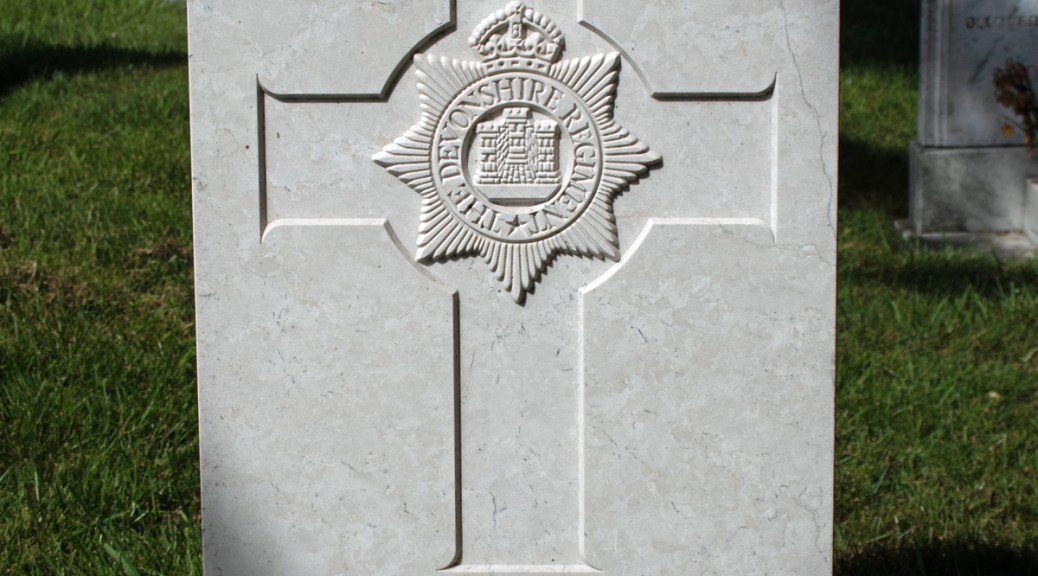
War was coming to Europe, but much of Joseph’s military career is a mystery. He had joined up by the autumn of 1916, and was assigned to the 13th (Works) Battalion of the Devonshire Regiment. He was based in Saltash and Plymouth, and served as part of the territorial force.

The only other documents available are Private Soper’s pension ledger and his entry on the Register of Soldier’s Effects. Both confirm that he died on 12th April 1917, and that the cause was “accidental injury received on active service“. Sadly, there is no further information about this. He was 41 years of age when he passed.

Joseph William Soper’s body was brought back to Somerset for burial. He lies at rest in Chard Cemetery, walking distance from where his widow and son still lived.


Private Albert Cook

Private Albert Cook

Albert William Cook was born on 29th August 1887, in the Somerset village of Chaffcombe. He was the oldest of six children – of which only three survived infancy – to William and Harriet Cook. William was a thatcher by trade, and moved his young family to nearby Chard when Albert was a youngster.

When he finished school, Albert found work as a wagoner for the local coal depot, Jarman & Co. War was on the horizon, however, and, at the start of 1915, he signed up to play his part for King and Country.

Private Cook joined the Somerset Light Infantry. While full details of his service are not available, his troop – the 1st Battalion – were heavily involved in the Second Battle of Ypres in the spring of 1915. While he seemed to have survived this, he was later injured, receiving a fractured skull and becoming paralysed on one side.

Albert was admitted to the Canadian No. 2 Stationary Hospital in Le Touquet, but subsequently evacuated to England for further treatment. He was operated on in a hospital in Birmingham, but his injuries proved too severe. He passed away on 3rd September 1915, and had just turned 28 years old.

Albert William Cook’s body was brought back to Somerset for burial. He was laid to rest in Chard Cemetery, not far from his family’s home.


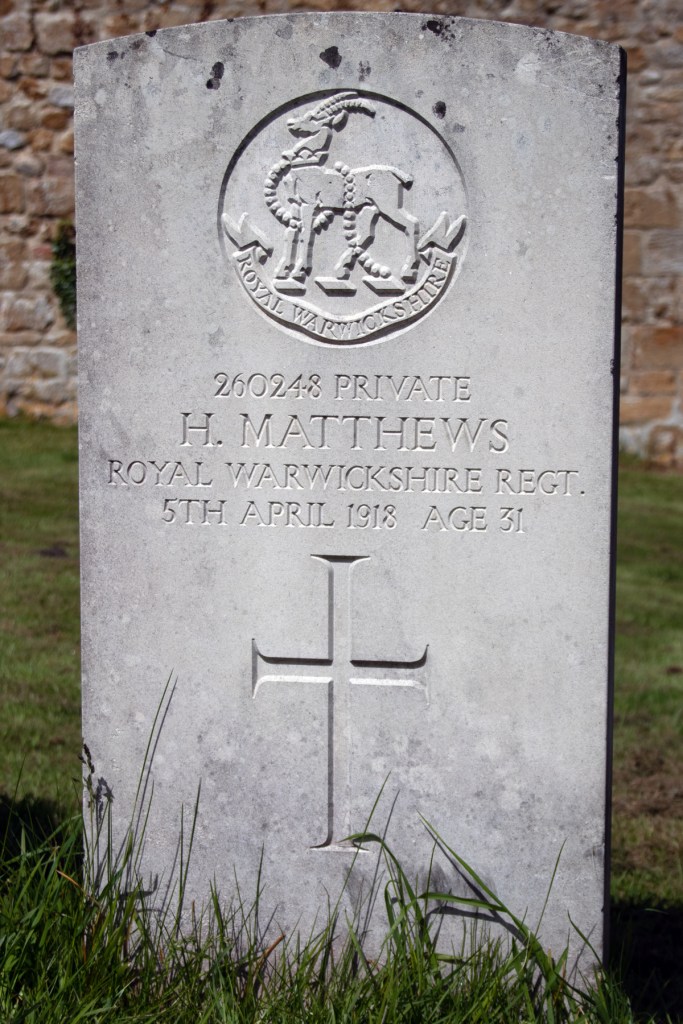
Private Herbert Matthews

Private Herbert Matthews

Herbert George Matthews was born in the autumn of 1886 in the Somerset village of Chillington. He was the oldest of two children to George and Elizabeth (known as Rosa) Matthews, and was baptised in the village church on Christmas Day that year.

George was a farm labourer, and this is work into which Herbert also followed. Rosa passed away in December 1910, leaving George a widow after 26 years of marriage.

War came to Europe in 1914, and Herbert signed up to play his part for King and Country. Full details of his service are not available, but he initially enlisted in the Somerset Light Infantry. He soon transferred across to the Royal Warwickshire Regiment (although the date of this is unclear) and was assigned to the 2nd/6th Battalion.

Private Matthews’ troop spent the war on the Western Front, and was involved at Fromelles, Ancre, Ypres and Cambrai. In the spring of 1918, he was caught up in the Battle of St Quentin – part of that year’s battles on the Somme. He was wounded, and medically evacuated to England, where he was admitted to the University War Hospital in Southampton.

Sadly, Private Matthews’ wounds proved too severe; he passed away from his injuries on 5th April 1918, at the age of 31 years old.

Herbert George Matthews was laid to rest in Chillington Cemetery, not far from where his mother was buried, and within walking distance of where his father still lived.


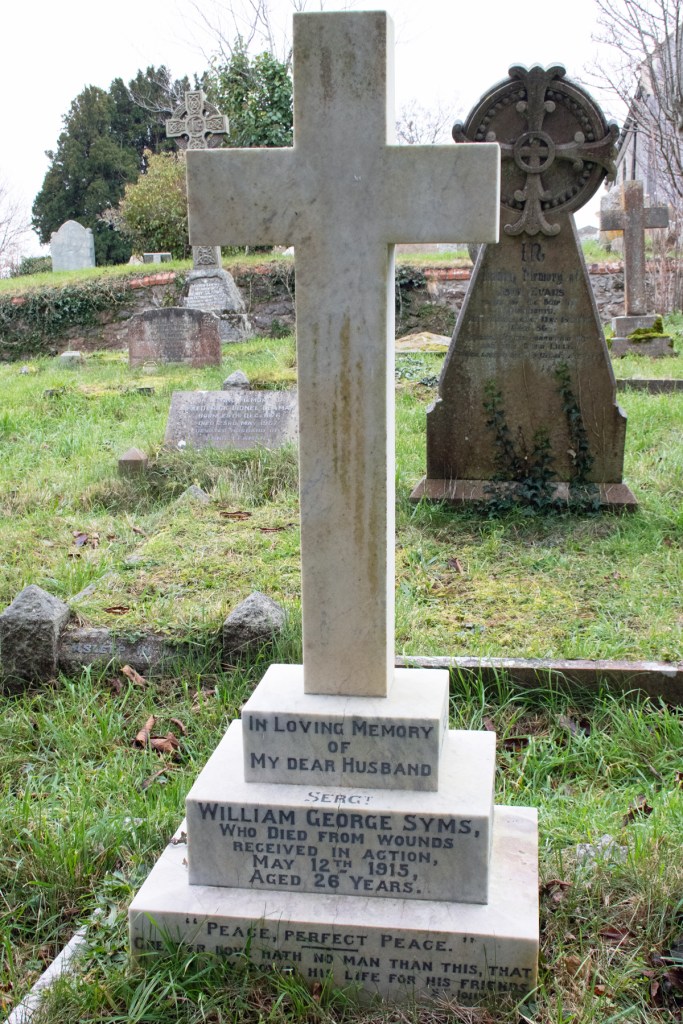
Serjeant William Syms

Serjeant William Syms

William George Syms was born in in the spring of 1889, the oldest of two children to George and Rose Symes (both spellings are recorded). George was a postman from Devon, and the family were born and raised in Highweek, Newton Abbot.

When William left school, he followed in his father’s footsteps becoming a postman in his home town. Life was not without its ups and downs, however, and the 1911 census record him as an inpatient, convalescing from an unknown illness in Exmouth.

In the summer of 1913, William married Amelia Oliver, a gardener’s daughter, who also from Highweek.

When war broke out William was eager to play his part, and enlisted in the early months of the conflict, alongside a number of his colleagues. He joined the Royal Engineers, and was assigned to the 1st (Wessex) Division Signal Company. He was sent to France on 22nd December 1914 and was involved on the Front Line from early on.

By the spring of 1915, he was fighting at Ypres, and was badly injured, fracturing both legs and suffering from the effects of being gassed. Serjeant Syms – as he was by then ranked – was medically evacuated to England for treatment. He was admitted to the Auxiliary Military Hospital in Manchester, but died of his injuries on 12th May 1915. He was just 26 years old.

William George Syms’ body was brought back to Devon for burial. He was laid to rest in the graveyard of All Saints Church in his home town of Highweek. Tragically, he was never to see his son, also called William, who had been born just two months before.


Private Arthur King

Private Arthur King

Arthur Thomas Rendell King was born early in 1896, the oldest of six children to Thomas and Bessie King. Engine driver Thomas had been born in London, but, after marrying his wife the year before Arthur was born, he settled in Highweek near Newton Abbot, Devon.

When he left school, Arthur followed his father in working for Great Western Railways, working as a carriage cleaner at the town’s depot. War was on the horizon, however, and he enlisted in the Devonshire Regiment shortly after conflict was declared.

Private King was assigned to the 1st/5th Battalion and sailed for India in October 1914, arriving in Karachi a month later. After nearly three years, his regiment moved again, this time to Egypt, in advance of action in the Middle East.

Involved in the Battle of Nebi Samwil in November 1917, Arthur was badly wounded – and initially recorded as missing, presumed dead. However, he was found, and evacuated to England. Tragically, within hours of being admitted to a hospital on home soil on 31st January 1918, Private King died of his injuries. He had just turned 22 years of age.

Arthur Thomas Rendell King’s body was brought back to Devon for burial. He was laid to rest in the family grave in the graveyard of All Saints Church, Highweek.


Private Arthur King
(from findagrave.com)

Private Mark Ford

Private Mark Ford

Mark Ford was born early in 1881 in Wellow, near Peasedown St John in Somerset. He was the youngest of eleven children, and the son of Thomas and Ellen Ford. Thomas was a coal miner, and this was a trade that his seven sons, including Mark, went into.

The 1901 census recorded Mark as boarding in a house in Abertillery, Monmouthshire, learning his trade. Within a few years, however, he was back in Peasedown St John. In the summer of 1910, he married local woman Emily Tucker and the couple set up home in Wellow, where they went on to have four children: George, Phyllis, Hubert and Ethel.

War was coming to Europe and, while records are scarce, it’s possible to build up a picture of the service Mark undertook. He initially enlisted as a Private in the Royal Berkshire Regiment, and was assigned to the 10th (Labour) Battalion. They were sent to France in June 1916, although it is not possible to confirm if Mark went at the same time.

His battalion became the 158th and 159th Labour Companies in April 1917, and it seems that Private Ford transferred to the former and, at this point, was definitely serving in France. That summer, he was wounded in the hip and head by an exploding shell and was medically evacuated to England for treatment.

Private Ford was admitted to the Military Hospital in York, where he lay injured for some time; long enough, thankfully, for Emily to make the journey to be with him. Sadly, his wounds were to prove too much: he passed away at the hospital on 28th October 1917, at the age of 36 years old.

Mark Ford’s body was brought back to Somerset for burial He was laid to rest in the churchyard of St John the Baptist, in Peasedown St John.