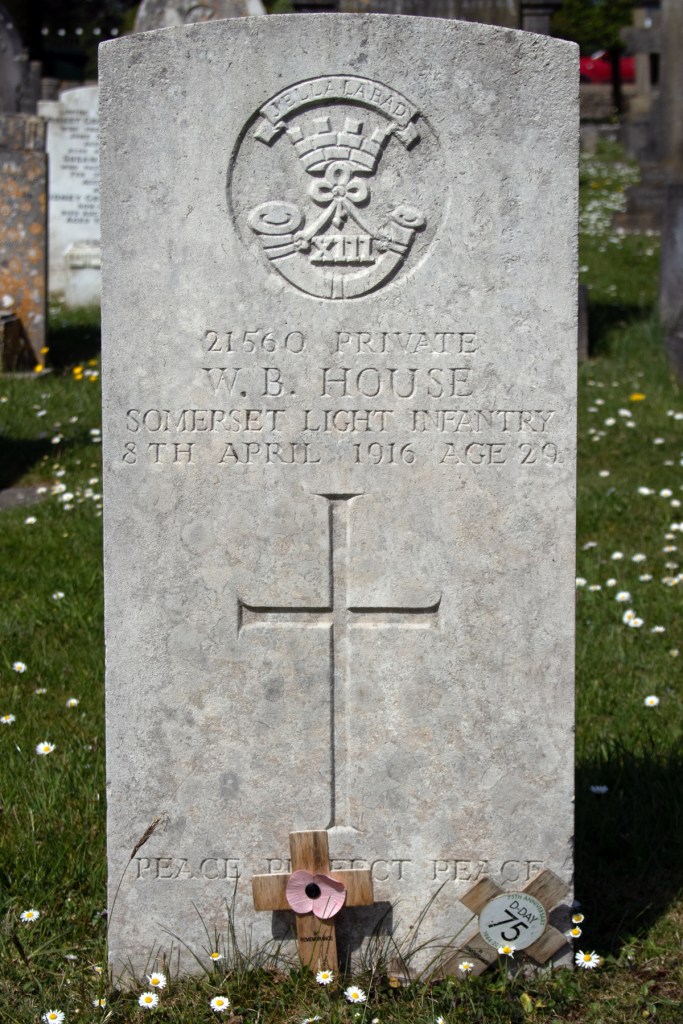
William Brewer House was born in Chard, Somerset, in the spring of 1888, one of eleven children to William and Minna House. William Sr was a farm labourer, and it was dairy work that William went into when he left school.
Little of William Jr’s life is documented. When war broke out, he stepped forward to play his part, enlisting in the 3rd (Reserve) Battalion of the Somerset Light Infantry at some point after October 1915. This particular troop was a territorial force, based primarily in Devon, and it is unlikely that Private House saw service overseas.
Sadly, the only other detail about his life is that relating to his passing. He was noted as having died on 8th April 1916 in the Military Hospital in Plymouth, although no cause is evident. He was just 28 years of age.
William Brewer House was brought back to Somerset for burial. He lies at rest in the Tatworth Cemetery near his home town of Chard.
William’s younger brother Frederick (known as Gordon) House also fought with the Somerset Light Infantry. He was killed in Mesopotamia in the spring of 1917.
Samuel Mattocks was born in Combe St Nicholas, Somerset, in 1885, one of six children to farm labourer George Mattocks and his wife, Anna. Sam sought a trade when he left school and soon found work as a butcher.
Documentation relating to Sam’s life is pretty scarce. When war broke out, he stepped forward to play his part, enlisting in the Army Service Corps (presumably because of his profession) by the start of 1916.
Private Mattocks was sent to Hampshire to work at one of the supply depots there. Sadly, this appears not to have been for long as, on 1st April 1916, he passed away at his base in Aldershot. No specific cause of death is evident – his records just note that he died ‘of disease’. He was 31 years old.
The body of Samuel Mattocks was brought back to Somerset for burial. He was laid to rest in the family plot in the graveyard of St Nicholas’ Church in his home village.
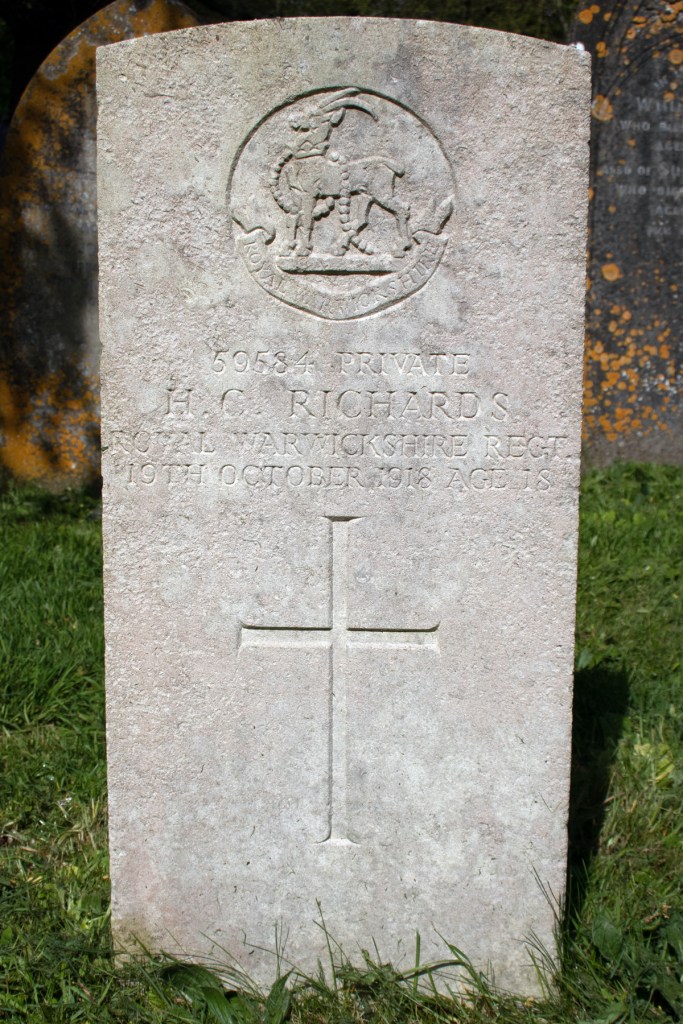
Howard Charles Richards was born in the summer of 1900, the youngest of seven children to George and Henrietta Richards. George was a sewing machine salesman from Combe St Nicholas in Somerset, and this was where the family were raised.
Howard was too young to join up when war was declared, but it seems to have been important to him. He enlisted in the 5th Battalion of the Royal Warwickshire Regiment soon after his eighteenth birthday and was sent for training.
Tragically, Private Richards’ time in the army was to be a short one. The next record for him confirms that he was admitted to the 1st Northern General Hospital in Newcastle-upon-Tyne, and that he passed away on 19th October 1918. The cause of his passing is not recorded, but he was just 18 years of age.
Howard Charles Richards’ body was brought back to Somerset for burial. He lies at rest in the graveyard of St Nicholas’ Church in his home town.
Arthur William Young was born on 11th July 1900, in the Gloucestershire village of Charfield. His parents, James and Eliza, were both born in the area, and this is where they raised their nine children.
James worked as a bone turner and sawyer, working the material for things like buttons. This was a family trade, and something that Arthur followed his father and older siblings into when he finished school.
By this point, storm clouds were brewing over Europe. Arthur was too young to enlist when war first broke out, but when his older brother Francis died in Northern France in December 1917, this seemed to have driven him to play his part as well.
Arthur enlisted in the Royal Marine Artillery on 1st July 1918, a couple of weeks before his eighteenth birthday. Assigned the rank of Private, his records show that he was 5ft 9ins (1.65m) tall, had blue eyes, brown hair and a fresh complexion. It was also noted that he had a scar on his right wrist and another on his forehead.
After nine months’ service, Arthur was promoted to Gunner and, by the autumn of 1919, he was assigned to the dreadnought HMS Queen Elizabeth.
On 1st December 1920, while moored in Portland Harbour, Dorset, a concert was held on HMS Warspite. Gunner Young attended, but on the trip back to his own ship, the boat he was on collided with another, and he and three others were knocked overboard and drowned. He was just 20 years of age.
Arthur William Young was brought back to Gloucestershire for burial. He was laid to rest in the family plot in the Congregational Chapelyard in his home village of Charfield.
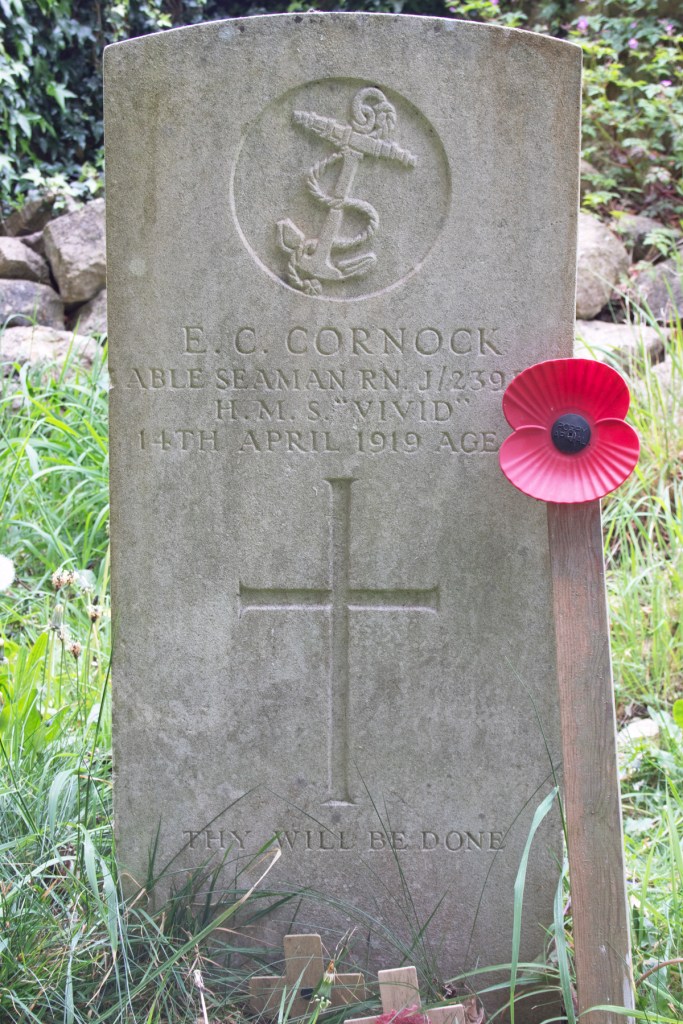
Ernest Charles Cornock was born on 16th June 1896, in the Gloucestershire town of Wotton-under-Edge. His parents were carter Charles Cornock and his wife, Millicent, both born and bred in the town, and he was one of eight children.
When he left school, Ernest found work as a rubber winder in the local mill. However, he wanted bigger and better things and so, on 8th April 1913, he enlisted in the Royal Navy. His service records show that he stood just 5ft 3ins (1.60m) tall, had brown hair grey eyes and a fresh complexion. He was also noted as having a scar on his right cheek.
As Ernest was under age when he joined up, he was initially given the rank of Boy 2nd Class. He was sent to HMS Vivid, the Naval Dockyard in Devonport and, after four months’ training, during which he was promoted to Boy 1st Class, he was given his first posting on board the battleship HMS Queen.
After five months on board, Boy Cornock was given another assignment, and was transferred to HMS Lion. While on board, a number of things happened: the First World War broke out, and the battle cruiser fought at Heligoland Bight and Dogger Bank; Ernest came of age, and was given the rank of Ordinary Seaman on his 18th birthday; with ongoing good conduct, in September 1915, he was then given a promotion to Able Seaman.
After a short spell back in Devonport, Ernest served on a further five ships, taking him through to the end of the war. By the start of 1919, however, Able Seaman Cornock’s health was beginning to suffer. Having contracted tuberculosis, he was medically discharged from service on 19th February, and was admitted to a sanatorium back in Gloucestershire. Sadly the condition was to get the better of him, and he passed away on 14th April 1919, at the age of just 22 years old.
Ernest Charles Cornock was brought back to Wotton-under-Edge for burial. He was laid to rest in the graveyard of St Mary the Virgin Church in the town, not far from his second cousin, Albert Cornock, who had been buried just the week before.
As an aside to Ernest’s tale, the newspaper that reported on his funeral also noted that his grandmother, Ruth Cornock, had not long received a message from the King, congratulating her on the fact that nine of her sons had served in the conflict
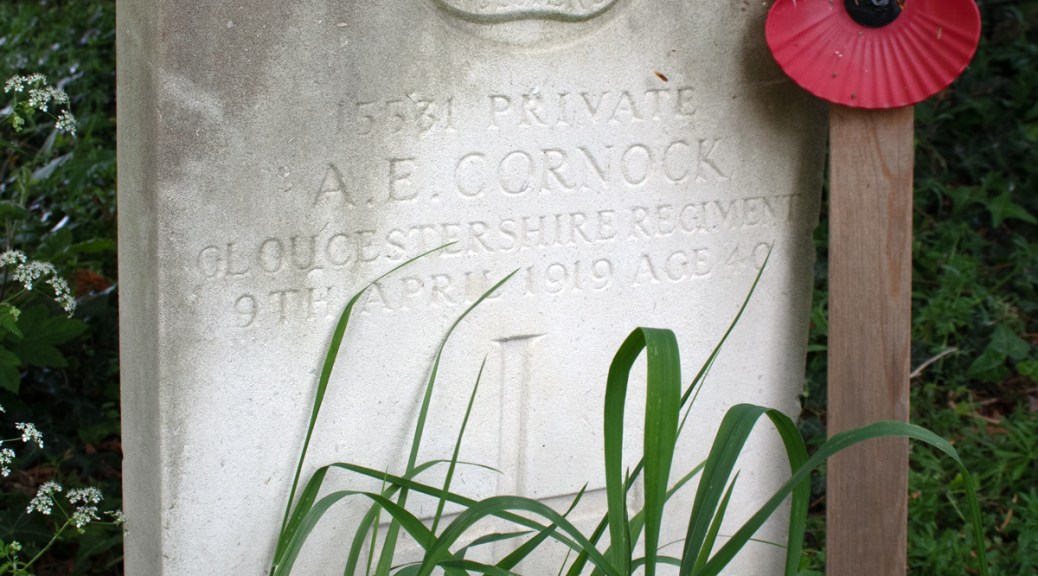
Albert Edward Cornock was born in 1878, and was one of eight children. His parents, John and Hannah Cornock, were both born in Wotton-under-Edge, Gloucestershire, ant this is where the family were brought up.
John was a labourer, and this was the trade than Albert also fell into. On 2nd August 1903, he married local woman Bessie Carter. The couple settled in their home town and went on to have eight children.
War came to Europe in 1914, and Albert was amongst those to enlist early on. He joined the 10th (Service) Battalion of the Gloucestershire Regiment in Bristol on 13th November. Albert’s service records show that he was 5ft 4ins (1.62m) tall and weighed 119lbs (54kg). He had a fresh complexion, brown eyes and black hair.
Private Cornock’s initial training was split between Cheltenham and Salisbury Plain, but he was eventually sent out to France as part of the British Expeditionary Force in August 1915. He spent nearly eighteen months overseas, but, towards the end of the following year, he contracted tuberculosis, and was sent back to England for treatment.
Albert’s lung condition was to ultimately lead to his discharge from the army on medical grounds. His last day of service was 8th February 1917.
At this point, Albert’s trail goes cold. He returned home to Gloucestershire, and lived on another couple of years. He passed away at home on 9th April 1919, aged 40 years old: while the cause of his passing is not clear, it seems likely to have been as a result of the illness that saw him discharged from the army.
Albert Edward Cornock was laid to rest in the graveyard of St Mary the Virgin Church in his home town of Wotton-under-Edge. He lies not far from his cousin, Ernest Cornock, another victim of the First World War, who was buried just a week later.
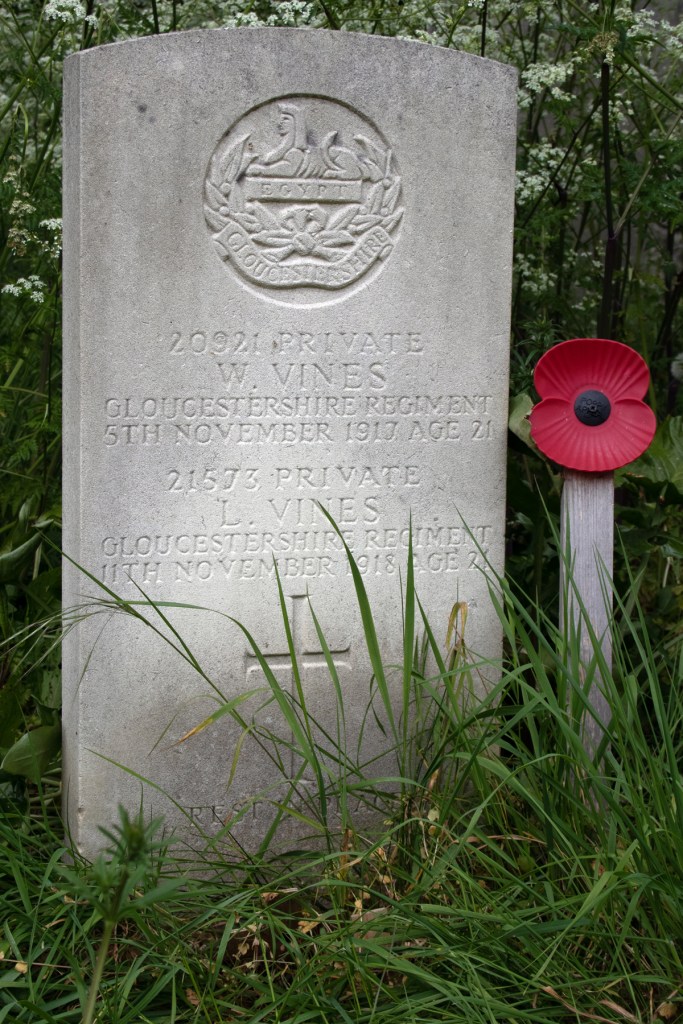
Leslie Vines was born on 16th September 1898, and was one of seventeen children to John and Emma. John was an elastic web maker or braider from Stroud, Gloucestershire, and it was in nearby Wotton-under-Edge that he and Emma raised their growing family.
Braiding and weaving ran in the family: the 1911 census recorded six of the Vines’ children who were over school age were employed in the local mill. When he finished school, Leslie also found work there.
When war came to Europe, Leslie was eager to play his part. He enlisted in the Gloucestershire Regiment on 18th June 1915, just a month after his older brother, Wilfred, had joined up. His service records confirm that he was 5ft 2ins (1.57m) tall: Keen as he was to follow his older brothers into glory, he gave his age as 19 (two years older than he actually was) in order to be accepted for duty.
Private Vines’ eagerness, however, was to be thwarted. On 29th June, less than two weeks after joining up, he was discharged from service. Details are scant, but this seems to have been on the basis that, following his medical examination, he was considered to be unfit for duty.
At this point, Leslie’s trail goes cold and the next available record is that for his death on Armistice Day, 11th November 1918. He was just 20 years of age. While the cause of his passing is not readily available, it was not reported on in any of the contemporary newspapers, so is likely to have been of natural causes.
Leslie Vines was laid to rest alongside his brother, Private Wilfred Vines, in the graveyard of St Mary the Virgin Church in his home town, Wotton-under-Edge.
Wilfred Vines was born on 19th March 1897 and was one of seventeen children to John and Emma Vines. John was an elastic web maker or braider from Stroud, Gloucestershire, and it was in nearby Wotton-under-Edge that he and Emma raised their growing family.
Braiding and weaving ran in the family: the 1911 census recorded six of the Vines’ children who were over school age were employed in the local mill. This included Wilfred, who was working as a bobbin collector.
War came to Europe, and Wilfred was keen to play his part. He enlisted on 25th May 1915, joining the 15th Battalion of the Gloucestershire Regiment as a Private. His records show that he stood just 5ft 2ins (1.57m) tall.
Private Vines was sent for training to the camp at Chiseldon, Wiltshire. It seems that, while he was there, he was injured and, although full details are not available, his wounds were serious enough for him to be discharged from the army because of them. He was formally released on 30th May 1916, and returned home to recover and recuperate.
At this point, Wilfred’s trail goes cold. All that is recorded is that, on 5th November 1917, he passed away at home from his injuries. He was just 20 years of age.
Wilfred was laid to rest in the graveyard of St Mary the Virgin Church in his home town. He shares his grave with his younger brother, Leslie, who died the following year.
William Cecil Rowell was born on 29th November 1892 in Wolborough, Newton Abbot, Devon. He was the youngest of three children to architectural surveyor Spencer Rowell and his wife, Annie.
The 1911 census recorded that William had left the family home to study to be a civil servant, and was boarding with a family in Fulham, London. His studies complete, he was driven by a need to serve his country and, on 22nd January 1913, aged just 20 years old, he enlisted in the Loyal North Lancashire Regiment.
Full details of his service are not available, but it is clear that he was committed to his purpose. He was promoted to Second Lieutenant soon after enlisting, rose to full Lieutenant in November 1914, and Captain a year later. It’s not possible to pinpoint where he served, he was wounded twice and, after his second recovery, he made a transfer to the Royal Flying Corps (later moving to the new Royal Air Force when it was founded in 1918).
Captain Rowell was based at Bekesbourne Airfield in Kent. He qualified as a pilot with 50 Squadron in October 1918, but was injured when, on the 12th November, his Sopwith Camel collided with the hanger. William was admitted to the Military Hospital in nearby Canterbury, but the injuries to his leg proved too severe for it to be saved, and he underwent an amputation in January 1919.
Tragically, while the initial prognosis was good, within a few weeks sepsis set in; Captain Rowell passed away on 22nd May 1919, aged just 26 years old.
William Cecil Rowell’s body was brought back to Devon for burial. He was laid to rest in the family plot in the graveyard of St Mary’s Church in Wolborough.
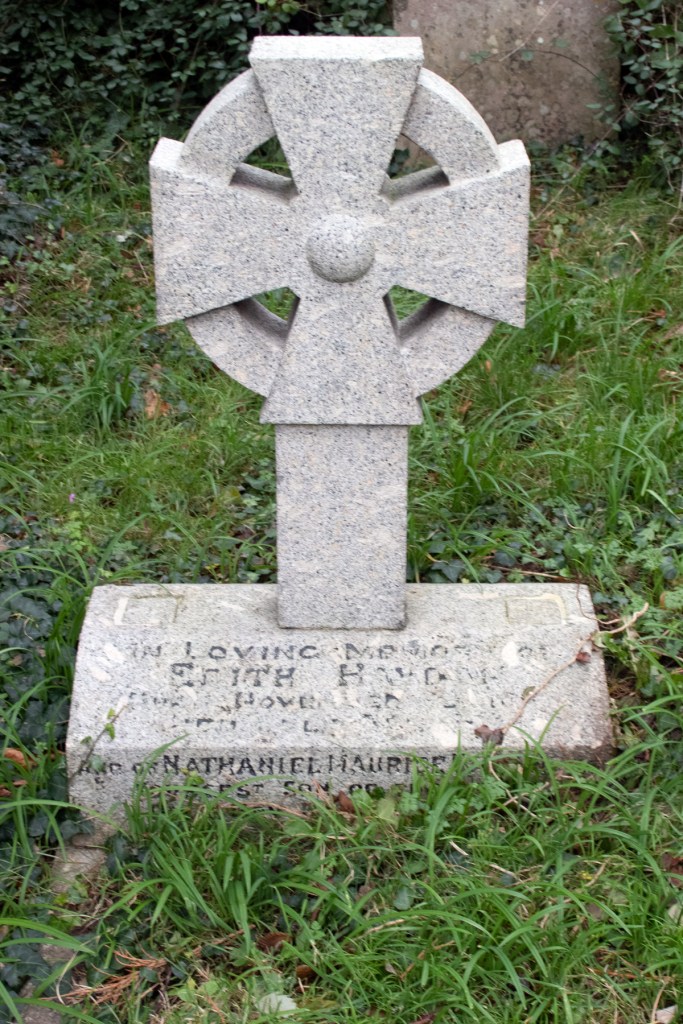
Nathaniel Maurice Haydon was born on 26th May 1900, and was the youngest of four children to Edgar and Edith Haydon. Edgar was a surgeon from Bovey Tracey, Devon, but the family were born and raised in Newton Abbot.
Edgar’s work gave them a comfortable lifestyle: the 1901 census shows the family had four live-in servants. Edith passed away from cancer in July 1903, when her youngest was only a toddler. Edgar married again – to a Gertrude Godwin, fourteen years his junior – four years later; given his role in the community, this is likely to have provided the family with a level of stability.
By the time of the 1911 census, Nathaniel and his older brother Frank were recorded as boarders in a private school in the town, while Edgar and Gertrude were listed at the family home with two domestics.
War was coming to Europe, but Nathaniel was initially young to become involved. Spurred on when his oldest brother, Edgar, was killed at the Somme in July 1916, he applied to join the Inns of Court Officer Training Corps in the summer of 1918. He was accepted, and sent off to Hemel Hempstead, Hertfordshire, for training that September.
Sadly, it was Private Haydon’s eagerness to emulate his brother that led to his undoing. While at the camp, he contracted pneumonia, and passed away on 1st November 1918, aged just 18 years old.
Nathaniel Maurice Haydon’s body was brought back to Devon for burial. He was laid to rest in the family plot in the graveyard of St Mary’s Church, Wolborough, Newton Abbot.










 Death and Service