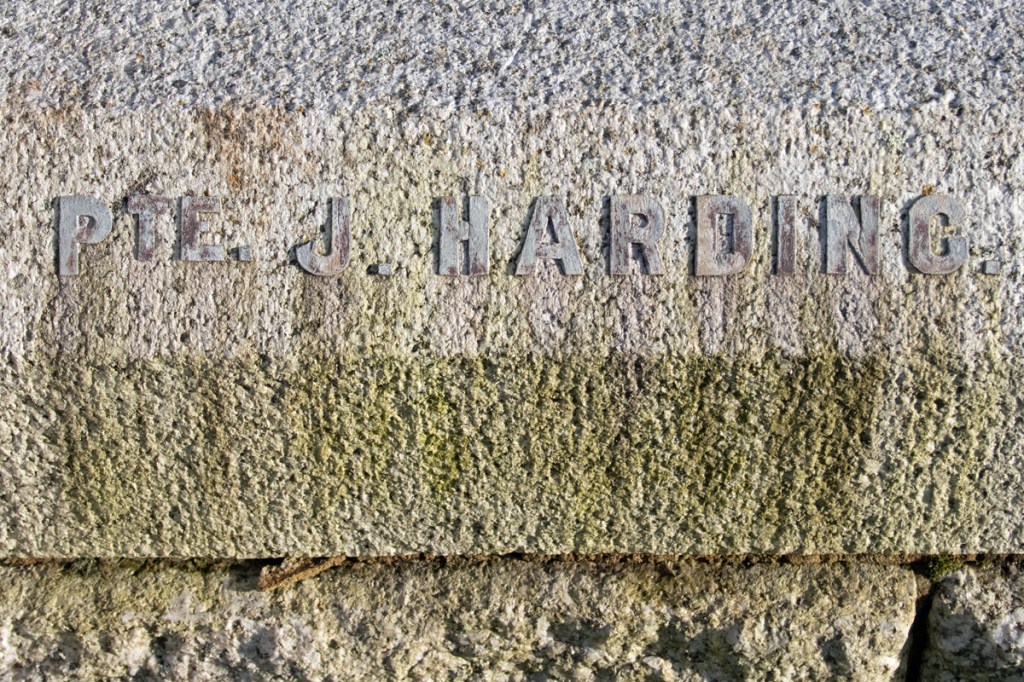
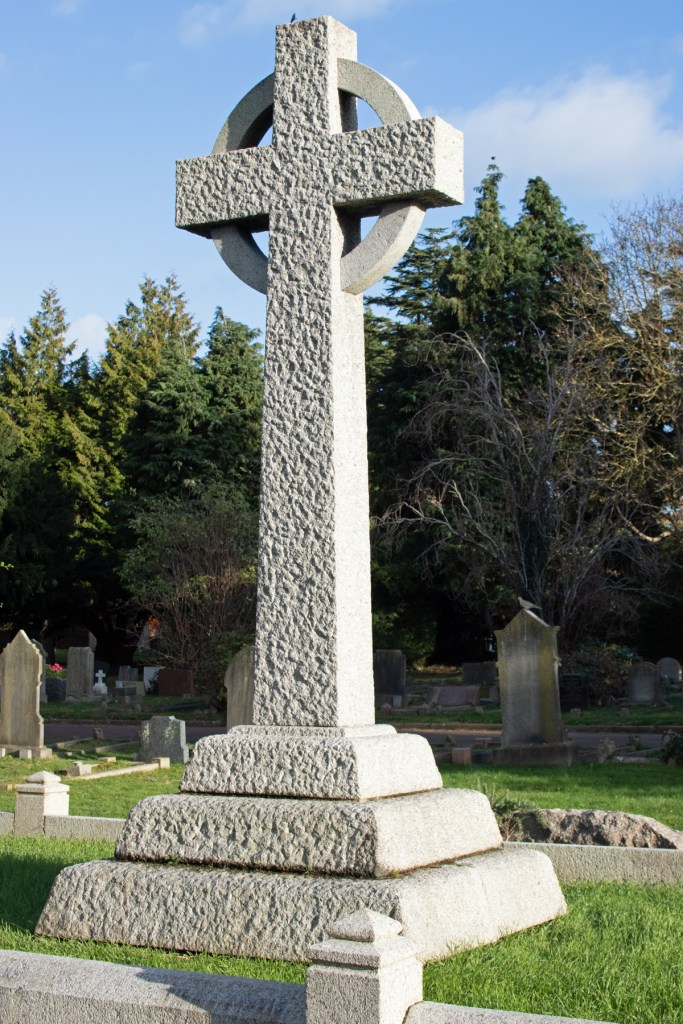
In a mass grave in Faversham Borough Cemetery, Kent, is a commemoration to Private John Harding, who died during the Faversham Explosion on 2nd April 1916.
Sadly, there is little concrete information about John, other than the details recorded in the Register of Soldiers Effects. This document confirms that he served in the 3rd Supply Company of the 3rd/4th Battalion of The Buffs (East Kent Regiment). He had enlisted before October 1915 and no next of kin is recorded.
Another document suggests that Private Harding was a resident of Milton Regis, a small village to the north of Sittingbourne. Again, however, there is not enough additional information to corroborate this or to expand on his personal life.
Unfortunately, therefore, Private John Harding is destined to remain a mystery, one of more than a hundred men and women to have died on that fateful day.
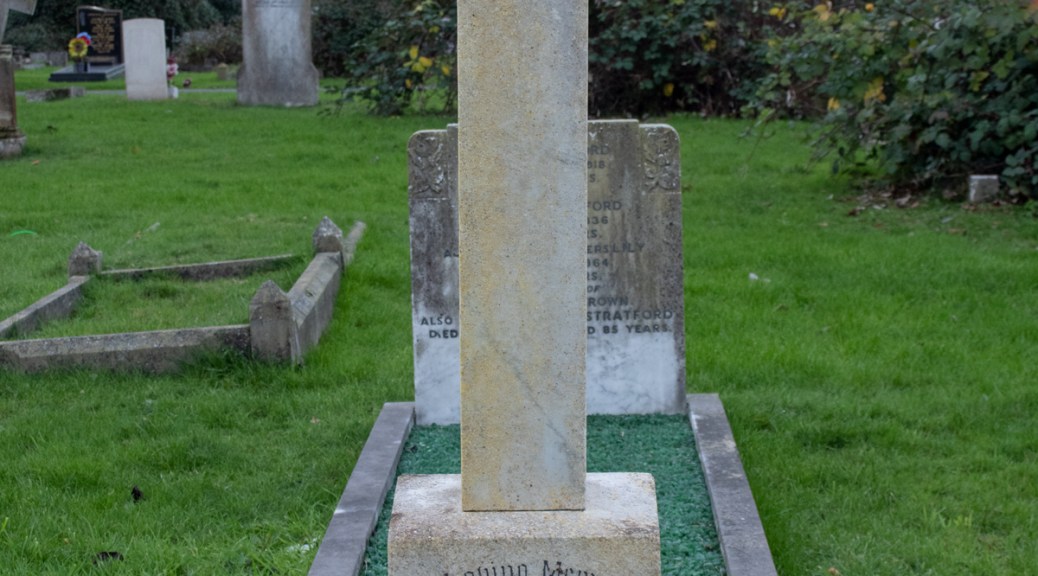
Memorial to the Faversham Explosion, Borough Cemetery
William Adams was born in Skelmersdale, near Liverpool, in around 1868. He was the son of George and Harriet Adams, although as his name was quite common in the area at the time, it is not possible to narrow down details of his early life any further.
At some point after leaving school, William joined the army, using the surname of Catlow. The 1891 census records him as a soldier in the Private Infantry, based at the Habergham Eaves Barracks near Burnley, Lancashire.
On leaving the army, William found work as a labourer and, by the 1890s, he had moved to Kent. He met and married a woman called Kate in 1895, and they went on to have a son, Archibald, the same year. The 1911 census records the family living in Cheriton, near Folkestone, William doing labouring work, and Kate employed as a laundress.
With the outcome of the First World War, William stepped forward to play his part again. By this point, he was 46 years old and, while he was assigned to the 4th Battalion of The Buffs (East Kent Regiment), was given more of a territorial role.
Private Catlow was serving at the site shared by the Cotton Powder Company and Explosives Loading Company to the north of Faversham in the spring of 1916. On the afternoon of 2nd April 1916, a fire caused a series of massive explosions at the factories, and William was one of around 110 people to be killed. He was 48 years of age.
William Adams, known militarily as Private William Catlow, was laid to rest, along with the other victims of the Faversham Explosion, in the town’s Borough Cemetery.
Memorial to the Faversham Explosion, Borough Cemetery
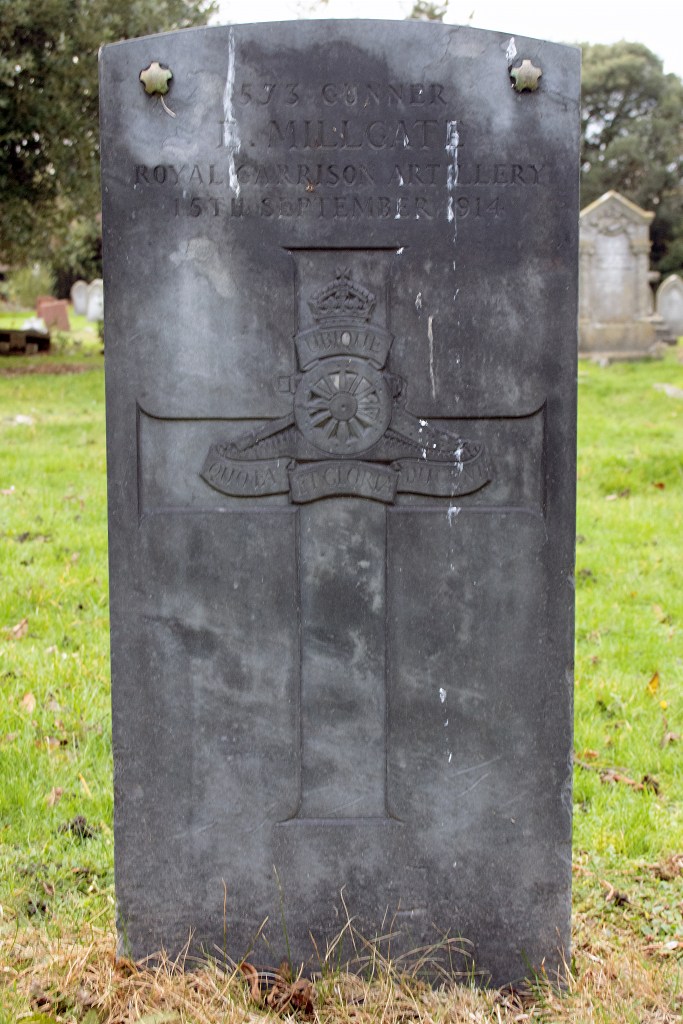
Ernest Millgate was born in late 1893, the fifth of six children to Henry and Agnes. Henry was a brewer’s drayman from Boughton, Kent, but it was in nearby Faversham that he and Agnes raised their family.
Ernest found work as a labourer in the town’s Cotton Powder Works, but when war was declared, he was one of the first to enlist. He joined the Royal Garrison Artillery as a Gunner on 5th September 1914, and was billeted nearby on the Isle of Sheppey. His service records show that he stood 5ft 9ins (1.75m) tall, had fair hair, blue eyes and a fresh complexion.
Gunner Millgate’s military service was to be tragically short, as a contemporary local newspaper was to report:
A terrible tragedy occurred at Minster, Sheppey, on Tuesday morning last, Ernest Millgate… who joined the Kent Heavy Battery barely a fortnight ago, being accidentally shot by a comrade, George Walter Cornelius… a gunner of three years’ service in the same Battery.
Gunner Cornelius, it appears, was handling a rifle preparatory to going on sentry duty shortly after eleven o’clock on Tuesday morning. On examining the rifle he had found that the magazine was charged but that there as no charge in the bore. Apparently the cut-off was in operation, for he pulled the trigger and there was no discharge. He examined the breech a second time and, afterwards pulled the trigger again. To his dismay there was this time a discharge and Millgate, who was standing near, fell dead, having been shot through the head. The theory is that Cornelius’ great coat, which he was wearing, caught in and released the cut-off, thereby bringing the magazine into operation.
Faversham Times and Mercury and North-East Kent Journal: Saturday 19th September 1914
An inquest was held, and it was a verdict of accidental death was given.
Gunner Ernest Millgate was just 21 years old, and had been in the service of the army for just eleven days. His body was brought back to Faversham, and he lies at rest in the town’s Borough Cemetery, just a few minutes walk from the home he had left just a fortnight before.
The same newspaper also ran a report on on Ernest’s older brother, Henry.
Private Millgate was a volunteer for the Northumberland Fusiliers, and was called into active service a couple of weeks before his brother. He had been caught up in the fighting at Mons, le Cateau and the Marne, and was, according to the newspaper, injured.
Medically evacuated to England for treatment, at the time of his brother’s funeral he was in a hospital in Newcastle-upon-Tyne.
Henry survived the war; he and his wife, Elizabeth, had two children, and he lived until 1939, passing away at the age of 52 years old.
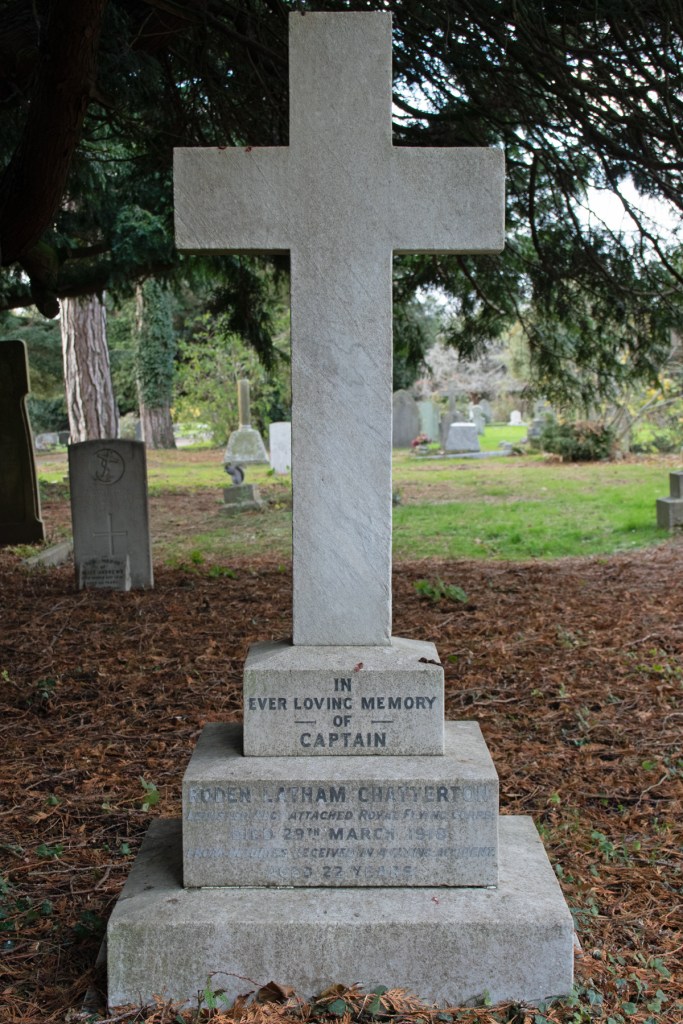
Roden Latham Chatterton was born on 13th July 1895, in Budin, Bengal, India. He was the only child to George and Ella Chatterton. George was a Lieutenant Colonel in the army, and had married Ella in India, where he was based.
The family had returned to England by the time of the 1911 census, but then moved permanently to Ireland. When war broke out, Roden joined up, enlisting in the 1st Battalion of the Leinster Regiment with the rank of Lieutenant. Full details of Roden’s military service are not available, but he arrived in France in January 1915 and, stayed there for the best part of two years.
In December 1917, the now Captain Chatterton transferred to the Royal Flying Corps. Based in Kent, he learnt to fly, and was close to gaining his wings, when an accident befell him in March 1918.
About 5:30pm on March 27th, [Captain Chatterton] was about 1.500 feet up, was trying to land near an aerodrome, and the wind was very rough. He shut off the engine and tried a left hand turn when the machine stalled and came down in a spin nose down and crashed to the ground. Several [people] went to his assistance. He was in great pain and made no remarks. He had been strapped in, but the belt had broken. The wind was from the south south-west. He came own into the wind and was trying to turn head into it when the machine got into a spin. It was not an ideal day for flying. Another machine… was flying with the deceased, and that landed all right. There was no collision in the air. When [he] turned he had not got the nose down far enough to keep up the engine speed and, in the witness’ opinion it was through an error of judgment on his part that the machine crashed. Had there been more space he would have got out of the spin. There was nothing wrong with the machine, but it was a type that was very difficult to handle in rough weather.
Whitstable Times and Herne Bay Herald: Saturday 6th April 1918
Captain Chatterton was taken to the Lees Court Military Hospital south of Faversham for treatment, but died of his injuries on 29th March 1918. He was 22 years of age.
Roden Latham Chatterton was laid to rest in a quiet corner of the Borough Cemetery in Faversham.
Walter James Stevens was born on 29th November 1899, the oldest of three children to James and Elizabeth. James was a labourer in the munitions factory in Faversham, Kent, and this is where Walter and his siblings were born and raised.
Initially attending the council schools, Walter won a scholarship to Wreight’s Grammar School, before gaining work as a clerk at the Shepherd Neame brewery in the town.
From the age of 11, Walter was also an active member of the local United Methodist Church. He was a keen organist, taught at the Sunday School, and played a key role in the Wesley Guild. He was also a sometime member of the St John’s Ambulance, undertaking duties at The Mount Hospital in the town.
When was broke out, Walter was keen to play his part. He enlisted in the Royal Naval Air Service, and was sent for training at their air base in Cranwell, Lincolnshire. While on a flight on 11th March 1918, Flight Officer Stevens’ aircraft crashed, and he was killed instantly. He was just 18 years of age.
Walter James Stevens’ body was brought back to Kent: he was laid to rest in the Faversham Borough Cemetery, not fat from his family home. At the funeral, Walter’s senior officers reported the promise he had shown, and that he was close to passing his probationary exams. Two weeks after his burial, a memorial service to him was given at the church to which he had dedicated so much of his young life.
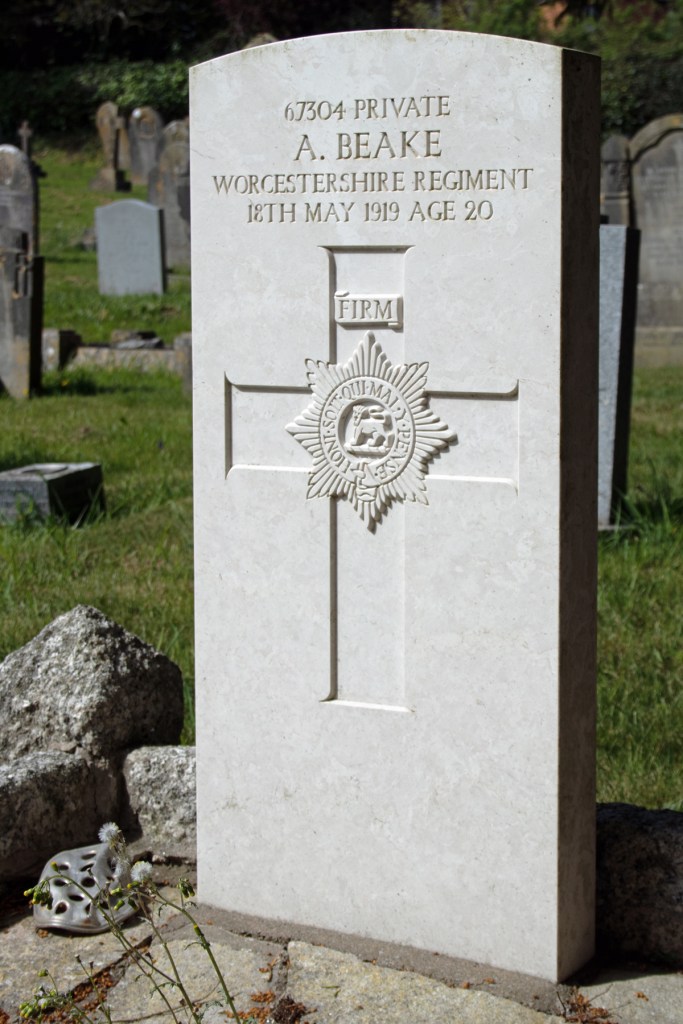
Alfred Beake was born in December 1898 and was one of nine children to Alfred and Charlotte Beake. Alfred Sr was a baker from Westonzoyland in Somerset, but it was in Chard that he and Charlotte had set up home and raised their family.
There is little documented about Alfred’s life. He played his part in the First World War, and had joined the Worcestershire Regiment by November 1918. His troop – the 5th (Reserve) Battalion – was a territorial force, and he would have split his time between Harwich, Essex, and Plymouth, Devon.
Private Beake survived the war and, by the spring of 1919 had been moved to Dublin. It was here on 18th May that he met with colleagues Private Simpson and Swindlehurst in the centre of the city. The trio caught a tram to the coastal town of Howth for a day out, where tragedy struck.
The Dublin Evening Telegraph reported on what happened next:
Private Sydney Simpson, Royal Engineers, stated… when they got to Howth, they walked along the Cliff Walk for about a mile, when they saw some seagulls down the cliff. [Beake and Swindlehurst] went out of witness’s sight for a while, when he heard a shout from Swindlehurst for help. On hurrying back, he saw Swindlehurst looking towards the sea, and he said the deceased had slipped down. The cliff was so steep that, although they tried to get down, they could not do so. Witness sent for help. None of the party had taken any drink.
Private Swindlehurst… said that he and deceased climbed down the grassy slope to get some seagulls’ eggs, but that the deceased suddenly slipped down. There was no horseplay going on at the time when the accident took place.
Captain Wynne, Royal Army Medical Corps, who made a post mortem examination, described the terrible injuries which the deceased had sustained. Death must have been instantaneous.
Dublin Evening Telegraph: Wednesday 21st May 1919
Private Beake had suffered a fractured skull from the fall. He was just 20 years of age.
Alfred Beake’s body was brought back to Somerset for burial. He was laid to rest in the family plot in Chard Cemetery.
Alfred’s oldest brother, Walter George Beake, had also served in the First World War.
Private Beake fought with the 7th Battalion of the Somerset Light Infantry, and was involved in some of the key skirmishes of the Somme. But it was at Ypres that he was buried alive during an attack, and the resulting shell shock left him totally incapacitated.
Walter was discharged from the army on medical grounds in September 1916. He returned home to try and piece his life together again. He never married, and passed away in December 1978, at the age of 87 years old.
Joseph William Soper was born at the start of 1876, the third of eleven children to John and Elizabeth Soper. Both of his parents had been born in Dorset but it was in the Devon town of Axminster that their children were raised. John was a labourer, but, when he finished school, Joseph found work as an ostler or groom.
John passed away at the end of 1894, just months after his youngest son, Arthur, was born. Joseph, by this point, had found work as a postman, and, in the spring of 1897, he married Charlotte Annie Lee in his home town. The couple moved across the border to Somerset and settled in Chard. They went on to have a son, Arthur, who was born in the summer of 1900.
Postal work seemed not to have suited Joseph, and he made the move to labouring for a mason. Money appears to have been tight: the 1911 census recorded Charlotte working as a charwoman, while her younger brother, Herbert, was also lodging with them, and working as a grocer’s porter.
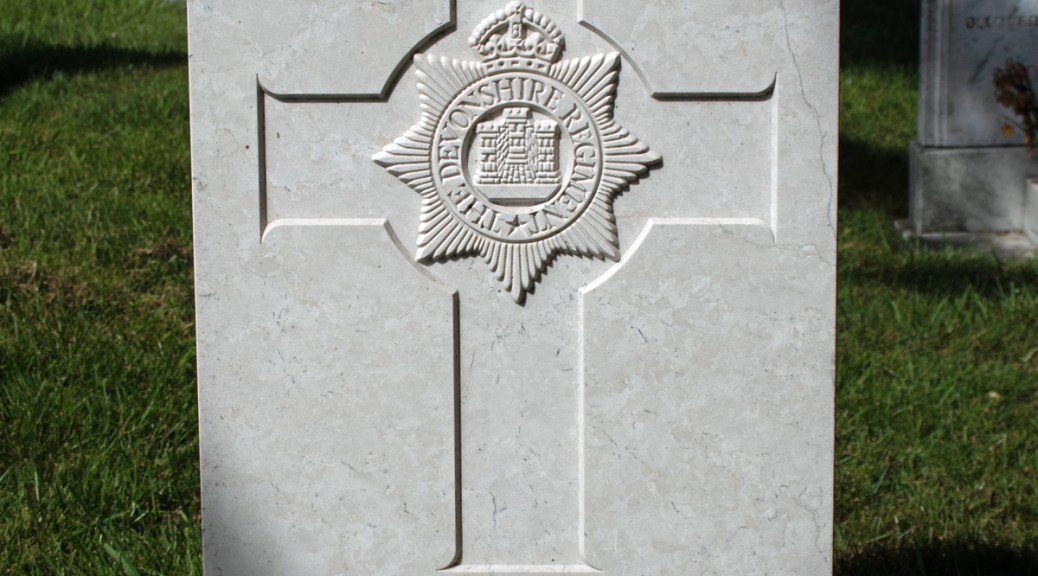
War was coming to Europe, but much of Joseph’s military career is a mystery. He had joined up by the autumn of 1916, and was assigned to the 13th (Works) Battalion of the Devonshire Regiment. He was based in Saltash and Plymouth, and served as part of the territorial force.
The only other documents available are Private Soper’s pension ledger and his entry on the Register of Soldier’s Effects. Both confirm that he died on 12th April 1917, and that the cause was “accidental injury received on active service“. Sadly, there is no further information about this. He was 41 years of age when he passed.
Joseph William Soper’s body was brought back to Somerset for burial. He lies at rest in Chard Cemetery, walking distance from where his widow and son still lived.
Arthur William Young was born on 11th July 1900, in the Gloucestershire village of Charfield. His parents, James and Eliza, were both born in the area, and this is where they raised their nine children.
James worked as a bone turner and sawyer, working the material for things like buttons. This was a family trade, and something that Arthur followed his father and older siblings into when he finished school.
By this point, storm clouds were brewing over Europe. Arthur was too young to enlist when war first broke out, but when his older brother Francis died in Northern France in December 1917, this seemed to have driven him to play his part as well.
Arthur enlisted in the Royal Marine Artillery on 1st July 1918, a couple of weeks before his eighteenth birthday. Assigned the rank of Private, his records show that he was 5ft 9ins (1.65m) tall, had blue eyes, brown hair and a fresh complexion. It was also noted that he had a scar on his right wrist and another on his forehead.
After nine months’ service, Arthur was promoted to Gunner and, by the autumn of 1919, he was assigned to the dreadnought HMS Queen Elizabeth.
On 1st December 1920, while moored in Portland Harbour, Dorset, a concert was held on HMS Warspite. Gunner Young attended, but on the trip back to his own ship, the boat he was on collided with another, and he and three others were knocked overboard and drowned. He was just 20 years of age.
Arthur William Young was brought back to Gloucestershire for burial. He was laid to rest in the family plot in the Congregational Chapelyard in his home village of Charfield.
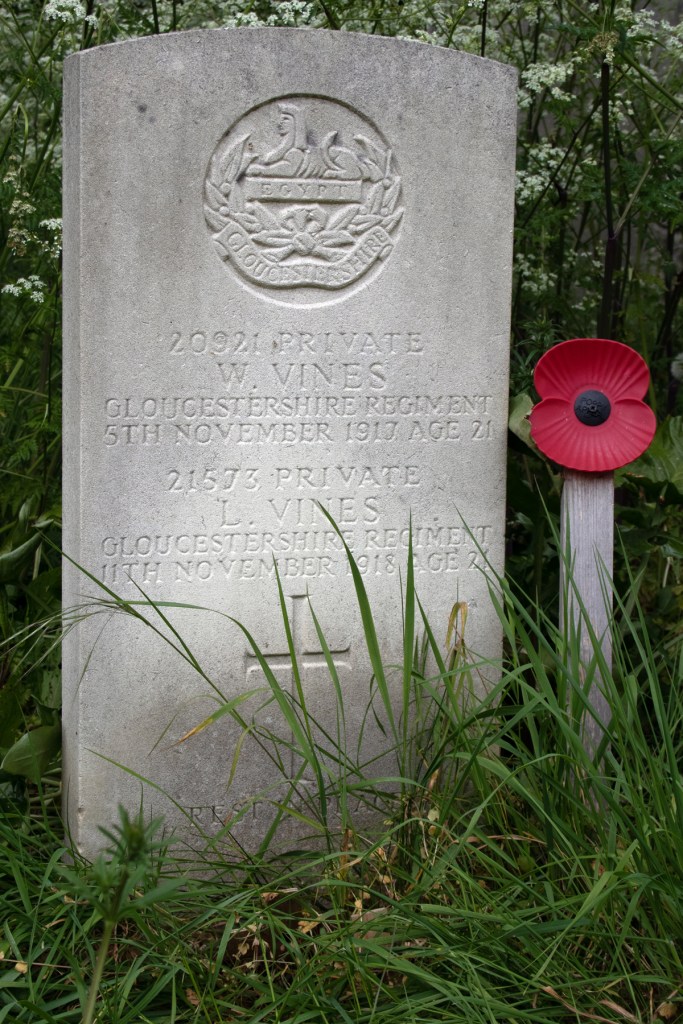
Wilfred Vines was born on 19th March 1897 and was one of seventeen children to John and Emma Vines. John was an elastic web maker or braider from Stroud, Gloucestershire, and it was in nearby Wotton-under-Edge that he and Emma raised their growing family.
Braiding and weaving ran in the family: the 1911 census recorded six of the Vines’ children who were over school age were employed in the local mill. This included Wilfred, who was working as a bobbin collector.
War came to Europe, and Wilfred was keen to play his part. He enlisted on 25th May 1915, joining the 15th Battalion of the Gloucestershire Regiment as a Private. His records show that he stood just 5ft 2ins (1.57m) tall.
Private Vines was sent for training to the camp at Chiseldon, Wiltshire. It seems that, while he was there, he was injured and, although full details are not available, his wounds were serious enough for him to be discharged from the army because of them. He was formally released on 30th May 1916, and returned home to recover and recuperate.
At this point, Wilfred’s trail goes cold. All that is recorded is that, on 5th November 1917, he passed away at home from his injuries. He was just 20 years of age.
Wilfred was laid to rest in the graveyard of St Mary the Virgin Church in his home town. He shares his grave with his younger brother, Leslie, who died the following year.
William Cecil Rowell was born on 29th November 1892 in Wolborough, Newton Abbot, Devon. He was the youngest of three children to architectural surveyor Spencer Rowell and his wife, Annie.
The 1911 census recorded that William had left the family home to study to be a civil servant, and was boarding with a family in Fulham, London. His studies complete, he was driven by a need to serve his country and, on 22nd January 1913, aged just 20 years old, he enlisted in the Loyal North Lancashire Regiment.
Full details of his service are not available, but it is clear that he was committed to his purpose. He was promoted to Second Lieutenant soon after enlisting, rose to full Lieutenant in November 1914, and Captain a year later. It’s not possible to pinpoint where he served, he was wounded twice and, after his second recovery, he made a transfer to the Royal Flying Corps (later moving to the new Royal Air Force when it was founded in 1918).
Captain Rowell was based at Bekesbourne Airfield in Kent. He qualified as a pilot with 50 Squadron in October 1918, but was injured when, on the 12th November, his Sopwith Camel collided with the hanger. William was admitted to the Military Hospital in nearby Canterbury, but the injuries to his leg proved too severe for it to be saved, and he underwent an amputation in January 1919.
Tragically, while the initial prognosis was good, within a few weeks sepsis set in; Captain Rowell passed away on 22nd May 1919, aged just 26 years old.
William Cecil Rowell’s body was brought back to Devon for burial. He was laid to rest in the family plot in the graveyard of St Mary’s Church in Wolborough.











 Death and Service