Category Archives: killed in action

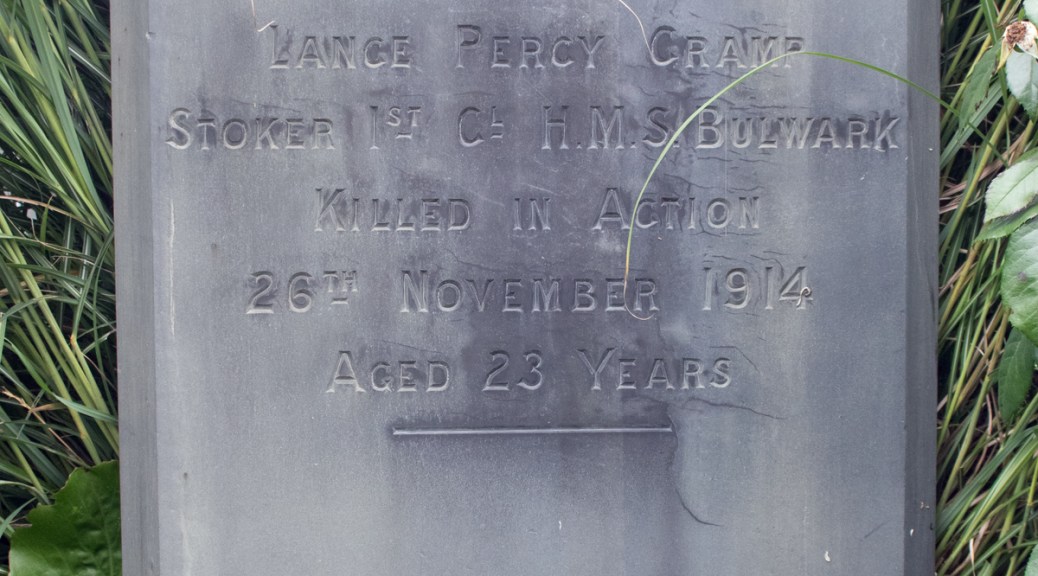
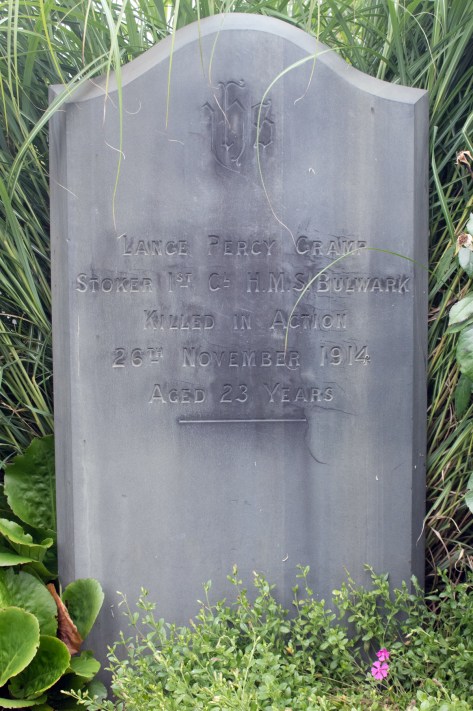
Stoker 1st Class Lancelot Cramp

Stoker 1st Class Lance Cramp

Lancelot Percival Cramp was born in the Kent village of Sutton on 7th June 1891. The youngest of five children, his parents were bootmaker Alfred Cramp and his wife Elizabeth.

Lancelot – who preferred to be called Lance – seems to have had a disjointed childhood. Neither of his parents are recorded in the 1901 census, while he is noted as living with his widowed aunt, also called Elizabeth, in Ticehurst, Kent.

By the time he completed his schooling, Lance found work as a tinsmith. However, he sought a bigger and better career and, on 30th April 1910, he enlisted in the Royal Navy. Assigned the role of Stoker 2nd Class, his papers note that he was 5ft 3ins (1.6m) tall, with auburn hair, grey eyes and a fresh complexion.

Stoker Cramp was sent to HMS Victory, the Royal Naval Dockyard in Chatham, Kent, for his training. He was then sent to the battleship HMS Renown for his first assignment.

Over the next four years, Lance would serve on seven ships in total, returning to Portsmouth in between assignments. His service record notes a very good character and satisfactory ability and, in September 1911, he was promoted to Stoker 1st Class.

On 8 February 1914, Lance was given a new posting aboard the battleship HMS Bulwark. When war broke out, she was assigned to the Channel Fleet, which had the responsibility for patrolling and protecting Britain’s southern coastline.

On the morning of 26 November 1914, Bulwark lay anchored in the River Medway near Sheerness while taking on shells and ammunition. During the process, improperly stored cordite charges overheated and ignited nearby munitions. The massive explosion that followed tore the ship apart, killing more than 740 members of the crew. Stoker Lance Cramp was amongst those who died: he was 23 years of age.

Those who were killed in the explosion were buried in the naval section of Woodlands Cemetery, Gillingham, Kent. The body of Lancelot Percival Cramp was identified, and laid to rest in a marked grave.
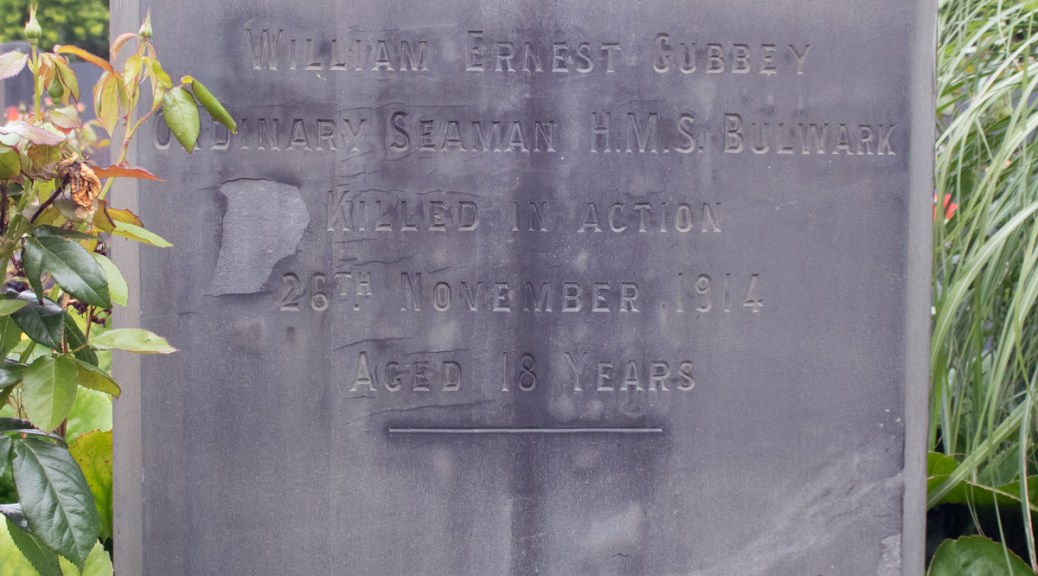
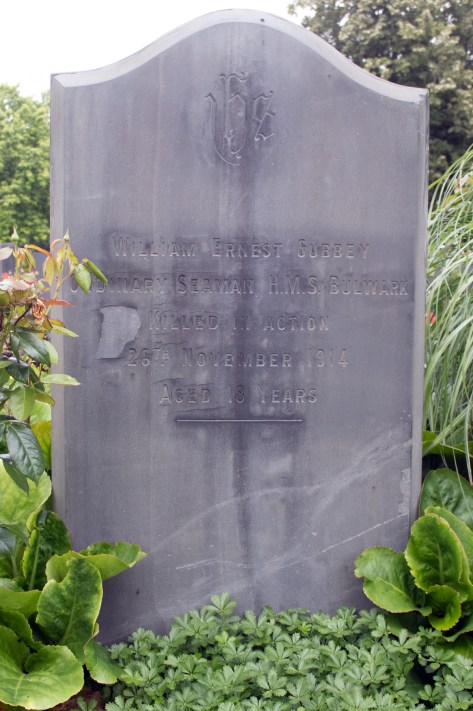
Ordinary Seaman William Gubbey

Ordinary Seaman William Gubbey

William Ernest Gubbey was born on 21st February 1896 in Portsmouth, Hampshire. He was the only child to William and Alice Gubbey. William Sr was a Petty Officer in the Coastguard, and the family travelled to where he was needed. The 1901 census found them in Malinmore, County Donegal, while ten years later, they were living in Tara, County Down.

It seemed natural for William Jr to follow in his father’s footsteps and, on 3rd August 1912, he joined the Royal Navy. He was too young to formally enlist, and was given the rank of Boy 2nd Class. Sent to HMS Impregnable, the school ship based in Devonport, she would remain his home for the next ten months while he was trained.

William was promoted to Boy 1st Class on 17th June 1913, and was assigned to the cruiser HMS Gibraltar the following day. After six months on board, and a short stopover at HMS Victory, the Royal Naval Dockyard in Portsmouth, Hampshire, he received his next posting, the battleship HMS Bulwark.

Boy Gubbey would spend the next year attached to Bulwark and, during this time, he came of age. Now formally inducted into the navy as an Ordinary Seaman, his service papers show the young man he had become. He was recorded as being 5ft 5.5ins (1.66m) tall, with brown hair, blue eyes and a dark complexion.

When was was declared in the summer of 1914, Bulwark was assigned to the Channel Fleet, patrolling and defending Britain’s southern coast. On 26th November 1914, she was moored in the River Medway, close to Sheerness, Kent, being reloaded with ammunition.

Some of the new cargo overheated and the resulting explosion ripped through the battleship. More than 740 crew were killed, including Ordinary Seaman Gubbey: he was just 18 years of age.

The bodes of the dead were laid to rest in Woodlands Cemetery, Gillingham, Kent. As his had been identified, William Ernest Gubbey was laid to rest in a marked grave.

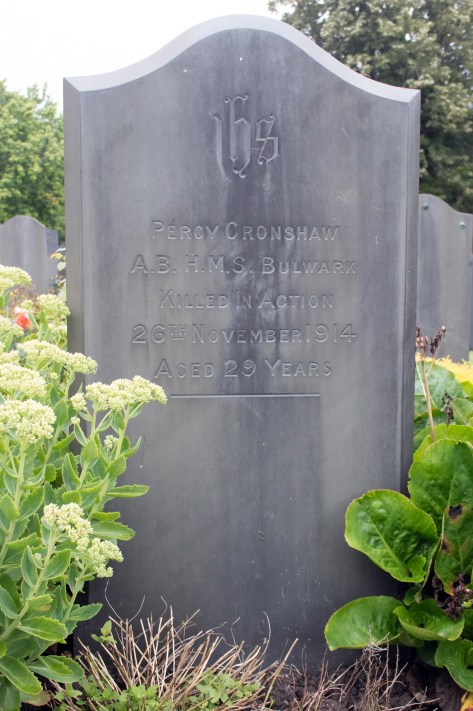
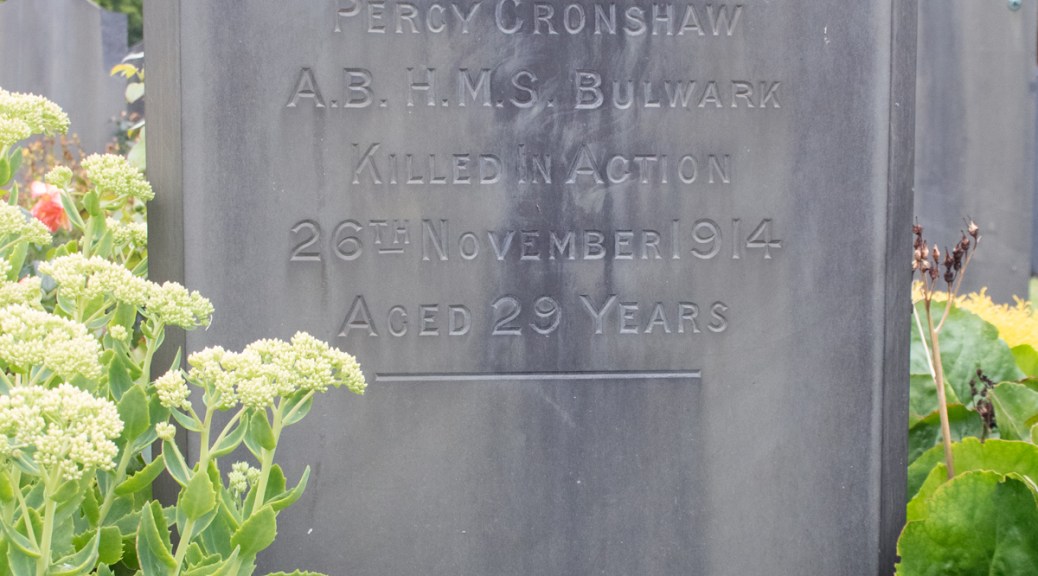
Able Seaman Percy Cronshaw

Able Seaman Percy Cronshaw

Percy Cronshaw was born in Ashton-under-Lyne, Lancashire, on 10th January 1885. The second of five children, he was the oldest son to Thomas and Alice Cronshaw. Thomas was a loom overseer in a local mill, and when Percy completed his schooling, he found work as a calico weaver. Alice had died by the time of the 1901 census, and the family has moved to a cottage on Loxham Street in Bolton.

Percy wanted a better life for himself and, on 12th February 1902, he joined in the Royal Navy. Too young to fully enlist, he was given the rank of Boy 2nd Class, and sent to HMS Northampton for his training. Over the next year he learnt the tools of his trade, rising to Boy 1st Class after just three months.

By the time of Percy’s eighteenth birthday, he had had three further postings: the shore bases HMS Calliope in Gateshead and HMS Victory in Portsmouth; and the cruiser HMS Good Hope. It was with her that he came of age, and was in a position to formally enlist in the Royal Navy.

The now Ordinary Seaman Cronshaw’s papers show the man he had become. He was 5ft 4.5ins (1.64m) tall, with auburn hair, black eyes and a fresh complexion. He was also noted as having moles on the right side of his face and neck, and two tattoos: his initials on his right forearm, and an anchor on his left.

Percy remained aboard HMS Good Hope until the spring of 1905. By this point, he had been promoted, taking the rank of Able Seaman. With his promotion came more training, and he spent the next year split between HMS Victory and HMS Excellent, another shore base in Portsmouth. His annual reviews noted a very good character and an ability to match.

Over the next seven years, Able Seaman Cronshaw would go on to serve on two further ships – HMS Venus and HMS Superb. In between voyages he returned to Portsmouth, with HMS Excellent becoming his home port. This land base offered some continuity, and the unexpected bonus of romance. On 28th January 1912, Percy married Frances Stubbington, a shoemaker’s daughter from the city: the couple would go on to have a child, Violet, who was born later that year.

By this point, Percy had been given a new posting, on board the battleship HMS Bulwark. When war was declared, she became a part of the Channel Fleet, tasked with patrolling and defending Britain’s southern coast.

On 26th November 1914, Bulwark was moored in the River Medway, close to Sheerness, and was being stocked with shells and ammunition. That morning, some poorly stowed charges overheated, detonating the shells stored nearby. The resulting explosion ripped through the battleship, and more than 740 crew were killed. Able Seaman Cronshaw was among those to be recovered: he was 29 years of age.

Percy Cronshaw’s body as laid to rest alongside his colleagues in Woodlands Cemetery, Gillingham, Kent. As his body had been identified, he was able to be buried in a marked grave.


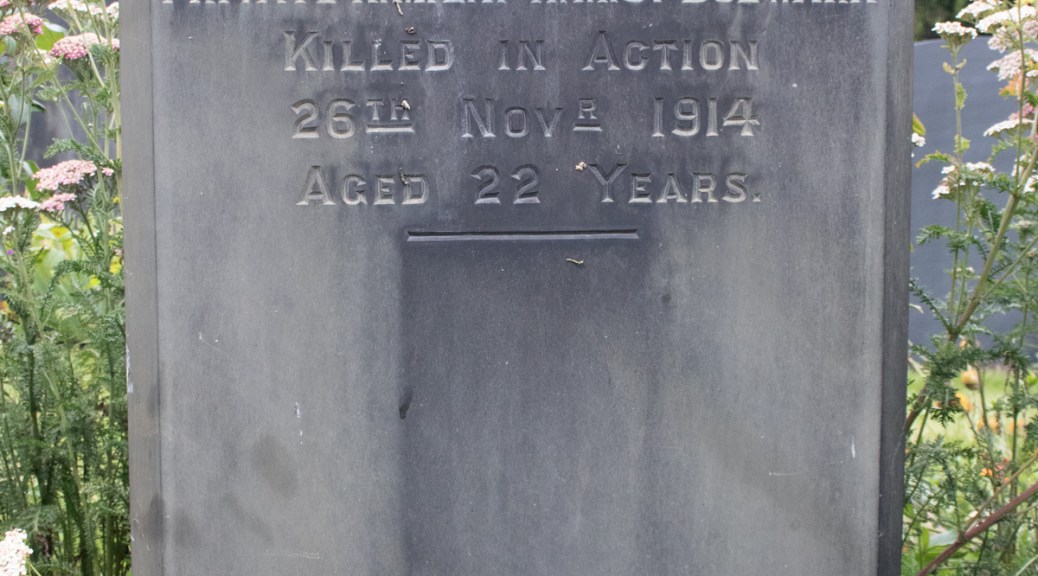
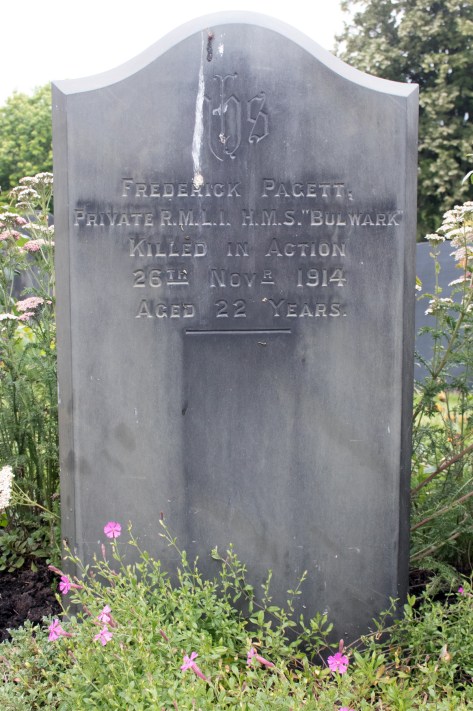
Private Frederick Pagett

Private Frederick Pagett

Frederick Pagett was born in the Worcestershire village of Hanley Castle on 27th July 1892. The seventh of eight children, he was the youngest son to Samuel and Ann Pagett.

Samuel was a policeman, but when he completed his schooling, Frederick found work as a miner. This seemed not to suit him, however, and, on 20th December 1910, he enlisted in the Royal Marine Light Infantry.

Private Pagett’s service records show that he was 5ft 4.5ins tall, and that he had brown hair, blue eyes and a fresh complexion. He had two small scars on his upper lip, and was noted as being able to swim.

Frederick was sent to Deal in Kent for his training. Over the next couple of years, he learnt his trade, and would serve in the Hampshire towns of Gosport and Portsmouth. His papers noted a very good character.

On 12th June 1912, Private Pagett was assigned to the battleship HMS Bulwark. He would remain part of her crew for the next couple of years.

On the 26th November 1914, when Bulwark was moored close to Sheerness, Kent, an explosion ripped through the ship, sinking it and killing more than 740 people. Frederick was on board at the time, and was amongst those to be killed: he just was 22 years of age.

The body of Frederick Pagett was laid to rest in a marked grave in the naval section of Woodlands Cemetery, Gillingham, Kent.


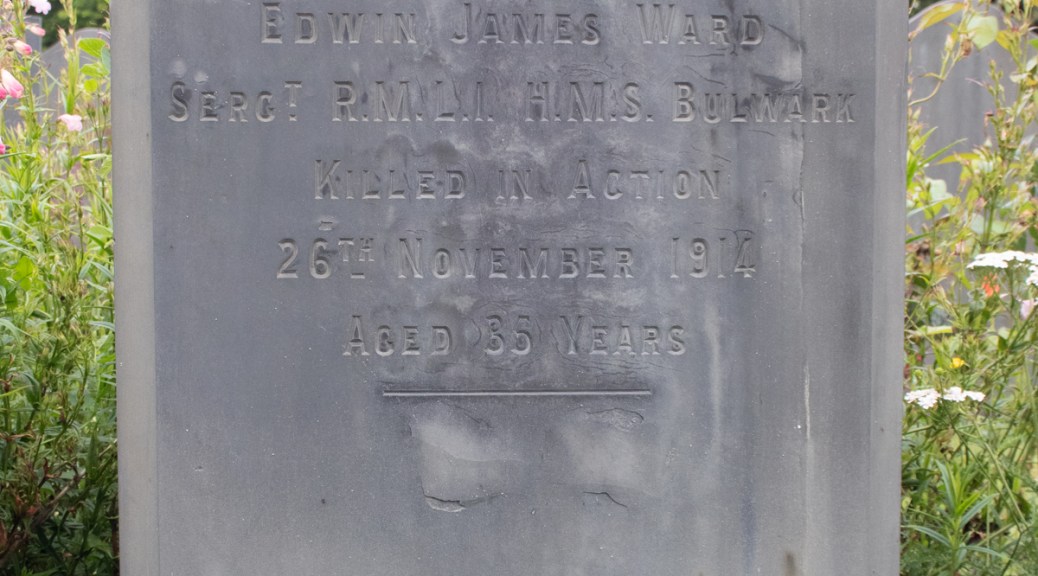
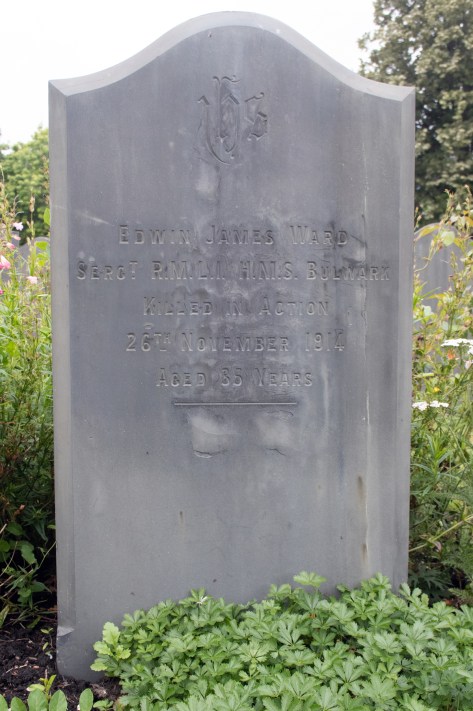
Sergeant Edwin Ward

Sergeant Edwin Ward

Edwin James Ward was born at the start on 3rd December 1879 in London. The oldest of four children, his parents were William and Emma Ward. William, who was a printer, had also been born in London, and the family lived initially in rooms on Trafalgar Street, Walworth, then Hardaker Street in Shoreditch.

There are tantalising gaps in Edwin’s life, and it is a challenge to piece together what happened to him after the 1891 census. He disappears from the records for nearly two decades, and is it likely that he had enlisted in the Royal Marine Light Infantry, and spent time overseas.

On 21st August 1908, Edwin married a woman called Kate. There is no further information available about her, although the couple went on to have a daughter, Kitty, who was born in Portsmouth on 13th November 1911.

Edwin’s trail goes cold again at this point. He appears to have risen through the ranks with the Royal Marines and, by the summer of 1914, was a Sergeant. He was assigned to the battleship HMS Bulwark, and was on board on the 26th November 1914, when she was moored close to Sheerness, Kent. That morning, an explosion ripped through the ship, sinking it and killing more than 740 people. Sergeant Ward was amongst them: he was 34 years of age.

The body of Edwin James Ward was laid to rest in a marked grave in the naval section of Woodlands Cemetery, Gillingham, Kent.


Corporal Frederick James

Frederick John James was born in Willesden, Middlesex, in the spring of 1890. The oldest of six children, his parents were William and Louisa James. Louisa was William’s second wife, his first, Emily, having died in 1887. Frederick had ten half-siblings from this first marriage.

William was a fishmonger: the 1891 census recorded the family at 159 York Road, Battersea, Surrey. Ten years later, they had moved over the river, and were living to 46 Artizans Dwellings, Hammersmith, Middlesex.

Frederick’s father had passed away by the time of the 1911 census. The document recorded his mother residing at 18 Western Terrace, Notting Hill, Middlesex. She lived with three of her children – Ben, Alice and Grace – and was doing char work to bring in a little money.

Frederick, however, was already carving out a career in the army for himself. The same census recorded him as one of 250 troops billeted in Fyzabad, India, where he was a Private in the 2nf Battalion of the East Yorkshire Regiment.

Private James’ military career lacks some detail, and can only be picked up around the time of his passing. By this point, he had switched regiments, and was a Corporal in the 8th (Service) Battalion of the Somerset Light Infantry. He is also noted as being married to a woman called Frances Esther New: the couple had married in 1913, although there is no other information about her.

In the summer of 1917, Corporal James’ unit was caught up in the fighting at Passchendaele. Frederick was initially reported missing, but was later declared as being killed in action on 4th October 1917. He was 27 years of age.

The body of Frederick John James was laid to rest in the Zandvoorde British Cemetery, Ypres.


Frederick was my great great grand-uncle.

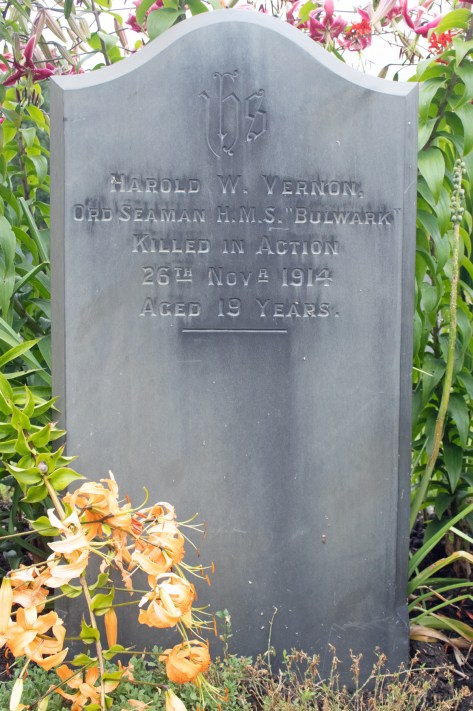
Ordinary Seaman Harold Vernon

Ordinary Seaman Harold Vernon

Harold William Vernon was born on 23rd March 1896. The older of two children, his parents were John and Julia Smith. Harold’s early life is a bit of a mystery: the 1901 census found him living with mother, who was running their newsagent and tobacconist on Wilberforce Road, in their home town of Leicester, Leicestershire. John is absent from the census, and Julia died in 1908. On the following census return, taken in 1911, all of the remaining members of the Vernon family are noticeable only by their absence.

In January 1913, Harold joined the Royal Navy. He had been working as a turner by this point, but a life on the oceans seemed too good an adventure to pass up. Und the age to formally enlist, he was given the rank of Boy 2nd Class, and sent to HMS Vivid, the Royal Naval Dockyard, for his training.

Boy Vernon must have shown promise, because he was promoted to Boy 1st Class just four months after enlisting. He was assigned to the battleship HMS Prince of Wales in May 1913, and transferred to HMS Bulwark, another battleship, that autumn. In March 1914, Harold came of age, and was formally inducted into the Royal Navy. His service papers show that he was 5ft 3ins (1.6m) tall, with light brown hair, brown eyes and a fresh complexion. He was also recorded as having a scar on the middle of his right arm, a large mole above his navel and two further moles on either side of his neck.

When war broke out, Bulwark was assigned to the Channel Fleet, whose task was to protect Britain’s southern shores. On 26th November 1914, she was moored in the River Medway, close to Sheerness, and was being reloaded with ammunition. Deep in the ship’s stores, a number of the charges overheated and detonated, causing a chain reaction in the bowels of the battleship. The resulting explosion ripped through the battleship, and more than 740 crew were killed. Ordinary Seaman Vernon amongst them: he was just 18 years of age.

A mass funeral was held in the Woodlands Cemetery, Gillingham, Kent, not far from the dockyard in Chatham. Harold William Vernon was laid to rest in a marked grave, a burial not afforded to the those unfortunate individuals whose bodies had not been identified.


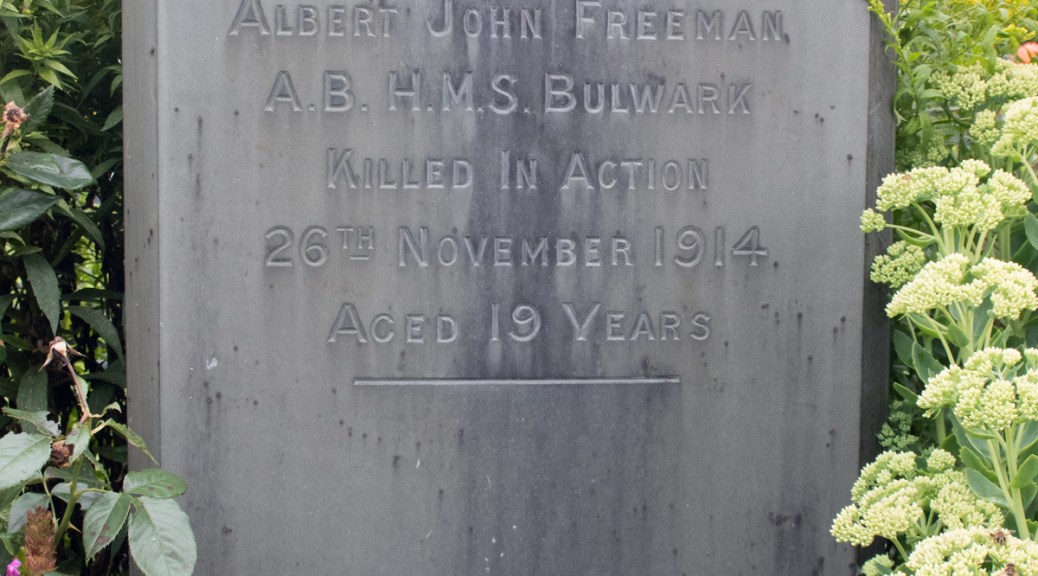
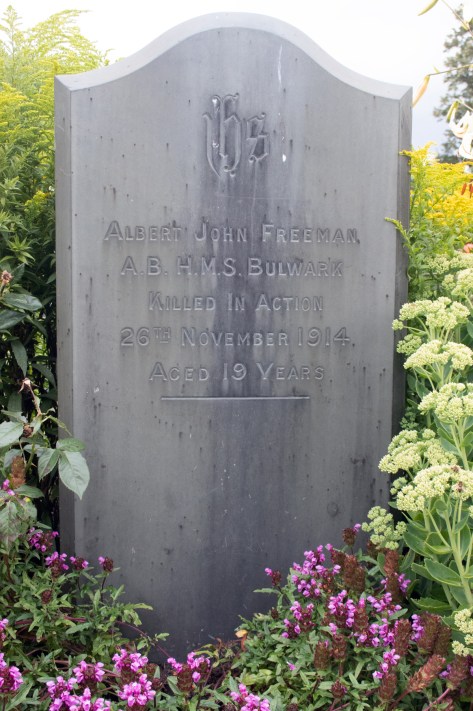
Able Seaman Albert Freeman

Able Seaman Albert Freeman

Albert John Freeman was born on 11th November 1895 in the Sussex town of Chichester. The twelfth of thirteen children, his parents were bricklayer Richard Freeman and his wife, Fanny.

When Albert finished his schooling, he found work as a barber’s assistant, but, having seen his older brother William make a career at sea, he decided to follow suit. He joined the Royal Navy on 27th January 1913, and, being underage, he was taken on with the rank of Boy 2nd Class.

Albert was sent to HMS Vivid, the navy dockyard in Devonport, Devon, for his training. He was obviously a quick study, and was promoted to Boy 1st Class just four months later. With the rise in rank came a posting, on board the battleship HMS Prince of Wales. He remained aboard for just five months, before being reassigned to another battleship, HMS Bulwark.

Boy Freeman would spend the next year assigned to Bulwark and, during this time, he came of age. Now formally inducted into the Royal Navy, his service papers show that he was 5ft 5ins (1.65m) tall, with brown hair, grey eyes and a sallow complexion. He was also noted as having a small burn scar on the back of his neck.

The now Ordinary Seaman Freeman’s naval career was beginning to take off, although his reviews were not so promising, noting a very good character and a satisfactory ability. Despite this, Albert gained a further promotion, to Able Seaman, on 15th October 1914.

Bulwark was a part of the Channel Fleet, whose task was to protect Britain’s southern shores. On 26th November 1914, she was moored in the River Medway, close to Sheerness, while she was being reloaded with ammunition. Some of the explosives overheated, causing a chain reaction in the stores. The resulting explosion ripped through the battleship, and more than 740 crew were killed. Able Seaman Freeman’s was one of those bodies to be recovered: he was just 19 years of age.

Those who were killed in the explosion were laid to rest during a mass funeral in Woodlands Cemetery, Gillingham, Kent. As his body had been identified, Albert John Freeman was laid to rest in a marked grave.

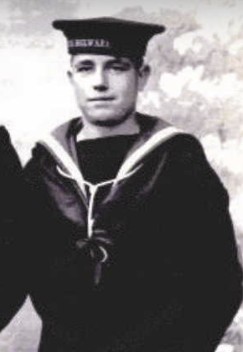
Able Seaman Albert Freeman
(from ancestry.co.uk)

Albert’s brother, William, also made a career for himself, rising to the rank of Able Seaman a year before his sibling. During the First World War he was assigned to the cruiser HMS Hampshire, and was killed when an explosion caused her to sink off the Orkney Islands on 5th June 1916.

Able Seaman William Freeman
(from ancestry.co.uk)

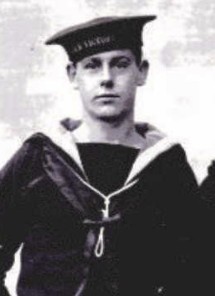
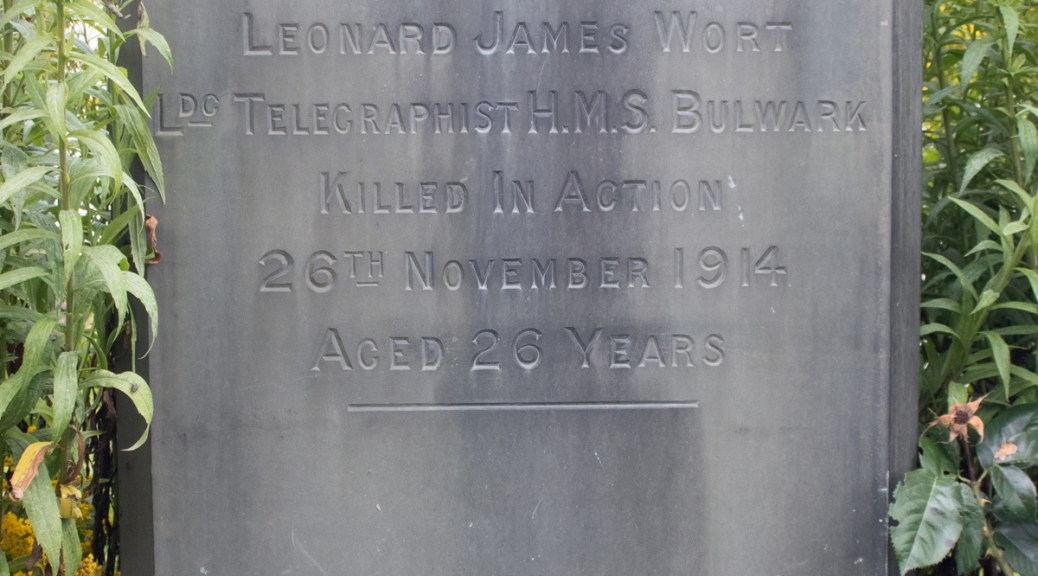
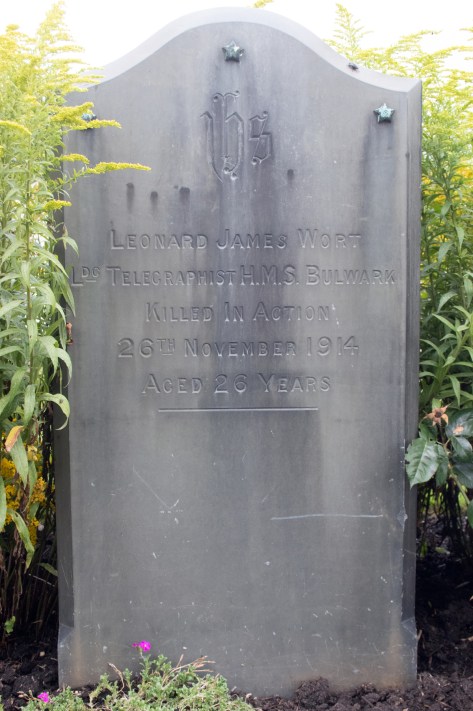
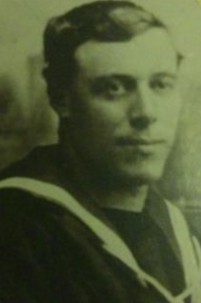
Leading Telegraphist Leonard Wort

Leading Telegraphist Leonard Wort

Leonard James Wort was born in the Wiltshire village of Woodfalls, on 28th September 1888. He was the second of eleven children – and the oldest son – to James and Annie Wort.

James was a sawyer, but Leonard sought a better life for himself. Initially finding work as a blacksmith’s mate when he completed his schooling, but took up a career in the Royal Navy at the start of 1907. Employed as a Stoker 2nd Class, documents show that he was 5ft 6.5ins (1.69m) tall, and that he had brown hair, hazel eyes and a fresh complexion. He was also noted as having scars on the thumb and finger of his left hand.

Leonard was sent to the training ship HMS Nelson for his initial induction. He remained there for four months, before being given his first sea-faring appointment, on board the cruiser HMS Spartiate. Over the next seven years, he would serve on nine ships in total, but his service took an unexpected route.

In February 1908, Leonard was promoted to Stoker 1st Class, and the next expected progression would have been to Leading Stoker. However, year later, while serving on HMS Hindustan, he took a different route, and became a Telegraphist. He appears to have enjoyed this role, and been more than capable of carrying it out: his annual reviews noted his superior ability on more than one occasion.

Over the next few years, Leonard spent time at HMS Victory – the Royal Naval Dockyard in Portsmouth, Hampshire – presumably to receive the training needed to undertake his role. At the start of 1911, he was promoted again, taking the rank of Leading Telegraphist.

Away from the sea, love was blossoming. Leonard had met Florence Bysouth, a casemaker’s daughter from Bankway, Hertfordshire. The couple exchanged their vows in Bromley, Kent, but had set up home in Poplar, East London.

In November 1912, Leading Telegraphist Wort was assigned to the pre-dreadnaught battleship HMS Bulwark. Part of the Channel Fleet, she was tasked with patrolling the southern coasts of Britain. On 26th November 1914, Bulwark was moored in the River Medway, close to Sheerness, and was being stocked with shells and ammunition. That morning, some of the cordite charges overheated, detonating the shells stored nearby. The resulting explosion ripped through the battleship, and more than 740 crew were killed. The body of Leading Telegraphist Wort was recovered: he was 26 years of age.

Those who were killed in the explosion were laid to rest during a mass funeral in Woodlands Cemetery, Gillingham, Kent. As his body had been identified, Leonard James Wort was laid to rest in a marked grave.

Leading Telegraphist Leonard Wort (from findagrave.com)

Leonard was not the only one of the Wort sons to sacrifice his life during the First World War. His younger brother, Alfred, also enlisted in the Royal Navy, giving up his role as footman and valet to serve as an Officer’s Steward.

Alfred’s service records show that he was attached to HMS Vivid – the Royal Naval Dockyard in Devonport – when, on 4th April 1918, he drowned. He was 26 years of age, and left a widow and son.


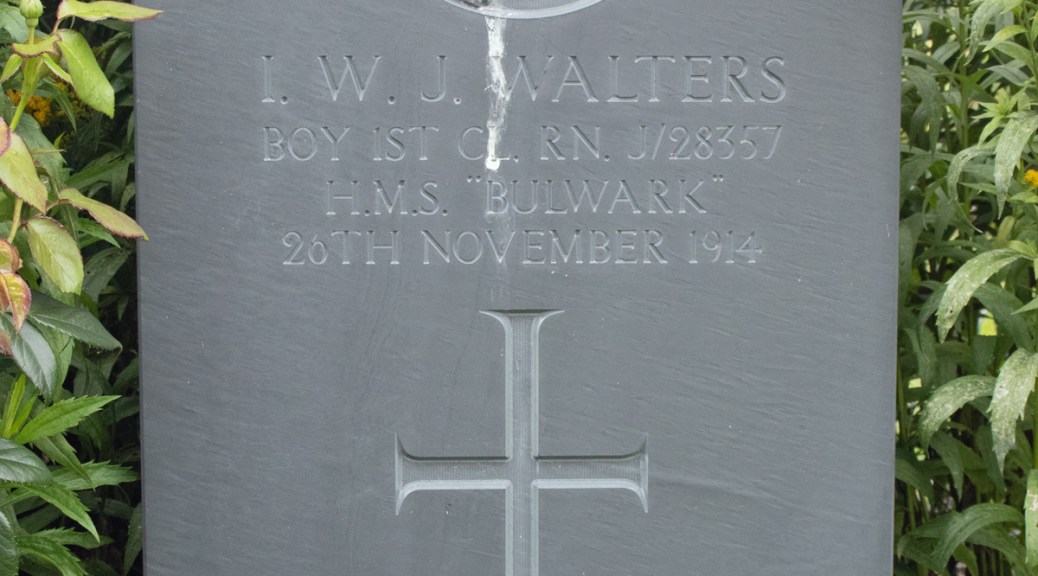
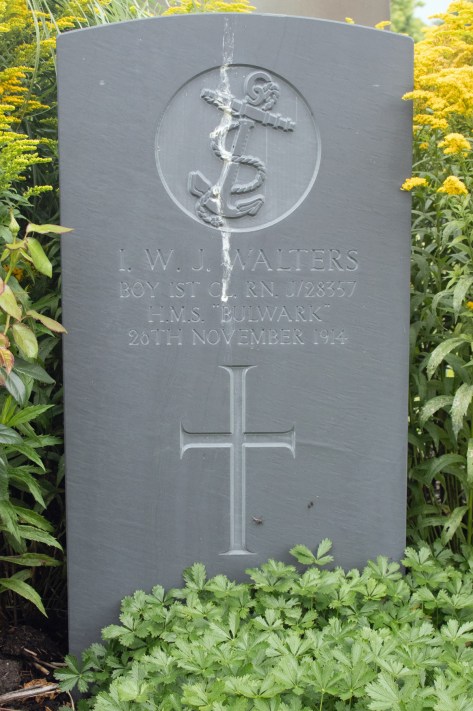
Boy 1st Class William Walters

Boy 1st Class William Walters

William John Walters was born in Portsmouth, Hampshire, on 9th July 1898. The fifth of nine children, his parents were Charles and Sarah Walters. Charles was a licensed boatman, and, for William’s short life, the family lived on Grange Street, Portsea.

Young William found work as a shop boy when he finished school, but he was drawn to the sea like his father and, on 22nd November 1913, he joined the Royal Navy. Too young to full enlist, he was given the rank of Boy 2nd Class and sent to HMS Impregnable, the navy’s school ship in Devonport, Devon.

Boy Walters’ service records show that he was 5ft 3.5ins (1.61m) tall, with brown hair, brown eyes and a dark complexion. He was also noted as having tattoos on both of his forearms.

By the summer of 1914, William has been promoted to Boy 1st Class. He returned to Hampshire, and was based at HMS Victory, the Royal Naval Dockyard in Portsmouth. This was just a staging post, however, as, on 26th August, he was assigned to the pre-dreadnaught battleship HMS Bulwark.

Part of the Channel Fleet, Bulwark was tasked with patrolling and defending Britain’s southern coast. On 26th November 1914, Bulwark was moored in the River Medway, close to Sheerness, and was being stocked with shells and ammunition. That morning, some poorly stowed cordite charges overheated, detonating the shells stored nearby. The resulting explosion ripped through the battleship, and more than 740 crew were killed. The body of Boy 1st Class Walters was among those to be recovered: he was 16 years of age.

Those who were killed in the explosion were laid to rest in the naval section of Woodlands Cemetery, Gillingham, Kent. As his body had been identified, William John Walters was laid to rest in a marked grave.
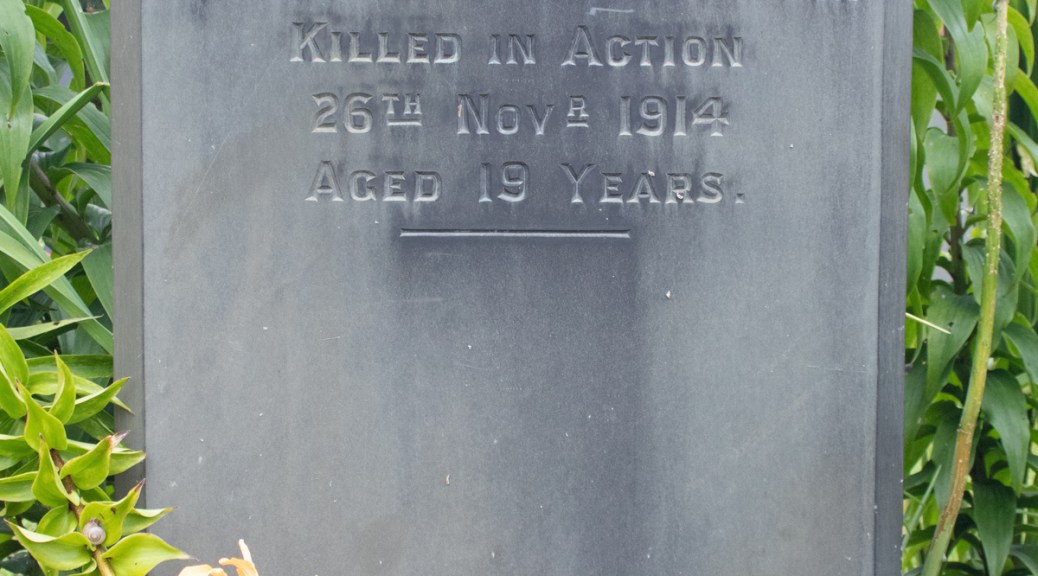

William’s headstone gives his name as IWJ Walters. There are no records to suggest that his forenames were anything other than William John, however.


William’s mother Sarah died around the same time as him. It is unclear whether she passed knowing her son had lost his life or not.