Henry William Brewer was born the spring of 1869 in Bitton, Gloucestershire. His is a common name for the area, and so it is not easy to unpick details of his early life.
On 5th May 1895, Henry married Ann Williams, a carter’s daughter from Keynsham, Somerset. The couple wed in St Thomas’ Church in Widcome, near Bath, and their marriage certificate gives Henry’s trade as a labourer, and his father as Louis Brewer.
The young couple up home in Kingswood, near Bristol, and went on to have three children, Henry, Lucy and Ethel. The 1901 census recorded Henry’s trade as a coal miner and hewer, but noted that he was also a Gunner in the Royal Artillery.
Sadly, Henry’s military records are lost to time, but if he was employed in the army, this would account for the lack of documents relating to his early life. It may be that he had completed his initial term of service by the time he and Ann married, or that he was a volunteer with the Royal Artillery at the time of the census.
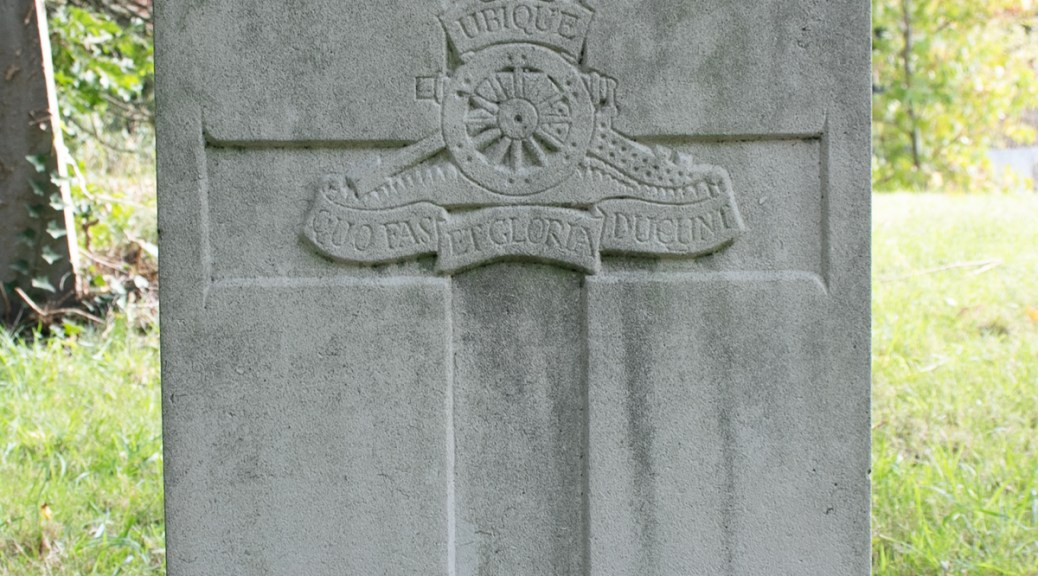
Whatever his connection with the army, when war broke out he was called into service. He joined the 30th Company of the Royal Garrison Artillery, and was based in Weymouth, Dorset, as part of Britain’s South Coast defences.
Without military documents, it’s challenging to identify Gunner Brewer’s trail during the war. Sadly, the next documents relate to his passing. He was admitted to a military hospital in Weymouth, suffering from the kidney condition nephritis. This was ultimately to kill him, and he passed away on 28th February 1917, at the age of 48 years old.
Henty William Brewer’s body was brought back to Gloucestershire for burial. He was laid to rest in the graveyard of St Mary’s Church in Bitton.
Alexander Popham Spurway was born on 8th April 1891 in Newbury, Berkshire. He was the second of six children to Edward and Gertrude Spurway. Edward was a clergyman, and the family moved to Heathfield in Somerset when Alexander was a small boy. Education was key to Edward and, the 1901 census records show Alexander as being a boarder at the Portmore School in Weymouth, Dorset.
Reverend Spurway set the family up well in Heathfield: by the time of the next census in 1911, the family were living in the village rectory, with five members of staff.
Alexander, meanwhile, had taken a different route, entering the Royal Naval College at Osborne on the Isle of Wight in January 1904. He was a keen sportsman and, while there, he represented the college at both cricket and football.
In September 1908, he passed out from the college as a Midshipman, and served on HMS Canopus in the Mediterranean. His career continued, and he was made Sub-Lieutenant in December 1911, and Lieutenant two years later.
Reverend Spurway died at home in February 1914 and, by the time war broke out, Lieutenant Spurway was assigned to HMS Achilles. He remained on board the cruiser for the next two years and it was during this time that he developed diabetes: something that was to prove an ongoing issue for him.
Returning home in the autumn of 1915, the condition was to prove too much, and he passed away on 29th November 1915, at the age of 24 years old.
Alexander Popham Spurway was laid to rest in the graveyard of his late father’s church, St John the Baptist in Heathfield.
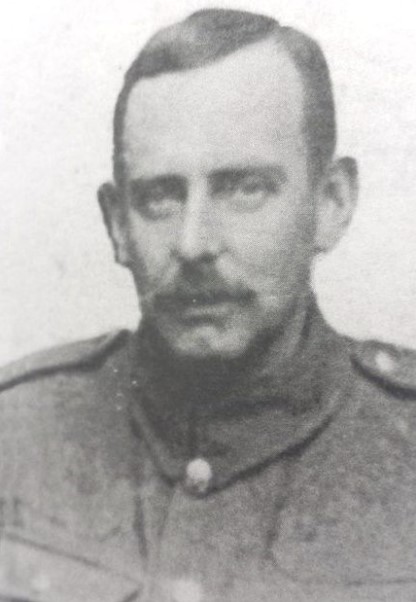
Lieutenant Spurway (from findagrave.com)
Sadly, Alexander was not the only member of the Spurway family to lose their life as a result of the war.
Richard Popham Spurway, Alexander’s older brother, was a 2nd Lieutenant in the Somerset Light Infantry, and was attached to the Hampshire Regiment, when it was moved to Gallipoli in 1915. He was killed on 13th August 1915, and is commemorated on the Helles Memorial at Canakkale, Turkey.
Alexander’s younger brother, George Vyvyan Spurway, joined the Royal Fusiliers, before transferring to the Machine Gun Corps. He had arrived in France in September 1916, and was killed while fighting on the Western Front on 28th March 1918. He was laid to rest at Arras and is commemorated on the memorial there.
George Charles Walrond Sweet was born on 4th December 1889, the oldest of three children to Reverend Charles Sweet and his wife Maud. A Church of England vicar, Charles moved around with his work, and, when George was born, he was based in Winterborne Kingston in Devon.
George was sent away to school, and, by the time of the 1901 census, Charles and the family had moved to Milton Lilbourne in Wiltshire, to tend the local flock.
After school, George studied at Oxford, then followed in his father’s footsteps by taking holy orders, and was soon appointed rector of Symondsbury, Dorset.
When war broke out, his calling was to serve in the Royal Army Chaplain’s Department. Details of his time during the conflict are unclear, although by the spring of 1919, he was attached to the headquarters of the Army of the Rhine.
It was here that he met Phyllis Squire Hickson, who was serving as a Nurse in the Queen Mary’s Auxiliary Army Corps. The couple fell in love and, in June 1919 they returned to England to marry. The wedding occurred on 6th August 1919, and the newlyweds set off on honeymoon the following day.
On his honeymoon tour, the Revd. George C Walrond Sweet… was drowned on Thursday evening in the Cherwell at Oxford, in the presence of his wife.
Mr and Mrs Sweet engaged a punt at Tims’s boathouse and went for a trip on the river. On returning about seven o’clock, when within 300 yards of the boathouse, the punt pole was embedded in the mud and, in attempting to dislodge it the pole broke.
Mr Sweet fell on the side of the boat and then over-balanced into the river. His wife tried to reach him, but without success, and then jumped into a second punt and from that into another boat, but failed to reach him, and he disappeared. The body was not recovered until a quarter of an hour had elapsed, and life was then extinct.
Mr Sweet, who was an MA of Keble College, was only married on Wednesday at St James’s Church, West Hampstead…
[Phyllis’ father] Mr William Hickson… said his daughter became engaged to Mr Sweet in France. He did not meet him until last Tuesday. They came to England to be married. Mr Sweet met with a bicycle accident some years ago and [he] understood from his daughter that her husband was unable to swim or take any active exercise, but while he had been in France his health had much improved.
It was stated [at the inquest] that Mr and Mrs Sweet had been married only one day when the accident occurred and Dr Brooks, a university coroner, said that the tragedy was one of the saddest that had ever come under his notice.
Taunton Courier and Western Advertiser: Wednesday 13th August 1919
The inquest confirmed that the punt pole had broken about 2.5ft (0.76m) from the top. When George was dragged from the river, artificial respiration was carried out for around 50 minutes, but proved unsuccessful. The inquest returned a verdict of accidental death. George was just 29 years of age.
Reverend George Charles Walrond Sweet’s body was brought to Somerset for burial. He was laid to rest in the graveyard of Holy Cross Church in Sampford Arundel, more than likely because he or his father had been vicars there.
This was the second tragedy to befall the Sweet family. George’s younger brother, Leonard, had been schooled in Sherborne, then at the Military College in Sandhurst. He joined the 1st Battalion of the Hampshire Regiment as Second Lieutenant on 5th February 1913, and was promoted to full Lieutenant in September 1914, and Captain in October 1915.
Captain Sweet was then attached to the 29th Squadron of the Royal Flying Corps, and gained his wings at the British Flying School in Le Crotoy, France, in August 1915. On 22nd June 1916, he was on patrol duty over the British lines, when he was involved in a skirmish, and his plane crashed, killing him instantly. He was just 23 years of age.
Captain Leonard Sweet was laid to rest at the Lijssenthoek Military Cemetery in Poperinge, near Ypres.
Captain Leonard Sweet (from findagrave.com)
Phyllis Sweet never remarried. By the time of the 1939 England and Wales Register, she was living in Bridport, Dorset, and working as a political organiser and speaker. She passed away in August 1944 in Cannock, Staffordshire, at the age of 63 years old.
Bernard Fred Lane was born in Wellington, Somerset, in the spring of 1880, and was the oldest of nine children to Frederick and Agnes Lane. Frederick was a house painter and, after a stint as a butcher, his son followed the same work. By the time of the 1901 census he was one of four boarders with the Hapgood family, living in Bournemouth, Dorset.
On 5th October 1901, Bernard married Annie Louisa Joyner. The couple wed in St Paul’s Church in Poole, but soon settled back in Wellington, and went on to have four children: Agnes, James, Mildred and Winifred.
War came to Europe in 1914, and Bernard wanted to play his part. Full details of his military service are not available, but it is clear that he had enlisted in the Devonshire Regiment by March 1918. At some point during the conflict Private Lane was assigned to the Labour Corps, and attached to the 312th Company.
Bernard was serving on Salisbury Plain by the autumn of 1918, and fell ill, although it is not clear what befell him. Admitted to the Fargo Military Hospital at Larkhill, Wiltshire, he passed away on 15th October 1918. He was 38 years of age.
Bernard Fred Lane was brought back to Somerset for burial. He was laid to rest in Wellington Cemetery, the resting place for several other members of his family.
Albert William Stockley was born in the spring of 1897, the youngest of twelve children to Frank and Mary Ann Stockley. Frank was a clay cutter from Dorset, and he and his wife raised their family in the picturesque village of Corfe Castle.
Sadly, much of Albert’s life is lost to time. He would have been 17 years old when war broke out, so it seems likely that he would not have been in the first wave of men to enlist.
Albert joined the Dorsetshire Regiment and, as a Private, was assigned to the 1st/4th Battalion. His troop was based in India for the first part of the war, before moving to Mesopotamia in 1916. There is nothing to confirm, however, whether Private Stockley served abroad, or if he remained as part of a territorial force.
Private Stockley was demobbed on 22nd May 1919, and awarded the Victory and British Medals for his service. He returned to Dorset, but is it at this point that his trail goes cold.
All that is evident is that Albert William Stockley passed away on 1st April 1920, ages just 23 years old. was laid to rest in the Old Church Cemetery in his home town of Corfe Castle.
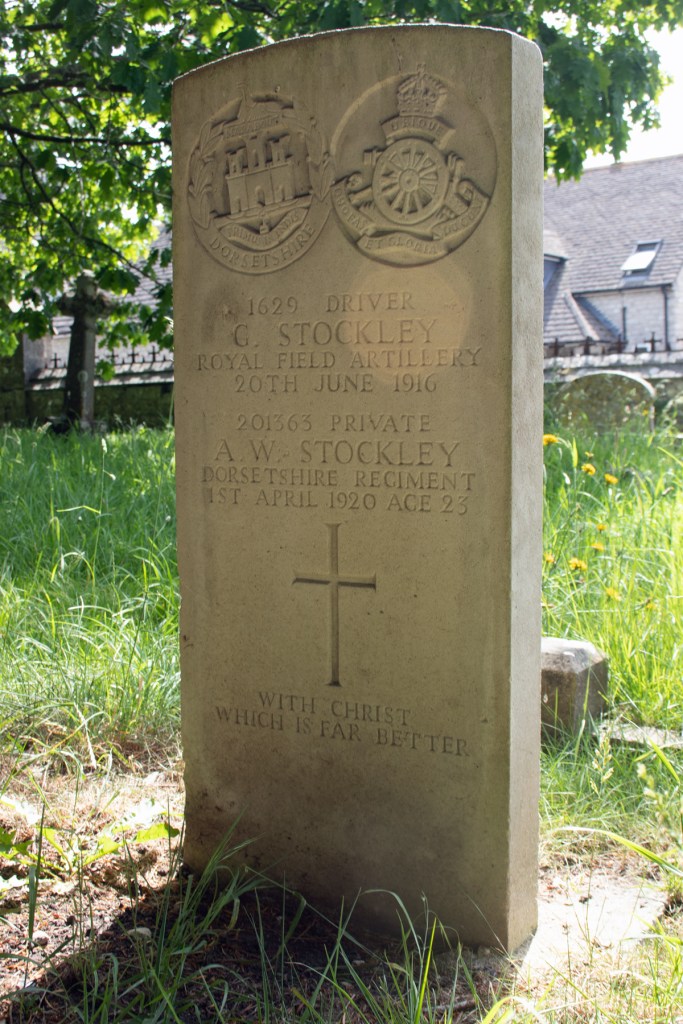
Albert shares his grave with his older sibling, George Stockley, who died in June 1916. The brothers are commemorated on the same headstone.
George Stockley was born in December 1888, one of twelve children to Frank and Mary Ann Stockley. Frank was a clay cutter from Dorset, and he and his wife raised their family in the picturesque village of Corfe Castle.
When he left school, George found work as a house painter but it seemed this was not to be a career. In March 1913, he married Lillian May Stockley, who had been born in Frome, Somerset, but who was working as a barmaid in nearby Weymouth. Later that year, the couple had a daughter, Georgina, and, by the time he enlisted two years later, George was working as a barman, and the young family were living in Bournemouth.
George had joined up on 10th February 1915, and was assigned to the 3rd/6th Hampshire Battery of the Royal Field Artillery. His service records show that he was 5ft 4ins (1.63m) tall, but they also confirm that, when he had his medical examination on 30th May, he was deemed as medically unfit for military service.
Sadly, there is no further information to confirm why Driver Stockley’s military career was cut so short. His trail goes for a year, until, on 20th June 1916, he passed away, aged just 27 years old. The cause of his passing is also lost to time
George Stockley was laid to rest in the Old Church Cemetery in his home town of Corfe Castle.
George shares his grave with his youngest sibling, Albert William Stockley, who died in April 1920. The brothers are commemorated on the same headstone.
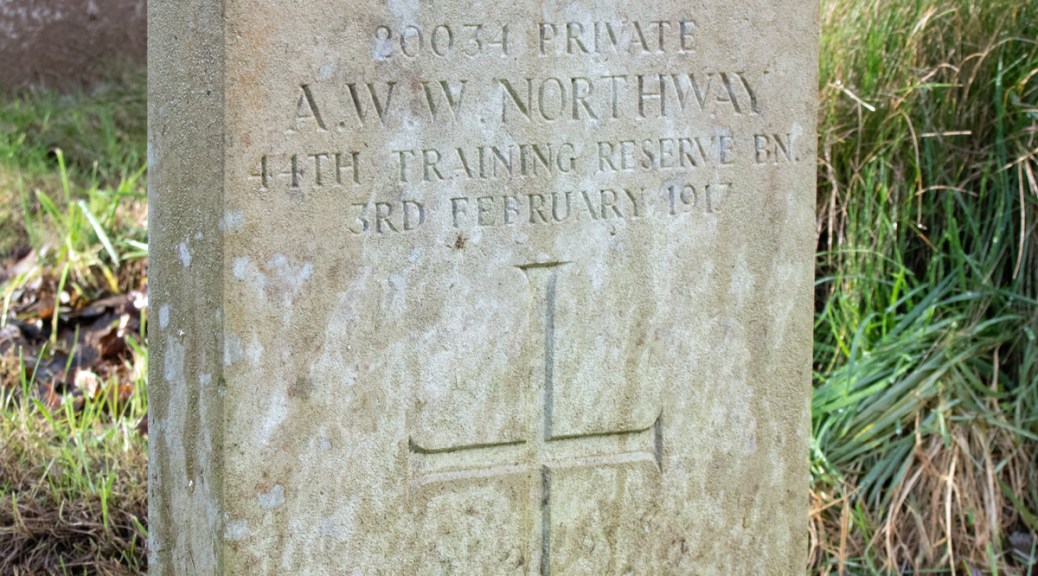
Alfred William Winsor Northway was born on 3rd December 1870 in Barnstaple, Devon. He was the only child to farm labourer John Northway and his wife Susan. By the time Alfred was a few months old, John had moved the young family to Ashburton.
On 2nd March 1890, Alfred married Susanna Raddon in Newton Abbot. The couple went on to have eleven children – Susanna already had two children when they married; there is no indication as to whether they were also Alfred’s.
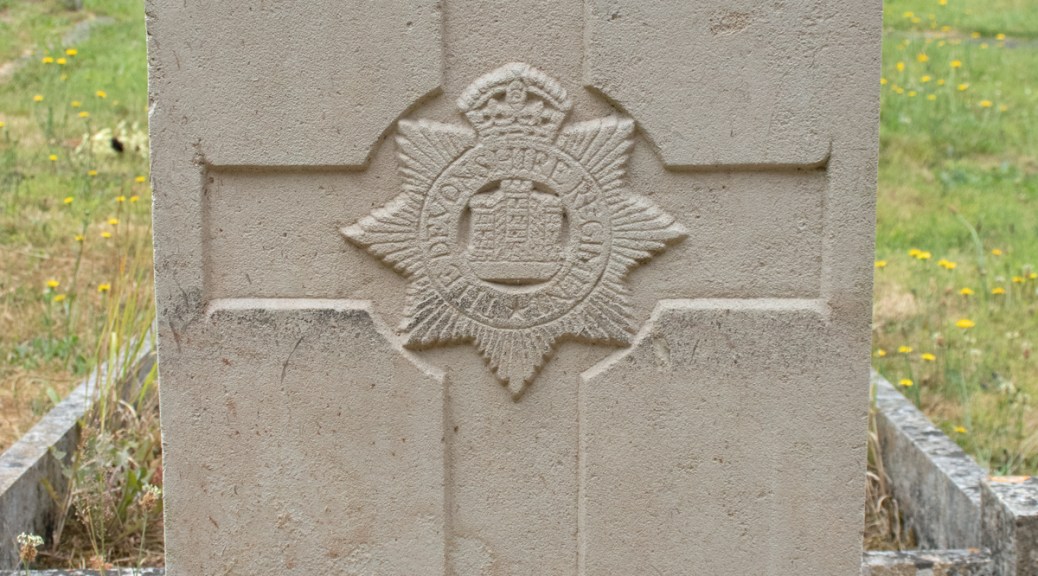
By the time they married, Alfred was working as a farm labourer. This was a job he continued to do to support his rapidly growing family. War was coming to Europe, however, and the stability of life in Ashburton was soon to change. During this time, he volunteered for the 3rd Battalion of the Devonshire Regiment and this stood him in good stead moving forward.
At least two of Alfred and Susanna’s sons enlisted when the First World War broke out; not to be outdone, Alfred also joined up on 11th September 1914. Assigned to the 11th (Reserve) Battalion of the Devonshire Regiment as a Private, there is no indication that he saw any time abroad. Instead it seems that he served at the regiment’s depot in Wareham, Dorset, supporting the Training Reserve.
By the end of 1916, Private Northway had fallen ill. Admitted to the Sidney Hall Hospital in Weymouth with pneumonia, sadly the condition got the better of him. He passed away on 3rd February 1917, at the age of 46 years old.
Alfred William Winsor Northway was brought back to Ashburton for burial. He was laid to rest in the graveyard of St Andrew’s Church in the town.
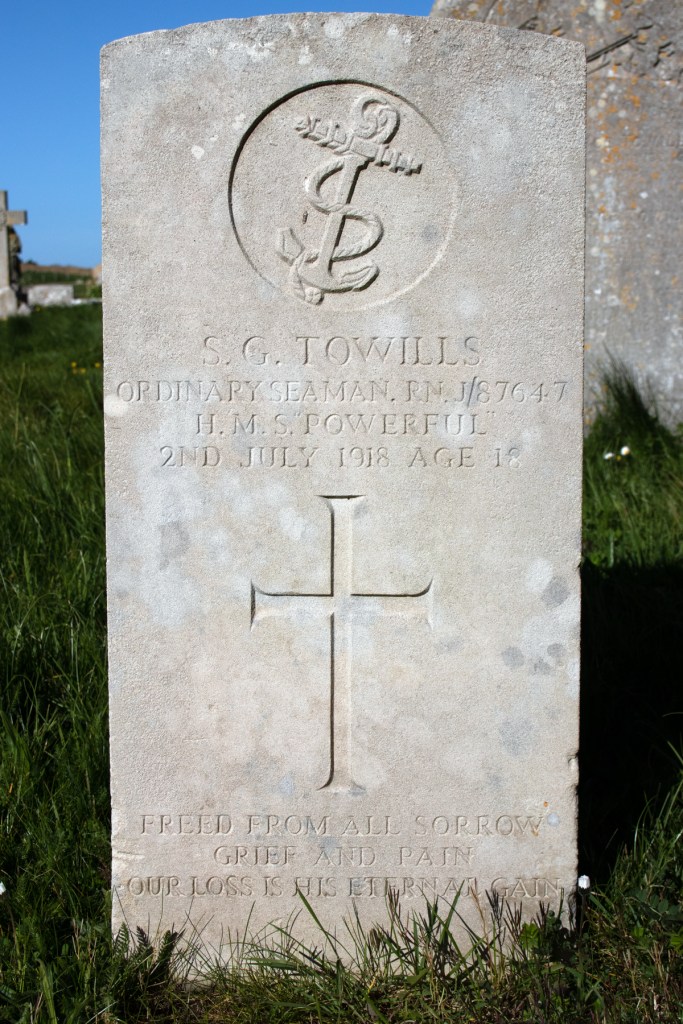
Sidney George Towills was born in Soho, London, on 14th May 1900. He was the youngest of two children to Henry and Maria Towills. Both had been born in Dorset, but Henry had found work as a constable for the Metropolitan Police and they had moved to London by the early 1890s.
The 1901 census recorded the family as living in Plaistow, but ten years later the family had moved back to Dorset, and were ensconced back in Maria’s home village of Abbotsbury.
When war broke out, Sidney was only 14 years old. He wanted to play his part, however, and as soon as he was able to enlist, he did so. He joined the Royal Navy on 9th April 1918 and, because of his age, was given the rank of Boy 2nd Class.
Sidney’s service records show that he was 5ft 9ins (1.75m) tall, had brown hair, blue eyes and a health complexion. He was assigned to the cruiser HMS Powerful and, on his eighteenth birthday, just over a month after enlisting, he was awarded the rank of Ordinary Seaman.
Tragically, Ordinary Seaman Towills’ service was not destined to be a long one. In June, he was admitted to the Royal Naval Hospital in Plymouth with empyema, a lung disease; he passed away from the condition on 2nd July 1918. He was barely 18 years of age and had served in the Royal Navy for 96 days.
Sidney George Towills was brought back to Abbotsbury for burial. He was laid to rest in the graveyard of St Nicholas’ Church in the heart of the village.
William John Moore was born in October 1893 in the Dorset village of Puncknowle. He was the second of four children to Richard and Elizabeth Moore. Richard was a farm labourer and Elizabeth’s family were all fishermen, but is was agricultural work that William sought out when he left school.
There is little direct information available about William’s life. When war came to Europe, he joined up, enlisting as a Private in the Dorsetshire Regiment at some point before April 1918. He served on home soil, and was based at one of the regiment’s depots on Salisbury Plain.
At some point late in 1918, Private Moore was admitted to the Military Hospital in Tidworth, although the cause for his admission is not known. Tragically, William died in the hospital on 13th October 1918. He was just 25 years of age.
William John Moore was laid to rest in the cemetery in his home village of Puncknole.
Arthur Thomas Foote was born on 18th June 1880 in the Dorset town of Sherborne. One of three children to Jane Foote, his mother married widower James Rose in 1887, giving Arthur a half-sibling. James passed away in 1889, and Jane married another widower – Albin Pitman – and Arthur had a further six siblings and half-siblings.
By this point, the family had moved to Somerset, settling in Compton Pauncefoot. The 1901 census recorded Arthur as having left the family home and he was boarding in nearby Holton. He had, by this time, found work as a carter.
Arthur had met Agnes Wetherall, a tailor’s daughter from the village of Baltonsborough. The couple married in Wells in April 1902, and set up home in nearby Glastonbury. They went on to have two children – Robert, who had been born in 1898, and Lillian, who was born in 1902 – and Arthur continued working as a carter for a miller.
When war broke out, Arthur enlisted. While full details of his service are not available, he joined the Royal Berkshire Regiment as a Private, and was assigned to their Labour Corps.
Robert had also enlisted early on in the war. He joined the 2nd Battalion Coldstream Guards, and was killed in fighting in Northern France in September 1916. He was awarded the Mons Star, and is commemorated on the memorial at Thiepval.
Arthur survived the war, and returned home in early 1919. He quickly came down with pneumonia, and passed away within a week of his return, on 11th February 1919. He was 38 years old.
Arthur Thomas Foote was laid to rest in a now overgrown plot at the top of Glastonbury Cemetery, walking distance from the family home.