Category Archives: London

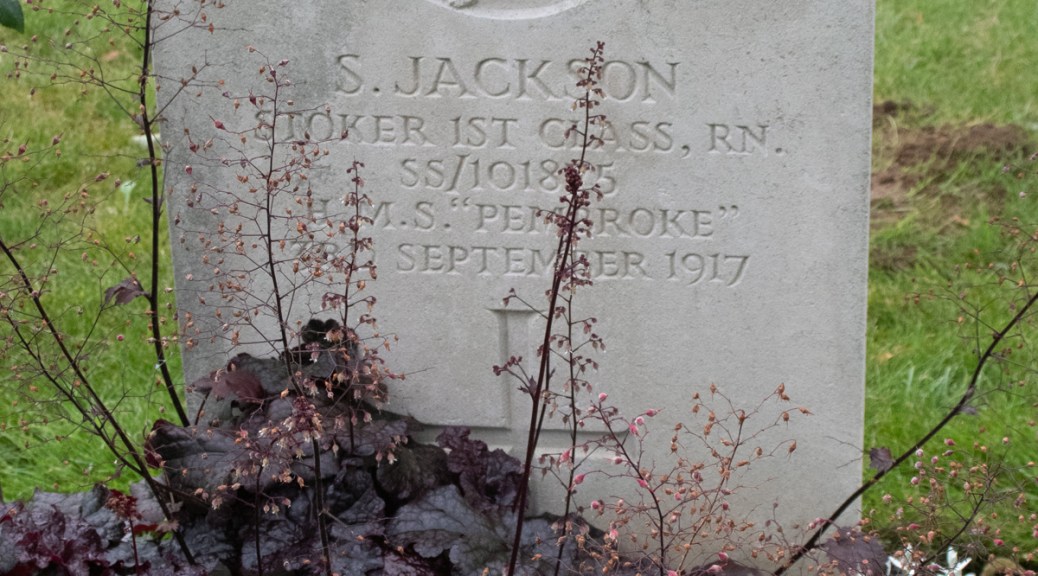
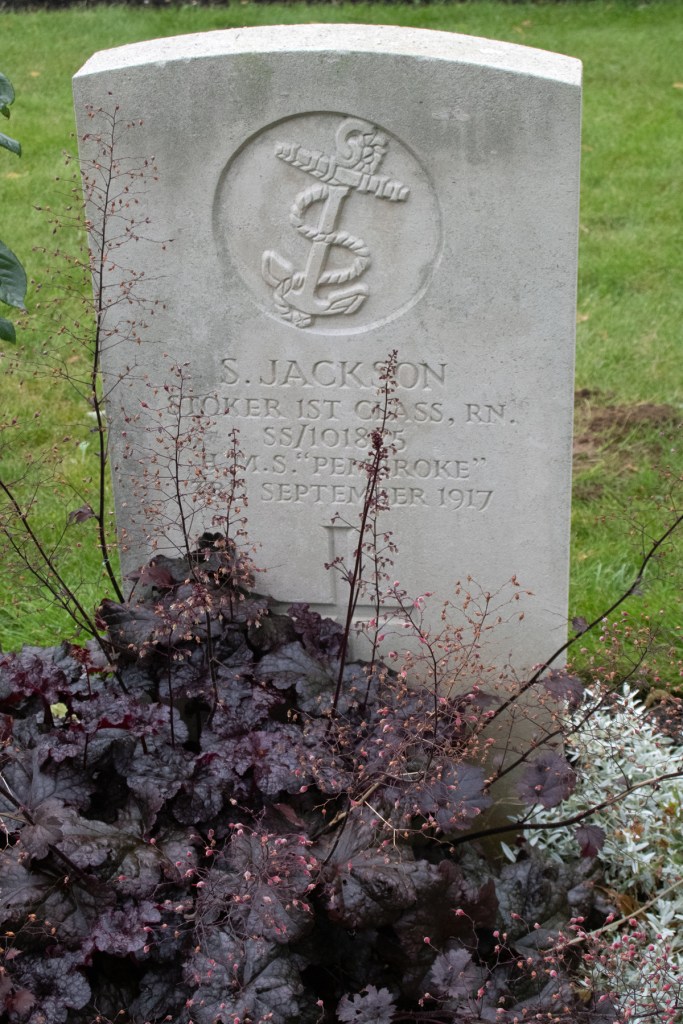
Stoker 1st Class Sydney Jackson

Stoker 1st Class Sydney Jackson

Sydney Jackson was born in Walsall, Staffordshire, on 1st May 1886. One of three children to William and Emma Jackson, he also had three older half-siblings through William’s previous marriage. William was a vice manufacturer, and this is something Sydney helped his father with when he finished school.

He had bigger plans, however, and, on 11th December 1905, Sydney enlisted in the Royal Navy. His service records show that he stood 5ft 6ins (1.68m) tall, had hazel eyes, dark brown hair and a fresh complexion. Sydney joined up for a period of 5 years, and was given the role of Stoker 2nd Class.

During his initial term of service, he served on seven different ships, rising to the rank of Stoker 1st Class in the process. Between each voyage he returned to HMS Pembroke, the Royal Naval Dockyard in Chatham, Kent, and this was to become his land base.

Stoker Jackson’s career was not to be blemish flee, though. In the autumn of 1906, he spent two periods of time in the brig – the first for seven days, the second for two weeks. There is nothing to confirm what infraction he had committed, but given that the two imprisonments were within weeks of each other, it seems likely that something external was going on with him at the time.

When Sydney’s initial term of service came to a close, he was placed on reserve. There is not a great deal of information available about this part of his life, although the 1911 census records him as boarding in the Bruce House Registered Lodging House in Central London; he is listed as being a stoker.

His time on reserve did not last for long, however, and in October 1912 he was recalled. Over the next five years, Stoker Jackson served on a further four ships. In the spring of 1917 he returned to HMS Pembroke; the base was a busy place that summer, and temporary accommodation was set up at the Dockyard’s Drill Hall. This is where Sydney found himself billeted.

On the 3rd September 1917, the German Air Force carried out its first night air raid: Chatham was heavily bombed and the Drill Hall received a direct hit; Stoker 1st Class Jackson was among those killed instantly. He was 31 years old.

Sydney Jackson was laid to rest, along the other victims of the Chatham Air Raid, in the Woodlands Cemetery, Gillingham.


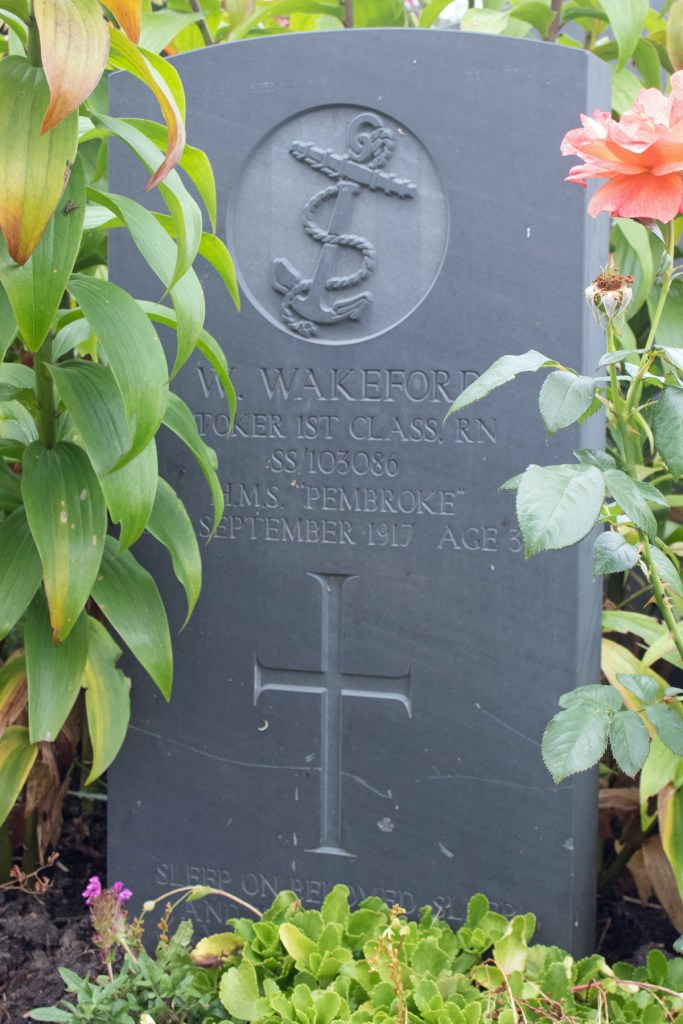
Stoker 1st Class William Wakeford

Stoker 1st Class William Wakeford

William Edward Wakeford was born on 18th April 1885, the oldest of seven children to William and Theresa. William Sr had been born in East London and was a labourer for the engineering company Vickers. Theresa came from south of the Thames, in Greenwich, and it was in South East London that the Wakefords raised their family.

When he left school, William Jr found work as an assistant to a corn dealer. He was set on a better life and career, however, and, on 1st June 1906, at the age of 20, he enlisted in the Royal Navy with the rank of Stoker 2nd Class.

William learnt on the job; he was initially assigned to HMS Acheron and, during his initial five-year term of service, he served on five further vessels, rising to the rank of Stoker 1st Class as a result of his hard work. In between his voyages, however, he was based at HMS Pembroke, the Royal Naval Dockyard at Chatham, Kent.

When his contract came to an end in May 1911, Stoker Wakeford was assigned to the Royal Naval Reserve. With war looming, however, this did not turn out to be for long and, when hostilities begun in 1914, he was called back into action. He was assigned to the battleship HMS Cornwallis, and spent more than two years on board. During this time, the ship saw action in the Eastern Mediterranean, primarily the Dardanelles Campaign, and the fighting around Gallipoli.

By the start of 1917, Stoker Wakeford was back on dry land, and based at HMS Pembroke. For a variety of reasons, that was a particularly busy year at the dockyard, and temporary additional accommodation was set up at the Chatham Drill Hall nearby; this is where William found himself billeted.

On the 3rd September 1917, the German Air Force carried out its first night air raid: Chatham was heavily bombed and the Drill Hall received a direct hit; Stoker 1st Class Wakeford was among those killed instantly. He was 32 years of age.

William Edward Wakeford was laid to rest, along with the other victims of the Chatham Air Raid, in the Woodlands Cemetery, Gillingham.


William’s younger brother Cecil also fought in the Great War. Serving as a Private in the 2nd Battalion Royal Inniskilling Fusiliers, he saw fighting on the Western Front. Caught up in the Battle of St Quentin in March 1918, he was killed as the regiment were cut off by German advances. He was just 22 years old. He was laid to rest in France, and is commemorated at the Pozières Memorial.


Ordinary Seaman Charles Goodsell

Ordinary Seaman Charles Goodsell

Charles Henry Goodsell – known as Harry – was born on 15th February 1897, the oldest of six children. His parents were Henry and Fanny Goodsell, who had been born in Sussex, but had moved to London in the late 1890s, presumably for work.

Henry was a compositor, setting type for printers, but his son’s first job after leaving school was as a van guard for the local Co-op. By the outbreak of the war, he had begun working in the store himself, but the hostilities soon put a stop to that.

In 1916, the call came, and, on 6th March, Harry joined the Royal Navy as an Ordinary Seaman. He was initially sent to HMS Pembroke – the Naval Dockyard in Chatham, Kent – where he completed his initial training. By May 1916, however, he was given his first posting, on board the battleship HMS Swiftsure, protecting the Atlantic convoys.

After nearly a year at sea, Ordinary Seaman Goodsell found himself back at HMS Pembroke. The Dockyard was particularly busy that summer, and the large number of extra servicemen meant that Harry was billeted in temporary accommodation in Chatham Drill Hall.

On the 3rd September 1917, the first night air raid carried out by the German Air Force bombarded the town, and scored a direct hit on the Drill Hall; Ordinary Seaman Goodsell was among those killed instantly. He was just 20 years old.

Charles Henry “Harry” Goodsell was laid to rest, along with the other victims of the Chatham Air Raid, in the Woodlands Cemetery, Gillingham.


Charles Henry Goodsell (Harry) 1897 - 1917
Ordinary Seaman Charles Goodsell
(from ancestry.co.uk)

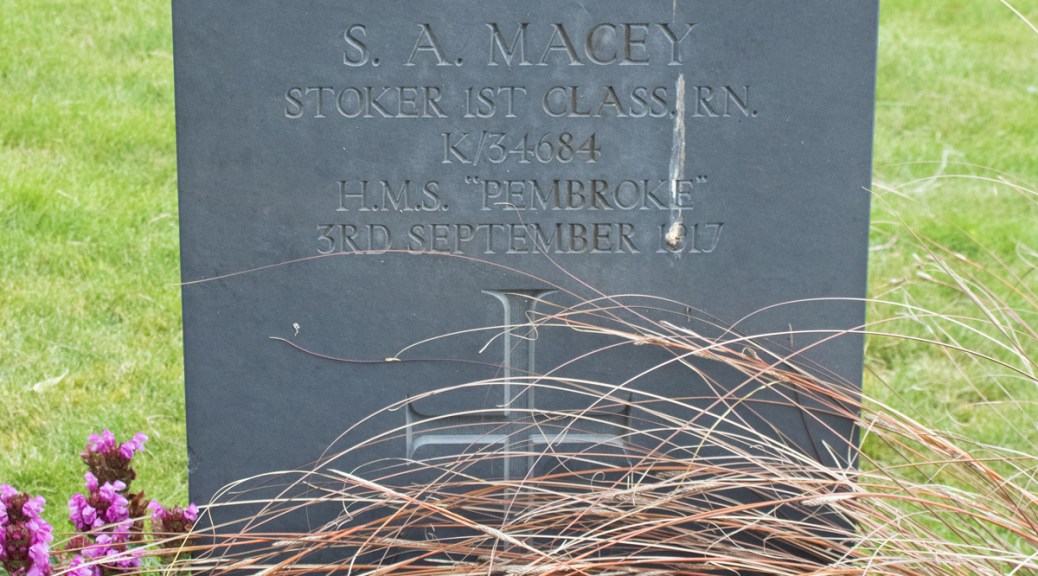
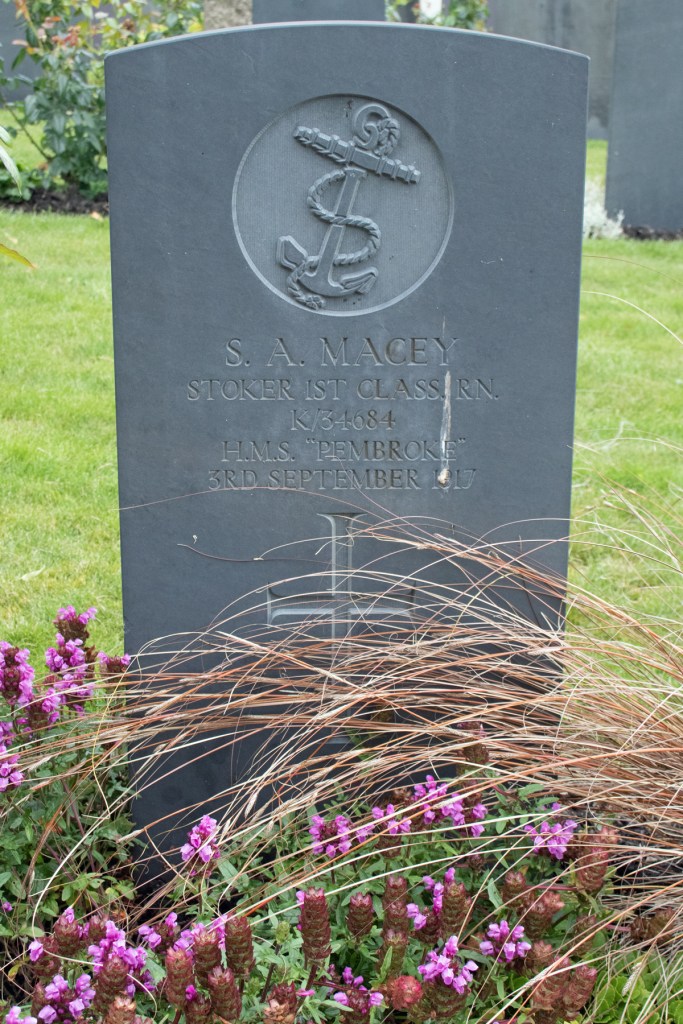
Stoker 1st Class Sidney Macey

Stoker 1st Class Sidney Macey

Sidney Albert Macey was born in Clapham, South London on 16th March 1898. The fourth of seven children, his parents were William and Beatrice Macey. William worked as a groom and coachman for a dairy, but, intriguingly, he and Beatrice appear to have been living as a common-law couple, rather than being formally married.

Beatrice was born in Wiltshire, and had married George Hodges; they had a son, also called George, before she was widowed in 1891. The 1901 census lists mother and son as William’s visitors, but, by this time, he and Beatrice had gone on to have five children of their own, Sidney included.

When he left school, Sidney found work as a telegraph messenger, but by this point, war was on the horizon. His older brothers went off to war – the oldest, William, died in France in August 1916 – and Sidney seemed keen not to be left out of the action.

On 30th June 1916, he enlisted in the Royal Navy as a Stoker 2nd Class. His service records show that he stood 5ft 5.5ins (1.66m) tall, had brown hair, brown eyes and a fresh complexion. He was initially dispatched to HMS Pembroke – the Royal Naval Dockyard in Chatham, Kent – for training, before being assigned to the cruiser HMS Dartmouth, that October.

Stoker Macey spent nine months on board Dartmouth, and gained a promotion to Stoker 1st Class in the process. In July 1917, his assignment complete, he returned to Chatham. HMS Pembroke was particularly busy that summer, and he was billeted in temporary accommodation in the town’s Drill Hall.

On the 3rd September 1917, the first night air raid carried out by the German Air Force scored a direct hit on the barracks and Drill Hall; Stoker 1st Class Macey was killed instantly. He was just 19 years old.

Sidney Albert Macey was laid to rest, along with the other victims of the Chatham Air Raid, in the Woodlands Cemetery, Gillingham. He was the second of two brothers lost to the conflict.


Stoker 1st Class Frederick Hartnall

Stoker 1st Class Frederick Hartnall

Frederick George Hartnall was born in St John’s Wood, London, on 28th March 1892. He was the youngest of three children to Harry and Elizabeth Hartnall, although, tragically, his two older brothers had both passed away within their first year.

Harry worked as a compositor – type setting for a local printer – and this is a trade into which Frederick followed his father, when he left school. After his mother passed away in 1907, he realised that he wanted bigger and better things. On 19th April 1910, having just turned 18, he enlisted in the Royal Navy.

Frederick’s service records show that he stood 5ft 4ins (1.63m) tall, had brown hair, blue eyes and a fair complexion. He was sent to HMS Victory – the naval base in Portsmouth – for his training as a Stoker 2nd Class, and his naval career began.

Over the next four years, Frederick served on six different ships, rising to the rank of Stoker 1st Class in the process. In between his ocean trips, however, his time was spent at on-shore bases, both in Portsmouth and Chatham – the Royal Naval Dockyard known as HMS Pembroke.

When war was declared in 1914, Stoker Hartnall was on board the cruiser HMS Dido. The reality of his life may well have hit home; on two separate occasions during this particular assignment, he was confined to the brig. Sadly his misdemeanours are lost to time now, but they must have been significant: his first confinement lasted a week, while his second was for 42 days, and ended with his transfer to HMS Pembroke.

For most of the rest of his service, Stoker Hartnall was shore-based. By the summer of 1917, he was back at HMS Pembroke. The base was particularly busy that summer, and he was billeted in temporary accommodation in the town’s Drill Hall.

On the 3rd September 1917, the first night air raid carried out by the German Air Force scored a direct hit on the barracks and Drill Hall; Stoker Hartnall was among those killed instantly. He was just 25 years old.

Frederick George Hartnall was laid to rest, alongside the other victims of the Chatham Air Raid, in the Woodlands Cemetery, Gillingham.


Stoker 1st Class Arthur Charlton

Stoker 1st Class Arthur Charlton

Arthur Charlton was born in St Pancras, London, on 21st November 1891. His parents were Arthur and Bridget Charlton, but little further information on Arthur Jr’s early life remains.

When he left school, he found work as a butcher, but it seems he was after a life of adventure and travel. On 6th November 1913, he enlisted in the Royal Navy, initially for a period of twelve years as a Stoker 2nd Class. Arthur’s service records show that he stood 5ft 6.5ins (1.69m) tall, had brown hair, blue eyes and a fair complexion.

Stoker Charlton was initially posted to HMS Pembroke – the Royal Naval Dockyard in Chatham, Kent – and this is where he did his training. He was then sent to the battleship HMS Vanguard, on board which he served for nearly three-and-a-half years. Arthur was assigned to Vanguard in the summer of 1917, when the vessel was sunk following a series of internal explosions in Scapa Flow, Scotland, with the loss of more than 800 souls. It seems, however, that he was not on board at the time, which likely saved his life.

Brought back to HMS Pembroke that summer, and with the Vanguard destroyed, Arthur found himself in an overly packed dockyard. He was billeted in the Chatham Drill Hall, which was being used as temporary accommodation.

On the 3rd September 1917, the first night air raid carried out by the German Air Force scored a direct hit on the barracks and Drill Hall; Stoker 1st Class Charlton was killed instantly. He was just 25 years old.

Arthur Charlton was laid to rest, alongside the other victims of the Chatham Air Raid, in the Woodlands Cemetery, Gillingham.


Arthur’s pension record gives a Mrs Amelia Ward as his next of kin. No details of a marriage between them are evident, and, as there is no record of his early life, it is not possible to identify whether Amelia was his sister. A mystery left unsolved.


Leading Stoker Percy Moore

Leading Stoker Percy Moore

Percy Edwin Moore was born on 14th April 1889, one of nine children to farrier Charles Moore and his wife, Eliza. Both of Percy’s parents were from West London, and the family was raised on the border between Kensington and Hammersmith.

When Percy left school he found work as a builder’s labourer, but he was drawn to bigger things and, in 1909, he joined the Royal Navy as a Stoker 2nd Class. His service records show that he stood 5ft 6ins (1.68m) tall, had light brown hair, brown eyes and a fresh complexion. He had a scar above his right eye, and a tattoo on each arm.

Percy’s sense of adventure seemed to have been kindled in his earlier years; the tattoo on his right arm was a depiction of Buffalo Bill Cody, the American showman who brought the Wild West to England in the early 1900s. Young Percy’s interest was obviously piqued early on.

Stoker Moore’s first posting was on board HMS Acheron. In the years leading up to the war, he served on six further vessels, returning to HMS Pembroke – the Royal Naval Dockyard in Chatham, Kent – in between voyages. During this time, he was promoted to Stoker 1st Class for his work.

It was during one of these pauses, in August 1913, that he married Annie Eliza Wells, a labourer’s daughter from Kensington. There honeymoon was brief – just five days after they married, Percy was back at sea.

When war was declared, Stoker Moore was assigned to the battleship HMS Triumph. She served in the Mediterranean, seeing action early on in the Gallipoli campaign. After a short spell back in Chatham, he transferred to HMS Tyne, a depot ship, and received a promotion to Acting Leading Stoker.

By the summer of 1917, Percy was back at HMS Pembroke. The base was overly busy that summer, and he was billeted in temporary accommodation in the town’s Drill Hall.

On the 3rd September 1917, the first night air raid carried out by the German Air Force scored a direct hit on the barracks and Drill Hall; Acting Leading Stoker Moore was killed instantly. He was just 28 years old.

Percy Edwin Moore was laid to rest, along with the other victims of the Chatham Air Raid, in the Woodlands Cemetery, Gillingham.


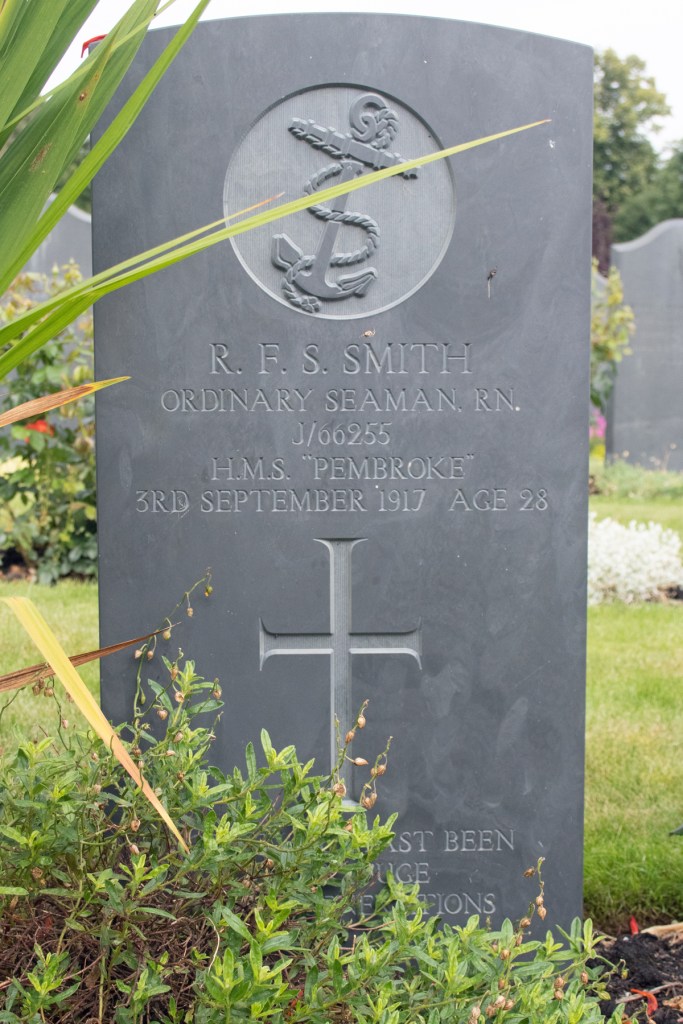
Ordinary Seaman Robert Smith

Ordinary Seaman Robert Smith

Robert Frederick Sydney Smith was born on 24th July 1889 in Peckham, London. One of seven children, his parents were Robert Smith – a tailor and draper – and his wife Ada.

Little more information is available on Robert Jr’s early life. He married Alice Brookman, a leatherworker’s daughter, on 3rd September 1911, and was, by this time, working as a bank clerk. The couple went on to have three children: Sidney, Eileen and Ronald.

War was on the horizon and, at Robert was soon called up. His service records are dated 31st January 1917, and note that he stood 5ft 5.5ins (1.66m) tall, had brown hair, brown eyes and a medium complexion.

Robert was employed as an Ordinary Seaman, and was initially posted to HMS Pembroke, the shore-based establishment at the Royal Naval Dockyard in Chatham, Kent. After a few weeks, he was posted to HMS Crescent, a cruiser that served in the North Sea.

After six months at sea, Ordinary Seaman Smith landed back in Kent. HMS Pembroke was a busy place at that point in the war, and additional accommodation was desperately needed. Robert found himself billeted at Chatham Drill Hall, away from the main barracks.

At this point in the war, the German Air Force had been suffering huge losses during the daylight bombing raids it had been undertaking. It was imperative for them to minimise these losses, and so a new tactic – night time raids – was employed.

The first trial of this approach was on the night of 3rd September 1917, and Chatham suddenly found itself in the firing line, startlingly unready and fundamentally unprotected. One of the German bombs landed a direct hit on the Drill Hall, and Ordinary Seaman Smith was killed. He was just 28 years old.

Ninety-eight servicemen perished during the Chatham Air Raid that night. They were buried in a mass funeral at the Woodlands Cemetery in nearby Gillingham. This, too, is where Robert Frederick Sydney Smith was laid to rest.


Leading Stoker William Osborne

Leading Stoker William Osborne

William Alfred Osborne was born in Islington, London, on 22nd August 1892. Sadly, this is where any concrete information on his early life – including his family – ends.

The only firm document available is William’s naval service records. This gives the date and location of his birth and also some physical details. He was 5ft 3ins (1.59m) tall, had brown hair, grey eyes (with a scar above his left one) and a fair complexion.

William enlisted in the Royal Navy on 11th May 1911, and was given the rank of Stoker 2nd Class. He was initially stationed at HMS Pembroke – the Royal Naval Dockyard in Chatham, Kent – where he spent a total of five months.

Weeks into his service in Chatham, he was put in the cells for seven days; it is not clear what misdemeanour he had committed, but the punishment this early on into his career seemed to have done the job, as the remainder of his service appears unblemished.

In October 1911, Stoker Osborne was given his first ocean-based posting. He was assigned to the battlecruiser HMS Inflexible on board which he served for nearly six years. During this time, he was given two promotions, to Stoker 1st Class in May 1912, and Leading Stoker four years later.

The Inflexible initially served in the Mediterranean, although during William’s time on board, she was involved in the Battle of the Falklands in the South Atlantic, the Dardanelles Campaign in the Eastern Mediterranean and the Battle of Jutland in the North Sea.

By the summer of 1917, Leading Stoker Osborne was back on home soil, stationed at HMS Pembroke. The Dockyard was a busy place at that point in the war, and additional accommodation was desperately needed. William found himself billeted at Chatham Drill Hall, away from the main barracks.

At this point in the war, the German Air Force had been suffering huge losses during the daylight bombing raids it had been undertaking. It was imperative for them to minimise these losses, and so a new tactic – night time raids – was employed.

The first trial of this approach was on the night of 3rd September 1917, and Chatham suddenly found itself in the firing line, startling unready and fundamentally unprotected. One of the German bombs landed a direct hit on the Drill Hall, and Leading Stoker Osborne was killed. He was just 25 years old.

Ninety-eight servicemen perished during the Chatham Air Raid that night. They were buried in a mass funeral at the Woodlands Cemetery in nearby Gillingham. This, too, is where William Alfred Osborne was laid to rest.


Stoker 1st Class William Walton

Stoker 1st Class William Walton

William Walton was born in St Neots, Cambridgeshire, early in 1868, the oldest child of William Moran and Hannah Walton. The couple married shortly after William’s birth and went on to have six further children. William Sr was a bricklayer’s labourer from Cambridgeshire, and until his mother’s death in 1903, William Jr used his father’s surname.

By the time of the 1881 census, William Sr had moved the family to London, where work was more plentiful. It was here that his eldest son met Annie Vigo; they married in Bethnal Green in August 1886 – using Hannah’s maiden name – and went on to have a son – also called William – the same year.

William was also working as a labourer by this point, but by the mid-1890s he and Annie had five children, and he needed a steadier income. In August 1895, he enlisted in the Royal Navy for a period of 12 years. His service record show that he stood 5ft 4ins (1.63m) tall, had brown hair, blue eyes and a fair complexion. He was also noted to have a scar on his head and an anchor tattoo on his left forearm.

Stoker 2nd Class Walton was initially based at HMS Victory, the training base in Portsmouth. By April 1896 he had been given his first off-shore assignment, HMS Fox. This was a cruiser, and he spent more than three years aboard, gaining a promotion to Stoker 1st Class in the process.

The summer of 1899 saw William back on land, as he was assigned to HMS Pembroke, the shore-based establishment at the Royal Naval Dockyard in Chatham. He remained here for the next three years, and returned to the dockyard in between assignments at sea.

In August 1907 Stoker Walton’s term of service with the navy came to an end, and he was placed on reserve. By this point he and Annie had had two more children, bringing the total to seven. The 1911 census found the family living in London, where William was still recorded as a stoker.

War was imminent, and, when hostilities broke out, William was recalled. This time, and probably because of his age, he was wholly based on land, spending nine months in Portsmouth, and the rest of the time in Chatham.

HMS Pembroke was a busy place and, in the summer of 1917, it had reached capacity. The Drill Hall was used as temporary accommodation, and this is where Stoker Walton found himself billeted.

On 3rd September, the German Air Force was trialling night raids on English locations to avoid suffering casualties in daylight; that night Chatham found itself in their flight path. The Drill Hall received a direct hit, and Stoker 1st Class Walton was killed, along with close to 100 others. He was 49 years old [the gravestone suggests a different age].

William Walton was laid to rest in the Woodlands Cemetery in Gillingham, within walking distance of the dockyard that had become his home. He was buried alongside the other victims of the Chatham Air Raid.


William’s younger brother Arthur Moran was also involved in the hostilities of the First World War. As a Bombardier in the Royal Garrison Artillery, he was caught up in the fighting on the Western Front, losing his life on 6th February 1917, seven months before his older brother. He was laid to rest in the Cité Bonjean Military Cemetery in Armentières, France.