Category Archives: London

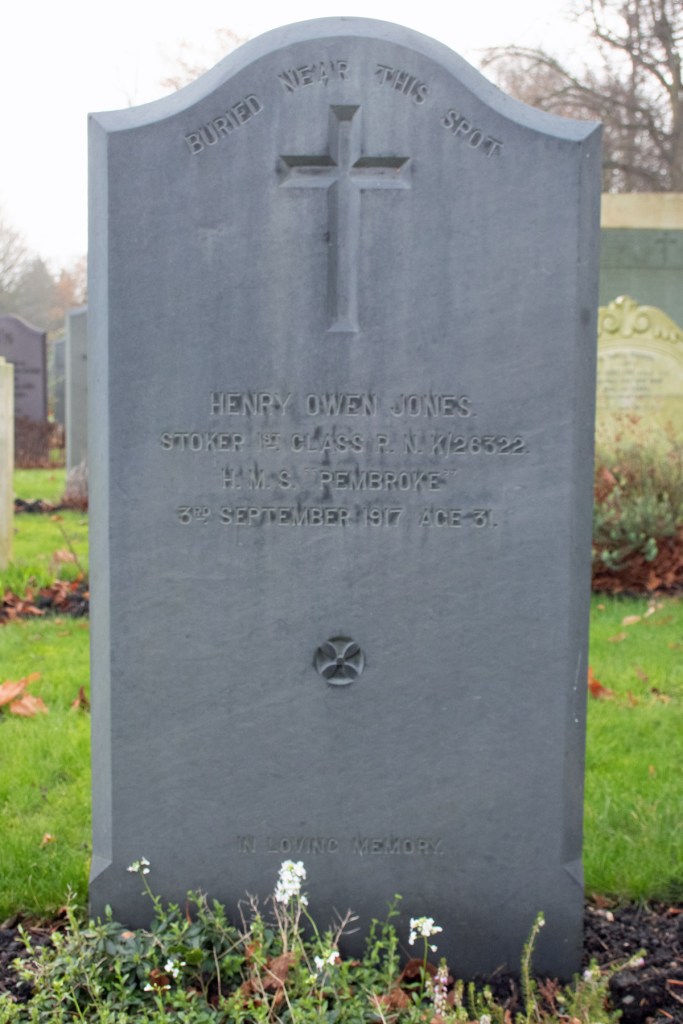
Stoker 1st Class Henry Jones

Stoker 1st Class Henry Jones

Owen Henry Jones was born in Islington, Middlesex, on 23rd October 1888. His father was tailor Edward Jones, but little additional information about Owen’s early life remains.

By the end of 1913, he was working as a packing case maker and living in Shoreditch. He had met Ada Elizabeth Cornelius, the daughter of a dock labourer, and the couple married on Christmas Day at St Peter’s Church in Hoxton Square.

Within a year, war had engulfed Europe and, on 1st June 1915, Owen enlisted in the Royal Navy. His service records show that he had swapped his names round, and was going by Henry Owen Jones. He was 5ft 9ins (1.75m) tall, had light brown hair, brown eyes and a fresh complexion.

Stoker 2nd Class Jones was initially sent to HMS Pembroke, the Royal Naval Dockyard in Chatham, Kent, for his training, but, within a couple of months, was assigned to the monitor vessel HMS Lord Clive. He served on board for just over a year, gaining a promotion to Stoker 1st Class in the process.

After six months back in Chatham, Henry was given his second posting, on board another monitor ship, HMS General Wolfe. After just three months, however, he found himself back on shore at HMS Pembroke.

The Dockyard was particularly busy that summer, and the large number of extra servicemen meant that Henry was billeted in temporary accommodation in Chatham Drill Hall.

On the 3rd September 1917, the first night air raid carried out by the German Air Force bombarded the town, and scored a direct hit on the Drill Hall; Stoker 1st Class Jones was among those killed instantly. He was just 28 years of age.

Henry Owen Jones was laid to rest, along with the other victims of the Chatham Air Raid, in the Woodlands Cemetery, Gillingham. Tragically he was buried as ‘unidentified’: the records state that he lies “in one of the following graves: 516, 522, 735, 935, 937, 948, 642.”


Stoker 1st Class Reginald Clark

Stoker 1st Class Reginald Clark

Reginald James Clark was born on 30th March 1896 in Shoreditch, East London. His parents were carver Reginald Clark and his wife, Elizabeth.

When he left school, Reginald found work as a boot packer, but was war on the horizon. On 3rd March 1915, he enlisted in the Royal Navy, signing up for the duration as a Stoker 2nd Class. His service records show that he stood 5ft 4.5ins (1.63m) tall, had dark brown hair, brown eyes and a dark complexion.

Stoker Clark was initially sent to the Royal Naval Dockyard in Chatham, Kent – also known as HMS Pembroke – for training, but was soon given his first posting. This was on the depot ship HMS Hecla, and he spent more than two years aboard, gaining a promotion to Stoker 1st Class in the process.

In June 1917, Reginald returned to Chatham, and spent the summer barracked at the Dockyard. HMS Pembroke was particularly busy at that point in the war, and temporary accommodation was needed quickly. Chatham Drill Hall was brought into service, and Reginald found himself billeted there.

On the 3rd September 1917, the German Air Force carried out its first night air raid: Chatham was heavily bombed and the Drill Hall received a direct hit; Stoker 1st Class Clark was among those killed. He was just 21 years of age.

Reginald James Clark was laid to rest, alongside the other victims of the Chatham Air Raid, in the Woodlands Cemetery, Gillingham.


Stoker 1st Class Ernest Hoskins

Stoker 1st Class Ernest Hoskins

Ernest Hoskins was born in Catford, Kent on 18th July 1885, and was the oldest of six children to Joseph and Harriet Hoskins. Joseph was a landscape gardener from Devon, who sought his fortune in the capital; the family moved across the London over the years, in search of work.

Ernest found work as a ship’s stoker when he left school. War soon broke out, and, on 14th July 1915, he enlisted in the Royal Navy as a Stoker 1st Class. His service records give him as 5ft 10in (1.78m) tall, with light brown hair, blue eyes and a fresh complexion. Interestingly, they also confirm a date of birth as 21st July 1889.

Stoker Hoskins was initially posted to HMS Pembroke – the Royal Naval Dockyard in Chatham, Kent – and spent the rest of the year there. He was then moved up river to the shore-based establishment in London known as HMS President, remaining there for eighteen months before transferring back to Kent.

Ernest seems not to have always been on the right side of the law: within days of arriving back in Chatham, he was detained for 36 days for “offering [a] forged receipt and attempting to obtain money by false pretences.”

Ernest was released on 6th May 1917, but within a couple of months, he was detained again, this time for five days for reasons unknown. By the end of July he returned to his duties.

HMS Pembroke was a busy place that summer, and temporary accommodation was needed. Chatham Drill Hall was brought into service, and the newly-released Ernest found himself billeted there.

On the 3rd September 1917, the German Air Force carried out its first night air raid: Chatham was heavily bombed and the Drill Hall received a direct hit; Stoker Hoskins was among those killed instantly. He was just 28 years of age (according to his service records).

Ernest Hoskins was laid to rest alongside the other victims of the Chatham Air Raid, in the Woodlands Cemetery, Gillingham.


Leading Seaman Robert Franklin

Leading Seaman Robert Franklin

Robert William Franklin was born on 9th March 1894, one of four children to Alfred and Annie Franklin. Alfred was Australian, who had settled in England in his teens and settled in Woolwich, London, to marry and raise his family. It was not long, however, before the family upped and moved to Greenock, Scotland.

There is little information available about Robert’s early life, but in 1913 he enlisted in the Royal Navy, and served for three years. His enrolment papers show that he was 5ft 4.5ins (1.64m) tall, had auburn hair and brown eyes. He was also noted has having a scar on his abdomen and had been working as an appliance fitter.

Details of his initial service are not readily available, although a later newspaper report suggests that he “was with the Naval Division at the siege of Antwerp [October 1914] and served through the Gallipoli campaign” [Daily Record: Saturday 8th September 1917].

Able Seaman Franklin was transferred to the Royal Naval Volunteer Reserve in April 1916, and was based at HMS President – the London shore-based establishment. However, he had moved to The Royal Naval Dockyard in Chatham, Kent – also known as HMS Pembroke – by the end of July 1917. With the move came a promotion, and Robert took the rank of Leading Seaman.

The Dockyard was particularly busy that summer, and the large number of extra servicemen meant that Robert was billeted in temporary accommodation in Chatham Drill Hall.

On the 3rd September 1917, the first night air raid carried out by the German Air Force bombarded the town, and scored a direct hit on the Drill Hall; Leading Seaman Franklin was among those killed instantly. He was just 23 years of age.

Robert William Franklin was laid to rest, along with the other victims of the Chatham Air Raid, in the Woodlands Cemetery, Gillingham.

Able Seaman John Abrey

Able Seaman John Abrey

John Thomas Abrey was born in Earl’s Court on 12th August 1867, the middle of five children to John and Anne Abrey. John Sr was a carpenter and labourer from Suffolk, and Anne was from Suffolk. By the time they married, however, the couple had settled in London.

When he left school, John Jr found work as a printer, but he was after bigger and better things and, on 4th October 1882, he joined the Royal Navy. He was only 15 at this point, and so was given the rank of Boy 2nd Class. His service document record that he was 5ft 2ins (1.57m) tall, had brown hair, brown eyes and a sallow complexion.

John received his training at HMS Ganges, the shore-based establishment near Ipswich, Suffolk, and gained promotion to Boy 1st Class. He then spent six months on the training ship HMS Impregnable, before being given his first posting on HMS Minotaur. He served aboard for just over a year, during which he turned 18, and so was formally inducted in the Royal Navy, and was given the rank of Ordinary Seaman.

At this point, John signed up for a period of ten years and, over that time, he served on board seven further ships, and was promoted to the rank of Able Seaman.

On 25th May 1890, John married Christiana Ann Hamshaw at All Saints Battle Bridge in Islington. Christiana had been married and widowed twice, and had two teenaged daughters. The couple settled down – as much as a sailor can – and had two children of their own, John and William.

In August 1895, having completed ten years’ naval service, Able Seaman Abrey was stood down to the Royal Naval Reserve. Over the next few years, he maintained this service, while finding work as a labourer.

When war broke out, John was recalled to active duty and, over the next three years, served on a number of vessels. Between each assignment, however, he returned to HMS Pembroke, the Royal Naval Dockyard in Chatham, Kent, which had become his base. It was here that he was barracked in the summer of 1917.

It was a particularly busy for the base, and temporary accommodation was set up in the Drill Hall; this is where John was billeted.

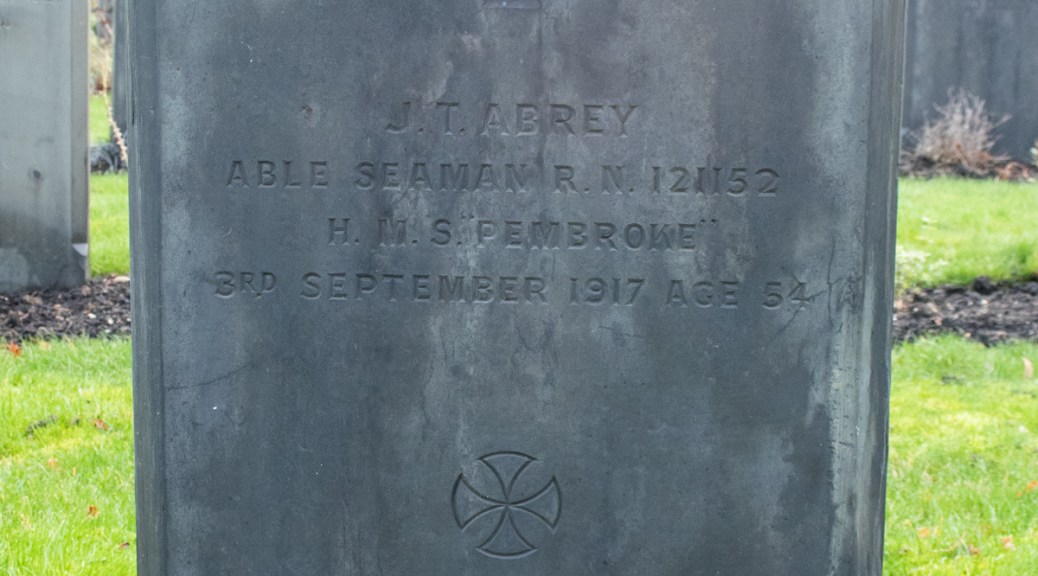
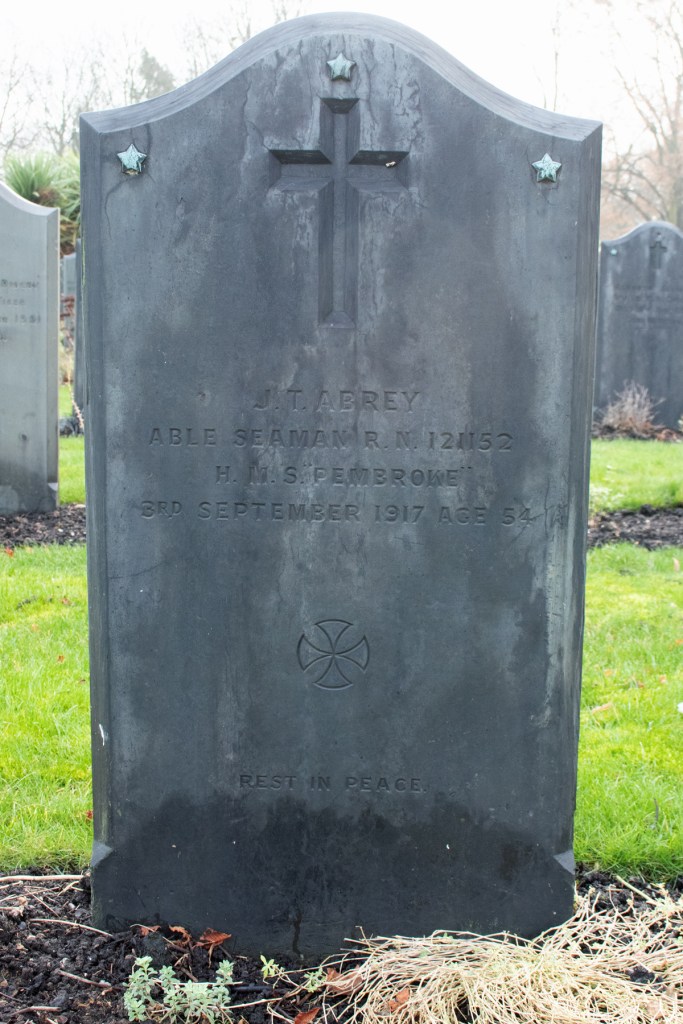
On the night of 3rd September 1917, Chatham suddenly found itself in the firing line as a wave of German aircraft bombed the town. The Drill Hall received a direct hit, and Able Seaman Abrey was amongst those to be instantly killed. He had celebrated his 50th birthday the month before.

John Thomas Abrey was laid to rest in the Woodlands Cemetery in Gillingham along with the other servicemen who had perished during the Chatham Air Raid that night.


Stoker 1st Class Frederick Lutitt

Stoker 1st Class Frederick Lutitt

Frederick Lutitt was born on 23rd May 1897, one of thirteen children – and one of twins – to Thomas and Mary Lutitt. Thomas was a sailor and so was away at sea a lot of the time. This left Mary raising the family alone, and the conditions seemed to have been against her.

The 1891 census recorded Mary as living at 11 Meard Street in St James, London. She was sharing the property with four other families at the time, although, with eight children by this point, hers was the largest. She was 40 years old and was earning some money working as a tailoress, as where here two oldest daughters.

Ten years later, and by now Mary was living in a new house; Thomas was away again, but four of her children – including Frederick – were still living at home, and there was also a boarder, 16-year-old printer’s boy Albert Poulter. Frederick and his twin, Charles, were working as errand boys at the local docks, while Mary was still tailoring.

Frederick was keen on bettering himself, however, and, on 25th January 1906, he enlisted in the Royal Navy. He signed up as a Stoker 2nd Class for an initial five year term of service, with another seven years in the reserve. His service records show that he has begun work as a labourer, and that he was 5ft 3.5ins (1.61m) tall, had brown hair, brown eyes and a fresh complexion.

Stoker Lutitt served on four ships during his term of service – HMS Acheron, Attentive, Endymion and Indomitable – and was promoted to Stoker 1st Class. Between each posting, however, he returned to his base port, the Royal Naval Dockyard in Chatham, Kent, which was also known as HMS Pembroke.

Frederick was stood down from active duty in January 1911 and that year’s census found him living back with his family in two rooms off Tottenham Court Road. Tailoress Mary was still very much the head of the household, with Frederick and Charles – who was employed as a trouser presser – still at home. Mary’s daughter, Ada, had moved back in with her two children in tow.

Storm clouds were gathering over Europe, and Frederick’s time on reserve was limited. He was recalled to HMS Pembroke in October 1912, and soon found himself at sea, on board the cruiser HMS St George. The following year, he was assigned to another cruiser – HMS Apollo – which had been converted to a minelayer.

Romance was in the air for Stoker Luttit, and on 11th April 1914, he married Edith Lambert. She was a plumber’s daughter from Kentish Town, and the couple wed at St Pancras Register Office, while he was on leave.

Two further postings awaited Frederick, the minesweeper HMS Bluebell and the coastguard gunboat, HMS Colleen. By July 1917, however, he found himself back at the dockyard in Chatham. It was a busy place that summer, and temporary accommodation was installed at Chatham Drill Hall. Frederick found himself billeted there.

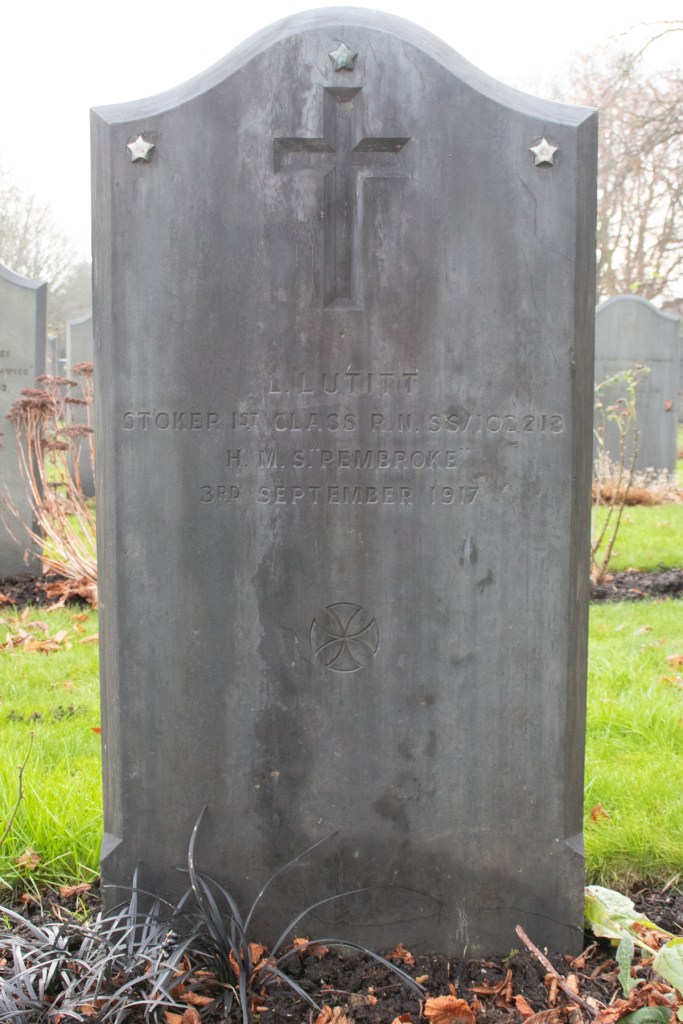
On the 3rd September 1917, the German Air Force carried out its first night air raid: Chatham was heavily bombed and the Drill Hall received a direct hit; Stoker 1st Class Lutitt was among those killed instantly. He was just 30 years of age.

Frederick Lutitt was laid to rest, alongside the other victims of the Chatham Air Raid, in the Woodlands Cemetery, Gillingham.


Frederick’s headstone gives the incorrect initial, but the details are correct.


Frederick’s older brother, Richard, served in the army. Initially enlisting in 1893, he served in Malta. He was called back into service in April 1915, joining the West Riding Regiment as a Private. Sent to France, he was killed on 12th December 1917, at the age of 42 years old; he left behind a widow and five daughters. He was buried at the Windmill British Cemetery in Monchy-le-Prieu.


Stoker 1st Class Frederick Cable

Stoker 1st Class Frederick Cable

Frederick Charles Cable was born on 22nd November 1890 in Eastbourne, West Sussex. He was the younger of three children to John and Louisa Cable, and the family lived on one floor of a three-storey house in the middle of the town.

When Frederick was born, John was working as a billiard marker, but it seems that this was a poor way to scratch together a living for a young father. The 1901 census found the family in London, where John had been born, and where he was not employed as a hotel waiter.

Sadly, the new set-up was not to last long: John died in 1905, leaving Louisa to raise her boys on her own. The next census record, in 1911, records the two of them living a five-room terraced house in East Finchley. They were not alone, however, as they were sharing it with a widow – Elizbeth Hickinbottom – and her 34-year-old son, George.

A year later, George and Louisa married, and went on to have a daughter, also called Louisa. Frederick, meanwhile, was to find love of his own, and, in the spring of 1914, while working as a milkman, he married Dorothy Ada Laurence. They would go on to have a son, who they named after his father, a year later.

By this point, war was raging in Europe, and Frederick was called to do his duty in May 1915. His records show that he was 5ft 7ins (1.70m) tall, had dark brown hair, brown eyes and a dark complexion and was given the rank of Stoker 2nd Class.

Over the next couple of years, Frederick served on two ships – HMS Actaeon and HMS Weymouth – and it was on board the latter that he was promoted to Stoker 1st Class in April 1916. The majority of his time, however, was spent on shore-based establishments: HMS Victory in Hampshire and HMS Pembroke in Kent.

The Royal Naval Dockyard in Chatham (HMS Pembroke) was where he spent most of his time, and was where he returned to in the summer of 1917. It was a particularly busy place at that point in the war and temporary accommodation was set up. Frederick found himself billeted at The Drill Hall, away from the main barracks.

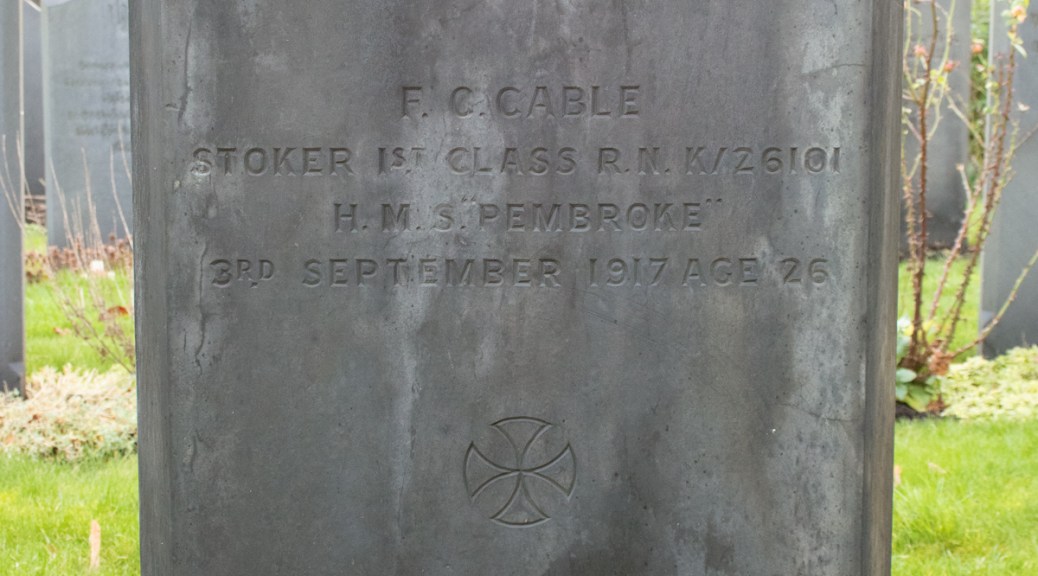
On the night of 3rd September 1917, Chatham suddenly found itself in the firing line, as the German Air Force launched a bombing raid. One of the bombs landed squarely on the Drill Hall, and Stoker Cable was killed instantly. He was just 26 years old.

Over a hundred servicemen perished during the Chatham Air Raid that night. They were buried in a mass funeral at the Woodlands Cemetery in nearby Gillingham. This, too, is where Frederick Charles Cable was laid to rest.


Frederick’s brother John Cable also fought in the First World War. He served as a Sergeant in the 21st Battalion Middlesex Regiment and was killed at the Battle of St Quentin on 25th March 1918. He was 28 years old and left a widow and three children.

Serjeant John Cable is commemorated on the Arras Memorial in Northern France.


Stoker 2nd Class Charles Cash

Stoker 2nd Class Charles Cash

Charles Cash was born on 8th August 1893 in Stepney, East London. He was one of seven children to Samuel and Clara Cash. The 1901 census gives Samuel’s trade as a fish porter, while his wife was recorded as a scrubber in a Sick Asylum.

Samuel died not long after the census was taken, and the family seems to have dissipated. Charles is recorded as having entered the local workhouse with his younger brother on 1st August 1906: the reason for admission being deserted by their mother.

The next census record – taken in 1911 – raises some hope for Charles as it found him living with his mother’s sister and brother-in-law in Bow, where he was working as a labourer in a chemical works.

Things continued to look up for young Charles. On 1st August 1915 – nine years after entering the workhouse, he married Florence Elizabeth Ribbons, a labourer’s daughter from Poplar. The couple went on to have one child, a daughter named after her mother, in October 1916.

War was, by this point, raging across Europe and, despite having a new baby, Charles had to play his part. On 12th December 1916, he joined the Royal Navy as a Stoker 2nd Class, and, given his age, it is likely that he was drafted, rather than volunteering.

Stoker Cash’s service records show that he was 5th 7.5ins (1.71m) tall, he had dark brown hair, brown eyes and a fresh complexion. He was posted to HMS Pembroke, the Royal Naval Dockyard in Chatham, and it was here that he served for nine months.

The summer of 1917 was particularly busy for the base, and temporary accommodation was set up in the Drill Hall; this is where Charles found himself billeted.

On the night of 3rd September 1917, Chatham suddenly found itself in the firing line as a wave of German aircraft bombed the town. The Drill Hall received a direct hit, and Stoker Cash was amongst those to be instantly killed. He was just 24 years old.

More than 100 servicemen perished during the Chatham Air Raid that night. They were buried in a mass funeral at the Woodlands Cemetery in nearby Gillingham. This, too, is where Charles Cash was laid to rest.


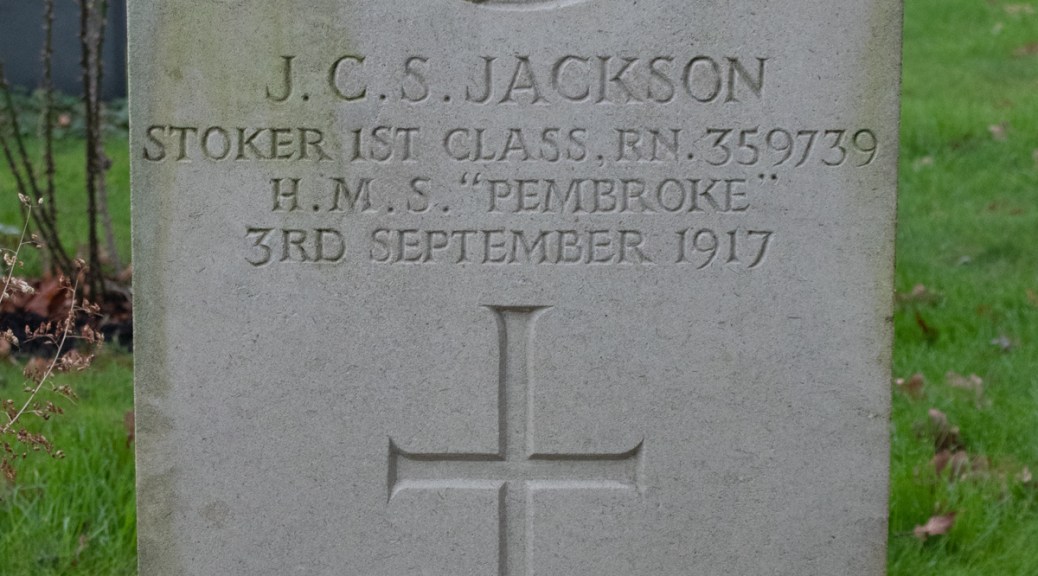
Stoker 1st Class Joseph Jackson

Stoker 1st Class Joseph Jackson

Joseph Charles Sackett Jackson was born in Rotherhithe, Surrey, on 4th May 1884, and was one of seven children. His father – post office worker Joseph Jackson Sr – died in 1895, leaving his mother, Eliza, to raise the family.

She soon married Matthew Newton, a widower himself, and the 1901 census found the couple living in Asylum Road, Peckham with eleven of their children and step-children. Joseph, who was 17 years old by this point, was one of only four of the household to be working, and was employed as a brass turner.

Keen to better himself, Joseph looked to a longer career and, in September 1901, he enlisted in the Royal Navy. His service records show that he was 5ft 3ins (1.6m) tall, had dark brown hair, brown eyes and a fresh complexion.

Initially underage, he served on the home front, Joseph was based at the shore establishments around the country – HMS President (London), HMS Pembroke (Chatham Dockyard, Kent) and HMS Victory (Portsmouth, Hampshire). In 1906, when he turned 23, he formally enlisted in the Royal Navy, and was given the rank of Stoker 2nd Class.

Over the next year, Joseph served on three vessels – HMS Hawke, HMS Dido and HMS Pathfinder – and was promoted to Stoker 1st Class. He continued his work at sea, but returned to HMS Pembroke in between voyages.

In the summer of 1913, Stoker Jackson was assigned to the battleship HMS Dominion, and it was here that he spent the next four years. He was promoted again, to Acting Leading Stoker in July 1915, and full Leading Stoker six months later. The role may not have suited Joseph, however: his service records recorded a drop in his character from Very Good to Fair, and he was demoted to Stoker 1st Class at the end of August 1916.

By the summer of 1917, Joseph was back at Pembroke and, as the dockyard was overcrowded, was billeted in temporary accommodation in the Drill Hall.

On the 3rd September 1917, the first night air raid carried out by the German Air Force bombarded the town, and scored a direct hit on the Drill Hall; Stoker 1st Class Jackson was among those killed instantly. He was 33 years old.

Joseph Charles Sackett Jackson was laid to rest, along with the other victims of the Chatham Air Raid, in the Woodlands Cemetery, Gillingham.


Private Wilfred Francis

Private Wilfred Francis

Wilfred Harry Francis was born in October 1890 in Castle Cary. He was the oldest of eight children to Edward and Rosina Francis, both of whom had also been born in the Somerset Town. Edward was a baker in his younger days, but, by the 1911 census he was employed as a builder’s labourer. Wilfred was recorded in the same document as a tailor.

War was coming to Europe, and Wilfred enlisted. He had been a volunteer in the Somerset Light Infantry, but on 6th April 1915, he made this a formal role. His service records show that he stood 5ft 6ins (1.68m) tall had light blue eyes and light brown hair.

Private Francis was assigned to the 6th Battalion and sent to France in the summer of 1915. His battalion was immediately thrown into the thick of the fighting at Ypres. The intensity of the battles of Hooge and Bellewaarde seemed to impact Wilfred as, on 7th October, he was admitted to the 4th London General Hospital, suffering from shell shock.

Wilfred was discharged after two weeks, and signed off as fit for light duties. It seems that he didn’t return to the Western Front, but instead was transferred to the 3rd (Reserve) Battalion of the regiment, based in Devonport.

The memories still seemed to haunt Private Francis, however. He was admitted to hospital again – this time the County of Middlesex Hospital in Napsbury, near St Albans – with mania. This time his ‘mental deficiency’ proved to much for the army, and he was discharged from military service on 18th July 1916. His discharge papers show that he gave the hospital as his address and recommended that he be admitted to a civil asylum.

Wilfred’s trail goes cold for the next few years. He seems to have been brought back to Somerset for ongoing treatment, but passed away in Wells on 27th March 1919; the cause of his passing is not known. He was 28 years of age.

Wilfred Harry Francis was laid to rest in the Castle Cary Cemetery, hopefully finding peace at last.