Category Archives: London

Private John Lake

Private John Lake

John Walker Lake was born in Eastbourne, East Sussex, in the spring of 1892, the only child of estate manager and auctioneer Percy Lake and his wife Elizabeth.

John’s mother passed away in 1900, when he was only eight years old, and details of his early life are hard to come by. However, by the time of the 1911 census, he had left school and enrolled in a mining college in Guston, near Dover, Kent.

When war broke out, John was quick to enlist. He joined the London Regiment on 18th September 1914, and was assigned to the 2nd/23rd Battalion. His service records show that he stood 5ft 8ins (1.72m) tall, had light hair, blue eyes and a fair complexion.

Private Lake was not to remain in the army for long. Within weeks of joining, he contracted tuberculosis and, on 22nd February 1915, after just 158 days, he was discharged from service as being no longer medically fit for duty.

At this point, John’s trail goes cold. He initially returned to live with his father in Eastbourne. By the autumn of 1918, however, he was in Weston-super-Mare, Somerset, probably for health reasons.

The tuberculosis got the better of John Walker Lake, however; he passed away on 20th October 1918, at the age of 26 years old. He was laid to rest in the Milton Road Cemetery in Weston-super-Mare.


Lieutenant Cecil Pearse

Lieutenant Cecil Pearse

Cecil George Lunell Pearse was born in the spring of 1883, one of seven children to George and Elizabeth Pearse. George was a schoolmaster from Devon, who moved the family to Weston-super-Mare in Somerset in the the 1870s to take up a post at the National School in the centre of the town.

Cecil and at least two of his siblings also went on to become teachers. By the time of the 1911 census, he was living in Plumstead, South East London, with his brother and sister-in-law, and teaching locally.

War was about to descend on Europe, and it is at this point that Cecil’s trail begins to go cold. He enlisted in the Royal Field Artillery, serving as part of the 8th London Howitzer Brigade. During his time, he rose to the rank of Lieutenant, and it seems that he remained part of the Territorial Force, but there is little more information available about his time in the army.

Nor is there much detail around Lieutenant Pearse’s death. He passed away on 20th October 1918, at the age of 35 years old, through causes unrecorded.

Cecil George Lunell Pearse was laid to rest in the Milton Road Cemetery in Weston-super-Mare, the town of his birth.


Major Stafford Douglas

Major Stafford Douglas

Stafford Edmund Douglas was born on 4th January 1863, the second of four children to Stephen and Mary Douglas. Stafford came from a military family, his father having been a Captain in the Royal Navy. This led to a lot of travelling and, having been born in Donaghadee, County Down, he then moved to South Wales.

By the 1880s, when Stephen and Mary had set up home in Portsmouth, Stafford had started to carve out a career for himself, and was a Lieutenant in the Argyll and Sutherland Highlanders, based at Edinburgh Castle.

Over the coming years, Lieutenant Douglas, who stood 5ft 8.5ins (1.74m) tall and also spoke French, travelled the world, serving in South Africa, Ceylon (Sri Lanka) and Hong Kong. By 1894 he had made Captain, and he finally retired in 1903, after nineteen years’ service.

On 29th April that year, at the age of 40, Stafford married Mary Louisa Harris. She was the daughter of an army colonel, and the couple wed in St George’s Church, Hanover Square, London. The couple set up home in Exeter, Devon, and went on to have two children – Violet and Stafford Jr.

At this point, Stafford’s trail goes cold. When war broke out in 1914, he was called back into duty, working as a Railway Transport Officer in Norwich. He continued in this role until 1919, before being stood down and returning home.

Stafford Edmund Douglas passed away on 15th February 1920, at the age of 57 years old, although no cause of death is immediately apparent. He was laid to rest in the Milton Road Cemetery in Weston-super-Mare, presumably where his family were, by this time, residing.


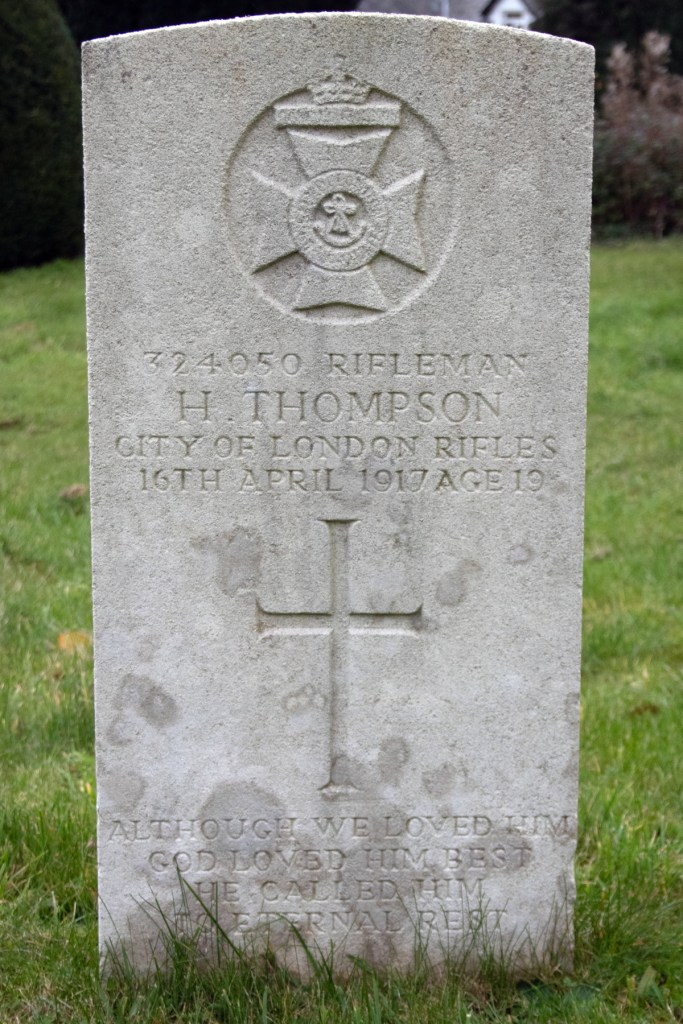
Rifleman Horace Thompson

Rifleman Horace Thompso

Horace Douglas Thompson was born in Camberwell, East London on 23rd April 1898. He was the oldest of four children – and the only boy – to Horace and Elizabeth Thompson. Horace Sr was a grocer’s packer, originally from the village of Gissing in Norfolk.

Details of Horace Jr’s early life are a little sketchy, but it seems that by some point after the 1911 census, both of his parents had died, and he was fostered by his aunt and uncle – Charlotte and Robert Thompson – who lives in Leytonstone. By this point, he was working as a doctor’s errand boy.

When war broke out, Horace was keen to play his part. He enlisted in the 6th Battalion of the London Regiment – also known as the City of London Rifles – towards the end of 1916. It is unclear whether Rifleman Thompson saw any action overseas, but in April 1917 he was admitted to the Voluntary Aid Detachment Hospital in Newton Abbot, Devon, suffering from acute gastritis, or appendicitis.

Sadly, Rifleman Horace Douglas Thompson was to succumb to the condition – he passed away at the hospital on 16th April 1917. He was laid to rest in Newton Abbot Cemetery; he was days short of his 19th birthday.


Stoker 1st Class William Bullock

Stoker 1st Class William Bullock

William Bullock was born on 25th December 1882, one of nine children to William and Ellen Bullock. William Sr was a fish fryer from London, and this is where he and Ellen brought up their family.

When he left school, William worked as a coster and porter, and, in 1909, he married long time love Amelia Horrigan. The couple went on to have four children: two boys and two girls.

War was closing in on Europe and, on 23rd November 1915, William enlisted. He joined the Royal Navy as a Stoker 2nd Class: his service records state that he stood 5ft 5ins (1.65m) tall, had dark brown hair, hazel eyes and a fresh complexion.

Stoker Bullock’s first posting was HMS Pembroke, the Royal Naval Dockyard at Chatham, Kent. He spent most of his time there, returning to the base after voyages on board HMS Cheerful and HMS Shannon. It was while on board the Shannon that William was promoted to Stoker 1st Class.

In August 1917, William was back at HMS Pembroke. The Dockyard was particularly busy that summer, and the large number of extra servicemen meant that he found himself billeted in temporary accommodation in Chatham Drill Hall.

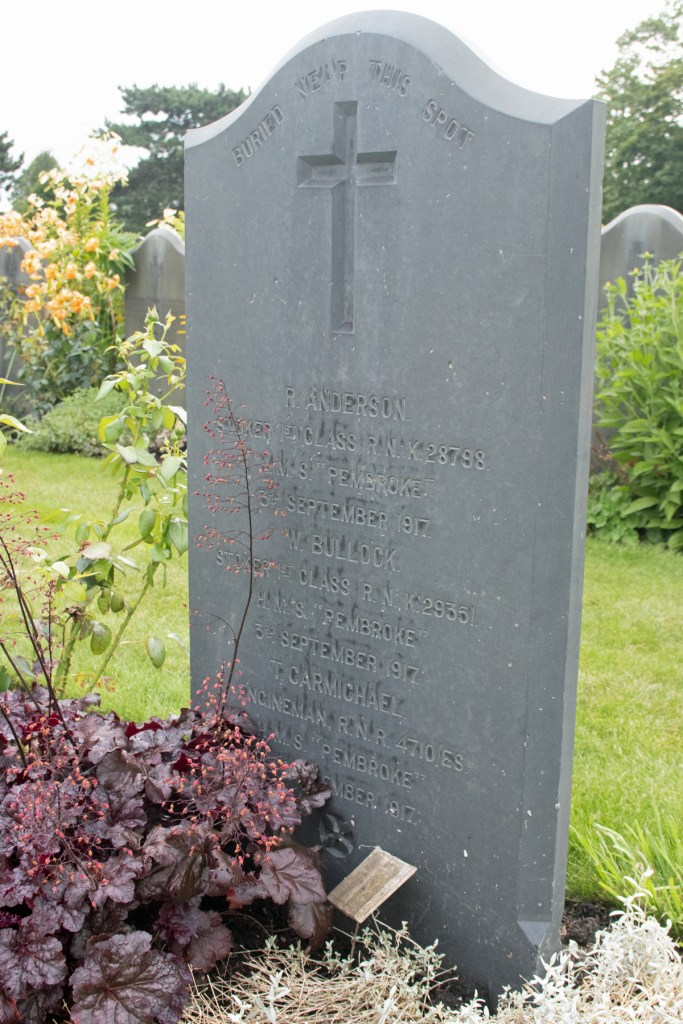
On the 3rd September 1917, the first night air raid carried out by the German Air Force bombarded the town, and scored a direct hit on the Drill Hall; Stoker 1st Class Bullock was among those killed instantly. He was 34 years old.

William Bullock was laid to rest, along with the other victims of the Chatham Air Raid, in the Woodlands Cemetery, Gillingham. Tragically, the Navy Death records state that he was: Buried as “unidentified” in one of the following graves – 516, 522, 735, 642, 935, 937 or 948.


Stoker 1st Class Frederick Reyner

Stoker 1st Class Frederick Reyner

Frederick Walter Reyner was born in Braintree, Essex, on 18th May 1884. The youngest of five children, his parents were Stephen and Martha Reyner. Stephen was a carpenter, who raised his family alone, when Martha passed away in 1889.

When Frederick left school, he found work as an iron worker. When Stephen also died in 1902, Frederick moved in with his older brother, Henry.

His father’s death seemed to have been the spur he needed to move on to bigger and better things: on 21st April 1904, Frederick enlisted in the Royal Navy as a Stoker 2nd Class for an initial period of five years. His service records show that he stood 5ft 4ins (1.63m) tall, had brown hair, brown eyes and a fresh complexion, with a small scar on his left thumb as an identifying mark.

Over the course of his term of service, Stoker Reyner served on three ships – HMS Acheron, Berwick and Irresistible – and was promoted to Stoker 1st Class. After each voyage, he returned to HMS Pembroke, the Royal Naval Dockyard in Chatham, Kent.

When his initial term ended in 1909, Frederick was placed on reserve, and moved back in with Henry and his family. He worked to pay his way, finding employment as a postman around Brixton, where his brother lived. He met local woman Charlotte Rebecca Scott, and the couple married in St Andrew’s Church, Peckham, on 31st May 1914.

War, by this time, was imminent, and Frederick soon found himself called back in to action. After spending a year on shore, at HMS Pembroke and HMS Victory – the Naval Dockyard in Portsmouth – Stoker Reyner was assigned to HMS Europa, a cruiser that patrolled the Eastern Mediterranean. He spent two years on board, before returning to HMS Pembroke in July 1917.

The base was particularly busy that summer, and the large number of extra servicemen meant that Frederick was billeted in temporary accommodation in Chatham Drill Hall.

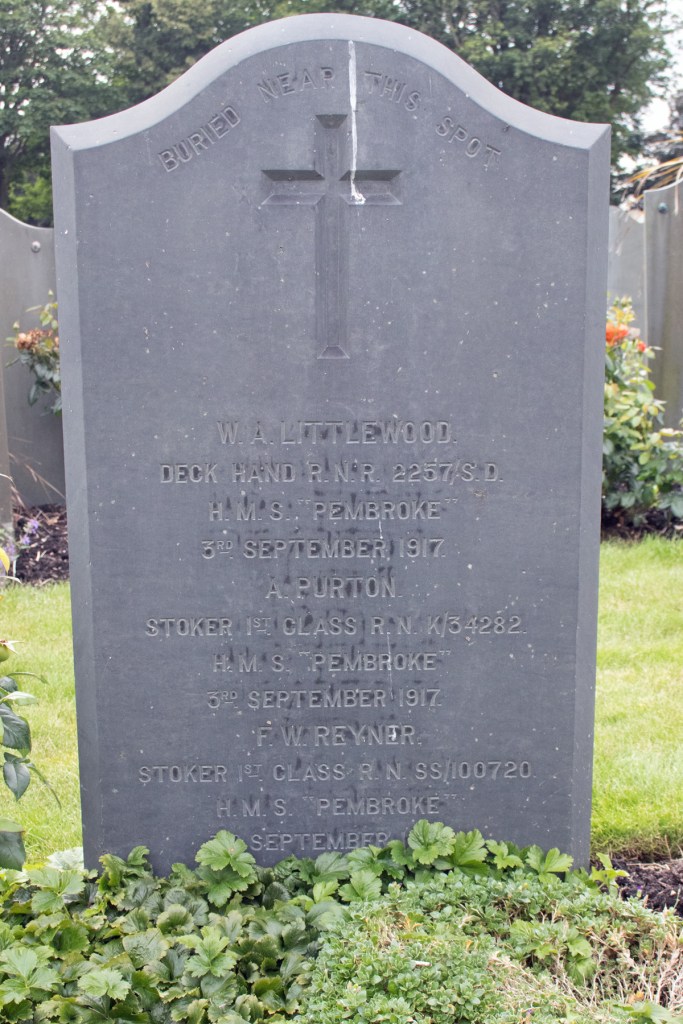
On the 3rd September 1917, the first night air raid carried out by the German Air Force bombarded the town, and scored a direct hit on the Drill Hall; Stoker 1st Class Reyner was among those killed instantly. He was 33 years old.

Frederick Walter Reyner was laid to rest, along with the other victims of the Chatham Air Raid, in the Woodlands Cemetery, Gillingham. Tragically, the Navy Death Records state that he was Buried as unidentified in one of the following graves: 516, 522, 642, 735, 935, 937 or 948.


To add to the sadness of Frederick’s story, Charlotte was pregnant when he died. She gave birth on 31st May 1918, to a son who she named in memory of her late husband.


Stoker 1st Class Alfred Purton

Stoker 1st Class Alfred Purton

Alfred Purton was born on 10th November 1897, one of fourteen children to Daniel and Rosetta Purton. Daniel was a dock labourer from Bromley-by-Bow, East London, and this is where the family were raised.

When he left school, Alfred found work as a stoker at the local gasworks, but in 1916, he was called up to do his duty for King and Country. Given his family background and his own employment, it is little surprise that he enlisted in the Royal Navy as a Stoker 2nd Class.

Alfred’s service records show that he stood 5ft 5ins (1.65m) tall, had auburn hair, brown eyes and a fresh complexion, although he was noted to have moles on his legs and arms. His first posting was at HMS Pembroke, the Royal Naval Dockyard in Chatham, Kent, and he spent a couple of months training there.

In October 1916, Stoker Purton was assigned to the cruiser HMS Dartmouth, which helped patrol the South Atlantic. During his nine months on board, his work was recognised and he was promoted to Stoker 1st Class.

In July 1917, Alfred returned to HMS Pembroke. The Dockyard was particularly busy that summer, and a large number of extra servicemen meant that he was billeted in temporary accommodation in Chatham Drill Hall.

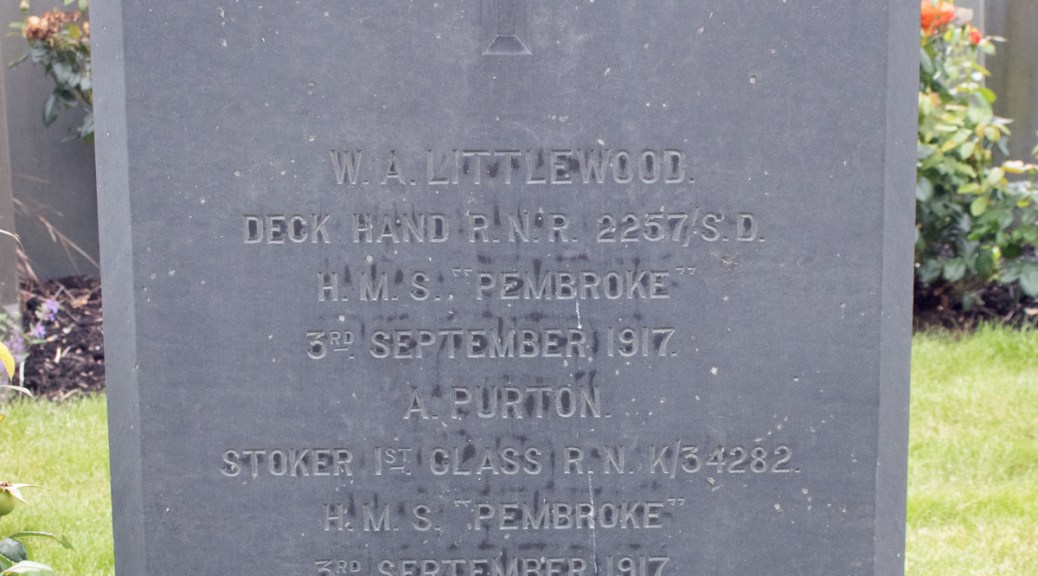
On the 3rd September 1917, the first night air raid carried out by the German Air Force bombarded the town, and scored a direct hit on the Drill Hall; Stoker 1st Class Purton was among those killed instantly. He was just 19 years old.

Alfred Purton was laid to rest, along with the other victims of the Chatham Air Raid, in the Woodlands Cemetery, Gillingham. Tragically, the Navy Death Records state that he was Buried as unidentified in one of the following graves: 516, 522, 642, 735, 935, 937 or 948.


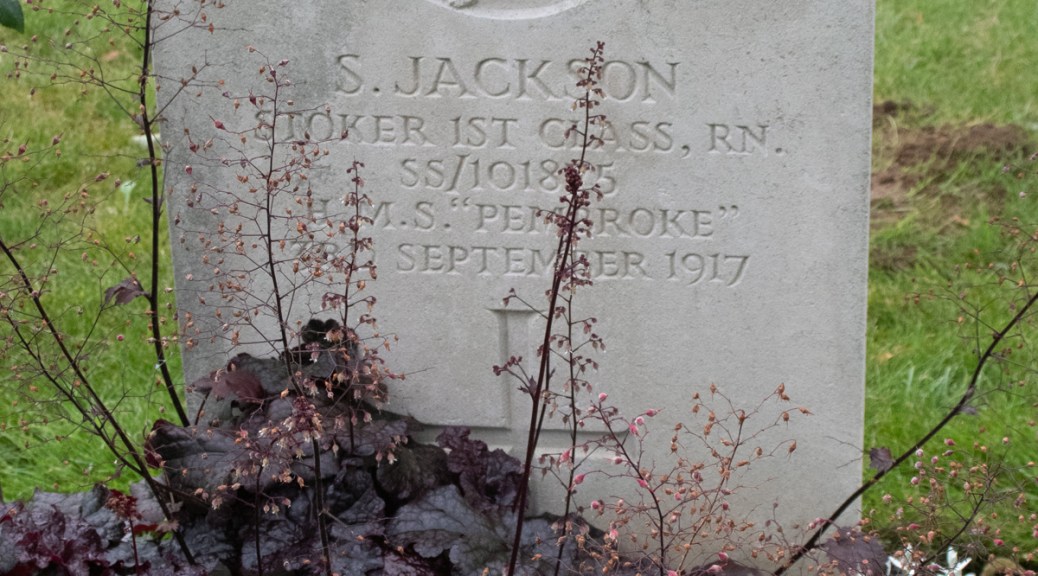
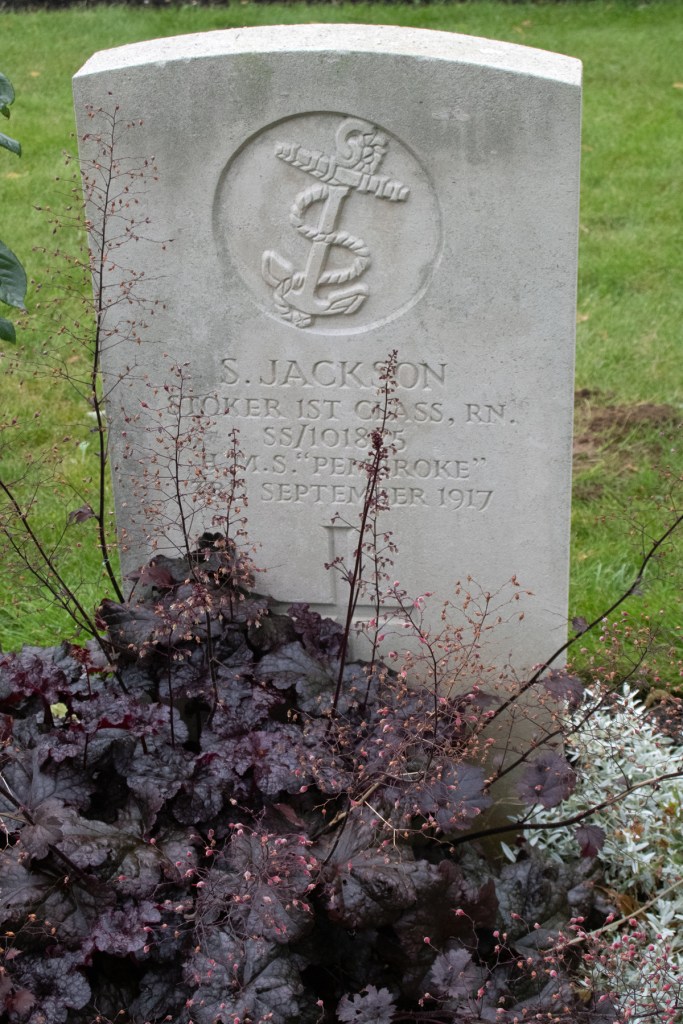
Stoker 1st Class Sydney Jackson

Stoker 1st Class Sydney Jackson

Sydney Jackson was born in Walsall, Staffordshire, on 1st May 1886. One of three children to William and Emma Jackson, he also had three older half-siblings through William’s previous marriage. William was a vice manufacturer, and this is something Sydney helped his father with when he finished school.

He had bigger plans, however, and, on 11th December 1905, Sydney enlisted in the Royal Navy. His service records show that he stood 5ft 6ins (1.68m) tall, had hazel eyes, dark brown hair and a fresh complexion. Sydney joined up for a period of 5 years, and was given the role of Stoker 2nd Class.

During his initial term of service, he served on seven different ships, rising to the rank of Stoker 1st Class in the process. Between each voyage he returned to HMS Pembroke, the Royal Naval Dockyard in Chatham, Kent, and this was to become his land base.

Stoker Jackson’s career was not to be blemish flee, though. In the autumn of 1906, he spent two periods of time in the brig – the first for seven days, the second for two weeks. There is nothing to confirm what infraction he had committed, but given that the two imprisonments were within weeks of each other, it seems likely that something external was going on with him at the time.

When Sydney’s initial term of service came to a close, he was placed on reserve. There is not a great deal of information available about this part of his life, although the 1911 census records him as boarding in the Bruce House Registered Lodging House in Central London; he is listed as being a stoker.

His time on reserve did not last for long, however, and in October 1912 he was recalled. Over the next five years, Stoker Jackson served on a further four ships. In the spring of 1917 he returned to HMS Pembroke; the base was a busy place that summer, and temporary accommodation was set up at the Dockyard’s Drill Hall. This is where Sydney found himself billeted.

On the 3rd September 1917, the German Air Force carried out its first night air raid: Chatham was heavily bombed and the Drill Hall received a direct hit; Stoker 1st Class Jackson was among those killed instantly. He was 31 years old.

Sydney Jackson was laid to rest, along the other victims of the Chatham Air Raid, in the Woodlands Cemetery, Gillingham.


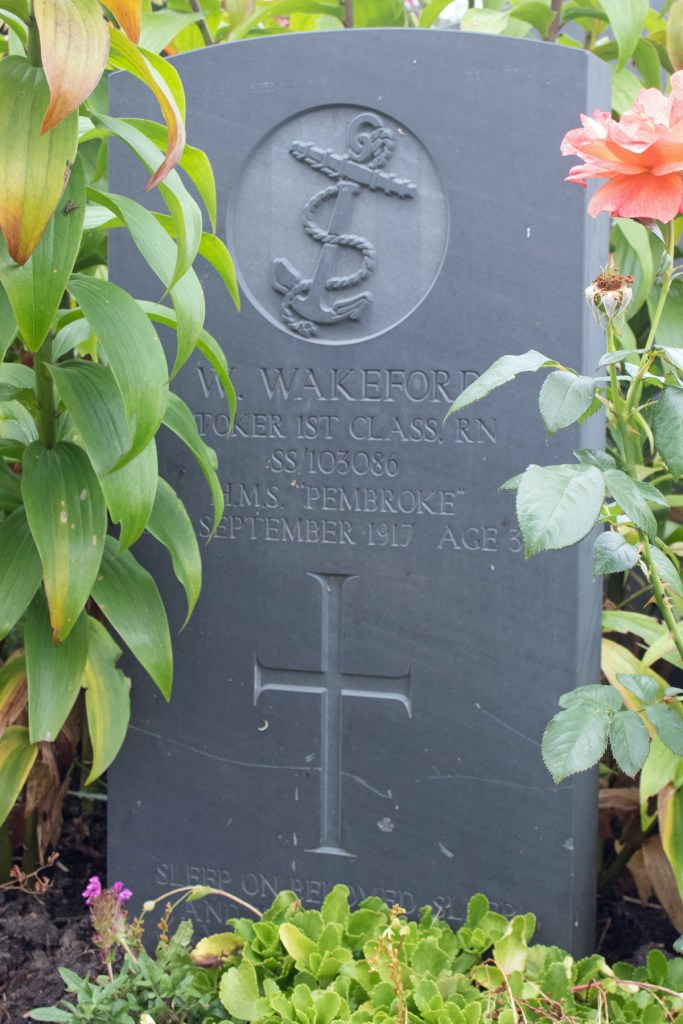
Stoker 1st Class William Wakeford

Stoker 1st Class William Wakeford

William Edward Wakeford was born on 18th April 1885, the oldest of seven children to William and Theresa. William Sr had been born in East London and was a labourer for the engineering company Vickers. Theresa came from south of the Thames, in Greenwich, and it was in South East London that the Wakefords raised their family.

When he left school, William Jr found work as an assistant to a corn dealer. He was set on a better life and career, however, and, on 1st June 1906, at the age of 20, he enlisted in the Royal Navy with the rank of Stoker 2nd Class.

William learnt on the job; he was initially assigned to HMS Acheron and, during his initial five-year term of service, he served on five further vessels, rising to the rank of Stoker 1st Class as a result of his hard work. In between his voyages, however, he was based at HMS Pembroke, the Royal Naval Dockyard at Chatham, Kent.

When his contract came to an end in May 1911, Stoker Wakeford was assigned to the Royal Naval Reserve. With war looming, however, this did not turn out to be for long and, when hostilities begun in 1914, he was called back into action. He was assigned to the battleship HMS Cornwallis, and spent more than two years on board. During this time, the ship saw action in the Eastern Mediterranean, primarily the Dardanelles Campaign, and the fighting around Gallipoli.

By the start of 1917, Stoker Wakeford was back on dry land, and based at HMS Pembroke. For a variety of reasons, that was a particularly busy year at the dockyard, and temporary additional accommodation was set up at the Chatham Drill Hall nearby; this is where William found himself billeted.

On the 3rd September 1917, the German Air Force carried out its first night air raid: Chatham was heavily bombed and the Drill Hall received a direct hit; Stoker 1st Class Wakeford was among those killed instantly. He was 32 years of age.

William Edward Wakeford was laid to rest, along with the other victims of the Chatham Air Raid, in the Woodlands Cemetery, Gillingham.


William’s younger brother Cecil also fought in the Great War. Serving as a Private in the 2nd Battalion Royal Inniskilling Fusiliers, he saw fighting on the Western Front. Caught up in the Battle of St Quentin in March 1918, he was killed as the regiment were cut off by German advances. He was just 22 years old. He was laid to rest in France, and is commemorated at the Pozières Memorial.


Ordinary Seaman Charles Goodsell

Ordinary Seaman Charles Goodsell

Charles Henry Goodsell – known as Harry – was born on 15th February 1897, the oldest of six children. His parents were Henry and Fanny Goodsell, who had been born in Sussex, but had moved to London in the late 1890s, presumably for work.

Henry was a compositor, setting type for printers, but his son’s first job after leaving school was as a van guard for the local Co-op. By the outbreak of the war, he had begun working in the store himself, but the hostilities soon put a stop to that.

In 1916, the call came, and, on 6th March, Harry joined the Royal Navy as an Ordinary Seaman. He was initially sent to HMS Pembroke – the Naval Dockyard in Chatham, Kent – where he completed his initial training. By May 1916, however, he was given his first posting, on board the battleship HMS Swiftsure, protecting the Atlantic convoys.

After nearly a year at sea, Ordinary Seaman Goodsell found himself back at HMS Pembroke. The Dockyard was particularly busy that summer, and the large number of extra servicemen meant that Harry was billeted in temporary accommodation in Chatham Drill Hall.

On the 3rd September 1917, the first night air raid carried out by the German Air Force bombarded the town, and scored a direct hit on the Drill Hall; Ordinary Seaman Goodsell was among those killed instantly. He was just 20 years old.

Charles Henry “Harry” Goodsell was laid to rest, along with the other victims of the Chatham Air Raid, in the Woodlands Cemetery, Gillingham.


Charles Henry Goodsell (Harry) 1897 - 1917
Ordinary Seaman Charles Goodsell
(from ancestry.co.uk)