Category Archives: Somerset

Private George Taylor

Private George Taylor

George William Taylor was born on 14th July 1884 in Holcombe, Somerset. He was one of ten children, and his parents were John and Martha Taylor. John was a coal miner and for a while after finishing school, George followed his father to the pit. But he wanted bigger and better things, and was drawn to a career in the army.

On 16th September 1901, George enlisted in the Somerset Light Infantry. His service records confirm that he was 5ft 7ins (1.69m) tall, and weighed 131lbs (59.4kg). It was also noted that he had brown hair, grey eyes and a fresh complexion, and that he had a scar on his right shin and another on his left arm.

Private Taylor was assigned to the 2nd Battalion, and spent the next ten months training on home soil. In July 1902, however, he set off on his first big adventure, travelling to South Africa with his troop. He returned home in the spring of 1903, and spent the remainder of his seven years’ term of service on British soil.

On Christmas Day 1906, George married Ellen Hitchcock. She was the daughter of a blacksmith from Bath, and their marriage certificate adds further details to George’s life. He was living in Plymouth, Devon, when they married, and he gave his trade as a Bugler in the Somerset Light Infantry.

During the rest of his army contract, George had a number of admissions to hospital, for recurring conjunctivitis, a sprained ankle in November 1905 and a bout of scabies in January 1908. That autumn, having served for seven years, he was stood down to reserve status.

By the time of the 1911 census, George had settled back into civilian life. The young couple set up home in Holcombe, and George took up work back in the colliery there, where he was employed as a carter. A boarder helped them bring in a bit more money, but the document shows evidence of tragedy as it notes that Ellen had given birth to two children, but that both had died.

When war came to Europe in 1914, George was called back into active service. Initially assigned to the 1st Battalion of the Somerset Light Infantry, he arrived in France in July 1915. He only remained there for a matter of months, however, and, by October Private Taylor was back in Britain and reassigned to the 3rd Battalion.

It appears that his repatriation may have been for health reasons. On 31st January 1916, George was admitted to the 4th Southern General Hospital in Plymouth. The handwriting in the notes for this admission is difficult to read, but the basic headline is starkly clear: ‘bronchitis and subsequently mental’.

Private Taylor remained in hospital for a couple of weeks, before being moved to the Wells Asylum in Somerset. He was assessed by the military doctor after a couple of months’ treatment, and was declared unfit to continue in active service, due to ‘general paralysis of the insane’ or shellshock/PTSD as it is known today. His illness was wholly attributed to his military service, and sheds some light on what he must have gone through during his short time in France, compared to his previous seven years’ service. George’s last day in the army was on 13th April 1916, and he had served for a total of 14 years, 211 days.

George’s trail goes cold at this point. He passed away on 22nd December 1916, at the age of 32 years old. Although records do not confirm this, it seems likely that he died while he was still admitted to the asylum, as his death was recorded in Wells.

George William Taylor was brought back to Holcombe for burial. He was laid to rest in the family plot in the graveyard of St Andrew’s Church.
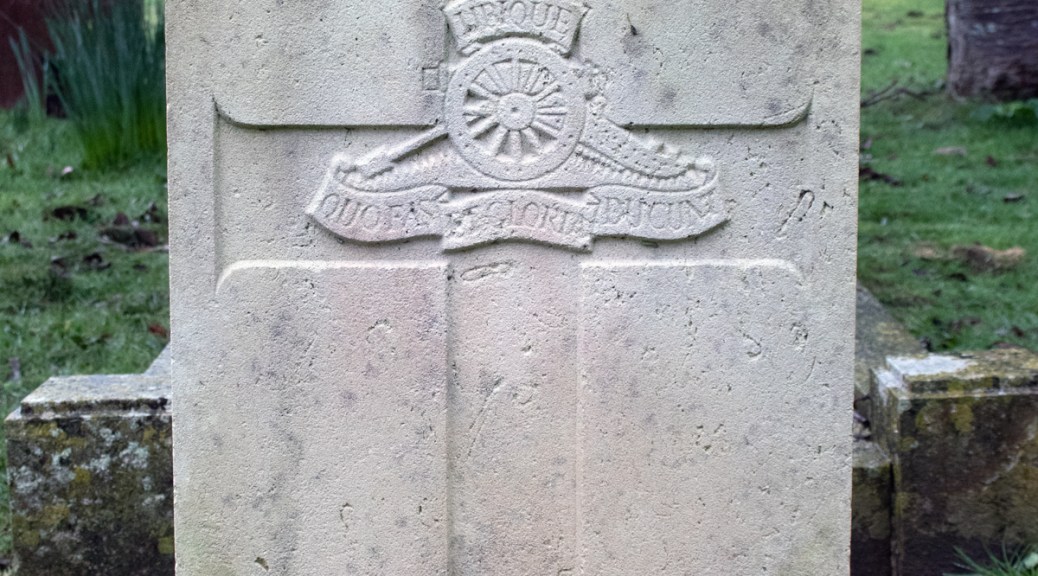

Gunner Alfred Taylor

Gunner Alfred Taylor

Alfred Taylor was born in the summer of 1888 in Crewkerne, Somerset. The second of twelve children, his parents were Henry and Selina Taylor. Henry, who was also known as Harry, was a stone mason, but when Alfred and his siblings left school, they went into the weaving industry, a key employer in the area.

War came to European shores in the summer of 1914, and Alfred was keen to play his part. He had already been a part of the 3rd (Special Reserve) Dorset Regiment, but formally enlisted on 9th December 1915, joining the Royal Garrison Artillery. His service records note that he was 5ft 9ins (1.77m) tall and weighed 149lbs (67.6kg). The document also confirms his next of kin as his father, who, at 48 years old, had also joined up, and was serving in the Royal Engineers in Canterbury, Kent.

Gunner Taylor was not mobilised until September 1916, and served the next eighteen month on home soil. He did his initial training in Hilsea, Portsmouth, before moving around the country. He finally made it to France in February 1918.

During his time in France, Alfred was caught up in a couple of gas attacks, and was evacuated to Britain at the end of August because of the impact on his lungs. Admitted to the 2nd Eastern General Hospital in Brighton, Sussex, his body finally succumbed to pneumonia. He passed away on 25th January 1919, at the age of 30 years old.

The body of Alfred Taylor was brought back to Somerset for burial. He was laid to rest in the Townsend Cemetery of his home town, Crewkerne. “…All the members of Gunner Taylor’s family were present, except his father and his brother George, who [were] with the Army of Occupation in Germany.” [Western Chronicle: Friday 7th February 1919]


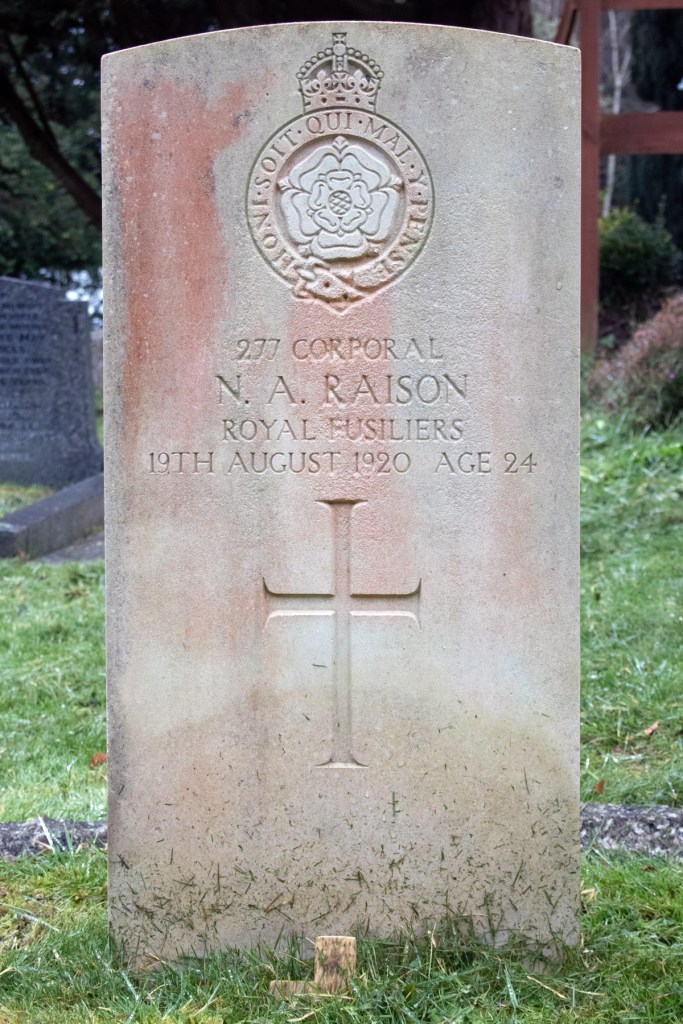
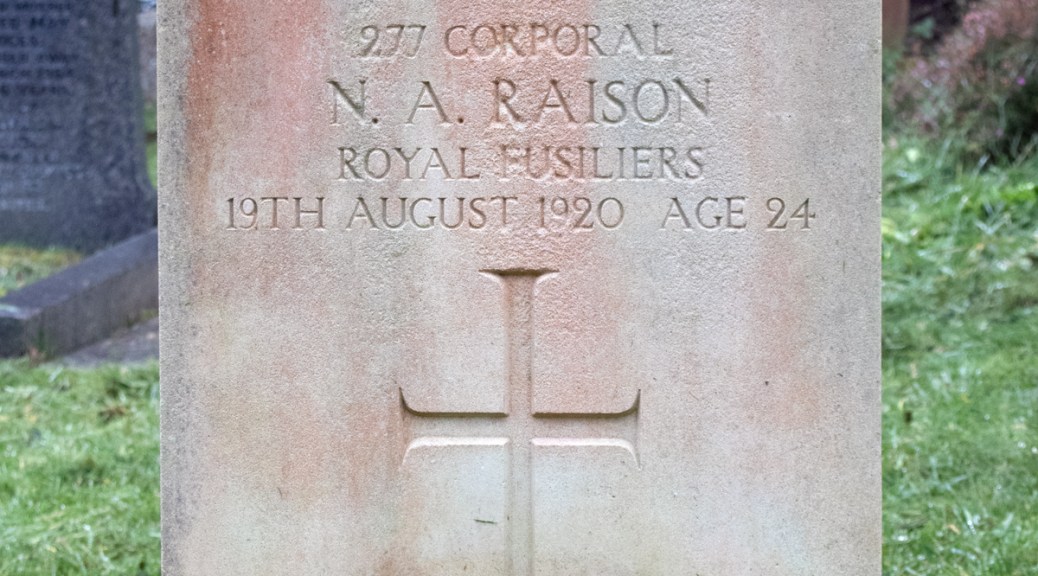
Corporal Austin Raison

Corporal Austin Raison

Austin Neal Raison was born in the spring of 1896 in Crewkerne, Somerset. The eighth of thirteen children, his parents were bootmaker Charles Raison and his wife, Lucy.

Austin’s siblings found a variety of trades, from dressmakers and costumiers to grocers and stationers. When Austin left school, however, he was apprenticed to a printer, a career laid our in front of him.

When war came to Europe, Austin joined the Royal Fusiliers. Full details of his military service have been lost to time, but a local newspaper, reporting on his funeral, provided a summary of his war experience:

The funeral took place at the Cemetery on August 24 of Corporal Austin Neal Raison… who died on the previous Thursday from wounds received in action. Deceased was 24 years of age and in September 1914, he volunteered for service in the Army, joining the Royal Fusiliers. He went to France in October 1915, and took part in most of the important battle from that date until he was severely wounded in the retreat from Cambrai. He returned home, and everything possible was done for him, but he never recovered health, and gradually sank, dying at his father’s house to the sorrow of all who knew him.

Western Chronicle: Friday 3rd September 1920

Corporal Austin Neal Raison died on 19th August 1920. He was laid to rest in the Townsend Cemetery, Crewkerne, within sight of the family home.


The Commonwealth War Graves Commission gives Corporal Raison’s name as Neal Austin, while all other records, including his service documents, confirm his name as Austin Neal.


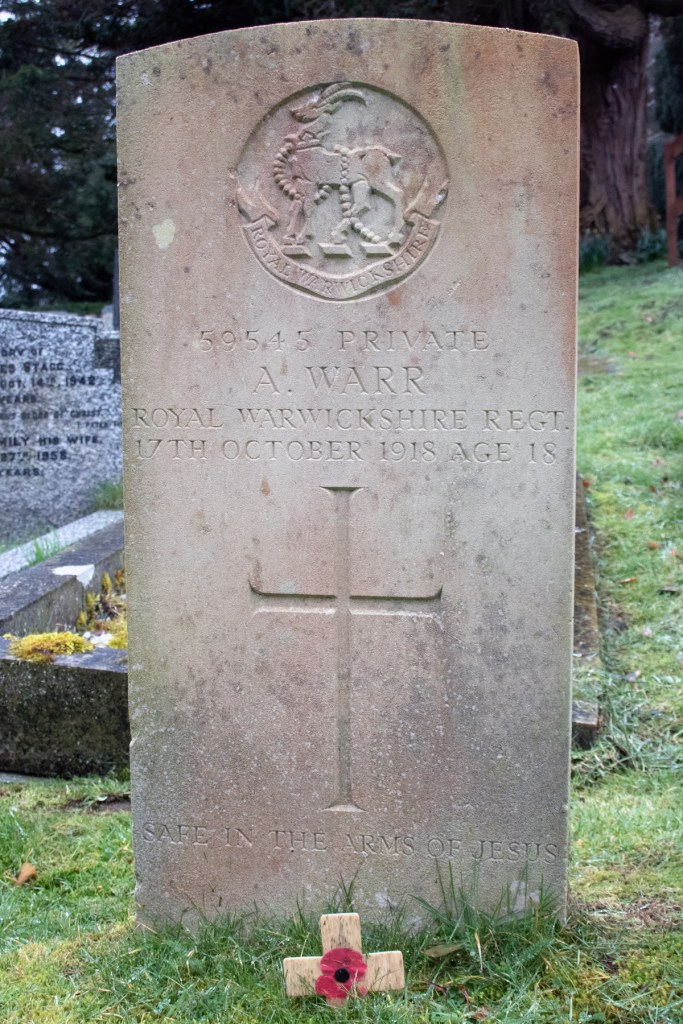
Private Albert Warr

Private Albert Warr

Albert Warr was born in Chaffcombe, near Chard, Somerset, in the spring of 1900. He was the middle of three children to William and Edith. Edith, who was also known as Sophie or Sophia, was nine years older than her husband, and had been married previously. When her first husband passed away, she was left with three children under ten years old – half-siblings to Albert – and so married William to provide them and her a home.

William was an agricultural labourer, but by the time of the 1911 census, the family had moved east to Crewkerne, where both he and Edith took up work in a laundry. The household was complemented by the two older of Edith’s children – Edith, who helped with the laundry work, and Samuel, who was a fishmonger.

Little information is available for Albert’s military service, so his time in the army is a challenge to piece together. He enlisted no earlier than April 1918, and was assigned to the 5th Battalion of the Royal Warwickshire Regiment. Private Warr’s troop fought in France and Italy, although it is unlikely that he saw any action overseas.

All that can be confirmed is that he was admitted to the 1st Northern General Hospital in Newcastle-upon-Tyne, although his condition is unknown. Private Warr passed away on 17th October 1918, aged just 18 years old.

The body of Albert Warr was brought back to Somerset for burial. He was laid to rest in the Townsend Cemetery, within walking distance of the family home in Crewkerne.


Private Warr’s pension ledger notes that Edith had passed away, and that the beneficiary was to be William instead. As this document is not dated, it is not possible to determine when Albert’s mother died, but it is likely to have been between 1917 and 1919.


Bombardier Charles Newbery

Bombardier Charles Newbery

Charles James Anderson Newbery was born in Misterton, a stone’s throw from Crewkerne, Somerset, in the spring of 1895. The oldest of eight children, his parents were Benjamin and Edith Newbery. Benjamin was a farmer, who passed away in 1908, when his son was just 13 years of age.

Charles seems not to have spent a great deal of time in the family home, however: the 1901 census found him living with his paternal grandmother, while the 1911 census, taken three years after his father’s death, recorded him as living with his paternal aunt, and working on their farm.

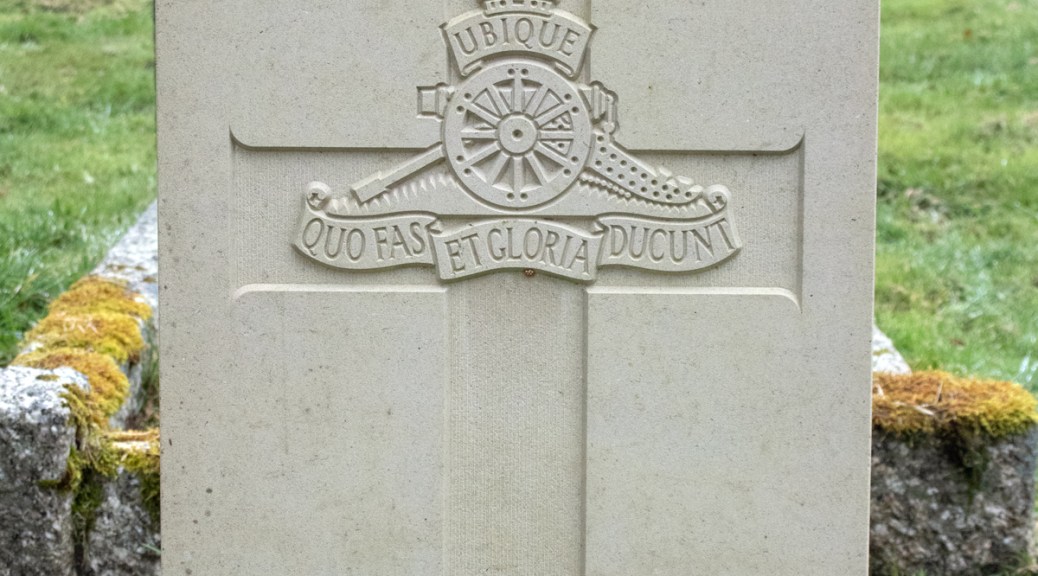
The farming life seemed to suit Charles: indeed he emigrated to Australia to pursue the life. When war broke out in Europe, however, he returned to England’s shores to better serve King and Country. He enlisted in the Royal Garrison Artillery on 18th October 1915, and was given the rank of Gunner.

Charles’ service records confirm that he was 5ft 5ins (1.65m) tall and weighed 140lbs (63.5kg). He was noted as having a mole on his left shoulder and an upper denture.

Private Newbery was sent to France in April 1916 and, a little over a year later, was promoted to Bombardier. He was attached to the 137th Heavy Battery and all seemed to be going reasonably well for him. He had ten days’ in England in July 1917, and a further two weeks’ in March 1918.

On 13th August 1918, possible during the Battle of Amiens, Charles was injured by a gun shot wound to his right leg. He was initially treated at the 47th General Hospital at Le Treport on the French coast, but was medically evacuated to Britain for further treatment.

Charles was moved to the 4th Northern General Hospital in Lincoln. To complicate matters, he had contracted bronchitis and, while his injury was being managed, it was a combination of the lung condition and cardiac failure to which he succumbed. Private Newbery passed away on 2nd September 1918, his mother and sisters by his side. He was just 23 years of age.

Charles James Anderson Newbery was taken back to Somerset for burial. He was laid to rest in Crewkerne’s Townsend Cemetery, not far from the family home.


Bombardier Charles Newbery
(from ancestry.co.uk)

Edith had to write to the regimental office three times to get her late son’s belongings back, and in the end it took more than six months to do so. She received the items he had on him in Lincoln in April 1919: they included and “upper row [of] teeth, cigarette case, wallet containing letters, hair brush [and] comb, disc, letter, wristlet watch, note paper and envelopes.”


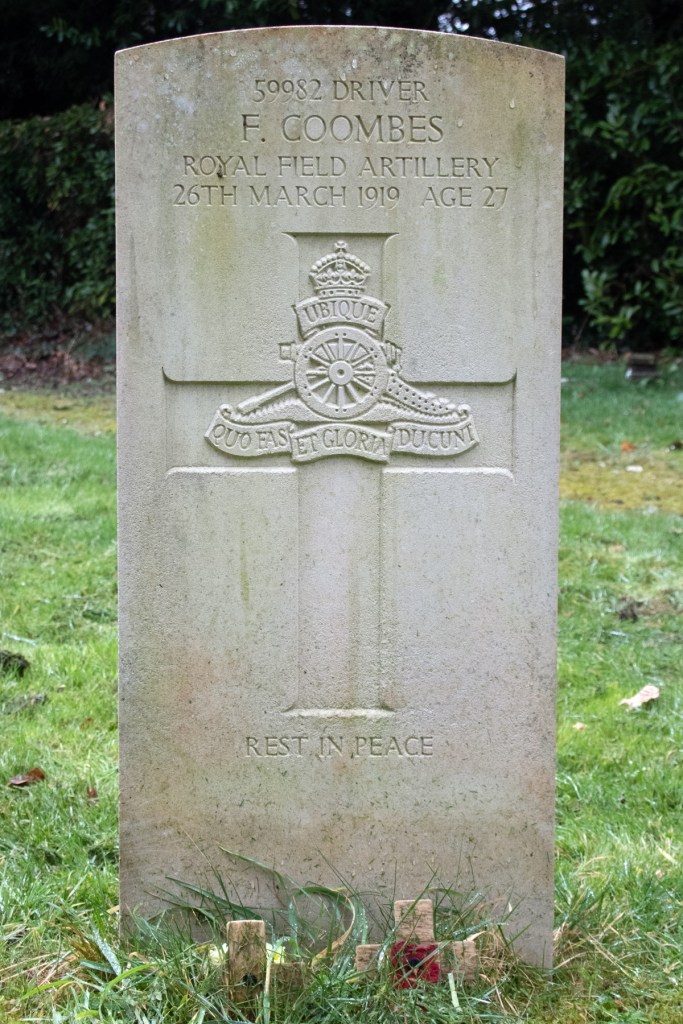
Driver Frederick Coombes

Driver Frederick Coombes

Frederick Walter Coombes was born in 5th July 1891 in Chard, Somerset. He was the oldest of eight children and his parents were mason’s labourer Walter Coombes and his wife, Sarah.

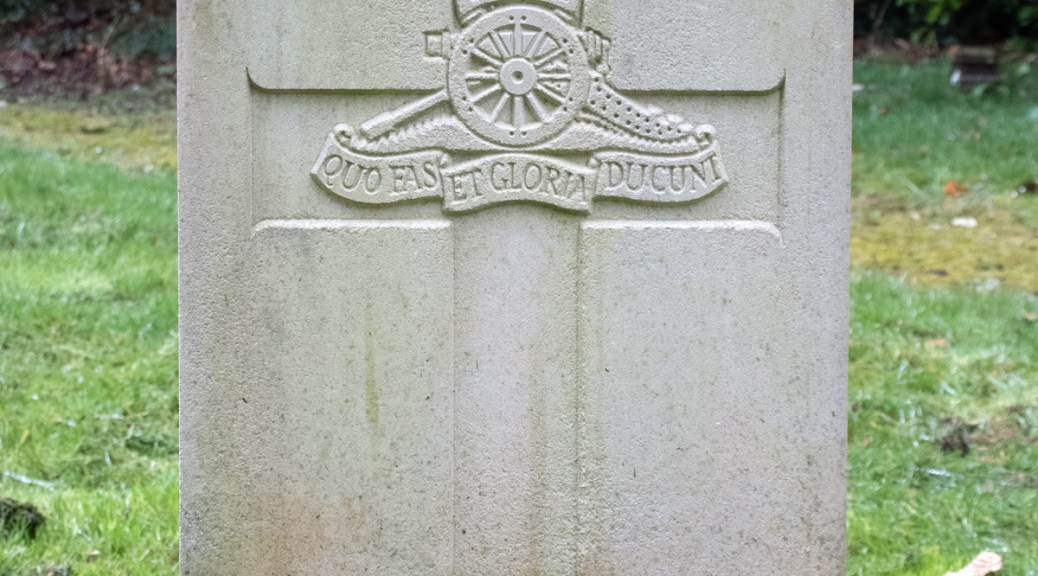
The family moved to nearby Crewkerne and, when he left school, Frederick found work as a weaver. He quickly realised, however, that he needed a career, and the the military could offer one. On 18th October 1909, he enlisted in the the Royal Field Artillery, signing up for three years with the regiment, followed by nine years on reserve.

Frederick’s service record confirms the man he had become. His medical examination gave his height as 5ft 6ins (1.68m) and his weight as 139lbs (63kg). He was noted as having brown hair, hazel eyes and a fresh complexion. He was also recorded as having a tattoo of a man’s head on the back of his right wrist and a small scar on his left hip.

After a year on home soil, Driver Coombes was sent to South Africa. He was to spend a little over two years in the country, the 1911 census recording him at the Roberts Heights Barracks in Transvaal, as part of the 98th Battery.

When his initial three year contract came to an end, Frederick was placed on reserve status and returned home. His trail goes cold for a couple of years, but when war was declared in 1914, he was immediately brought back into active service.

By the middle of August 1914, Driver Coombes was on the Western Front in France. Within a matter of weeks he was caught up in the Retreat from Mons, and was gassed in the process.

He soon recovered and, in December 1915 his troop was moved to Mesopotamia, modern-day Iraq. Within a month, Frederick fell ill again, having contracted malaria. He was treated at the base and, eventually remained in the Middle East for a year.

By December 1916 Frederick was on the move again, this time to India. His lungs had had a battering by this point, however, and he fell ill once more, this time having developed tuberculosis. Initially treated in India, by February 1917 he had been medically evacuated back to Britain. The condition was seen as unlikely to improve, and he was eventually discharged from the army as being no longer fit enough to serve.

Driver Coombes’ medical report confirmed that the condition was fully the result of his army service, and treatment at a sanatorium was recommended. His last day with the Royal Field Artillery was 7th May 1917: his career had lasted 7 years 202 days.

Again, Frederick’s trail goes cold at this point. It seems likely that he would have returned to Somerset and would possibly had been admitted to a medical facility for treatment and recuperation. The next record for him is that of his death, which happened at home on 26th March 1919. He was just 27 years of age.

Frederick Walter Coombes was laid to rest in Crewkerne’s Townsend Cemetery.


Driver Frederick Coombes

Driver Henry Sweet

Driver Henry Sweet

Henry – or Harry – Sweet was born on 31st July 1887 in the Somerset village of Merriott. He was the fourth of seven children to Edward and Emma Sweet. Emma had married Edward after her first husband, John, had died, and so Harry also had three half-siblings.

Edward was an agricultural labourer by trade, but by the time of the 1901 census he had turned his hand to brewing, and listed his trade as a maltster. Harry’s older brother John, was also recorded as a maltster, while he had left school and was noted as being a brewery hand.

The next census, in 1911, found Emma and Edward heading up the family in Crewkerne, brewing for, and working at, the Volunteer Inn. Harry was working with his father, while two of his sisters – Prudence and Beatrice – were still living at home and working as shirt and collar machinists. Making up the household were Harry’s other sister, Ellen, who was a shirt ironer, and her husband George, who was recorded as a web weaver. In all there were seven wages coming into the household, meagre salaries though they may have been.

On 26th December 1911, Harry married Rosina Woodland in the parish church in Crewkerne. She was the daughter of Walter Woodland, a local labourer, although there is little further information on her family.

When war came to Europe, Harry wanted to play his part. Full details of his military service are lost to time, although he had certainly enlisted in the Royal Army Service Corps by the start of 1917. Driver Sweet served in the Eastern Mediterranean, and was ensconced in Salonika, in Northern Greece, for nearly two years.

Harry suffered on and off with dysentery, and was moved to the 4th Scottish General Hospital in Glasgow in January 1919 for treatment. This was initially successful, but while was was admitted he contracted a combination of bronchitis and pneumonia, and these were ultimately to take his life. Driver Sweet passed away on 13th February 1919, at the age of 31 years old.

Henry Sweet’s body was brought back to Somerset for burial. He was laid to rest in the Townsend Cemetery in his home town of Crewkerne.


Private Albert Taylor

Private Albert Taylor

Albert Edward Taylor was born in the autumn of 1887 and was the fifth of eight children to John and Mary Taylor. John was a mason and both he and Mary came from Crewkerne, Somerset, which is where they raised their family.

Albert worked as an errand boy when he left school, but he sought a career and, enlisted in the Army Service Corps in July 1904. He lied about his age to join up, suggesting he was nearly 22, where he was actually just 17 years of age.

Driver Taylor’s service records confirm that he was 5ft 3ins (1.6m) tall and weighed 115lbs (52.2kg). He was noted as having brown hair, blue eyes and a fresh complexion. He had a mole between his shoulder and the back of his neck, and his religion was recorded as Baptist.

Albert’s contract was for two years’ service, followed by ten years in the Army Reserve. While a military career was what he sought, he seems to have had a disregard for rules, and regularly had run ins with authority, as his Regimental Defaulter Sheet testifies.

On 19th December 1904, while based in Woolwich, Surrey, he was absent without a pass from 6am until 12:15am on 30th December. He was confined to barracks for eight days.

The following year, Driver Taylor had moved to Bordon in Hampshire. On 28th November 1905, he was absent without a pass, from midnight until 8:30am on 1st December. He was again confined to barracks, this time for ten days.

A third offence came on 29th May 1906, by which time Albert had moved to Aldershot, Hampshire. He was found in neglect of duty ‘in allowing dirty pudding cloths to be deposited in the cupboards of the cookhouse’ and being ‘absent from work from 1:30pm till found in his barrack room at 9:20pm.’ For these, he was confined to barracks again, this time for eight days.

Within a matter of weeks, he was found in neglect of duty again, having broken out ‘of barracks after tattoo and remaining absent till apprehended by the Military Police at about 10:50pm’ and being ‘drunk and improperly dressed.’ This time the punishment was more severe and he was detained in prison for 96 hours.

Unsurprisingly, Albert’s military career didn’t go much further than this. When his two-year contract came to an end, he returned to Somerset and found employment as a mason.

In July 1910, Albert married Mabel Wallbridge, the daughter of a carman, also from Crewkerne. The couple set up home on the outskirts of the town, and went on to have a son, Frederick, who was born later that year.

The 1911 census found the young family living in a cottage in Lye Water, with Albert listing himself as a ‘mason (army pensioner)’. While the military reference may have been added with a sense of pride, irony or bloody mindedness, Albert was not to fully leave his army career behind. When war came to Europe in 1914, he was still within his reserve status, and was called up to play his part.

Private Taylor was to leave his family behind: son Frederick had now been joined by daughters Kathleen and Joyce, and Mabel pregnant with another daughter, Rosaline, who was born in January 1915. Albert was assigned to the 1st Battalion of the Somerset Light Infantry and, in contrast to his previous tenure on the Home Front, he soon found himself in the thick of things.

Albert’s regiment was involved in some of the fiercest opening skirmishes of the First World War, and he would have been caught up on the Battles of Le Cateau, the Marne, the Aisne and Armentières. By the spring of 1915, the battalion was entrenched at Ypres, and it was here during the Battle of St. Julien that Private Taylor was injured.

Albert has received a gun shot wound to the left side of his skull and was medically evacuated to Britain for treatment. He was admitted to the Beechfield House Hospital in Southampton, but his wounds proved too severe, and he passed away on 14th May 1915, at the age of 27 years old.

The funeral of Private Albert Edward Taylor, of the Somerset Light Infantry… who died from wounds received at the Front, took place with military honours at the Cemetery [in Crewkerne] on Tuesday afternoon, and attracted a large attendance. As a mark of respect to the memory of the deceased soldier blinds were drawn at the private and business houses en route to the Cemetery, while the flag erected outside the Victoria Hall for the children’s Empire-day celebration was lowered to half-mast.

Rev. J Street (Unitarian Minister)… spoke of the painful circumstances and the heroic conduct of the deceased, who had sacrificed his life for others. Although death was attended with pain and sorrow, yet in after years deceased’s children would look back with pride to the part their father took in the present war.

Taunton Courier and Western Advertiser: Wednesday 26th May 1915

Albert Edward Taylor was laid to rest in the cemetery of his home town, Crewkerne.


Private Albert Taylor (from findagrave.com)

Albert’s headstone gives his initials as AC Taylor. They should be AE Taylor.

Private Albert Lowman

Private Albert Lowman

Albert Lowman was born in Crewkerne, Somerset, in the autumn of 1876. He was the younger of two children to Charles and Sarah Lowman. The 1881 census recorded the family – Charles, Sarah and their boys Charles Jr and Albert – living in Back Lane. Charles Sr was noted as being a labourer, although in the column highlighting any medical conditions (‘deaf-and-dumb’, ‘blind’, ‘imbecile or idiot’, ‘lunatic’), is one word: “afflicted”.

Charles Sr passed away in 1886, when Albert was just 9 years old. The next census, in 1891, found Sarah working as a charwoman, while her youngest, who had left school by this point, was employed as a labourer. Mother and son also had a lodger, Alice, who was a dressmaker. Charles Jr, by this point, had left home, and was living in Penarth, Glamorganshire, where he was apprenticed to his paternal uncle, who was a tailor.

On 28th November 1896, Albert married Sarah Ann Dodge, a weaver’s daughter who was also from Crewkerne. Albert recorded his job as a drayman, although this seems to have been piecemeal employment.

The next census found more permanent work, as he was cited as being a shirt factory packer, while Sarah was employed by the factory as a machinist. Making up the household was young Charles Lowman, the couple’s first son, who was just a month old although sadly, he survived only a couple of months more before dying.

Further tragedy is highlighted by the 1911 census, as it highlights that the couple had had a further child, who had also died when just a babe-in-arms. The Lowmans were now living on Hermitage Street near the centre of the town. Albert was still a shirt packer, and, even though their cottage was small, they had two boarders and a visitor staying. The lodgers brought the couple a little rent, which meant that Sarah no longer had to work.

War was closing in on Europe and, while his full military records are lost to time, it is clear that Albert had stepped up to play his part. He had enlisted by January 1918, and was attached to the Devonshire Regiment, through which he served with the 380 Company of the Labour Corps.

Private Lowman was barracked on Salisbury Plain, Wiltshire, and in July he was admitted to the military hospital in Salisbury itself, suffering from appendicitis. He was operated on, but died following complications. He passed away on 10th July 1918, at the age of 41 years old.

Albert Lowman was brought back to Somerset for burial. He was laid to rest in the cemetery of his home town, Crewkerne.


Private Lowman’s pension ledger record shows the beneficiaries of his army service. The document identified Sarah as his widow, but also Phillis Annie Matilda Denning, the couple’s adopted daughter, who had been born in August 1904.

Sarah was not to outlive her late husband for long, however.

The death occurred with tragic suddenness on Sunday afternoon, January 7th, at her residence in Hermitage-street, of Mrs Sarah Ann Lowman… The deceased, who was of middle age, was about as usual attending to her ordinary household duties in the morning. Just before dinner hour, however, she complained of not feeling well and went upstairs to lie down. Her niece took her up a cup of how water, and she then apparently went to sleep. She awoke about 3:40pm, and then had to get out of bed owing to sickness. Upon going back into bed again she expired almost immediately. Dr Wolfenstein was called, but he could only pronounce life extinct.

Langport & Somerton Herald: Saturday 20th January 1923

Sarah was 47 years of age when she passed away. It is likely that she was laid to rest near her husband, although records to confirm this have been lost.


Albert’s brother, Charles, survived his sibling by less than six months. He had left tailoring behind him in South Wales, and instead embarked on a military career. He joined the Royal Field Artillery in 1895 and, over the course of his twelve years’ service, served in the Caribbean and the Mediterranean.

Charles married Florence Dodge in 1908, and the couple went on to have two children – Cecil and Freda. When war broke out in 1914, he stepped up once more. Having already risen through the ranks from Gunner to Bombardier and Corporal, he re-entered service as a Sergeant in the Royal Garrison Artillery.

Based in Le Harve, Northern France, Sergeant Lowman was admitted to a hospital in Harfleur, having contracted bronchial pneumonia. Sadly, he passed away while admitted, on 8th November 1918, just three days before the end of the conflict. He was 43 years of age.

Charles Lowman was laid to rest in the Sainte Marie Cemetery, near the centre of Le Harve.


Private William Pinney

Private William Pinney

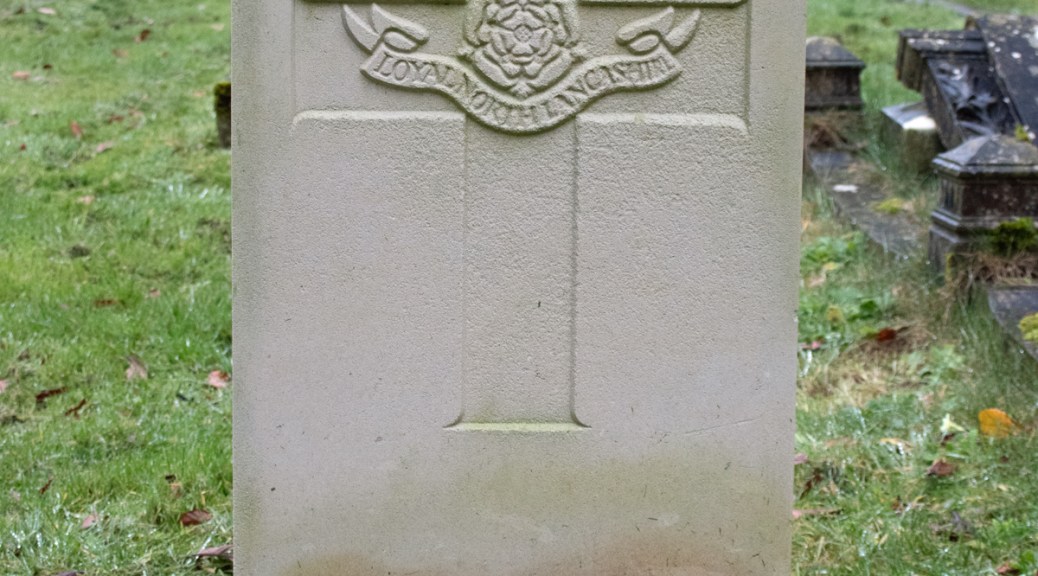
The details of William Pinney’s life seem destined to remain a mystery. His headstone – in Crewkerne Cemetery, Somerset – confirms that he was a Private in the Loyal North Lancashire Regiment, and that he died on 14th August 1919.

The British Army Register of Soldiers’ Effects expands a little on this, identifying that he was in the 2nd Battalion of the regiment. The document states that he died of wounds and had been admitted to the War Hospital in Southampton, Hampshire (this is likely to have been the Royal Victoria Hospital in Netley). It also confirms that his effects were to be passed to his widow, Sarah Pinney.

From this point on, some elements of supposition come in to the research.

There is a marriage certificate for a William Pinney and Sarah Jane Witheyman at the parish church in Crewkerne on 6th January 1911. This record gives William’s age as 23, and shows that he was a weaver and the son of weaver William Pinney Sr. Sarah, meanwhile, was five years older than her new husband, worked as a factory hand, and was the daughter of another factory hand, George Witheyman.

The same year’s census gives more information about William Pinney. He was one of eleven children to William and Mercy Pinney, and every member of the family over school age was involved in weaving and spinning. It should be noted, however, that the census was taken on 2nd April 1911, three months after William’s marriage and, while the ages on the document match, the document states that he is single.

The same census for Sarah tells a similar story. She is noted as being one of twelve children to George and Amelia Witheyman. George is noted as being a ‘hand ackler’, or handyman, while Sarah and the two of her teenage brothers still at home are all working as mill hands. The same anomaly arises as William, however, as she is also noted as being single.

Returning to the marriage certificate, an answer to the anomaly in the dates seems to resolve itself, however. The marriages are noted in chronological order, and the previous wedding to be solemnised in Crewkerne Parish Church was on 26th December 1911, while the following one was on 14th February 1912. It would appear, therefore, that Leonard Jackson, the curate of the church, entered the incorrect date on the certificate.

The census records and marriage certificate all seem to fit the William and Sarah Pinney who were separated by William’s death in 1919. There are certainly no documents suggesting another William Pinney in the Crewkerne area around that time period. It is reasonable to assume, therefore, that they do all connect to the gravestone in the town’s cemetery.

Private Pinney’s military records are missing, or no longer available, so it is not possible to trace his actions during the First World War. The 2nd Battalion of the Loyal North Lancashire Regiment served in India during the first half of the conflict, moving to Egypt in 1917 and to France the following year. It is not possible to confirm where William served, but wherever he fought, he was wounded, and these injuries were to prove fatal. He passed away in the Southampton hospital on 14th August 1919, nine months after the end of the war, aged around 31 years old.