Cecil Frank Sims was born in the village of Manston, Dorset, towards the end of 1897. The youngest of six children, his parents were Henry and Ann Sims. Henry was a dairyman and, after his death in 1909, his wife continued in this line of the work.
Cecil was just 16 years old when war was declared, but he was keen to do his bit for King and Country as soon as he could. In May 1917, he joined the 2nd Battalion of the Royal Marine Light Infantry in Portsmouth.
Sadly, information on Private Sims dries up at this point. His service records no longer exist, and the only document that remains is his pension record. This confirms that he died on 11th February 1919 from ‘disease’, but there is no further information to be had. He was just 21 years of age.
Cecil Frank Sims was laid to rest in Yeovil Cemetery.
There is one other element that adds to Cecil’s family story. When researching the local newspapers for any reports on his funeral, an advert was posted just a few days before he passed:
Farmer’s son wanted: Willing to help on farm. Lodgings found close. Good place for willing chap, age 16 or 17 years preferred. SIMS, Poplars Farm, Yeovil Marsh.
Western Gazette: Friday 7th February 1919
It would seem that, if he was at home, Cecil’s health was weakening, and so extra support to manage the farm was being sought.
Herbert George Rendell was born in the summer of 1886, the oldest of six children to George and Catherine Rendell. George was a twine maker from West Coker, near Yeovil in Somerset, and it was in this village that he and Catherine raised their young family.
While he initially found work as a labourer when he left school, the lure of a better life and career proved too much for Herbert and, in June 1905, he enlisted in the Royal Engineers as a Sapper. He spent three years spent on home soil, working hard and earning a Good Conduct medal for his service. During his tour of duty, he contracted pneumonia, spending five weeks in hospital in Chatham, Kent, over Christmas 1905, but fully recovering.
In September 1908, Herbert was sent to Singapore for a three-year tour of duty with the 21st Company. His body was not accustomed to the different environment, and he was hospitalised three times for malaria and myalgia, as well as two bouts of gonorrhoea in 1908 and 1910.
In December 1911, Sapper Rendell returned home, where he served for a further three years before war broke out in the summer of 1914. Having been promoted to Lance Corporal, and after a short bout in hospital following a reaction to his cowpox vaccination, he was sent to Egypt.
Assigned to the 359th Water Company, he would have been charged with constructing and maintaining the supply pipes to and from the Front Line and for his work was soon promoted to Corporal.
In the spring of 1918, the now Sergeant Rendell was transferred to the 357th Water Company, and found himself in Palestine, where he stayed until the end of the war. He came home on leave in April 1919, and it was here that, once again, he contracted pneumonia.
Sadly, Sergeant Rendell was not to recover from the lung condition for a second time; he passed away at his parents’ home on 9th April 1919, at the age of 32 years old.
Herbert George Rendell was laid to rest in Yeovil Cemetery, not far from the village where he was born.
Joseph Dodge was born in the summer of 1883, and was one of twelve children, including eleven boys. His parents were David and Eliza Dodge, who raised their growing family in Stoke-sub-Hamdon, a few miles to the east of Yeovil, Somerset.
David was a mason and stone sawyer, but his children went into other roles when they left school; Joseph found work as an agricultural labourer.
In October 1903, Joseph married Elizabeth Ann Case – better known as Annie – who came from just over the Dorset border in the village of Corscombe. Setting up home in Yeovil itself, the couple went on to have two children – both boys – Walter and Norman.
War was coming to Europe, and Joseph was intent on doing his bit. Full service details are not available, but the documents that exist confirm that he enlisted as a Private in the Wiltshire Regiment. Initially assigned to the 1/4th Battalion (which served in Egypt), he transferred to the 2/4th Battalion (which served in India).
Sadly, there is no documentation to give service dates, it is impossible to establish when or if Joseph actually served in these locations. India seems likely, however, as he later transferred to the 1st Garrison Battalion of the East Yorkshire Regiment, which was based in Lucknow.
Private Dodge survived the war and came back to England, but seems to have contracted pneumonia on the journey home. Admitted to hospital in Liverpool, the condition sadly got the better of him. He passed away on 16th February 1919, at the age of 35 years old.
Joseph’s body was brought back to the county of his birth; he was laid to rest in Yeovil Cemetery.
Joseph came from a very patriotic family, and local newspapers early in the war highlighted that many of the Stoke-sub-Hamdon brothers had enlisted to serve King and Country.
At the time of the article, six had enlisted – Thomas, Arthur and Percy (all in the Somerset Light Infantry), Albert (West Somerset Yeomanry), Evan (Royal Navy) and David (Canadian Infantry).
Corporal David Dodge seems definitely to have distinguished himself. Having emigrated to Canada before the war, he returned to Europe when conflict broke out. An article in the Western Chronicle reported that he had “been awarded the Military Medal for conspicuous bravery on the field under heavy fire.” [Western Chronicle: Friday 15th November 1918]
Amazingly, of the seven brothers who fought in the conflict, only Joseph perished.
An earlier series of articles tells the tragic story of another of Joseph’s siblings. Henry Dodge (known as William) had moved to Senghenydd, to the north of Cardiff, in 1910; mining work was plentiful there and he and a number of his fellow villagers had sought money from the black gold.
On the 14th October 1913, and explosion happened in the mine and together with the resulting fire and subsequent poisonous gas outpouring killed more than 430 miners. Initially reported missing, William was later confirmed dead; he was just twenty years old and left a widow and child.
Charles Samways was born in Yeovil, Somerset, in the summer of 1893, the oldest of three children to leather dresser George Samways and his wife Martha.
Sadly, little documentation on Charles’ life remains. The 1911 census lists him as living in a small house to the north of Yeovil town centre with his mother and younger brother – his sister Nellie having passed away in 1903 when she was just a toddler. Martha was working as a dressmaker, Charles as a glove cutter, but George does not appear on the document.
War was approaching, and Charles was keen to do his bit. While full details are not available for his military service, it is evident that he enlisted as a Private in the Somerset Light Infantry, and that he did so at some point before the summer of 1918. He joined the 12th (West Somerset Yeomanry) Battalion, which was initially based in the Middle East. The battalion arrived in France in May 1918, and soon became embroiled on the Western Front, including at the Second Battle of the Somme.
The Western Chronicle reported that “Private C Samways… [was] in hospital at Warrington, Lancashire, suffering from wounds in the head and hands. He was struck by a piece of shell when going ‘over the top’, and the fact that he was wearing a steel helmet undoubtedly saved his life.” [Western Chronicle: Friday 13th September 1918] It went on to state that he was “progressing favourably.“
Within weeks, Charles was recovering at home, although this was sadly not to last. He passed away from ‘disease’ on 6th November 1918, aged just 25 years old.
Charles Samways was laid to rest in Yeovil Cemetery, finally at peace.
The specific cause of Charles’ death is not documented. However, given that his father George also died at home around the same time, it seems likely to have been one of the many lung conditions – influenza, tuberculosis, pneumonia – that became prevalent as the war came to a close.
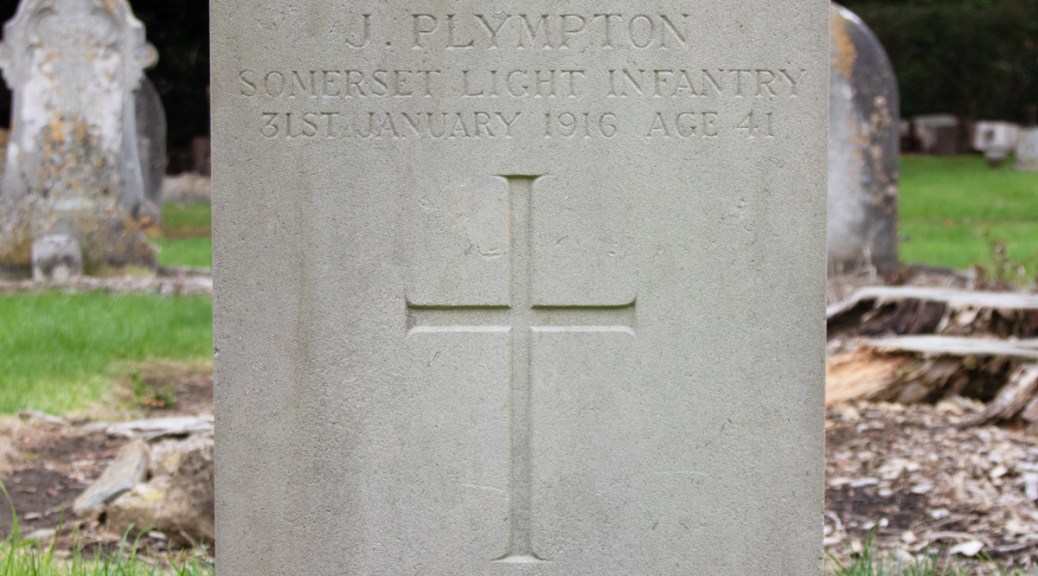
James Plympton was born in the spring of 1875, one of four children to Richard and Mary Plympton from Yeovil, Somerset. They raised the family in a cottage to the south of the town centre, where Richard was a labourer and Mary a glover. When they left school, James and his two brothers followed in their father’s footsteps, finding labouring work in the local area.
In the summer of 1899, when James was 24, he married Elizabeth Maria Holt, an agricultural labourer’s daughter from the village of Misterton, near Crewkerne. The couple would go on to have six children, but, according to the 1901 census, they had set up home near the centre of Yeovil, with their first born, Dorothy, and James’ recently widowed mother.
Mary, at 69, was no longer working, and so Elizabeth found employment as a cloth ripper – presumably for the local glove industry – earning a little extra money to support James’ labouring work. This was a job that he continued to do: the 1911 census found James and Elizabeth living in a five-roomed cottage in Yeovil; Mary had by this time passed away, as had young Dorothy, but the couple were surrounded by their other five children, Elizabeth looking after them and James working as a jobbing mason.
By now war was imminent, and James enlisted to play his part. While full details of his service are no longer available, it is evident that he had joined up by the summer of 1915. He was a Private in the Somerset Light Infantry and was assigned to the 7th (Service) Battalion. He was shipped to France on 24th July 1915, and, for his service, was awarded the 1915 Star and the British and Victory Medals.
Private Plympton returned from France at the start of 1916; he was suffering from nephritis – inflamed kidneys – and was admitted to St Bartholomew’s Hospital in London. Sadly, it seems that his treatment came too late; he passed away on 31st January 1916, at the age of 41.
James’ body was brought back to his home town; he was laid to rest in Yeovil Cemetery.
A local newspaper, the Western Chronicle, reported on James’ funeral; interestingly it gave his rank as Sergeant, although none of the official military documentation corroborates this.
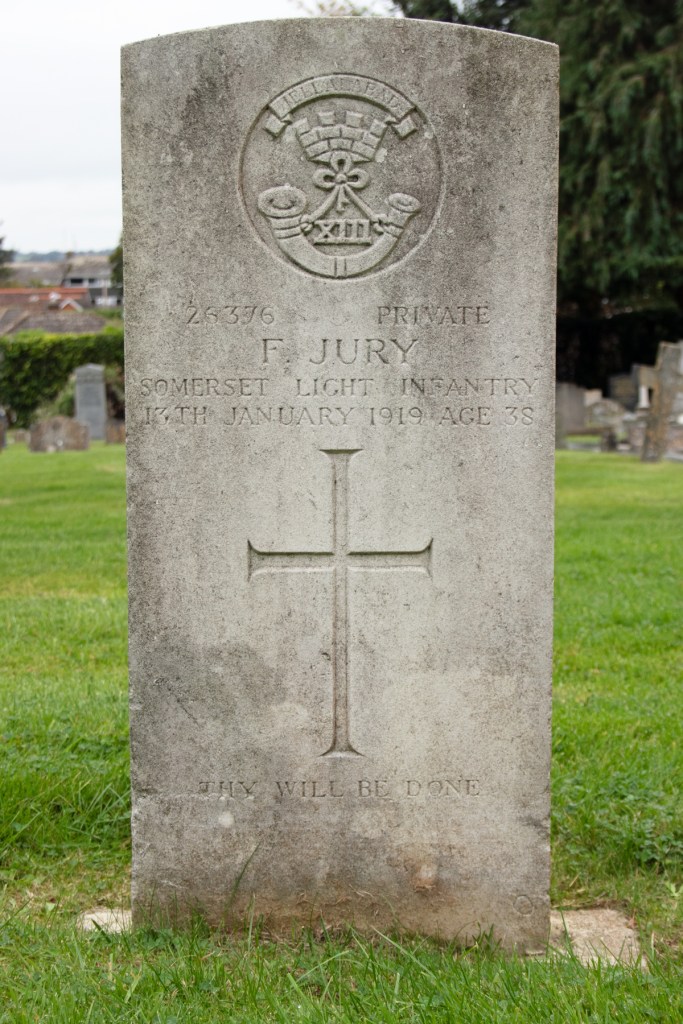
Frederick Jury was born in 1882, the oldest of four children to William and Lucy. William was a farm labourer from Minehead, Somerset, and this is where the young couple raised their family.
When he left school, Frederick found work as a labourer for a stonemason, but he had his sights on a higher calling. In March 1903, he enlisted in the Somerset Light Infantry and, after two years’ service, he was assigned to the Army Reserve.
By the time of the 1911 census, Lucy has been widowed; she was working as a charwoman in Minehead and living in a small cottage with her youngest daughter – Frederick’s youngest sister – Alice. Sadly, there is no record to confirm where Frederick was at this time.
When war broke out, Private Jury was called back into service. He was dispatched to France on 19th September 1914, and served there with his regiment for eight months before returning to England in May 1915 and transferring across to the Agricultural Company of the Labour Corps.
Private Jury’s time in the army seems to have been a troubled one. He was pulled up at least six times between 1903 and 1905, for being absent from parade, and for smoking in the stables. He was subsequently censured for failing to attend training during both 1910 and 1911, and the list went on into his time on active duty. He was punished for overstaying his pass in July, October and November 1915, for having a rusty rifle on inspection in August 1915 and for quitting his guard duty in January 1916. On each of these latter occasions, he was brought back by the Military Police and fined.
Frederick’s service records also confirm that he was treated in hospital for gonorrhoea in January 1905, something that may well have been par for the course for young soldiers at the time.
The continuous lapses in duty, however, may have proved too much for his regiment, and Frederick was discharge from military service on 8th March 1916.
At this point, Frederick Jury’s trail goes cold. The only further information available is that he died on 13th January 1919, at the age of 38 years old. He was laid to rest at Yeovil Cemetery in his home county of Somerset.
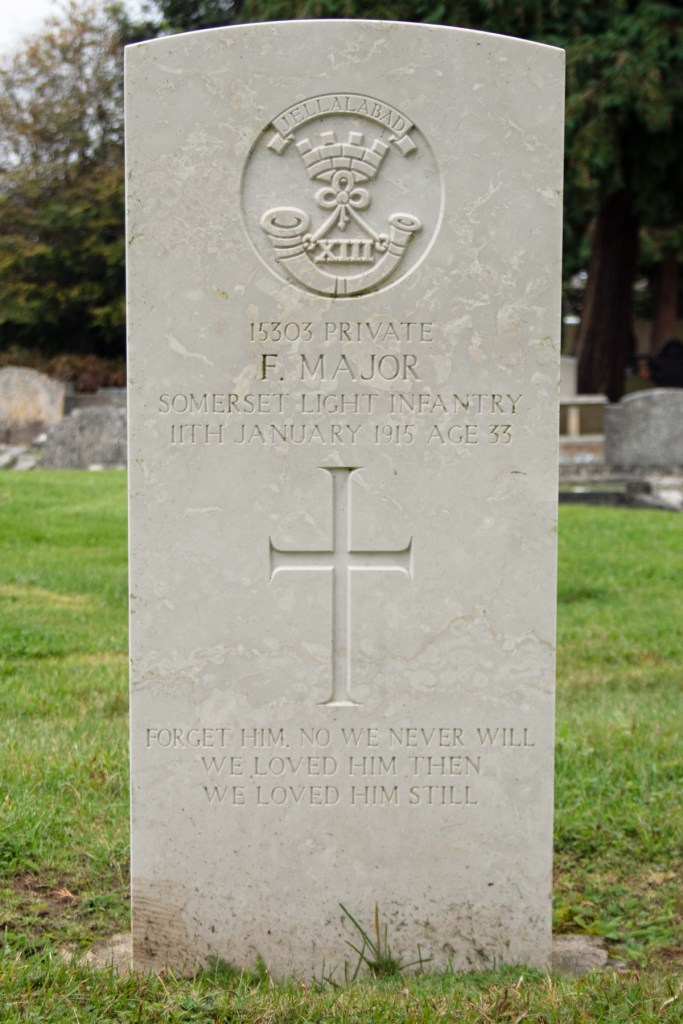
Frederick John Major was born in the spring of 1882, the oldest of seven children to John and Eliza Major. John was a farm labourer and he and Eliza – who was 20 years his junior – raised their family in the Dorset village of Batcombe.
John passed away in 1900, when Frederick was just 18 years old. He was already working as a carter, and continued to live with his mother, helping support her financially, along with his brother and sister.
With war on the horizon, Frederick was keen to do his part. He enlisted in the Somerset Light Infantry, and was assigned to the 9th Battalion as a Private. This was a service battalion based in Plymouth, and it is unlikely, therefore, that Private Major saw any active service overseas.
Sadly, Frederick’s time in the army was to be short. He passed away in Somerset on 11th January 1915, aged just 33 years old. No evidence of the cause of his death is documented.
Frederick John Major was laid to rest in Yeovil Cemetery, in the town in which he died.
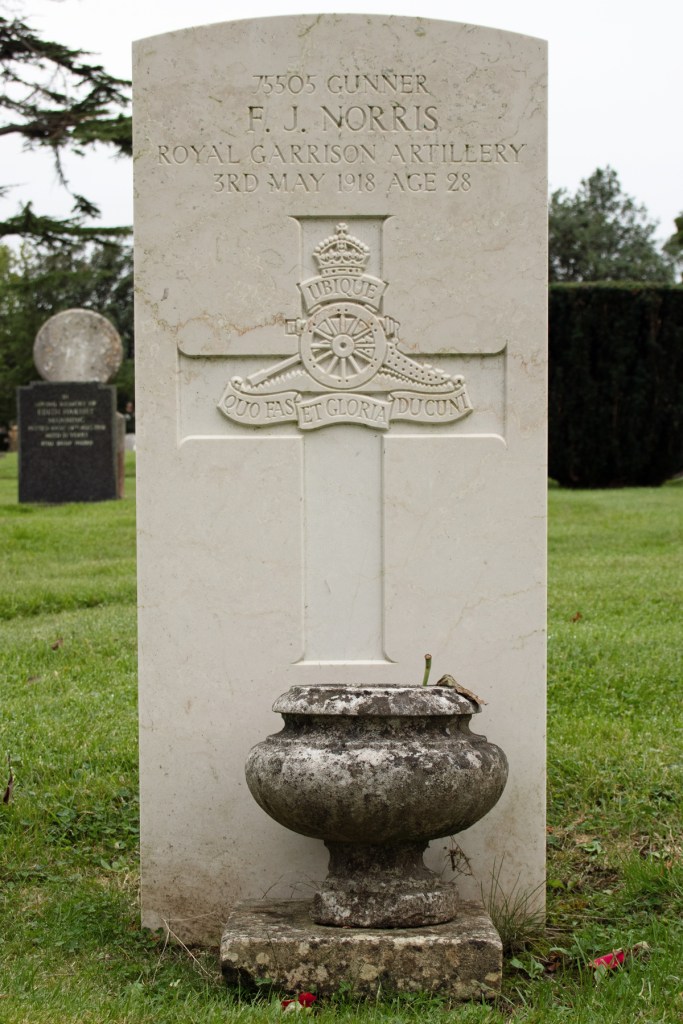
Frederick James Norris was born in the spring of 1890, one of eight children to Henry and Sarah Norris. Henry was a brewer’s drayman and groom, Sarah a milliner, and together they raised their family in the Somerset town of Yeovil.
When he left school, Frederick found work as a carman and carter, following in his father’s footsteps. Henry had died in 1907, followed by his two older brothers, Alfred in 1911 and Frank in 1912. Frederick, by this time, had met Emily Katherine White, and the couple married in Yeovil Parish Church on 23rd May 1909. They went on to have a daughter, Gwendoline, the following year.
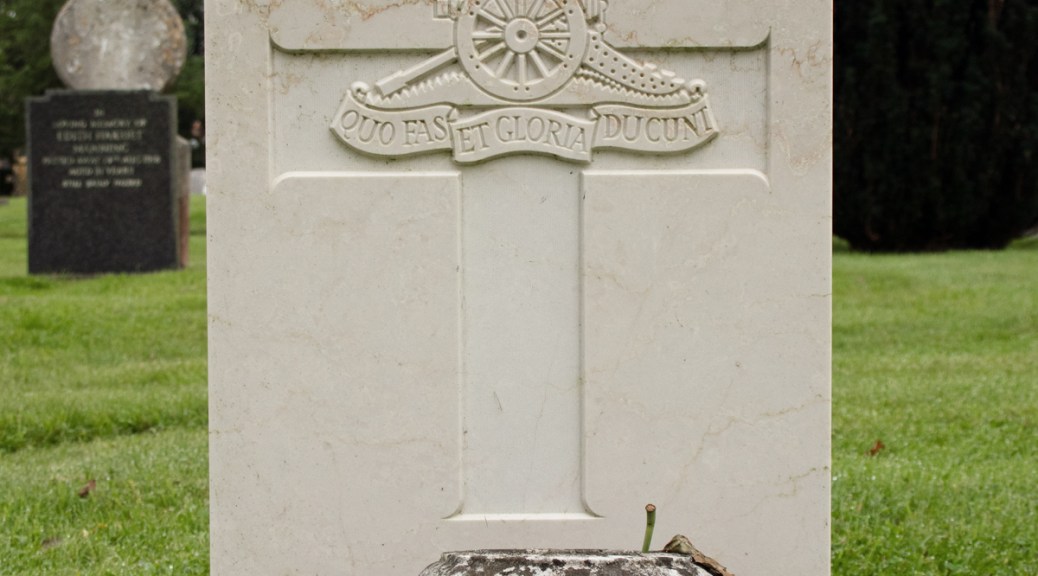
War was fast approaching and, in December 1915, Frederick enlisted, joining the Royal Garrison Artillery as a Gunner. After a few months’ training, he was sent to Columbo, Ceylon (now Sri Lanka), where he served for just over a year. During his time there, he had contracted tuberculosis, a condition that ultimately resulted in his return to the UK.
Gunner Norris arrived back in England in August 1917, where he was again admitted to hospital with the respiratory condition. He was ultimately discharged from the army on medical grounds in August of that year.
After leaving the army, Frederick was admitted to a sanitorium, but at this point his trail goes cold. He died on 3rd May 1918, at the age of 28. While the cause of death is not stated, it seems likely to have been as a result of his already debilitated health.
Frederick James Norris was laid to rest in the cemetery in his home town of Yeovil.
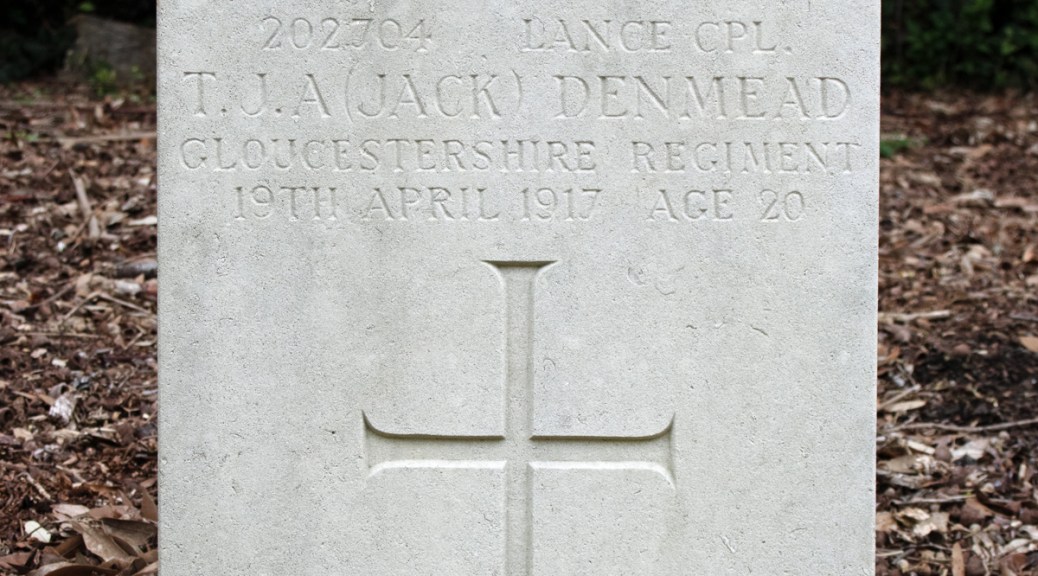
Thomas John Ambrose Denmead – better known as Jack – was born in Yeovil in the summer of 1896. The oldest of seven children, his parents were Thomas and Elizabeth Denmead. Thomas was a glover – the key industry in the Somerset town – who raised his young family in the middle of the town.
When he left school, Jack found work as a clerk at Petters’ Ltd, a local engine manufacturer and iron foundry. War was on the horizon, though, and he enlisted in the spring of 1916.
Jack joined the Gloucestershire Regiment, and was assigned to the 2nd/4th (City of Bristol) Battalion. He was sent to France in May 1916, and was involved in the Attack at Fromelles, part of the larger Somme offensive. He had started as a Private, but rose to the rank of Lance Corporal.
Towards the end of 1916, Jack fell ill. He was medically evacuated to the UK, and was admitted to the Royal General Infirmary in Paisley, Scotland. His condition was serious enough to need an operation, but the Lance Corporal sadly passed away not long after this treatment. He was just 20 years of age.
Jack’s body was brought back to Somerset for burial. He was laid to rest in the cemetery in his home town, Yeovil.
William Bartin was born in the Somerset village of Montacute in the summer of 1893 and was the oldest of four children to Georgina Bartin. Georgina married George Gaylard in 1895 and, while the 1901 and 1911 censuses record William Gaylard as George’s son, later documentation suggests that George may not have been his father. George was a carter and labourer on a farm, and when he left school, William followed suit.
By the time of the 1911 census, most of the family were working – William was listed as a groom and gardener, while his mother and the oldest of his three sisters were employed as seamstresses.
Little specific information remains of William’s military career. He enlisted as a Private in the Somerset Light Infantry under his mother’s maiden name (and his birth name), Bartin. A local newspaper after he passed provides some information:
[He] enlisted in 1914, was badly wounded and for seven months was treated in the Bethnal Green Hospital, and then sent to the Southern General Hospital, Plymouth, where for 17 months he was treated for lung trouble. He was discharged in 1917 and has been practically ever since under treatment by the Ministry of Pensions. Much sympathy is felt with the bereaved widow and child.
Western Chronicle: Friday 19th November 1920
There are no details of William’s wife or child, albeit that his pension record refuses payment to them as he married after being discharged from the army.
There are similarly no details about the cause of his death, although, based on the newspaper report, it seems likely to have resulted from the lung condition that dogged the last few years of his life.
Private William Bartin died on 17th November 1920, at the age of 27 years old. He was laid to rest in the graveyard of St Catherine’s Church in his home village of Montacute.
George Gaylard had passed away in July 1919, at the age of 47. The Western Chronicle noted that:
There mourners were as follows: Mrs G Gaylard (widow), Mr WC Bartin (step-son), Misses Lucy, Florence and Edith Gaylard (daughters)…
Western Chronicle: Friday 25th July 1919
It was tragic for Georgina to lose both her husband and son within 18 months; it is also sad to note that George’s father – also called George – was still alive, and outlived both his son and step-son.








 Death and Service