Category Archives: Somerset

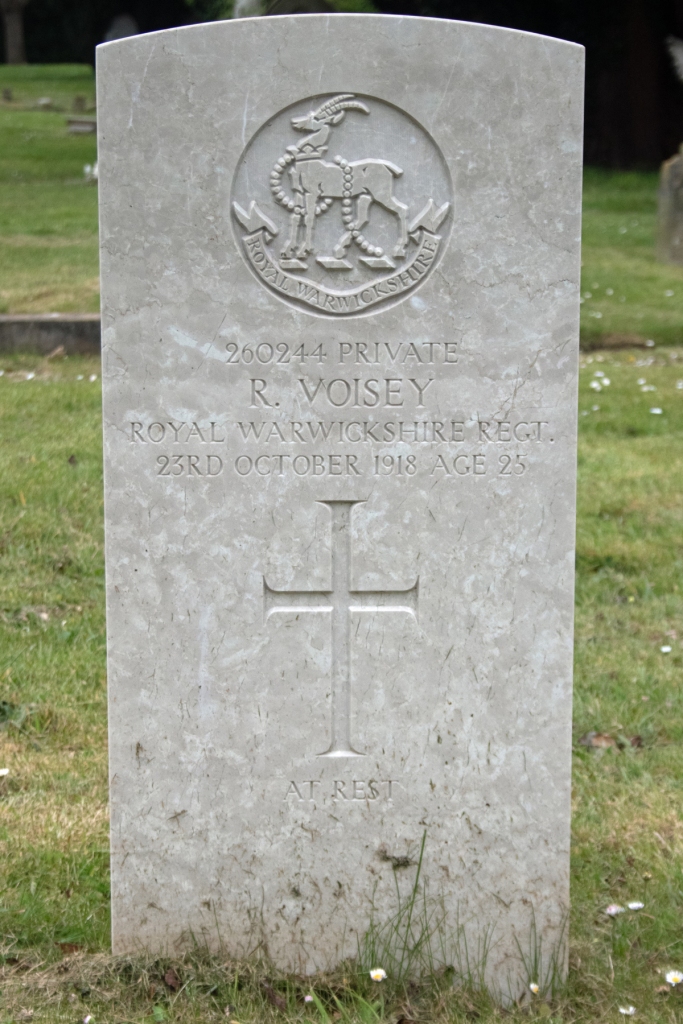
Private Robert Voisey

Private Robert Voisey

Robert Voisey was born towards the end of 1891, one of six children to Richard and Sophia. Richard was a tailor and, while both he and Sophia had been born in Cullompton, Devon, by the time Robert was born, they had moved to the Somerset town of Taunton.

When he left school, Robert followed his father’s trade and, by the time of the 1911 census, he was living with his parents and two of his sisters in a terraced house not far from the town’s station.

With the outbreak of the Great War, Robert was keen to do his bit. While full details of his military service are not available, it seems that he initially enlisted in the Somerset Light Infantry, but was subsequently transferred to the Royal Warwickshire Regiment. Joining the 6th Battalion as a Private, he saw action on the Western Front, and was wounded in April 1918.

Evacuated to England for treatment, Private Voisey was admitted to the 5th Northern General Hospital in Leicester. He seemed to be recovering well from his injuries, but then contracted influenza.

Sadly, this developed into pneumonia and Private Voisey subsequently died on 23rd October 1918, at the tender age of 25 years old.

Robert Voisey’s body was brought back to Somerset and he was laid to rest in the St James’ Cemetery in the town.


Robert’s funeral was written up in the local newspaper, and the report sheds more of a light on the Edwardian attitude towards some medical and mental health conditions than it does on the actual service.

The very fact of [Robert] ever having been a soldier, considering the great disability he was afflicted with through an incurable impediment in his speech, testifies abundantly to his high and noble interpretation of duty and patriotism.

Had he insisted he could at any time have evaded military service, but so eager was he to serve his country that it was not until he had actually been four times rejected as “physically unfit for military service” was he eventually accepted.

To the writer o this brief notice, who was his friend and fellow shop-mate for a long while, but who was at the time doing duty at Castle Green Recruiting Office, he often time used to express his indignation at not being accepted, and on the last occasion he spoke to the writer, it was to emphatically declare himself “as fit to be a soldier as anyone who had yet left Taunton.”

He dreaded the thought of being considered a shirker, and his opinion of many who have, even up till now, successfully evaded service, though far more physically fit than he was, was contemptuous to the bitterest extreme.

He was a true Britisher, a faithful friend and shop-mate, and a courageous soldier of whom no fitter epitaph could be written than “he gave himself in defence of home, country and liberty.”

Taunton Courier and Western Advertiser: Wednesday 6th November 1918

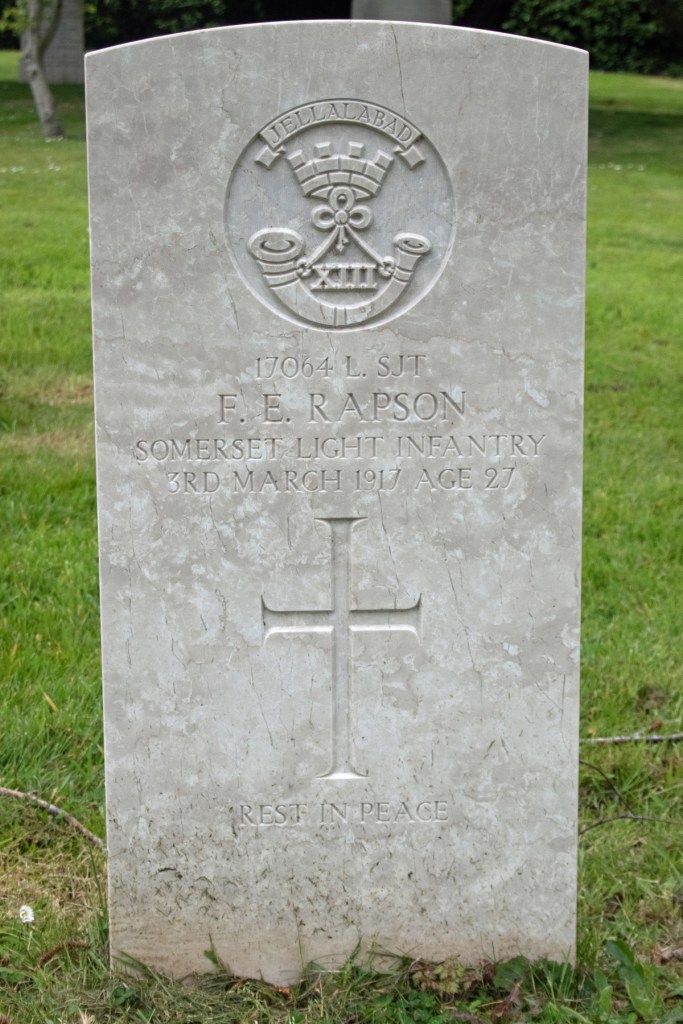
Lance Serjeant Frederick Rapson

Lance Serjeant Frederick Rapson

Frederick Ernest Rapson was born in the spring of 1888, one of nine children to Francis and Susan Rapson. Francis was a Serjeant in the 18th Hussars, and the family lived in Dulverton, a village on the edge of Exmoor.

Francis had served in the armed forces for 26 years, but passed away after a short illness in February 1891. According to a local friend and supporter, he had been in charge of the local yeomanry in Dulverton for a number of years and had been ‘in the prime and flower of life’. [West Somerset Free Press: Saturday 28th February 1891]

Susan was left widowed with nine children, the eldest of whom was only 13 years old. Frederick was only three at the time, and had lost his father at a very early age.

In 1895, Susan married a Frederick Howard, who was a painter and carpenter. The family moved to Taunton in Somerset, and Frederick and Susan went on to have three children of their own.

On 6th February 1910, Frederick Rapson married Lucy Knight; by this time, he was working as a compositor for the local newspaper. The couple set up home in the middle of Taunton, and went on to have three children, Francis, Frederick and Ronald.

War was coming, and, while Frederick did not actively seek military service in the same way as his father had done, it was not something he was able to avoid. While his full military records are not available, it’s clear that he enlisted in the Somerset Light Infantry at some point early on in the conflict.

Private Rapson was assigned to the 1st Battalion, who were based on the Western Front for the duration of the conflict. During his time there, he was awarded the Victory and British Medals, but not the 1915 Star, so that would narrow down his enlisting to some point in 1916.

While he was promoted to the role of Lance Serjeant, his service was to be a short one. At the start of 1917, he contracted pneumonia and was admitted to hospital. Sadly, the condition was to get the better of him, and he passed away on 3rd March 1917. He was just 27 years of age.

Frederick Ernest Rapson was buried in a quiet corner of St James’ Cemetery in Taunton, Somerset.


Private Henry Oaten

Private Henry Oaten

Henry Oaten was born in 1876, the second youngest of seven children to Henry and Mary Ann Oaten. Henry Sr was an agricultural labourer, who raised his family in his home village of Pitminster, to the south of Taunton in Somerset.

When he left school, Henry Jr followed in his father’s footsteps as a farm worker. Sadly, however, there is very little further documentation to expand on his life.

Henry married a woman called Emily; this is likely to have been at some point around 1900, although there is nothing to confirm an exact date. The couple went on to have four children – John, Albert, William and Howard.

When war broke out, Henry joined up. Again, dates for his military service are not available, but he enlisted in the Devonshire Regiment as a Private. He was assigned to the 13th (Works) Battalion, which was a territorial force, based in Plymouth.

Little further documentation exists in relation to Private Oaten. The next time he appears is on his pension record, which confirms that he passed away on 20th February 1917, having been suffering from bronchitis. He was just 40 years old.

Henry Oaten was brought back to Taunton and laid to rest in the St James’ Cemetery in the town.


As an aside to this story, while researching Private Oaten, an additional piece of information about his father came to light. A record confirms that, on the 1st October 1851, at the age of just 16, Henry Oaten was admitted to gaol. Sadly further details – including that of his crime and his sentence – are lost to time, but it adds an interesting footnote to his son’s background.


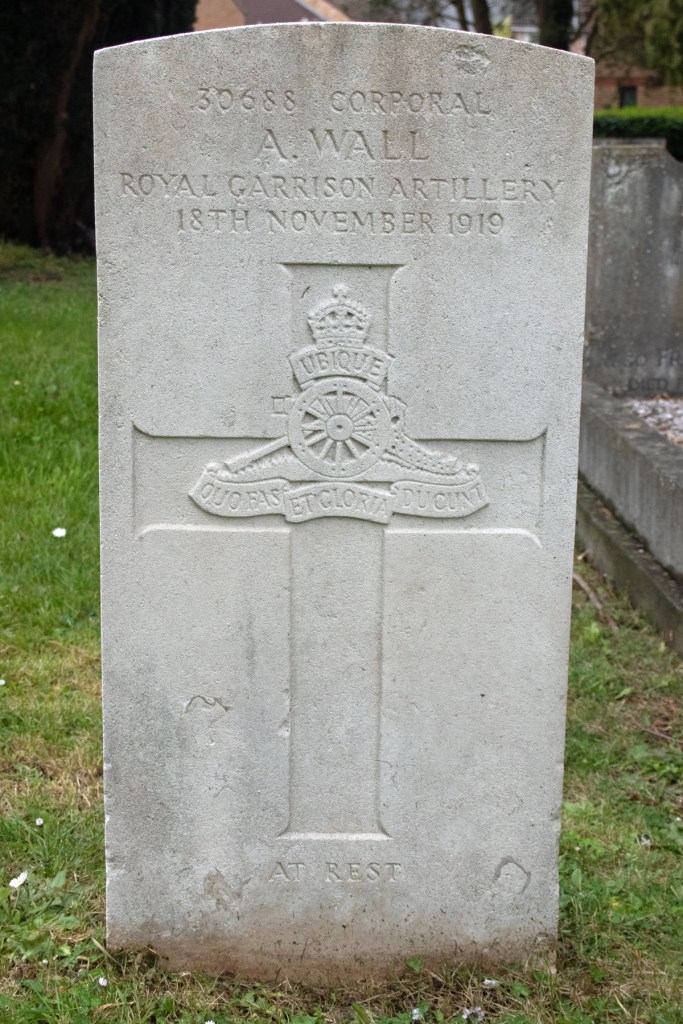
Corporal Albert Wall

Corporal Albert Wall

Albert Wall was born in the spring of 1890, one of eight children to James Wall and his wife Louise. James was a mason’s labourer from Taunton, Somerset, and brought his family up in his home town.

Details of Albert’s life are tantalisingly absent. It appears that he had a sense of adventure, and joined the Royal Garrison Artillery when his age allowed. By 1911, he was stationed at Port Royal in Jamaica, and was listed as a Gunner.

Gunner Wall’s involvement with the Royal Garrison Artillery extended into the Great War. He was sent to Egypt in April 1915, and, as part of his service, gained the Victory and British Medals and the 1915 Star. Albert seems to have been luck in that he saw out the war fairly unscathed, and was promoted to the rank of Corporal.

In the winter of 1918, Albert married Beatrice Salter. The war over, he was subsequently discharged from active service in April 1919.

Life on civvy street was not destined to be a long one, however, as, on 18th November 1919, he passed away from kidney disease. He was just 29 years of age.

Albert Wall was laid to rest in the St James Cemetery in his home town of Taunton.


As a sad footnote to this story, on 5th March 1920, Beatrice gave birth to a little boy, who she called Gordon. Albert was never to see his son.


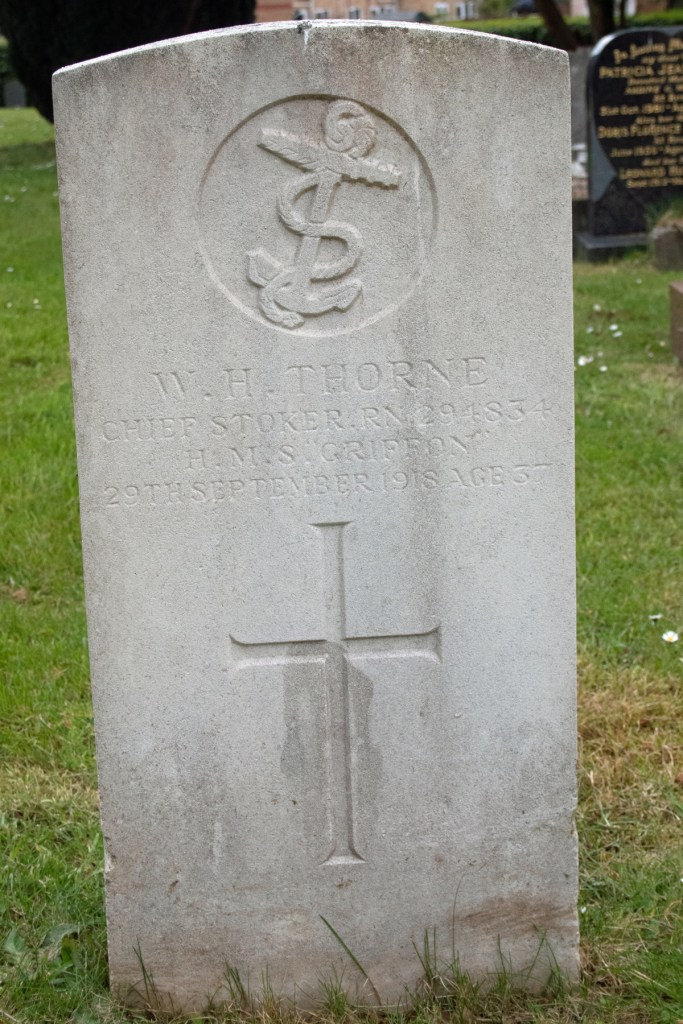
Chief Stoker William Thorne

Chief Stoker William Thorne

William Henry Thorne was born on 28th July 1881 in the Somerset village of Milverton. He was the oldest of five children to farm labourer Henry Thorne and his wife Mary.

William was a young man with a keen sense of adventure. In February 1900, he joined the Royal Navy as a Stoker. After his initial training in Devonport, he was assigned to HMS Thunderer and, after six months, joined HMS Hood, where he spent the next two years.

Over his twelve years of his service, Stoker Thorne served on six further vessels, attaining the rank of Stoker Petty Officer.

In 1907, William had married Mabel Cross, a young woman from Taunton. While her husband was away from England – the marriage certificate gives his address as ‘on the high seas’ – she set up home near the centre of town. The young couple went on to have two children, twins Phyllis and Doris, who were born in 1911.

Back at sea, and Stoker Petty Officer Thorne’s terms of service were extended in 1912, so that he would continue to be a part of the Royal Navy until the cessation of hostilities. He served on a further six vessels and was promoted to Chief Stoker in June 1917.

It was while he was serving on HMS Griffon in the autumn of 1918 that William fell ill. Brought back to shore, he was admitted to the Military Hospital in Taunton. There is nothing to confirm the illness he contracted, but it was one he would succumb to. Chief Stoker Thorne passed away on 29th September. He was 37 years old.

William Henry Thorne lies at peace in the St James Cemetery in his home town of Taunton.


Private Sidney Watts

Private Sidney Watts

Sidney Gilbert Watts was born in 1892, one of five children to railway inspector Arthur Watts and his wife Laura. Initially brought up in the village of Congresbury, near Bristol, Arthur soon moved the family to nearby Taunton.

A likeable man, Arthur continued working for Great Western Railways. He also became involved in the Taunton Co-operative and Industrial Society and, for a number of years was the Chairman. Suddenly, and unexpectedly, however, on 20th January 1907, he collapsed and died from a heart attack.

Now widowed, Laura’s children rallied around her. Most of them had left school; her eldest, Reginald, was a school master, her older daughters Florrie and Mabel worked for a milliner and draper, and two lodgers moved in to help financially support her and her youngest daughter Evelyn.

By this time Sidney had followed in his father’s footsteps, and found work as a porter for GWR. He had moved to Hayle in Cornwall, where, according to the 1911 census, he was boarding with 33-year-old widow, Lizzie Richards, and sharing the house with another railway worker, Richard Crago.

Sidney seemed to be looking for something more. In February 1912, he enlisted as a Private in the Royal Army Medical Corps. He trained as a cook and, when war broke out, was sent out to France as part of the British Expeditionary Force.

In July 1915, Private Watts contracted pleurisy and was treated in a hospital in Boulogne. He was discharged for duty and assigned to a hospital ship, where he stayed for six months. While there, he contracted pneumonia and was bedridden for six weeks, his lung having collapsed.

Sidney was evacuated to England to recuperate. His health did not improve, however, and he was medically discharged from the army on 31st July 1916. A few months later, he was admitted to Cranham Lodge Sanatorium near Gloucester, but passed away on 24th September 1916. He was just 24 years old.

The body of Sidney Gilbert Watts was brought back to Taunton, and he was laid to rest in the St James Cemetery in the town.


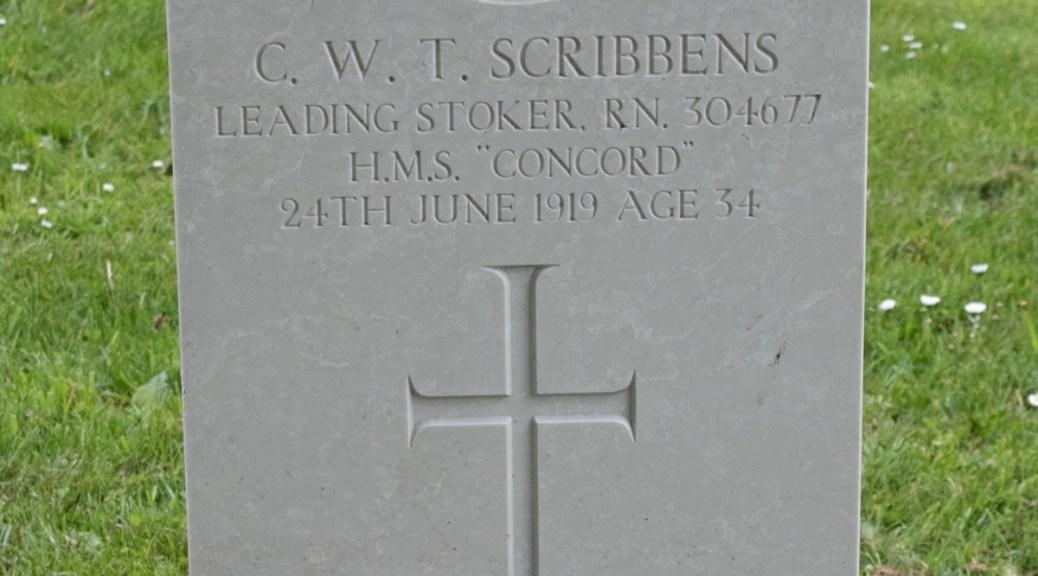
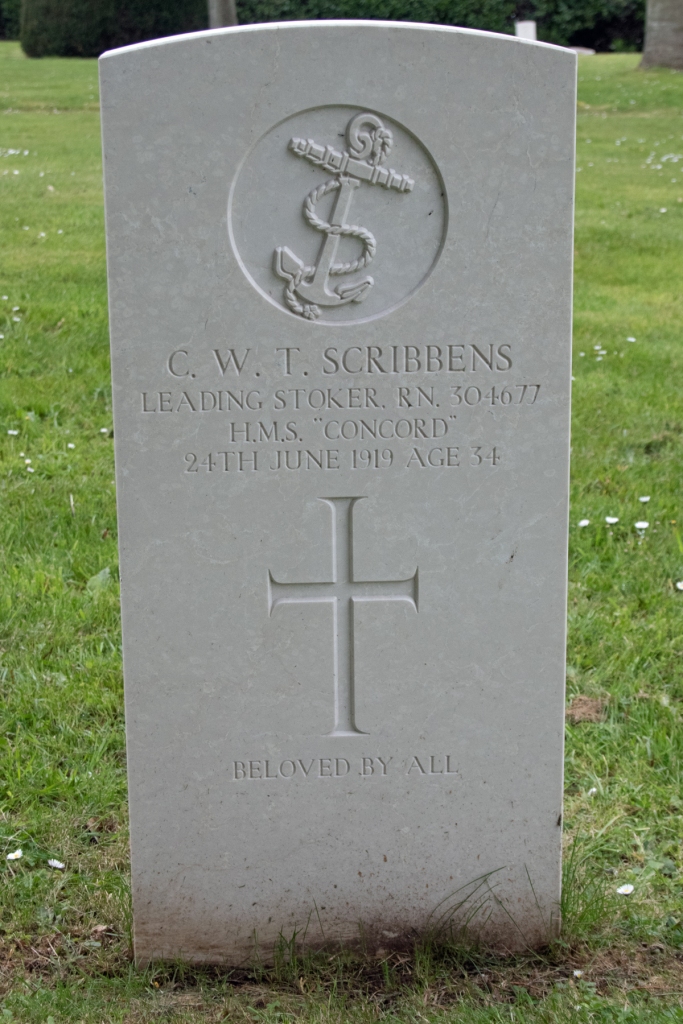
Leading Stoker Cecil Scribbens

Leading Stoker Cecil Scribbens

Cecil Walter Thomas Scribbens was born on 27th June 1885 in Taunton, Somerset. He was one of five children to George and Ann Scribbens. Sadly, George passed away when Cecil was a toddler, leaving his widow to raise her young family alone.

Ann initially found work as a laundress, and her eldest daughter, Alice, began working at the local silk mill when she left school. This brought in a little money, but with five children to feed and clothe, it must have been a struggle.

In 1894, Ann found love again, and married George Sully, a scull labourer, on Christmas Day 1894. The couple went on to have a child together, a son they called Arthur, and the new family set up home in Taunton.

When he left school, Cecil found work as a labourer, but he had a sense of adventure and a life on the ocean was calling him. In July 1903 he joined the Royal Navy as a Stoker 2nd Class and, after his initial training in Plymouth he was assigned to HMS Russell.

Stoker Scribbens’ term of service was twelve years and, during that time, he served aboard five vessels, and was promoted to Leading Stoker. War had broken out when his initial contract ended, so it was extended until the end of the hostilities.

After five years aboard HMS Cornwall and eighteen months on HMS Cleopatra, Leading Stoker Scribbens was assigned to HMS Concord, which would turn out to be his last vessel, in December 1916. He stayed with this ship for nearly three years until falling ill in June 1919.

Brought back to England, he was admitted to the Military Hospital in Taunton with pneumonia. Leading Stoker Scribbens died from this lung disease on 24th June 1919, at the age of 34 years old.

Cecil Walter Thomas Scribbens was laid to rest in the St James’ Cemetery in his home town.


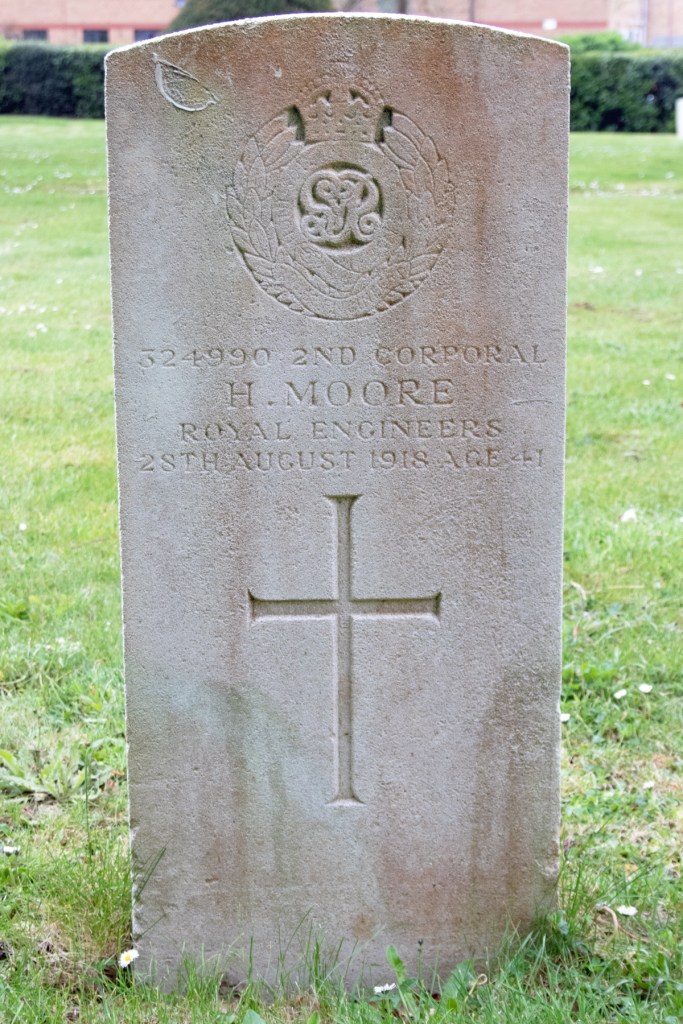
Corporal Harry Moore

Corporal Harry Moore

Harry Moore was born in Tiverton, Devon, in early 1877. He was the fourth of eleven children to James Moore, a railway policeman, and his wife Ann.

By 1890, James had moved the family to Taunton, in Somerset (where his work was now listed as railway porter). Over the next decade, Harry was to encounter tragedy and happiness.

In 1894, his father died from Bright’s disease (a kidney complaint), at the age of just 45 years old.

Three years later, Harry’s mother died, from what appears to have been heart failure. Ann was 49 years of age.

On 13th November 1898, Harry married Alice Mary Larcombe, a dressmaker from Taunton. The young couple set up home together in the north of the town. They went on to have five children, although, sadly, only one would live to reach their 20s.

By now Harry had found employment as an insurance agent, but war was coming to Europe. His military records are lost to time, but he enlisted in the Royal Engineers and was assigned to G Depot Company. (The Depot Battalions received men who had returned from the Expeditionary Force and also those men who had enlisted for Tunnelling Companies, Special Companies and other specialist units.)

The next evidence we have of Corporal Moore is in the Army Register of Soldiers’ Effects. This confirms that he had been admitted to the Southern General Hospital in Bristol with an illness, and that he subsequently passed away on 28th August 1918, at the age of 41.

Harry Moore was laid to rest in the St James’ Cemetery in his home town of Taunton.


Private David Percy

Private David Percy

David Percy was born in 1896, one of ten children to Elizabeth Percy. By the time of the 1901 census – the first one on which David appeared – Elizabeth was widowed, so there is no record of who his or his siblings’ father was.

Elizabeth, working to make ends meet, found employment as a cook at Taunton Boys’ School, in her home town. The 1911 census shows her two youngest sons – David and his older brother Douglas – were living with her, as was a lodger, Owen Howe. David, by this time, had left school and found work as a labourer, while Douglas was employed as a carter.

David soon found a new job as a printer for Hammett & Co. in the town, but war was beckoning across the Channel. In October 1914 he enlisted, joining the West Somerset Yeomanry as a Private and was sent to Minehead for training.

The local newspaper picked up his story:

He there caught a chill and was in hospital for some time. At Easter [1915] he was removed to the Taunton Hospital, and subsequently sent home.

Taunton Courier and Western Advertiser: 26th May 1915

Sadly, after Private Percy’s discharge home, he passed away from his ‘chill’, breathing his last on 15th May 1915. He was just 19 years old.

David Percy was buried in St James’ Cemetery in his home town of Taunton.


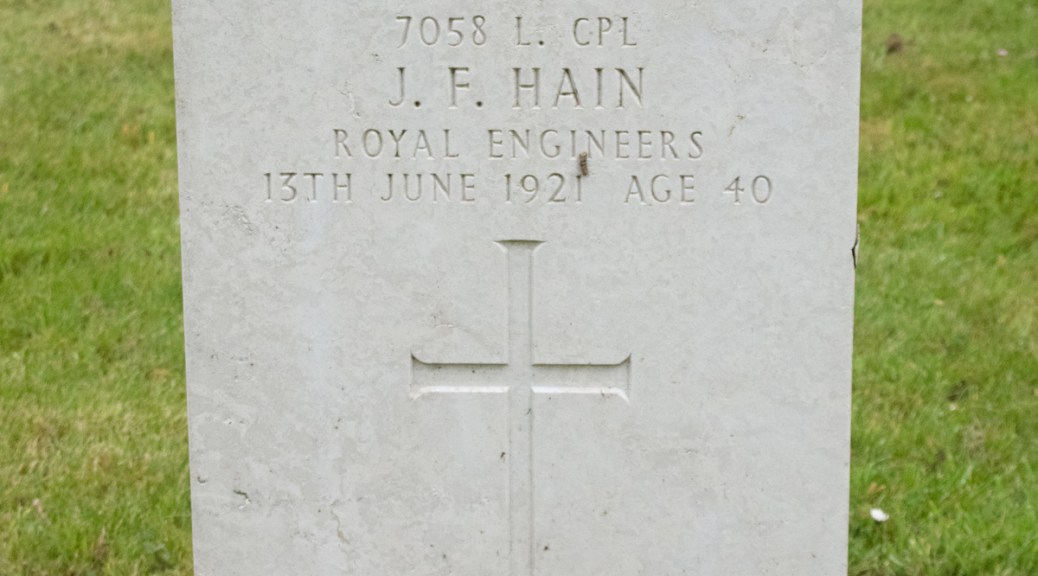
Lance Corporal James Hain

Lance Corporal James Hain

James Frederick Hain was born on 5th November 1881 in the village of Holmer in Herefordshire. He was one of seven children to James and Catherine Hain, and was more commonly known as Fred. On James Jr’s birth certificate, his father was listed as a manure agent, although by the time of the 1891 census, the family had moved to London, where James Sr was now running a coffee house.

When he left school, James Jr started work as a French polisher, but he had a taste for adventure and joined the army. He served in South Africa during the Boer War campaign of 1899-1900, attaining the Cape Colony, Orange Free State and Transvaal Clasps.

In 1900 James returned home, finding work as a French polisher. The military life was in his blood by now, though, and in September, he re-enlisted. Initially joining the Royal Berkshire Regiment, he was soon transferred over to the Royal Engineers as a Sapper.

James had signed up for a period of eight years and, as part of his role as a wireman (maintaining and fitting telegraph cables), he was stationed abroad. On one particular trip, when his battalion was travelling from Plymouth to Limerick early in 1908, he was injured. According to the accident report: “owing to bad weather on boat between Fishguard and Waterford he was thrown violently forward, striking his head against a girder.” Treated in Limerick, “the disability is of a slight nature, and in all probability will not interfere with his future efficiency as a soldier.”

Sapper Hain’s time with the service was nearly up, and he was put on reserve status in November 1908. By 1911, he was working as a linesman, and boarding in a house in Hayle, Cornwall.

War was on the horizon by now, and on 5th August 1914, James was called back into service. He saw action on the Western Front, adding the Victory and British Medals and the 1915 Star to his count. In October 1915, he was treated for shell shock, and evacuated back to England.

At the beginning of 1917, Lance Corporal Hain was transferred back to the Army Reserve, suffering from neuritis. His health was to suffer for the rest of his life.

In September 1917, having settled in Cornwall, James married Beatrice Opie, an innkeeper’s daughter from the village of Wendron, Cornwall. The couple would go on to have a son, who they called Frederick, two years later.

Discharged from the Army, James put his engineering experience to good use, joining the General Post Office to work with telegraphs.

By this time, James’ medical condition had been formally diagnosed as General Paralysis of the Insane. A degenerative disease, similar to Alzheimer’s disease, it was associated with brisk reflexes and tremors (usually most obvious of the lips, tongue, and outstretched hands) and characterised by failing memory and general deterioration.

By August 1920, James was admitted to the Somerset and Bath Asylum in Cotford, because of his worsening condition. He was not to come out again, and passed away ten months later, on 13th June 1921. He was just 39 years old.

James Frederick Hain was buried in the St James’ Cemetery in Taunton, Somerset.


James Frederick Hain
(from findagrave.com)