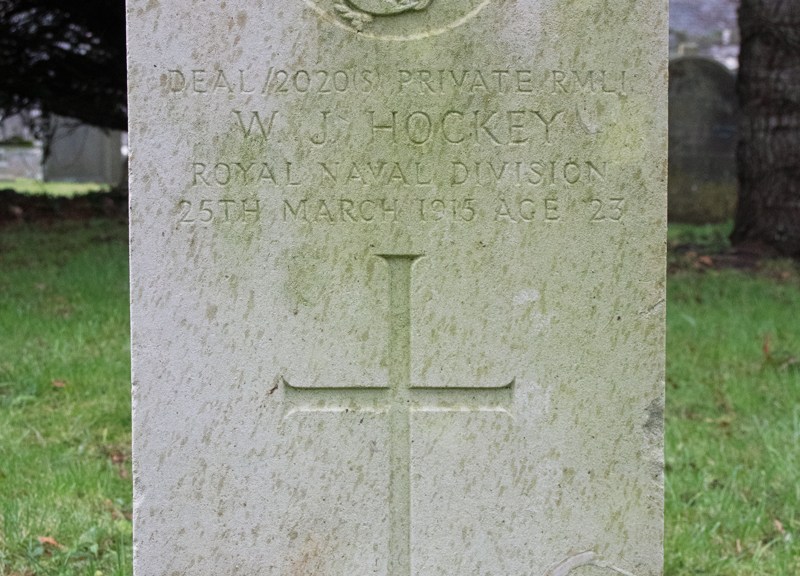
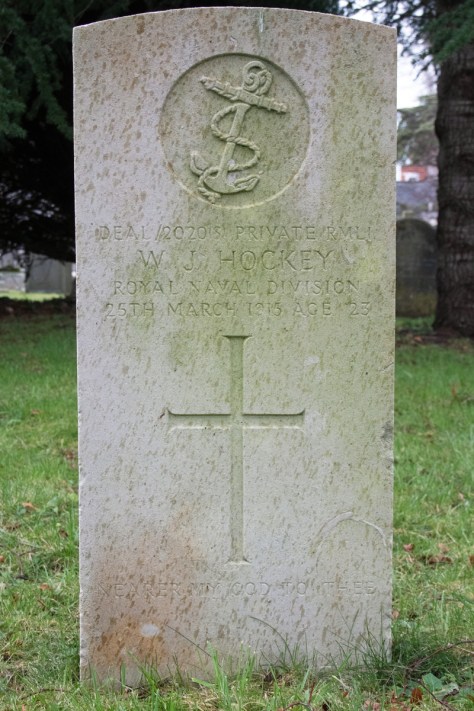
Wilfred James Hockey was born in September 1892, the sixth of nine children to William and Mary. William was the village butcher, but Wilfred followed his older brother Oliver into the gardening business.
Military records for Wilfred are difficult to locate, but it appears that there is a reason for this.
He enlisted in February 1915, joining the Royal Marine Light Infantry. His initial service took him to Crystal Palace in South London – then a naval training base.
Returning home on leave on 12th March, Private Hockey fell ill on his first evening at home. Quickly diagnosed with ‘spotted fever’ (or meningitis), he sadly passed away on 25th March. He was just 23 years of age.
Wilfred Hockey lies at rest in the graveyard of St Matthew’s Church in his home village of Wookey, in Somerset.
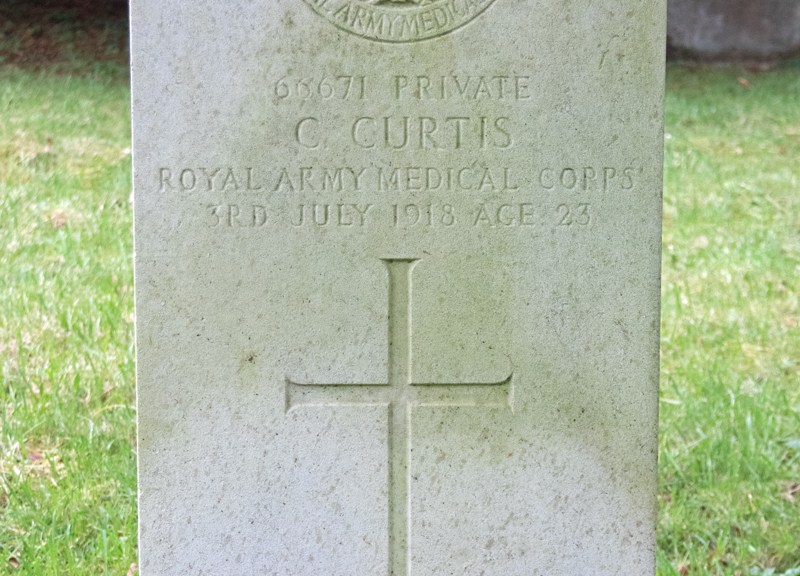
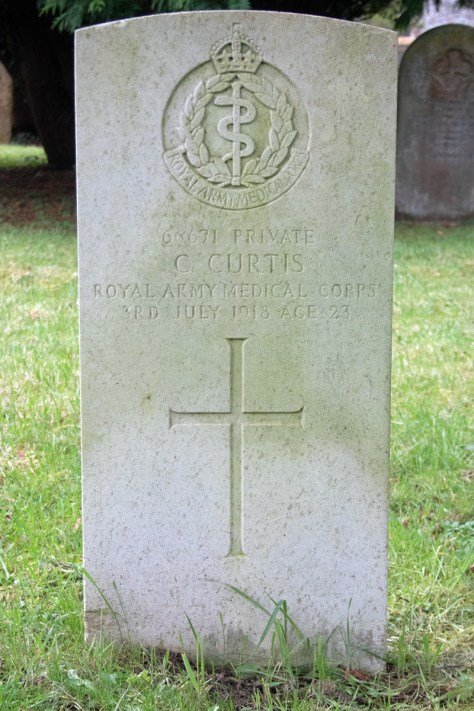
Charles Curtis was born in Wells, Somerset, in January 1894, one of fifteen children to Charles and Mary Jane Curtis. Charles Sr worked as a gardener in the Wells area, and, after leaving school, Charles Jr started work as a mill hand for the local paper mill (this would have been either St Cuthbert’s Mill in Wells, or the Wookey Hole Mill in the nearby village).
Charles enlisted in October 1915, joining the Royal Army Medical Corps. He was posted to France a month later and, while specifics of his military service are not readily apparent, Private Curtis was awarded the Victory Medal, the British Medal and the 1915 Star.
Charles was admitted to hospital on 1st November 1917 with an inflamed cervical gland (reported as Trench Fever), for which he underwent an operation. He remained hospitalised at Whalley Range for more than two months, and was passed for active service, having apparently recovered.
Private Curtis was suddenly taken ill again on 1st July, and his family telegrammed. His mother and one of his sisters boarded a train for the hospital – again in Whalley – but they had not gone far when word came that he succumbed to rheumatic fever. He was 24 years old.
Charles Curtis Jr lies at rest in the graveyard of St Matthew’s Church in the village of Wookey, Somerset.
A newspaper report of his funeral confirms that Charles was one of five brothers who had entered military service during the Great War. Amazingly, given that seven of the brothers ended up serving, Charles was the only one to die as a result of the war.
Bertram Falls Perkins was born in December 1872, the third of four children to Alfred and Mary Perkins. Alfred was a Colonel in the army and has met his wife while serving in Madras, India. He had retired by the time Alfred was born, and had brought his family back to England, where he set up as a Country Magistrate, living in the village of Wookey in Somerset.
Bertram was set for good things – by the time of the 1881 census, the family were living in Eastcott House, with a footman, cook, two ladies’ maids, two house maid and a governess to look after them.
Bertram’s military records are a little scant, but can be pieced together from his funeral notice.
The late Captain Bertram Perkins… joined the 1st Vol. Batt. of the Somerset Light Infantry as 2nd Lieutenant in February 1892, and, in November 1894, was transferred to his father’s regiment, the 3rd Batt. Welsh Regt. as Lieutenant… In October 1896 he went to South Africa and joined the Natal Mounted Police, in which he saw much active service… at the relief of Ladysmith and Dundee. Being stricken down with a very severe attack of enteric fever, he had to resign… and return home. As soon as he recovered his health he again retuned to South Africa as a Captain in the 3rd Battalion Welsh Regiment, where he saw much service…
Whilst at Vryburg, he was appointed Provost Marshal, and in recognition of his tact and energy in filling a very difficult position, was presented by the inhabitants of the district with a gold watch and an illuminated address. He was in possession of the Queen’s Medal with four clasps and the King’s Medal with two clasps. On his return home he took to farming… He retired from the Service in 1905, but on the outbreak of the present war was appointed as Captain to the 12th Battalion of the Sherwood Foresters. Unfortunately, his health, which had never been quite restored, broke down, and he was invalided out of the Regiment.
Wells Journal: Friday 16th June 1916
During the Great War, Captain Perkins’ regiment has been the 12th (Service) Battalion for the Nottinghamshire and Derbyshire Regiment. His unit been shipped out to France in August 1915, but it is likely that he saw little, if any, time on the Western Front. After being invalided out, he succumbed to his ongoing illness on 14th June 1916, aged 43.
Bertram Falls Perkins lies at rest in the graveyard of St Matthew’s Church, in his home village of Wookey, near Wells in Somerset.
Victor Charles Edelsten Bracey was born in October 1897, the only child of William and Florence Bracey. William was a physician and surgeon, practicing in Lancashire when Victor was born. The young family soon moved south, however, and by the time of the 1901 census, they were living in Wedmore, Somerset, where William had taken up as the village’s general practitioner.
Military records for Victor are not available, but his life can readily be pieced together from newspaper reports of his death and the de Ruvigny’s Roll of Honour, published after the war.
TWO PILOTS KILLED IN THE NEW FOREST
Two air fatalities have occurred within twenty-four hours of each other in the New Forest. On Saturday [22nd September 1917] Second Lieutenant Ernest Hargrave’s machine nose-dived from the height of 200ft, and crashed to earth.
Second Lieutenant Victor Bracey was flying on Sunday morning at a height of 300ft, when his machine turned and came down in a spinning nose-dive.
At the inquests verdicts of “Death by misadventure” were returned.
Western Gazette: Friday 28th September 1917
BRACEY, VICTOR CHARLES EDELSTEN, 2nd Lieut., RFC, only child of William Edelsten Bracey, LRCP [Licentiate of the Royal College of Physicians], Lieut. (Hon.) RAMC (retired), by his wife, Florence Marion, dau. of the late James Canning Gould.
[Victor was] educated St Peter’s School, Weston-super-Mare, and Blundell’s School, Tiverton, where he was a member of the OTC [Officers’ Training Corps]; passed into the Royal Military Academy in April 1915; joined the Inns of Court OTC in December 1916; was gazetted 2nd Lieut. RFC [Royal Flying Corps] 27 April 1917, obtaining his wings in July, and was killed in an aerial accident at the Beaulieu Aerodrome, Hampshire, 23 September, while testing a new machine.
A brother officer wrote that he was a gallant gentleman and a most skilful pilot.” He was a keen cricketer and footballer, and while at Blundell’s played in the First Cricket XI and the Second Football XV, and was also captain of the First Hockey XI; later played for the Royal Military Academy, Woolwich, and the RFC Rugby Football XV at Oxford.
de Ruvigny’s Roll of Honour, 1914-1919
A note on Second Lieutenant Bracey’s Roll of Honour states that he was ineligible for medals as he saw no overseas service; this seems to have been challenged by Victor’s father in 1921, but nothing confirms whether this anything was subsequently awarded.
Victor Charles Edelsten Bracey lies at rest in the churchyard of St Mary’s in Wedmore, where his father continued to practice. He died, aged just 19 years of age.
William’s prominence in the village played a big part in Victor’s legacy. A Memorial Fund was set up; this helped fund “necessitous cases for medical requirements and for conveying patients to hospitals“. The Victor Bracey Cup was also awarded into the 1940s for sporting achievement in the schools he had attended.
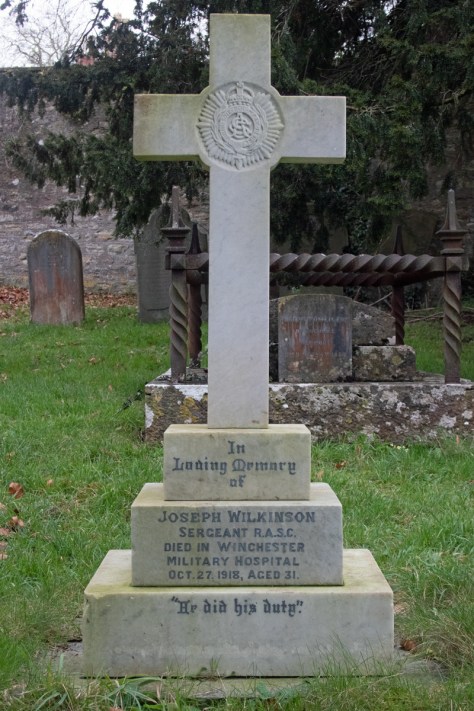
Joseph Wilkinson was born in the village of Greystoke, Cumbria in the summer of 1888. His parents were John and Margaret Wilkinson, and he had two siblings, also called John and Margaret. Joseph’s father worked as a railway signalman, and the industry employed a large number of people in the village.
Joseph’s life was to take a different turn, however, and it was likely the railway that took him there. He next appears on the 1911 census, boarding in a house in the village of Wedmore in Somerset. At 23 years old, he is listed as a Solicitor’s Cashier.
As with so many other fallen men and women, Joseph’s trail goes cold. There is not enough evidence to detail his military career – he joined the Royal Army Service Corps as a Driver and was promoted to Sergeant.
The UK Army Register of Soldiers’ Effects show that he was married to a woman called Ethel, although there are no records of their wedding. The document also confirms that he died at the Union Hospital in Winchester, Hampshire on 17th October 1918, but there is no cause of death given. He was 31 years old.
“He did his duty” says his impressive gravestone, but it is tragic that that duty is lost to time.
Sergeant Joseph Wilkinson lies at rest in the churchyard of St Mary’s in Wedmore, the Somerset village that came to be his home.
William Collard was born in August 1891, the youngest of two children to William and Agnes Collard from Wedmore in Somerset. William Sr was a carter for a local miller and his son followed him into labouring when he left school.
William’s life seems to have been a tragic one. His mother died in 1910, while his sister Mabel passed a year later.
William married Eva Heal, a woman from the same village, in April 1914. The couple didn’t go on to have any children.
There is limited information relating to William’s military service. What is apparent is that he enlisted in the Royal Army Medical Corps, presumably at some point after the start of the Great War.
Private Collard’s battalion, the 3rd South Midlands, were based in Essex and were shipped to France in March 1915. There is, however, no evidence that William went with his troop. His training must have gone well, however, and he was promoted to Lance Corporal.
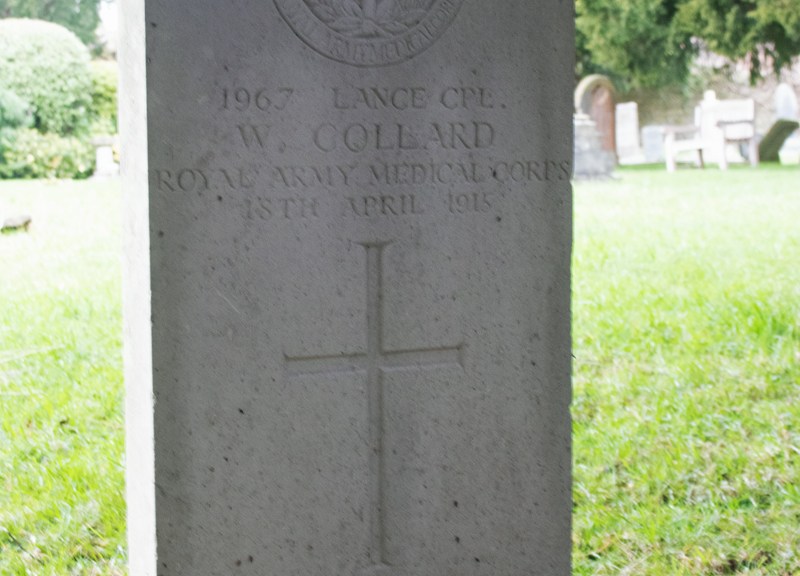
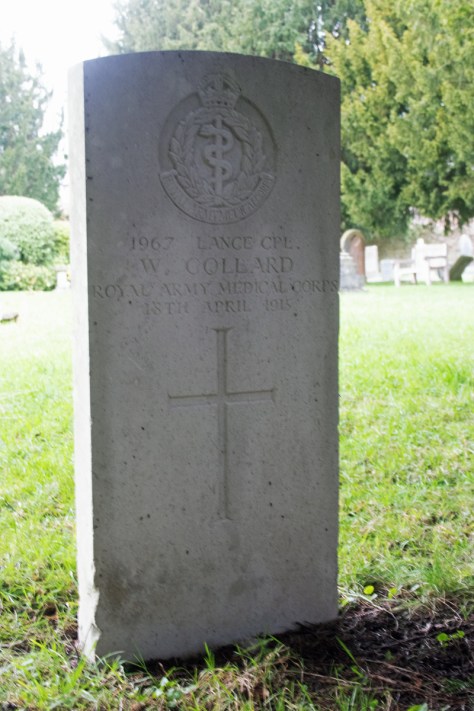
Details of his death are vague; William’s gravestone confirms he passed on 18th April 1915; the cause of his death was not reported. He was 23 years of age.
A brief notice in a local newspaper gives a little more information:
Mr W Collard [Senior], of Wedmore, one of the patients at the Country Sanatorium, received last week the news of the death of his soldier son. The funeral took place on Thursday at Wedmore in the same grave as the mother and only other member of the family, a sister of the deceased.
Shepton Mallet Journal: Friday 30th April 1915
William Collard lies at rest in the churchyard of St Mary’s Church in his home village of Wedmore, Somerset.
William is remembered in on a plaque in Bristol Cathedral; this commemorates the fourteen members of the 3rd South Midland Field Ambulance who fell during the war.
Comment should also be made of William’s father. In the space of four and a half years, he had lost his wife and both his children. He was already in a sanatorium when his son died. He too passed away, in December 1924, at the age of 58.
William’s widow, Eva, never remarried. She went on to live the age of 96, and passed away in Poole, on the Dorset coast.
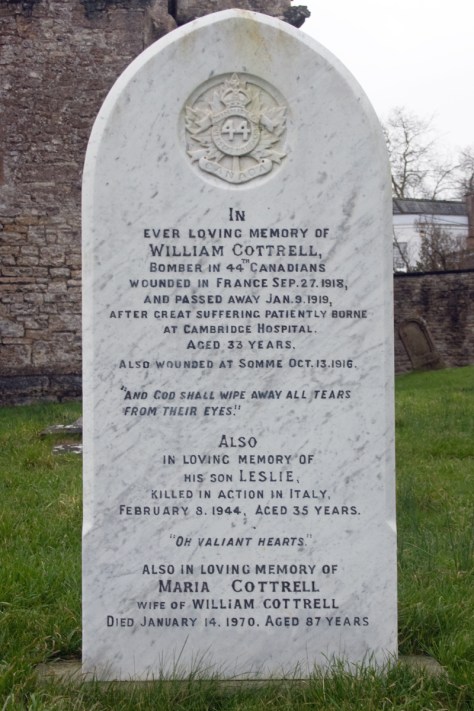
William Cottrell was born in April 1885, the third of twelve children to Henry and Annie Cottrell from Bampton, Devon. When William left school, he became an assistant to the village baker, but new opportunities lay ahead.
In May 1907, William married Maria Wall, the daughter of a stonemason from Wedmore in Somerset. With weeks, the young couple had embarked for a new life, boarding the Empress of Britain in Liverpool, setting sail for Canada.
Emigrating to Manitoba, William became a labourer, and he and Maria had three children – Leslie, Ronald and Kathleen.
War came, and William enlisted in the Canadian Expeditionary Force in August 1915. Shipped to England in the spring of the following year, Annie followed suit, returning to Somerset with the three children.
Private Cottrell was assigned to the 44th Battalion Canadian Infantry, setting off for France in August 1916, just weeks before his fourth child – Ruby – was born.
The battalion was involved in some of the fiercest fighting of the war, and it was during the Somme Offensive that William was shot in the left arm. Initially treated in the field, he was soon shipped back to England to recover in a military hospital in Epsom. Discharged after three months, he was returned to his battalion in early 1917.
The fierce fighting continued, and Private Cottrell was wounded again in October 1918. Further treatment back in the UK was needed, and he was admitted to the 1st Eastern General Hospital in Cambridge.
Details of the William’s injuries at the Somme are readily available, but information on his second lot of injuries is scarcer. They must have been pretty severe, however, as he was not discharged. He lost his final battle after four months, succumbing to his wounds on 9th January 1919. He was 33 years old.
William Cottrell lies at rest in the graveyard of St Mary’s Church in his widow’s home village of Wedmore, Somerset.
William’s gravestone is also a memorial to his eldest son, Leslie, who was killed during the Second World War.
Details of his military service are sketchy, but he enlisted in the Queen’s Own Royal West Kent Regiment. His battalion – the 1st – was involved in the fighting in Italy, and it was here that he lost his life. He was killed on 8th February 1944 and is buried in the Sangro River War Cemetery, in Abruzzo.
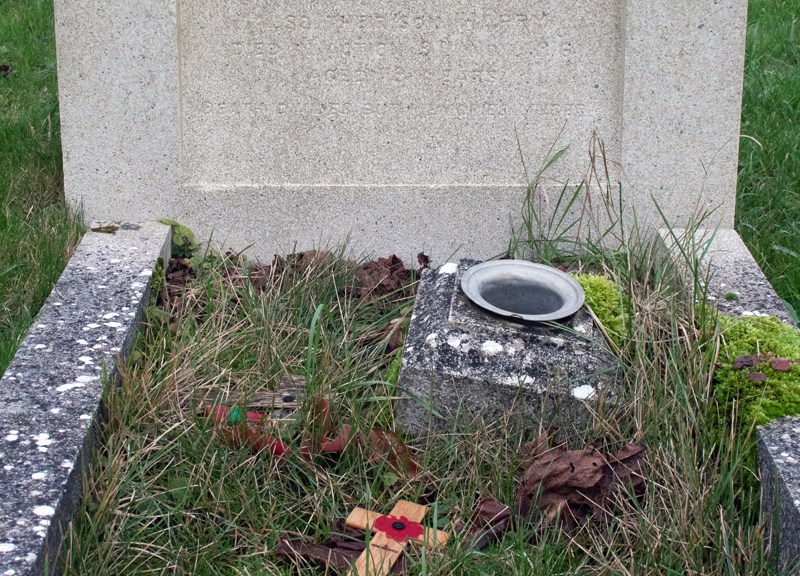
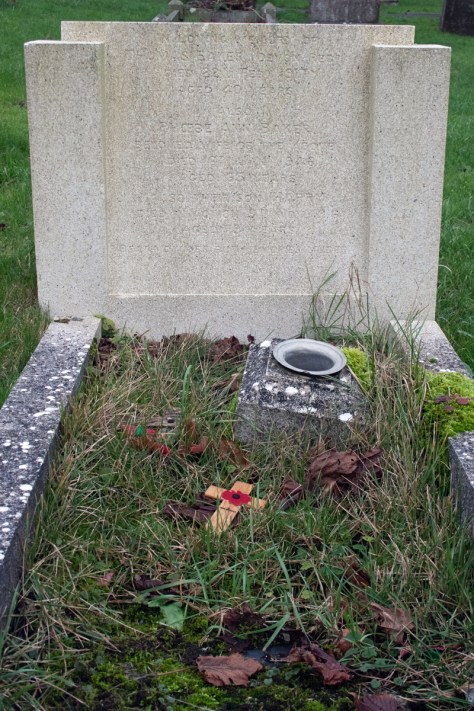
Thomas Baker was born in 1877, the youngest of four children – all boys – to John and Anna Baker from Meare in Somerset. John was a farm labourer, and it was rural trades that his four sons followed, Thomas himself also becoming a farm worker.
Thomas married in August 1896; Phoebe Ann Willis was also from Meare and was just seventeen when the couple married. While I am sure there was love involved, something more practical might have prompted such a young marriage as, six months later, the couple had their first child, Henry.
Thomas and Phoebe went on to have four children, three of whom – Henry, Florence and Amy – survived. By the time of the 1911 census, the family were living in their home village of Meare, with Henry following in his father’s – and grandfather’s – line of work.
Full details of Thomas’ military services are not available. He enlisted in the Devonshire Regiment as part of the 13th Works Battalion and, while there is no documentation to confirm when he joined up, it was probably early in 1917.
Thomas and Phoebe’s son Henry had enlisted in 1915, joining the Gloucestershire Regiment. It seems likely he fought on the Somme, and he was killed in action in November 1916, aged just 20 years old. It may have been this loss that prompted Thomas to do his duty, albeit on the Home Front.
Whenever it was that Private Thomas Baker had enlisted, it was Phoebe that was to suffer the ultimate price. Having already lost a child young, her boy had died in the fields of France, and her husband was also about to add to that loss.
Thomas contracted pneumonia in the winter of 1916-17, and passed away in a military hospital on 22nd February 1917. He was 40 years old.
Thomas lies at rest in the graveyard of the Church of the Blessed Virgin Mary & All Saints in his home village of Meare in Somerset.
James Patch was born in 1882, the third of four children – all boys – to Albert and Jane. Albert was a farm labourer in the village of Meare, Somerset, and this is something that, once leaving school, the Patch boys also went into.
Albert passed away in 1904, so James stepped up and stayed living with his mother. By the time of the 1911 census, they were living near the Grape Vine Pub in Meare, both working as agricultural labourers, and had a John Lee boarding with them.
No firm details remain of James’ military service, although it is evident that he enlisted in the Devonshire Regiment and, from the Army Register of Soldiers’ Effects, this can be narrowed down to the 7th Infantry Works Company.
While Private Patch’s military records are sparse, his name crops up a lot in the newspapers around the time of his death, with headlines like “Mysterious Death of Meare Soldier”.
On the evening of the 25th March 1917, James was found lying across the tram tracks in Horfield, a suburb to the north of Bristol. He was in a semi-conscious state, and was taken to the nearby barracks.
An inquest was held and the story unfolded.
Witness statements confirmed that Private Patch was on a tram and had asked the conductress to let him know when they reached the barracks. The tram halted at the allotted stop, but, when nobody alighted, the driver started up again.
James apparently asked the conductress if that had been the stop for Horfield Barracks and, having confirmed that it was, and that he had wanted to get off there, she pressed the bell for the driver to pull up at the next stop. She then went up to the top deck of the tram, and it appear that James had decided he couldn’t wait for the next stop and jumped off the moving tram.
It seems that James fell from the tram and hit his head when he landed; this was when a passer-by found him.
The morning after his fall, the camp doctor identified the extent of James’ injury and he was moved from the barracks to the Royal Infirmary in Bristol. Private Patch died an hour after being admitted, having suffered an extensive fracture of the skull. He was 35 years of age.
The inquest into his death returned a verdict of “accidental death, due to a fall from a tram-car, caused by stepping from the car while in motion”.
James Patch lies at rest in the ground of the Church of the Blessed Virgin Mary and All Saints in his home village of Meare in Somerset.
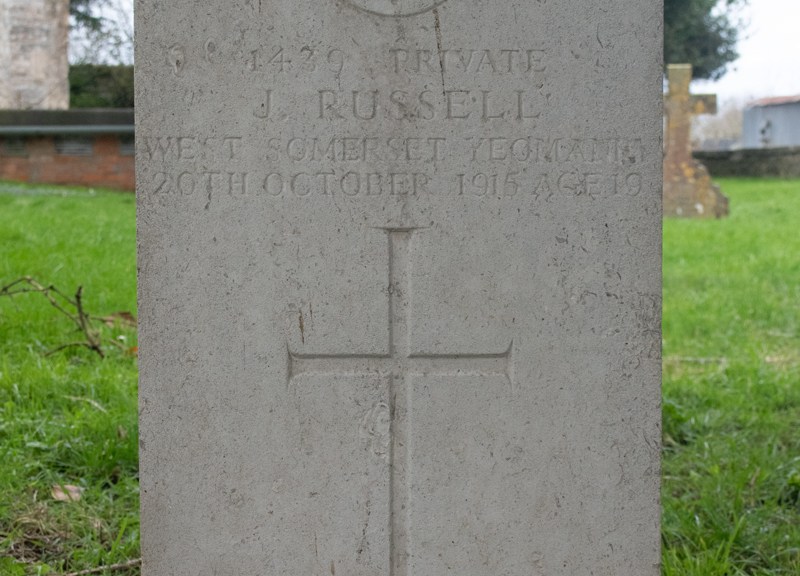
Born in September 1896, John Russell was one of thirteen children to Henry and Ellen Russell. Henry worked as a turf cutter on the Somerset levels, and the family lived in the village of Meare, near Glastonbury.
By the time of the 1911 census, John, aged 15, had left school and joined his father’s business.
When war broke out, John joined up; sadly, his military records are absent, but what we do know for certain is that he enlisted in the West Somerset Yeomanry, and was based at the Stanway Camp near Colchester in Essex.
Sadly, much is written of Private Russell’s death. He was acting as a sentry at the camp on the morning of Tuesday 19th October 1915 when he was hit by a car; taken to the military hospital in Colchester, he passed away the following morning.
An inquest was held into the incident, and the following was ascertained:
Vera Coysh, aged 19, was driving near the camp with two friends and her gardener; as she was approaching the entrance, a horse-drawn military wagon ahead of her turned and she swerved to avoid it. In doing so, she hit Private Russell “and carried him some way along the ground”.
John’s injuries were significant. When admitted to hospital, he “was suffering from bruises on the back of the head and haemorrhage from the right ear and nose. His left hand and the lower part of his left arm were swollen from bruising. He was semi-conscious and restless…”
The inquest identified some discrepancies in what happened.
Witnesses in the military wagon and a second one following it all saw a turning signal being given, although not necessarily in time for Vera to slow down or stop. All of the army witnesses stated that she was driving at a quick speed, possibly as much as 35mph.
Vera and her passengers all stated that they saw no signal, saying that the wagon pulled across without indication. They also stated that they were not travelling at speed.
The inquest was a lengthy one, but the final verdict was one of accidental death, with a recommendation that signs were put up on the road to warn of the entrance to the camp.
John Russell was just 19 years old when he died. He was laid to rest in the graveyard of the Church of the Blessed Virgin Mary and All Saints in his home village of Meare, Somerset.
It’s worth also having a look into the life of the driver of that fated motor car.
Vera Murdoch Coysh was born in September 1896, the eldest child of Commander William Henry Coysh and his wife Beatrice Murdoch. The family lived in Yorkshire and, by the time of the incident, William and Beatrice had had four other children – Humphrey Cecil (who became a Commander), Geoffrey Ernest (who went on to be Sub Lieutenant), John William and Barbara Daphne.
Three months after the accident, Vera married Second Lieutenant Trevor Davidson, of the Essex Regiment, and the couple soon emigrated to Mozambique.
All was not well, however, as, by 1924, Vera has moved back to England, the couple had divorced and she had remarried, to a Douglas Stuart-Jervis. The couple went on to have two children.
Meanwhile, Vera was also making a bit of a name for herself in the literary world, writing a number of novels under the name of Jane England. While rarely seen nowadays, she wrote books with such ‘pulp fiction’ titles as Red Earth, Romantic Stranger, Flowering Harvest, Stormy Passage and Winter Jasmine.
It’s bittersweet to see that Vera made a life for herself, in the way that John Russell was sadly unable to.








 Death and Service