Category Archives: Canadian Infantry

Lance Corporal William Neads

Lance Corporal William Neads

William John Neads was born on 16th December 1892, the middle of three children to cab driver and groom William Neads and his wife Ellen. Both William Sr and Ellen were from Somerset, although William Jr and his brother Charles – who was eleven months older – were both born in the Monmouthshire village of Cwmcarn.

William’s parents soon moved the family back to Clevedon in Somerset, and, when he left school, he found work as a farm labourer. He was eager to see more of the world, however and, in April 1913, he emigrated to Canada.

After working as a labourer there for a year or so, back in Europe war was declared. Keen to do his bit for King and Country, William enlisted in the 1st Battalion of the Canadian Infantry in January 1915. He soon found himself caught up on the Front Line.

In October 1916, he was involved in the Battle of the Somme – either at Le Transloy or The Battle of the Ancre Heights – and received a shrapnel wound to his left shoulder. Initially admitted to the Canadian General Hospital in Etaples, he was subsequently evacuated to England and the Northern General Hospital in Leeds. He spent three months recovering from his injuries, and was back on the Western Front in January 1917.

Later that year, William – now a Lance Corporal – was involved in the fighting at the Second Battle of Passchendaele (part of the Third Battle of Ypres). He was wounded again, this time receiving a rather unceremonious gunshot wound to the right buttock. Treated at the scene, he was evacuated back to England and admitted to the Fusehill War Hospital in Carlisle on 17th November.

Sadly, despite treatment, Lance Corporal Neads’ health deteriorated, and he passed away from his injuries on 16th December 1917, his 25th birthday.

William John Neads was brought back to his family’s home of Clevedon, and buried in the clifftop churchyard of St Andrew’s, overlooking the sea.


Tragically, William’s father had died in May 1917, at the age of 51. While no details of his passing are recorded, it meant that Ellen had, in just over a year, seen her son wounded, her husband die and her son wounded again and die as a result.


Private Oliver Chubb

Private Oliver Chubb

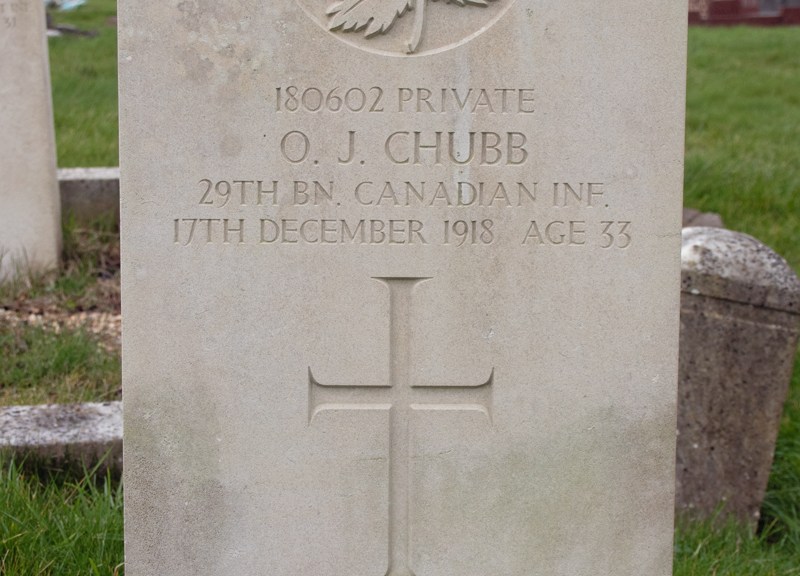
Oliver Job Chubb was born on 3rd December 1884 in the village of Smallbridge in Devon. He was one of six children to Job Chubb, who was an agricultural labourer, and his wife Louisa. Oliver did not seem to be one for settling down; after his parents had moved the family to Ilminster in Somerset when he was just a child, by 1901 he was living in Lyme Regis, working as a carter in a market garden.

In 1902, at the age of 17, Oliver enlisted in the Somerset Light Infantry. Eighteen months later he transferred to the Royal Navy, serving as a Stoker on a number of ships during what would become twelve years’ service, including the Royal Oak, Skirmisher and Newcastle.

In 1906 he married Rosina Keirle, a brickmaker’s daughter from Somerset. The wedding was in Bridgwater, and the couple went on to have three children, Olive, Albert and Cecil.

There is a sense that Oliver either had perpetually itchy feet, or that he was always running from something. The 1911 census found him aboard HMS Suffolk in the Mediterranean, where he listed himself as single. By the end of his naval service in November 1915, however, Stoker Chubb disembarked in the port of Victoria, British Colombia, and immediately signed up for military service with the Canadian Expeditionary Force.

Again, however, indecision seems to have set in. He listed his marital status as ‘single’ and confirmed his next of kin as his sister Elsie, but on his military will, he left everything to Rosina.

Private Chubb was assigned to the 29th Battalion of the Canadian Infantry; they served on the Western Front from early in 1915 through to the end of the war. He was involved in the fighting at Ypres, and, in September 1916, was treated in England for an inguinal hernia. After three months’ recover, he returned to the front.

While Private Chubb seems to have had a good overall manner, there were blips in his character. In May 1917, he was sentenced to three days’ field punishment for being absent without leave for 21hrs. In March 1918, he was sentenced to another five days’ field punishment for going AWOL for 48 hours. On 11th April 1918, Private Chubb received 14 days’ field punishment for drunkenness on duty.

In December of that year, Oliver was invalided back to England for medical treatment; he was admitted to the Fort Pitt Military Hospital in Chatham with lymphatic leukaemia. Sadly, Private Chubb passed away shortly after being admitted, dying on 17th December 1918. He was 34 years old.

Oliver Job Chubb lies at rest in St John’s Cemetery in Bridgwater, where his family still lived.


Private William Cottrell

Private William Cottrell

William Cottrell was born in April 1885, the third of twelve children to Henry and Annie Cottrell from Bampton, Devon. When William left school, he became an assistant to the village baker, but new opportunities lay ahead.

In May 1907, William married Maria Wall, the daughter of a stonemason from Wedmore in Somerset. With weeks, the young couple had embarked for a new life, boarding the Empress of Britain in Liverpool, setting sail for Canada.

Emigrating to Manitoba, William became a labourer, and he and Maria had three children – Leslie, Ronald and Kathleen.

War came, and William enlisted in the Canadian Expeditionary Force in August 1915. Shipped to England in the spring of the following year, Annie followed suit, returning to Somerset with the three children.

Private Cottrell was assigned to the 44th Battalion Canadian Infantry, setting off for France in August 1916, just weeks before his fourth child – Ruby – was born.

The battalion was involved in some of the fiercest fighting of the war, and it was during the Somme Offensive that William was shot in the left arm. Initially treated in the field, he was soon shipped back to England to recover in a military hospital in Epsom. Discharged after three months, he was returned to his battalion in early 1917.

The fierce fighting continued, and Private Cottrell was wounded again in October 1918. Further treatment back in the UK was needed, and he was admitted to the 1st Eastern General Hospital in Cambridge.

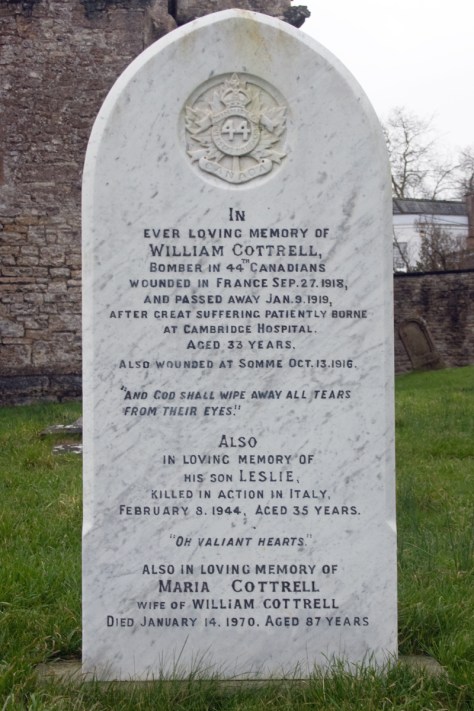
Details of the William’s injuries at the Somme are readily available, but information on his second lot of injuries is scarcer. They must have been pretty severe, however, as he was not discharged. He lost his final battle after four months, succumbing to his wounds on 9th January 1919. He was 33 years old.

William Cottrell lies at rest in the graveyard of St Mary’s Church in his widow’s home village of Wedmore, Somerset.


William’s gravestone is also a memorial to his eldest son, Leslie, who was killed during the Second World War.

Details of his military service are sketchy, but he enlisted in the Queen’s Own Royal West Kent Regiment. His battalion – the 1st – was involved in the fighting in Italy, and it was here that he lost his life. He was killed on 8th February 1944 and is buried in the Sangro River War Cemetery, in Abruzzo.


Private Bridges Baker

Private Bridges Baker

Bridges Baker, also known as James, was born in Oare, near Faversham, Kent, in January 1874. He was the third of six children to Bridges Baker Sr and his wife Caroline. Bridges Sr was a bricklayer, and this was a trade that Bridges Jr and his older brother both went into.

He soon made the decision to seek new opportunities, however, and left England to emigrate to Canada in 1903.

Private Baker enlisted in the Canadian Expeditionary Force in Calgary. It was 22nd June 1915. Now known as James Baker, he was 40 years old and he cited his mother, Caroline, as his next of kin.

Baker’s actual service is lost to history; all I have been able to ascertain for certain is that he died on 15th February 1915.

Private Bridges Baker lies at rest in the graveyard of St Margaret’s Church, in his home town of Rainham, Kent.