Category Archives: Canadian Infantry

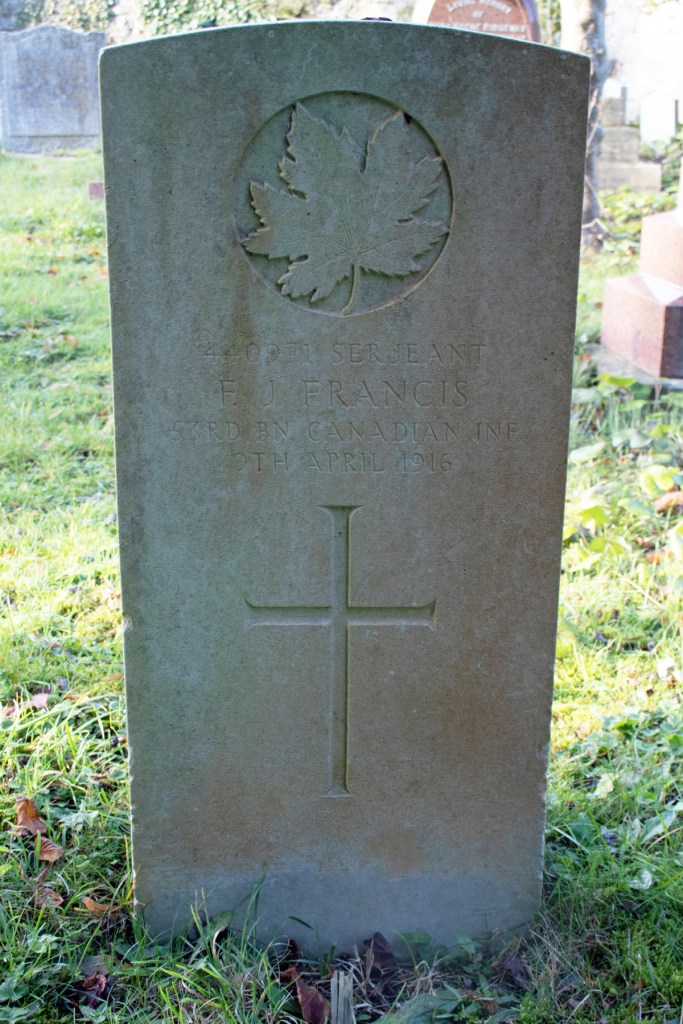
Serjeant Frederick Francis

Serjeant Frederick Francis

Frederick John Francis was born on 15th February 1893, to Henry and Mary Francis. One of nine children, the family lived in the Somerset village of Curry Rivel.

Henry was a labourer, but Frederick had his sights set on a new life and, at some point in his teens, he emigrated to Canada to work as a farmer. Details of his life in North America are scarce, but it is clear that he was in Manitoba when war broke out back in Europe.

Frederick stepped up to serve his King and Country, enlisting at Camp Sewell on 5th April 1915. His service records confirm that he was 5ft 5ins (1.65m) tall, and weighed 145lbs (65.8kg). He was assigned to the 53rd Battalion of the Canadian Infantry. His service papers also note that he was promoted to the rank of Sergeant on 30th April 1915, although whether the date is correct, or whether Frederick had previous military experience is unclear.

Sergeant Francis boarded the SS Empress of Britain to make the journey back to Europe, little knowing that he was not going to see his home again. On 9th April 1916, just one day from docking in Hampshire, he passed away from quinsy, or throat abscess. He was just 23 years of age.

The body of Frederick John Francis was brought back to Somerset for burial. He was laid to rest in the graveyard of St Andrew’s Church in the village of his birth, Curry Rivel.


Frederick’s younger brother, Charles, had also made a life in Canada. He enlisted at Camp Sewell just two months after his brother, joining the same battalion.

Charles, who had the rank of Private, arrived in Europe before Frederick and, and was sent to the front line in February 1916. In June, he was involved in the fighting at Mount Sorrel, on the Ypres Salient, and it was here, on 6th June 1916, that he lost his life. He was just 21 years of age.

Charles Arthur Francis is commemorated on the Menin Gate in Ypres. His parents had to mourn the loss of two sons within two months.


Second Lieutenant Cyril Croft

Second Lieutenant Cyril Croft

Cyril Talbot Burney Croft was born on 28th January 1891 in Streetsville, Ontario, Canada. He was the only child of Dorset clergyman Otho Croft and his Canadian-born wife, Lucy.

Otho brought his young family back to England when Cyril was a boy. The 1901 census found him and Lucy living in South Cadbury, Somerset, where he had taken the role of the local rector. Their young son, meanwhile, was boarding at a school in St Leonard’s in East Sussex.

Education was key to Cyril’s development. He was sent to King’s College in Taunton and St Boniface College in Warminster, and enlisted in the Officer’s Training Corps for three years.

During this time, he and Lucy had travelled back to Canada, and there was an obvious draw for the young man as, in 1913, he made a move to Quebec, becoming the Assistant to the Commissioner of Harbour Works in the city.

When war broke out, Cyril was quick to step up and play his part. Joining the Canadian Expeditionary Force on 23rd September 1914, his service records show that he was 6ft 1in (1.85m) tall, with black hair, grey eyes and a dark complexion.

Cyril was initially assigned to the 12th Battalion of the Canadian Infantry, where he held the rank of Lance Corporal. On arriving in England, however, he took his leave of the Canadian force, and accepted a role in the King’s Royal Rifles. Within a few months, he transferred again, gaining the rank of Second Lieutenant in the 8th (Service) Battalion of the Somerset Light Infantry.

Details of Cyril’s actual service are vague, however, as his British Army service records are no longer available. It appears that he did not serve any time overseas, as his battalion was raised in Taunton, Somerset, and did not move to France until the end of 1915.

Second Lieutenant Croft had made a further transfer by this point, joining the Royal Flying Corps in the summer. He gained his wings on 27th October 1915 at a Military School in Birmingham.

On 8th December 1915, he was a passenger in an aircraft being piloted by a Lieutenant McDonald at Castle Bromwich.

The weather was “bumpy” but not bad… They went towards Birmingham, and then made a turn to the left. [McDonald] noticed that the engine was missing fire when he was at a height of 1,500ft [460m], and decided to land. He turned off the petrol, but did not switch off the electric ignition. He made a right-hand turn, so as to reduce the height, the machine then being at a normal angle, when, owing to the wind, the aeroplane banked. To put the machine back again he put the control lever over to the left, but finding that the machine did not answer to the control, he put on the right rudder, and Lieutenant C Black, of the Royal Flying Corps, who had instructions to watch the aeroplane, stated that shortly after eleven o’clock in the morning it ascended to a height of 1,500ft. Shortly afterwards he saw the machine coming down: it made a short spiral, then a complete circle, and while turning to make another at a height of 500ft [150m], fell straight to the ground, nose downwards. The aeroplane was in proper working order, and the witness was of the opinion that the accident was due to wind disturbances.

De Ruvigny’s Roll of Honour

Croft and McDonald were both killed. Cyril was just 24 years of age. His Colonel wrote to Otho and Lucy, noting that Cyril “did so well that it makes one feel the loss all the more of such a promising young officer. He is, indeed, a great loss to our country, especially in these times.” Cyril’s Major noted “he had a most charming, lovable character, and was thoroughly popular with all his brother officers. He was exceedingly keen at his work, and in him the service has lost a most promising and capable officer.”

Cyril Talbot Burney Croft was brought back to Somerset for burial. He was laid to rest in the graveyard of his father’s church: St Thomas a Becket’s in South Cadbury.


Second Lieutenant Cyril Croft
(from ancestry.co.uk)

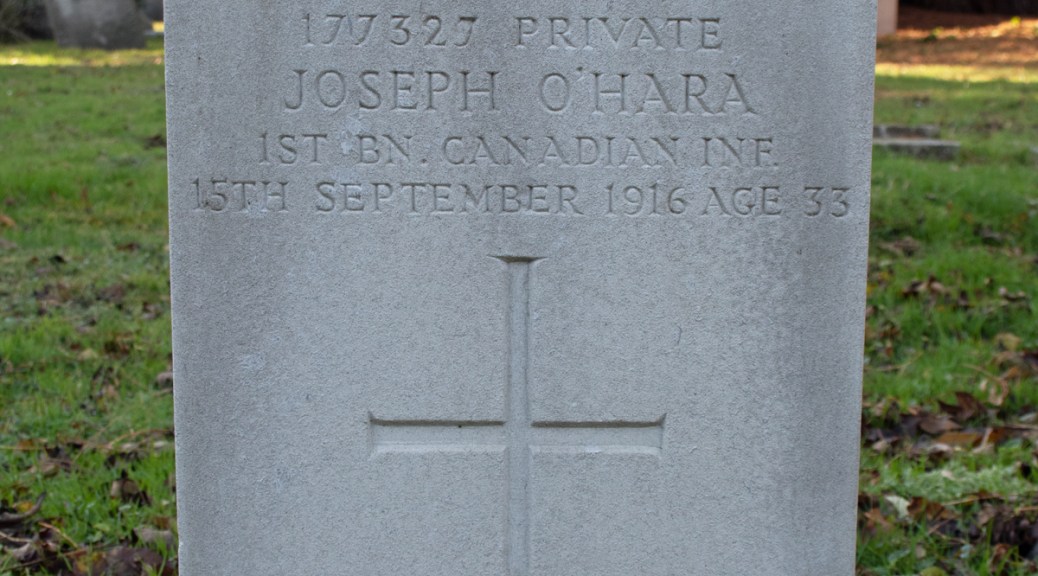
Private Joseph O’Hara

Private Joseph O’Hara

Joseph O’Hara was born in Manchester on 30th May 1882, the son of John and Kate O’Hara. There is little information available about his early life, although it is clear that at some point the family emigrated to Canada, settling in Toronto.

When war broke out, Joseph enlisted, joining the 1st Battalion of the Canadian Infantry. By 1916 Private O’Hara was not only back in Europe, but fighting on the Western Front. Details are scarce, but a contemporary newspaper sheds a little light on what happened to him next.

A contingent of 132 wounded men was detrained at Faversham last Friday morning. Forty-four of the number were taken to The Mount, seventy-one to Lees Court, and seventeen to Glovers (Sittingbourne).

With one exception the cases were all “sitting up” cases and were in a separate train by themselves. This train, however, was preceded by a train of “cot” cases which was going through to Chatham, but owing to the serious condition of one of the men – Joseph O’Hara, of the Canadian Expeditionary Force – the train was stopped at Faversham for his removal to the Mount Hospital. O’Hara had been badly wounded in both legs and he died at the Mount a few hours after his arrival there.

Faversham News: Saturday 23rd September 1916

Private Joseph O’Hara was 34 years of age when he passed away. He was laid to rest in the Faversham Borough Cemetery.


Private Joseph O’Hara
(from findagrave.com)

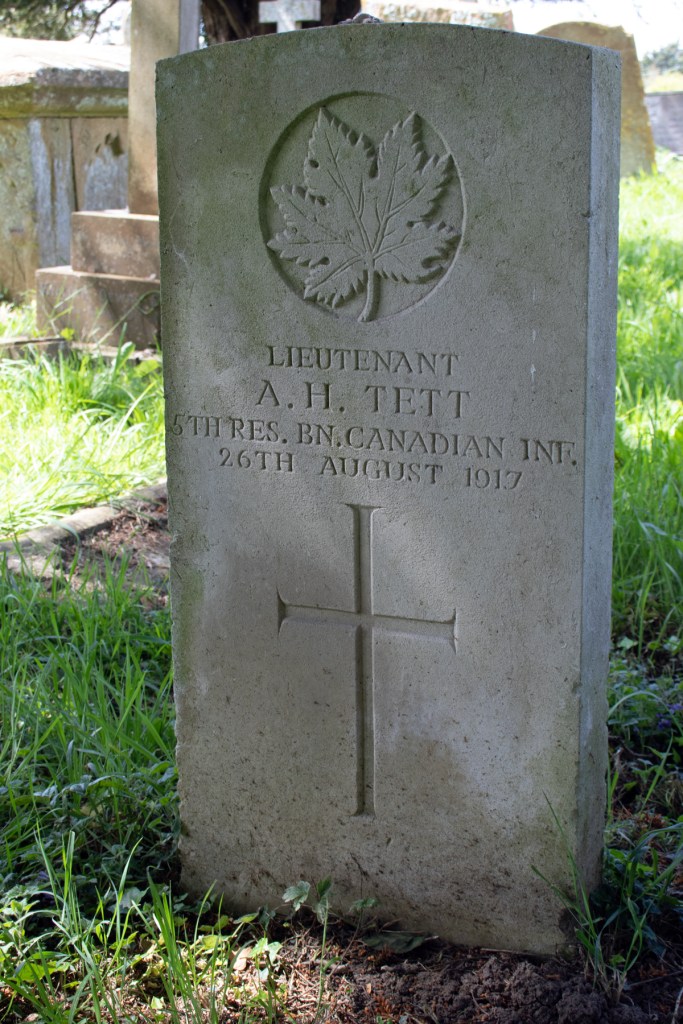
Lieutenant Arthur Tett

Lieutenant Arthur Tett

Arthur Hopkins Tett was born on 22nd August 1881 in Bedford Mills, Ontario, Canada. He was one of six children to lumberjack John Tett and his wife, Harriet. Both sets of Arthur’s grandparents had moved to Canada in the 1830s – John’s from Somerset, Harriet’s from Ireland – and his paternal grandfather had gone on to represent the county of Leeds in Ontario’s first parliament.

Arthur wanted to see the world, and viewed the army a a way to do that. After leaving school, he attended the Royal Military College, and was subsequently appointed a Signaller in the 3rd Canadian Mounted Rifles. He spent time in South Africa and, on returning to his home country, he took work as a bank clerk with the Union Bank, where he worked his way up to Head Office in Winnipeg.

He soon sought another challenge, and set up business in Outlook, Saskatchewan. In January 1913, Arthur married Bessie Kearns, an artist from back in Westport, Ontario. The couple settled in a detached property on Bagot Street, Kingston, Ontario and went on to have a son, John, who was born in 1917.

Arthur was still active in military circles at this point, playing a part in the local 14th Regiment. When war was declared, he again stepped forward to play his part, taking up a role of Lieutenant in the 253rd Battalion of the Canadian Expeditionary Force: this was a regiment made up mainly of students from the Kingston area, and it is likely that Arthur’s expertise would have been welcomed.

Having initially enlisted on 1st November 1916, Lieutenant Tett was declared fit a few months later and sent to Europe in May 1917. Based in Somerset, Arthur was not far from where his paternal grandparents had come from, nor where his cousins still lived. Sadly, however, his time in England was not to be a long one.

Lieutenant Tett was admitted to the Military Hospital attached to Taunton Barracks, suffering from pneumococcal meningitis. Sadly, this was to get the better of him, and he passed away on 26th August 1917, days after his 36th birthday.

Arthur Hopkins Tett was brought to the village of Kingstone in Somerset for burial. He was laid to rest in the graveyard of his second cousin George’s local church, St John and All Saints.


Bessie Tett did not marry again after her husband’s passing. She remained in Ontario for the rest of her life, passing away in October 1974, at the age of 89.

Arthur and Bessie’s son, John, was a babe-in-arms when his father died. He also remained in Ontario for much of his life, although he served in Europe during the Second World War. He married Sylvia Bird in September 1941; the couple went on to have two children. They returned to Canada when the war was over, and remained in Ontario until August 1974, when he passed away.


Ordinary Seaman Knight Cooke

Ordinary Seaman Knight Cooke

Knight Cooke was born in Vancouver, Canada, on 10th December 1892. He was one of nine children to John and Mary Cooke. John was a tallyman, selling goods by instalments. Knight, however, preferred working with his hands, and when he left school, found a job in a wood mill, as a planer.

When war came to Europe, those in the Commonwealth were asked to play their part. Knight enlisted, joining the Canadian Expeditionary Force on 22nd April 1916. His service records show that he stood 5ft 9ins (1.75m) tall and weighed 135lbs (61kg): he had dark brown hair, brown eyes and a dark complexion.

When he arrived in England, Knight was initially transferred to the 72nd Regiment of the Seaforth Highlanders, although he was quickly moved again to the 13th Field Ambulance. Within a matter of weeks, Knight was discharged under the King’s Regulations that suggested he would not become an efficient soldier.

At this point, Knight’s trail goes cold. It seems that he remained in England, and it seems that he was still keen to play his part. What is clear is that he enlisted in the Royal Naval Canadian Volunteer Reserve at some point in the months after being discharged from the army.

Knight was given the rank of Ordinary Seaman, and was, by the summer of 1917, based at HMS Pembroke, the Royal Naval Dockyard at Chatham in Kent. This was a busy, overcrowded place at that time, and Knight found himself billeted in temporary accommodation at Chatham Drill Hall.

On the 3rd September 1917, the German Air Force carried out its first night-time air raid: Chatham was heavily bombed and the Drill Hall received a direct hit; Ordinary Seaman Cooke was among those who were killed. He was just 24 years of age.

Knight Cooke was laid to rest alongside the other victims of the Chatham Air Raid, in the Woodlands Cemetery, Gillingham, not far from the Dockyard in which he finally managed to serve.


Knight’s headstone gives his surname as Cook, although his service records – and signature – give the spelling as Cooke.


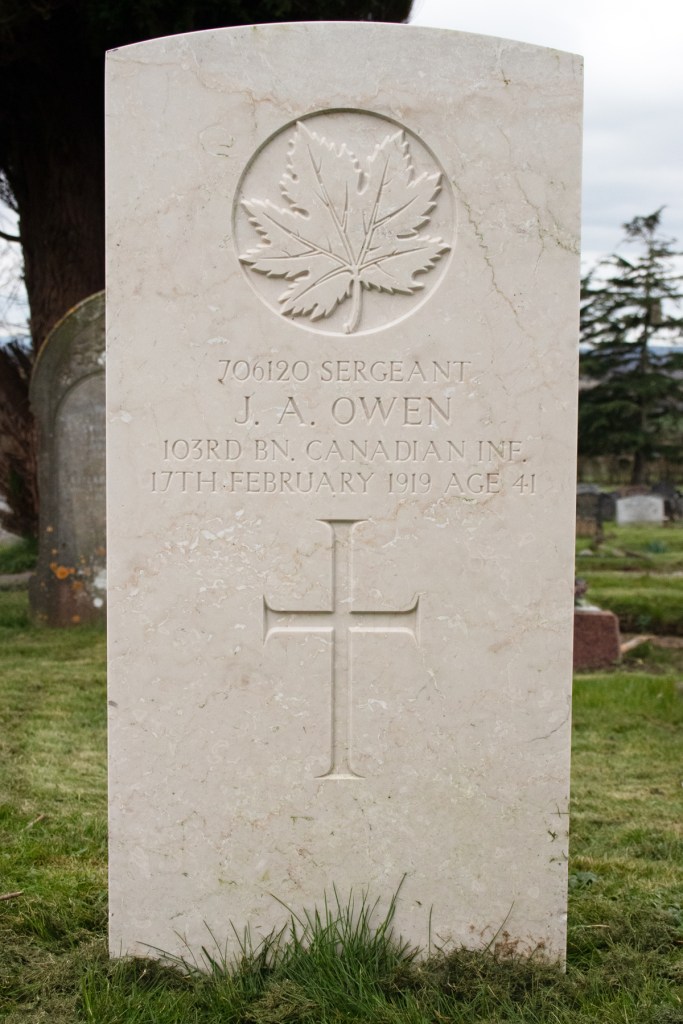
Sergeant James Owen

Sergeant James Owen

James Alfred Owen was born on 4th August 1877 and was the middle of three children to James and Sarah Owen. James Sr was a woodman from Herefordshire, who had moved the family to Radnor in mid-Wales.

James Jr’s early life has been lost to time, but by the time he turned 30, he had emigrated to Canada. He settled in the west coast town of Prince Rupert and found work as a salesman. On 28th January 1910 he married Hattie Whidden: the couple went on to have three children – Annie, Louisa and Dorothy.

War was coming to Europe, and James wanted to play his part for King and Country. He enlisted on 4th December 1915, joining the 103rd Battalion of the Canadian Infantry. His service records show that he stood 5ft 9ins (1.75m) tall and weighed 156lbs (70.8kg). His physical development was recorded as ‘average’, he had a ruddy complexion, brown hair and brown eyes. It was also noted that he had a birthmark in his left groin and his teeth were poor and required attention.

Private Owen departed for England in July 1916 and was assigned to the Oxney Camp in Hampshire. He was promoted to Corporal and then to Sergeant and, over the next few years, he remained in England. He was primarily based in barracks at Bramshott – also in Hampshire – though did spend time in Seaford in Sussex.

Sergeant Owen survived the war, but was admitted to the Ripon Military Hospital on 8th February 1919, having contracted bronchitis and malaria. The hospital didn’t have any specific expertise in contagious diseases, so it is likely that his move to Ripon was one stage of his move back to Canada.

Sadly, the conditions proved too much for James. He passed away on 17th February 1919, at the age of 41 years of age.

James Alfred Owen’s body was brought to Castle Cary in Somerset, where his sister Eleanor lived with her family. He was laid to rest in the town’s cemetery.


Lieutenant Herbert Marshall

Lieutenant Herbert Marshall

Herbert William Hare Marshall was born in Ambala, India, on 19th August 1890. His father – Herbert Seymour Marshall – was a Colonel in the army, and was serving in India with his wife, Charlotte, when their children – Charlotte (known as Jessie) and Herbert Jr – were born.

The family were back in England by 1898, and had set up home in the Somerset seaside town of Weston-super-Mare. When Herbert Sr passed away that year, Charlotte was set up on a widow’s pension, and this allowed her to send her son to St Peter’s, a private boarding school in the town.

When her son’s schooling was complete, Charlotte took the family off to Canada. They settled in British Colombia, in Revelstoke, a mountain town halfway between Calgary and Vancouver. Here, Herbert found work as a bank clerk, but war came to Europe, and he felt a need to do his bit for King and Country.

Herbert enlisted in the Canadian Expeditionary Force (CEF) in November 1914; his service papers record him as being 5ft 8ins (1.73m) tall, 148lbs (67kg) in weight. He had black eyes, brown hair and a dark complexion – something that he may well have inherited through his mother’s genes.

Shipped to England, by August 1915, Private Marshall had been discharged from the CEF as part of a transfer to the New Army – also known as Kitchener’s Army, the volunteer British Army raised as a direct result of the outbreak of war.

Detailed information about Herbert’s military service is lacking, although it seems that he joined the 17th Battalion of the West Yorkshire Regiment, one of the regiments heavily involved during the Battle of the Somme.

By October 1916, however, the now Lieutenant Marshall had made another move, this time joining the Royal Flying Corps. On the afternoon of 26th August 1917, he was an observer on a flight at Marham, in Norfolk. The pilot, a Lieutenant Challington, was banking the aircraft, when it dived and crashed, killing both men. Lieutenant Marshall had turned 27 years old the week before.

Herbert William Hare Marshall’s body was brought back to his adopted home of Weston-super-Mare. He lies at rest alongside his father in the town’s Milton Road Cemetery.


Ordinary Seaman William Stanley

Ordinary Seaman William Stanley

William Alfred Stanley is one of those names that seems destined to be lost to the annuls of time. Little documentation exists for his early life, but what there is gives some hints at a determined young man.

William was born in London to an Annie Stanley, who lived in the Kentish Town area of the city. At some point, he emigrated to Canada as, according to his wartime enlistment papers, he joined up in Ontario.

William enlisted in the Canadian Expeditionary Force on 5th November 1915, and was initially assigned to the 44th Battalion of the Canadian Infantry. His troop embarked for England in July 1916, and, on his arrival he was transferred to the 98th Battalion.

It was at this point that things too an unusual turn. With a few months, Private Stanley was again transferred, this time to the 19th Battalion, and then again to the 4th Reserve Battalion from where he was discharged from the Canadian Infantry in February 1917 for being underage.

At this point, William seems to have been undeterred.

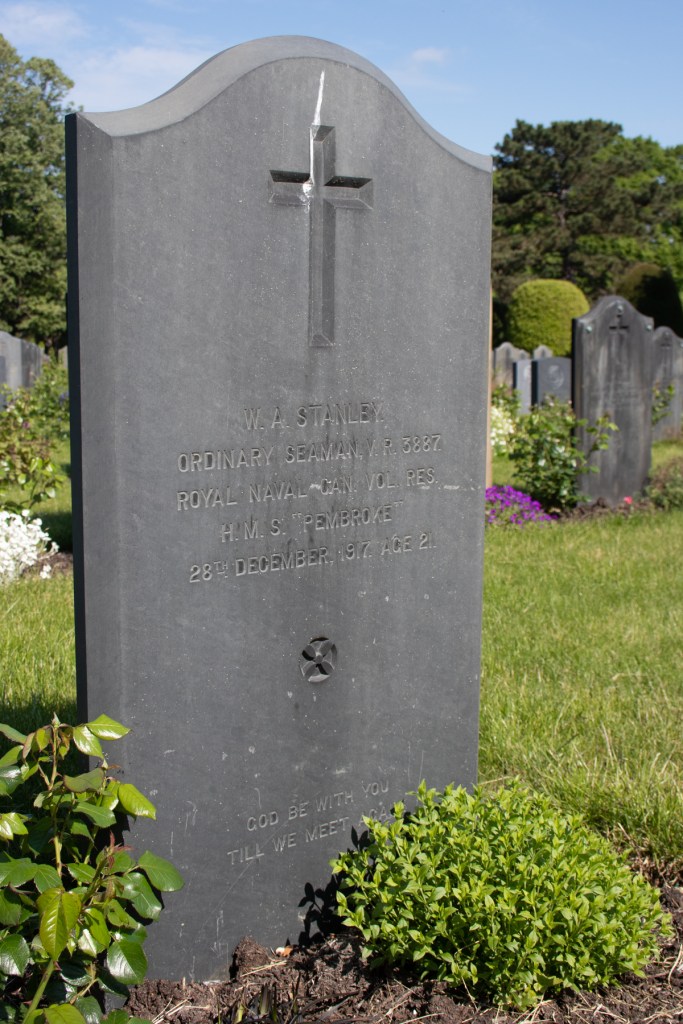
The next record for him – in fact the memorial to him – is his headstone. This confirms that he had enlisted in the Royal Naval Canadian Voluntary Reserve as an Ordinary Seaman. He was based at HMS Pembroke, the shore establishment at Chatham Dockyard, but there is no other information for him.

Ordinary Seaman Stanley died on 28th December 1917, at the age of 21. (His previous military discharge might suggest that he was, in fact, younger than this, but that is conjecture on my part.) There is no record of a cause of death and nothing in contemporary newspapers to suggest anything out of the ordinary.

William Alfred Stanley was laid to rest in the Woodlands Cemetery in Gillingham, Kent, not far from the Naval Dockyard where he had been based.


Private William Ridley

Private William Ridley

William Frederick Ridley was born on 7th April 1887 in the New Brompton area of Chatham/Gillingham, Kent, one of eight children to John and Elizabeth Ridley. John was an engine fitter in the nearby naval dockyard and, as the key employer in the area, William followed in his father’s footsteps.

Sadly, John died in 1904, and this seems to have been what spurred his son on to a better life. In 1907 William emigrated to Canada, settling in the town of Wentworth, on the banks of Lake Ontario.

It was in Ontario that William met his future wife. Edith Wass was the daughter of a local labourer; the young couple married on 5th June 1909, and went on to have two children, John, born in 1910, and Wilfred, who was born five years later.

During this time, William was putting his engineering skills to the test; his marriage banns confirm he was a machinist. While there is nothing to confirm any specific trade, given his proximity to the coast, dockyard employment seems probable.

On the other side of the Atlantic, war was breaking out; keen to do his part for King and Country, William enlisted in the Canadian Expeditionary Force on 28th July 1915. Initially enlisting in the 76th Overseas Battalion of the Canadian Infantry, he was shipped to England a year later and transferred across to the 4th Battalion.

Once on the Western Front, Private Ridley was thrown right into the thick of things. His battalion fought at the Battle of Flers-Courcelette – part of the Battle of the Somme – and it was here, on 18th September 1916, that he was wounded.

William received shrapnel wounds to his head, hand and right leg. Initially treated on site, he was quickly evacuated back to England, and admitted to the 2nd London General Hospital in Chelsea. Sadly, however, his wounds appeared to have been too severe; Private Ridley passed away from them on 30th November 1916, aged just 29 years old.

With his widow and children still in Canada, William’s body was taken back to Kent. He lies at rest in the Woodlands Cemetery in Gillingham, close to where his mother was still living.


Larger memorial image loading...
Private William Ridley
(from findagrave.com)

Private Charles Dyer

Private Charles Dyer

Charles William Dyer was born on 12th May 1895, the youngest of seven children to Harry and Mary Dyer.

Harry was a farmer, who brought his family up in the village of Kewstoke, just to the north of Weston-super-Mare, Somerset. He seems to have been keen to try new things because he and Mary lived for a while in Australia, and their first two children were born there. They then moved back to the UK in around 1887, settling back in Somerset.

By the time of the 1911 census, Charles was 16 years old, and all of the family were helping out on the farm. He seemed to share his father’s sense of adventure; in 1913, he emigrated to Canada, setting himself up as a farmhand in Winnipeg.

War was coming to Europe, however, and Charles joined up. He enlisted in October 1917, joining the Canadian Infantry. Leaving Canada on a troop ship on 19th February 1918, he arrived back in England on 4th March.

Private Dyer was soon installed at the Canadian Infantry camp at Bramshott in Hampshire. Within weeks of arriving in England, however, he had contracted influenza; this developed into pneumonia, and was admitted to the camp’s Military Hospital on 22nd May. Sadly, a week later, Private Dyer was dead. He was just 23 years old.

Charles William Dyer was taken back to Weston-super-Mare and laid to rest in the Milton Cemetery there.


Charles Dyer (on right) in Canada
(Courtesy of ancestry.co.uk)