Harold Stanley Randall was born in Taunton, Somerset, in the autumn of 1898. One of twins, his parents were Joseph and Elizabeth Randall. Joseph was a carpenter, and when Elizabeth died in 1900, he was left with nine children to raise on his own. This led to Harold being raised Joseph’s brother and sister-in-law, George and Caroline, and he is noted as living with them in Bath, Somerset, in the 1901 and 1911 censuses.
There is little direct evidence of Harold’s life: at the time of the 1911 census he was still at school, so it is not clear what employment he took up once his education came to an end. When war broke out, he played his part, and had enlisted in the Gloucestershire Regiment by the summer of 1918.
Private Randall was attached to the 17th Battalion, a territorial force based in Essex. By the end of the war, Harold was billeted in St Osyth, and it was here that he fell ill. Details of his condition are lost to time, but his health was impacted enough for him to be admitted to the general hospital in Colchester.
Harold Stanley Randall’s illness was to get the better of him. He passed away on 7th December 1918, aged just 20 years old. His body was brought back to Somerset for burial, and he was laid to rest in Bath’s sweeping Locksbrook Cemetery. His next of kin was noted as his aunt Caroline, who had raised him from a toddler.
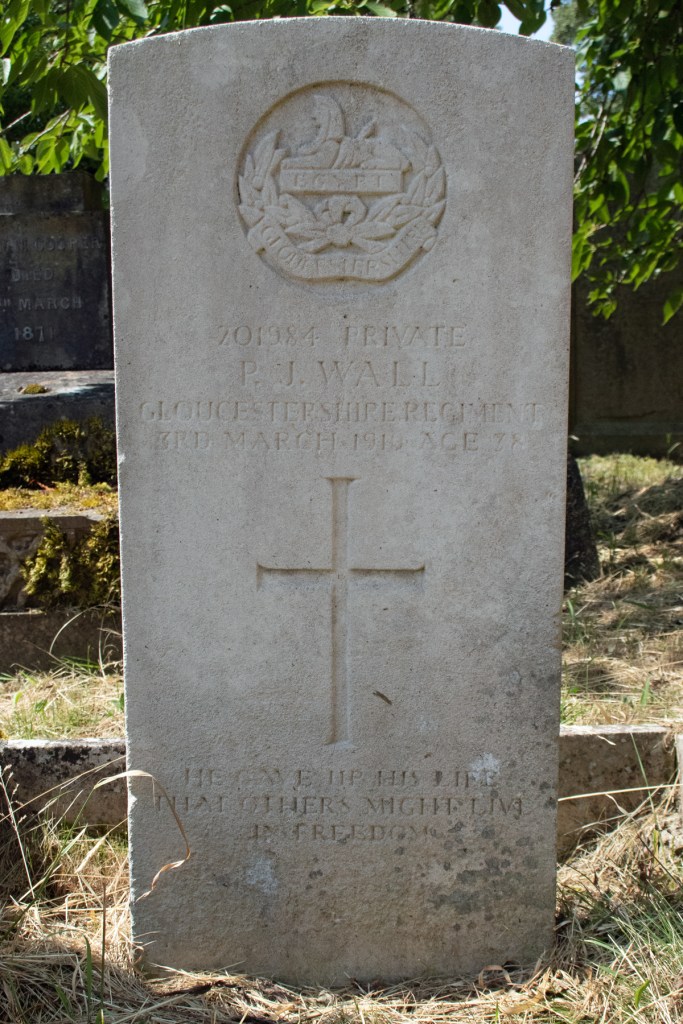
Percy James Wall was born in the Somerset village of Kilmersden in the summer of 1880. The fifth of ten children, his parents were called Robert and Amelia. Robert was a cashier for a local colliery, but it seems that Percy did not follow into his father’s line of work.
The 1901 census found Percy working as a draper’s assistant for Jolly & Son’s in Bath. He was one of 27 boarders at the company’s lodgings on Milsom Street in the city centre. By 1911, he was still working for the same company, but as a draper’s clerk, and had moved to some new lodgings just to the north in Lansdown Road.
When war broke out, Percy stepped up to play his part. He enlisted in the Gloucestershire Regiment, although his full service records are no longer available. Private Wall was attached to the 1st/4th Battalion, and, by the autumn of 1916, he found himself caught up in fighting at the Ancre, part of the Battles of the Somme.
Percy was badly wounded, and evacuated to Britain for treatment. Full details are unclear, but his injuries were enough for him to medically discharged from the army. He was awarded the Silver War Badge – proof of his genuine discharge – but at this point his trail goes cold.
Percy struggled on with his injuries for a further two years. Hhe may have remained in hospital since his original injuries, but there are no records to corroborate this either way. At the start of 1919, he had been admitted to the Bath War Hospital, his family having also moved to the city by this point. He finally succumbed to his wounds, passing away on 3rd March 1919: he was 38 years of age.
Percy James Wall was laid to rest in the sprawling Locksbrook Cemetery, Bath, his pain finally eased.
Richard Ezra Baron White was born in the autumn of 1886 in the Cornish village of St Minver. The third of four children, his parents were Joseph and Zillah White. Joseph was a ship’s carpenter by trade, and Richard served an apprenticeship as a woodworker. By the time of the 1911 census, however, the Whites were working as farmers on the outskirts of the village.
When war was declared, Richard stepped up to serve King and Empire. It is unclear when he enlisted, but he joined the Gloucestershire Regiment, and was attached to the 3rd (Reserve) Battalion. Private White was based in Kent during the conflict, his unit being attached to the Thames and Medway Garrison.
Richard survived the conflict, but the winter of 1918/19 was to prove his undoing. He contracted pneumonia, and was admitted to the military hospital in Aylesford. The condition was to get the better of him: he passed away on 20th February 1919, at the age of 33 years.
The body of Richard Ezra Baron White was taken back to Cornwall for burial. He was laid to rest in the peaceful graveyard of St Menefreda’s Church in his home village, St Minver.
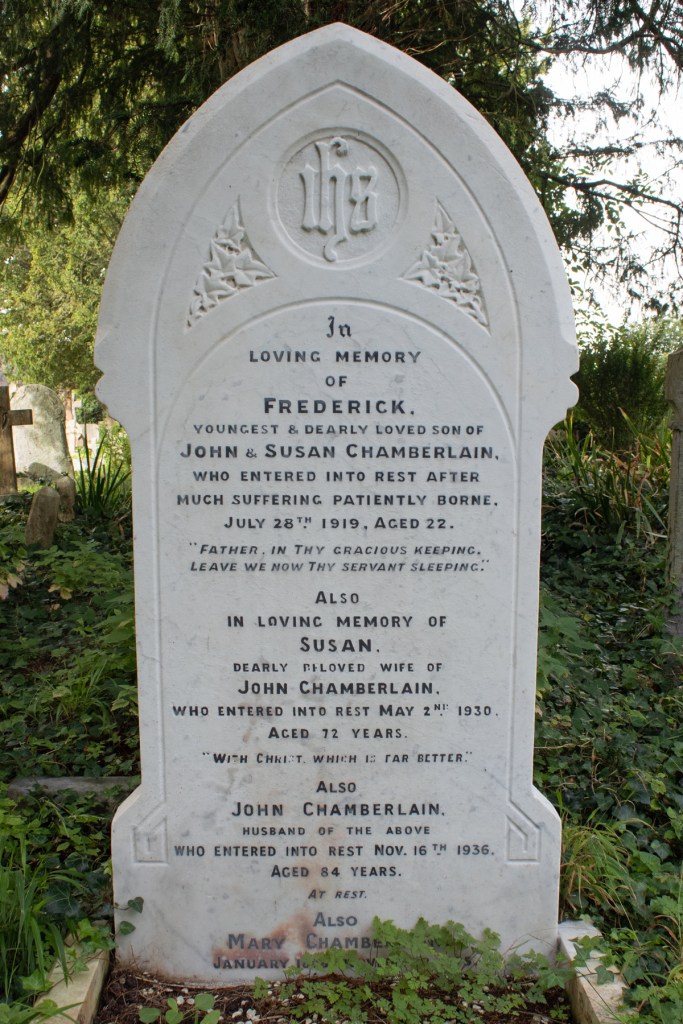
Frederick Chamberlain was born in the summer of 1896, the youngest of six children to John and Susan Chamberlain. John was a gardener from Dulverton in Somerset, but it was in Abbots Leigh, near Bristol, that the family were born and raised.
When he finished his schooling, Frederick found work in service and, by the time war broke out, he was employed as a footman. War presented a new adventure, however, and he was quick to step up and serve his country. He enlisted on 1st September 1914, just a few weeks after hostilities were announced, and was assigned to the 1/4th (City of Bristol) Battalion of the Gloucestershire Regiment.
Private Chamberlain’s service records are pretty sparse, but his unit was sent to France in May 1915, and he was to spend the next thirteen months on the Western Front. He seemed to have performed his duty well, however, and during that time was promoted to Corporal. Frederick returned to Britain in the summer of 1916, for what seemed to be health reasons. He was discharged from the army on medical grounds in November, suffering from phthisis, or tuberculosis.
At this point, the trail goes cold. He returned to Somerset, but his health deteriorated. Frederick passed away at home on 18th July 1919: he was just 22 years of age.
Frederick Chamberlain was laid to rest in the family plot in Holy Trinity Churchyard, Abbots Leigh. His funeral was presided over by Reverend Walter Brinkley, who had performed his baptism two decades earlier.
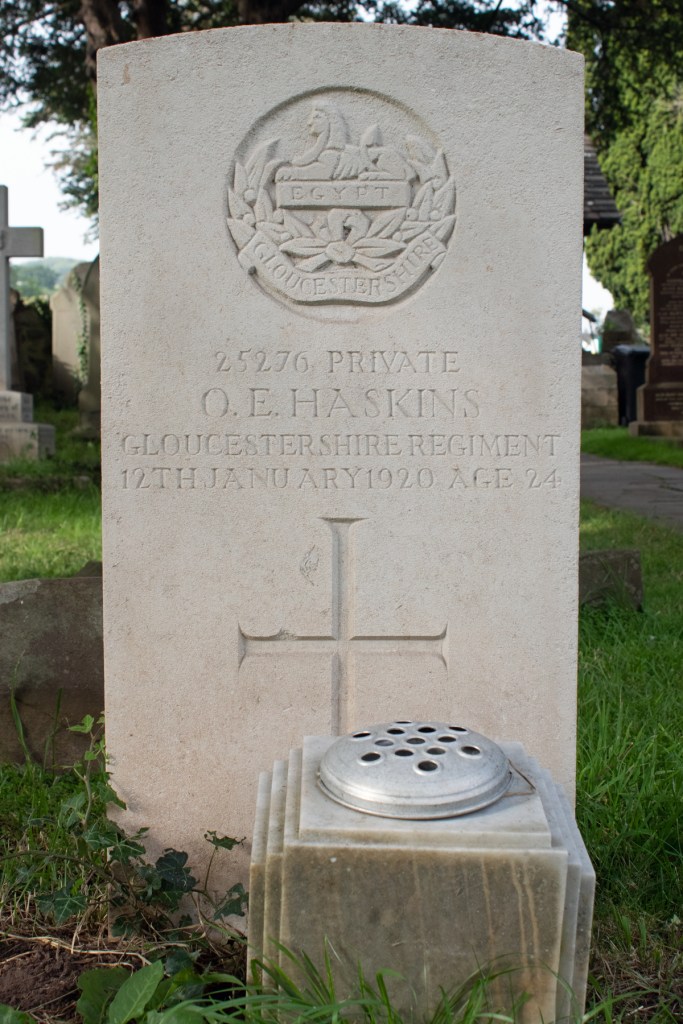
Oliver Edgar Haskins was born in 1896 in Portbury, Somerset. One of ten children, his parents were John and Hester Haskins. John was a gardener, and the 1911 census noted that Oliver was ‘working at home’, although no trade is listed.
When war came to Europe, Oliver stepped up to serve his King and Country, and was one of six Haskins brothers to fight in the conflict. He joined the Gloucestershire Regiment, and was initially assigned to the 15th (Reserve) Battalion. Based on home soil, his unit were barracked at Chiseldon Camp on the fringes of Salisbury Plain, Wiltshire.
At some point Private Haskins transferred to the Labour Corps, and became attached to the 207th Employment Company. It is not possible to identify exactly where he served, but he remained on home soil during the conflict.
The funeral took place at Portbury on Saturday of Mr Oliver Haskins… He was very popular in the village and at business, by virtue of his cheerful disposition and sterling qualities, and was beloved by everybody who came into contact with him. Mr Haskins was taken ill some ten days ago, and confined to his room, but he apparently made a quick recovery until Monday last, when he was suddenly taken worse and died in a few hours, at the age of 24.
Bristol Times and Mirror: Monday 19th January 1920
Oliver Edgar Haskins died on 12th January 1920. He was laid to rest in the once peaceful graveyard of St Mary’s Church in Portbury.
William George Newton was born in Culmstock, Devon, early in 1889. His mother, Ada, was unmarried at the time, and there is no indication as to who his father was. The 1891 census found mother and son living with Ada’s parents, John and Hannah, in South Street, Wellington, Somerset.
In the summer of 1892, Ada married Frederick Higgins, a police constable from Baltonsborough. The couple set up home in the village of Mark, and went on to have ten children. It was at this point that William took on Frederick’s name, though whether that was because he was actually his birth father is unclear.
When he finished his schooling, William found labouring work. On 9th March 1910, he married Annie Achilles, a painter’s daughter from Glastonbury. The couple set up home in a small cottage in Bank Street, Highbridge, and went on to have three children.
The next year’s census recorded that William was employed as a stoker for Highbridge Bacon Co Ltd, a large factory to the south of the town. His and Annie’s oldest child, son William Jr, who was just two months old at this point, and William’s grandfather, the now widowed John, completed the household.
When war broke out, William stepped up to play his part. He enlisted on 28th October 1915, joining the 3rd Battalion of the Gloucestershire Regiment as a Private. His service records show that he was 26 years and 10 months old, and stood 5ft 2ins (1.57m) tall.
Private Higgins’ service documents confirm that he served for nine months before being medically discharged from the army. He had contracted haemoptysis and had an enlarged heart. His medical records confirmed that, at the time of his dismissal, he was totally incapacitated and unable to work.
William returned to Somerset, but is would seem that his health continued to dog him over the next couple of years. He passed away on 29th October 1918, at the age of 29 years of age.
William George Higgins was laid to rest in the cemetery of his adopted home town, Highbridge.
Annie was now a widow, with three young children to support. She married again in the spring of 1922, to bus conductor William Davey. Annie was to outlive not only her husband, but all three of her children.
William and Annie’s youngest, Cyril, passed away when he was just a couple of months old.
Albert, their middle son, “had been for a great while a cripple from trouble in his leg, but was able to get about on crutches.” [Central Somerset Gazette: Friday 22nd July 1932] He passed away on 16th July 1932, aged just 18 years old.
William Jr had tried out in the Royal Navy when he was sixteen years of age. Beginning with the rank of Boy 2nd Class, he was dismissed in March 1928, as he was deemed unsuitable for the rank of Boy 1st Class.
In the autumn of 1934, he married Nettie King, the daughter of a factory worker from Street, Somerset. The couple went on to have three children, although in an echo of his parents’ tragedy, their middle child, Phyllis, passed away when just eighteen months old.
When war came to Europe for a second time, William sought to serve his country for a second time. He enlisted in the Royal Air Force, and rose to the rank of Leading Aircraftman. On 18th June 1940, he was on board a Blenheim aircraft flying from the UK to Malta, when the plane came down in bad weather near Marseille. William and his two companions, Pilot Officer Johnston and Sergeant Micklethwaite were all killed.
Leading Aircraftman Higgins was laid to rest in the Mazargues War Cemetery near Marseille.
Victor William Sperring was born in the spring of 1897, in Lympsham, Somerset. One of nine children, his parents were James and Catherine Sperring. James was a farmer, 22 years older than his wife and, when he died in 1904, she was left to bring up the family alone. She remarried, to dairy farmer Frederick Butler, continuing the farming life.
Frederick died in 1914, and with her older children now in their 20s, Catherine’s sons took up the reins to keep the farm going. War was on the horizon now, and tragedy was never going to be far from the Sperring household.
Of the five brothers, at least two – Victor and his older brother, Hubert – stepped up to serve their King and Country. Hubert joined the Gloucestershire Regiment, rising to the rank of Lance Corporal in the 1st/6th Battalion. He was caught up at the Battle of the Somme, and was recorded as missing, presumed killed, on 21st July 1916. He was just 23 years of age, and is one of the tens of thousands of names commemorated on the Thiepval Memorial in Northern France.
Victor also joined the Gloucestershire Regiment, but his story is less clear. Certainly by 1918 he was attached to one of the regiment’s depots, possibly on home soil. He was admitted to the 2nd Southern General Hospital in the autumn of 1918, and this is where he passed away on 16th November. He was just 21 years of age.
Victor William Sperring was brought back to Lympsham for burial. He was laid to rest in the family plot in St Christopher’s Churchyard.
It seems likely that illness is what took Victor’s life. Just a month later, his sister, Annie, also passed away: she was interred next to her brother.
Catherine’s grief must have been indescribable, having lost a husband and three children in a matter of years. She continued on, however, and, by the time of the 1939 England and Wales Register, she was living with her son Roland, supporting him with his farm. She died in October 1941, at the age of 77: she was buried with her family in St Christopher’s.
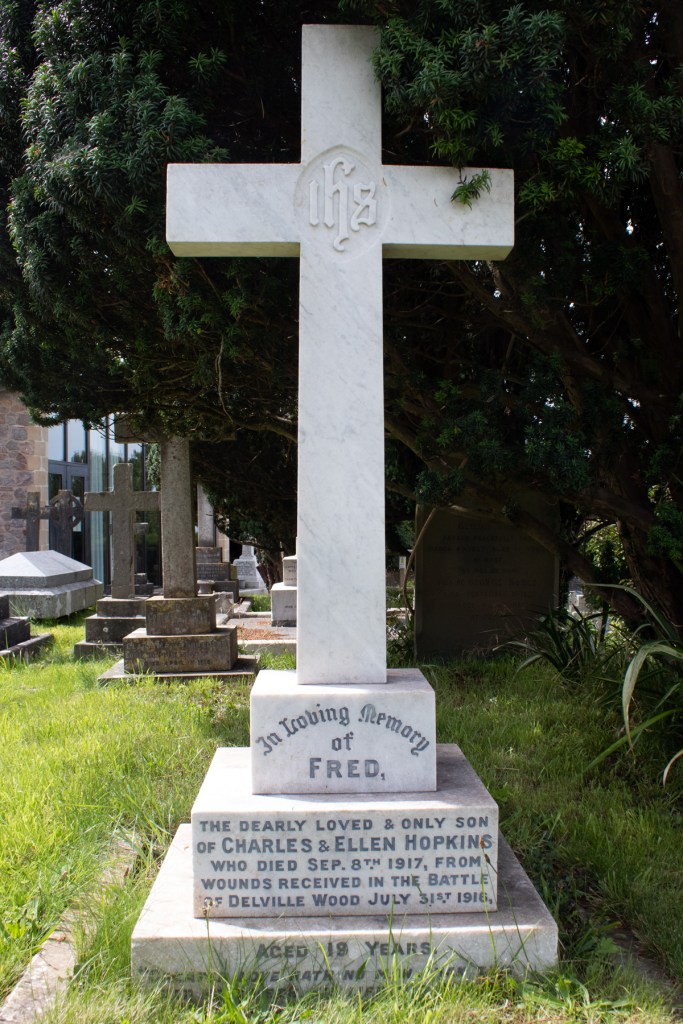
Frederick Charles Hopkins was born in the spring of 1898 in the sleepy Somerset village of Hinton Charterhouse. The younger of two children, his parents were Charles and Ellen Hopkins. Charles was a gardener who, not long after the 1911 census, moved the family west, to the village of Backwell.
When Frederick finished his schooling, he found work as a porter. When war broke out, however, he was keen to play his part, and enlisted at the end of December 1914. His service records note that he was 5ft 4ins (1.63m) tall, and that his apparent age was 19 years and one month. This highlights Frederick’s keenness to fight, as he was actually over two years younger than this at the time he signed the paperwork.
Private Hopkins was attached to the Gloucestershire Regiment, and assigned to the 12th (Service) Battalion. After his initial training on Salisbury, his troop was sent to the Western Front on 21st November 1915.
Frederick would have been involved in a number of the key skirmishes at the Somme, in July 1916, including at Albert and Bazentin. An epitaph on his gravestone suggests that he was injured at Delville Wood, although while his battalion was not actually involved in that specific battle, it is likely that he was injured at around the same time.
Wherever he was wounded, Private Hopkins was sent back to Britain. His service records suggest that he was transferred to the regimental depot but by July 1917, he was medically discharged from the army as being no longer fit for active service.
At this point, Frederick’s trail goes cold. He passed away on 8th September 1917, aged just 19 years old. He was buried in the peaceful St Andrew’s Churchyard in his adopted home village of Backwell.
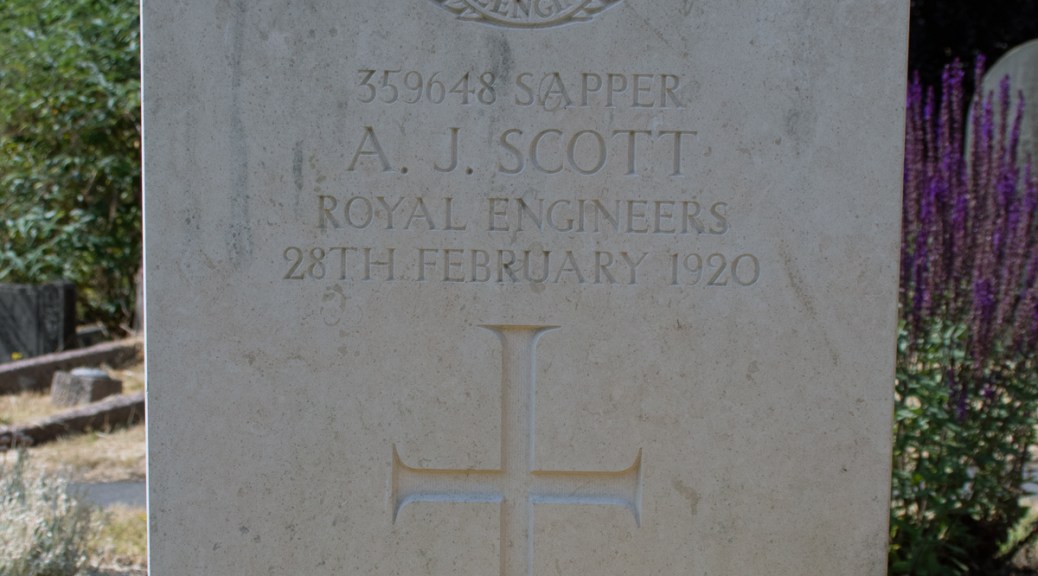
Abraham James Scott was born in Bathford, Somerset, in the spring of 1893. He was one of fourteen children to Abraham and Lucy Scott, and became known as James, to avoid any confusion with his father. Abraham was a shepherd, who travelled where work took him: both he and Lucy were from Wiltshire, but had moved to Somerset by the end of the 1880s. When James was just a babe-in-arms, the family had relocated to Gloucestershire, but by the time of the 1901 census, they were back in Wiltshire once more.
Abraham Sr died in 1910, at the age of just 41 years old. The following year’s census found the now widowed Lucy living in North Wraxhall, Wiltshire, with eight of her children. Abraham Jr is absent, and, indeed, does not appear on any of the 1911 censuses.
Lucy needed options and, on Christmas Day 1912, she married carter William Amblin in the village church. Abraham was, by this time, living in Bath and working as a carter.
When war came to Europe, Abraham felt the need to step up and play his part and, on 15th December 1915, he enlisted in the army. His service records show that he was 5ft 5ins (1.65m) tall and weighed 132lbs (59.9kg). He had a vaccination mark on his left arm which, according to the document’s section on ‘distinctive marks’, has a tendency to rupture.
Private Scott was mobilised in March 1916, and was assigned to the 1st/5th Gloucestershire Regiment. He soon found himself on the Western Front, and, having transferred to the 1st/4th Battalion, served at the Somme.
Abraham was in for a chequered time in Northern France. On 26th August 1916, he was injured when he received a gunshot wound to his scalp. He was admitted to the 1st Canadian General Hospital in Etaples, the moved to Rouen to recuperate. Private Scott rejoined his unit on 21st October 1916.
Just weeks later, however, Abraham was back in a hospital in Rouen, having fractured his ankle. After a couple of weeks in the 1st Australian General Hospital, the injury was deemed severe enough for him to be evacuated back to Britain for recuperation, and he was posted to Ballyvonare Camp in County Cork. Abraham returned to his unit in France in September 1917, nine months after his ankle injury.
On 1st March 1918, Abraham transferred to the Royal Engineers where, as a Sapper, he was attached to the Depot in Rouen. He remained there for more than a year, during which time he was admitted to hospital once more, this time with trench fever. Little additional information is available about this spell in hospital, other than that Lucy had written to the regiment thanking them for informing her of her son’s illness, and confirming a new address for her.
Sapper Scott’s health continued to suffer, however. In May 1919, he was admitted to a camp hospital, suffering from appendicitis. He was operated on, and medically evacuated to Britain for further treatment and recuperation. Abraham was admitted to the Bath War Hospital on 25th July 1919, and remained there for four months.
Abraham’s health seemed to improve, albeit slowly, and he was moved to the Pension’s Hospital in Bath on 27th November. The head wound, broken ankle and bout of trench fever appear to have taken their toll on his body which, by this point, seems to have been too weak to recover. On 28th February 1920, two months after being transferred to the Pension’s Hospital, he passed away there from a combination of appendicitis and pelvic cellulitis. He was just 26 years of age.
Abraham James Scott’s body did not have to travel far after this point. He was laid to rest in the sprawling Locksbrook Cemetery in his adopted home city of Bath.
Claude John Howard Rawlings was born on 5th November 1896 in the Monmouthshire village of Aberbeeg. One of three children, his parents were Sidney and Alice Rawlings. Sidney was a brewer from Bath, Somerset, while Alice was born in the Welsh village and this is where the couple raised their family.
By the time of the 1911 census, Claude had been sent to Weston-super-Mare, Somerset, and was a boarding student at the Brynmalyn Private School to the north of the town centre. His heritage would not have been out of place, though, as nine of the 25 live-in students were from Wales. Claude’s parents seemed to have taken the opportunity to visit Sidney’s mother in Bath, a possible prequel to them moving back to Somerset permanently.
Claude completed his schooling at Brynmalyn the following year, and took up a place as an agricultural student in Broadstone, Dorset. When war broke out, however, he was called upon to play his part.
Details of Claude’s military service are sketchy, but he initially enlisted in the Gloucestershire Regiment and was assigned to the 4th (City of Bristol) Battalion. The regiment service in France and Italy from 1915 onwards, but there is no evidence of Private Rawlings serving anywhere other than on home soil.
Claude wanted greater things, and was drawn to a life in the sky. In the spring of 1918, he transferred to the Royal Air Force, and was attached to 125 Squadron. Sent to Fowlmere Airfield near Royston, Hertfordshire, Flight Cadet Rawlings began his training. Over the next couple of months, he learnt to fly a Royal Aircraft Factory R.E.8 biplane.
Flight Cadet Rawlings was dong a routine practice flight on 12th August 1918, when, during a left hand turn, the aircraft’s side slipped and nose dived. The plane crashed to the ground, and Claude was killed instantly. He was just 21 years of age.
The body of Claude John Howard Rawlings was brought back to Somerset for burial. He was laid to rest in Bath Abbey Cemetery.
Flight Cadet Claude Rawlings (from britishnewspaperarchive.co.uk)
Claude’s grave was a family plot, and he was reunited with his parents when Alice and Sidney died in 1933 and 1945 respectively.
The inscription on the family headstone gives Claude’s date of death as October 1918. All other records confirm the crash took place on 12th August, and that he died at the scene.










 Death and Service