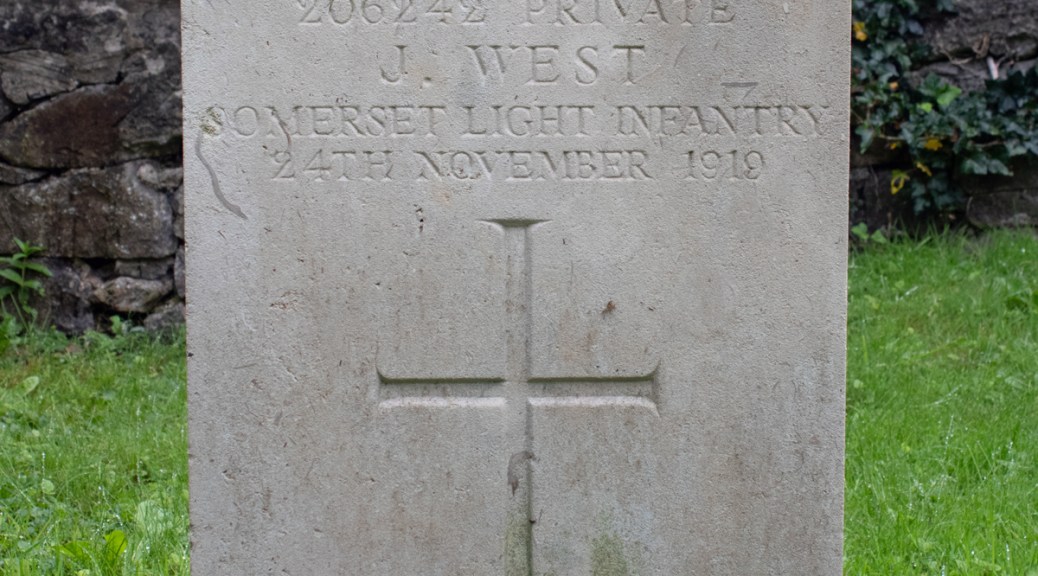
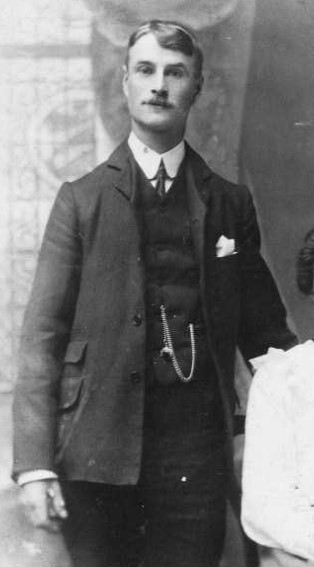
Jeremiah West was born in the spring of 1892, the oldest of eight children to John and Laura West. John was an agricultural labourer from Somerset, and it was in the village of Bleadon that the family were born and raised.
When he finished his schooling, Jeremiah followed in his father’s footsteps. By the time of the 1911 census, he was working as a servant on the nearby Shiplette Farm, where he was employed by Kate Poole.
War came to Europe in 1914, and Jeremiah stepped up to play his part. He enlisted in the Somerset Light Infantry in 1915, and was assigned to the 4th Battalion. Private West set sail for India that August, and seems to have remained overseas for some time.
Records are not clear, but it would appear that Jeremiah returned to Britain at some point, and became attached to the 3rd Battalion of the Bedfordshire Regiment. This was a garrison troop, based in Harwich, Essex, and Jeremiah found himself part of the battalion’s Labour Corps.
Private West survived the war, but came down with pneumonia in the autumn of 1919. He passed away on 24th November 1919: he was 27 years of age.
Jeremiah West was brought back to Somerset for burial. He was laid to rest in the peaceful graveyard of St Peter and St Paul’s Church in his home village of Bleadon.
Maurice Lock was born in Nailsea, Somerset, the seventh child to William and Rebecca Lock. Dates of birth vary according to documents available: census records suggest he was born around 1884, although his military records put his year of birth as 1877.
Maurice had a total of eleven siblings, with names including Merrick, Britannia and Cinderella. His father was a licensed hawker and this was something of a family trade.
The 1891 census recorded the family living at The Heath in Nailsea, although, unusually, it was noted that “this family now residing in a house occupy a travelling van in summer.” By the time of the next census return, the family business was continuing, with eight members, Maurice included, recorded as being peddlers, hawkers and horse dealers.
On 23rd January 1909, Maurice married Emily Hughes. There is little information available about her, but the couple continued Maurice’s parents’ travelling lifestyle, and went on to have four children: Albert, Mary, Gladys and Agnes.
Maurice was called upon to do his duty when war came to Britain. He enlisted on 4th September 1916 and was initially assigned to the Duke of Cornwall’s Light Infantry. Private Lock’s service record shows that he was 39 years and 10 months old when he joined up, and that he stood 5ft 8ins (1.73m) tall. He was working as a basket maker and farm labourer when he received the call to enlist.
Private Lock spent a couple of months on home soil, before his troop – the 12th (Labour) Battalion – were sent to France. He remained overseas for some sixteen months, before three separate bouts of trench fever within a month saw his return to Britain’s shores.
Maurice was transferred to the Labour Corps at this point and, once he had recovered, it was to be presumed that his previous farm work would be called upon once more. However, his age and the conditions on the Western Front conspired against him, and he developed rheumatism, which led to his discharge from the army. His medical records at this point noted that “he walks very lame with the aid of a stick. His left leg is especially [bad]. He has pains in his back, legs and shoulders. These pains are aggravated by pressure and weather changes.”
Maurice returned home, but his time back in Somerset was to be brief. His health deteriorated, and he passed away at home on 29th June 1918: he was in his late 30s or early 40s when he died.
Maurice Lock was laid to rest in the peaceful graveyard of Christ Church in his home town of Nailsea.
Frank Gunney was born in Brushford, Somerset, in the spring of 1890. The youngest of four children, with two sisters and a brother, his parents were William and Mary. William was a groom-turned-gardener, but when Frank left school, he found other employment: by the time of the 1911 census, he was recorded as being a tailor.
Frank’s older brother, James, followed his father’s trade, becoming a groom when he finished his schooling. His work took him to South Wales, where he met and married Emma Lewis. The couple went on to have two children: Hilda and Kenneth. When war came to Europe, James enlisted, joining the Royal Army Service Corps as a Private.
Frank followed his brother into the army, enlisting in the Somerset Light Infantry on 11th December 1915. This must have proved a tragic time for his mother, Mary, as, just ten days later, William died “after a long and painful illness.” [Western Times: Friday 24th December 1915]
Frank’s service records give little away about the man he had become, but do note that he was 5ft 5ins (1.65m) tall. He was re-assigned to the 1st/21st Battalion of the London Regiment, and was sent to France in June 1916.
Private Gunney’s service papers suggest that he was injured on 9th September 1916, having received a gun shot wound to the head. He appears to have been treated on site, and there seems to be no notable break in his time on the front line.
James was killed in action on 7th April 1917: he was 33 years of age, and was laid to rest in the Warlincourt Halte British Cemetery in Saulty. Mary had lost a husband and a son within eighteen months, and James had left a widow and two children.
In March 1917, Private Frank Gunney had transferred to the Labour Corps, and aside from a six-month period on home soil, would remain in France until September 1919. He then returned to Britain, and was demobbed a month later.
Frank returned to Somerset, but his trail then goes cold. Two documents give an idea as to what happened next, however. The first is a newspaper report about his burial:
The funeral took place in All Saints’ Churchyard, Dulverton… of Mr F Gunney, only don of Mrs Gunney… who died on Tuesday last. Deceased served three years in France, and has been in failing health practically ever since demobilisation, although the end came rather suddenly.
Western Times: Tuesday 22nd March 1921
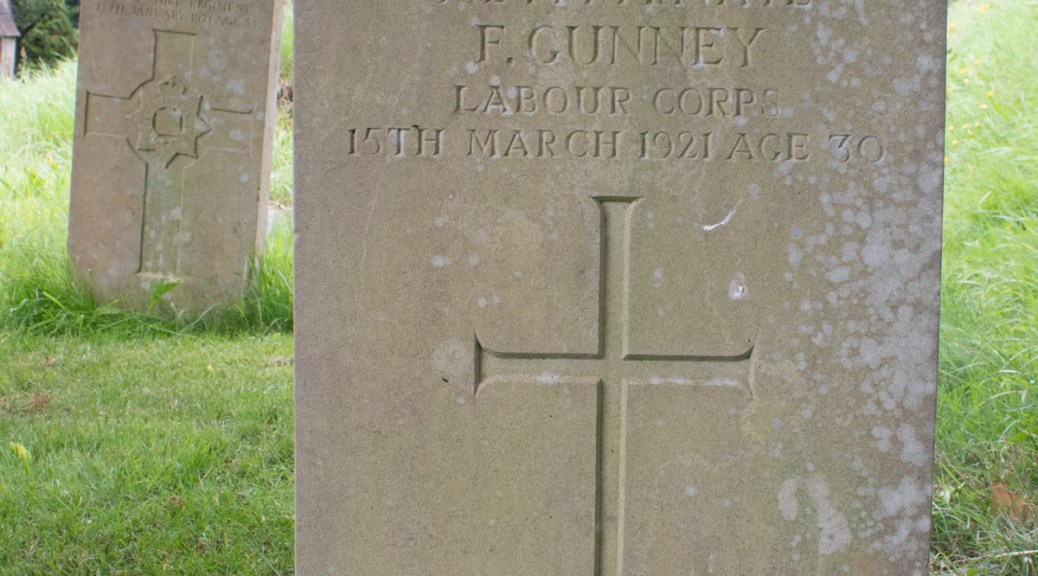
His army Pension Ledger Card, confirms that he had been discharged from the army because of a ‘septic wound to his left thumb’, which was due to his military service. It appears that this had festered over the ensuing years: Frank Gunney passed away on 15th March 1921, aged 30 years of age.
Herbert Francis Wear was born in the summer of 1895, one of twelve children to Charles and Harriet Wear. Charles was a farmer from Congresbury, and when he died in 1907, aged just 51 years old, it fell to Harriet and her children to keep the farm running.
At this point, however, much of Herbert’s trail goes cold, and it is a challenge to piece together anything concrete. When war broke out, he stepped up to play his part, enlisting in January 1917. He was assigned to the Military Police Corps and initially served in the Military Foot Police.
However, at some point during the conflict, Corporal Wear transferred to the Labour Corps, where he was attached to the 449th Agricultural Company. This meant he remained relatively close to home, as he was based in the Taunton area of Somerset.
The next record for Herbert is the British Army Register of Soldiers’ Effects, which confirms that he passed away in Somerset. An entry in the Bristol Times and Mirror (Wednesday 4th December 1918) states that “The funeral of the late Lance-Corporal HF Wear, Stonewell Farm, Congresbury, will take place to-day… 2:30pm.”
Herbert’s death certificate confirmed that he died at home from a combination of influenza and pneumonia. He was 23 years of age when he breathed his last.
Herbert Francis Wear was laid to rest close to his father in the graveyard of St Andrew’s Church in Congresbury.
Albert Edwin Pearce was born on 12th November 1883 in Bristol. Gloucestershire. One of nine children, his parents were William and Mary Pearce. William was a farmer and grazier and, when he finished his schooling, Albert followed him into farm work.
In 1908, when Albert was 25, his older sister Olive was widowed: the following year, their mother, Mary, also passed away. Olive’s late husband had been a farmer in Tickenham, near Clevedon, and so Albert and his older brother Walter moved in with Olive and her four children to help run the farm.
When war came to Europe, Albert stepped up to play his part. Full service details are not available, he served with the Labour Corps. Attached to the 446th Agricultural Company, towards the end of the conflict, he seems to have been serving in the West Midlands.
By the autumn of 1918, Private Pearce was admitted to the Military Hospital on Dudley Road in Birmingham. Details of his condition are not available, but they were to take his life. He passed away on 19th November 1918: he had celebrated his 35th birthday just a week before.
Albert Edwin Pearce’s body was brought back to Somerset for burial. He was laid to rest in the quiet graveyard of St Peter & St Paul’s Church in Weston-in-Gordano. He was buried in the family plot, reunited with his mother: his father, William, would be interred there just five months later, when he died in April 1919.
In a quiet corner of Portishead Cemetery, Somerset, is the grave of Private EG Davies. His headstone confirms that he was in the Duke of Cornwall’s Light Infantry, give the date of his death – 23rd March 1919 – and his age when he passed – 40 years old. The Commonwealth War Graves Commission website confirms that Private Davies transferred to the Labour Corps, but only a couple of documents remain from his time in the army.
The soldier’s pension records confirm that his full name was Edward George Davies, and that, at the time of his death, he was living with his ‘unofficial wife’, Minnie Louisa Holbrook. The records also give the cause of death: influenza and septic bronchitis.
Minnie Louisa Fido was born in the spring of 1874 in Bedminster, Bristol, one of thirteen children to farmworker David Fido and his wife, Sarah. She married Arthur Holbrook on 28th April 1895, and had Gertrude four months later.
The Somerset School Register from 1906 notes that Gertrude Fido joined the Church of England School in Weston-in-Gordano on 12th February. It gives her mother’s name as Minnie Fido, but doesn’t give a father’s name. It seems that Gertrude left the school in November 1914, as she had found work.
A search of the 1911 census records shows Edward and Minnie (whose surname is now given as Davies), living in George Street, Portishead. Edward is listed as a wagoner on a farm, and that he was born in Gloucestershire. Minnie is noted as a charwoman from Nailsea, Somerset. Making up the household is Gertrude, noted as being Edward’s stepdaughter, and who was working as a domestic servant.
Edward’s history is more of a challenge to piece together. The 1911 census gives his place of birth as Iron Acton, Gloucestershire, and census records from the years following his birth give his parents names as Henry and Charlotte Davis.
In 1896, Edward joined the Gloucestershire Regiment as a Private, his papers suggesting that his apparent age was 18 years and 3 months (he was, in fact, barely 17 years old). Despite having ‘rather flat feet’, he spent the next five years in the army, and served in South Africa. He was medically discharged in November 1901.
Returning to the 1911 census once more, the document suggests he and Minnie had been married for eight years, although later army pension documents suggest Minnie was his unofficial wife.
When war broke out, it seems that he stepped up to play his part once more, although the records give some confusion about how and where he served. The war memorial in Portishead records him as Private Edward George Davies of the Royal Horse Artillery, while the Somerset Book of Remembrance commemorates Gunner Edwards George Davies of the Royal Horse Artillery. The North Weston War Memorial suggests he was a Private in the Duke of Cornwall’s Light Infantry, and this matches the details recorded by the Commonwealth War Graves Commission.
Minnie did not marry, or co-habit, again, and she passed away on Christmas Day 1949, at the age of 75 years old. Gertrude looks to have married a man called Bessant. The 1939 England and Wales Register recorded her living in the Portishead area, and working as a supervisor in a boot factory. She was living with her maternal uncle, Herbert Fido, but was noted as being the head of the household. She died early in 1967 in Weston-super-Mare.
Richard Francis Gould was born in the autumn of 1893 in Wraxall, Somerset. One of fifteen children, his parents were Devon-born farm labourer and carter John Gould and his wife Mary, who came from Bristol.
When he left school, Richard found work as a domestic gardener, and this is what he was doing when he met Ada Archer. She was a nurse from Bristol, and the couple married in Knowle on 17th August 1908. They set up home in Bedminster, and went on to have three children: Edith, born late in 1909; Richard Jr, born in 1915; and Ronald, who was born the following year.
When war broke out, Richard was drawn to serve his country. Sadly, most of his service records have been lost to time, so it’s impossible to piece together a complete record of his time in the army. He was initially attached to the 36th Training Reserve Battalion, but was soon transferred. Attached to the 599th Agricultural Company of the Labour Corps, Private Gould was based in Somerset.
It was while serving in the autumn of 1918, that Richard fell ill. Having contracted pneumonia, he was hospitalised, but the condition proved too much, and he passed away on 19th October, at the age of 34 years old.
Ada and the children were living in the Somerset village of Long Ashton by this point, but it was in the graveyard of the local church – All Saints’ – that Richard Francis Gould was laid to rest.
Arthur Chard was born in the spring of 1893, one of eight children to Isaac and Eliza Chard. Isaac was a labourer at the colour works in Winford, Somerset, and this is where the family were born and raised.
When Arthur finished his schooling, he found work as a farm labourer and, by the time of the 1911 census, he was living with his maternal uncle and family in the village, where he was employed as a farm lad.
As war came to Europe, Arthur stepped up to serve his country. He enlisted on 16th November 1915, joining the Somerset Light Infantry. His service records show that he was 5ft 3ins (1.6m) tall and weighed 113lbs (51.3kg).
Private Chard was formally mobilised in January 1916, and was sent to France in September, having completed his training. By May of 1917, he seems to have been back in Britain, and was transferred to the Labour Corps. There appears to have been some health issue behind this, as, on 11th August he was admitted to Henham Hall Auxiliary Hospital in Suffolk, suffering from ‘debility’. Having been moved to another hospital after a couple of weeks, he was finally discharged back to his unit on 20th September 1917.
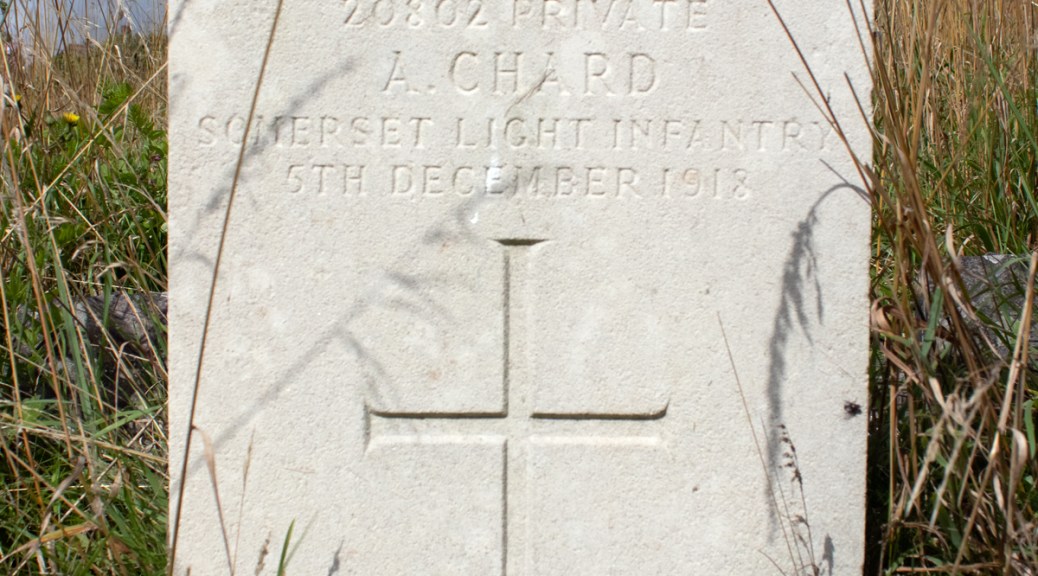
Arthur joined the 626 Agricultural Company, which was based in Taunton. By July 1918, he had moved to another of the Somerset troops, 593 Agricultural Company. His health was still suffering, however, and he was soon admitted to Taunton Military Hospital. Private Chard passed away from nephritis on 5th December 1918. He was 25 years of age.
Arthur Chard’s body was taken back to Winford for burial. He was laid to rest in the village’s parish church, St Mary & St Peter’s.
Henry Wiggs was born in Camberwell, Surrey, in the autumn of 1880. One of eleven children, his parents were dock labourer Thomas Wiggs and his wife, Sarah.
When he finished his schooling, Henry also took up labouring work and, by the time of the 1911 census, was working as a partition block maker in the building trade. The census shows him a living with his brother William and his family.
On 3rd August 1913, Henry married Blanche Hill. She was eight years older than Henry, and the daughter of a Sergeant in the Royal Horse Artillery. Blanche had been widowed ten years earlier, and had four children, who Henry took on as his own.
At this point, Henry’s trail goes cold. When war broke out, he stepped up to play his part, initially joining the Worcestershire Regiment. At some point he was transferred to the Royal Berkshire Regiment, subsequently becoming attached to the Labour Corps.
Details of Private Wiggs’ military service are lost to time, and it is unclear whether he served on the Home Front or overseas. He survived the war, and was discharged from the army on 13th March 1919. He was suffering from heart disease, directly attributable to his military service.
Again, Henry falls off the radar at this point. He and Blanche made the move to Somerset, setting up home in Weston-super-Mare. His heart problem seems to have dogged him, however, and likely caused his admission to a hospital in Bath towards the end of 1920. It was in the city that he passed away, on 28th December 1920, at the age of 40 years old.
Henry Wiggs’ body was not brought back to Weston-super-Mare for burial – the cost of doing so may have been too much for the now twice-widowed Blanche to afford. Instead, he was laid to rest in the sweeping Locksbrook Cemetery in Bath.
In the war grave section of Locksbrook Cemetery in Bath, Somerset, is a headstone dedicated to a Private J Curtis, of the King’s Liverpool Regiment, who passed away on 3rd January 1921. The Commonwealth War Graves Commission confirms that Joseph Curtis had transferred to the 430th Company of the Labour Corps at some point.
Little additional information is available for Joseph Curtis. Only one service document remains, his Medal Roll Index Card. This gives the dates of his service – 22nd February 1915 to 17th October 1918 – but no other identifying details.
Without a year or place of birth, it is not possible to track down any census records. As Bath was the location of both a War Hospital and one for army pensioners, his burial in a cemetery nearby is no guarantee that the city was ever his home. There is also no report of Private Curtis’ passing or funeral in any available contemporary newspapers.
The life of James Curtis is destined to remain a mystery, therefore, taken with him when he was laid to rest.