
Category Archives: Loyal North Lancashire Regiment

Lance Sergeant Henry Lewis

Lance Sergeant Henry Lewis

The early life of Henry Watkin Lewis is a challenge to piece together, and a lot of the detail comes from his later service records.

The document confirms that Henry was born in Pontypool, Monmouthshire, in December 1885. It gives his next of kin as his aunt, Ann Dunning, and there are no details about his parents.

Henry joined up in the days after war was declared. He was working as a plumber by this point, and enlisted in Preston, Lancashire, although it is not clear whether he was living in the area at this point. His records showing that he was 5ft (1.52m) tall and weighed 116lbs (52.6kg). With brown hair, blue eyes and a fresh complexion, he had a scar across the bridge of his nose and another on his lower lip.

Henry’s military career is an intriguing one. Assigned to the Loyal North Lancashire Regiment, he was initially given the rank of Private. He was promoted to Lance Corporal on 5th September 1914, just two weeks after enlisting. Four days later his rank was increased to Corporal, and by 14th October he had been promoted again, this time to Lance Sergeant. There is no evidence of any previous military background for him, and the cause of this rapid rise is unclear.

With any rapid rise, a rapid fall is often likely to follow, and Henry’s case was to be no different. He service records note that he was discharged from the army on 16th January 1915, as he was ‘not likely to become an efficient soldier’. Again, there is no further record as to why, although his papers do not suggest the cause was anything medical.

Lance Sergeant Lewis’ unit was based in Tidworth, Wiltshire, by this point, but he must have moved to Warminster following his discharge. It was here that he died on 23rd April 1915, the cause of his passing unknown. He was 29 years of age.

Henry Watkin Lewis was laid to rest in the graveyard of St Denys’ Church, Warminster.

Private William Pinney

Private William Pinney

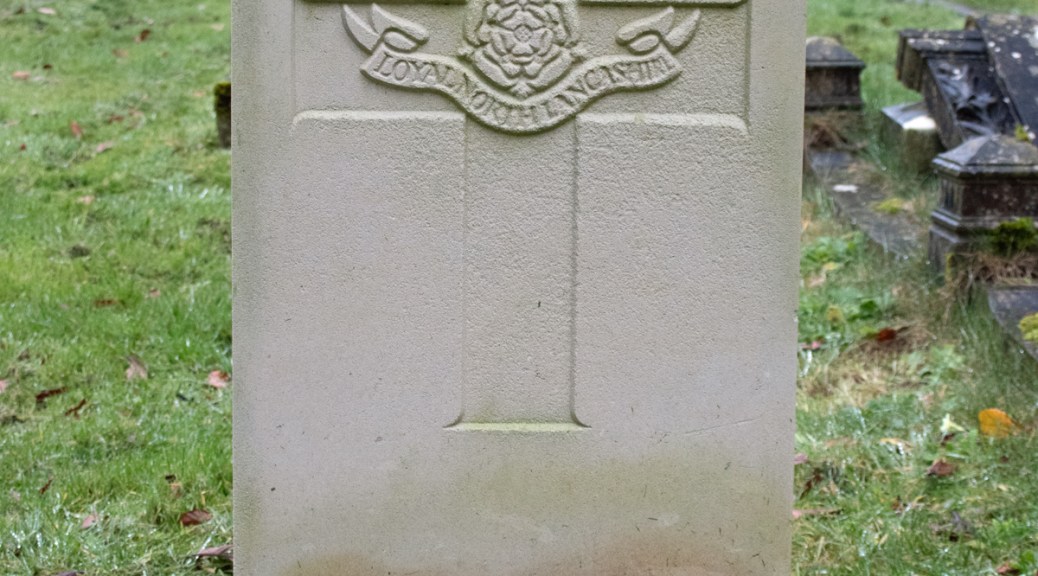
The details of William Pinney’s life seem destined to remain a mystery. His headstone – in Crewkerne Cemetery, Somerset – confirms that he was a Private in the Loyal North Lancashire Regiment, and that he died on 14th August 1919.

The British Army Register of Soldiers’ Effects expands a little on this, identifying that he was in the 2nd Battalion of the regiment. The document states that he died of wounds and had been admitted to the War Hospital in Southampton, Hampshire (this is likely to have been the Royal Victoria Hospital in Netley). It also confirms that his effects were to be passed to his widow, Sarah Pinney.

From this point on, some elements of supposition come in to the research.

There is a marriage certificate for a William Pinney and Sarah Jane Witheyman at the parish church in Crewkerne on 6th January 1911. This record gives William’s age as 23, and shows that he was a weaver and the son of weaver William Pinney Sr. Sarah, meanwhile, was five years older than her new husband, worked as a factory hand, and was the daughter of another factory hand, George Witheyman.

The same year’s census gives more information about William Pinney. He was one of eleven children to William and Mercy Pinney, and every member of the family over school age was involved in weaving and spinning. It should be noted, however, that the census was taken on 2nd April 1911, three months after William’s marriage and, while the ages on the document match, the document states that he is single.

The same census for Sarah tells a similar story. She is noted as being one of twelve children to George and Amelia Witheyman. George is noted as being a ‘hand ackler’, or handyman, while Sarah and the two of her teenage brothers still at home are all working as mill hands. The same anomaly arises as William, however, as she is also noted as being single.

Returning to the marriage certificate, an answer to the anomaly in the dates seems to resolve itself, however. The marriages are noted in chronological order, and the previous wedding to be solemnised in Crewkerne Parish Church was on 26th December 1911, while the following one was on 14th February 1912. It would appear, therefore, that Leonard Jackson, the curate of the church, entered the incorrect date on the certificate.

The census records and marriage certificate all seem to fit the William and Sarah Pinney who were separated by William’s death in 1919. There are certainly no documents suggesting another William Pinney in the Crewkerne area around that time period. It is reasonable to assume, therefore, that they do all connect to the gravestone in the town’s cemetery.

Private Pinney’s military records are missing, or no longer available, so it is not possible to trace his actions during the First World War. The 2nd Battalion of the Loyal North Lancashire Regiment served in India during the first half of the conflict, moving to Egypt in 1917 and to France the following year. It is not possible to confirm where William served, but wherever he fought, he was wounded, and these injuries were to prove fatal. He passed away in the Southampton hospital on 14th August 1919, nine months after the end of the war, aged around 31 years old.


Private Edward Savage

Private Edward Savage

In the graveyard of St Augustine of Hippo Church in Penarth, Glamorgan, lies the Commonwealth War Grave for Private Edward Savage. The headstone confirms that he had died on 25th December 1915 and that he was in the Loyal North Lancashire Regiment.

The Commonwealth War Grave Commission website suggests that he was the son of Edward and Rachel Savage and that he was born in Beccles, Suffolk. Sadly, there are no available census documents to shed any further light on that early life.

The same website suggests that he served in Burma, and in the South African campaign, which would have placed him there in the late 1890s and early 1900s.

It is also noted that Edward was the husband of Emily Savage and that they were living in Fleetwood, Lancashire. Edward’s later pension ledger suggests this was an Emily Shannon, who is, in fact, noted as the guardian of his illegitimate child. Further information, however, is not available.

From a military perspective, it is likely that Private Savage was either still service at the point that the First World War broke out, or that he was called into service – or volunteered his services – shortly after its declaration. He was assigned to No. 5 Supply Company of the 3rd/4th Loyal North Lancashire Regiment and, by the autumn of 1915, he found himself based at Penarth Head Fort near Cardiff.

Edward’s death seems to have been a less than auspicious one, as a local newspaper reported at the time.

The district coroner held an inquest at Penarth on Tuesday touching the death of Private Edward Savage, who was found dead at the billets of the A Company of the Loyal North Lancashire Regiment on Sunday morning. Surgeon-Major Charles Parsons, the local medical officer, stated that the deceased had apparently fallen down some stone steps, causing a fracture of the base of the skull. The jury returned a verdict of “Accidental Death.”

Western Mail: Wednesday 29th December 1915

Private Edward Savage had died on Christmas Day, 25th December 1915. He was 54 years of age. He was laid to rest in the graveyard of St Augustine of Hippo Church in Penarth.


Edwards shares his grave with another member of the Loyal North Lancashire Regiment, Serjeant Frank Carter. Read his story here.

Serjeant Frank Carter

Serjeant Frank Carter

In the graveyard of St Augustine of Hippo Church in Penarth, Glamorgan, lies the Commonwealth War Grave for Serjeant Frank Carter. The headstone confirms that he had died on 31st August 1915 and that he was in the Loyal North Lancashire Regiment.

Little further information is available about him, apart from a few scattered details from a number of documents.

Frank’s burial record shows that he had been residing in The Fort, Penarth, a garrison constructed on the cliffs near the entrance to the harbour and Cardiff Bay. The record, written by George Turner, confirms that his burial was on 2nd September 1915, and that he was 51 years old when he passed.

Serjeant Carter’s record in the Army Register of Soldiers’ Effects confirm that he was in the 2nd/4th Battalion of his regiment, and that he must have enlisted at some point before February 1915. The document states that he died in the Western Hospital in Cardiff, and that his beneficiary was Miss M Smithson.

These few documents add up to very little, and do not provide enough information to concretely uncover anything else of Frank Carter’s life. His is a story that is destined to remain lost to time.


Frank shares his grave with another member of the Loyal North Lancashire Regiment, Private Edward Savage. Read his story here.


Captain William Rowell

Captain William Rowell

William Cecil Rowell was born on 29th November 1892 in Wolborough, Newton Abbot, Devon. He was the youngest of three children to architectural surveyor Spencer Rowell and his wife, Annie.

The 1911 census recorded that William had left the family home to study to be a civil servant, and was boarding with a family in Fulham, London. His studies complete, he was driven by a need to serve his country and, on 22nd January 1913, aged just 20 years old, he enlisted in the Loyal North Lancashire Regiment.

Full details of his service are not available, but it is clear that he was committed to his purpose. He was promoted to Second Lieutenant soon after enlisting, rose to full Lieutenant in November 1914, and Captain a year later. It’s not possible to pinpoint where he served, he was wounded twice and, after his second recovery, he made a transfer to the Royal Flying Corps (later moving to the new Royal Air Force when it was founded in 1918).

Captain Rowell was based at Bekesbourne Airfield in Kent. He qualified as a pilot with 50 Squadron in October 1918, but was injured when, on the 12th November, his Sopwith Camel collided with the hanger. William was admitted to the Military Hospital in nearby Canterbury, but the injuries to his leg proved too severe for it to be saved, and he underwent an amputation in January 1919.

Tragically, while the initial prognosis was good, within a few weeks sepsis set in; Captain Rowell passed away on 22nd May 1919, aged just 26 years old.

William Cecil Rowell’s body was brought back to Devon for burial. He was laid to rest in the family plot in the graveyard of St Mary’s Church in Wolborough.