Category Archives: Royal Army Service Corps

Saddler Henry Evans

Saddler Henry Evans

Henry Evans was born in Newport, Monmouthshire, in the summer of 1883. Little concrete information remains about his early life, but it is clear that he was boarding with a dock labourer and his family in the town by the time of the 1901 census.

Henry married Margaret Jane Garner in Pontypridd on 14th March 1909. Within a couple of years, the young couple had moved to Llangollen in Denbighshire, and had had two children, Horace and Emlyn. Henry was now working as a saddler.

War was coming to Europe and, in November 1915, Henry enlisted in the Royal Army Service Corps. His previous trade saw him well, as he was assigned to the regiment’s 1st Company with the rank of Saddler. His service records show that he was 5ft 8.5ins (1.74m) tall, had no distinctive marks, and that his was Wesleyan in his beliefs.

After a few weeks on home soil, Saddler Evans was sent to the Western Front, arriving there just before Christmas 1915. For the next year, he worked in France, returning to Britain 366 days after he left for the continent. By this point, however, his health seems to have been suffering, and it was to prove to be the beginning of the end for him.

Saddler Evans was suffering from transverse myelitis, an inflammation of the spinal cord. Symptoms can be wide-ranging, but in Henry they were severe enough to be viewed as a permanent ailment. At the end of May 1917, while admitted to the Queen Alexandra Hospital on Millbank, London, he was recommended for immediate military discharge.

Unfortunately, as is often the way with bureaucracy, the discharge papers went missing. In July 1917, Henry was moved to the Croesnewydd Hospital in Wrexham, and is was here, a month later, that his documents caught up with him. Saddler Evans was finally discharged from military service on 4th August 1917.

Sadly, his army status was not to have any kind of effect on his health: at 9:30am on 17th August Henry passed away while still admitted to the Wrexham hospital. He was just 34 years of age.

Brought back to Llangollen for burial, Henry Evans was laid to rest in a plot in the town’s Fron Cemetery. He was to be reunited with his family in time: Horace died in 1940, Margaret in 1956 and Emlyn in 1963, and all were laid to rest in the same grave.


Private Alfred Bishop

Private Alfred Bishop

Alfred John Bishop was born on 25th April 1896 in the Devon village of Kingswear. The older of two children, his parents were John and Susanna Bishop. John was a farm worker, and his expertise with horses was not lost on Alfred, who became a delivery driver for a baker in Marldon, to the north of Paignton, when he left school.

On 3rd September 1917, Alfred married road contractor’s daughter Bessie Webber. Originally from Staverton, her family had settled in Ipplepen, and this is where the newlyweds made their home.

War had come to Europe by this point, and Alfred had enlisted in the Royal Army Service Corps (RASC). His background with horses came in useful, as he was assigned to the Yeomanry Remount Depot. Details of Private Bishop’s military service are lost to time, so it is unclear if he was attached to one of the RASC depots in the UK, or if he served abroad.

Alfred survived the war and, by 1919, was back home. He and Bessie had a son, Leslie, who was born on 23rd October 2020. Time with his son was to be tragically brief, however, as Alfred passed away on 14th April 1921. The cause of his death is not known, but he was just 25 years of age.

Alfred John Bishop was laid to rest in the graveyard of St Andrew’s Church in Ipplepen.


Bessie went on to marry again, to James Joint in the autumn of 1932. She passed away in Newton Abbot in 1980, at the age of 85.


Alfred’s brother James’ life was also cut short. He married Ethel Warren in 1925, and is recorded has having passed away in London in the autumn of 1935, when he was only 35 years old. Ethel was left with two young children to raise, and John and Susanna were to outlive both of their sons.


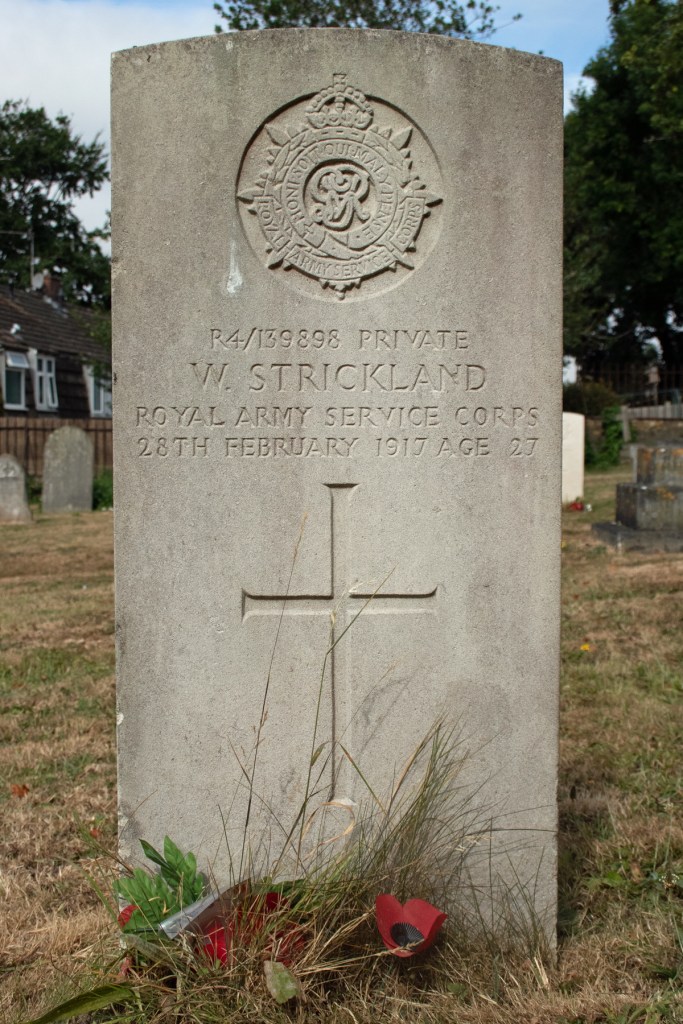
rivate Walter Strickland

Private Walter Strickland

Walter Strickland was born in 1890 in Pitminster, Somerset, the youngest of eight children to William and Sarah Strickland. William was a farm labourer, but his son found employment in the local coal mines on leaving school.

In December 1910, Walter married local woman Eliza Burton. The couple moved with Eliza’s brother and sister-in-law to Monmouthshire, where mining was the primary industry. After a couple of years, the young couple moved back to Somerset and went on to have a son, Wilfred, who was born in 1913. Walter had found other work, by this time, and was employed as a groom.

Storm clouds were brewing over Europe, and Walter enlisted in September 1915. He was assigned to the Royal Army Service Corps and given the rank of Private. His service records show that he was 5ft 6ins (1.67m) in height, and had a 35in (89cm) chest measurement.

Details of Private Strickland’s military service are limited. It seems likely that he was sent overseas, but that cannot be confirmed. By the start of 1917, however, he was back in England, and had been admitted to the Royal Victoria Hospital in Netley, near Southampton. He was suffering from an exophthalmic goitre – also known as Grave’s Disease – which results in heart palpitations, and an enlargement of the thyroid gland.

Sadly, this was an illness to which Private Strickland was to succumb: he passed away in the hospital on 28th February 1917, Eliza by his side. He was just 27 years of age.

Walter Strickland’s body was brought back to Somerset for burial. He was laid to rest in the graveyard of All Saints’ Church in his now home town of Norton Fitzwarren.


Private William Pole

Private William Pole

William James Pole was born on 22nd July 1892 in the Somerset village of Halse. He was the third of six children to shepherd and farm labourer William Pole and his wife, Harriet. When he left school, William Jr also found work on a relative’s farm in Herefordshire.

William Jr was still working on the farm when war broke out. He enlisted in the spring of 1915, joining the Royal Army Service Corps as a Private. There is no evidence of whether he served overseas, although it seems likely that he would have done, if only for a short while.

By September 1915, however, he was back on English soil, having been admitted to Netley Hospital in Southampton, suffering from enteric fever, also known as typhoid. Sadly, his illness was to get the better of him, and he passed away in the medical facility on 12th September 1915. He was just 23 years of age.

William James Pole’s body was brought back to Somerset for burial. He lies in the graveyard of St James’ Church, Halse. His parents would also be buried there: William Sr in 1935, and Harriet in 1949.


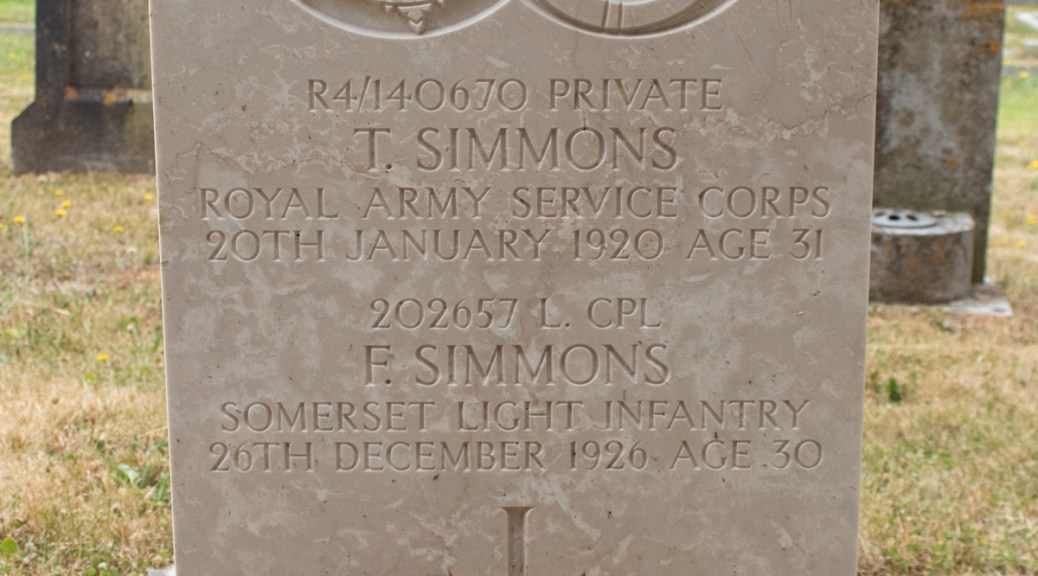
Private Tom Simmons

Private Tom Simmons

Tom Simmons was born early in 1889, one of fourteen children to William and Elizabeth Simmons. William was a farm labourer from Devon, who had moved to Runnington, near Wellington in Somerset, with Elizabeth in the late 1880s. This was where their growing family was born and raised.

Tom found work away from Somerset when he left school and, by the time of the 1911 census, he was lodging in a house in Llanwonno, Glamorgan. He was employed as an assistant machine repairer at the local colliery.

War was beginning to encroach on England’s shores, and Tom was to play his part. Full service details are not available, but he enlisted in the Royal Army Service Corps and served as part of a territorial force. For the part he played, he was awarded the Victory and British Medals and the Silver War Badge.

It would seem that Private Simmons survived the war and was demobbed, returning to Somerset at some point by the end of 1919. Sadly, his trail goes cold: the next record available is of his death – through causes unspecified – at home on 20th January 1920, at the age of 31 years old.

Tom was buried in Wellington Cemetery, not far from his family home.


Tom’s headstone also includes a dedication to a Lance Corporal F Simmons.

Frederick Simmons was seven years younger than his brother. When he left school, he worked as a wool spinner in the local wool mill. When war came to Europe, he too played his part. Again, full details of his service are sketchy, but he enlisted in the Somerset Light Infantry.

Like Tom, Frederick served as part of the territorial force, and worked his way to the rank of Lance Corporal. After the war he returned home, but his life there was not set to be a long one. He passed away, through causes not noted, on 26th December 1926. He was just 30 years of age.

Frederick was laid to rest in the same grave as his brother. Technically not entitled to an official Commonwealth War Grave (the rules are laid out here), his service was remembered alongside that of Tom’s.


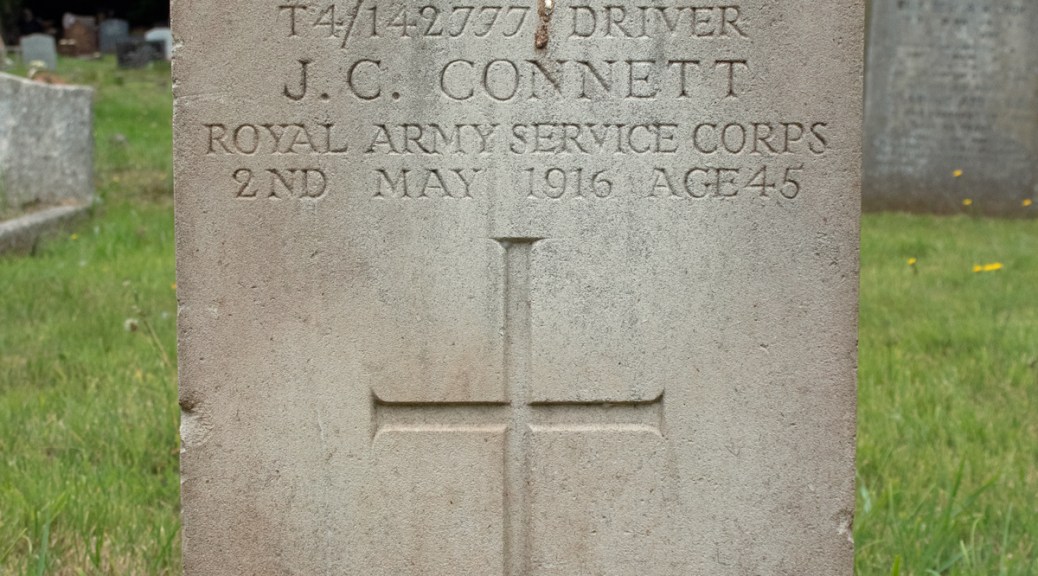
Driver John Connett

Driver John Connett

John Charles Connett was born at the end of 1870 in Holway, on the outskirts of Taunton, Somerset. He was one of seven children to Charles and Thursa Connett. Charles was a farm labourer and, in John’s early years, Thursa worked from home as a glover to bring in a little extra money for the growing family.

In 1897, John married a woman called Annie; the couple settled down in a small cottage near the centre of Wellington, Somerset. John found work as a coachman, and the couple went on to have one child, a daughter called Ethel, in 1900.

When war came to Europe, John was keen to play his part, even though he had turned 43 by the time hostilities were declared. He enlisted, joining the Royal Army Service Corps by November 1915, and was assigned to the 663rd Company.

Driver Connett’s time in the army was to be tragically short, however. He is recorded as passing away at home on 2nd May 1916, having contracted bronchitis and pneumonia while on active service. He was 45 years old.

John Charles Connett was laid to rest in Wellington Cemetery, within walking distance of where his widow and daughter still lived.


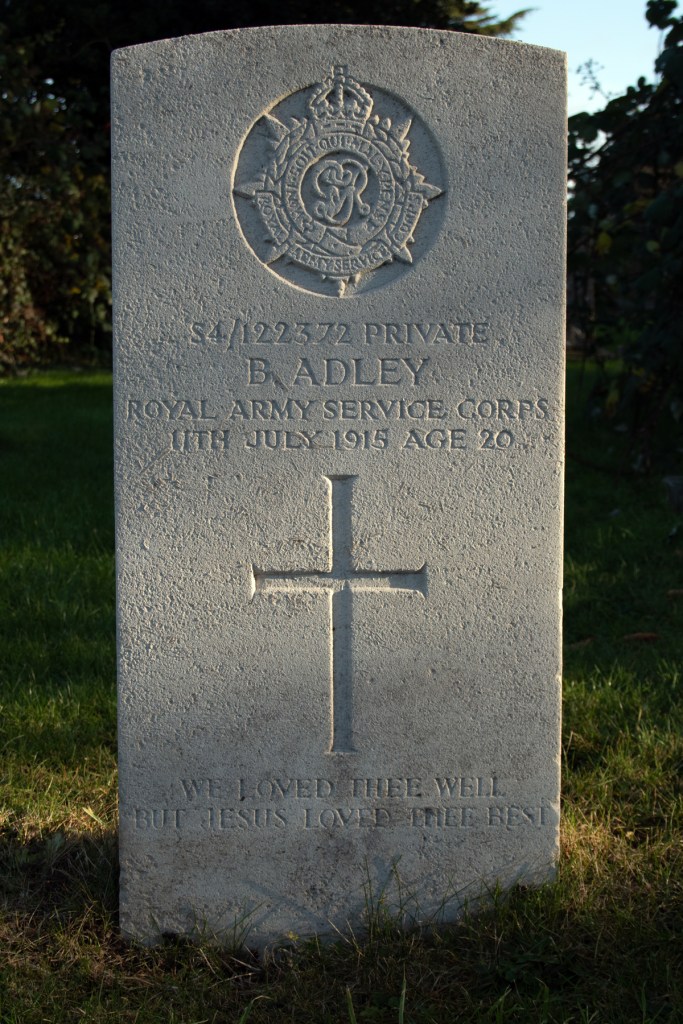
Private Bert Adley

Private Bert Adley

Bert Bennett Adley was born in the spring of 1895, the youngest of eleven children to George and Alma Adley. George was a brickmaker’s labourer from Canterbury, Kent, but it was in nearby Faversham that he and Alma raised their family.

Bert – who was affectionately known as Bertie – found work with a local baker when he left school, and this stood him in good stead when war broke out. He was called up in June 1915, and joined the Army Service Corps as a Private. His service records give little personal information, but they do give his height as 5ft 5ins (1.65m) and his weight as 9st 2lbs (58kg).

Private Adley’s military life was to be tragically short. Based in Aldershot, Hampshire, it is likely that the sudden mixing of recruits from across the country was key in his contracting pneumonia. He was admitted to hospital on 26th June, and died two weeks later, on 11th July 1915. He was just 20 years of age, and had been in the Army Service Corps for just 28 days.

Bert Bennett Adley’s body was brought back to Kent for burial. He was laid to rest in his home town, in the Faversham Borough Cemetery.


Private Edgar Boyland

Private Edgar Boyland

Edgar Albert Boyland (known as Albert) was born in the summer of 1894, the third of eight children to John and Sarah Boyland. John was a farm labourer from Chaffcombe in Somerset, but it was in nearby Chard that the family were born and raised.

Albert followed in his father’s footsteps and, when he finished school, he found work on a local farm. The 1911 census recorded him boarding with the Boait family in Winsham, to the south-east of Chard. He was living there along with another boarder, a baker called Fred Baker, and his influence seems to have paid off, as, by the time war was declared in 1914, baking was the trade that he had taken up.

With the conflict declared, Albert was called upon to play his part. In April 1915, he enlisted in the Army Service Corps. His records show that he stood 5ft 5.5ins (1.66m) tall and he gave his trade as baker. This was the trade that served him well, as it is the one for which he was employed.

Private Boyland was sent to France within a few weeks of enlisting. In November 1915, he was sent to Salonika, Greece, and spent the next couple of years in the Eastern Mediterranean providing food for the troops.

In December 1917, Albert returned to England where, within a couple of months, he was medically discharged from active duty. Sadly, there is nothing documented to confirm the condition that led to him leaving the army, but it seems likely to have been an illness of some description.

At this point, Albert’s trail goes cold. He passed away on 19th February 1919; again the cause of his death is lost to time. He was just 24 years of age.

Edgar Albert Boyland was laid to rest in Chard Cemetery, not far from where his family still lived.


Private Arthur Boyland

Two rows back from Private Albert Boyland’s headstone is another Commonwealth War Grave, dedicated to another Boyland. This is from the Second World War, and identifies the resting place of Albert’s cousin.

Arthur James Boyland was born on 21st October 1908, one of nine children to Arthur’s uncle and aunt, Joseph and Julia Boyland. Joseph worked at an iron foundry, but it seems that Arthur was destined for other things. While a lot of his life is lost to time, by the time of the 1939 Register, he was working as a dental mechanic in Chard.

Arthur had married Bessie Hopkins in 1936; the couple went on to have three children.

When the Second World War was declared, Arthur had a role to play; he enlisted as a Private in the Royal Army Dental Corps. Sadly, details of his service are not available; he survived the war, however, and returned to Chard afterwards.

Arthur James Boyland passed away at home on 14th December 1947, at just 39 years of age. He was laid to rest in Chard Cemetery.


Private Sam Mattocks

Private Sam Mattocks

Samuel Mattocks was born in Combe St Nicholas, Somerset, in 1885, one of six children to farm labourer George Mattocks and his wife, Anna. Sam sought a trade when he left school and soon found work as a butcher.

Documentation relating to Sam’s life is pretty scarce. When war broke out, he stepped forward to play his part, enlisting in the Army Service Corps (presumably because of his profession) by the start of 1916.

Private Mattocks was sent to Hampshire to work at one of the supply depots there. Sadly, this appears not to have been for long as, on 1st April 1916, he passed away at his base in Aldershot. No specific cause of death is evident – his records just note that he died ‘of disease’. He was 31 years old.

The body of Samuel Mattocks was brought back to Somerset for burial. He was laid to rest in the family plot in the graveyard of St Nicholas’ Church in his home village.


Driver W Steer

Driver W Steer

The life of WH Steer is destined to remain lost to time. Details of his first names and date of birth are not obtainable and, other than the fact that his father was called Thomas, there is no other information about his family.

He had enlisted as a Driver in the Army Service Corps by August 1918, but there is no record as to where he served or for how long he did so. All that can be confirmed is that he was based in Warwick after the conflict ended, and this is where died, of causes unknown, on 10th February 1919.

WH Steer was brought to Devon for burial – presumably this is where Thomas and the rest of his family lived – and he was laid to rest in the graveyard of St Mary’s Church in Wolborough, near Newton Abbot.