Category Archives: Officer’s Steward

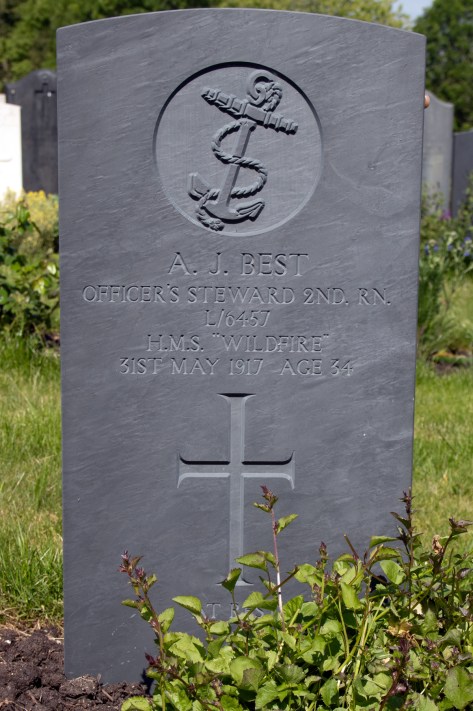
Officer’s Steward 2nd Class Alfred Best

Officer’s Steward 2nd Class Alfred Best

Alfred Henry John Best was born on 17th November 1883. The second of ten children, his parents were William and Alice Best. William was an engine driver and both he and Alice were from Ipswich, Suffolk. Alfred was born in Dovercourt Essex, but by the time of the 1901 census the family had settled in the village of Ramsey, near Harwich.

When he finished his schooling, Alfred was set on a life of adventure. Living so close to the sea, a life on the ocean drew him in, and he found employment on the steamships as a steward. Absent from the 1901 census, the following return, taken in 1911, found him back at home with the family, and employed as a ship’s steward.

When war broke out, Alfred stepped up to serve his country. He enlisted in the Royal Navy as an Officer’s Steward 3rd Class, and was sent to HMS Pembroke, the Royal Naval Dockyard in Chatham, Kent. His service records give his year of birth as 1884, but show that he was 5ft 4.5ins (1.64m) tall, with light brown hair, blue eyes and a fresh complexion. He was also noted as having a mole under his right eye.

Within a matter of days, Alfred’s previous experience gained him a promotion to Officer’s Steward 2nd Class. He would spend the next couple of years on shore, his time being split between Pembroke and HMS Wildfire, a similar establishment just along the coast in Sheerness.

By the spring of 1917, Officer’s Steward Best was back in Chatham, and had been admitted to the town’s Royal Naval Hospital with tuberculosis. The condition would prove fatal, and he breathed his last on 31st May 1917: he was 33 years of age.

The body of Alfred Henry John Best was buried in the naval section of Woodlands Cemetery, Gillingham, Kent, not far from the base he had called home for some time.


Officer’s Steward 2nd Class Alfred Best
(from ancestry.co.uk)

Officer’s Steward 3rd Class Joseph Cutting

Officer’s Steward 3rd Class Joseph Cutting

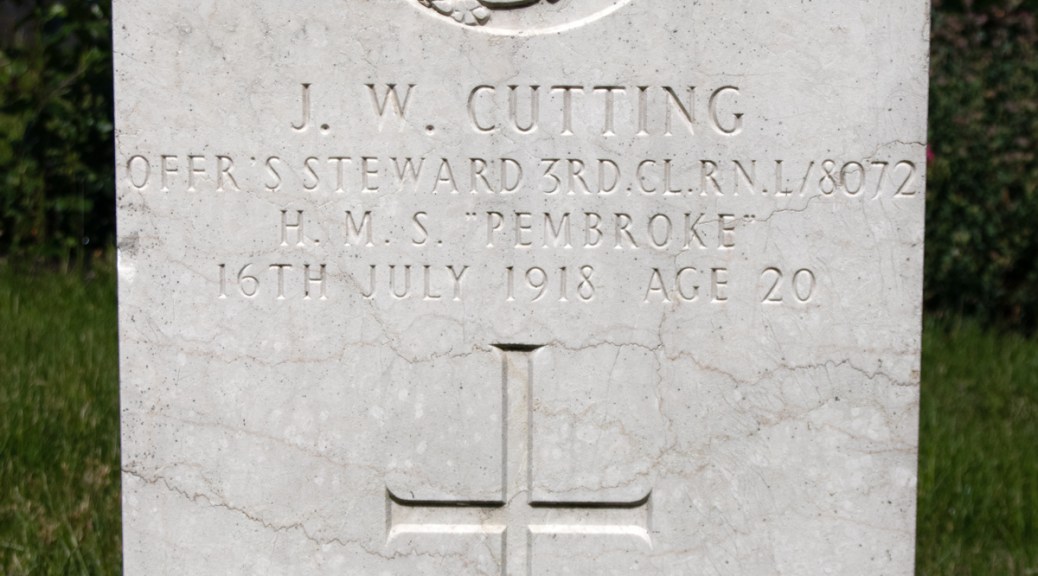
Joseph William Cutting was born on 10th September 1897 in Stratford, Essex. The middle of three children, his parents were Alfred and Clara. Alfred was a stoker in a carpenter’s workshop, but when he completed his schooling, his son found work as a clerk.

When war broke out, Joseph stepped up to play his part. He enlisted in the Royal Navy on 22nd September 1915, joining as an Officer’s Steward 3rd Class. His service records show that he was 5ft 8ins (1.72m) tall, with dark brown hair, blue eyes and a fresh complexion. He was also noted as having a scar in the middle of his forehead.

Officer’s Steward Cutting was based at HMS Pembroke, the Royal Naval Dockyard in Chatham, Kent, and would continue in his role for the next two and a half years. His annual review recorded a very good character, and moderate to satisfactory ability, which may be why he did not rise above his junior rank.

In the summer of 1918, Joseph was admitted to the Royal Naval Hospital in Chatham, suffering from tuberculosis. The lung condition was to prove his undoing, and he succumbed to it on 16th July 1918. He was just 20 years of age.

Joseph William Cutting was laid to rest in the naval section of Woodlands Cemetery in Gillingham, Kent, not far from the base he had called home for so long.


Officer’s Steward Giovanni Teuma

Officer’s Steward Giovanni Teuma

Giovanni Teuma was born on 25th December 1878 in Valetta, Malta. There is little information about his early life, but documents confirm that his parents were Paulo and Vinza Teuma.

Most of the information about Giovanni comes from his service records. He enlisted in the Royal Navy on 13th February 1898 as a Domestic 3rd Class. He was noted as being 5ft 5ins (1.65m) tall, with brown eyes, black hair and a dark complexion.

Giovanni’s first posting was on the cruiser HMS Venus. He remained on board for more than three years, which would be his longest assignment. Over the next fifteen years, he would serve on another dozen vessels, returning to shore at HMS Victory and HMS Pembroke – the Royal Naval Dockyards in Portsmouth, Hampshire, and Chatham, Kent, respectively – in between voyages.

Giovanni continually attained a Very Good rating at his annual reviews, and rose through the ranks over the years. He was promoted to Domestic 2nd Class in March 1905 and Officer’s Steward 2nd Class in October 1907. At this point, however, his ranks started to vary, spending just over a year as Officer’s Cook 1st Class before returning to the rank of Officer’s Steward 2nd Class.

On 21st January 1914, Giovanni was stood down: he seems to have requested extended shore leave. He returned to action three months later, retaking his previous rank. On 11th August, just a few weeks after war was declared, he was assigned to the light cruiser HMS Arethusa, as Officer’s Steward 1st Class.

The Arethusa had been launched in the autumn of 1913, and was confirmed as the flotilla leader of the Harwich Force when was was declared. Within weeks of Officer Steward Teuma boarding her, she was involved in the Battle of Heligoland Bight. Severely damaged by two German cruisers, a number of the crew were killed and injured, and she had to be towed home.

When the Arethusa docked at HMS Pembroke, those who were injured were taken to the Royal Naval Hospital in Chatham. Officer’s Steward Teuma was one of those treated there but, sadly, his wounds were to prove too severe. He passed away on 29th August 1914, the day after the battle: he was 35 years of age.

Givoanni Teuma was laid to rest in Woodlands Cemetery, Gillingham, not far from the Kent naval base he had visited regularly.


Officer’s Steward Thomas Ounan

Officer’s Steward Thomas Ounan

Thomas Peter Ounan was born on 21st July 1894 in St Helier, Jersey. The oldest of three children, his parents were Thomas and Augustine Ounan. Thomas Sr was a groom from England, who had married his Jersey-born wife and settled on the island to raise their family.

There is, in fact, little documented information about young Thomas’ life. From his military service records, it would seem that he found employment as a steward when he left school. When war broke out, he was called upon to play his part and, on 10th June 1916, he enlisted in the Royal Navy as an Officer’s Steward 3rd Class.

Thomas was initially sent to HMS Victory – the Royal Naval Dockyard in Portsmouth, Hampshire – for training. After a month he was assigned to the steam ship HMS Lucia, spending the next few months on board. At this point, he became unwell, having contracted tuberculosis. and was admitted to hospital in Portsmouth for treatment.

On 30th August 1916, Officer’s Steward Ounan was medically discharge from naval duty due to the condition. He returned to Jersey, remaining in the family home for the next year.

Thomas’ condition was to get the better of him, though. He passed away from tuberculosis at home on 6th October 1917: he was 23 years of age.

Thomas Peter Ounan was laid to rest in the peaceful La Croix Cemetery in Grouville.


Officer’s Steward Sidney Gordon

Officer’s Steward Sidney Gordon

Hidden away above the busy A371 to the north of Axbridge, Somerset is an unassuming graveyard. Overgrown and haunting, with headstones lining the boundary of the copse, this is the cemetery for the former St Michael’s Sanatorium, now the St Michael’s Cheshire Home. In the middle of the plot, next to the central memorial, is a headstone dedicated to Sidney Gordon, notably buried somewhere else in the grounds.

Sidney Vincent Gordon was born in Upton Park, Essex, on 7th May 1897. There is little information about his early life, other than his mother’s name, May.

The 1911 census recorded Sidney as being an inmate at the Scattered Home for the West Ham Union, the workhouse that covered the area. At 13 years of age, he was one of the older of the thirteen students boarding in the home, which was overseen by Emma Caroline Simpson, the House Mother.

When Sidney completed his schooling, he managed to find employment as an undertaker’s boy. But he sought out bigger things and, on 8th June 1914, he enlisted in the Royal Navy. His service records note that he was 5ft 6ins (1.68m) tall, with brown hair, blue eyes and a fresh complexion.

Being under-age when he enlisted, Sidney was given the rank of Boy. He was first sent to HMS Pembroke, the Royal Naval Dockyard in Chatham, for training, and remained there for a couple of months. In August 1914, Boy Gordon was moved down the coast to HMS Actaeon, a torpedo school based in Sheerness, Kent.

After five months, he moved to HMS Wildfire, another part of the Sheerness base, and it was while there he turned 18, and could formally join the Royal Navy. He was given the rank of Officer’s Steward 3rd Class and remained at Wildfire until the end of 1915. After a short stint back in Chatham, Sidney was given a new posting on board the supply ship HMS Tyne, where he remained until the following May.

Officer’s Steward Gordon returned to HMS Pembroke once more, and was assigned to his final sea-going ship, the newly launched monitor, HMS Erebus. She was to be his home until June 1917, when, having become unwell, he was posted back to HMS Pembroke.

Sidney had contracted pulmonary tuberculosis, which led to him being invalided out of the Navy on 1st August 1917. At this point his trail goes cold once more, but it is likely that, by the start of 1919, his condition had led to his admission to St Michael’s.

When he died there, on 5th March 1919, Sidney was just 21 years old. Given his background, it seems probable that his mother, if she was still alive, would not have been able to afford for his remains to be brought back to Essex. Sidney Vincent Gordon was laid to rest in the sanatorium’s cemetery, in the foothills of the Mendips, finally at peace.


Officer’s Steward 3rd Class Harry Macklin

Officer’s Steward 3rd Class Harry Macklin

Harry Ernest Macklin was born in the Frome area of Somerset in the autumn of 1893. The oldest of four children, his parents were Henry and Elizabeth Macklin. Henry Sr was a groom who travelled with work, and by the time of the 1901 census, the family were living in East Adderbury, Oxfordshire, which is where the third of the four siblings, Evelyn, was born.

Harry Jr seems to have been known as Ernest, probably to avoid confusion with his father. When he left school, he found work as a page. The family had moved again by 1902, to Witham Friary, to the south east of Frome. Harry Sr was now working as a farm labourer, while Minnie, his and Elizabeth’s second child, was employed as a house maid. The two younger children – Evelyn and George – were both at school, while Elizabeth’s widowed father, also called George, was visiting his daughter and their family.

Ernest changed jobs, becoming a gardener – possibly a euphemistic way of saying he had followed his father into agricultural labouring – but when war was declared he found the need to play his part. On 15th February 1915 he joined the Royal Navy as an Officer’s Steward 3rd Class, possibly drawing on his experience as a page.

For some reason, Ernest’s service records give his date of birth as 18th October 1894: they also confirm he was 5th 7.5ins (1.71m) tall, had dark brown hair, brown eyes and a fresh complexion. They also note that he had a scar on his left thigh.

Officer’s Steward 3rd Class Macklin’s first posting was HMS Victory, the Royal Naval Dockyard in Portsmouth, Hampshire. This is where he received his training and, on 10th August 1915, he was given his first posting, on board the Chilean-built HMS Canada.

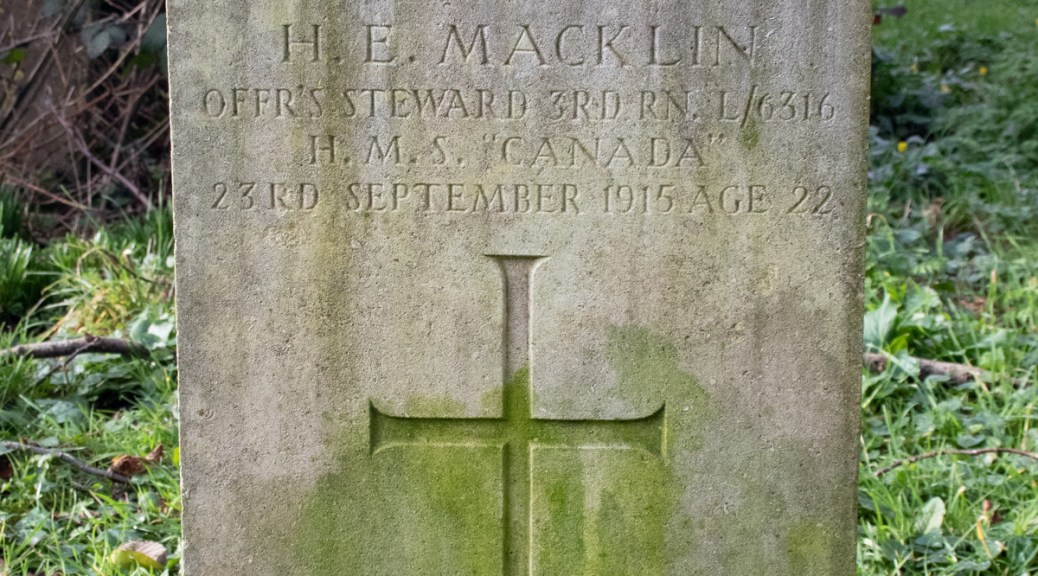
The ship sailed to Scapa Flow, following the North Sea Coast. When it reached Newcastle-upon-Tyne, however, Ernest was disembarked, and admitted to the Armstrong College Hospital, suffering from an ear infection. Tragically his condition turned septic, and he died of blood poisoning on 23rd September 1915, having served just 43 days at sea. Officer’s Steward 3rd Class Macklin was just 22 years of age.

Harry Ernest Macklin’s body was brought back to Somerset for burial. He was laid to rest in the quiet graveyard of St Mary’s Church in Witham Friary. “He was a promising young fellow, liked by all who knew him, and he was a member of the Witham Church Choir from boyhood.” [Somerset Standard : Friday 1st October 1915]


Officers’ Steward Peter Galea

Officers’ Steward Peter Galea

Peter Galea was born in the Maltese town of Senglea on 25th August 1893. His mother’s name was Carmela, but there is little further concrete information about his early life.

What is clear is that Peter found employment by enlisting in the Royal Navy. He joined up on 2nd January 1912 as an Officer’s Steward 3rd Class. His service records show that he was 5ft 9.5ins (1.66m) tall, had brown eyes, black hair and a dark complexion.

Officer’s Steward Galea’s first assignment was on board the dreadnought battleship HMS Orion. He was to spend more than three years on board, although his continuous service was interrupted by three days spent in the cells in May 1913: unfortunately his misdemeanour is not recorded.

In February 1914, Peter was transferred to the Apollo-class cruiser HMS Thetis. She was to be his home for the next year, during which time war was declared across Europe. In March 1915, Officer’s Steward Galea was assigned to another ship, the ocean liner Princess Irene.

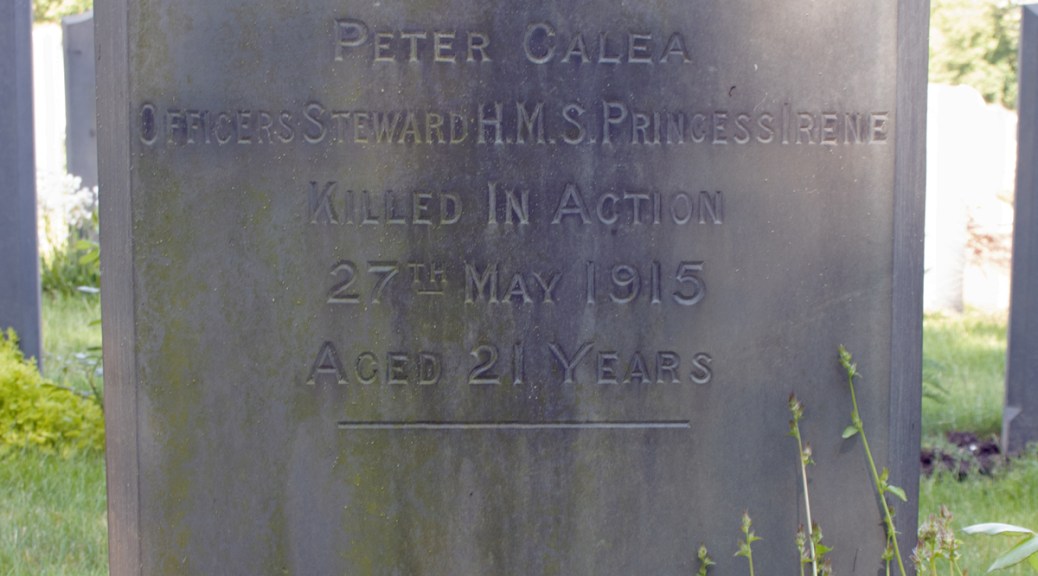
Tragically, Peter was on board when, on 27th May 1915, an explosion ripped through the ship, while moored off Sheerness, Kent and he was one of the 352 souls killed. He was just 21 years of age.

Peter Galea was laid to rest in the Woodlands Cemetery in Gillingham, Kent. His body having been identified, he was given his own grave, unlike those who were buried in a mass grave nearby.


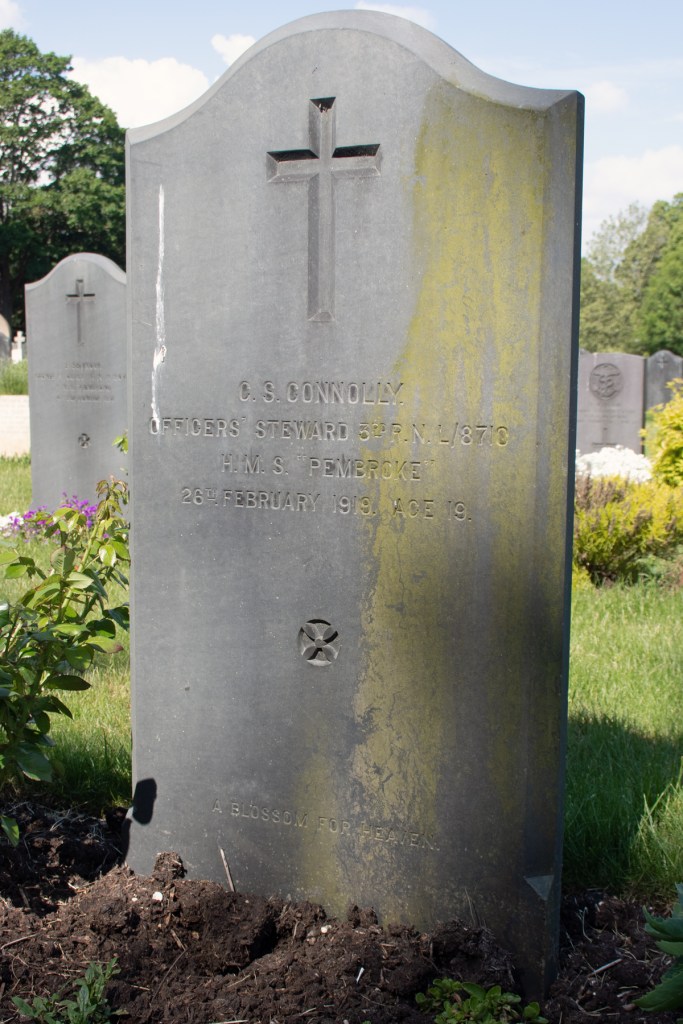
Officer’s Steward Gerald Connolly

Officer’s Steward Gerald Connolly

Gerald Sidney Connolly was born in the spring of 1899, one of eleven children to Thomas and Mary Connolly. Thomas was a retired soldier who had been born in Malta, while Mary had come from Portsmouth. The couple had lived in India for a while, but, by the time Gerald was born, had settled in Kildare, Ireland.

Retirement from the armed forces left Thomas needing to financially support his family, and so they made the move to London in 1910. According to the following year’s census, the family had settled in Manor Park, to the east of the city, where Thomas was working as a storekeeper for a local hostelry.

Military service was obviously in young Gerald’s blood and, in April 1916, he gave up work as an errand boy for a life in the Royal Navy. Initially taken on as a servant boy at HMS Pembroke and HMS President – the shore-based establishments in Chatham, Kent – he subsequently served on HMS Shannon, a cruiser that patrolled the North Sea for German warships.

It was while he was aboard the Shannon that Gerald came of age, and was given the rank of Officer’s Steward (3rd Class). During the next few years, he served short periods on five further vessels, before returning to HMS Pembroke in December 1918.

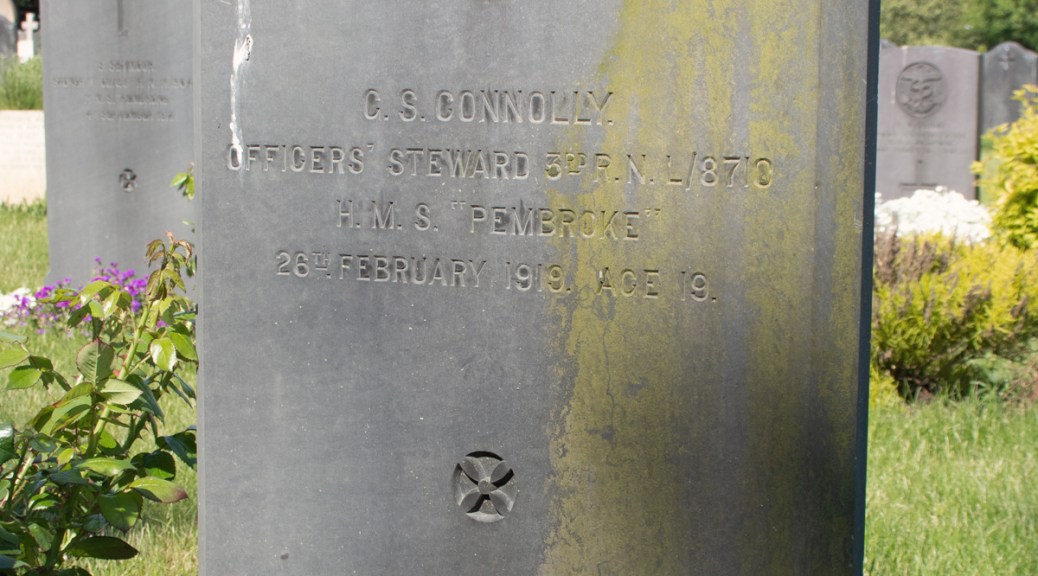
Officer’s Steward Connolly was still serving in Chatham two months later, and he kept himself active. It was while he was making use of the barracks’ swimming baths that an accident befell him. His service record confirmed that he was found drowned in the baths on 26th February 1919 and a subsequent inquest identified that no foul play was to blame. Gerald had ‘accidentally drowned whilst bathing’. He was just 19 years of age.

Gerald Sidney Connolly’s body was laid to rest in the Woodlands Cemetery in Gillingham, Kent, not far from the Naval Dockyard where he was based.


Officer’s Steward 2nd Class Frederick Shiplee

Steward 2nd Class Frederick Shiplee

Frederick John Shiplee was born on 15th November 1895 in the Essex town of Harwich. The oldest of eight children, his parents were Frederick and Matilda. Frederick Sr worked as a carter for the local railway, while his son found employment as a butcher’s errand boy when he left school.

In November 1913, having just turned 18, Frederick Jr enlisted in the Royal Navy as an Officer’s Steward, and spent three years training and serving on board HMS Ganges, the shore establishment at Shotley, near Ipswich.

From Suffolk, Frederick moved to Kent, and was based at the HMS Pembroke in Chatham. From here, he was involved in trips on HMS Spey, an old river gunboat that had been converted for use as a diving tender. It was during one of these trips that tragedy struck.

STORY OF A COLLISION IN THE THAMES

Mr CB Sewell resumed the inquest at Chatham, on Monday, on the 13 naval men who lost their lives after a collision between the London County Council steam hopper Belvedere and an old naval vessel in the Thames on March 7th [1917]…

The collision occurred shortly before four o’clock in the afternoon, the weather being bitterly cold and boisterous, and the sea extremely rough. The men, who had taken to a raft, were drifting about till 9pm before the raft was driven ashore. On the raft, when discovered, were a pile of dead men, who had been rendered unconscious by the cold and subsequently drowned through the raft being partly submerged. Lieutenant Humphreys, Royal Naval Reserve, and the other officers were all drowned. In all, 30 of the 37 members of the ship’s company lost their lived, and several bodies have not been recovered. Thirteen of the ship’s crew managed to get ashore at Sheerness in the cutter and three reached the shore at the Isle of Grain in the gig, while one was saved by the hopper.

Arthur George Chick, able seaman, said he was at the wheel of the naval vessel, which was steaming up river at six knots an hour to secure shelter from the weather. Lieutenant Humphreys and a warrant officer were on the bridge, and there were two look-out men. All were now missing. He saw the hopper coming down the river when she was two miles away. When the vessels were nearing each other, the hopper suddenly altered her course to starboard. The witness then altered his course to port by his officer’s orders, but the hopper crashed into his ship, stroking it a glancing blow in line with the forepart of the bridge on the starboard side. The ship sank in three minutes.

Alfred Rawlings, leading signalman, stated that the hopper changed her course when almost abreast of the naval vessel. The hopper’s alteration of course was, he considered, the cause of the collision.

Henry Davies, second officer, and Joseph Beard Hasdell, master of the hopper, gave evidence that they considered the collision was caused through the naval vessel’s error of judgment in starboarding, instead of going to port. The hopper, they stated, ported its helm in accordance with the ‘rule of the road’.

South Eastern Gazette: Tuesday 27th March 1917

While not mentioned in the newspaper report for security reasons, the ‘old naval vessel’ was, in fact HMS Spey. Annoyingly, I can trace no further report of the inquest, other than the conclusion that the deaths were due to drowning following a collision at sea.

Officer’s Steward Shiplee was one of the twenty men who died that day. He was just 21 years of age.

Frederick John Shiplee’s body was laid to rest in the Woodlands Cemetery in Gillingham, not far from the Naval Dockyard in Chatham, where he had been based.