Occasionally I have found that some people are destined to remain hidden. No matter how much research you try and do, details stay lost, and the name on a gravestone will remain just that.
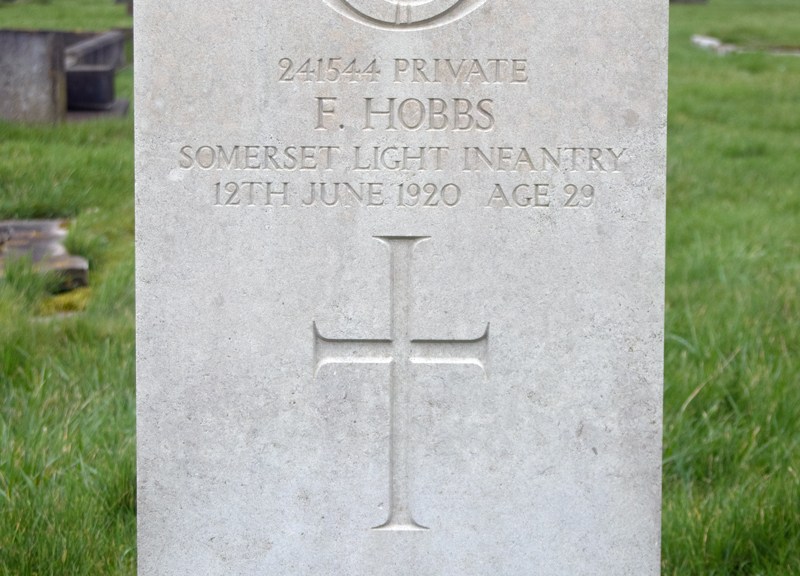
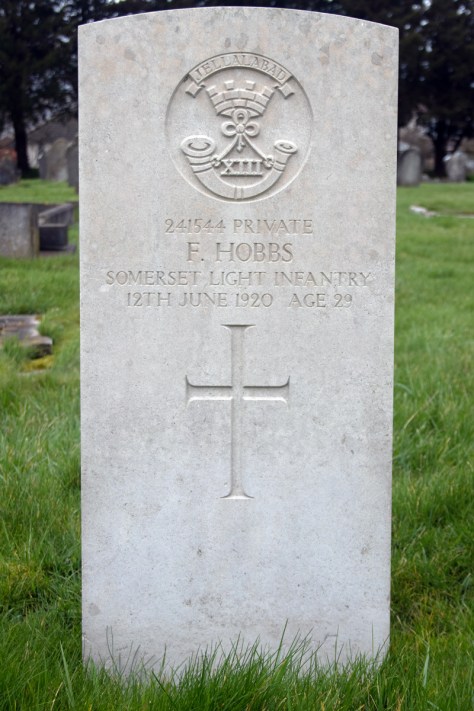
Private Fred Hobbs is one of those people.
He was born in around 1891; he enlisted in the 1st/5th Battalion of the Somerset Light Infantry. Private Hobbs’ service records are not available, but he was awarded the Victory and British Medals for his actions.
His pension record gives Mrs Ellen Louisa Hobbs as his next of kin; there is no confirmation of whether this was his mother or his wife – research has uncovered nothing to identify either.
Private Hobbs does not appear in the contemporary media – this would seem to suggest nothing out of the ordinary about his passing.
All we know for certain is that Fred Hobbs passed away on 12th June 1920, aged 29 years old. He lies at rest in St John’s Cemetery in Bridgwater, Somerset.
Walter Henry Taylor is one of those people whose details are difficult to track down. From his pension card, he is recorded as having been married to a woman called Lilla Rhoda, and that they had a daughter, Joan Valeria, who was born in April 1916.
Walter’s war grave confirms that he was a Private in the Essex Regiment; his pension records also support this, showing that he was assigned to the 6th Battalion, then the 10th Battalion. The two troops were positioned in different locations during the conflict – the 6th fought the Turkish, including involvement at Gallipoli, while the 10th was based on the Western Front.
An article in the local newspaper – the Taunton Courier and Western Advertiser – reported his death, confirming that he passed at the War Hospital in Preston, Northampton. He had been in service for more than a year, having previously been employed by Redwood & Sons in Taunton. The newspaper went on to report that Private Taylor had been suffering from ill health and had been hospitalised in both France and England.
The name is a fairly common one, and my usual resource, Ancestry, wasn’t bringing up anything concrete around him. There are no definitive birth or marriage records and the censuses I have been able to locate do not convince me that they relate to the name on the gravestone.
There is a Walter Harry Taylor, who was born in Bridgwater in 1883, one of ten children to Henry John Taylor and his wife Emma; Henry was a sailmaker, while Walter went into boot making.
The 1911 census picks up this Walter in St Pancras, London, where he was working as a boot trade shop assistant, while boarding with a dressmaker called Minnie Adelaide Lloyd.
While these seem likely candidates for Walter, there is nothing to definitively connect the documents to the man being researched. What potentially sways it, is that Redwood & Sons (Walter’s pre-service employer) were a boot and shoe dealer.
Sadly, the only other definitive documentation of Walter’s life is that he passed away on 14th July 1918, from a kidney sarcoma. He was 35 years old.
Walter Henry (Harry) Taylor lies at rest in the St John’s Cemetery in his presumed home town of Bridgwater, Somerset.
Frederick Hobbs was born in December 1886, the fourth of ten children to William and Martha Hobbs, from Bridgwater in Somerset. William was a mason, and all of his children seemed to be good with their hands. Frederick went on to become a plumber’s apprentice, while his siblings worked as a mason, a dressmaker and a carpenter.
The 1911 census found him living in Polden Street, Bridgwater with his mother and youngest sibling, Florrie. William, however, was living round the corner in Bath Road, with three of his other children, Clara, Tom and George. Both of Frederick’s parents are listed as married, which adds to the confusion of them being in separate houses.
Frederick enlisted with weeks of was being declared; he joined the 10th (Service) Battalion of the Devonshire Regiment and, after a year on home soil, his troop was shipped to France. This wasn’t the end of the Private Hobbs’ journey, however as, within a couple of months, he journeyed on as part of the Mediterranean Expeditionary Force, finally arriving in Salonica, Greece, in November 1915.
Private Hobbs has only been serving for a month when he was admitted to the Hospital Ship Asturias in Alexandria, with lacerations to his cheeks and eyelids. The initial report seemed to suggest the wounds were as a result of gunshot, although a more detailed report later confirmed that the injuries were caused by barbed wire.
While in hospital, Frederick’s urine was found to include a high level of sugar. He also confirmed having lost a lot of weight in recent months, but could not confirm when this had begun. He was diagnosed with diabetes, and was evacuated back to England for treatment for both his injuries and his illness.
The damage to his left eye healed, but he was left with significant ptosis, or drooping of the eyelid. When it came to his diabetes, specialists back in England determined that, while it could not be put down to Private Hobbs’ service, it had definitely been aggravated by it. He was deemed no longer fit for military service and furloughed in June 1916, with a follow-up report confirming this three months later.
Sadly, whether Frederick’s life returned to normal is not recorded. It seems likely, however, that the diabetes got the better of him, and he passed away on 25th November 1916, aged just 29 years old.
Frederick Hobbs lies at rest in St John’s Cemetery in his home town of Bridgwater, Somerset.
Frederick’s younger brother Herbert Hobbs also fought in the Great War. He enrolled in the Royal Marines Light Infantry and fought on the Western Front. Caught up in the Battle of Gavrelle Windmill, he was one of 335 Royal Marines to be killed in that skirmish. He lies buried at the Arras Memorial in Northern France.
Wilfred Allen Gillson was born in 1888, the fourth of nine children – and one of eight boys – to George and Emma Gillson. George was a coachbuilder from Cornwall; Emma, whose maiden name was Allen, came from Derbyshire. The family were living in Torquay by the time Wilfred was born.
In 1895, George had moved the family to Bridgwater in Somerset, presumably as railway works had dried up in the coastal Devon town. By this time his oldest son, also called George, was working as a compositor, keying text for a printer. Wilfred was still at school, but his other two older siblings – William and Albert – were both working with their father, working on railway coaches.
Wilfred was also to follow in his father’s employment, and the 1911 census found him living in Bristol, boarding with the Cridland family, earning his keep a a carriage painter.
He joined up within weeks of war breaking out, enlisting in the Worcestershire Regiment on 20th September 1914. Private Gillson readily proved his worth, and was promoted to Lance Corporal after three months, and Corporal within a year of enlisting.
Corporal Gillson’s promotion coincided with his shipment abroad, and he served on the Western Front for eight months. Returning to England in March 1916, he subsequently transferred to the Devonshire Regiment, before being moved to the 4th Reserve Battalion in the spring of 1917.
Things were not right for Wilfred; he was reprimanded for neglecting his post on the night of the 26th May that year, before being medically discharged with neurasthenia in August.
The root of the matter is detailed in his discharge report; he was hospitalised at Neuve Chapelle in February 1916, suffering from shellshock, and it seems that he never really fully recovered.
Sadly, at this point Wilfred’s trail goes cold. He passed away on 10th November 1918, aged 30 years old.
Wilfred Allen Gillson lies at rest in St John’s Cemetery in Bridgwater, Somerset.
There are a couple of additional notes to Wilfred’s life.
During the war, Wilfred’s youngest brother, Thomas, fought with the Oxfordshire & Buckinghamshire Light Infantry. He was involved in the fighting in France, but died from wounds on 10th June 1918. He was just 18 years old, and is buried at Aire-sur-la-Lys, not far from Boulogne.
Given that Wilfred was one of eight brothers, all of whom would have been of fighting age during the war, it is lucky – although still a tragedy – that only he and Thomas died as a result of the conflict.
Sadly, Wilfred’s mother, Emma, passed away in the autumn of 1914, at 57 years of age. It might be a blessing, however, that she was not alive to see two of her sons suffer so.
Ernest James Wood was born in 1891, one of ten children to Alfred and Charlotte Wood. Alfred was a carpenter and machinist for a timber merchant, and, by the time of Ernest’s birth the family lived in Bridgwater, Somerset.
When hostilities broke out, Ernest was quick to enlist. He joined the Royal Army Service Corps in September 1914. Driver Wood was assigned to the Horse Transport Depot Company at Park Royal in London, and there is a note of him being injured on 29th July 1916. Sadly, little else of his military service remains.
In January 1916, Ernest married Hilda Williams. She was the same age as her new husband, and was the daughter of Thomas and Elizabeth, who were also from Bridgwater.
The trail of Driver Wood goes a little cold after that. He was demobbed om 6th January 1919 and on the release form declared that he was not medically unfit as a result of his military service.
Frustratingly, the trail goes totally cold at that point. All we know for certain is that Ernest died on 2nd March 1919, two months after leaving the army. There a no records confirming a cause of death but, as he does not appear in any contemporary newspapers, it is likely that the cause was not unusual; perhaps one of the respiratory conditions going around at the time, such as influenza or pneumonia. Whatever the cause, Ernest was just 28 years old when he died (his headstone is based on an incorrect date of birth).
Ernest James Wood lies at peace in the St John’s Cemetery in his home town of Bridgwater, in Somerset.
Arthur Henry “Harry” Frampton was born in 1882, the oldest of six children to Henry and Alice. Henry Sr worked as a clerk and cashier in a shoe factory in Bridgwater, while Harry and his brothers also initially followed that line of work.
In the autumn of 1908, Harry married Emma Jane Lee, who was originally from Crediton in Devon. The couple went on to have two children, Rose and John, and, by the time of the next census, the family were living in a small house in the middle of Bridgwater. Harry, by this time, was working as a general labourer.
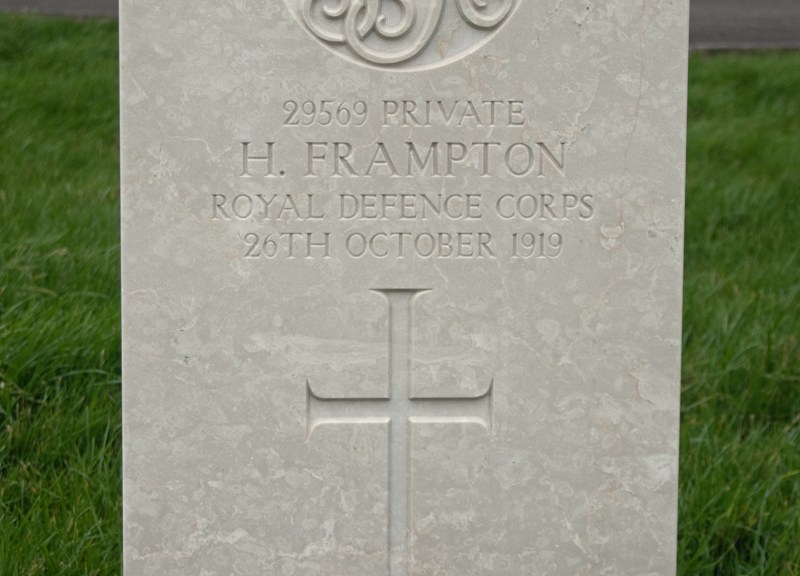
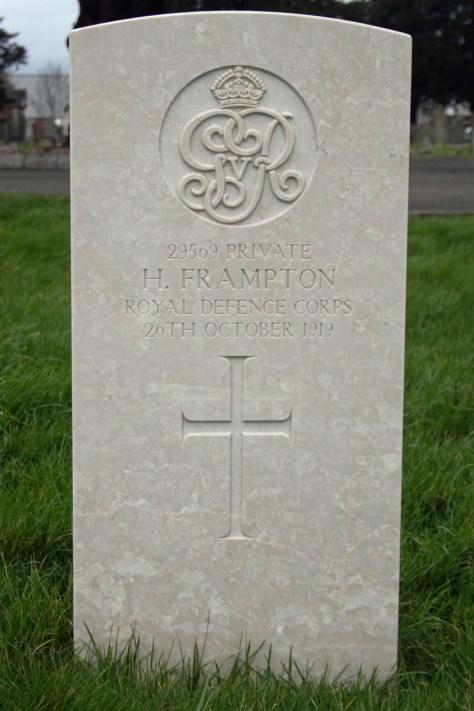
War broke out, and Harry was quick to enlist. Initially assigned to the Somerset Light Infantry in December 1914, Private Frampton was transferred to the Royal Defence Corps after two years’ service.
He was part of the army’s territorial force, and it seems likely that his transfer to the RDC may have been on medical grounds. He had been admitted to Castlemount Military Hospital (in Dover) a couple of times, suffering from “rheumatism and debility”.
Private Frampton’s later medical report stated that he was a frail man, with an accentuated heartbeat, which gave rise to fainting. He had no appetite and suffered from insomnia, and, according to the report, was “quite unfit to perform the duties of a soldier”.
Ultimately, this led to Harry being medically discharged from the army, and he was demobbed on 10th March 1917, after just over two years’ service.
Little is known about Harry after his discharge form the army. His pension record confirms that he passed away on 26th October 1919, having suffered from dyspepsia (indigestion) and debility. He was 37 years old.
Harry Frampton lies at rest in the St John’s Cemetery in his home town of Bridgwater, Somerset.
The early life of Charles Willcox is a bit of a mystery. From fragments of information, we can determine that he was born in 1893 and had a brother called Edmund and a sister called Beatrice. His mother was a Mrs S Willcox, who, by the early 1920s was living in Johannesburg, South Africa.
Piecing together the tiny pieces of information online, it seems likely, therefore, that his parents were Frank and Sarah Willcox. Frank was a cabinet maker and upholsterer, he and Sarah were from Bridgwater in Somerset, and they had eleven children.
By 1895, Frank had moved the family from Somerset to Cardiff; Charles was the last of the siblings to be born in England. The family did eventually move to South Africa – alongside Sarah, both Beatrice and Edmund lived and died there in their later years.
Back to Charles and, once the Great War started, he was quick to enlist. He joined the Somerset Light Infantry in August 1914, and had a narrow escape in October of that year. The Bridgwater Mercury reported that he was in the trenches and had had a near miss when his backpack was hit by a shell.
Corporal Willcox was wounded at Ypres in November, when a piece of shrapnel hit him in the shoulder, went through the lung and had to be cut out of the centre of his back. He was expected to make a full recovery within a year. Charles was also awarded the Distinguished Conduct Medal for his actions in the battle.
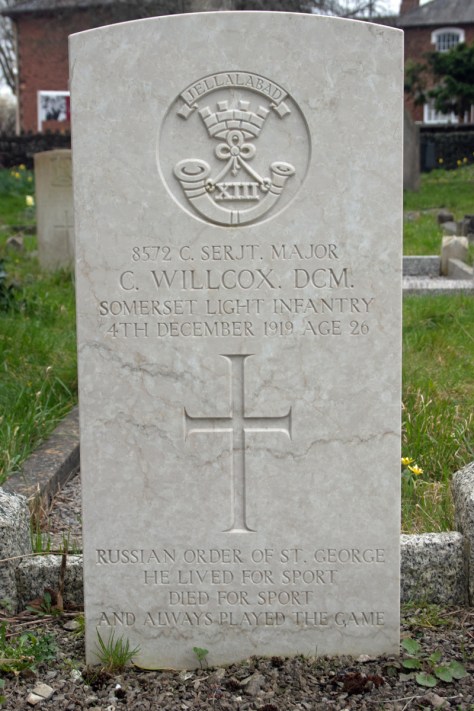
In September 1915, Sergeant Willcox received another award; the Russian Cross & Order of St George; the BridgwaterMercury noted that Charles was the first man from the town to be awarded both this and the DCM. The town’s mayor also subsequently presented him with a gold watch and chain on behalf of the town.
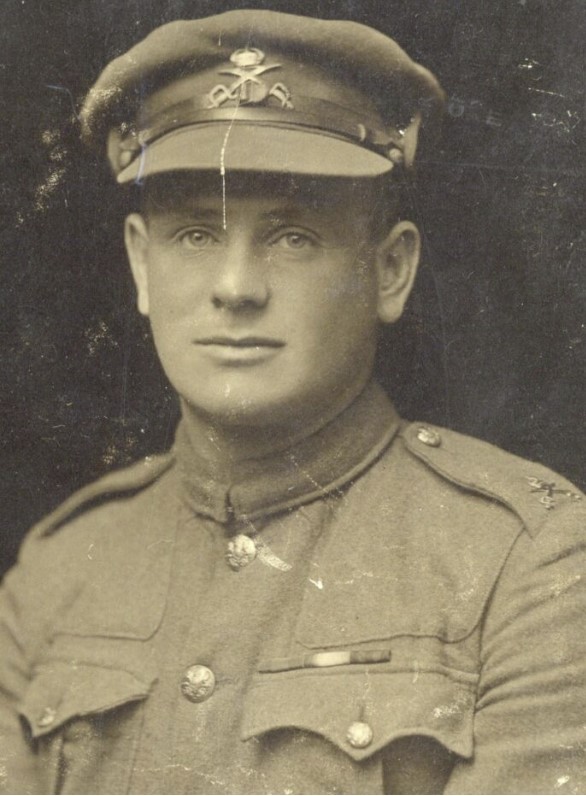
Promotion continued for Charles, and, by 1917, he had been elevated to Company Sergeant Major. He was heavily involved in recruitment for the Somerset Light Infantry, and it is likely that, standing at a strapping 6ft 4ins (1.93m) tall and weighing in at 17st (107kg), he would have been the perfect advert for the battalion.
When the war came to a close, things quietened down for him. A keen sportsman – he played rugby for Somerset – he had been a gym instructor in the army, and had taken up boxing around 1912. He entered a novices’ boxing competition in Southampton in December 1919, and found himself up against Seaman Merrilees, from the HMS Hearty.
In the fight, Charles received a body blow and a blow to the jaw, he fell to the floor, landed awkwardly and was knocked out. Attended to by doctors in the sports club, he was sent to Charing Cross Hospital when he did not regain consciousness after a couple of hours.
At the hospital, bruising was reported to Charles’ eye and cheek, but no skull fracture was found. They operated on him, two pieces of bone were removed, and a large clot on the left-hand side of his brain discovered. Sadly, the operation did no good, and Charles died that afternoon, the 4th December 1919. He was just 26 years old.
His death was recorded as concussion and a cerebral haemorrhage, attributed to the fall he had had in the ring. An inquest was held, although one report suggests a verdict of accidental death, while another states excusable homicide by misadventure.
Charles Willcox lies at rest in the Wembdon Road Cemetery in his home town of Bridgwater in Somerset. His gravestone remembers that he lived for sport, died for sport and always played the game.
Serjeant Major Charles Willcox (from wembdonroadcemetery.com)
Robert Roberts was born in Liverpool in November 1887 the youngest of two children to Robert and Alice Roberts.
The New World beckoned for the Roberts family, and they set sail for Canada when Robert Jr was just 4 years old. The family settled in the city of Regina, Saskatchewan.
Little is recorded about Robert Jr until October 1911, when he married a Quebecois woman called Edna Webber. The young couple went on to have two children, a daughter, One, and a son, George.
In April 1916, he enlisted in the Canadian Expeditionary Force. His trade was noted as a Lumberman, and his record notes that Robert had already served as part of the 95th Saskatchewan Rifles.
Joining the 224th Battalion, Robert was shipped to England in May 1916. He transferred to the Canadian Forestry Corps in November, reaching the rank of Staff Sergeant, and was assigned to the company’s Base Depot in Sunningdale, near Windsor.
When the war ended, demobilisation was still a way off for a lot of soldiers, particularly those from the Commonwealth. Robert was transferred to Stirling, and was appointed Quartermaster Sergeant (responsible for supplies and stores) for 121st Company.
On 28th January 1919, Robert was admitted to the Royal Infirmary in Stirling with influenza and double pneumonia. Sadly, he passed away just over a week later, breathing his last on 6th February 1919. He was 33 years old.
Robert Roberts lies at peace in the Wembdon Road Cemetery in Bridgwater, Somerset.
There is no evident connection between Robert and Bridgwater, so why this was chosen as his place of rest is a mystery. It is likely that there was some sort of family connection, but that cannot be definitely established.
Albert George Bellringer was born in April 1889, the youngest of three children to Charles and Sarah. Charles was a sawyer in a local timber yard, and his son followed suit.
Little detail of Albert’s early life remains, but he married Elizabeth Burge in December 1909, and the couple went on to have three children – Albert Jr, Cecil and Charles.
Albert enlisted when war appeared inevitable, joining the Somerset Light Infantry in June 1914. When his training was complete, his troop – the 2nd Battalion – were shipped off to India, and this is where Private Bellringer spent the majority of the war.
Distance from home and family made some soldiers act in ways they otherwise wouldn’t. On 15th August 1917, Albert was admitted to hospital with a venereal sore. He was then admitted to the Dinapore (now Danapur) Station Hospital on 2nd December 1917, “in a very excited condition. He was childish, silly and had grandiose delusions”.
Things were not going well for Private Bellringer’s health. He was transferred back to England for treatment on the Hospital Ship Wandilla – this was torpedoed on the journey home, although the device failed to explode. While on board, he was seen to be “exalted in his ideas, and to have physical signs of GPI [General Paresis (or Paralysis) of the Insane]”.
The ship arrived back in England on 25th April, and Albert was admitted to the Royal Victoria Hospital in Netley, Hampshire. The medical report again showed that “he was foolish, demented and [that] the physical signs of GPI were marked.”
Moved to Dykebar Hospital in Paisley – a mental health institution – for specialist attention, Private Bellringer was eventually discharged from the army. Medical grounds were the reason for his dismissal, and his last day of service was 5th July 1918.
Sadly, however, Albert’s health faltered; he was transferred again, this time to the Somerset and Bath Asylum in Somerset, and it was there that he passed away. Albert George Bellringer died on 5th December 1918; he was 30 years old.
Albert lies at rest in the Wembdon Road Cemetery in his home town of Bridgwater.
So, what was the cause of Albert’s illness and death? His initial hospital admission identified a venereal sore, and, based on his subsequent decline, it is likely that this was syphilis. One of the last symptoms of the disease is mental illness – insanity – and so this underlines the probably diagnosis.
However, mental illness only usually appears on average 10 to 30 years after the STI is first contracted, and then only if it is not treated (which, given that this would have been Victorian England, is it likely not to have been).
What this suggests, therefore, is that Albert contracted syphilis before the war, probably before his marriage to Elizabeth, and he may not have been unfaithful while serving in India.
Roland Roberts was born in September 1896, one of three children – all boys – to Albert and Minnie Roberts.
Minnie, who was originally from Yeovil, had married Walter Shury, a Londoner, in 1874, and the couple had six children together. Walter then went on to have four children with Alice Norwood, and the couple married in 1898. Minnie, meanwhile, had met Albert Roberts, who was from Dundalk in Ireland, and, while no marriage seems to be confirmed, the couple had three boys, including Roland. (It is pure speculation, but as Minnie’s maiden was also Roberts, this might have provided a good enough cover for any divorce or re-marriage.)
Albert had been a Band Sergeant in the 4th Hussars, and continued that passion by becoming a music teacher Travel was also definitely in his blood: the couple’s first child, Willie, was born in South London, Roland was born in Somerset, and his younger sibling, Glencoe, was born in Penzance, Cornwall. Albert’s musical success led him to become bandmaster for the Penzance Town Band. Sadly, it was not all positive for him; in 1901, Minnie passed away, and in the same year, Willie also died, at the tender age of six.
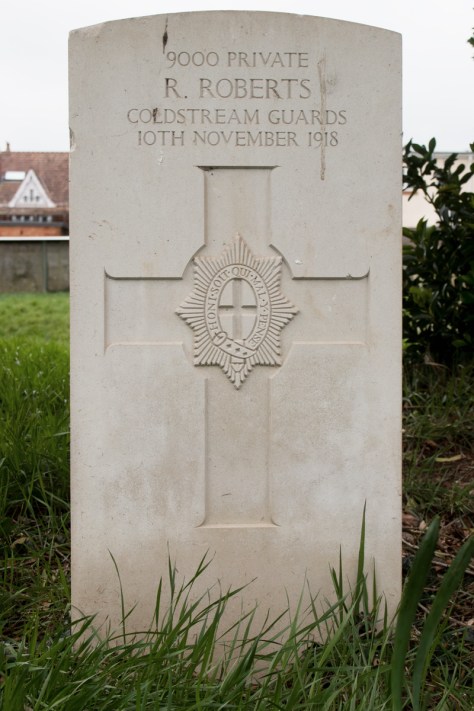
It was the military that drew Roland in, and, in 1910, aged just 14 years old, he enlisted in the Coldstream Guards. According to the following year’s census, he was stationed at the Ramillies Barracks in Aldershot, and held the rank of Boy.
Differing from the naval rank of the same name, lads of 14 or over could serve in any regiment as musicians, drummers, tailors, shoemakers, artificers or clerks, and all were ranked as boys. It seems likely, therefore, that his father’s enthusiasm for music served him well.
When war broke out, he was of fighting age, and, as part of the “Old Contemptibles”, he was involved in the Battle of Mons, the first major confrontation for the British Expeditionary Force.
During the war, Private Roberts took part in some of the most severe fighting on the Western Front, was wounded three times, as well as being gassed. He was also recommended for the DCM for gallantry in action.
He transferred to the Labour Corps, and spent time doing land work in Somerset. It was here that Roland met and married Gladys Pyne, whose family was from Bridgwater, and the couple tied the knot in March 1918.
Sadly, it was during this war service that Private Roberts contracted influenza and pneumonia and he passed away as his in-laws’ home on 10th November 1918, the day before the Armistice was signed. He was just 22 years old.
The local newspaper reported on Roland’s continued gallantry in its article on his funeral:
[Roland] held the medal of the Royal Humane Society for saving a woman’s life.
He was also the hero of an incident that occurred in Bridgwater a few weeks ago, when he succeeded in checking the career of an infuriated bull through pluckily catching the animal by its horns.
His disposition was always most cheerful, and although suffering from his [war] wounds a good deal, he never complained.
The Cornishman: Wednesday 27th November 1918
Roland Roberts lies at rest in the Wembdon Road Cemetery in his adopted home town of Bridgwater, Somerset.






 Death and Service