William Thomas Woodham was born at the end of 1877 in Peasedown St John, Somerset. One of four children, his parents were coal miner and pit worker William Thomas and his wife, Sarah. The young family quickly moved from Peasedown to nearby Radstock to set up home.
William Jr did not immediately follow his father to the mine: instead, when he left school, he found work as a cowherd for a local farm. By the time of the 1911 census, however, he was recorded as being a colliery stoker.
The following year, William married Matilda Gulliford. She was a local coal miner’s daughter: the couple went on to have three children, Gwendoline, Stanley and Irene.
In his spare time, William volunteered for the Somerset Light Infantry and, when war broke out, he was formally placed on reserve – mining was one of the reserved occupations. However, in June 1915, he transferred to the Royal Engineers, and was sent to the Military Barracks at Taunton for training.
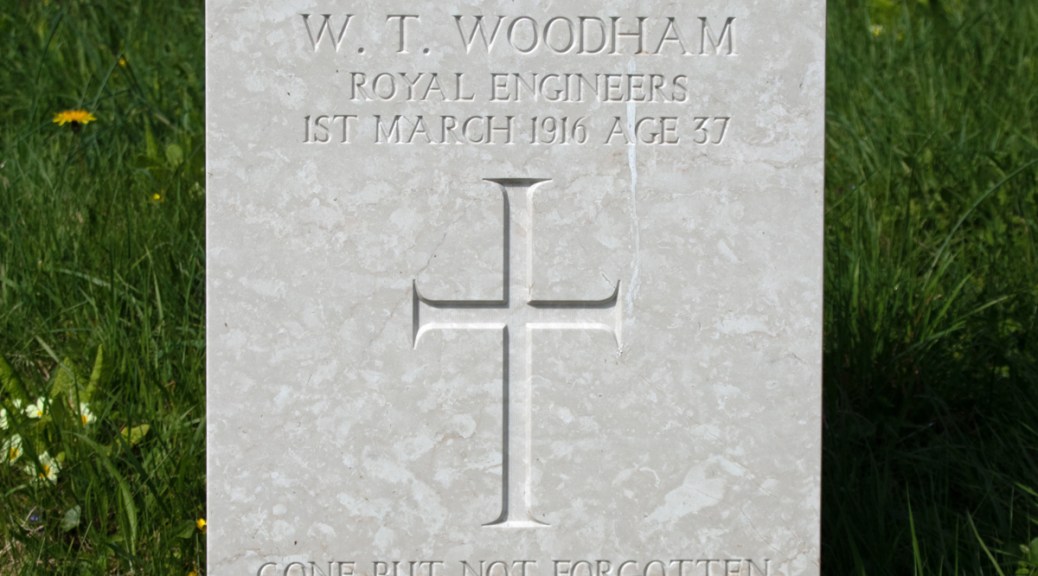
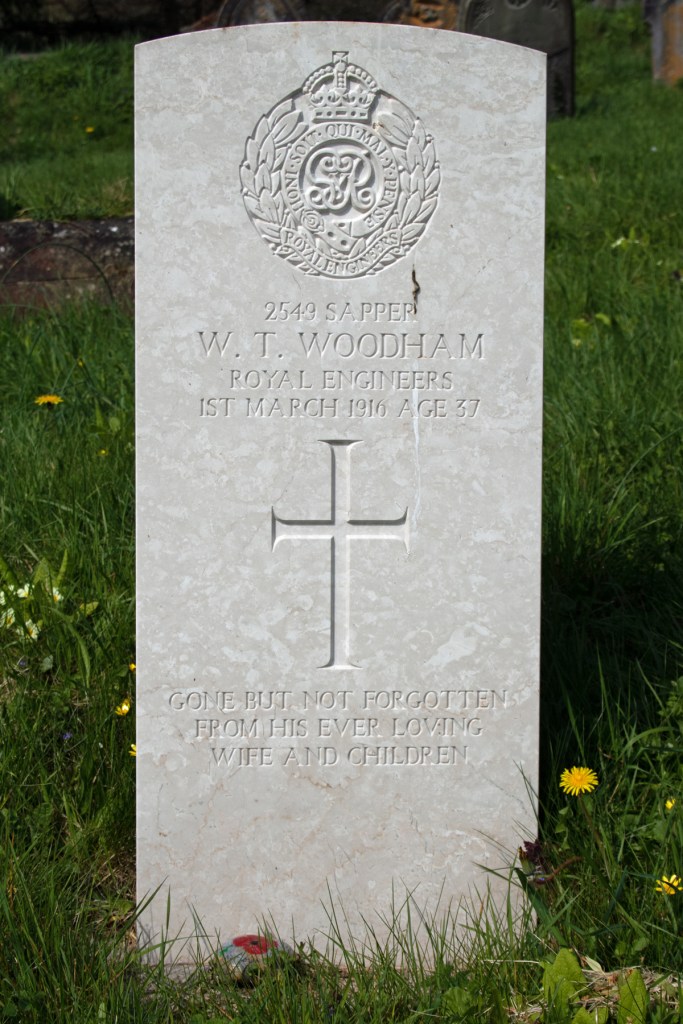
Sapper Woodham was due to be sent to France in the spring of 1916, but started feeling unwell. He was admitted to the Taunton Military Hospital, suffering from pneumonia on 20th February, but his condition worsened. He passed away at the hospital on 1st March 1916, aged 38 years old.
William Thomas Woodham’s body was brought back to Radstock; he was laid to rest in the graveyard of the town’s St Nicholas’ Church.
Sapper William Woodham (from britishnewspaperarchive.co.uk)
Ronald James Ewart Blackwell was born in London in February 1890, one of eight children to Frederick and Elizabeth Blackwell. Frederick was a tailor from Devon, while Elizabeth had been born in Somerset. By the time of the 1911 census, they had moved back to Somerset, settling in the village of Dunster.
Ronald followed in his father’s footsteps and, by the time war broke out, was living and working in Taunton. It’s clear that he wanted to play his part in the growing conflict, enlisting in the Royal Engineers in January 1915.
Sapper Blackwell’s service records confirm that he stood 5ft 6.5ins (1.69m) tall; they also note that he had the tattoo of a heart on his left forearm. His skill as a tailor is mentioned numerous times, and it appears that this talent was how his time was put to use. He was shipped to France on 25th January 1915, and, by the end of the conflict, he was in Italy. It was from here that he returned to England on 26th January 1919.
It seems that Ronald’s return to the UK was as a result of him becoming ill, as, within a month of coming home, he was medically discharged from the army, having been suffering from tuberculosis.
Ronald returned to Somerset, but was to be dogged by the lung disease for a further year. He passed away at home on 25th June 1920, aged just 30 years old.
Ronald James Ewart Blackwell was laid to rest in Dunster Cemetery, not far from his parents’ then home.
Ronald’s older brother, Harold Frederick Blackwell, also fought in the First World War. He was a Private in the 2nd Battalion of the Essex Regiment. He was killed during the Allied advance into Flanders in August 1918, and was laid to rest in the Terlincthun British Cemetery in Northern France.
William Henry Merrifield was born on 29th December 1893, in Newton Abbot, Devon. One of six children to Henry and Kezia Merrifield, his father was an agent for the removal company Pickford’s.
When William left school, he found work as a labourer for a local tannery. War was, by this time, on the horizon, and William soon found himself caught up in it. Full details of his military service are not available, but it is clear that he had a varied career.
William initially worked for the British Red Cross as a cook, and was sent to France in October 1914. He Subsequently joined the Royal Field Artillery as a Gunner, before transferring across to the Royal Garrison Artillery. By June 1915, he had made the move again, and was recorded as a Sapper in the Royal Engineers. During this time, he had been awarded the Victory and British Medals and the 1914 and 1915 Stars for his war efforts.
By this point, William had seen a fair amount of tragedy in his life. Kezia had died in 1905, at the age of 44, and his sister Evelyn had passed away in 1914, aged just 25 years old. The following year, Henry also died, aged 52 years of age.
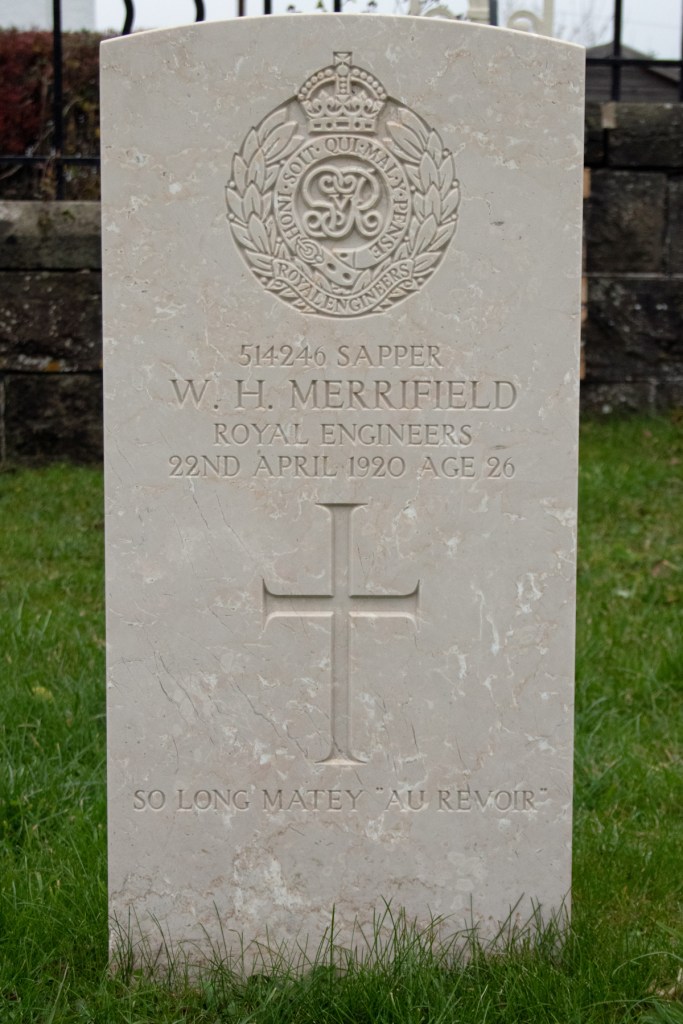
Sapper Merrifield survived the war and was demobbed in February 1919. At this point, his trail goes cold. He returned to Newton Abbot, and passed away just over a year later, on 22nd April 1920. He was 26 years old.
William Henry Merrifield was laid to rest in Newton Abbot Cemetery; his gravestone marked with the message ‘SO LONG MATEY “AU REVOIR”.
Herbert George Rendell was born in the summer of 1886, the oldest of six children to George and Catherine Rendell. George was a twine maker from West Coker, near Yeovil in Somerset, and it was in this village that he and Catherine raised their young family.
While he initially found work as a labourer when he left school, the lure of a better life and career proved too much for Herbert and, in June 1905, he enlisted in the Royal Engineers as a Sapper. He spent three years spent on home soil, working hard and earning a Good Conduct medal for his service. During his tour of duty, he contracted pneumonia, spending five weeks in hospital in Chatham, Kent, over Christmas 1905, but fully recovering.
In September 1908, Herbert was sent to Singapore for a three-year tour of duty with the 21st Company. His body was not accustomed to the different environment, and he was hospitalised three times for malaria and myalgia, as well as two bouts of gonorrhoea in 1908 and 1910.
In December 1911, Sapper Rendell returned home, where he served for a further three years before war broke out in the summer of 1914. Having been promoted to Lance Corporal, and after a short bout in hospital following a reaction to his cowpox vaccination, he was sent to Egypt.
Assigned to the 359th Water Company, he would have been charged with constructing and maintaining the supply pipes to and from the Front Line and for his work was soon promoted to Corporal.
In the spring of 1918, the now Sergeant Rendell was transferred to the 357th Water Company, and found himself in Palestine, where he stayed until the end of the war. He came home on leave in April 1919, and it was here that, once again, he contracted pneumonia.
Sadly, Sergeant Rendell was not to recover from the lung condition for a second time; he passed away at his parents’ home on 9th April 1919, at the age of 32 years old.
Herbert George Rendell was laid to rest in Yeovil Cemetery, not far from the village where he was born.
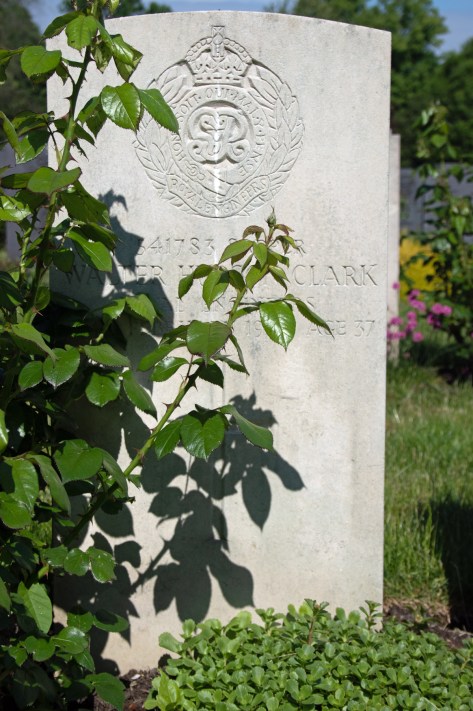
Walter Hudson Clark was born in 1883, the youngest of eight children to Thomas and Isabella Clark from Gillingham, Kent. Thomas was a miller who, with his wife, who was affectionately known as Sibella, raised their family in the centre of town.
When he left school, Walter found work as an apprentice to a painter and decorator. After Sibella died in 1903, he and two of his sisters remained living at home and, by the time of the 1911 census, he was supporting his father by working as a cooper in the nearby Naval Dockyard in Chatham.
Thomas passed away in December 1915, and this may have been the spur to guide his son into enlisting. Little documentation about Walter’s military service remains available although he joined the 480th Field Company of the Royal Engineers as a Sapper. He was in receipt of the Victory and British Medals, but there is nothing to confirm that he served abroad, so it seems likely that he was part of the territorial force.
Sadly this is where Sapper Clark’s trail goes cold. He survived the war, but died on 20th February 1920, at the age of 37 years old. There is no cause of death available either, but Walter was laid to rest in the Woodlands Cemetery in his home town of Gillingham, Kent.
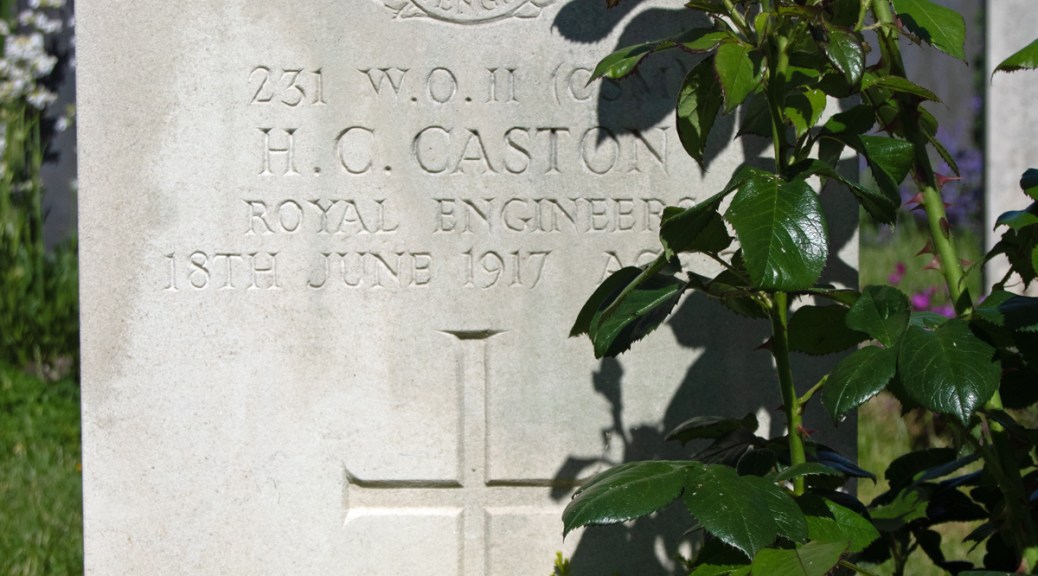
Hugh Charles Caston was born in Chelsea in the summer of 1881, the oldest of three children to Emily and Hugh Caston. Hugh Sr died in the late 1880, leaving Emily to raise the family on her own. She moved the family to Gillingham, Kent, to be near her family. She found work as a seamstress and took in boarders.
As the effective head of the family, Hugh obviously felt he had to earn a wage. On 1st August 1896, he enlisted in the Royal Engineers as a Bugler.
Hugh’s medical report shows he stood at 5ft 4.5ins (1.63m) tall and weighed 97lbs (44kg). He had a medium complexion, with brown eyes and brown hair. The report also gave his distinctive marks as being a scar on his forehead, a brown patch on his left buttock and that his eyebrows meet.
Initially too young for full active service, Hugh formally joined up on 1st June 1897. He spent more than five years on home soil, rising through the ranks from Sapper to Lance Corporal to 2nd Corporal. In May 1902, he was posted to Malta, returning home nearly two years later. Hugh’s promotions continued over the next decade, and, by the time war broke out, he had reached the rank of Company Sergeant Major.
By this point, Hugh had married, wedding Rochester woman Mary May Coast in September 1907. The couple went on to have two children, Hubert, who sadly died young, and Joan.
War came to Europe, and things took a turn for Company Sergeant Major Caston. He was admitted to Netley Hospital near Portsmouth, with mania:
Patient’s very restless, often gets ‘excited’ is thwarted in any way. Has a delusion that he is to be promoted to Major and that he possesses great wealth. He continually asks that his motor may be sent round to take him out, also that his tailor be sent for to rig him out. Stated this morning that he wished all the other patients be supplied with Egyptian cigarettes.
Medical Report on Hugh Caston, 20th January 1915
The medical officer went on to state that he did not consider that military service had in any contributed to the mania; he was dismissed from the army on medical grounds on 2nd February 1915, after nearly 20 years’ service.
Sadly, at this point Hugh’s trail goes cold. There is no documentation relating to his time after being discharged from the army and, tragically, after his death Mary was not granted a war pension, as he had served for less that six months during the First World War.
Hugh Charles Caston died on 18th June 1917, at the age of 36 years old. While the cause of his passing is lost to time, he was laid to rest in the Woodlands Cemetery in Gillingham, Kent.
George Palmer Carpenter was born in Worthing, West Sussex, in 1881, one of fourteen children to James and Elizabeth Carpenter. James ran the Steyne Hotel on the seafront, and sent his boys off to the Lucton Boarding School in Henfield for their education.
A regimented life seems to have suited George. When he left school, he enlisted in army, joining the Royal Engineers as a Sapper. The 1901 census found him billeted at the Elphinstone Barracks in Portsmouth.
Sadly, there is little further documentation on the life of Sapper Carpenter. He served through to and during the Great War, attaining the rank of Serjeant. He was sent to France in May 1915, though there is little to confirm his role there, or how long he stayed.
Serjeant Carpenter was subsequently attached to G Depot Company of the Royal Engineers, which received men returned from Expeditionary Force and also men enlisted for Tunnelling Companies, Special Companies and other specialist units. By this time – presumably later on in the conflict – he was based back in England, at the regiment’s barracks in Chatham, Kent.
When the war came to a close, George continued with his army career. With conflict in Europe coming end, he was shipped to Singapore in 1917, where he served through to 1920. A Sussex newspaper picked up his story from there:
Much sympathy will be extended to Mrs Carpenter and her family, of the Steyne Hotel, consequent upon the death of Sergeant George Carpenter, of the Royal Engineers, another of our Worthing boys whose life has been laid down in his country’s service. He arrived home in a bad state of health on the 25th of February last from Singapore, where he had been on duty for three years. Suffering from gastric influenza, it was found necessary that he should undergo an operation, which was carried out at midnight on Saturday. But he sank from weakness, and died at half-past eight on Sunday morning. This is the second son of whom Mrs Carpenter has been bereaved within a year, and there is pathos in the words addressed to us by her: “I have again the sorrowful task of sending the news of the death of one of my sons this morning.
Worthing Gazette: Wednesday 24th March 1920
George Palmer Carpenter was 39 years old. He was laid to rest in the Broadwater Cemetery of his home town, Worthing, in West Sussex.
The other brother referred to in the report was George’s younger brother Norman.
He had emigrated to Canada in 1906, but returned to Europe as part of the Canadian Expeditionary Force when war broke out. Wounded in battle in May 1917, he returned to the UK for treatment and recuperation, and remained on home soil for the rest of the war.
In the spring of 1919, he was admitted to hospital with pleurisy and anaemia, and seems that he never fully recovered, succumbing to the conditions in August of that year. He was just 32 years old.
Harold Mattick was born in the spring of 1895, the youngest of four children to Walter and Augusta. Walter was a harness maker and brought the family up in his home town of Weston-super-Mare, Somerset.
When he left school, Harold found work as a plumber. He seemed to had sought a life of adventure, however, and, in 1908, aged just 14, enlisted in the Wessex Division of the Royal Engineers as a Bugler. He served for five years, fulfilling his duties at the same time as carrying out his plumbing work.
When war broke out, Harold immediately re-enlisted. As a Sapper, he was assigned to the 1st/2nd (Wessex) Field Company. After initial training, he was sent to the front as part of the British Expeditionary Force just before Christmas in 1914.
Sapper Mattick was caught up in some of the fiercest fighting on the Wester Front, including the First and Second Battles of Ypres. On 30th September 1915, at Loos, he received a gunshot wound in his right leg, which fractured his tibia. The Germans were also using gas to attack the Allied front lines, which also affected Harold.
Medically evacuated to England for treatment on 9th October, his condition was such that he was discharged from the army on health grounds six months later, on 30th March 1916.
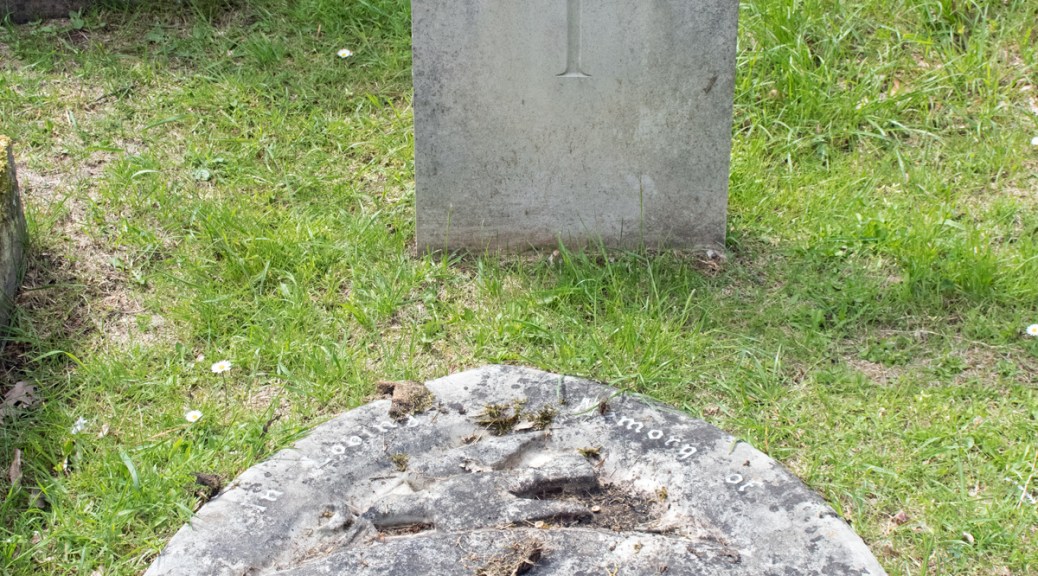
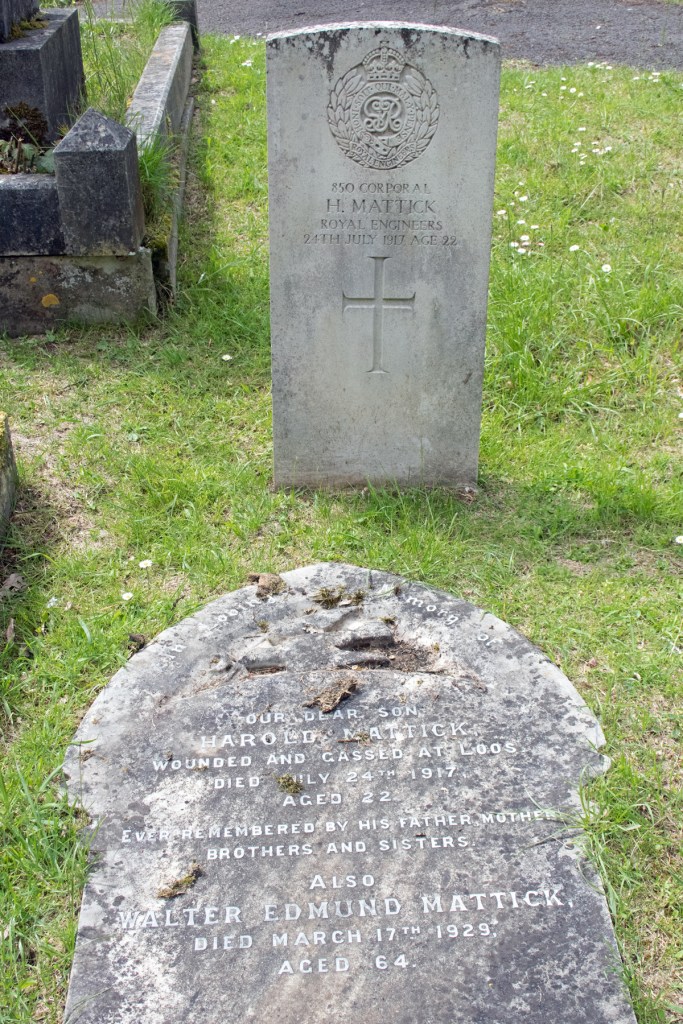
Sadly, while Harold’s leg healed, the injuries he sustained in the gas attack were too severe for him to recover from. He died at home from a lung condition on 24th July 1917, aged just 22 years old.
Harold Mattick was laid to rest in the Milton Cemetery of his home town, Weston-super-Mare.
James Frederick Hain was born on 5th November 1881 in the village of Holmer in Herefordshire. He was one of seven children to James and Catherine Hain, and was more commonly known as Fred. On James Jr’s birth certificate, his father was listed as a manure agent, although by the time of the 1891 census, the family had moved to London, where James Sr was now running a coffee house.
When he left school, James Jr started work as a French polisher, but he had a taste for adventure and joined the army. He served in South Africa during the Boer War campaign of 1899-1900, attaining the Cape Colony, Orange Free State and Transvaal Clasps.
In 1900 James returned home, finding work as a French polisher. The military life was in his blood by now, though, and in September, he re-enlisted. Initially joining the Royal Berkshire Regiment, he was soon transferred over to the Royal Engineers as a Sapper.
James had signed up for a period of eight years and, as part of his role as a wireman (maintaining and fitting telegraph cables), he was stationed abroad. On one particular trip, when his battalion was travelling from Plymouth to Limerick early in 1908, he was injured. According to the accident report: “owing to bad weather on boat between Fishguard and Waterford he was thrown violently forward, striking his head against a girder.” Treated in Limerick, “the disability is of a slight nature, and in all probability will not interfere with his future efficiency as a soldier.”
Sapper Hain’s time with the service was nearly up, and he was put on reserve status in November 1908. By 1911, he was working as a linesman, and boarding in a house in Hayle, Cornwall.
War was on the horizon by now, and on 5th August 1914, James was called back into service. He saw action on the Western Front, adding the Victory and British Medals and the 1915 Star to his count. In October 1915, he was treated for shell shock, and evacuated back to England.
At the beginning of 1917, Lance Corporal Hain was transferred back to the Army Reserve, suffering from neuritis. His health was to suffer for the rest of his life.
In September 1917, having settled in Cornwall, James married Beatrice Opie, an innkeeper’s daughter from the village of Wendron, Cornwall. The couple would go on to have a son, who they called Frederick, two years later.
Discharged from the Army, James put his engineering experience to good use, joining the General Post Office to work with telegraphs.
By this time, James’ medical condition had been formally diagnosed as General Paralysis of the Insane. A degenerative disease, similar to Alzheimer’s disease, it was associated with brisk reflexes and tremors (usually most obvious of the lips, tongue, and outstretched hands) and characterised by failing memory and general deterioration.
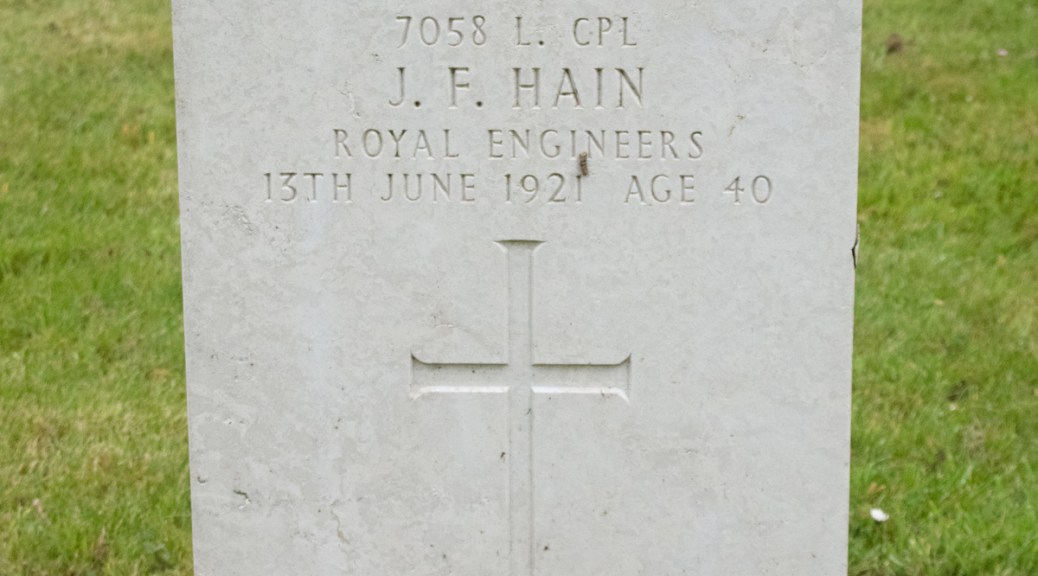
By August 1920, James was admitted to the Somerset and Bath Asylum in Cotford, because of his worsening condition. He was not to come out again, and passed away ten months later, on 13th June 1921. He was just 39 years old.
James Frederick Hain was buried in the St James’ Cemetery in Taunton, Somerset.
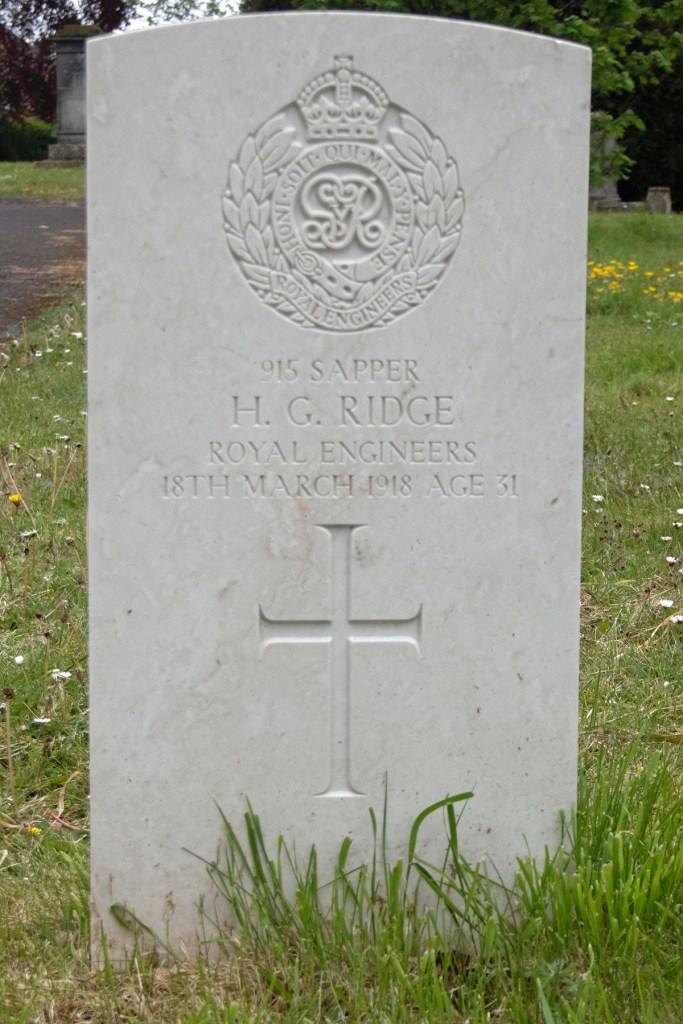
Herbert Gladstone Ridge was born in December 1886, the youngest of three children to Alfred and Sarah. Alfred was from Lancashire and had met and married his wife in Ireland, which is where Herbert’s older siblings had been born.
Sarah had died when Herbert was only eleven years old. Alfred’s skills were as a machine engineer, and, after his wife had passed away, he brought his family down to Somerset. Initially living with his father in Taunton, Herbert had found work as a piano tuner, and moved to a boarding house in Bristol to further his trade.
War was close, however, and, in July 1915, Herbert enlisted. Joining the Welsh Field Company of the Royal Engineers as a Sapper, he was quickly posted as part of the Mediterranean Expeditionary Force. He served nearly a year in Egypt, before being sent back to England in September 1916.
By this point, Sapper Ridge was suffering from a bout of tuberculosis, and had been sent back to England for treatment. The condition refused to clear up, however, and he was eventually discharged from the army on medical grounds three months after returning home.
Details of Herbert’s life after the army are sparse. It can be assumed, however, that he remained dogged by tuberculosis, and this is what eventually killed him. He passed away on 18th March 1918, aged just 31 years old.
Herbert Gladstone Ridge lies at rest in St Mary’s Cemetery in his adopted home town of Taunton in Somerset.









 Death and Service