Category Archives: Signalman

Chief Yeoman of Signals Charles Welling

Chief Yeoman of Signals Charles Welling

Charles James Welling was born on 23rd October 1860, and was the oldest of three children to Charles and Ann Welling. The Wellings were a military family, Charles Sr employed as a Serjeant Instructor of Musquetry in the Parkhurst Barracks on the Isle of Wight when his son was born.

Ann had been born in South Africa while her Irish parents were based out there. She and Charles Sr married in Farnham, Surrey, presumably where the families were based by that point.

Charles Jr’s mother died in 1863, just a month after giving birth to his youngest sibling. His father married again, to Sarah Ash, and by 1871, the Wellings were living in barracks at the School of Musketry in Hythe, Kent.

Being his father’s son, Charles Jr was set to make his own mark on the world and, on 21st January 1876, he joined the Royal Navy. Too young to formally enlist, he was given the rank of Boy 2nd Class, and sent off to HMS Impregnable, the shore base in Devonport, Devon, for his training.

Over the next eighteen months, Boy Welling learnt his trade, spending time at HMS Ganges – another shore base near Ipswich, Suffolk – and the sloop HMS Penguin. It was here that Charles came of age in 1878, and he officially joined the Royal Navy with the rank of Ordinary Seaman. His service papers show that he was just 4ft 10.5ins (1.49m) tall, with light brown hair, blue eyes and a fair complexion.

Ordinary Seaman Welling career was to take a turn in 1880, when he began training as a signaller. His initial contract with the navy was for ten years, and, by the time that came to an end in May 1889, he had served on eight ships in all, rising through the ranks from Signalman 3rd Class, to Signalman 2nd Class in August 1881 and Qualified Signalman seven years later.

When Charles’ term of service came to an end, he immediately renewed it, and with the new contract came a promotion to Leading Signalman. The next decade saw him travel the world, returning to HMS Pembroke, the Royal Naval Dockyard in Chatham, Kent, in between voyages. His commitment to the role paid off: in March 1894 he was promoted to 2nd Class Yeoman of Signals. Just eight months later he took the rank of Yeoman of Signals.

It was around this time that Charles married the love of his life, Harriet Carlaw. Born in London, the couple exchanged vows in St Pancras, Middlesex, on 13th January 1894 and had a son, also called Charles, the following year.

Charles’ naval career continued its upward trajectory, and on 1st March 1898, he was awarded the rank of Chief Yeoman of Signals. By this point HMS Pembroke had become his permanent base and, at the end of his contract in 1899, he was stood down to reserve status.

The 1901 census shows what may have been a downward step for the Wellings: it recorded the family living in rooms at 136 Bayham Street, Camden, Middlesex, where Charles was working as a messenger.

Opportunities come in the most unexpected of places, however, and the following census found them living at Pier House, Sunderland, Tyne and Wear, where Charles was employed as a lighthouse keeper.

By this point, Charles had been invalided out of the navy for medical reasons. The writing on his service papers is unclear, and his dismissal seems to have been as a result of disease of gestes, possibly the neurological disorder dystonia.

When war broke out in 1914, however, anyone with experience was called upon to play their part. Given his age at the time, it seems likely that Charles volunteered for service, reporting to HMS Pembroke on 2nd August 1914. He was given his old rank of Chief Yeoman of Signals, and remained at the naval base for the next two years.

Charles’ health was definitely suffering by this point, and he was admitted to the Royal Naval Hospital in Chatham, in September 1916. Suffering from the heart condition endocarditis, this would take his life. He passed away on 16th September, at the age of 55 years old.

With Harriet still living in Sunderland, Charles’ body was laid to rest in Woodlands Cemetery, Gillingham, Kent, not far from the base he had called home for so long.


Charles and Harriet’s son had also stepped up to play his part when war broke out. Enlisting in the Royal Engineers, Pioneer Welling soon found himself in the Middle East. While serving in Palestine, he contracted malaria, and passed away from the condition on 16th October 1918. Charles was just 23 years of age, and was laid to rest in Haifa War Cemetery.

It is tragic to note that Harriet had lost her husband and her son within two years.
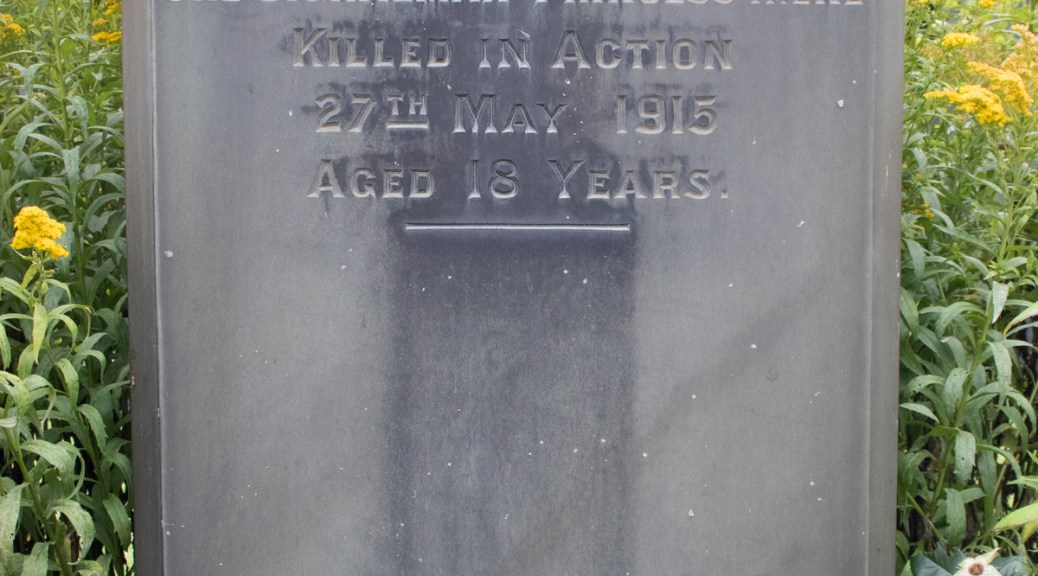

Ordinary Signalman Frederick Timms

Ordinary Signalman Frederick Timms

Frederick James Timms was born on 21st January 1897 in Watford, Hertfordshire. One of ten children – and the oldest surviving boy – his parents were Frederick and Rosina Timms. Frederick Sr was a farm labourer, but when his son completed his schooling, he found work with a blacksmith.

Frederick Jr wanted bigger and better things, however, and, on 18th April 1913, he enlisted in the Royal Navy, set on a life at sea. As he was below the age to be a full recruit, he was given the rank of Boy 2nd Class, and was sent to HMS Ganges, the navy’s training base on the outskirts of Ipswich, Suffolk, for his induction.

During his initial training, Boy Timms seems to have had some educational affinity. Seven months after enlisting, he was moved to the signal corps, and ranked as Signal Boy accordingly. In April 1914, a year after enlisting, he was transferred to HMS Victory, the Royal Naval Dockyard in Portsmouth, Hampshire, for posting. He was assigned to the battleship HMS Duncan, his first formal service at sea.

Over the next year, Frederick served on three further ships, coming of age on board the cruiser HMS Latona. Now formally inducted into to the Royal Navy, he was assigned the rank of Ordinary Signalman.

In March 1915, Frederick was transferred again, to HMS Princess Irene, an ocean liner built in 1914 for the Canadian Pacific Railway. With the outbreak of the war, she was requisitioned by the Royal Navy, and converted to a minelayer. In the spring of 1915, she was involved in laying a minefield to the north west of Heligoland, but spent much of her time in and around the Thames Estuary.

On the morning of 27th May 1915, Princess Irene was moored in the Medway Estuary and was being loaded with mines in preparation for a mission. At 11:14am, she exploded and disintegrated, taking two neighbouring barges with her. More than 250 crew – including Ordinary Signalman Timms – were killed. He was just 18 years of age.

Frederick James Timms body was laid to rest in the Woodlands Cemetery in Gillingham, Kent, alongside some of the other crew whose bodies had been rescued and identified.


Frederick’s death was the second tragedy to strike the Timms family in less than a fortnight. Back in Hertfordshire, Rosina had been pregnant with her eleventh child. On 16th May, she had had an internal haemorrhage, which resulted in the loss of both mother and child.


Leading Signalman Alexander Daisley

Leading Seaman Alexander Daisley

Alexander William Arthur Daisley was born on 13th November 1886, and was the second of four children to William and Judith Daisley. William was a Private in the Royal Marines and, as the time his son was born, the family were based in Dartmouth, Devon. By the time of the 1891 census, however, they had moved to Kent, and were billeted in family accommodation in the Milton Barracks, near Gravesend.

Ten years on, and the 1901 census confirms that the Daisleys had relocated again. William had left his military service behind him, and had taken up work as a publican at the Seven Stars Inn in Litlington, Cambridgeshire. Alexander is noticeable in his absence from the record, however. The following year, he surfaces again, however, and seems that he was destined to follow his father’s naval career.

On 10th April 1902, Alexander enlisted in the Royal Navy. At just 15 years of age, he was assigned the rank of Boy 2nd Class, and was sent to HMS St Vincent, a training ship based in Haslar, Hampshire, for his induction. He remained there for the next fifteen months, gaining promotion to Boy 1st Class in February 1903.

Alexander spent the second half of that year at HMS Victory, the Royal Naval Dockyard in Portsmouth, Hampshire, before being given his first posting in November. His assignment was on board the armoured cruiser HMS Good Hope: she was to become his home for the next year and a half, during which he came of age, and was formally inducted into the Royal Navy.

At this point, Alexander’s service records give an insight into the man he was becoming. He was noted as being just 5ft 1in (1.55m) tall, with hazel eyes and light brown hair. He had a fair complexion and three scars on the back of his head. It seems that he had some aptitude, as he was given the rank of Signalman, rather than being directed to the role of seaman.

Over the next twelve years – the term of his contract – Signalman Daisley would serve on eight ships: in between assignments he would return to his Portsmouth base. His time in the Royal Navy was not without incident, and he spent three separate periods in the cells – 14 days in 1907, 17 days in 1908 and 10 days in 1909. Despite this, he was promoted to the rank of Leading Seaman in January 1913, while serving on board HMS Egmont, an armoured frigate.

On 9th March 1915, Leading Signalman Daisley was assigned to HMS Princess Irene, an ocean liner that had been converted to a minelayer at the start of the war.

On 27th May 1915, while Irene was moored off Sheerness, Kent, a series of explosions ripped through the ship, killing more than 350 crew. Leading Signalman Daisley was among those who perished: he was 29 years of age.

The body of Alexander William Arthur Daisley was buried in Woodlands Cemetery, Gillingham, Kent, alongside the other victims of the disaster.


Signalman Philip Files

Signalman Philip Files

Phillip William Turner Files was born on 13th April 1894 in Walmer, Kent. One of eight children, his parents were George and Annie Files. George was a carpenter at a local colliery, but living so close to the sea, his son was inevitably drawn there. On 25th January 1910, Phillip gave up his life as an errand boy and joined the Royal Navy.

Phillip’s service records show that he was 5ft 4ins (1.62m) tall, with dark brown hair, blue eyes and a fresh complexion. He was just 15 years old when he enlisted, and, as he wasn’t of full age, he was given the rank of Boy 2nd Class. He was initially sent to HMS Ganges, the shore-based establishment in Suffolk for his initial training.

Phillip remained at HMS Ganges for the next year, and was promoted to Boy 1st Class on 5th September 1910. The following January he was moved to the Royal Naval Dockyard in Portsmouth, Hampshire, also known as HMS Victory.

Over the next year, with Victory as his base, Boy Files was sent to serve on three ships – the dreadnought battleship HMS Albermarle, and the cruisers HMS Sappho and HMS Philomel. While on board Philomel, Phillip came of age and, because of his technical abilities, was given the rank of Ordinary Signaller – changing to Signalman when the ranks were updated later in 1912.

Phillip remained on Philomel until October 1913 and, after a brief spell back in Portsmouth, he was transferred to the armoured cruiser, the converted RMS Laconia. She was to be Signalman Files’ base for the next year, when, on 9th March 1915, he was transferred again, this time to HMS Princess Irene.

Princess Irene was a converted liner, requisitioned as a minelayer when war broke out. On 27th May 1915, an explosion ripped through the ship, while moored off Sheerness, Kent. Signalman Files was one of the 352 souls killed. He was just 21 years of age.

Phillip William Turner Files was laid to rest in the Woodlands Cemetery in Gillingham, Kent. His body having been identified, he was given his own grave, unlike those who were buried in a mass grave nearby.


Signalman Files’ headstone spells his first name with one L. However, all the other documents relating to Phillip spell it with two.


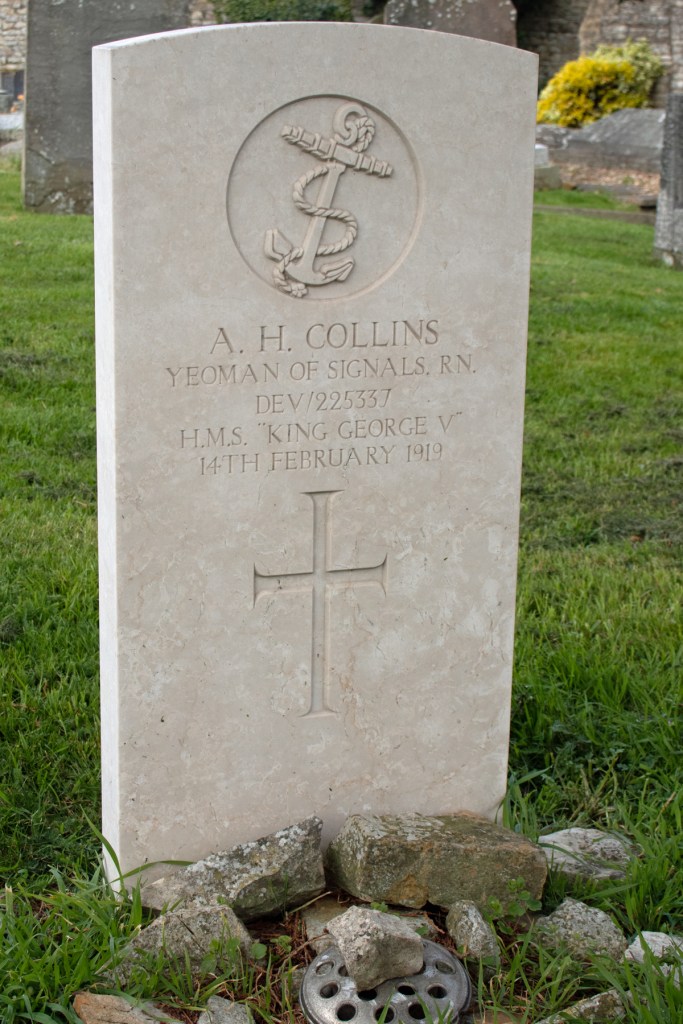
Yeoman of Signals Alfred Collins

Yeoman of Signals Alfred Collins

Alfred Henry Collins was born on 22nd August 1886, in the Gloucestershire village of Wotton-under-Edge. One of five children, his parents were cowman and farm labourer Samuel George Collins and his wife, Jane. Samuel’s work took the family south, and by the time of the 1901 census, the Collinses had settled in Whitchurch, near Bristol.

When Alfred finished his schooling, he also found employment labouring on a farm, but he was drawn to a more reliable career and a life at sea. On 9th March 1903, Alfred enlisted in the Royal Navy. His service records show the young man he was becoming. He was 5ft 4ins tall, with brown hair, brown eyes and a fresh complexion.

Alfred was still underage in the navy’s eyes, and so he was given the rank of Boy 2nd Class. He was assigned to HMS Northampton, a training ship, and must have shown some promise, as within three months he had been promoted.

In June 1903, Boy 1st Class Collins was assigned to HMS Victory, the Royal Naval Dockyard in Portsmouth, Hampshire, and his trajectory was still upwards. When he turned seventeen on 22nd August, Alfred was formally enrolled in the Royal Navy, and was given the rank of Ordinary Seaman. However, his training in Portsmouth continued, and by November he had become a Signalman.

In December 1903 he was posted to the cruiser HMS Isis and, over the next decade he served on ten different ships, returning to HMS Vivid, the Royal Naval Dockyard in Devonport, in between voyages. During this time he was promoted to Leading Signalman, and his annual reviews showed him as having a very good character and a superior ability.

With war now brewing across Europe, the role of the navy intensified. When conflict was declared, Leading Signalman Collins was serving on board the cruiser HMS Pomone and, after nine months back at HMS Vivid, possibly in a training role, Alfred was assigned to the newly-refitted battleship HMS Bellerophon, on board which he would serve for more than two years.

Bellerophon served at the Battle of Jutland, and remained patrolling the southern part of the North Sea for the rest of the war. In July 1917, Alfred was promoted again, to Yeoman of the Signals, and transferred to HMS King George. He remained in the North Sea, but his new ship was there to protect the convoys transporting good between the UK and Norway, so he was based in Scotland.

Yeoman of the Signals Collins survived the war, but in February 1919 he was admitted to the Royal Naval Hospital in Granton, near Edinburgh, suffering from pneumonia. Sadly, the condition was to get the better of him and he died on 14th February 1919, at the age of 32 years old. He had served for just short of sixteen years.

The body of Alfred Henry Collins was brought back to Somerset for burial. He was laid to rest in the graveyard of St Nicholas’ Church in Whitchurch.


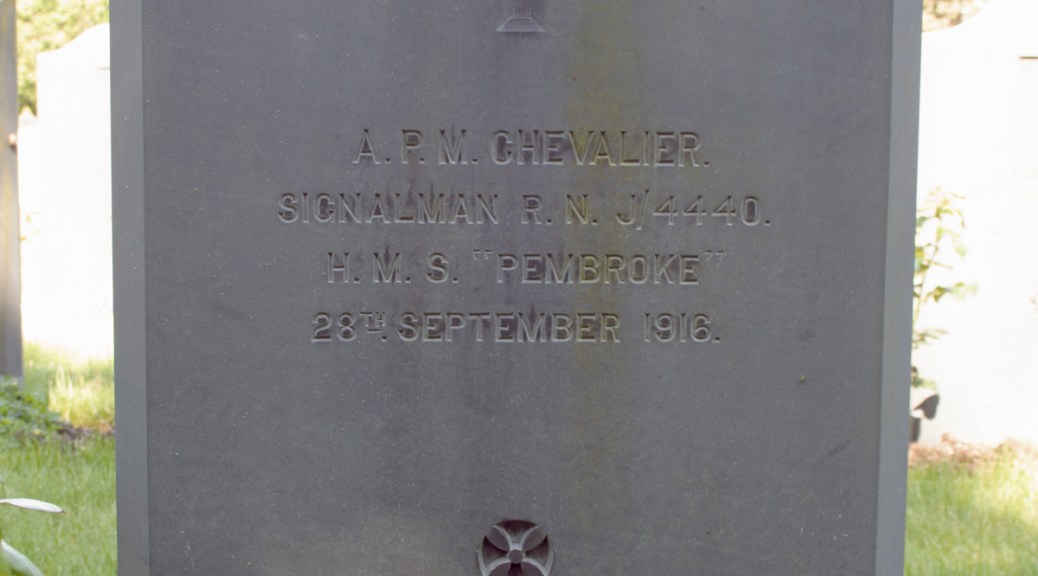
Signalman Albert Chevalier

Signalman Albert Chevalier

Albert Patrick Michael Chevalier was born in India on 16th June 1893. There is little definitive information about his early life, although his mother was called Georgina, and the family may have moved back to England when Albert was just a child.

When he left school, Albert found work as an errand boy in an office. But he wanted bigger and better things and, on 4th May 1909, aged just fifteen years old, he enlisted in the Royal Navy. Because of his age, he was given the rank of Boy 2nd Class, and for the first eighteen months, he was assigned to training bases – HMS Ganges and HMS Impregnable.

After only a few months, Albert was promoted to Boy 1st Class and, after a month at HMS Pembroke – the Royal Naval Dockyard in Chatham, Kent – he was given his first sea-going appointment on board the cruiser HMS Minerva.

Albert spent eighteen months on Minerva, during which time he came of age. He seems to have had an understanding of basic technology, as he was given the rank of Ordinary Signalman. After some more time in Chatham, Albert went to sea again, this time on board another cruiser, HMS Cressy. At the start of 1913 he was promoted again, and given the rank of full Signalman.

Signalman Chevalier went on to serve on a number of different vessels, primarily the battleship HMS Swiftsure, where he served for nearly three years, plying the waters between Britain and India. By the spring of 1916 he was back in Chatham, however, and it was here that things took a turn for the worse.

Albert was admitted to the Royal Naval Hospital in the town, suffering from pleurisy. Sadly, the condition was to get the better of him and he passed away the hospital on 28th September 1916, at the age of just 23 years of age.

Albert Patrick Michael Chevalier’s body was laid to rest in Woodlands Cemetery, Gillingham, not far from the dockyard from which he had made so many of his voyages.


Albert’s mother Georgina had not settled in England for long. The army pension record gives her as Albert’s beneficiary, but notes her address as Victoria Street, Daylesford, Victoria, Australia.


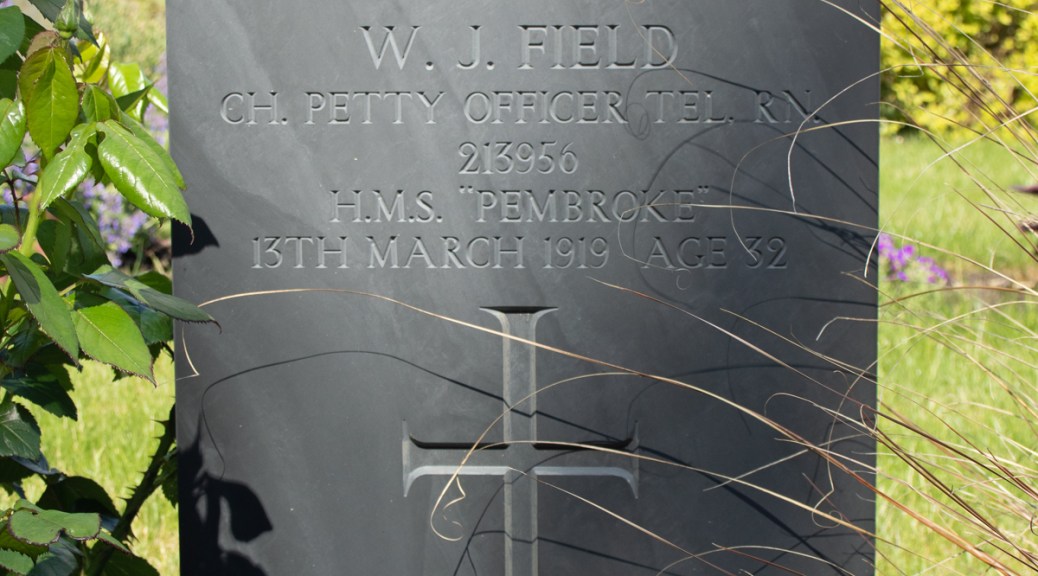
Chief Petty Officer Telegraphist William Field

Chief Petty Officer Telegraphist William Field

William John Field was born on 8th October 1885 in Boston, Lincolnshire. The eldest of four children, his parents were Charles and Ellen. Charles was a boatman for the coastguard; his job, by the time of the 1891 census, had taken the family to the village of Dawdon on the County Durham coastline.

Given his father’s job, it is not unsurprising that William was destined for a life at sea. As soon as he left school in the spring of 1901, he joined the Royal Navy and was sent to HMS Ganges, the shore-based training establishment in Suffolk. Being underage, he was initially assigned the role of Boy, moving, after a year, to HMS Pembroke, also known as the Naval Dockyard in Chatham, Kent.

By November 1902 Boy Field was moved to HMS Venerable, a ship that was to be his home for the next three years. During this time, William came of age, and was formally enrolled in the Royal Navy as a Signalman. He evidently worked hard on the Venerable, rising through the ranks to Qualified Signalman and Leading Signalman.

In June 1905, William was moved to HMS Leviathan, where he was again promoted, to Second Yeoman of Signals, before again being assigned to Chatham Naval Dockyard six months later.

While based in Kent, William met Nelly Watt, the daughter of a labourer at the dockyard. The couple married in 1906, and went on to have four children.

Over the next few years, the now Petty Officer Telegraphist Field spent an almost equal amount of time at sea and on shore. War was coming and when his initial term of service came to an end in October 1915, he immediately renewed his contract through to the end of the hostilities.

All of William’s time was now spent on land, primarily at HMS Pembroke, but also at HMS Actaeon in Portsmouth, HMS Victory VI at Crystal Palace, London and HMS Bacchante in Aberdeen.

While Chief Petty Officer Telegraphist Field’s naval service records are quite detailed, his passing is anything but. The war over, he moved back to Chatham Dockyard in January 1919. At some point he was admitted to the Royal Naval Hospital in the town, and died from ‘disease’ on 13th March that year. He was just 33 years of age.

William John Field was laid to rest in the Woodlands Cemetery in nearby Gillingham.


A sad aside to the story is that, at the time of he husband’s death, Nellie was pregnant with the couple’s fourth child. John William Field was born on 16th October 1919, destined never to know his father.