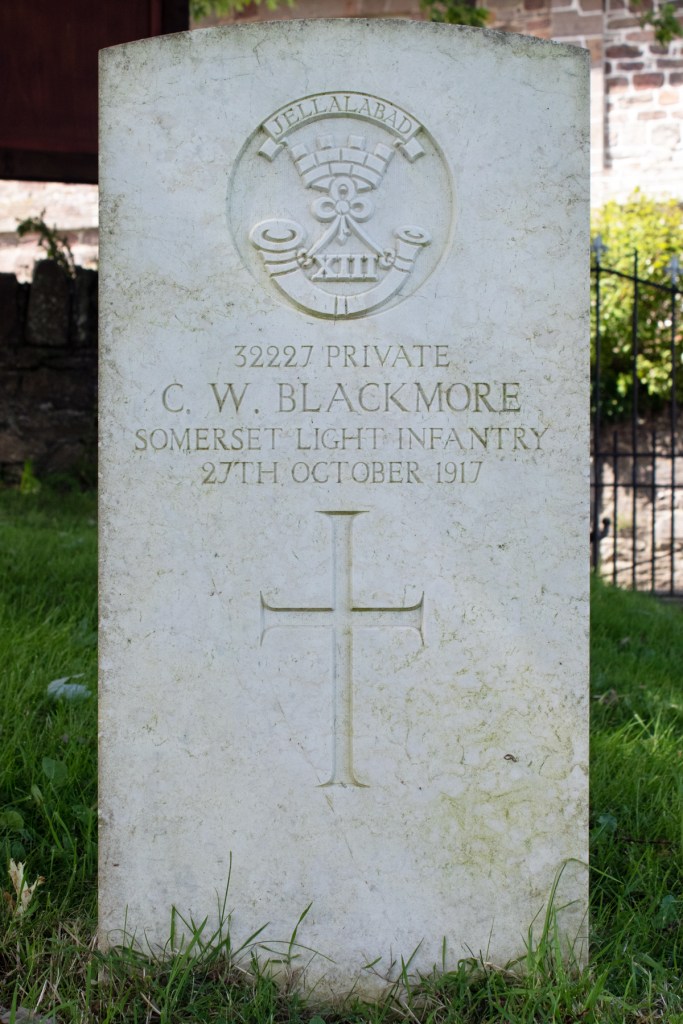
Charles William Blackmore was born in Brompton Regis (or Kingsbrompton), Somerset, on 19th August 1896. He was the twelfth of thirteen children to journeyman carpenter Joshua Blackmore and his wife, Margaret. Charles attended the nearby Upton Primary School until Christmas 1909 at which point he started working with his father.
When war erupted across Europe, however, he stepped up to play his part. He enlisted as a Private in the Somerset Light Infantry on 14th January 1916. Little remains of his service documents, but his medical report confirms that he was 5ft 9ins (1.75m) tall, with light brown hair and grey eyes. Interestingly, the document also gives his date of birth as 14th February 1897, six months later than his school intake record.
The documents that remain for Private Blackmore’s time in the army, do not specify exactly where he served, but his battalion – the 1st – were heavily involved in the Battle of the Somme in 1916, and at Arras the following year.
It was during that summer that Charles fell ill, contracting tuberculosis. He was medically evacuated to Britain for treatment, and admitted to the Toxteth Park Auxiliary Military Hospital in Liverpool. The former workhouse was to be where Charles breathed his last: he died on 27th October 1917, at the age of 21 years old.
The body of Charles William Blackmore was brought back to Somerset for burial. He was laid to rest in the peaceful and picturesque graveyard of the Church of the Blessed Virgin Mary in his home village, Brompton Regis.
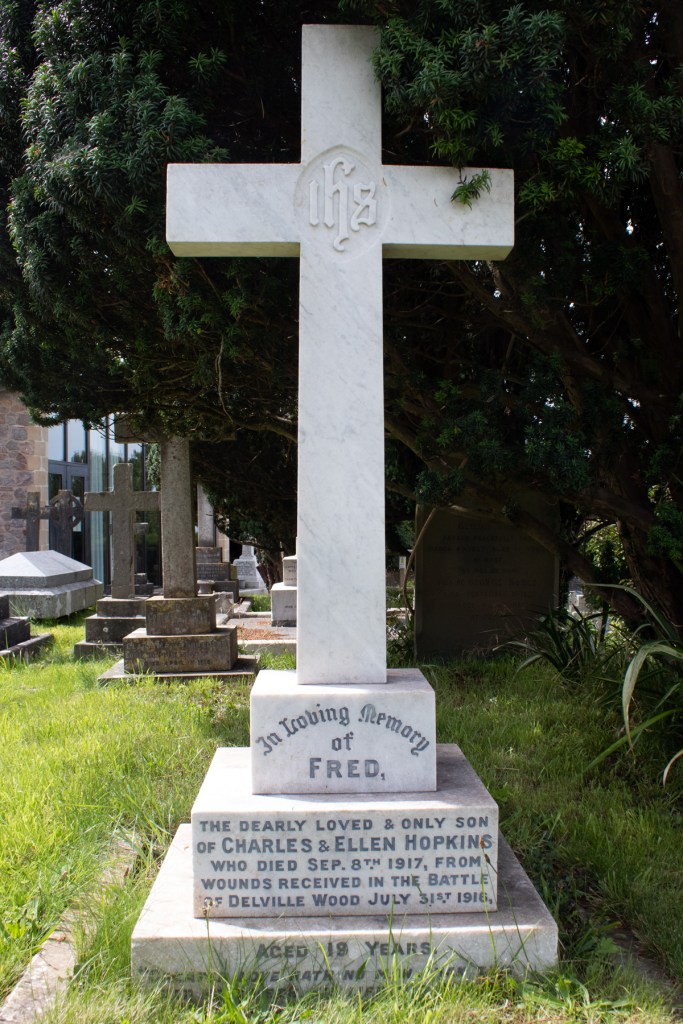
Frederick Charles Hopkins was born in the spring of 1898 in the sleepy Somerset village of Hinton Charterhouse. The younger of two children, his parents were Charles and Ellen Hopkins. Charles was a gardener who, not long after the 1911 census, moved the family west, to the village of Backwell.
When Frederick finished his schooling, he found work as a porter. When war broke out, however, he was keen to play his part, and enlisted at the end of December 1914. His service records note that he was 5ft 4ins (1.63m) tall, and that his apparent age was 19 years and one month. This highlights Frederick’s keenness to fight, as he was actually over two years younger than this at the time he signed the paperwork.
Private Hopkins was attached to the Gloucestershire Regiment, and assigned to the 12th (Service) Battalion. After his initial training on Salisbury, his troop was sent to the Western Front on 21st November 1915.
Frederick would have been involved in a number of the key skirmishes at the Somme, in July 1916, including at Albert and Bazentin. An epitaph on his gravestone suggests that he was injured at Delville Wood, although while his battalion was not actually involved in that specific battle, it is likely that he was injured at around the same time.
Wherever he was wounded, Private Hopkins was sent back to Britain. His service records suggest that he was transferred to the regimental depot but by July 1917, he was medically discharged from the army as being no longer fit for active service.
At this point, Frederick’s trail goes cold. He passed away on 8th September 1917, aged just 19 years old. He was buried in the peaceful St Andrew’s Churchyard in his adopted home village of Backwell.
Albert Edward Farvis Packer was born in Bristol, Gloucestershire, in 1890. The middle of three children, his parents were Francis and Eliza. Francis was a grocer, and when Albert finished his schooling, he worked as his father’s assistant.
Albert went on to work as a butcher’s manager for Messers. John Lewis and Sons in Midsomer Norton. By the time of the 1911 census, he was living in Batheaston with his parents and younger sister, Elsie. When war broke out, Albert stepped up to play his part, following in his older brother’s footsteps. He enlisted in Taunton on 9th December 1915: his service records showed that he was 5ft 10.5ins (1.79m) tall.
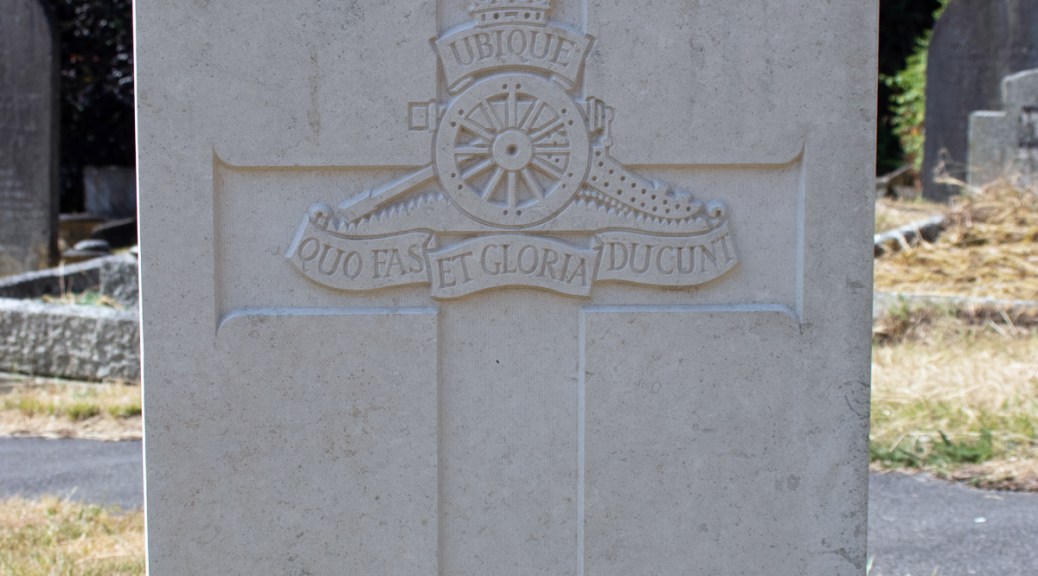
Gunner Packer was assigned to the Royal Garrison Artillery. Initially posted to a depot in Cornwall, he was soon assigned to the 173rd Siege Battery, and found himself in France by the beginning of October 1916. Albert remained overseas for the next fourteen months and, in March 1917, was appointed Acting Bombardier.
On 12th December 1917, Albert returned home on leave and, five days later, he married his sweetheart, stationery shop assistant Dorothy Flower, in St Paul’s Church, Bath. The couple made their way to Bristol, to stay with Dorothy’s parents, but Albert fell ill. He was admitted to the 2nd Southern General Hospital in Bristol, suffering from pleurisy and double pneumonia. The condition was to prove too much for his body, and he passed away, while still admitted, on 27th December 1917. He was just 27 years of age.
Albert Edward Farvis Packer was taken back to Bath for burial. He was laid to rest in the sweeping vista of the city’s Locksbrook Cemetery.
In less than a fortnight, Dorothy had become the blushing bride and a widow. She was to go on and find happiness, however. On 20th February 1920, she married Sapper Sidney Bethell, of the Royal Engineers. Their wedding was in Jamaica, where he was based, and the couple went on to have a daughter, Phyllis, the following year.
Sidney and Dorothy eventually settled in Hertfordshire. He died in 1953, at the age of 59: Dorothy passed the next 38 years as a widow again, passing away on 26th December 1991 – almost exactly 74 year after Albert – at the age of 93.
Albert’s older brother, Francis Packer, also fought and died in the First World War. His story can be found here.
Godfrey George Beames was born in the spring of 1891, in Henbury, Gloucestershire. One of eleven children, his parents were Thomas and Minnie Beames. Thomas was in the navy, which meant that Minnie was left to her own devices a lot of the time. While her husband came home often enough for them to build a large family, the 1891 and 1901 censuses record Minnie and the children living with her farm labourer brother-in-law, George Watkins.
The 1911 census gives the same information for Minnie and the children – living with George in Redwick, Gloucestershire. Minnie is, however, noted as a widow, although this seems to be out of convenience, as the now naval pensioner Thomas was living with his wife of eight years, Louisa, in Arundel, West Sussex.
Godfrey, now 21 years old, was working as a farm labourer. In the autumn of 1913, he married a woman called Lily Ball, although little information about her remains today. War was coming to Europe, and things were to change for the young couple.
Godfrey stepped up to play his part. While his full service records no longer exist, what remains paints a picture of his time in the army. He had enlisted by the spring of 1917, joining the Royal Engineers. At some point, however, he moved to the Worcestershire Regiment, and was assigned to the 10th (Service) Battalion.
While it’s not possible to determine exactly where Private Beames fought, he was definitely caught up in the fighting on the Western Front and, by October 1917, was entrenched at Passchendaele. It was here that he was wounded, and he was medically evacuated to Britain for treatment.
Private Beames was admitted to the General Hospital in Nottingham, but his injuries were to prove too severe. He died on 15th November 1917, at the age of just 26 years old.
Godfrey George Beames’ body was brought back to Somerset for burial. He was laid to rest in the graveyard of Ss Mary and Peter’s Church in Winford, where Lily was now living.
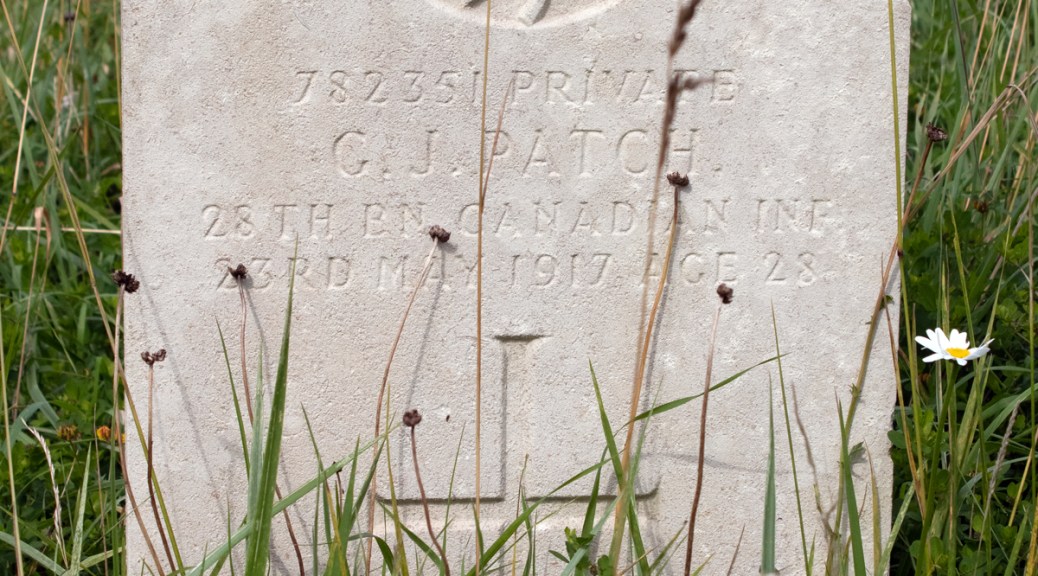
Gilbert John Patch was born in Winford, Somerset, on 3rd July 1888. The third of seven children, his parents were haulier Robert Patch and his wife Ann.
Gilbert followed his father into carting work, but the opportunity of a bigger and better life presented itself. In the spring of 1913, he emigrated to Canada, to find land and work as a farmer. He settled in the hamlet of Caron, Saskatchewan with a friend from home, Percy Worle.
Gilbert’s time overseas was not to be a length one, however. When Europe went to war, the empire was called upon and, on 1st April 1916, Gilbert enlisted in the Canadian Expeditionary Force. His service records show that he was 5ft 8ins (1.72m) tall, with blue eyes, fair hair and a medium complexion.
After his training, Private Patch arrived in France on 28th December 1916, and was assigned to the 28th Battalion of the Canadian Infantry – the same troop as his friend, Percy. During the Capture of Hill 70 in May 1917, Percy was killed and Gilbert himself was badly injured, receiving shrapnel wounds to his head, left arm and right leg.
Private Patch was medically evacuated to Britain for treatment. He was admitted to the Clopton House War Hospital in Stratford-upon-Avon, and while his wounds were treated, within a couple of weeks, he was dangerously ill with a kidney infection. The combination proved too much for his body to take, and Gilbert died on 23rd May 1917. He was 28 years of age.
Gilbert John Patch’s body was brought back to Somerset for burial. He was laid to rest in the graveyard of the local parish church, St Mary & St Peter’s, in his home village of Winford.
William George MacPherson was born in the township of Greenway, Huron County, Ontario, on 24th September 1893. The eighth of nine children, his parents were farmer Edmund Macpherson and his wife, Sarah, who was better known by her middle name, Keren (short for Kerenhappuch).
Edmund was the fourth generation of the family to be born in Canada, his maternal great grandfather having emigrated from Scotland to Nova Scotia in the late 1770s. Sarah was the first generation of her family to be born in North America, her parents having moved there in the 1850s.
After he finished his schooling, William followed his father into farming. When war broke out in Europe, the Empire was called upon to serve their King. On 7th January 1916, William enlisted in the Canadian Expeditionary Force. His service records show that he was 5ft 6.5ins (1.69m) tall and weighed 150lbs (68kg). He was noted a having dark hair, brown eyes and a dark complexion.
Private MacPherson set sail from Halifax on 22nd August 1916, and arrived in Liverpool eight days later. His troop was based in Witley, Surrey, and it was here, while attached to the 125 Battalion of the Canadian Infantry, that William spent the winter.
On 23rd May 1917, Private MacPherson was transferred to the 4th Battalion, and set sail for France. He was to spend the summer at Ypres, where he encountered some of the bloodiest fighting of the conflict. William was not to be unscathed, and was wounded in his shoulder and neck on 6th November 1917.
William was initially treated at the No. 2 State Hospital at Abbeville. Dangerously ill, though, he was medically evacuated to Britain, on board the Hospital Ship Essequibo, from Le Havre to Shornescliffe. Private MacPherson was quickly moved to Somerset, and was admitted to the Bath War Hospital. Tetanus set in, and he died of his wounds on 21st December 1917. He was 24 years of age.
With his family thousands of miles away, William George MacPherson was laid to rest in the Locksbrook Cemetery in Bath, not far from the hospital in which he had breathed his last.
Samuel Treeby was born in December 1865 in Taunton, Somerset. The third of seven children, his parents were cordwainer Thomas Treeby and his wife, Anna (or Hannah).
When he finished his schooling, Samuel found work as a blacksmith at a collar factory in Taunton. His trade stood him in good stead away from the forge: he volunteered for the Royal Horse Artillery, becoming adept at shoeing the animals.
In 1906, Samuel married Sarah Parker. She was from Enmore, between Bridgwater and Taunton, although the couple married in Cardiff, Glamorgan. The couple settled back in Enmore, where Samuel continued his smithing trade.
War came to Europe in 1914 and, although he was 49 years old, Samuel stepped up to play his part. He was attached to the Royal Army Service Corps and given a rank that echoed his civilian profession, that of Shoeing Smith. His service records show that he was of average height – 5ft 6ins (1.68m) tall – but that he was illiterate: he signed his declaration with a cross.
Samuel spent several months on home soil, before being sent out to France in March 1916. He spent six months overseas, before being shipped back to Britain, suffering from rheumatism. Shoeing Smith Treeby was admitted to the East Leeds War Hospital before being discharged to the regiment’s Remount Depot in Woolwich, Kent.
Samuel returned home to Somerset, but his poor health still dogged him during the winter of 1916/17. He contracted bronchitis, and died of the condition on 27th February 1917, while still based in London. He was 51 years of age.
Samuel’s body was taken back to Somerset for burial. He was laid to rest in the peaceful graveyard of St Michael’s Church in Enmore, not far from where his widow still lived.
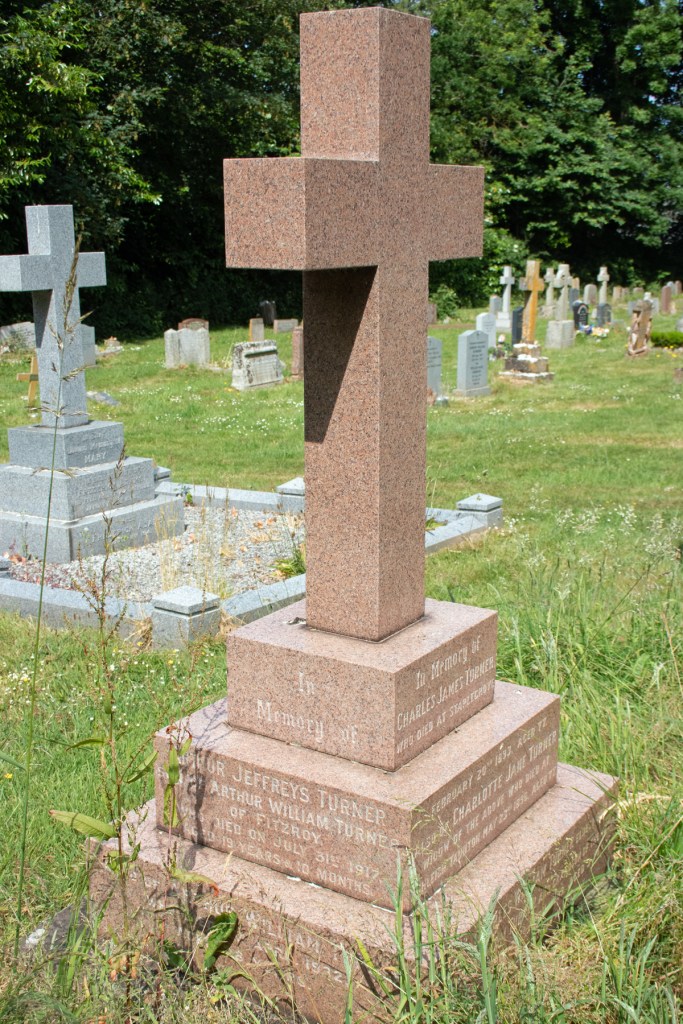
It is with great regret that we announce the death of Mr Arthur Jeffreys Turner, which took place on Tuesday last. The deceased was the only surviving son of Mr AW Turner, or Fitzroy.
Taunton Courier and Western Advertiser: Wednesday 8th August 1917
Arthur Jeffreys Turner was born in Staplegrove, near Taunton, in 1897. There is little concrete information about his life, although the newspaper report of his funeral acts as a starting point.
Arthur – who, the report suggests, was known as Jeff – was the son of Arthur William Turner. The son of a gentleman, Arthur Sr was a coffee planter, who disappears from the UK Census returns from 1881 and 1891. On 4th August 1894, he married Carsina Florence Marie le Gay, the Paris-born daughter of Gustave Ferdinand le Gay, an officer in the French Army. Arthur was 40 years old, and gave his address as the Travellers’ Club in Piccadilly, London, while Carsina, who was just 21 years of age, lived in Richmond.
Of Carsina, there appears to be no further record. The 1901 census found Arthur Sr based back in his Piccadilly Club, and gives his marital status as married. Ten years later, Arthur Sr is recorded as living in Fitzroy House, to the north west of Taunton. He is still noted as married, and a retired coffee planter, and that he had two children, of whom only one survived. Arthur Sr’s only companions in the 14-roomed manor house, however, were two servants, Bessie Hill and Eva Caddy.
The same census recorded Arthur Jr boarding at a prep school in Berrow, Somerset. Naish House been purpose-built just seven years before, when the school moved down the coast from Clevedon. Arthur was one of 39 boarders, who were supported by a dozen staff.
Within three years of the census being taken, Britain was at war. Arthur Jr was 17 at this point, and was sent to Cambridge, where he enlisted in the Officers’ Training Corps (OTC). No details of his military career exist, but at some point he made the move to the Somerset Light Infantry. He was given the rank of Private, somewhat unusually, given his time in Cambridge. This would suggest either that he didn’t complete his OTC training, that he did not pass it, or that he chose to work his way up through the ranks, rather than accepting a paid commission.
At this point, Private Turner’s trail goes cold. There are no records to expand on his military career and the newspaper report spends more time focused on the inscriptions on the floral tributes at his funeral, than on his short life.
The Commonwealth War Graves Commission documentation confirms that Arthur had died “of heart failure 31st July 1917. Age 20.” No other context is available, to whether heart failure was the primary cause, or it was brought on by another illness or injury can only be guessed at.
The body of Arthur Jefferys Turner was laid to rest in the graveyard of St John’s Church in Staplegrove, once a separate village, now a suburb of north west Taunton. He was buried in the family plot, alongside his paternal grandparents, Charles and Charlotte Turner.
Private Arthur Turner (from findagrave.com)
Arthur Turner Sr lived on for a further six years after his son’s death. He died on 9th April 1923, and was also laid to rest in the family plot in St John’s Churchyard, Staplegrove. The newspaper report on his funeral gives similarly little away about his life:
The funeral took place at Staplegrove, Taunton, on Tuesday, of Mr Arthur William Turner, of Fitzroy, Norton Fitzwarren, who died… in his 79th year.
…the chief mourners were Lieut.-Com. Kenderdine and Mrs Kenderdine (son-in-law and daughter)…
The late Turner was a keen follower for many years of the Culmstock Otter Hounds, and the oldest member of the Somerset Country Club.
Langport & Somerton Herald: Saturday 16th April 1932
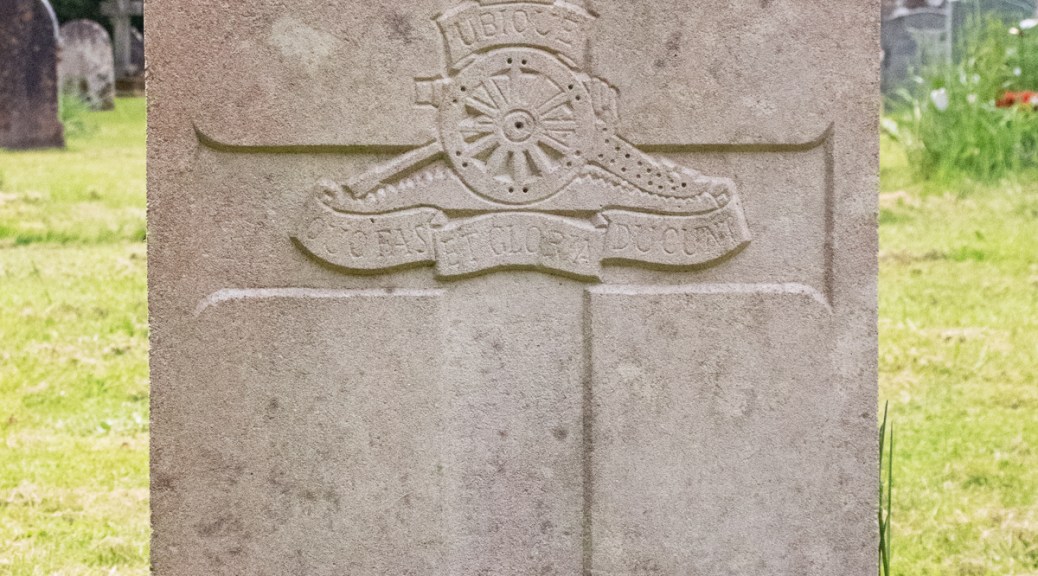
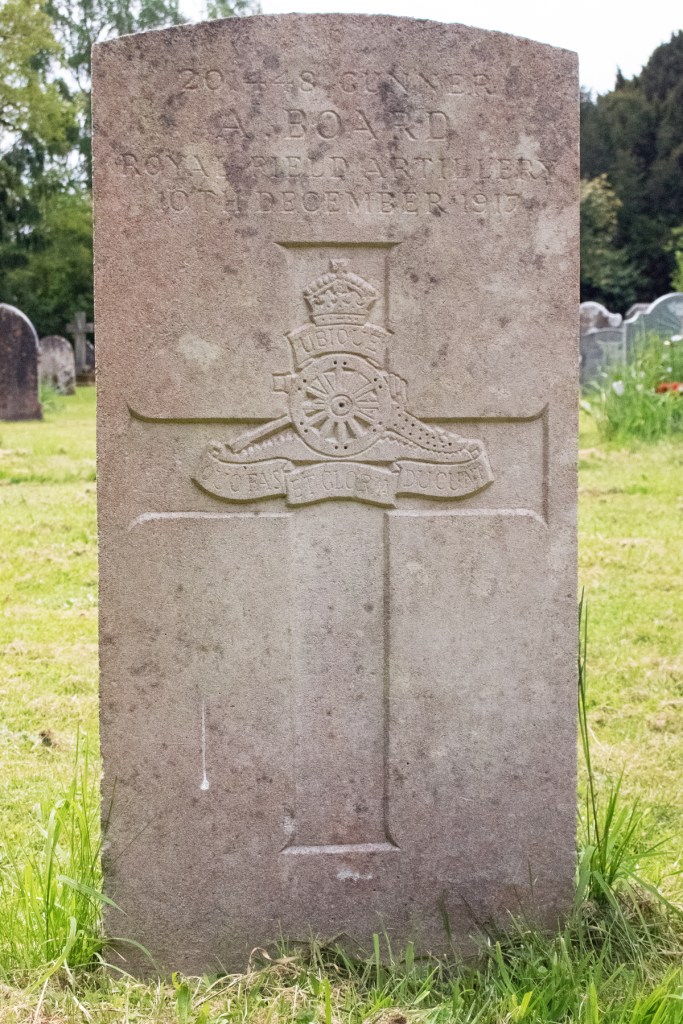
The funeral took place at Pitminster parish churchyard… of Gunner A Board, of the Royal Field Artillery, youngest son of Mr and Mrs W Board… who died in the 3rd Southern General Hospital, Oxford… from wounds received in action on 29th October. Deceased was only 21 years of age, and was buried with full military honours. Having been a former Boy Scout members of the Taunton and Trull Troops attended as a last tribute of respect and sympathy.
Taunton Courier and Western Advertiser: Wednesday 26th December 1917
Concrete information about the young life of Albert Board is destined to remain lost to time, but entries in the 1901 and 1911 censuses suggest that he had been born in Willesden, Middlesex. His parents were William and Annie Board, and the family moved to Pitminster, Somerset, at some point between the two documents.
One of seven children, by 1911 Albert had left school, and had found work as an errand boy. The youngest of the household, he was living with two older siblings – William, who was employed as a gardener; and collar making sister, Lily – and his parents. William, by this time, was working as a boot repairer.
When war came to Britain’s shores, Albert stepped up to play his part. He had enlisted in the Royal Field Artillery by the summer of 1917, and was attached to the 168th Brigade. Private Board fought on the Western Front, and may have been involved in the Arras Offensive of 1917.
Caught up in the fighting on 29th October, he was injured, and medically evacuated to Britain for treatment. He was admitted to the hospital in Oxford, but succumbed to his wounds on 10th December 1917. He was just 21 years of age.
Albert Board’s body was brought back to Somerset for burial. He was laid to rest with all due ceremony, in the quiet graveyard of Saint Mary and Saint Andrew’s Church, Pitminster.
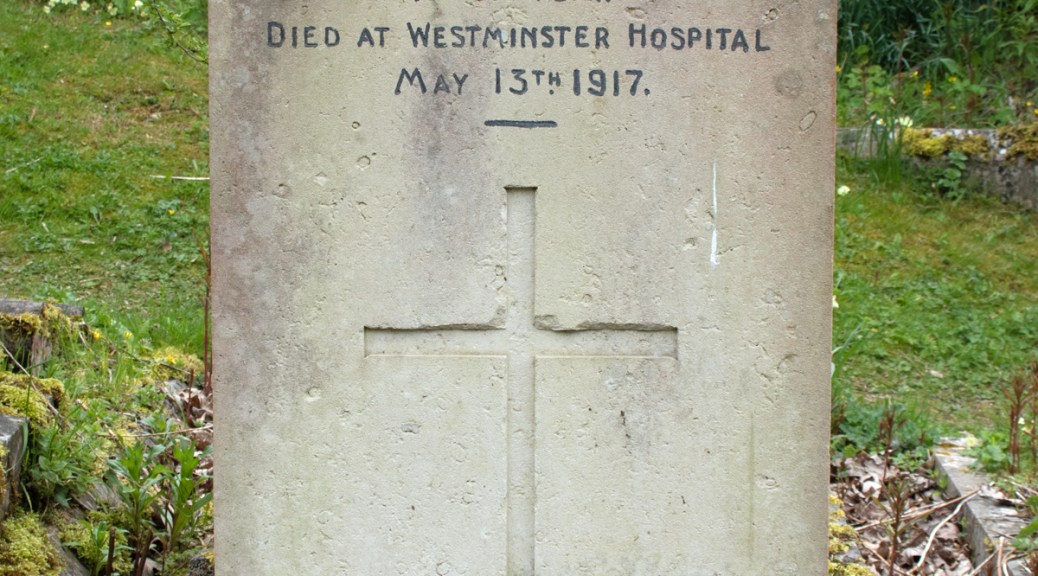
Much public interest was manifested in the funeral, on Thursday, of Private John St Clair Cotterell eldest son of Mr T Sturge Cotterell, JP, of Bath. Deceased, who was 26 years of age, was educated at Bath College, and left England to take up the life of a rancher in Canada. Here he joined the Alberta Rifles and saw service on the Western Front, where he was dangerously wounded in an attack on the Arras front on April 28th. He was, however, brought back to this country, only to succumb to his severe wounds in Westminster Hospital on Saturday. He leaves a widow and one child.
Bath Chronicle and Weekly Gazette: Saturday 19th May 1917
John St John Cotterell was born in Bristol, Gloucestershire, on 17th September 1891. One of six children, his parents were wallpaper manufacturer turned quarry manager Thomas Sturge Cotterell, and his wife, Edith. John remains noticeably absent from both the 1901 and 1911 censuses in which his parents and sibling – and servants – are recorded, so his early life is hard to piece together.
By 1908 John had emigrated to Canada to become a farmer. It was here that he met and married Gladys Nettleton. The couple settled in Alberta and had a daughter, Nellie, who was born in 1915.
When war came to Europe, John stepped up to play his part for King and Empire. He enlisted in the Canadian Expeditionary Force on 8th March 1916, and was assigned to the 192nd Overseas Battalion. Private Cotterell’s service records confirm that he was 5ft 5ins (1.65m) tall, weighed 117lbs (53kg) and had fair hair, grey eyes and a fair complexion.
Private Cotterell left Canada for Britain on 1st November 1916, arriving in Liverpool ten days later. He was transferred to the 9th (Service) Battalion of the Canadian Infantry, and barracked at St Martin’s Plain, near Folkestone in Kent. Early in 1917, he was moved to the 10th Battalion and, on 4th March was shipped off across the English Channel.
John’s arrival in France was not an auspicious one. Tightly packed barracks were a breeding ground for disease, and, by the time he had arrived in Le Havre, John had contracted mumps. He was laid up in a camp hospital for just over a month before returned to his battalion and heading to Arras.
Private Cotterell’s was severely injured in the fighting, and he received a gunshot wound to his spine. Medically evacuated to Britain, he was admitted to the Westminster Hospital in London. His medical report noted that his ‘1st lumbar vertebra [was] shattered and [spinal] cord [was] cut through‘. He had complete paralysis below the groin and that he was in a ‘hopeless condition‘. His injuries proved too severe, and he passed away on 13th May 1917, three days after being admitted. John was just 25 years of age.
John St Clair Cotterell’s body was brought back to Somerset for burial. He was laid to rest in Bath’s Abbey Cemetery.









 Death and Service