Much of the life of William F Lloyd is destined to remain lost to time.
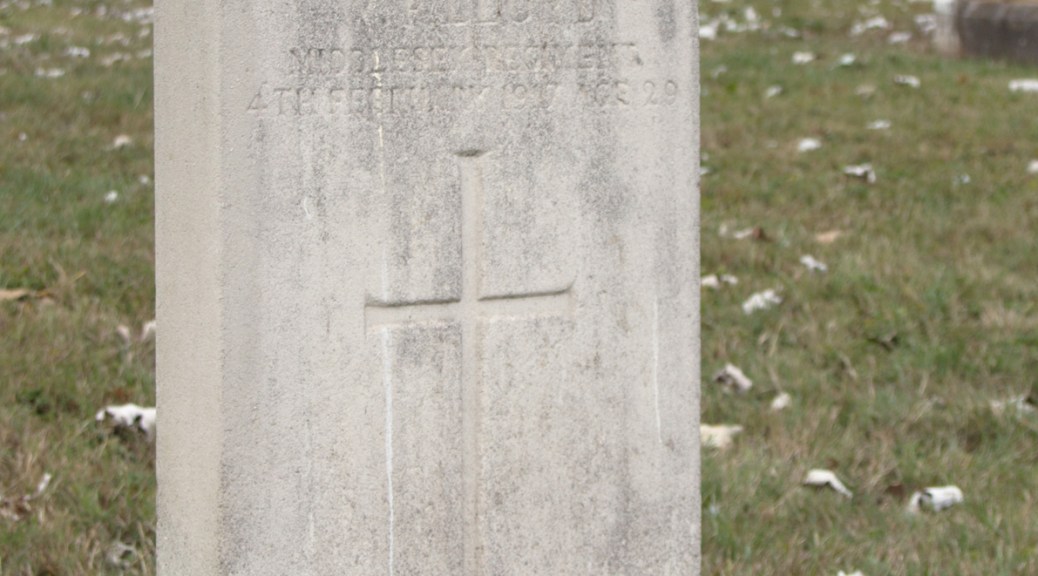
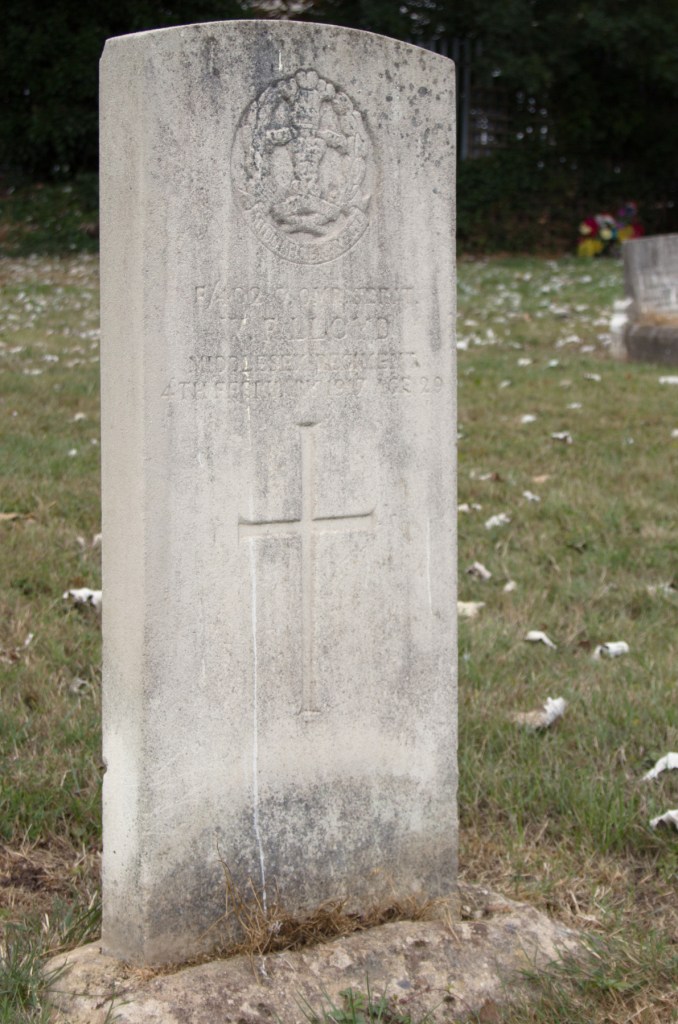
Buried in Streatham Park Cemetery, Surrey, his entry on the Commonwealth War Graves Commission register states that he was a Quartermaster Sergeant in the Middlesex Regiment, and had transferred to the 101st Training Reserve Battalion. It also confirms that he was the son of Mrs Annie Shane, of 24 Paulet Road, Camberwell.
The only document relating to William’s military service – his Pension Ledger record – adds a bit more detail. It records that he died from appendicitis on 4th February 1917. He was 29 years old when he passed. This document gives his mother’s name as Mrs Annie Lloyd, so it would seem that she re-married at some point after his passing.
There do not appear to be any potential census records for William, certainly not for a William F Lloyd, although to achieve the rank of Quartermaster Sergeant by age that he did would suggest he had enlisted prior to the First World War. It may be, therefore, that he was overseas at the time the census returns were taken.
Sadly, there is little more information that can be uncovered. William F Lloyd retained his anonymity after death, and he lies at rest in the large grounds of Streatham Park Cemetery.
George James Bush was born in the autumn of 1889 in Bath, Somerset. One of eight children, his parents were Edward and Sarah Bush. Edward was a general labourer turned fishmonger and the family lived in a ramshackle cottage in Griffin’s Court, off Milk Street towards the centre of the city.
When he finished his schooling, George found employment as a general labourer. By the time of the 1911 census, he and three siblings were still living at home with their parents, and all of them were working to bring together an income for the household. Times were obviously hard for the Bush family, and the list of trades reads like something from one of Dickens’ novels: fishmonger, charwoman, box maker, carter and daily domestic.
Edward died in 1912, and this put a further strain on the household. When war came to Europe two years later, a career in the army seemed a price worth paying for the additional financial support it would bring George and his family. He had enlisted in the Royal Engineers as a Sapper by the spring of 1917.
Attached to the 503rd Field Company, George’s full service details are lost to time. He definitely saw action overseas, however, fighting in some of the fiercest battles of the war, at the Third Battles of Ypres in 1917. It was here, at Passchendaele, that Sapper Bush was wounded, his injuries severe enough for him to be medically evacuated to Britain.
George was admitted to Sheffield War Hospital, but complications set in.
Sapper G Bush, RE, formally employed by the Corporation as a motor lorry driver, died in the Warecliffe Hospital, Sheffield, on Saturday. He was wounded a short time ago, but the cause of death was pneumonia, which supervened. Sappe Bush, who was… unmarried, was a son of Mrs R Bush, of 19, Denmark Road, Twerton. He had been in the army close on two years. He was one of three brothers, all of whom joined the army. A younger brother, who enlisted soon after the outbreak of war, is now in Egypt with the Somersets.
[Bath Chronicle and Weekly Gazette: Saturday 1st December 1917]
George James Bush died on 24th November 1917: he was 28 years of age. His body was brought back to Somerset for burial, and he was laid in the family plot in Locksbrook Cemetery, Bath, reunited with his father far too soon.
William George Masters was born in Padstow, Cornwall, on 15th April 1877. The older of two children, his parents were Samuel and Catherine (or Kate) Masters. Samuel was an agricultural labourer, but his son sought a life at sea.
On 7th November 1894, William enlisted in the Royal Navy. Sent to HMS Northampton, an armoured cruiser repurposed as a training ship, he took on the role of Boy 2nd Class. His service records show that he was 5ft 6.5ins (1.69m) tall, with brown eyes, auburn hair and a freckled complexion. He was noted as having a scar on the third finger of his right hand.
Over the next six months, William showed a remarkable dedication to the job. On 7th February 1895 he was promoted to Boy 1st Class, and, just three months later, he came of age and assumed the rank of Ordinary Seaman.
William’s shore base was to be HMS Vivid, the Royal Naval Dockyard in Devonport, Devon, and he returned here regularly over the twelve years of his service. Ordinary Seaman Masters served on ten ships during this time and, on 1st May 1902, was promoted to Able Seaman.
His time in the navy wasn’t to be without incident, however, and he had two spells in the brig – for three days in July 1897, and ten days in December 1905. His misdemeanours are lost to time, but they did blemish an otherwise clear term of service for William.
William married Laura Oldham in 1905: they would go on to have three children – William Jr, Emily and Katharine. He was stood down to reserve status in April 1907 and, by the time of the next census in 1911, the family were living in Church Street, Padstow. No longer working for the Royal Navy, he was, instead, self-employed as a general labourer.
When war was declared in August 1914, William was called back into action. Assigned to HMS Argonaut, he once again too the rank of Able Seaman. He spent a year on board, patrolling the Atlantic, before the protected cruiser was converted to a hospital ship.
In September 1915, Able Seaman Masters transferred to another cruiser – HMS King Alfred – which served in the Mediterranean. He remained on board until the following summer, by which point his health was beginning to become affected.
William returned to Devonport in August 1916, remaining there for a couple of months. On 4th October, he as medically discharged, suffering from myocarditis, a heart condition.
At this point William’s trail goes cold. He returned to Cornwall, passing away at home on 13th September 1917: he was 40 years of age.
William George Masters was laid to rest in Padstow Cemetery, on the outskirts of the town he called home.
George Edward Tucker was born in Lyncombe, Bath, Somerset in the autumn of 1883. The fourth of eight children, his parents were stone mason Edward Tucker and his wife, both of whom were from northern Somerset.
When he finished his schooling, George found work as an errand boy. By the time of the 1911 census, however, he had taken a job as a painter, possibly being employed by his father’s boss.
George married Rosina Hurley at Bath Register Office at the start of 1913. the couple set up home and went on to have two children, Edina and Audrey.
George enlisted in the opening weeks of the First World War, joining the Somerset Light Infantry as a Private. His time in service was not to last long, however. He was out on a route march on 1st December, when he was pulled up with acute pain in the chest.
Private Tucker was sent back to barracks, and given light duties. A subsequent medical confirmed an enlarged heart, and he was medically discharged from military service on 31st December 1914.
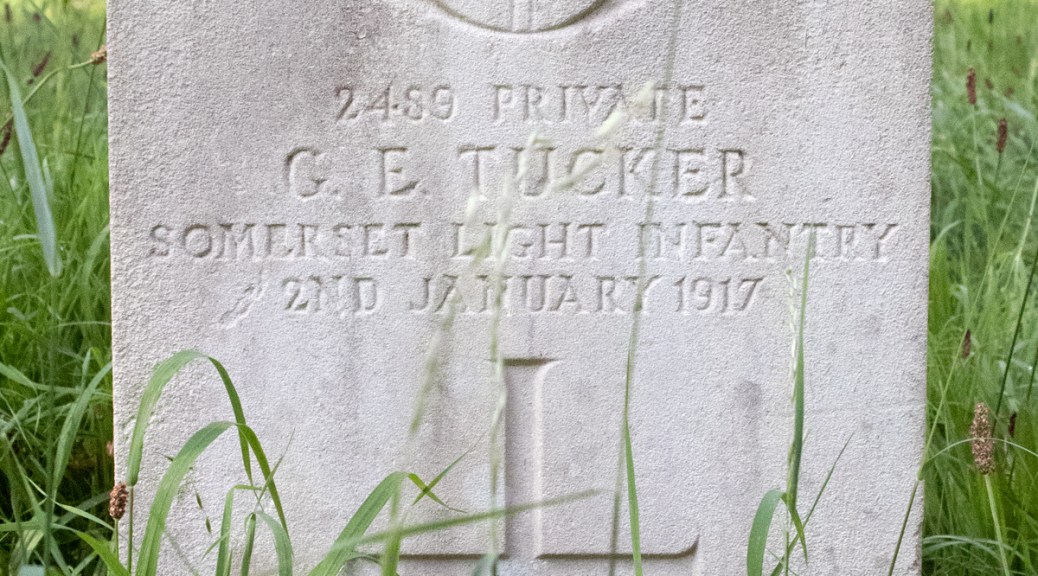
At this point, George’s trail goes cold. The next record for him is that of his passing, on 2nd January 1917. He was 33 years of age.
George Edward Tucker was laid to rest in Bath’s sweeping Locksbrook Cemetery.
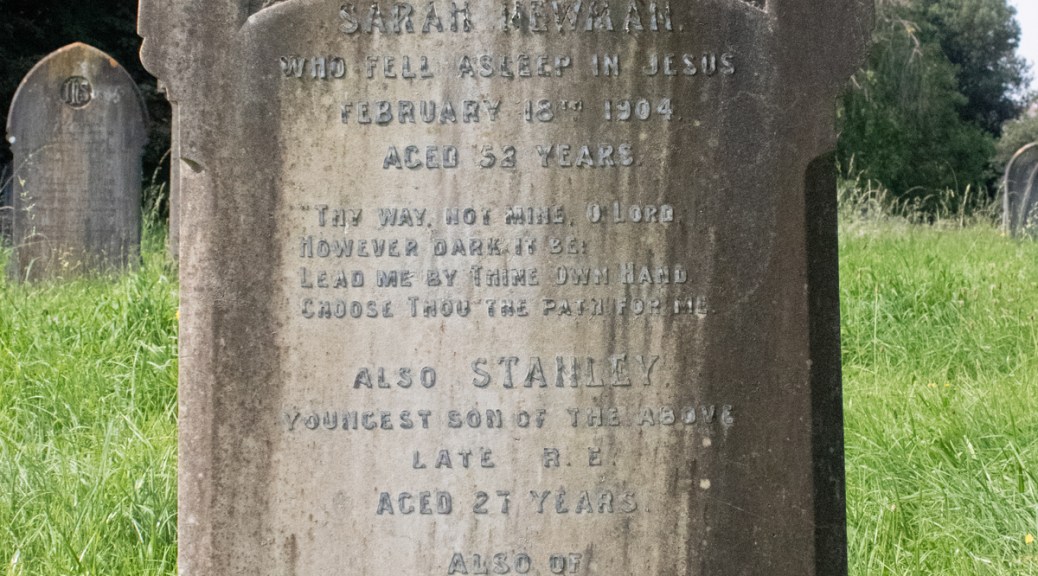
Stanley Herbert Newman was born on 14th May 1890 in the Walcot area of Bath, Somerset. One of at least six children, his parents were Charles and Sarah Newman. Charles was a stonemason and, when Sarah died in 1904, he married again, to widow Matilda Shearn, raising her children as part of the family.
When Stanley left school, he found work as a mason’s labourer – presumably either assisting his father, or having found work through him. On 3rd August 1912, he married Rosa Bean, a farm worker’s daughter from Bathwick, to the east of the Bath. The couple set up home at 7 Margaret’s Hill, and went on to have two children, Mabel and Albert.
With a growing family to support, Stanley’s work as a labourer was not going to bring enough money in, and he sought a more reliable career. On 2nd September 1912, he enlisted in the army, joining the Royal Engineers. His service record shows that he was 5ft 5.5ins (1.66m) tall.
Detailing Sapper Newman spent just over two years in the Royal Engineers, his time there coming to an end on 11th December 1914 when he was deemed medically unfit to serve.
At this point Stanley’s trail goes cold. At some point he joined the Somerset Light Infantry, although his service documents for this period of time in the army as lost to time. Attached to a Depot Battalion, it seems likely that he remained in Somerset, although this is not conclusive.
Private Newman died in a military hospital on 28th July 1917, through causes unknown. He was 27 years of age.
Stanley Herbert Newman was laid to rest in the family plot in Bath’s sweeping Locksbrook Cemetery. He was reunited with his mother, who had been buried there thirteen years before. His father, Charles, was buried with them in 1921.
William James Mackay was born in Bath, Somerset, on 2nd January 1900. The son of a woman called Matilda, the following year’s census found him living as a nurse child in the home of John and Elizabeth Logie. The household was made up of the Logies, their five children, a boarder, and another nurse child, Harold Fellows.
The next census, taken in the spring of 1911, shows a change in circumstances for the family. Matilda and William were living in the Walcot area of the city, with Matilda’s husband, William Smith. The document suggests that the couple had been married for twelve years, but this would not account for the younger William’s original surname. The census return states that he had taken the name of Smith as well, and there was a fourth resident in the household, widow Elizabeth Clarke.
War came to Europe in the summer of 1914, and William Jr was keen to step up and play his part. Because of his age he was unable to enlist immediately, and it was not until the start of 1917, that he was able to enlist.
William – who had returned to the name Mackay by this point – was working as a clerk when he joined the Royal Naval Air Service (RNAS) on 23rd January 1917. His service records show that he enlisted as a Boy Mechanic, and that he was 5ft 8.5ins (1.74m) tall. He had brown hair, brown eyes and a fresh complexion.
Boy Mechanic Mackey was assigned to HMS Daedelus, one of the RNAS shore-based facilities: it was here that he was to receive his training over the spring and summer. Military barracks were notoriously cramped and hotbeds for illness and disease, and William was not to be immune to health issues. He contracted cerebrospinal meningitis within months of arriving at the base, and passed away on 5th August 1917. He was just 17 years of age.
William James Mackay was brought back to Somerset for burial. He was laid to rest in the sweeping grounds of Bath’s Locksbrook Cemetery.
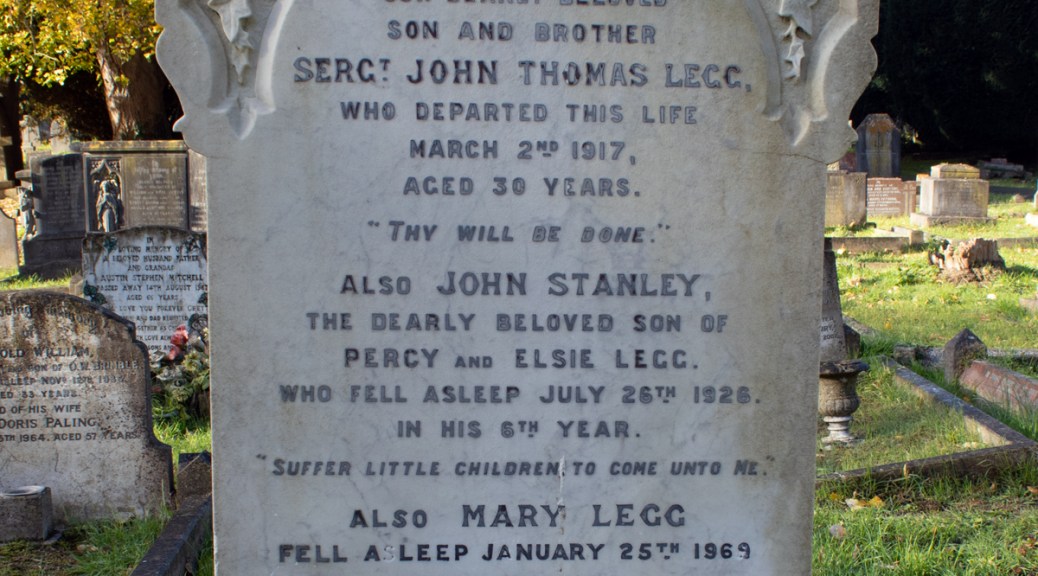
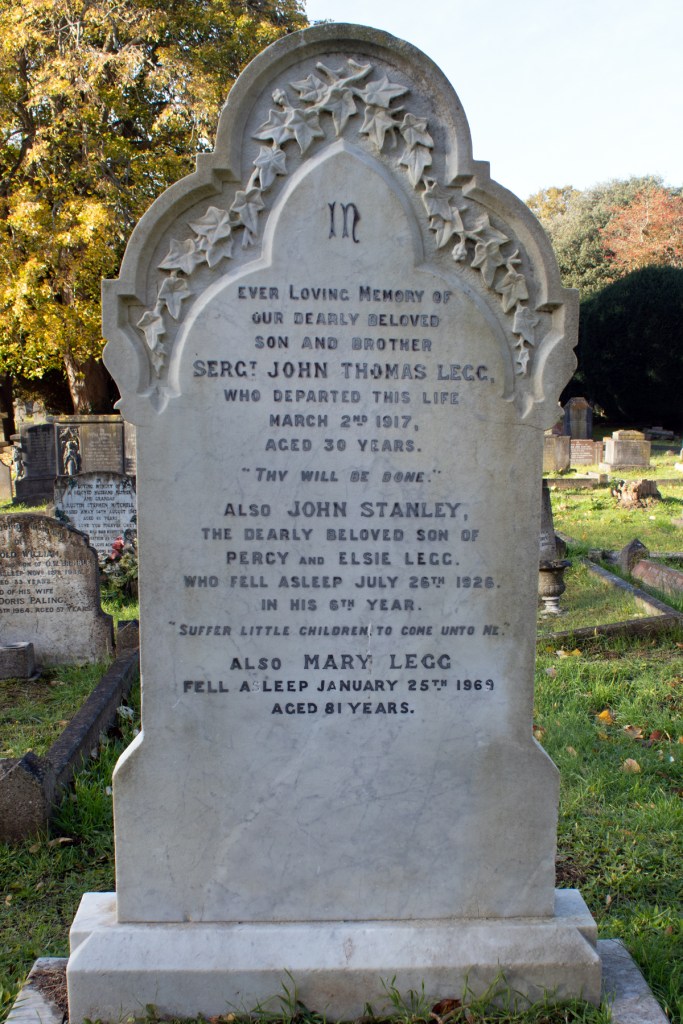
John Thomas Legg was born in the summer of 1885, the oldest of five children to Benjamin and Sarah Legg. Benjamin was a carpenter from Dorset, and it was in Bridport that John was born. Within a year or so, however, the young family moved north to Weston-super-Mare, Somerset, and this is where they settled.
When he completed his schooling, John found a job as a clerk. By the time of the 1911 census, he was working as a political assistant/clerk, and five of the six members of the Legg household were gainfully employed. Benjamin was still working as a carpenter, while John’s two sisters were dressmakers, and his younger brother Percy was a tailor’s assistant.
In the summer of 1914, war came to Europe, and John was one of the first to step up and serve his King and Country. He initially enlisted in the North Somerset Yeomanry, and was assigned to the 1st/1st Battalion. Private Legg’s unit was quickly sent to France, and fought at the Battle of Nonne Bosschen that November.
John’s service records are sparse, and so it is not possible to confirm exactly when and how he served. He moved from the North Somerset Yeomanry to the 6th Battalion of the Reserve Cavalry Regiment: his promotion to Corporal and then Lance Sergeant suggests that this move enabled him to share his skills with incoming recruits. It is unclear whether he was based in Somerset by this point, but it is certainly where he ended up by the start of 1917.
The remains of Sergeant JT Legg, North Somerset Yeomanry, were buried at Weston-super-Mare Cemetery on Wednesday. The first portion of the service was held at St Saviour’s Church, which the sergeant formerly attended, and the interior of which bears many evidences of his skill as an amateur wood-carver… Sergeant Legg was formerly chief clerk in the offices of the Well Division Conservative Association.
Bath Chronicle and Weekly Gazette: Saturday 10th March 1917
John Thomas Legg passed away on 2nd March 1917: he was 31 years of age. He was laid to rest in the sweeping grounds of Milton Road Cemetery, Weston-super-Mare, a short walk from where his family still lived.
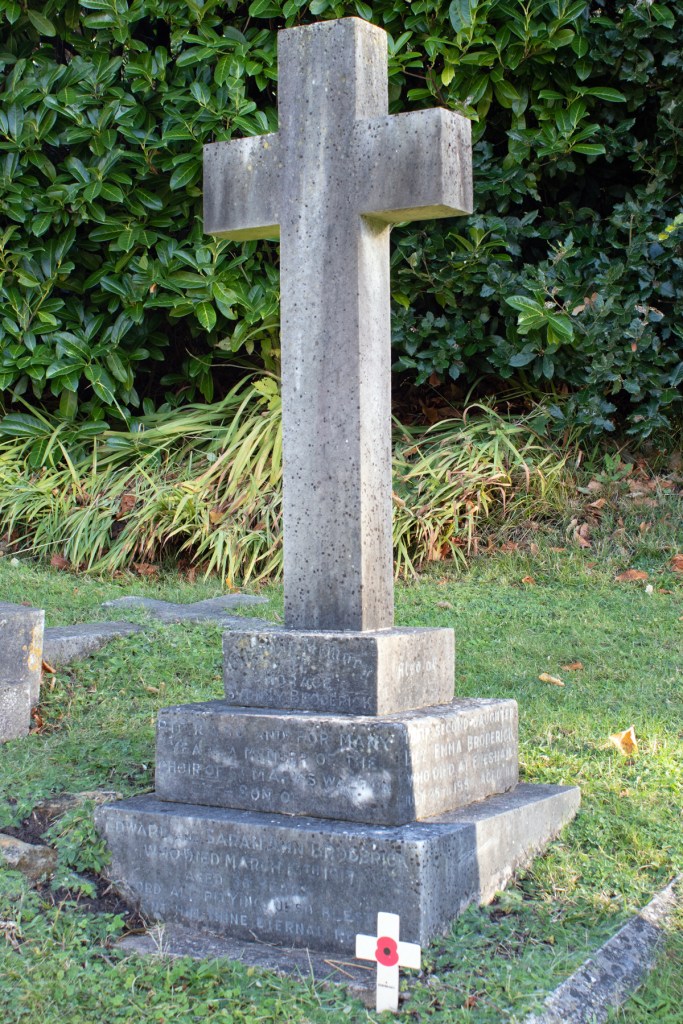
Horace Sydney Broderick was born in the summer of 1880, and was the youngest of ten children to Edward and Sarah Broderick. Edward was a clothier from Newport Pagnell, Bedfordshire, but the family were born and raised in Horfield, Gloucestershire.
By the time of the 1891 census, the family had moved to the south of Bristol, setting up home at Rugby House in Walton-in-Gordano, Somerset. Horace was still at school, and of the four other siblings living at the family home, only one, Horace’s older brother, Walter, was gainfully employed, assisting his father in the cloth trade. The Brodericks were supported by two live-in staff, a cook, Elizabeth Phipps, and a housemaid, Ada Perrett.
The next census, taken in 1901, found Horace and three of his sisters still living at Rugby House with their parents. Edward was now employing his son as a clerk to the family business, and two new staff had come on board, cook Lily Collier and housemaid Florence Hadeley.
By the time of the 1911 census, Edward and Sarah had been living in Rugby House for more than twenty years. Both now in their 70s, they still had their oldest daughters living with them, but Horace is nowhere to be found. Indeed, there is no sign of him on any of the UK census returns, and it is not until six years later that he seems to surface again.
When war broke out, Horace stepped up to enlist. He joined the Army Service Corps and, based on his service number, was employed as a Driver Mechanic. Beyond this, Private Broderick’s time in the military is lost to time.
News has been received in Bristol of the death at the Royal Herbert Hospital, Woolwich, of Pte. Horace Sydney Broderick, youngest son of the late Mr Edward Broderick (of the firm Broderick & Co,. Limited, St James’s Barton, Bristol) and of Mrs Broderick, of Walton Park, Clevedon. Deceased soldier was in his 37th year.
Bristol Times and Mirror – Thursday 15 March 1917
The report appeared in a dozen or so contemporary newspapers and, as no specific detail is given, it is likely that Horace passed away from illness, rather than injury or any unexpected cause. He died on 13th March 1917, at the age of 36 years old.
Horace Sydney Broderick’s body was brought back to Somerset for burial. He was laid to rest in the graveyard of St Mary’s Church, Walton Clevedon, next to Edward, who had passed away two years before.
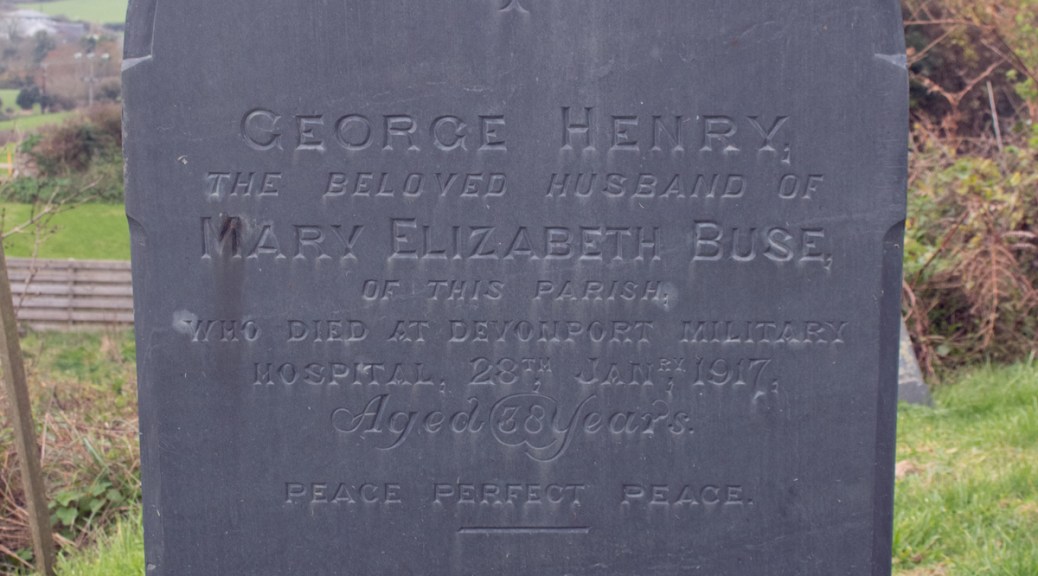
George Henry Buse was born in the Cornish village of St Minver in 1880. One of four children, his parents were Richard and Angelina. Richard was an agricultural labourer, but his son followed a different trade, finding employment as a stonemason.
In the summer of 1904, George married a woman called Mary. They went on to have a daughter, Olive, who was born in 1906, and set up home in Splatt, on the outskirts of the village.
When war came to Europe in the summer of 1914, George stepped up to play his part. He enlisted by the summer of 1916, and joined the 2nd Battalion of the Devonshire Regiment. Private Buse’s unit served on the Western Front, but it is unclear whether he fought overseas.
By the winter of 1916, George had fallen ill. He contracted pneumonia, and was admitted to the military hospital in Devonport, Devon. The condition was to prove too severe, however, and he passed away on 28th January 1917: he was 36 years of age.
George Henry Buse was brought back to Cornwall for burial. He was laid to rest in the peaceful graveyard of St Menefreda’s Church in St Minver.
Charles James Hibbs was born in the summer of 1895 the fifth of nine children to James and Emily Hibbs. James was a groom from Dorchester, Dorset, but the family were first raised in Bere Regis, where Charles was born, before moving to Amesbury, Wiltshire, by 1900.
When he finished his schooling Charles found work as an under boot for a local hotel. When war came, however, he stood up to play his part. Unfortunately, full details of his service are lost to time, but he had joined the Somerset Light Infantry by January 1917. Assigned to the 11th Battalion, Private Hibbs soon found himself barracked in Tankerton, Kent.
While there, Charles seemed to keep himself to himself, rarely mixing with any of his colleagues. His seniors did not appear to think a great deal of him. Towards the end of May, things had come to a head for Private Hibbs:
Charles James Hibbs… was found at a quarter past three on Wednesday afternoon lying dead by the downstairs front door of his billet at Buena Vista, Tankerton Road, with his right hand under the breech of the rifle and the muzzle pointing to his right shoulder.
Whitstable Times and Herne Bay Herald: Saturday 2nd June 1917
The subsequent inquest shone a harsh light on the Edwardian attitude towards mental health. In the week leading up to Charles’ suicide, he was pulled off patrol a couple of times for absentmindedness.
Deceased’s manner was very strange and his companions complained of him and said he was very strange the whole time…
He would lean about over the bannisters and one could not get any sense of reason out of him. He would not associate with his comrades in any way. If I [Sergeant Edward Risden] asked him whether there was anything the matter he would pull himself together and say “I’m all right, sergeant.” He would then be all right for a few minutes and then wander away from his comrades.
The Coroner – Did you think he was not quite right in his mind? – That was my opinion.
Whitstable Times and Herne Bay Herald: Saturday 9th June 1917
Private Hibbs was sent to see the Medical Officer, but was sent back to his unit and advised to stick to light duties.
One of Charles’ colleagues, Private Harold Prosser, was billeted him the night before he killed himself:
At 1:30am… [Prosser] heard deceased moving about in the next bed to him and the he got up in bed. Witness got a match and lit the gas. Deceased put on his trousers, boots, and hat and told [Prosser] to get back to bed and put the gas out. [Prosser] left the gas on and deceased sat on the bed for about half an hour smoking and kept saying “Yes, sir.” The deceased mentioned by name his father and mother and all his relations an then got up and said “Yes, this time I am going to do it.” Deceased went to the rifle rack and [Prosser’s colleague, Private Middleton] awoke then and told him to let the rifles alone or he would report him. Deceased then took his hand off the rifle rack and said “All right” and went back and sat on the bed again. He was still smoking. He had his eye fixed on the same rifle for about half an hour after that and then he undressed and went to bed.
Whitstable Times and Herne Bay Herald: Saturday 9th June 1917
Private Prosser then went to sleep in another room because, as he told the Coroner, he did not feel safe being in the same one. A report was made to Private Hibbs’ corporal the next morning and, when asked by the Coroner if he thought Hibbs “was a little off his head”, Harold replied “Yes, the previous day he sat in bed talking to himself all day. I asked him what was the matter and he said ‘I am all to pieces.'”
In summing up, the Coroner did show some sympathy towards Charles’ actions:
…while no military regulation might have been infringed he did think people should understand that it was most important to tell the doctor the symptoms of a patient. It not only applied to military patients, but to civilian patients. If the medical officer on [the morning of 30th May] had had the facts reported to him of the strange behaviour of the deceased during the night he would most probably have placed him in hospital and the man might have received such treatment there or elsewhere that would have got him back into a sane condition.
Whitstable Times and Herne Bay Herald: Saturday 9th June 1917
At the inquest, the jury recorded a verdict of suicide during temporary insanity. Private Hibbs died on 30th May 1917: he was just 21 years of age.
Charles James Hibbs’ body was taken back to Wiltshire for burial. He was laid to rest in Amesbury Cemetery, not far from where his grieving family lived.