Tag Archives: 1918

Able Seaman Percy Strong

Able Seaman Percy Strong

Percy William Strong was born in April 1897, the youngest of five children to Albert Strong and his wife Elizabeth. The family lived in Shepton Mallet, Somerset, where Albert worked as a mason’s labourer.

Percy was keen to make his own way in the world. By the 1911 census, and having left school, he was working as a farm boy on Kingsdown Farm in Shepton, alongside a couple of other paid, and boarding, employees.

He seemed to have been after adventure in his life too; in January 1913, he enlisted in the Royal Navy, getting his training on a number of vessels, even before the start of the Great War. In his six years of service, he was promoted from Boy to Able Seaman, and served on nine ships.

Able Seaman Strong’s final assignment was at HMS Idaho, the naval base in Milford Haven, Pembrokeshire, which he joined in May 1918. It was while he was stationed at HMS Idaho that tragedy would strike.

A boat belonging to a Government Patrol-boat capsized in Milford Haven, when three members of the crew lost their lives. They were Sub-Lieutenant Lever (20), Birkenhead; Leading Seaman Thomas Palmer (30) Shepton Mallet; and AB Percy Strong (21), Shepton Mallet.

The boat, containing six men, had come ashore in a rough sea. It left Milford Haven Naval stage on return to the ship at eleven am. A sharp squall caught the men when well out on their return journey, and this the craft failed to weather, and was capsized. The six occupants were cast into the sea, and despite the efforts of men in boats from other vessels, the three named were drowned, and the others had a narrow escape.

Western Mail: Friday 11th October 1918

Able Seaman Strong has lost his life on 9th October 1918. He was just 21 years old.

Percy William Strong’s body was returned to Shepton Mallet, the town of his birth, and lies at rest in the cemetery there.
Second Lieutenant Frederick Pullen

Second Lieutenant Frederick Pullen

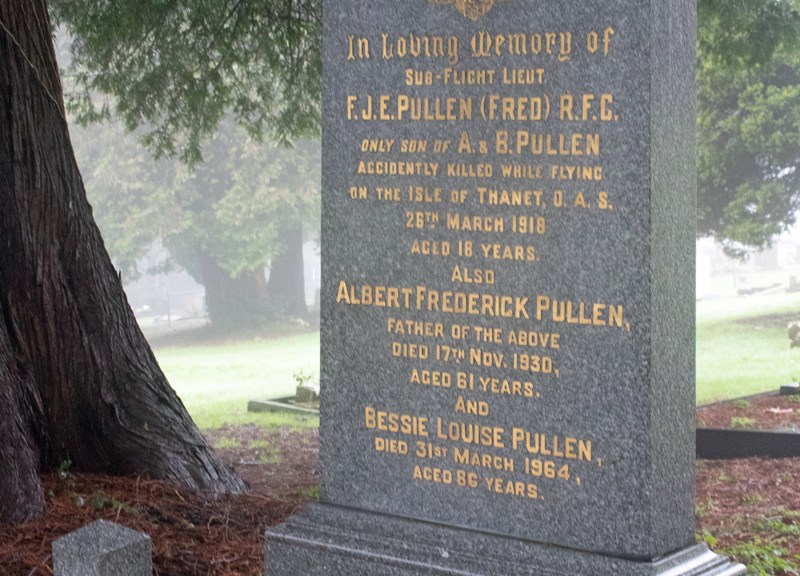
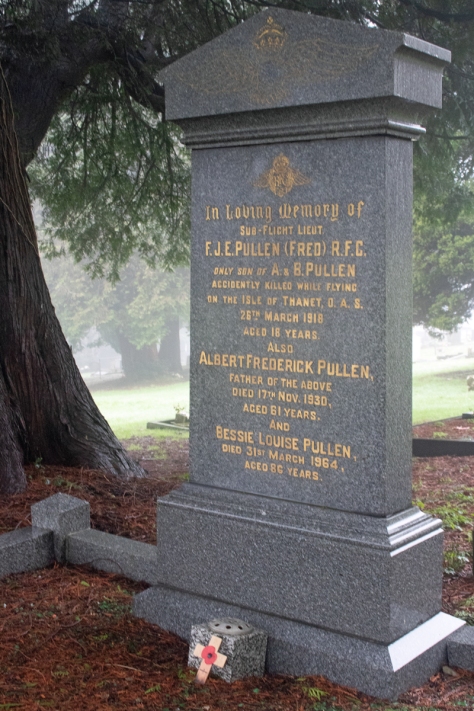
Frederick John Edward Pullen was born in May 1899, the only son to Albert and Bessie Pullen from Shepton Mallet in Somerset. Albert worked at the local prison, acting as clerk, warden and school master to the inmates.

Little else survives to expand on Fred’s military life; his gravestone confirms that he had enlisted in the Royal Flying Corps and, although no date can be attributed to this, it is likely to have been almost as soon as he turned 17.

A report of the young man’s funeral does give a little insight into the young man.


…before entering the service of his country, Lieutenant Pullen was in the Civil Service, and a letter from his late surveyor at Oxford, speaks in high terms of his character and abilities.

He graduated to the rank of Service Pilot in February last, and was gazetted in March. By the Naval authorities he was considered a very good pilot, and was graded as Class A (exemplary).

Shepton Mallet Journal: Friday 5th April 1918

Alongside the Edwardian trait of listing the chief mourners and floral tributes, the newspaper also gives an in-depth report of the cause of Second Lieutenant Pullen’s demise.


The brave young office, who was at a war school [Manston Airfield, Kent], was engaged in ‘stunting’ or trick flying, absolutely necessary in warfare, when from some unknown cause, he fell into a field, and was instantly killed.

A farmer who was ploughing near the spot said he was not conscious of the presence of an aeroplane in the vicinity till this one seemed to drop from the clouds. It nose-dived, but righted on coming near the earth, and seemed to swoop up again, but before going far turned turtle and fell, upside down.

The poor lad was found crushed beneath his gun, and had met instantaneous death. Letters received from witnesses of the accident stated that people living in the neighbourhood hurried to the spot with remedies of all sorts, and were much saddened to find that nothing that they could do was of any avail.

Shepton Mallet Journal: Friday 5th April 1918


Second Lieutenant Pullen met his death in a flying accident on 26th March 1918. He was just 18 years old.

Frederick John Edward Pullen lies at rest in the cemetery of his home town of Shepton Mallet.


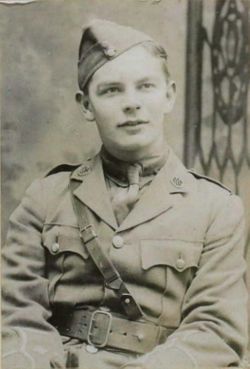
Second Lieutenant Fred Pullen (courtesy of findagrave.com)

Private Henry Mees

Private Henry Mees

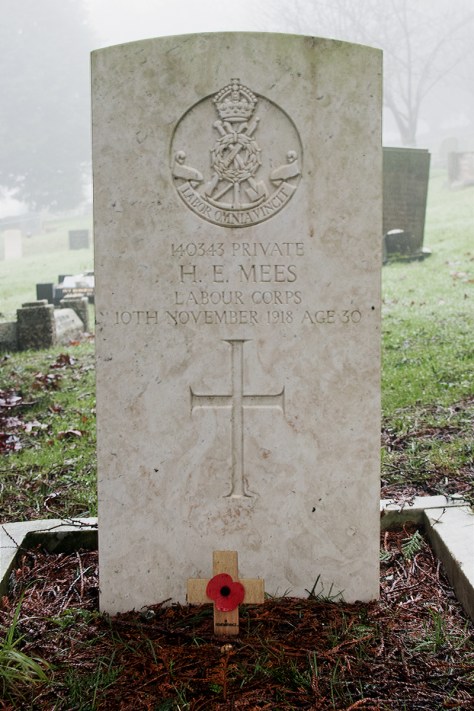
Henry Edward Mees was born in Shepton Mallet, in June 1888. Henry was one of six children, and lived in Somerset with his father – Frederick and his mother Emma. Frederick was a gardener who worked as a groundsman for the local cemetery.

After leaving school, Henry found work as a clerk for a local auctioneer. Of his two brothers, the elder has found a trade in carpentry, while his younger sibling helped his father.

Henry’s service records are scant; he enlisted in the Labour Corps, although there is no confirmation of when this happened. Private Mees joined the 615th Home Service Employment Company and was based in England.

The HSE Companies categorised the employment of the men serving with them, whether they were cooks, caretakers, clerks, policemen, butchers or telephone operators, and used the men to the best of their skills. It is likely, therefore, that Private Mees continued in his clerk role, albeit in a different line of work from auctioneering.

Sadly, few further details of Henry’s life remain documented. He is listed as having been admitted to the War Hospital in Bath, and he died from influenza on 10th November 1918. He was 30 years old.

Henry Edward Mees lies at rest in the cemetery of his home town, Shepton Mallet, sadly tended by his father as part of his day-to-day job.


Private Albert Coward

Private Albert Coward

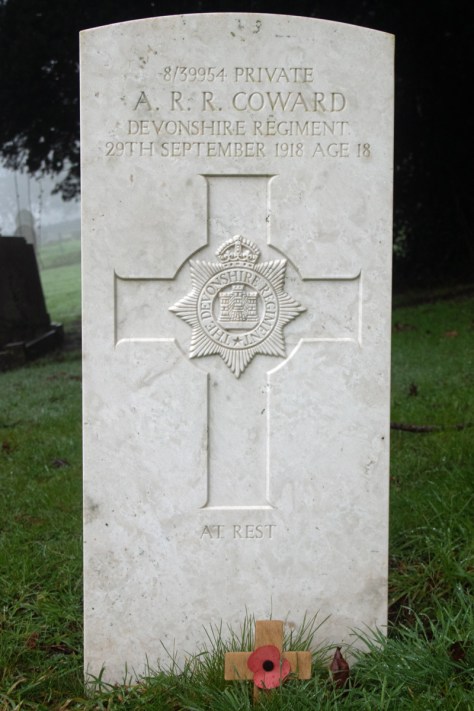
Albert Reginald Robert Coward was born on 26th August 1900, the middle of three children – all boys – for James and Florence Coward. James was a labourer and drayman for the railways, and the family lived in Shepton Mallet, Somerset.

Little remains of Albert’s military service records. His older brother Arthur was a Corporal in the Somerset Light Infantry. He died in France in April 1918, which may have been a contributing factor to his sibling’s decision to do his duty.

Albert enlisted in the 53rd Battalion of the Devonshire Regiment and, given his age, I would presume that this was as soon as he was able to – sometime in 1918.

Whether Private Albert Coward saw any military action is not known. He is listed as having passed away at a military hospital on 29th September 1918, although, as I have been unable to find a cause of death, it is likely to have been an illness, rather than an injury. Albert was aged just 18 years old.

Albert Reginald Robert Coward lies at rest in the cemetery of his home town.


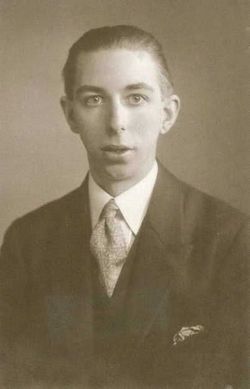
Albert Reginald Robert Coward
(courtesy of findagrave.com)

Corporal Arthur William James Coward is commemorated on the Arras memorial in France. He was 23 years old when he died.


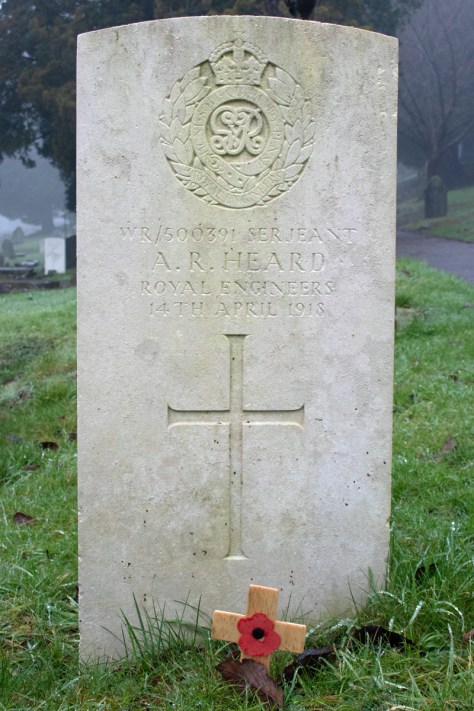
Serjeant Arthur Heard

Serjeant Arthur Heard

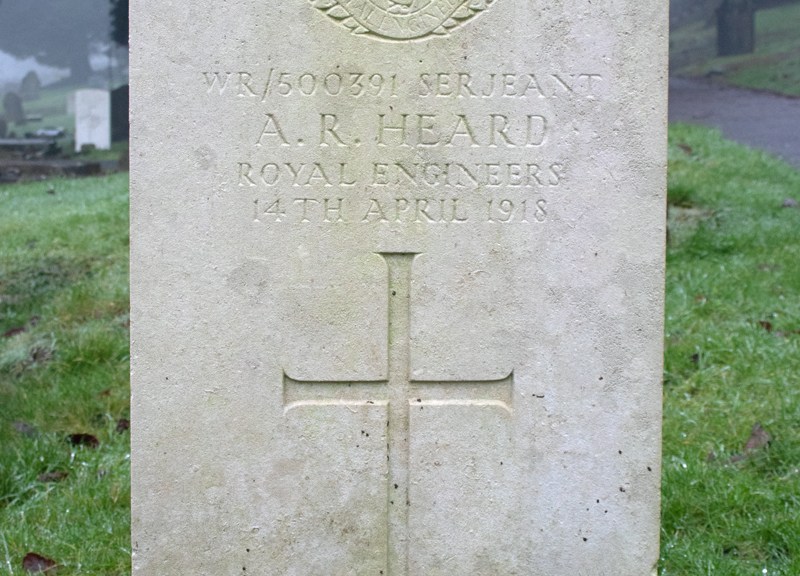
Arthur Reginald Heard was born in 1887, the youngest son to Herbert and Emily. Herbert was a local surveyor and land agent, and the family lived in the middle of Shepton Mallet in Somerset, two doors up from the town’s Baptist Church and within sight of the Magistrate’s Court.

In 1908, aged 21, Arthur made the journey across the Atlantic to Argentina, settling in Buenos Aires and working for the Pacific Railway Company. When war broke out, however, he immediately returned to England, when he enlisted in the army, and was assigned to the Royal Engineers.

Sapper Heard was shipped out to France and was quickly promoted, first to Corporal, then to Serjeant. In November 1917, Arthur was caught up in a shell impact on the front, and was buried. He was quickly dug out, and not severely hurt.

On 25th March 1918, Serjeant Heard was due to return home on leave, but was taken ill. Back in England, he was hospitalised in Birmingham, where meningitis was confirmed. He seemed to recover – even going out for tea with his sister-in-law when she visited him – and was transferred to recuperate in Saltash, Cornwall.

Within days of arriving, he collapsed with a fit, and passed away within half an hour. Subsequent examination confirmed that Arthur had died from a brain tumour. He was just 30 years old.

Arthur Reginald Heard lies at rest in the cemetery of his home town, Shepton Mallet.


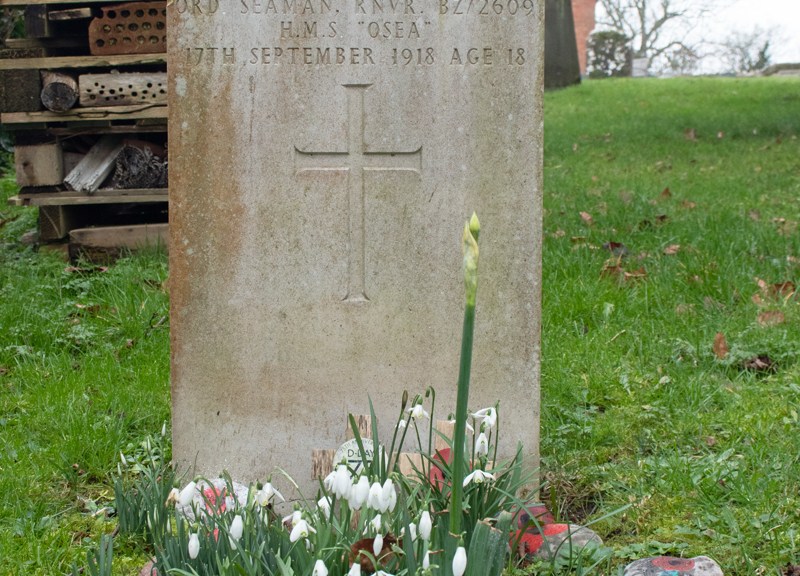
Ordinary Seaman Harry Kick

Ordinary Seaman Harry Kick

Harry Kick was born in August 1900, the oldest of six children to George and Georgina Kick from the small village of Middlezoy in Somerset. George was an agricultural labourer, while his wife helped with the dairy side of Jones Farm, where he worked.

Details of Harry’s military service are scarce, but, based on his age, it is likely to have been the second half of the war when he enlisted. He joined the Royal Navy and was assigned to HMS Osea, a naval base in Essex.

Sadly, there is little evidence of Harry’s time in the navy. His pension records confirm that he passed away on 17th September 1918, having been suffering from pneumonia. He was just 18 years old when he died.

Harry Kick lies at peace in the churchyard of Holy Cross Church in his home village of Middlezoy, Somerset.


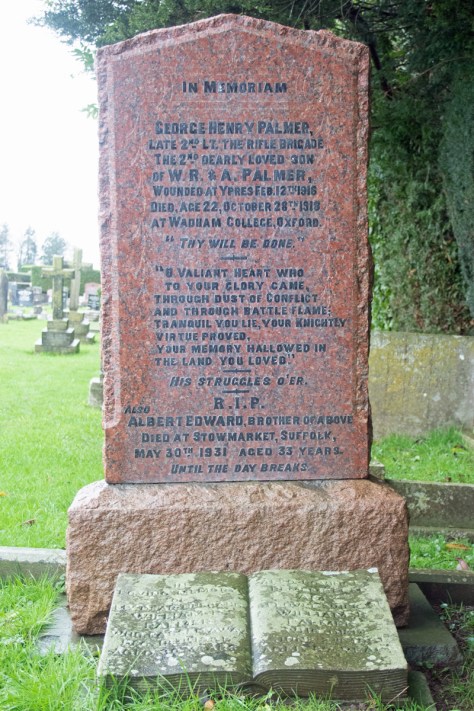
Second Lieutenant George Palmer

Second Lieutenant George Palmer

George Henry Palmer is one of those names that has been a challenge to research and who risked being lost to time.

George and Henry are common names for the late Victorian era, so a simple search on Ancestry brought up too many options to confirm anything specific.

Given the ornate nature of his headstone, it seemed reasonable that his passing and funeral would have been recorded in contemporary media, and indeed it was; the only identifiable name was his own. (His parents “WR and A Palmer” and featured, as is his grandfather “Rev. J Palmer”, but, again, this is not enough to go on for research.)

The additional name on the gravestone, however – George’s brother Albert – proved to be the key, though, identifying the following.


George Henry Palmer was born in May 1896, one of five children to William Richard Palmer and his wife Amy. William was a chemist’s assistant, a job that seemed to move him around the country. William was born in Wells, Somerset, as was his wife and eldest son; George was born in Regents Park, London, while Albert, who was a year younger, was born back in Wells. By the time of the 1901 census (when George was 4 and Albert 3), the family were living in Leicester, and they remained so for the next ten years.

Details of George’s military service comes primarily from the newspaper report of his funeral:

Deceased… was discharged from the Army through wounds received at Ypres in February, 1916, and had resumed his studies at Oxford and entered on a course of forestry, which he was following with great success.

He was well known in Wells, having spent a considerable time in the city and vicinity. He took a great interest in the Wells Volunteers, and was able to drill them in true Army style, having received his training in the Artist Rifles, and later gained his commission in the Rifle Brigade, where he was spoken highly of by his brother officers and men.

Mr Palmer was most thorough and painstaking in all his duties and studies. He was a Wyggestine [sic] scholar at the age of ten years in open competition, and later senior scholar at Wadham College Oxford.

Wells Journal: Friday 1st November 1918.

Second Lieutenant Palmer contracted pneumonia while up at Oxford, succumbing to the illness on 28th October 1918, just a fortnight before the end of the war. He was 22 years of age.

George Henry Palmer lies at rest in the cemetery of his home city of Wells.


Cook’s Mate Harry King

Cook’s Mate Harry King

Harry George King was born in Somerset in December 1894, one of nine children to John and Sarah King. John worked as a cabinet maker in Wells, and Harry followed in a similar vein to his father, becoming an upholsterer.

When war broke out, Harry – who stood at 5’3″ (1.6m) tall – enlisted in the Royal Navy as a Cook’s Mate. He trained on HMS Victory I in Portsmouth, before transferring to the HMV Vernon, a land-based ship, also in Portsmouth.

While on leave in 1917, Harry married Alice Trickey, who had also been born in Wells.

Harry’s first sea-going assignment was on the HMS Hermione, which was a guard ship off the Southampton coast. After two years on board, Cook’s Mate King was transferred to another vessel.

The HMS Glatton was a monitor vessel requisitioned by the Royal Navy from the Norwegian fleet at the outbreak of the First World War. After a lengthy refit, she was finally ready for service in the autumn of 1918, and positioned in Dover in preparation for a future offensive across the Channel.

At 6:15 on the evening of 16 September, there was a small explosion in a 6-inch magazine below decks, which then ignited the cordite stored there. Flames shot through the roof of one of the turrets and started to spread. The fire was not able to be brought under control, and there were concerns that, if the ship’s rear magazine exploded, the presence of the ammunition ship Gransha only 150 yards (140 m) away risked a massive explosion that would devastate Dover itself. The decision was taken to torpedo the Glatton, in the hope that the incoming flood water would quash the fire.

In the event, sixty men aboard the Glatton were killed outright, with another 124 men injured, of whom 19 died later of their injuries. This included Cook’s Mate King.

While the incident wasn’t reported in the media of the time, Harry’s funeral was; it gives a little more insight into the tragedy.

News reached Wells… that 1st Class Cook’s Mate Harry George King… was lying in a hospital at Dover suffering from severe burns caused through an internal explosion on the ship on which he was serving. His wife (…to whom he was married 12 months ago) and his sister at once proceeded to the hospital, where they arrived only a few minutes before he died.

The unfortunate young man had sustained shocking injuries and was conscious for only two hours on Friday. He lost all his belongings in the explosion.

Wells Journal: Friday 27th September 1918.

Harry George King was only 27 years old when he died. He lies at rest in Wells Cemetery, Somerset.


Harry’s widow, Alice, did not remarry; the couple had not had any children, and she passed away in their home town of Wells, in January 1974.


Serjeant Albert West

Serjeant Albert West

Albert Charles West was born in Aldershot, Hampshire, in 1870. The second of nine children, his father Charles was in the army, while his mother Hannah is listed on the 1871 census as a “Soldier’s Wife”.

By the time of the next census, ten years later, Charles had relocated the family to Wells in Somerset – Charles had been born just up the road in Shepton Mallet, so, in effect, he was bringing his family home. By this point, the Wests were a family of seven; Albert had an older sister, Eliza, and three younger siblings, Mary, Joseph and Earnest.

Albert seemed keen to make his own way in the world; by the 1891 census, he had relocated again, this time to South Wales, where he worked as a minor. He boarded with a grocer in the village of Llantwit Fardre. It would have been a bustling house, because Albert was living there with the grocer, his wife and four children and three other lodgers.

The following year, Albert enlisted in the 2nd Battalion Welsh Regiment. Posted to India, he served there for ten of his twelve years’ service.

After completing his enlistment, Albert moved back to Somerset and married Emily Sparrow in Wells. The couple moved back to South Wales for work, however, this time with Albert working in a mine in Llanwonno, ten miles up further up the Taff Valley from Llantwit Fardre.

When war broke out, Albert re-enlisted, this time joining the South Wales Borderers. Sadly, little documentation of his second time in the army remains. He is recorded as having served in the 51st (Graduating) Battalion, which was a training unit based in Suffolk; presumably his experience made him ideal to train others and enabled him to take the rank of Serjeant.

There is nothing to confirm how Serjeant West died. All that is know is that he passed on 9th July 1918. The lack of any media reports around his funeral suggests it is likely to have been illness, rather than injury, that took him. He was 48 years old.

Albert Charles West lies at rest in Wells Cemetery in Somerset.


Charles and Hannah had nine children in total. Two years before Albert passed, their youngest son – Alfred Augustus West – died suddenly and unexpectedly. Records confirm that he was working on the lines at Wells Railway Station, when his foot got caught in the points. Unable to free himself, he was hit by a train and killed.


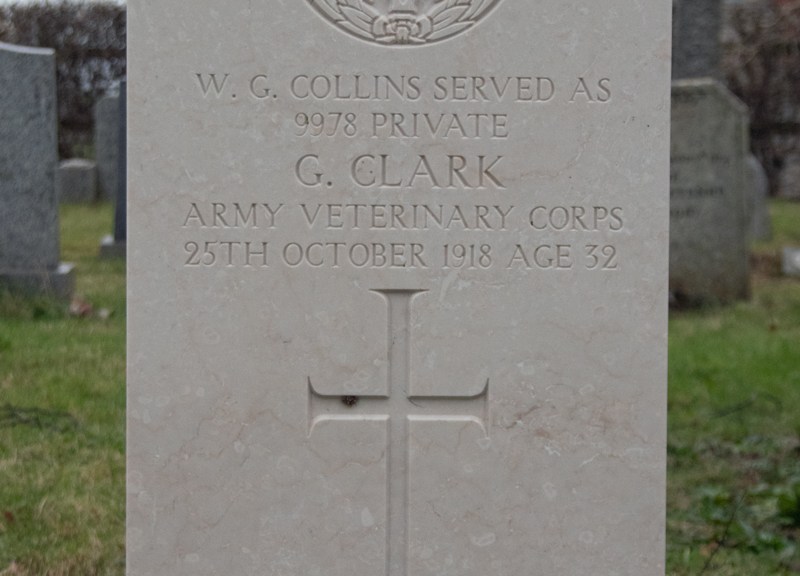
Private William Collins, AKA Geoffrey Clark

Private Geoffrey Clark / Private William Collins

One of the things I have found during this research is that occasionally a mystery will come to light. In the case of the gravestone in the Somerset village of Coxley – nestled on the main road between Wells and Glastonbury – it was the very identity of a person buried there that threw me.

The headstone in question simply says “WG Collins served as Private G Clark in the Army Veterinary Corps”, but the research tools I normally use drew blanks.

The Commonwealth War Graves Commission website confirmed that the second name is Geoffrey Clark, but does not give full names for WG Collins.

Unfortunately, the Findagrave website does not have the burial listed under either name, so that too was a dead end.

The British Newspaper Archives site – a record of media across the UK covering 250 years – similarly has no entry for either name around the time of his death, which suggests it was either not ‘out of the ordinary’ (not headline-grabbing) or his death and funeral were just not submitted to the local paper.

Fold3 – which stores military records – has a record for 9978 Private Geoffrey Clark. The Register of Soldiers’ Effects confirms that a war gratuity was awarded to his sister, Ada Jane Waldron, after his death.

And, as it turns out, it was Ada who proved the key to the mystery of her brother. Working on the basis that Ada’s maiden name was Collins, I used Ancestry.co.uk to try and track her down. The site presented a family tree featuring both an Ada Jane Collins and, more importantly, a William George Collins, and the game was afoot…


William George Collins was born in the Somerset village of Coxley in the summer of 1889. He was the youngest of seven children – Ada was his oldest sister – to James Collins, an agricultural labourer, and his wife Jane.

Following the death of his mother in 1901, and his father a decade later, it’s evident that William wanted to make his way in the world. By the 1911 census, he had moved to Wales, working as an attendant at the Glamorgan County Lunatic Asylum. The asylum, which was in Bridgend, South Wales, was home to nearly 900 patients, and William acted as one of the 120 staff looking after them.

War was on the horizon, however, and the mystery surrounding William returned once more. Military records for William (or Geoffrey) are limited; he enlisted in the Royal Army Veterinary Corps in the summer of 1915 and was shipped to France in September of that year.

There is no record why he enlisted under the name Geoffrey Clark, nor does there seem to be any evidence of either names in his family. As to his passing, there is nothing to give a hint to how he died. All that can be confirmed for certain is that he passed away at the University War Hospital in Southampton on 25th October 1918, at the age of 32.

William’s probate records give his address as Railway Terrace in Blaengarw and show that his effects went to his sister, Ada.

William George Collins – also known as Geoffrey Clark – lies at peace in the graveyard of Christ Church, in his home village of Coxley.