Tag Archives: 1919

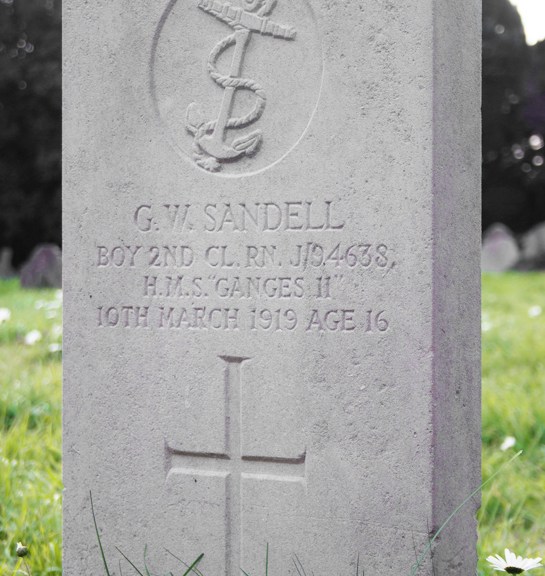
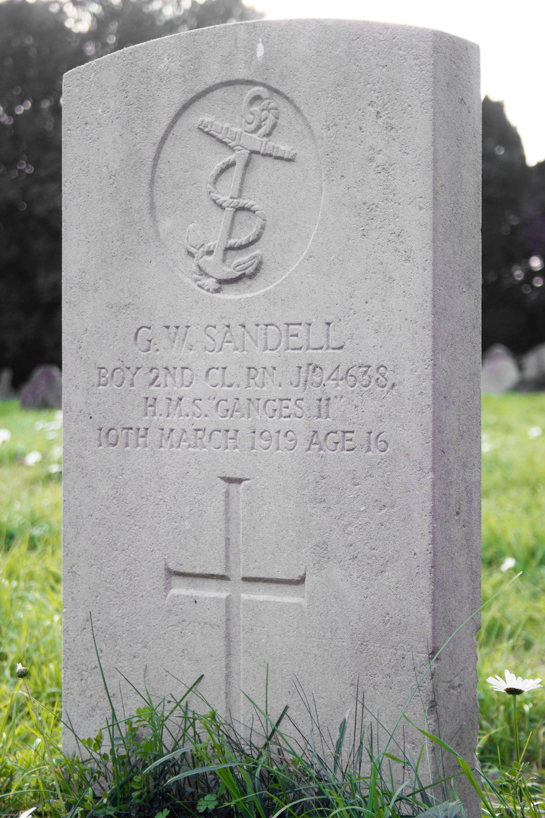
Boy 2nd Class George Sandell

Boy George Sandell

George William Sandell was born on 13th August 1902, the oldest of five children to William and Mary Sandell. While George was born in Chichester, William raised the family in Worthing; he was a carpenter and joiner by trade, and came from a local building family.

When George left school, he found work as a porter on the railways. Too young to be directly involved in the 1914-1918 conflict, he was definitely for adventure, and, on 5th February 1919, he enlisted in the Royal Navy.

Assigned the rank of Boy – because of his age – he was sent to HMS Ganges II, a training establishment in Suffolk. His decision to enlist was set to be young George’s undoing; within weeks he had contracted pneumonia, and he passed away on 10th March 1919. Tragically, he was just 16 years old.

William and Mary brought their boy back to Worthing; he was buried in the Broadwater Cemetery there, within walking distance of their home.


For me, a huge coincidence to this story is that I lived in the house George was brought up in. He was raised at 27 Southfield Road, in Worthing, up until he was sent for training in 1919. I lived at the same address for a number of years in the early 2000s.


Private James Butcher

Private James Butcher

James Butcher was born in the village of Durrington, West Sussex, on 12th April 1880. He was one of seven children to agricultural labourer Henry Butcher and his laundress wife, Sarah. The family were dedicated to the countryside life; by the time of the 1891 census, James was listed as a cowboy, as was his older brother, so at 10 years old, his time would have been spent up on the South Downs, tending a farmer’s bovine herd.

In 1904, James married Eleanor Andrews, the daughter of a publisher’s packer from London. The couple would go on to have six children: William, Thomas, George, Walter, Ernest and Gladys. By the time of the 1911 census, the family were living in Broadwater, to the north of Worthing, and James was listed as a general labourer for the town council.

When war arrived on England’s shores, James was keen to to his bit. He initially joined the Royal Sussex Regiment, although subsequently moved to the Agricultural Company of the Labour Corps. Sadly, Private Butcher’s military service records are no longer available, so it’s impossible to confirm exact dates for his time in the army.

James survived the conflict, but the next record for him is the Army Register of Soldiers’ Effects. This confirms that he was admitted to the Swandean Isolation Hospital on the outskirts of Worthing, and subsequently passed away there. There’s nothing to confirm his cause of death, although, based on the nature of the hospital, it is likely to have been one of the lung conditions prevalent at the close of the war.

James Butcher died on the 22nd March 1919, at the age of 38 years old. He was laid to rest in the Broadwater Cemetery, not far from his home.


James Butcher
James Butcher
(from ancestry.co.uk)

Private Frederick Slaughter

Private Frederick Slaughter

Frederick John Slaughter was born in around 1878, one of eight children to Stephen and Frances (who was better known as Fanny) Slaughter. Stephen was a brewer’s drayman, who had gotten himself in trouble with the law the year before Frederick was born.

Stephen Slaughter charged with feloniously embezzling five several sums of 10s each, which he had received for and on account of his masters, Octavius Coope and others, at Worthing, on the 7th September 1876, was sentenced to six calendar months’ hard labour.

Sussex Advertiser: Saturday 14th April 1877

Stephen was imprisoned in Petworth Jail, but took ill there. Two months later, a further newspaper report shed further light on him:

ANOTHER DEATH IN THE GAOL

On Thursday another inquest – the second within a week – was held at Petworth Gaol… on the body of Stephen Slaughter.

Mr Linton, the governor, said the deceased was about 36 years of age, was a brewer’s drayman and was sentenced at the April Quarter Sessions to six months’ imprisonment with hard labour for embezzlement. He was a very quiet, industrious, and well-conducted prisoner.

On admission he was put to a labour machine, which consists of turning a handle, weighted to 10lbs, and making 14,000 revolutions daily as a maximum. About a fortnight after he was reported to the surgeon. He was looking pale, and was put in the open air to work at the pumps.

About the middle of June he was put to spinning wool, a very light description of work, and on the 18th June witness again reported him to the surgeon. He continued wool spinning until taken ill on Sunday morning last. Warder Daughtery then reported his illness and witness at once sent for Dr Wilmot, and at that gentleman’s request Dr Hope was also called in consultation.

From that time till his death, early on Wednesday, he was under the care of the surgeons, in his cell, which was a roomy, airy one. The Infirmary was occupied by another case.

On Sunday witness wrote to deceased’s brother, and two of them visited him on Monday. (Witness produced a letter, since received from one of deceased’s brothers, in which he said “In conclusion I beg to thank you and all the officials connected with the prison for your kindness to my brother during his illness, as he told me on Monday when I saw him he was treated with the greatest kindness.”)

The evidence of Mr Wilmot and Mr Hope, surgeon, showed that the nature of deceased’s illness necessitated an operation, which was performed with his consent, but that after it he gradually sank and died of exhaustion.

Horsham, Petworth, Midhurst and Steyning Express: 24th July 1877

Stephen died before Frederick was born, leaving Fanny, to bring him and the youngest of his siblings up alone. Fanny found work as a dressmaker and, according to the 1881 census, she lived in a small cottage just off Worthing seafront with her 15 year old daughter, Emily, and her three youngest boys, Walter (who was 8), Arthur (5) and Frederick (3).

When he left school, Frederick found work as a errand boy for the local fishermen; his two older brothers we employed by a local dairy, and the three of them were living with their mother, a paternal uncle and lodger in a cottage in the centre of the town.

Fanny died in 1902, at the age of 62. Seven years later Frederick, now working as a carman for a grocer, married Gertrude Lawrence, who had been born in Kent. The couple went on to have a son – also called Frederick – the following year.

When war came to European shores, Frederick was quick to enlist. He joined the Royal Sussex Regiment on 9th October 1914, and was assigned to the 7th (Service) Battalion as a Private. Full service details are not readily available, but he certainly served in France, having been posted there in June 1915.

While Private Slaughter’s military records are scarce, his medical ones are very detailed. In June 1916 he was treated in the field for scabies, in December that year, he received treatment for pediculosis, an infestation of lice. Eight months later, he was admitted to a hospital in Camiens with an inflamed knee, something which subsequently recurred two months later, when he was admitted for treatment in Etaples. Frederick was received treatment for a fifth time in January 1918, this time for a deformed toe, but after this, his overall health seemed to stabilise.

Private Slaughter was demobbed in March 1919, and returned to England. Sadly, it seemed that his health wasn’t as good as it might have seemed; on 17th July 1919, he died at home from heart failure, which was subsequently attributed to his was service. He was 41 years old.

Frederick Slaughter was laid to rest in the Broadwater Cemetery in his home town of Worthing, West Sussex.


The war years were particularly tragic for Stephen and Fanny’s children. Along with Frederick’s passing in 1919, his oldest brother Harry had died in 1914, two other brothers – Henry and William – had died in 1916, while a fourth brother, Walter, passed away in 1920.


Private Charles Duke

Private Charles Duke

Charles Edward Duke was born in early 1880, the oldest of three children to George and Charlotte Duke. George was a market gardener, but for all of Charles’ childhood censuses – 1881, 1891 and 1901 – his father is absent. Instead, Charlotte is listed as the head of the household, married and working as a launderess. Given that the censuses were all taken in the spring, it is possible that her husband was working away each time the document was recorded, although this is supposition. In every census, though, it is interesting to note that she had taken in lodgers to help pay the bills.

The family lived in Worthing, West Sussex, in a small house near the centre of town. When he left school, Charles found work as an errand boy for a local stationer, before finding more gainful employment as a gardener in one of the multitude of nurseries surrounding the coastal town.

In 1901, Charles married Lucy Barnes, a carter’s daughter from the town; the young couple set up home in Broadwater, to the north of Worthing town centre, and went on to have four children; Alice, Henry, Dorothy and Margaret.

When war arrived on European shores, Charles played his part. Sadly his military records are all but non-existent, but from what remains it’s possible to piece together something of his military life.

Private Duke enlisted in the Machine Gun Corps, and was assigned to the 16th Company. While it is impossible to place him in any specific location, his company was certainly involved in the Battle of the Somme.

Charles survived the war; the next evidence available for him notes that he died on 31st October 1919 in a hospital in Brighton, although o cause is given for his death. The Commonwealth War Graves Commission give his age as 41, although it seems likely he was a couple of years younger than this, based on when his birth was registered.

Charles Edward Duke was buried in the Broadwater Cemetery, a short walk from where his widow and children were living.


Private Henry Greenfield

Private Henry Greenfield

Henry Gordon Greenfield was born in Worthing, West Sussex, in 1890. The fourth of nine children, his parents were Edmund and Caroline. Edmund was a carter from the town, who raised his family in a small terraced house near the station.

By the early 1900s, Edmund had changed profession, becoming a plasterer, and this was employment that his son followed him into. This seems to have been more lucrative for the family, and they moved to a larger property to the north of the town.

In August 1911, Henry married Edith Tombs. Edith was a gardener’s daughter from London, who had moved to Worthing for work. When the couple married, she was employed as a domestic servant for a solicitor and his wife. The young couple would go on to have three sons.

When war broke out, Henry was quick to enlist. He initially joined the Royal Sussex Regiment, serving his time as part of the 10th Battalion. This was a reserve company, that was based on home soil. When hostilities came to an end, Henry was transferred to the Labour Corps, and was billeted in Belfast.

Little further information about Henry’s service can be confirmed; he was admitted to the Military Hospital in Belfast with pneumonia, but sadly died of the condition on 27th February 1919. He was just 28 years old.

Brought back to Worthing, Henry Gordon Greenfield lies at rest in the Broadwater Cemetery there, not far from his parents and widow.


Henry’s younger brother Frederick also served during the Great War. Joining the Royal West Kent Regiment as a horse driver, he fought on the Western Front. He was killed on 17th August 1917, and is buried at the Duisans Cemetery in northern France. He was just 21 years of age.


Deck Hand Charles Bashford

Deck Hand Charles Bashford

Charles Bashford was born on 10th August 1890, one of fifteen children to James and Mary Ann Bashford. James was a fisherman, and the family lived in Field Row, a narrow lane in the centre of Worthing, West Sussex.

The seaside town was a centre of fishing activity, so it is no surprise that most of James and Mary Ann’s children went into it in some way, and Charles was no exception. The 1911 census list him as the youngest of four siblings still living at home, and three of those gave their trade as fisherman, as well as James. Charles’ older brother William was the only sibling not to, and he was working as a printer.

War was coming to Europe, and, given his seafaring experience, it is no surprise that Charles sought to enlist in the Royal Navy. He joined up on 12th August 1916 and, after six weeks’ training, was assigned to the Royal Navy Reserve (Trawler Section). During his service he would have been involved in minesweeping and anti-submarine activities, using his own boat – or his family’s one – to do so.

Little further information is available for Deck Hand Bashford. He survived the war, but passed away on 11th August 1919 at the Royal Haslar Hospital, where he had been admitted, suffering from pneumonia. He was 28 years old.

Charles Bashford was brought back to his home town of Worthing; he was laid to rest in the Broadwater Cemetery there.


Private Fred Vincent

Private Fred Vincent

Fred Vincent was born in Crewkerne, Somerset, in 1889, one of seven children to Charles and Elizabeth Vincent. Charles was a dairyman, and, over the years, the whole family helped out in the business. This seemed a transitory business – over the years, the family moved around Dorset and, by the time of the 1911 census, were living in Wiltshire.

Frustratingly, after that document, Fred’s trail goes quiet. He married a woman called Dorothy, and at some point the couple moved to Worthing, West Sussex, although there are no records to confirm dates for either of these.

When war broke out, Fred enlisted in the Royal Sussex Regiment. Documents are again lacking, so it is impossible to tell which battalion he served in, or whether he was based at home or abroad. Private Vincent did subsequently transfer to the Labour Corps, although again, dates and the location of his service are not available.

Sadly, Fred has disappeared into the mists of time. He and Dorothy were living in Worthing when he passed away on 9th March 1919, at the age of 30 years old. There is nothing in contemporary newspapers to suggest that his passing was anything out of the ordinary.

Fred Vincent lies at rest in the Broadwater Cemetery of his adopted home town of Worthing.


Petty Officer William Dale

Petty Officer William Dale

William Edmund Dale was born in Worthing, West Sussex on 25th November 1886 and was the older of six children. His father, also called William, was a carman, and he and William’s mother, Eliza, brought the family up in the Sussex town.

William Jr seems to have had a number of jobs, working as a draper’s errand boy, a milkman’s assistant and a gardener. He found his true calling at the age of 12, however, when he enlisted in the Royal Navy.

Initially acting as a Boy 2nd Class, over his initial twelve years’ employ he served on eleven vessels, and rose through the ranks to Boy, Ordinary Seaman and Able Seaman.

It was while serving on HMS Blake in 1910, that he married Mary Williams. The couple went on to have two children, William, born in 1910, and Harry, born the following year. The family set up home in Portsmouth, where the sailor was based.

With his initial service complete in 1916, William’s term of duty was extended until the end of hostilities. A promotion to Leading Seaman followed, and he was assigned to HMS Attentive, part of the Dover Patrol guard.

In 1917, William was promoted again, this time to the role of Petty Officer, and was assigned to HMS Royal Sovereign, the Navy’s new battleship. He served on the vessel for the remainder of the way, and through into the summer of 1919.

It was in the last month of his service, that Petty Officer Dale fell ill. He was taken ashore, and sent to the Royal Naval Hospital in Chatham, Kent. He had contracted meningitis, and sadly succumbed to it within days of being admitted. He died on 4th August 1919, at the age of just 32 years old.

William Edmund Dale was brought back to the town of his birth; he lies at rest in a quiet corner of the Broadwater Cemetery in Worthing, West Sussex.


Private John Blake

Private John Blake

John George Blake was born early in 1878, and was the oldest of seven children. His father, Job, was a general labourer, and, with Eliza, John’s mother, brought the young family up in the West Sussex town of Worthing.

Job died in 1898, ages just 36 years old; Eliza found work as a housekeeper, while John was employed as a carter for the railway. By the 1901 census, the family were living in a terraced house near the centre of town, Eliza living there with her three sons, two daughters, son-in-law and granddaughter.

In October 1904, John married Alice Attwater, a labourer’s daughter from mid-Sussex. The couple moved into a house close to the station and went on to have four children; John Jr, Ernest, Bertha and Dorothy. John was by now working as a porter for the railway, a role he continued through to the outbreak of war.

John enlisted in November 1914; he joined the Royal Sussex Regiment, working as a member of the depot staff. Private Blake was shipped overseas, arriving in France in March 1916.

Almost exactly a year after landing in France, John was injured in the line of duty. The medical report confirmed that a “scald on the left arm and neck [had] occurred while on duty on March 1st 1917, in France. He was preparing hot soup for his company in the front line at midnight. He was not to blame. Injury caused by enemy shelling the company kitchen“.

Private Blake was shipped back to England for treatment, and admitted to Netley Hospital near Southampton. While there, he contracted phthisis (tuberculosis), which left his totally incapacitated. He was medically discharged from military service in August 1917.

Further details of John’s life are scarce. He returned home to his family, although whether he took up his job again is unknown. He passed away on 22nd June 1919 at the age of 41. The cause of his death is unknown, although it seems likely to have been related to the tuberculosis.

John George Blake lies at rest in the Broadwater Cemetery of his home town, Worthing.


Serjeant William Wilcox

Serjeant William Wilcox

Soloman William Wilcox – known by just his middle name – was born in 1894 and was one of seven children. His father, James, was a carter from Keinton Mandeville in Somerset, and he and William’s mother, Eliza, brought the family up in neighbouring Charlton Mackrell.

By the time of the 1911 census, William had left school, and was working as a farm labourer, with his older brother Sidney. James, meanwhile, had found further employment working in a local bluestone quarry.

War was on the horizon and, while it is evident that he enlisted in the Duke of Cornwall’s Light Infantry, there is little further documentation to track his service. Both of the regiment’s main battalions fought on the Western Front, though where and when William was involved is lost to time.

He seems to have been an ambitious young man; he rose through the ranks and, at the point he was discharged, he had risen to the role of Serjeant. He was also in receipt of the Military Medal, though there is no further information about the events that led to this.

William may well have been spurred on by family losses he suffered during the conflict. His mother Eliza died in April 1915, his brother Sidney was killed in action on 10th September 1916, and his father James passed away in August 1918.

Serjeant Wilcox survived the war, and was eventually discharged from military service in August 1919. Whether he was simply demobbed, or he was medically discharged is unclear, but, given that he died only a few months later, it seems likely that the latter was the case.

Soloman William Wilcox died in Taunton, Somerset, on 10th November 1919, at the age of 25 years old. His body was brought to St Peter & St Paul’s Church in Charlton Adam, Somerset, potentially close to where some of his remaining family lived.


Larger memorial image loading...
Serjeant William Wilcox
(courtesy of findagrave.com)