Edward John Browning was born in the autumn of 1897 in the Somerset village of Over Stowey. The youngest of five children, his parents were blacksmith-turned-farmer John Browning and his wife, Alice.
By the time of the 1911 census, the family had moved to nearby Colepool Farm in Stogursey. Edward’s older brothers were all supporting their father on the farm, while, at 13 years of age, he was still to complete his schooling.
Details of Edward’s military life are scarce. When war broke out he enlisted, and joined the 3rd (Reserve) Battalion of the Somerset Light Infantry. His troop served on home soil, moving to Derry/Londonderry, Northern Ireland, by November 1917, and Belfast by the following spring.
Private Browning survived the conflict but had fallen ill by the summer of 1919. He was admitted to the Purdysburn Military Hospital in Belfast. He was suffering from cerebrospinal meningitis, and this was to claim his young life. He passed away there on 9th July 1919, at the age of just 21 years old.
The body of Edward John Browning was brought back to Somerset for burial. He was laid to rest in the peaceful graveyard of St Andrew’s Church in Stogursey.
Oliver Banwell was born in Burnham-on-Sea, Somerset, in 1882. One of nine children, his parents were mason William Banwell and his wife Jane. When he completed his schooling, Oliver followed his father into manual work and, by the time of the 1901 census, he was employed as a bricklayer.
In 1910, Oliver married Mary Ann Burrows, a carter’s daughter from Axbridge: the couple settled down in lodgings on Oxford Street, near the centre of Burnham-on-Sea, and went on to have three children: Stanley, Primrose and Violet.
When war came to Europe, Oliver stepped up to serve his King and Country. He gave up his new employment as a groom and enlisted on 13th September 1915, joining the Royal Engineers as a Sapper. His service records give some idea of the man he had become. He was 5ft 8.5ins (1.74m) tall, weighing 141lbs (64kg), and was noted to be of good physical development, although he had slight varicose veins in both legs.
Sapper Banwell found himself in France by the end of April 1916. He spent six months overseas, before being posted back to Britain. Initially attached to the 82nd Training Reserve Battalion at the Royal Engineers Barracks in Chatham, Kent, by July 1917, he had moved again, to the 39th Fortress Company, in Sheerness.
In July 1918, Oliver was back in France again, where he was to remain until after the Armistice. By this point his health was beginning to fail and, on his return to Britain in December 1918, a medical examination deemed him no longer fit for army service. He was formally discharged from the Royal Engineers on 30th January 1919, suffering from cancer of the rectum.
Oliver returned to Burnham-on-Sea, and spent the next ten months with his family. His battle with cancer finally proved too much: he passed away on 4th December 1919, at the age of 37 years old.
Oliver Banwell was laid to rest in the family plot in Burnham Cemetery. Mary Ann was buried alongside him when she passed away in 1965, husband and wife reunited after 46 years.
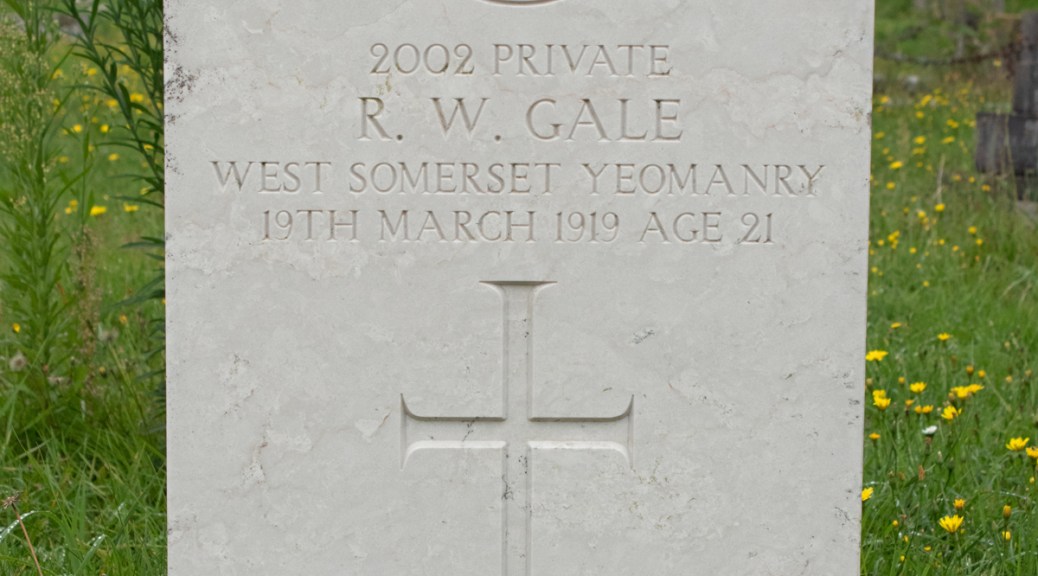
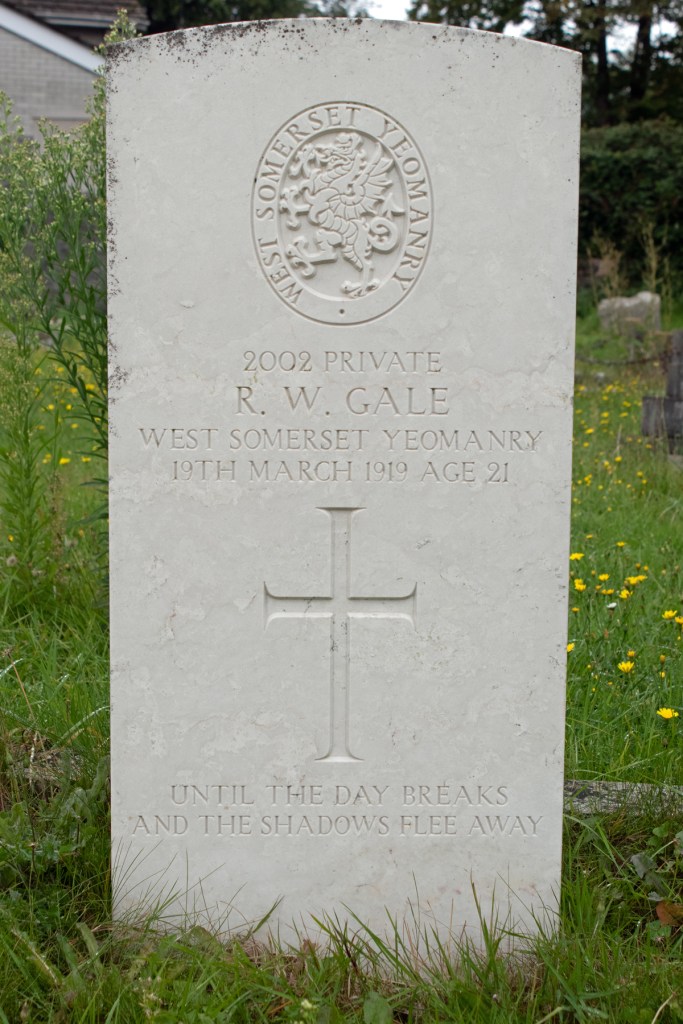
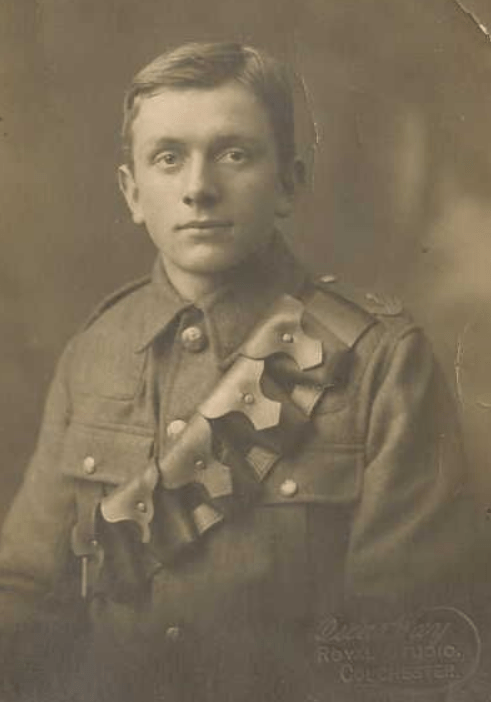
Richard William Gale was born in the autumn of 1897 in the Devon village of Sidbury. The third of six children, he was the son of George and Emma Gale. George was a bricklayer and labourer, and the family had moved to Burnham-on-Sea, Somerset, by the time Richard was ten, as this is where he had found work.
When Richard finished his schooling, he found employment as an errand boy for a school outfitters. By the time oft he 1911 census, there were four wages coming into the Gale household. Besides Richard and his father, his older brother, Frederick was working as a grocer’s apprentice, and his sister, Laura, was a dressmaker.
War was declared in the summer of 1914, and Richard was called upon to play his part. His service records no longer exist, so it is not possible to fully track his time in the army. However, he initially joined the 2nd/1st Battalion of the West Somerset Yeomanry and was sent for training in East Anglia.
As some point, Private Gale transferred to the Labour Corps, and became attached to the 949th Employment Company. Based in the London area, Richard’s duties are unclear, and his troop would have taken on any of a wide range of roles, from cooking and store work, to salvage, traffic control and telephone operating. Whether his previous work at the outfitters came into play is unclear, although Employment Companies were also involved in tailoring, shoemaking and laundry work.
Private Gale survived the conflict, and seems to have been based in the the Nottingham area after the Armistice. By March 1919, he had become unwell and, having contracted pleurisy, he was admitted to the Berridge Road Military Hospital. The condition took its toll on Richard, sadly, and he passed away on 19th March 1919. He was just 21 years of age.
Richard William Gale’s body was taken back to Somerset for burial. He was laid to rest in the cemetery of Burnham-on-Sea, a short walk from where his family lived.
Henry George Yard was born on 25th October 1884 in the Somerset village of Burnham-on-Sea. The second of seven children, his parents were John and Elizabeth Yard. John was a railway porter, but Henry chose a different route, becoming a mason’s labourer.
Henry’s work took him to South Wales, where he took up a position as a pit mason. The 1911 census recorded him as boarding in a six-roomed house in Abertillery, Monmouthshire. From the document there can be no mistaking that this was a mining community. The head of the household for 70 New Gladstone Street was 28-year-old Albert Francis, colliery banksman. He lived there with his wife, Martha, who was fifteen years older than him, and her three children: William, Herbert and Horace.
Martha had been married previously, to coal miner Walter Mutter. Both had been born in Somerset, and had come to South Wales like so many other families, because of the work. Walter died at the beginning of 1909, leaving his widow to raise three children on her own. It seems likely that this is where Albert stepped up: it was not unknown for mine workers to support each other in times of dire need. He married his former colleague’s widow in the autumn, securing a future for her and her family.
According to the census record, the Francis family had one other boarder and all but Martha and Horace worked in the local colliery in one way or another.
There seemed to have been money in Henry’s career move, as it set him up to marry Gertrude Coombes on 6th August 1912. She was a gardener’s daughter from Berrow in Somerset, and eight years younger than her husband. The couple married at St Mary’s Church, Berrow, and appeared to settle back in South Wales. They went on to have two children: Gertrude, who was born the following year, and Daisy, who came along in 1916.
When war came to Europe, Henry was called upon to play his part. He enlisted in October 1915, and was initially assigned to the 3rd Battalion of the Welch Regiment. His service records show that he was 5ft 6ins (1.68m) tall, and weighed 133lbs (60.3kg). He was noted to be of good physical development, although dental treatment was required.
Private Yard transferred to the Machine Gun Corps at some point, and by the autumn of 1916 was sent to Greece. He remained there for nearly two years, but became dogged by malaria in later months there. Initially coming down with the condition in August 1917, he spent the remainder of the war in and out of hospital as attacks of the condition came and went.
Initially returning to home soil and placed on reserve status, Henry was eventually discharged on medical grounds at the end of 1918. He returned to the family home. He was not to be there for long, however: debilitated by malaria, Henry passed away in Bedwellty on 23rd March 1919, at the age of 34 years old.
With strong family connections in Somerset, Gertrude took her husband back there to be laid to rest. Henry George Yard was buried in the tranquil graveyard of St Mary’s Church in Berrow.
Lot Evans was born in Street, Somerset, on 30th October 1895. The second of two children, his parents were George and Elizabeth Evans. Lot’s mother had four children from a previous marriage and, by the time of the 1901 census, the family had set up home in the coastal village of Brean. George was employed as a farm labourer there, as were Lot’s older half-brothers.
When Lot completed his schooling, he also found work as a farm labourer. The next census return, in 1911, recorded the family of four still living in Brean. George had eased up on the manual work – he was 67 by this point – and was employed as a domestic gardener. Lot’s older brother Ben was a bricklayer’s labourer, so there were three wages – albeit probably meagre ones – coming in to support the household.
When war came to European shores, both Lot and Ben stepped up to play their part. Lot enlisted on 10th November 1915, but was not actually mobilised until January 1918. He joined the Royal Garrison Artillery as a Gunner, and was assigned to the 4th Siege Battery.
On 28th March 1918, Lot married his sweetheart, Hester Puddy. Theirs was to be a brief honeymoon, as he was sent to France just three days later.
Gunner Evans remained overseas until the end of the year, returning home on 5th February 1919 in advance of being demobbed.
He was very ill with influenza. He went to bed and we had the Doctor. It developed into pneumonia and he died last night [13th February 1919].
Letter from Private Ben Evans to the Royal Garrison Artillery
Gunner Evans was just 23 years old when he died. The letter sent by his brother – who was also at home and waiting to be demobbed from the Wiltshire Regiment – explained that Hester was living with their family and his question to the regiment concerned how to claim his brother’s pension.
Lot Evans was laid to rest in the graveyard of St Bridget’s Church in Brean. Now surrounded by caravan parks and holidaymakers, at the time, this would have been a place of sanctuary bordering the Somerset coastline.
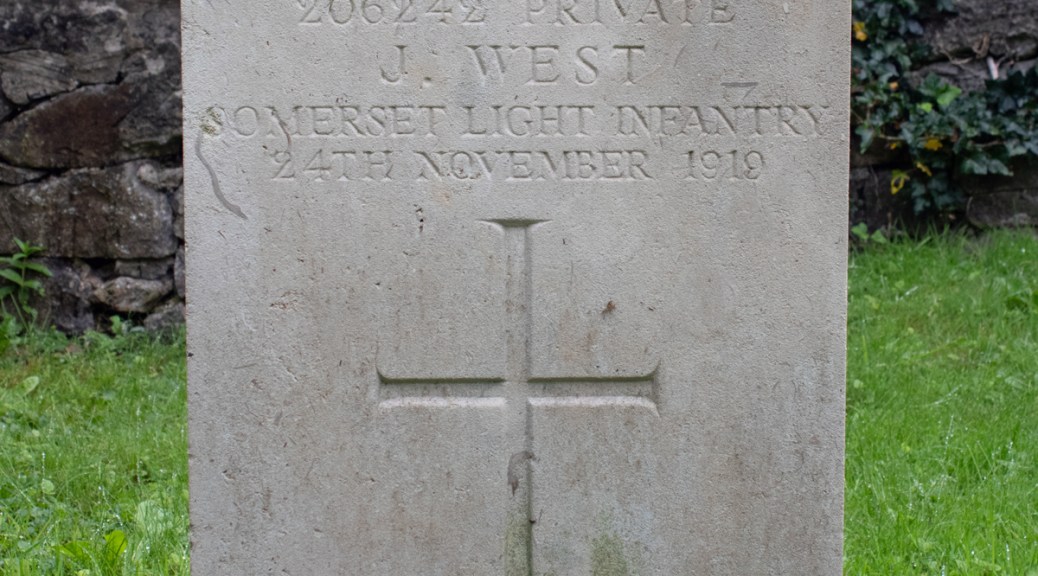
Jeremiah West was born in the spring of 1892, the oldest of eight children to John and Laura West. John was an agricultural labourer from Somerset, and it was in the village of Bleadon that the family were born and raised.
When he finished his schooling, Jeremiah followed in his father’s footsteps. By the time of the 1911 census, he was working as a servant on the nearby Shiplette Farm, where he was employed by Kate Poole.
War came to Europe in 1914, and Jeremiah stepped up to play his part. He enlisted in the Somerset Light Infantry in 1915, and was assigned to the 4th Battalion. Private West set sail for India that August, and seems to have remained overseas for some time.
Records are not clear, but it would appear that Jeremiah returned to Britain at some point, and became attached to the 3rd Battalion of the Bedfordshire Regiment. This was a garrison troop, based in Harwich, Essex, and Jeremiah found himself part of the battalion’s Labour Corps.
Private West survived the war, but came down with pneumonia in the autumn of 1919. He passed away on 24th November 1919: he was 27 years of age.
Jeremiah West was brought back to Somerset for burial. He was laid to rest in the peaceful graveyard of St Peter and St Paul’s Church in his home village of Bleadon.
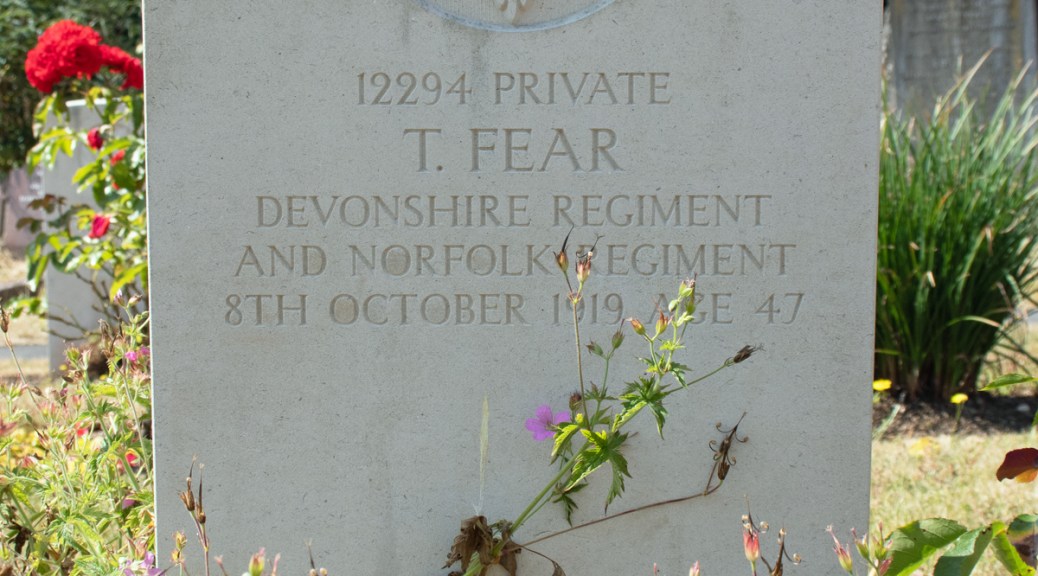
Thomas Fear was born in around 1872 in East Pennard, Somerset. The youngest of six children, his parents were Thomas and Harriet Fear. Thomas Sr was a general labourer, who had moved his family to Bath, where work was more plentiful, by the time of the 1881 census.
When Thomas Jr finished his schooling, he sought bigger and better things. He enlisted in the Devonshire Regiment, and while his service records no longer exist, other documents confirm that he fought in the Second Boer War in South Africa at the turn of the century.
On 5th August 1893, Thomas had married Bath-born Sarah Hughes, who was the daughter of a printer’s machinist. The couple went on to have three children: Albert, Nora and Rose. By the time of the 1911 census, the family were living in a four-roomed apartment near the centre of Bath. Thomas was employed as a stoker for a gas company, Albert was working as a tailor’s errand boy, and Nora had found employment at a lace factory.
When war broke out, Thomas felt the calling to serve his country once more. He enlisted on 1st September 1914, just weeks after conflict had broken out, joining the Somerset Light Infantry. His service records confirm that he was 5ft 5ins (1,65m) tall and weighed 136lbs (61.7kg). He was noted as having brown hair, blue eyes and a fair complexion.
Private Fear was transferred to his old regiment – the Devonshire – at the end of September, remaining on home soil until September 1915. At this point, his troop was sent to France, but he was not to remain on the Western Front for long. In November, his troop was sent to the Eastern Mediterranean, and for the next year, Thomas was based in Salonika.
While in Greece, Thomas contracted malaria, and this was to continue to affect his health in the months and years to come. By Christmas 1916, he had been sent back to Britain, and the following September, he was medically discharged from the army as he was no longer physically fit to continue.
At this point, Thomas’ trail goes cold. At the end of December 1917, “after much suffering patiently borne” [Bath Chronicle and Weekly Gazette: Saturday 5th January 1918], Sarah passed away, aged just 44 years of age. All of the children were of age by this point, and it can only be assumed that Rose, at least, was still residing in the family home.
The funeral took place at Locksbrook on Monday of the late Private Fear, whose death occurred at the [Bath] War Hospital. Private Fear, whose age was 45 [sic], was an old soldier, and had seen service in the South African and the late European Wars. In the latter he served with the 2nd/4th Battalion of the Norfolk Regiment, from which he was discharged in May, 1916. As an army pensioner, he was sent to the War Hospital by the Ministry of Pensions, but, unfortunately, his case proved fatal.
Bath Chronicle and Weekly Gazette: Saturday 18th October 1919
Thomas was actually 47 at the time of his passing, and it seems likely that he died of the condition that had resulted in his medical discharge from the army, malaria.
Thomas Fear was laid to rest in the military section of Locksbrook Cemetery, Bath, not far from where Sarah had also been buried.
John Edmonds was born on 12th November 1871 in Bath, Somerset. The oldest of five children, his parents were market gardener Albert Edmonds and his wife, Ellen.
When he finished his schooling, John found work as a miner. He sought a more adventurous career, however, and, on 8th November 1894 he enlisted in the army. Assigned to the Royal Artillery, Gunner Edmonds’ service records noted that he was 5ft 8ins (1.73m) tall and weighed 149lbs (67.6kg). He had brown hair, grey eyes and a sallow complexion, with a couple of marks above and below his left eye.
Gunner Edmonds was assigned to the 4th Mountain Battery and spent most of the next year training on home soil. On 17th September 1895, however, he was transferred to the 5th Mountain Battery, and shipped off to India, where he was to spend the next nearly nineteen years. During his time on the Asian sub continent, John was awarded the India Medal, with clasps for the Punjab Frontier and Tirah (both 1897-98). He was also awarded the Delhi Durbar Medal in 1911.
When war came to Europe in August 1914, John was recalled to British shores. He was not to remain on home soil for long, however as, on 9th December he was sent to France as part of the Royal Garrison Artillery. He spent just over a year on the Western Front before his troop was dispatched to Salonika, Greece, in December 1915.
Gunner Edmonds was to remain in the Eastern Mediterranean for a little over three years. During this time he had a short period in hospital, having contracted malaria, but saw the war out in Greece, returning home in March 1919. John was formally stood down from military service on 25th April 1919, having completed 24 years 169 days in the army.
Returning to Bath, John’s health had started to suffer. He had developed cancer, and passed away from the condition on 4th October 1919. He was 47 years of age.
John Edmonds’ body was laid to rest in the military section of Bath’s Locksbrook Cemetery.
In a quiet corner of Portishead Cemetery, Somerset, is the grave of Private EG Davies. His headstone confirms that he was in the Duke of Cornwall’s Light Infantry, give the date of his death – 23rd March 1919 – and his age when he passed – 40 years old. The Commonwealth War Graves Commission website confirms that Private Davies transferred to the Labour Corps, but only a couple of documents remain from his time in the army.
The soldier’s pension records confirm that his full name was Edward George Davies, and that, at the time of his death, he was living with his ‘unofficial wife’, Minnie Louisa Holbrook. The records also give the cause of death: influenza and septic bronchitis.
Minnie Louisa Fido was born in the spring of 1874 in Bedminster, Bristol, one of thirteen children to farmworker David Fido and his wife, Sarah. She married Arthur Holbrook on 28th April 1895, and had Gertrude four months later.
The Somerset School Register from 1906 notes that Gertrude Fido joined the Church of England School in Weston-in-Gordano on 12th February. It gives her mother’s name as Minnie Fido, but doesn’t give a father’s name. It seems that Gertrude left the school in November 1914, as she had found work.
A search of the 1911 census records shows Edward and Minnie (whose surname is now given as Davies), living in George Street, Portishead. Edward is listed as a wagoner on a farm, and that he was born in Gloucestershire. Minnie is noted as a charwoman from Nailsea, Somerset. Making up the household is Gertrude, noted as being Edward’s stepdaughter, and who was working as a domestic servant.
Edward’s history is more of a challenge to piece together. His name is too common to be able to single him out on census records, and, while the 1911 census suggests he and Minnie had been married for eight years, there is no marriage record to shed any further light on his family. (This is not surprising, given that his army pension documents suggest Minnie was his unofficial wife.)
Most of Edward’s life, therefore, is destined to remain lost to time. Minnie did not marry, or co-habit, again, and she passed away on Christmas Day 1949, at the age of 75 years old. Gertrude looks to have married a man called Bessant. The 1939 England and Wales Register recorded her living in the Portishead area, and working as a supervisor in a boot factory. She was living with her maternal uncle, Herbert Fido, but was noted as being the head of the household. She died early in 1967 in Weston-super-Mare.
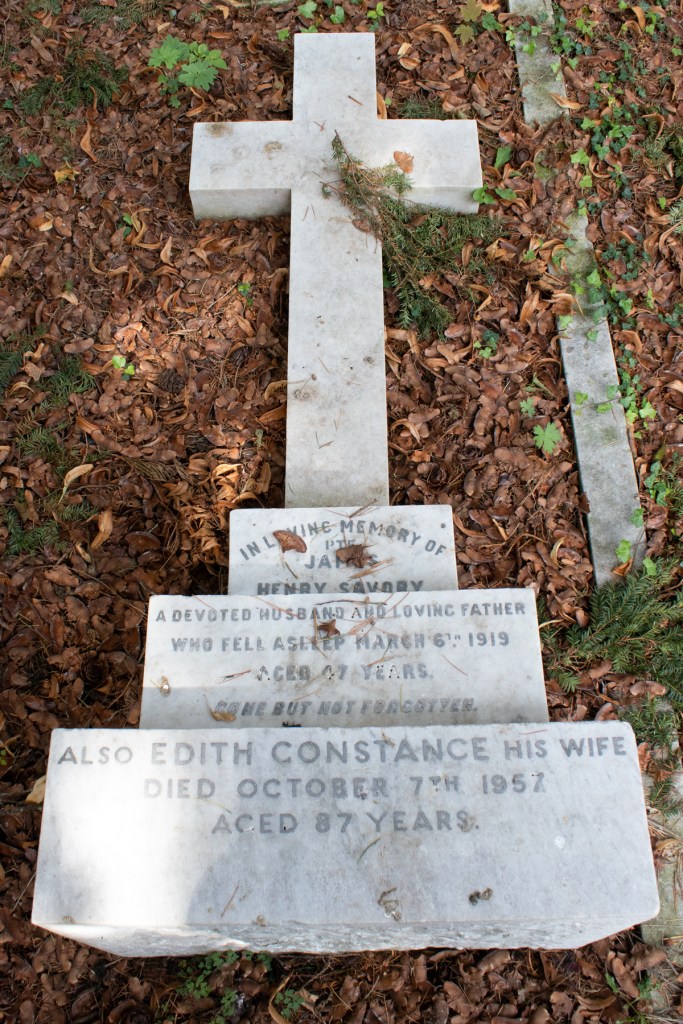
James Henry Savory was born in Gloucester in the spring of 1872. An only child, his parents were Frederick and Sophia Savory. Frederick was innkeeper of the town’s Bell Inn, but things seemed to go wrong for the family as time passed.
Both Frederick and James disappear from the 1891 census return, while Sophia is recorded as being an inmate in the Bristol City Workhouse. She was still there ten years later, although whether she had been there for the full decade is unclear.
James, by this point, had found employment as a travelling labourer. By the autumn of 1891, he had met Edith Morgan, a butcher’s daughter from Bristol. The couple married on 16th May 1892, four days before Edith gave birth to their first child, a daughter they called Eleanor. The couple set up home in Bedminster, James finding work as a foreman at the local marble works. He and Edith went on to have four children in all.
James was drawn to piecemeal work: by the time of the 1911 census, the family had moved to Portishead, Somerset, and he was employed as an ironmonger. His son, James Jr, was apprenticed in the same line of work, and the family had a relative, 71-year-old printer William Badger, boarding with them to bring in a little extra money.
What war came to Europe, James stepped up to play his part. Full records are not available for him, but he certainly enlisted in the army. Based on his age – he was 42 years old when the conflict began – it seems likely that he either volunteered for service, or that he was called up later in the war.
Private Savory was attached to the 19th Battalion of the Hampshire Regiment. Whether he service on home soil or overseas is unclear, but he survived through to the end of the war, and had returned home by the start of 1919.
James Henry Savory died on 6th March 1919: he was 46 years of age. He was laid to rest in Portishead Cemetery, not far from where his widow still lived. Edith lived on until October 1957: she was laid to rest with her late husband, reunited after nearly forty years.








 Death and Service