Tag Archives: 1919

Private Thomas Fear

Private Thomas Fear

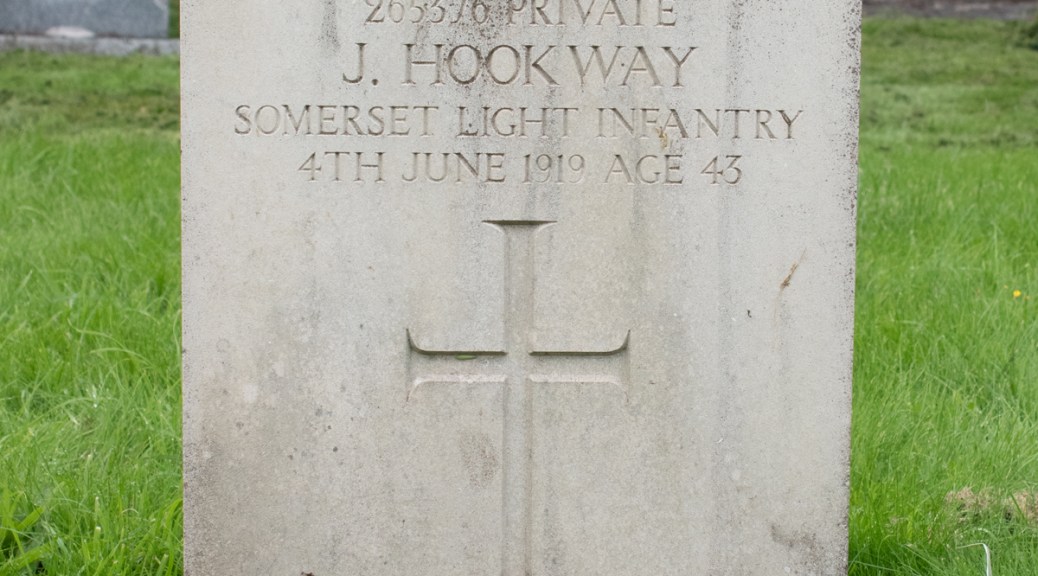
Thomas Fear was born in around 1872 in East Pennard, Somerset. The youngest of six children, his parents were Thomas and Harriet Fear. Thomas Sr was a general labourer, who had moved his family to Bath, where work was more plentiful, by the time of the 1881 census.

When Thomas Jr finished his schooling, he sought bigger and better things. He enlisted in the Devonshire Regiment, and while his service records no longer exist, other documents confirm that he fought in the Second Boer War in South Africa at the turn of the century.

On 5th August 1893, Thomas had married Bath-born Sarah Hughes, who was the daughter of a printer’s machinist. The couple went on to have three children: Albert, Nora and Rose. By the time of the 1911 census, the family were living in a four-roomed apartment near the centre of Bath. Thomas was employed as a stoker for a gas company, Albert was working as a tailor’s errand boy, and Nora had found employment at a lace factory.

When war broke out, Thomas felt the calling to serve his country once more. He enlisted on 1st September 1914, just weeks after conflict had broken out, joining the Somerset Light Infantry. His service records confirm that he was 5ft 5ins (1,65m) tall and weighed 136lbs (61.7kg). He was noted as having brown hair, blue eyes and a fair complexion.

Private Fear was transferred to his old regiment – the Devonshire – at the end of September, remaining on home soil until September 1915. At this point, his troop was sent to France, but he was not to remain on the Western Front for long. In November, his troop was sent to the Eastern Mediterranean, and for the next year, Thomas was based in Salonika.

While in Greece, Thomas contracted malaria, and this was to continue to affect his health in the months and years to come. By Christmas 1916, he had been sent back to Britain, and the following September, he was medically discharged from the army as he was no longer physically fit to continue.

At this point, Thomas’ trail goes cold. At the end of December 1917, “after much suffering patiently borne” [Bath Chronicle and Weekly Gazette: Saturday 5th January 1918], Sarah passed away, aged just 44 years of age. All of the children were of age by this point, and it can only be assumed that Rose, at least, was still residing in the family home.

The funeral took place at Locksbrook on Monday of the late Private Fear, whose death occurred at the [Bath] War Hospital. Private Fear, whose age was 45 [sic], was an old soldier, and had seen service in the South African and the late European Wars. In the latter he served with the 2nd/4th Battalion of the Norfolk Regiment, from which he was discharged in May, 1916. As an army pensioner, he was sent to the War Hospital by the Ministry of Pensions, but, unfortunately, his case proved fatal.

Bath Chronicle and Weekly Gazette: Saturday 18th October 1919

Thomas was actually 47 at the time of his passing, and it seems likely that he died of the condition that had resulted in his medical discharge from the army, malaria.

Thomas Fear was laid to rest in the military section of Locksbrook Cemetery, Bath, not far from where Sarah had also been buried.


Gunner John Edmonds

Gunner John Edmonds

John Edmonds was born on 12th November 1871 in Bath, Somerset. The oldest of five children, his parents were market gardener Albert Edmonds and his wife, Ellen.

When he finished his schooling, John found work as a miner. He sought a more adventurous career, however, and, on 8th November 1894 he enlisted in the army. Assigned to the Royal Artillery, Gunner Edmonds’ service records noted that he was 5ft 8ins (1.73m) tall and weighed 149lbs (67.6kg). He had brown hair, grey eyes and a sallow complexion, with a couple of marks above and below his left eye.

Gunner Edmonds was assigned to the 4th Mountain Battery and spent most of the next year training on home soil. On 17th September 1895, however, he was transferred to the 5th Mountain Battery, and shipped off to India, where he was to spend the next nearly nineteen years. During his time on the Asian sub continent, John was awarded the India Medal, with clasps for the Punjab Frontier and Tirah (both 1897-98). He was also awarded the Delhi Durbar Medal in 1911.

When war came to Europe in August 1914, John was recalled to British shores. He was not to remain on home soil for long, however as, on 9th December he was sent to France as part of the Royal Garrison Artillery. He spent just over a year on the Western Front before his troop was dispatched to Salonika, Greece, in December 1915.

Gunner Edmonds was to remain in the Eastern Mediterranean for a little over three years. During this time he had a short period in hospital, having contracted malaria, but saw the war out in Greece, returning home in March 1919. John was formally stood down from military service on 25th April 1919, having completed 24 years 169 days in the army.

Returning to Bath, John’s health had started to suffer. He had developed cancer, and passed away from the condition on 4th October 1919. He was 47 years of age.

John Edmonds’ body was laid to rest in the military section of Bath’s Locksbrook Cemetery.


Private Edward Davies

Private E Davies

In a quiet corner of Portishead Cemetery, Somerset, is the grave of Private EG Davies. His headstone confirms that he was in the Duke of Cornwall’s Light Infantry, give the date of his death – 23rd March 1919 – and his age when he passed – 40 years old. The Commonwealth War Graves Commission website confirms that Private Davies transferred to the Labour Corps, but only a couple of documents remain from his time in the army.

The soldier’s pension records confirm that his full name was Edward George Davies, and that, at the time of his death, he was living with his ‘unofficial wife’, Minnie Louisa Holbrook. The records also give the cause of death: influenza and septic bronchitis.

Minnie Louisa Fido was born in the spring of 1874 in Bedminster, Bristol, one of thirteen children to farmworker David Fido and his wife, Sarah. She married Arthur Holbrook on 28th April 1895, and had Gertrude four months later.

The Somerset School Register from 1906 notes that Gertrude Fido joined the Church of England School in Weston-in-Gordano on 12th February. It gives her mother’s name as Minnie Fido, but doesn’t give a father’s name. It seems that Gertrude left the school in November 1914, as she had found work.

A search of the 1911 census records shows Edward and Minnie (whose surname is now given as Davies), living in George Street, Portishead. Edward is listed as a wagoner on a farm, and that he was born in Gloucestershire. Minnie is noted as a charwoman from Nailsea, Somerset. Making up the household is Gertrude, noted as being Edward’s stepdaughter, and who was working as a domestic servant.

Edward’s history is more of a challenge to piece together. His name is too common to be able to single him out on census records, and, while the 1911 census suggests he and Minnie had been married for eight years, there is no marriage record to shed any further light on his family. (This is not surprising, given that his army pension documents suggest Minnie was his unofficial wife.)

Most of Edward’s life, therefore, is destined to remain lost to time. Minnie did not marry, or co-habit, again, and she passed away on Christmas Day 1949, at the age of 75 years old. Gertrude looks to have married a man called Bessant. The 1939 England and Wales Register recorded her living in the Portishead area, and working as a supervisor in a boot factory. She was living with her maternal uncle, Herbert Fido, but was noted as being the head of the household. She died early in 1967 in Weston-super-Mare.


Private James Savory

Private James Savory

James Henry Savory was born in Gloucester in the spring of 1872. An only child, his parents were Frederick and Sophia Savory. Frederick was innkeeper of the town’s Bell Inn, but things seemed to go wrong for the family as time passed.

Both Frederick and James disappear from the 1891 census return, while Sophia is recorded as being an inmate in the Bristol City Workhouse. She was still there ten years later, although whether she had been there for the full decade is unclear.

James, by this point, had found employment as a travelling labourer. By the autumn of 1891, he had met Edith Morgan, a butcher’s daughter from Bristol. The couple married on 16th May 1892, four days before Edith gave birth to their first child, a daughter they called Eleanor. The couple set up home in Bedminster, James finding work as a foreman at the local marble works. He and Edith went on to have four children in all.

James was drawn to piecemeal work: by the time of the 1911 census, the family had moved to Portishead, Somerset, and he was employed as an ironmonger. His son, James Jr, was apprenticed in the same line of work, and the family had a relative, 71-year-old printer William Badger, boarding with them to bring in a little extra money.

What war came to Europe, James stepped up to play his part. Full records are not available for him, but he certainly enlisted in the army. Based on his age – he was 42 years old when the conflict began – it seems likely that he either volunteered for service, or that he was called up later in the war.

Private Savory was attached to the 19th Battalion of the Hampshire Regiment. Whether he service on home soil or overseas is unclear, but he survived through to the end of the war, and had returned home by the start of 1919.

James Henry Savory died on 6th March 1919: he was 46 years of age. He was laid to rest in Portishead Cemetery, not far from where his widow still lived. Edith lived on until October 1957: she was laid to rest with her late husband, reunited after nearly forty years.


Sapper John Renouf

Sapper John Renouf

John Renouf was born in Bedminster, Bristol, on 26th June 1875. Hiss parents, Charles and Emily Renouf, had been born in St Helier, Jersey, and had moved to the mainland with their older children in around 1874. Charles was a blacksmith, initially working on naval vessels in Jersey, he continued his smithing when the family had settled in Bedminster.

John was one of seven children and became apprenticed to his father when he finished his schooling. Charles’ trade offered him an opportunity for a career, however, and, on 23rd September 1893, he enlisted in the Royal Navy as a Blacksmith’s Mate. His service records show that he was 5ft 7.5ins (1.71m) tall, with black hair, grey eyes and a fresh complexion.

John signed up for a 12-year contract, and was primarily based out of HMS Vivid, the Royal Naval Dockyard in Devonport. His records confirm that he was not shore-bound, however, and he spent time on eleven ships up to 1905. At this point, his contract came to an end, and he chose not to re-enlist.

At this point, John’s trail becomes a little hazy. He returned to Bristol, and seems to have continued working as a blacksmith. The 1911 census recorded him as being one of a number of residents at the city’s Salvation Army Hostel on Tower Hill. According to the same census, Charles, now 71 and a widower of three years, was living with his youngest son, Ernest, and family.

When war came to European shores, John’s skills as a blacksmith were to be called upon once again. His service records are no longer available, but it is clear that he chose not to re-join the navy, instead enlisting in the Royal Engineers as a Sapper.

Sapper Renouf’s trail goes cold again: he was assigned to one of the Waterways and Railway Troops, but it is unclear whether he spent his time on home soil or overseas. Either way, he survived the conflict, and was back in Britain soon after the Armistice.

The next record for John Renouf is that of his passing. He died in Bath, Somerset, on 30th December 1919, at the age of 44 years old. John was laid to rest in the sweeping grounds of the city’s Locksbrook Cemetery.


Private William Parsons

Private William Parsons

On the main road between Glastonbury and Wells, on the outskirts of the village of Coxley is the old Wesleyan Methodist Chapel. Now converted to a house, its back garden contains the remains of Private WR Parsons, who died in January 1919.

William Reginald Parsons was born on 22nd February 1895 in the hamlet of Chilton Burtle, near Bridgwater. The second of eight children, his parents were Wallace and Harriet Parsons. By the time of the 1901 census, the family had moved to Wells, where William was employed as a platelayer by Great Western Railways.

When he left school, William found employment as a paper maker, and was employed by the St Cuthbert’s Paper Mill to the west of the city. He wanted bigger and better things, however, and, on 11th April 1912, he enlisted in the Royal Marine Light Infantry.

Private Parsons’ service records show that he was 5ft 6.5ins (1.68m) tall, with brown hair, hazel eyes and a fresh complexion. It was also noted that he had a small scar on the right side of his back. Initially sent to the regiment’s depot in Deal, Kent, this is where he was tested for his swimming ability: he passed on 24th June 1912.

William remained in Deal until the end of the year. After seven months in Portsmouth, Hampshire, he embarked on a number of postings that lasted for the next six years. Initially assigned to the battleship HMS Bulwark, Private Parsons’ main posting was on board another battleship, HMS Zealandia.

Primarily based guarding the North Sea Coast, Zealandia also served in the Mediterranean, sailing as far as the Dardanelles towards the end of 1915. In all, Private Parsons spent more than three years on board the battleship.

William’s next posting was on board the cruiser HMS Royalist, on which he served until the end of the First World War. While he was on board, it appears that he became unwell, and he was admitted to the Royal Naval Hospital in Granton, near Edinburgh. Details of his condition are not readily available, but they were serious enough for him to succumb to them: he passed away on 30th January 1919, at the age of just 23 years old.

The body of William Reginald Parsons was brought back to Somerset for burial. He was laid to rest in the quiet churchyard of the Wesleyan Methodist Chapel in Coxley.


(c) Sharky Ward 2025

As the chapel is now a family home, its garden is not readily accessible. The photo of Private Parsons’ grave was taken by Commonwealth War Graves Commission volunteer Sharky Ward, to whom I am indebted for its use.


Private James Baker

Private James Baker

James Baker was born in 1884, and was the youngest of three children to William and Martha Baker. The family were from Kentisbeare in Devon, and tragedy was to strike James early in life, when Martha passed away in 1890, followed by William just five years later.

By the time of the 1901 census, James had moved to the nearby village of Uffculme, where he was employed as a cowman on William Stevens’ farm. At the same time, he was gaining some military experience, volunteering for the Devonshire Regiment. This seemed to offer him a way out, and on 19th October 1903, he formally enlisted in the army.

Private Baker’s service records show that he was 5ft 9ins (1.75m) tall, and weighed 127lbs (57.6kg). He had blue eyes, brown hair and a fresh complexion. James served for 16 months on home soil, but was sent to India in February 1905. He remained there until November 1906, when he returned to England’s shores once more.

James was transferred to the Army Reserve at this point, and returned to farm labouring. He found work in Somerset and, on 31st December 1910, he married Clara Pike. She was the daughter of a farm labourer, and the following year’s census found the newlyweds living with Clara’s widowed father, George, in Tapper’s Lane, North Petherton. James and Clara had a daughter, Clara, who was born in July 1912.

When war came to Europe, James was mobilised once more, and was assigned to the 2nd Battalion in the Devonshire Regiment. Within weeks of conflict erupting, he was in France, remaining there for six months. Over the next four years, Private Baker had two further tours of duty in France, as well as spending considerable time on the Home Front. He had a number of bouts in hospital, suffering from rheumatism, particularly in the winter months.

In the spring of 1918, Private James was caught up in the actions of Villers-Bretonneux, to the east of Amiens. He was badly wounded in the chest and abdomen, and medically evacuated to Britain. He was admitted to the 3rd Western General Hospital in Cardiff, where he spent time recovering. He was declared unlikely to be fully fit for war service, and, on 5th August 1918, he was formally discharged from military duty.

At this point, James’ trail goes cold. He returned to Somerset, and settled back into family life with his wife, daughter and son, Sidney, who had been born in 1915. James passed away at home, through causes unknown, on 27th September 1919, at the age of 35 years of age.

James Baker was laid to rest in the peaceful North Petherton Cemetery, within walking distance from the family home.


Private William Lye

Private William Lye

William Harry Lye was born in Ilchester, Somerset, in the spring of 1875. The middle of five children, his parents were agricultural labourer Charles Lye and his wife, Sarah. Over the years, Charles found additional work as a groom and, by the time of the 1901 census, this is what William turned his hand to as well.

On 8th April 1901, William married Elsie Drayton, who was from Bishops Lydeard, to the west of Taunton. Elsie was the daughter of a labourer, and the couple married in St Mary’s Church her home village. The couple set up home in nearby Kingston St Mary, and went on to have two children, Herbert, who was born in 1902, and Reginald, who came along six years later.

When war came to Europe, William was called on to play his part. His service records are lost to time, but from what remains it is possible to confirm that he enlisted in the Royal Army Service Corps. His peacetime experience with horses made him an ideal candidate for the Remount division, and he was assigned to the 75th Squadron.

Private Lye survived the war, and by early 1919, was placed on furlough to await being demobbed. His trail goes cold at this point, and the last record for him is that of his passing, through causes unknown, on 24th May 1919. He was 43 years of age.

William Harry Lye was laid to rest in the quiet graveyard of St Mary’s Church, in Kingston St Mary, not far from where Elsie and the children still lived.


Stoker 2nd Class Percival Berry

Stoker 2nd Class Percival Berry

Percival Arthur Berry was born in January 1902, one of five children to Henry and Elizabeth Berry. Henry was a bricklayer from West Monkton in Somerset, and this is where the family were born and raised.

Percival seems to have had a roaming soul, or itchy feet. When he finished his schooling, he worked as a farm labourer, but in January 1918, he found employment as an engine cleaner for Great Western Railways in Taunton. This was not to last, however, and hi employment ended on 15th March, his work records stating that he just left.

Percival went back to farm labouring, but still sought a way out of that life. In January 1919, he enlisted in the Royal Navy. So keen was he to escape Somerset, he added a year to his age, to ensure that they allowed him to enlist. His records show that he was 5ft 6ins (1.68m) tall, with brown hair, blue eyes and a fresh complexion.

Assigned the rank of Stoker 2nd Class, Percival was sent to HMS Vivid, the Royal Naval Dockyard in Devonport. Within a matter of weeks, however, Stoker Berry had fallen ill. The details are a little confusing at this point – he was stationed at HMS Vivid, but admitted to the Dreadnought Seaman’s Hospital in Greenwich, Kent, his admission records stating that he had come from HMS Harlech. It is likely, therefore, that he was on a voyage from Devon, on board the converted trawler Harlech, when he fell ill. Docking in London, he was then admitted to the Greenwich hospital.

Stoker 2nd Class Berry had contracted influenza, and this was to take his life. He died on 26th February 1919, aged just 17 years old. He had served in the Royal Navy for just 47 days.

Percival Arthur Berry was brought back to Somerset for burial. He was laid to rest in the peaceful graveyard of St Mary’s Church in Kingston St Mary, a few miles from his old family home.


Lance Corporal Ernest Bennett

Lance Corporal Ernest Bennett

Ernest Harry Bennett was born in the summer of 1890, he third of ten children to Harry and Caroline – or Carrie – Bennett. Harry was a journeyman mason from the Devon village of Chagford, and this is where the Bennett family were raised.

When he finished his education, Ernest found work as a general labourer, and it this work that likely took him across the border to Somerset. He found work as a platelayer for the Great Western Railway in Taunton, and settled in Rowbarton, to the north west of the town.

On 28th September 1912, Ernest married Gertrude Alice Bennett in her local parish church, St George’s in Ruishton. A few months later, the couple had a son, Frederick, and almost exactly two years later, a daughter, Gladys, was born.

By this point, war was raging across Europe, and in July 1915, Ernest received the notice to enlist. Assigned to the Royal Engineers, he was attached to the 53rd Railway Company, probably to make use of his civilian trade. By the end of 1915, Ernest found himself in Egypt, and remained there for the rest of the war.

In July 1918, the now Lance Corporal Bennett was posted to the Railway Operating Division, but continued his service in North Africa. On 8th March 1919, he sailed from Port Said, heading back to Britain to be demobbed.

Returning to Somerset, Ernest fell ill, contracting pneumonia, probably on the journey home. He was admitted to the Taunton Military Hospital, but passed away from the condition just ten days after reaching England’s shores, on 1st April 1919. He was just 28 years of age.

The body of Ernest Harry Bennett was laid to rest in the graveyard extension to St George’s Church in Ruishton, not far from where his widow and children lived.