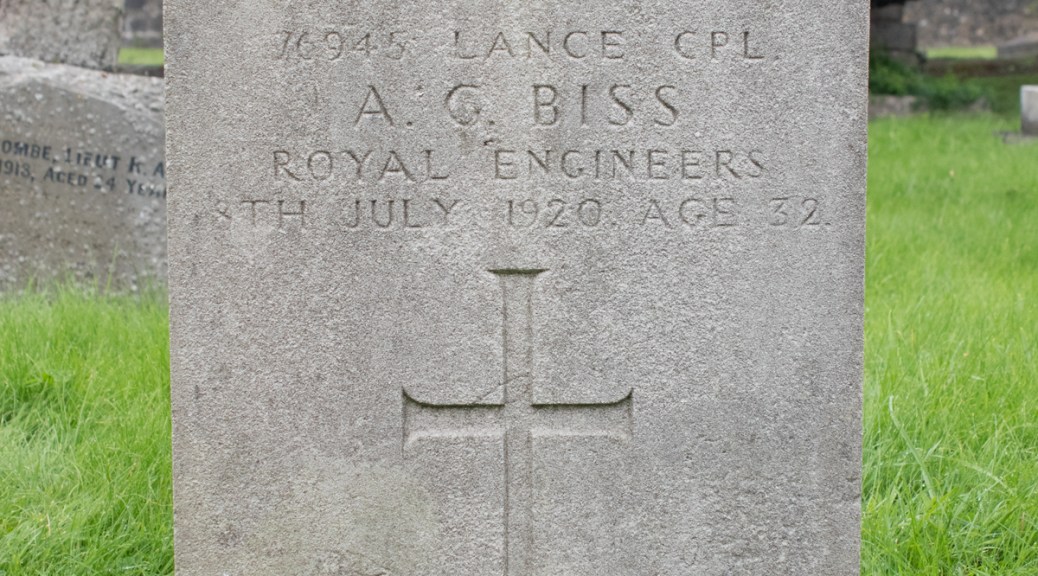
Albert Gillard Biss was born in Highbridge, Somerset, on 3rd July 1888. The middle of five children, he was the oldest surviving son of Richard and Rosanna Biss. Richard was a tin worker twelve years older than his wife and when he died, in September 1907, Rosanna was left to raise her family alone.
By the time of the 1911 census, Rosanna was living in a five-roomed cottage in Highbridge. Albert and his two younger brothers were living with her, and all three were working as building labourers to bring in money for the family. They also had a boarder, 87-year-old widow Henrietta Crandon, to bring in a little extra each month.
Albert was also saving up for other things. On 15th November 1911, he married Ada Alice Vincent. The couple went on to have three children – Albert Jr, Richard and Irene – before Ada’s untimely death in August 1915, just five weeks after Irene’s birth. At this point Albert had enlisted in the army, and it seems that his sister, Sarah, took on responsibility for her nephews and niece.
Albert was working as a telegraphist for the Post Office when he signed up. He had previously volunteered for the 3rd Somersets, but was assigned to the Royal Engineers when he enlisted. His service records show that he joined up in Weston-super-Mare, was 27 years and three months old, and stood 5ft 10.5ins (1.79m) tall.
Sapper Biss initially served on home soil, but was subsequently moved to the Base Signal Depot as part of the East Africa Expeditionary Force. He was promoted to Lance Corporal in April 1918, but over the next twelve months his health began to deteriorate.
On 6th April 1919, Albert was medically discharged from the army, suffering from a combination of malaria, epileptic fits and tuberculosis. He returned home to Somerset, and moved back in with Rosina. His sister Sarah was living in London by this point, and it is not clear whether Albert’s children came back to Highbridge or not.
Over the next year Albert’s health went from bad to worse. On 8th July 1920 he finally succumbed to a combination of pulmonary tuberculosis, acute nephritis, meningitis and uraemia. He had just turned 32 years of age.
Albert Gillard Biss was laid to rest in the sweeping grounds of Highbridge Cemetery.
After Albert’s death, his two sons fell under the guardianship of their aunt Sarah. Responsibility for Irene, however, was given to an Ebenezer and Eliza Monks, who lived in Clapham Common, London. The 1938 Electoral Register found Irene, who went by the name Monks-Biss, still living with here adopted family.
Robert Oborne and his twin, William, were born in the summer of 1880, two of ten children to John and Elizabeth Oborne. John was an agricultural labourer, and the family were raised in Bishop’s Lydeard, Somerset.
Death was to surround Elizabeth Oborne: William died when he was only three years old and John also passed away in 1886. This was around the time that she gave birth to their last child, who she also named William. The 1891 census recorded Elizabeth as living in the centre of Bishops Lydeard with four of her children: John, who was a farm labourer, Elizabeth, an errand girl, and Robert and William, both of whom were still at school.
When he completed his schooling, Robert found work as a coal hewer. He moved to South Wales, and boarded with the Hampshire family, in Ystradyfodwg, Glamorganshire. Further details of his life before the outbreak of war are scarce, although it seems that he changed career, taking up work as a groom. Known as Bobbie, later reports suggest that he was a genial young man, and had a large number of friends.
1915 proved a pivotal year for Robert: that summer he married Amy Lyons in Taunton. Elizabeth died in October, and his next oldest sibling, a sister also called Elizabeth, passed away just weeks later.
“Just before the war he joined the Somerset Light Infantry [Territorial] and went through the Gallipoli campaign, and then went to Egypt… he acted [in the capacity of a groom] to his officer commanding, and whilst in Egypt had the misfortune to get thrown from his horse, which caused internal trouble.” [Taunton Courier and Western Advertiser: Wednesday 14th April 1920]
The now-Serjeant Oborne was medically discharged from 3rd/4th Battalion on 21st August 1916, and returned to Somerset. He took up employment with Colonel Dennis Boles MP, acting as his groom from him from Watts House, on the outskirts of Bishops Lydeard.
Robert appears to have continued with this life for the next few years, but his wartime injuries continued to dog him.
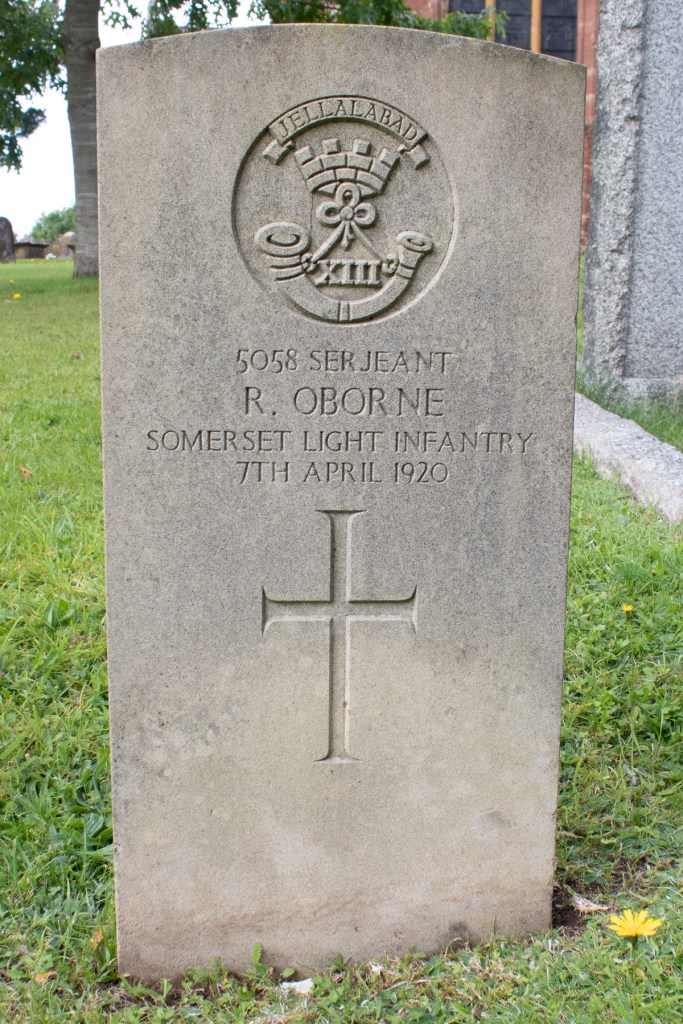
…on Tuesday, March 2nd [1920], he gave up work and went to the doctor, who advised his removal to the hospital, where he was taken the following Friday, and underwent an operation the same evening. Hopes were held out for his recover, and he lingered until 1:30 on Wednesday morning [7th April], when he passed away.
Taunton Courier and Western Advertiser: Wednesday 14th April 1920
Robert Oborne was 39 years old when he died. He was laid to rest in the grounds of St Mary’s Church in his home village, Bishops Lydeard.
Wallace Waterman Parsons was born in the autumn of 1893 and was one of thirteen children. His parents were both Somerset-born, David and Mary Parsons, and it was in a small terraced house in Bampton Street, Minehead, that the family were raised.
David was a chimney sweep and by the time of the 1911 census, eight of the then household of nine people were earning a wage. Six of the Parsons children – ranging in age from 15 to 33 – were living with their parents, working variously as a chair caner, a labourer and a French polisher. Wallace, 17 years old by this point, was employed as a stone worker, presumably alongside his older brother, David, who was a mason.
When war came to European shores, at least two of the Parsons brothers enlisted. While full service records no longer exist, it is clear that Wallace joined the Somerset Light Infantry, and was attached to the 8th (Service) Battalion.
Private Parsons arrived in France on 11th October 1915, and may have been involved in the closing days of the Battle of Loos. Over the next year, he would have been caught up in the fighting at the Somme, but by the autumn of 1916, he had fallen ill and returned to Britain.
Whatever condition Wallace had contracted led to his discharge from the army: his final day in service was 19th December 1916. He was awarded a Silver Star for his service: this confirmed his honourable discharge, and he wore it to show that he had served his country and was not, in effect, a coward for walking the streets of his home town, while other sons, brothers and fathers were fighting for their country.
At this point, Wallace’s trail goes cold. It is likely that he returned home, but his health continued to dog him. He passed away from anaemia on 17th July 1920, at the age of 26 years old.
Wallace Waterman Parsons was laid to rest in the sweeping vista of Minehead Cemetery.
Wallace’s older brother Hubert also served in the Somerset Light Infantry. Attached to the 1st/5th Battalion, he fought in the Middle East and rose to the rank of Corporal. Hubert fell ill with enteritis, dying from the condition on 13th April 1916. He was laid to rest 3,500 miles (5632km) from home, in the Kut War Cemetery, Iraq.
Arthur Moyle Tudball was born in the spring of 1893 in Minehead, Somerset. One of seven children, his parents were William Tudball and his Cornish wife, Mary.
When he completed his schooling, Arthur found work as a hairdresser. By the time of the 1911 census, there were seven in the Tudball household: William, Mary, four of their children, including Arthur, and their nephew, four-year-old William, who had been born in Ontario, Canada. There were four wages coming in: William, who was working as a general labourer, Arthur’s hairdressing salary. His older brother was a carpenter, and two sisters were employed as dressmakers.
Details of Arthur’s time in the army are sketchy at best. He certainly enlisted when war broke out, joining the Somerset Light Infantry. His Medal Roll Index Card seems to suggest that he didn’t serve overseas, despite both battalions he served with – the 1st/5th and 2nd/5th – fighting in India.
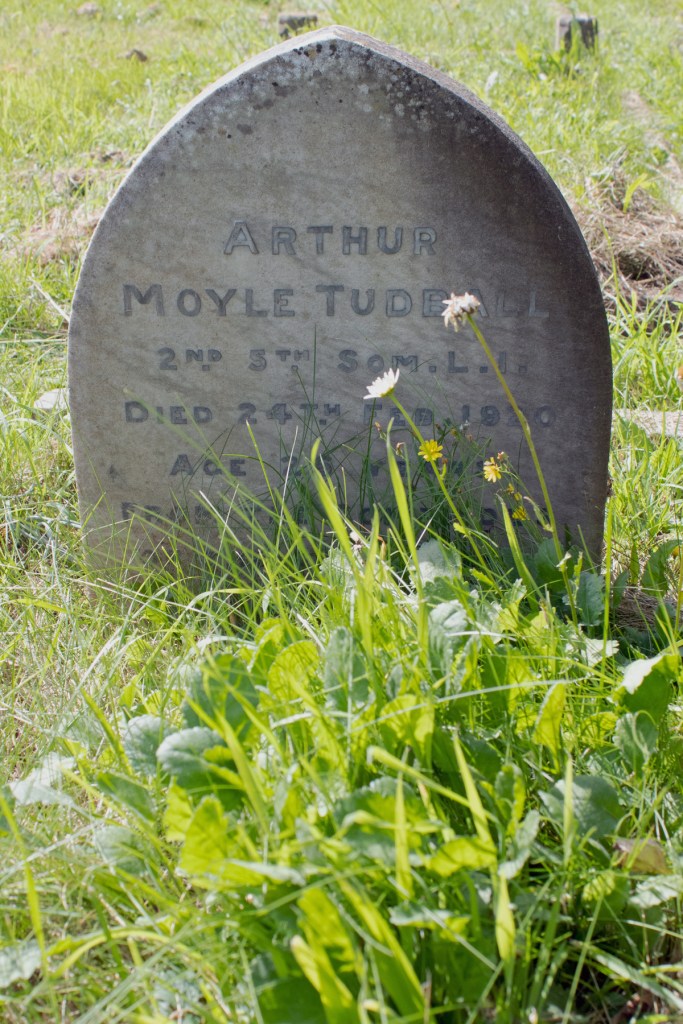
Private Tudball survived the war, returning to Somerset at the end of the conflict. The next record for him is that of his passing. His death, from disease, was recorded in the Taunton district, which would suggest that he was either still based at the army barracks in the town, or has been hospitalised there. He died on 24th February 1920, at the age of 26 years old.
Arthur Moyle Tudball was buried in Minehead Cemetery, not far from where his grieving family lived. His modest headstone was donated by his army colleagues.
William Richard Griffin was born in the summer of 1899, the fourth of six children to James and Joice Griffin. James was from Somerset and worked as a superintendent for a life assurance company. He met his wife while working in Wales, and this is where their oldest three children had been born. By the time of William’s birth, however, James had moved the family back to Somerset, setting up home in the Weston area of Bath.
There is little information about William’s life. When war was declared, he joined the Devonshire Regiment, and was assigned to the 51st (Graduated) Battalion. His troop remained on home soil – remaining in Norfolk for the duration – so it is unlikely that Private Griffin saw any active service overseas.
William survived the conflict and returned home. He passed away, possibly due to an infection, based on what little is documented, on 22nd July 1920. He had not long turned 21 years of age.
William Richard Griffin was laid to rest in the graveyard of St Martin’s Church in Worle, near Weston-super-Mare.
Bertie James Parsons was born in the summer of 1889, and was the fourth of six children to James and Elizabeth Parsons. James was a quarryman and slate-maker from Somerset, and he and Elizabeth raised their family in the parish of Ashbrittle.
While his older siblings found farm work in this peaceful part of the county, Bertie found employment as a baker’s assistant. This meant a move away from Somerset, and, by the time of the 1911 census, he was apprenticed to a bakery in the Crediton area of Devon.
The following year proved a tragic one for the Parsons family. Bertie’s younger brother, Richard, had found work as a hall boy for an estate in Wheathampstead, Hertfordshire. This was to prove a springboard for him, and he landed work for one of the new class of liners ploughing the waters of the Atlantic. Employed as a 2nd Class Steward, he was employed on the RMS Titanic and, like most of the ship’s 900 crew, he perished on that fateful night of 15th April 1912.
Among the large number of souls who perished with the Titanic recently we regret to report that among that number was a young man named Richard Parsons, aged 18, a native of Ashbrittle, and whose relatives still live in the neighbourhood, his father, James Parsons, being an invalid.
The deceased, who a couple of years ago embarked on a seafaring life, was on board the Olympic when it collided with the Hawke, and he left his home about a month ago, and journeyed to Belfast to assist in getting the Titanic ready for her maiden voyage.
He was particularly pleased at being appointed to a post on the largest ship in the world.
Deceased, who was a bright lad and much respected in the village, occupied the position of lift steward on his previous boat, and on the Titanic was a steward in a second-class dining saloon.
He was unable to swim.
Somerset County Gazette: Saturday 27th April 1912
Steward 2nd Class Richard Parsons
Back in Devon, Bertie was still working as a baker. When war came to Europe, however, he stepped up to play his part. While full service details are not available, it is clear that he enlisted in the Royal Army Service Corps as a Private. He was attached to the 2nd/1st Wessex Field Ambulance, who were sent to France in January 1916.
Private Parsons saw action – or helped treat the results of it – at some of the key battles on the Western Front: the Somme, Ypres, Cambrai, Givenchy and Festubert. In the autumn of 1917, Bertie returned home to marry Florence Riddaway, a milliner from Bow, Devon, who he had courted while working in nearby Crediton. The couple went on to have a son, Douglas, who was born on 26th May 1918.
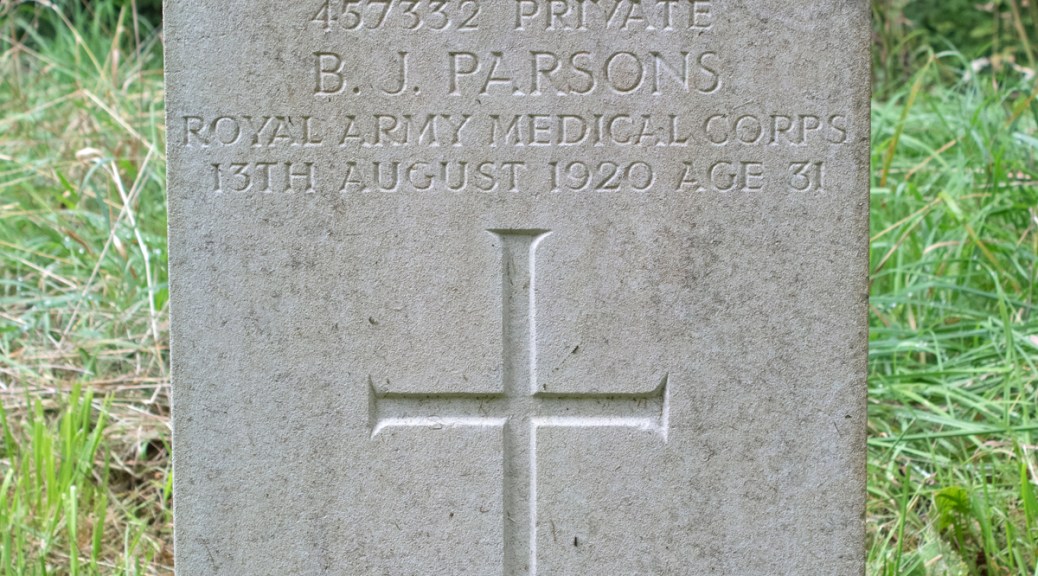
It is unclear how long Bertie remained in the army after the Armistice was signed. By the summer of 1920, he was back on British shores, and had fallen ill. He was admitted to hospital in Bath with acute staphlococcic infection and a cerebral embolism. He died in hospital on 13th August 1920, at the age of 31 years old.
The body of Bertie James Parsons was taken back to Ashbrittle for burial. He was laid to rest in the village’s St John the Baptist Churchyard.
Tragedy was to remain close by for the Parson family. Florence was a couple of months pregnant when Bertie died. Bertie Jr was born on 26th March 1921, but both mother and son died during childbirth. They were laid to rest near her family in Devon.
Douglas, just two years old, was now an orphan. There is little information about his life in the aftermath of his parents’ passing, but by the time of the 1939 Register, he was working as a motor mechanic in Wellington, Somerset. He lived on until 1993, passing away in Taunton Deane, at the age of 74.
Reginald Cuthbert Langford was born in Frome, Somerset, in the spring of 1899, the youngest of thirteen children to Albert and Charlotte Langford. Albert was a chalk seller turned jobbing gardener, who, by the time of the 1911 census, had moved the family to Bath.
Reginald appears to have helped his father with his work when he finished his schooling, but, during the First World War, he enlisted in the Royal Engineers as a Driver. His service records no longer remain, but a later newspaper report shed some light onto his time in the army: “[He] enlisted when he was just over 16, and went to the Wessex Engineers to Salonica. He returned to England and then went to France with the Glamorgan Engineers.” [Bath Chronicle and Weekly Gazette: Saturday 16th October 1920]
All did not fare well for Driver Langford: he contracted malaria and dysentery, and a combination of the conditions led to his ultimate discharge from the army. He left the Royal Engineers on 24th June 1919, and returned home to Somerset.
When he had recovered his health, Reginald took up employment as a gardener once more. On September 1920, he was in the employ of a Mr J Milburn, in Bath, when he felt a nail drive through his boot, scratching his foot. The following Tuesday, he visited his doctor – a Mr John Jarvis – complaining that his malaria had returned. According to a later inquest:
[He] did not make any mention of a wound in the foot. On Thursday, at about 10 o’clock, [Jarvis] was asked to go and see Langford, who was in bed. He was covered with a cold sweat, he could speak only with difficulty, and complained that he could not swallow anything, especially the medicine… His limbs were rigid, but he had not all the symptoms of tetanus. [Jarvis] decided to send Langford to the hospital at once, suspecting that he was suffering from tetanus. He did not know till later that there was an injury to [Reginald’s] foot.
Bath Chronicle and Weekly Gazette: Saturday 16th October 1920
Reginald’s landlady, Amelia Baily, also gave evidence at the inquest:
Langford had lodged with her for about nine months. His inly complaint was of his head when he had malaria… He came home saying his foot was sore and that he had thought it was gathering. He had hot water to soak it, and he did the same the next night, an afterwards sad it was alright… he went to work, but returned at dinner time again complaining of his head and perspiring terribly. He was ill and witness looked after him during the night. He complained of pains in the stomach and aid they were going up to the throat. Next morning [Amelia] sent for the doctor.
Questioned as to the injury to Langford’s foot, [she] said he told her he had a nail enter the toe while he was in the army, and that it was festering again. He wad worn the army boots up to just before he became ill, when he bought new ones.
Bath Chronicle and Weekly Gazette: Saturday 16th October 1920
Admitted to the Pensions Hospital, Bath, Reginald was to be there only one day. He passed away on 8th October 1920, aged just 21 years old. Medical evidence at the inquest diagnosed tetanus as the cause of his death, but Reginald’s older brother, George, contested this.
George’s challenge was that, having some medical background, he felt that his brother’s death was caused not by tetanus, but by malaria. He was a sufferer himself, and he knew the symptoms. He had examined Reginald’s body, and could not see how the small scratch on his foot could have induced tetanus to the extent of causing his brother’s passing.
The Coroner at the inquest, a Mr F Shum, declined George’s assertion, on the basis that separate medics had determined tetanus as the cause:
“It may not have been from the foot, but the evidence is clear. Dr Jarvis said he formed the opinion before any suggestion was made to him, that the man was suffering from tetanus. He saw the symptoms, and the man was brought here [to the Pensioner’s Hospital]. Two doctors saw him here and came to the same conclusion, and a medical specialist confirmed the diagnosis. Therefore, it is quite clear to me, and my verdict will be that he died from tetanus. It is a very unfortunate thing, and I am sorry for you.
Bath Chronicle and Weekly Gazette: Saturday 16th October 1920
George’s challenge was as much about the financial aspect as it was his late brother’s wellbeing. Had Reginald’s death been the result of malaria, it could have been attributable to his military service, and therefore any funeral costs – or at least a proportion of them – would have been paid for by the army. As the inquest had identified tetanus as the cause of his passing, however, the family would have to pay for the burial themselves.
Following the inquest, Reginald’s funeral was held: he was laid to rest in the sweeping Locksbrook Cemetery, Bath, not far from where his bereaved family still lived.
There are two other intriguing aspects of Reginald’s case.
The first is that of his being awarded a war grave. Amongst other criteria, which can be seen here, the Commonwealth War Graves Commission (CWGC) are responsible for the commemoration of personal who died after they were discharged from a Commonwealth military force, if their death was caused by their wartime service.
Based on the inquest, Reginald’s passing was clearly not – the tetanus having come on after his medical discharge for malaria and dysentery. Technically, therefore, his should not be designated a war grave.
The second confusing thing is that of the date on Reginald’s headstone. The CWGC headstone gives the date of his death as 13th October 1920, as do his grave registration documents. While newspaper reports are not always a reliable source of information, the first media report of the inquest came on Tuesday 12th October.
The Bath Chronicle and Weekly Gazette article confirms that Dr Jarvis’ visit to Reginald was on Thursday 7th October. He was admitted to hospital straight away, “where he died the following day” [Bath Chronicle and Weekly Gazette: Saturday 16th October 1920]. This would suggest that Reginald died on Friday 8th October.
While the newspapers do not confirm the date of the inquest, it is likely to have been held soon after Reginald’s passing. The date provided by the CWGC, therefore, looks to be either that of the conclusion of the inquest, or of Reginald’s burial.
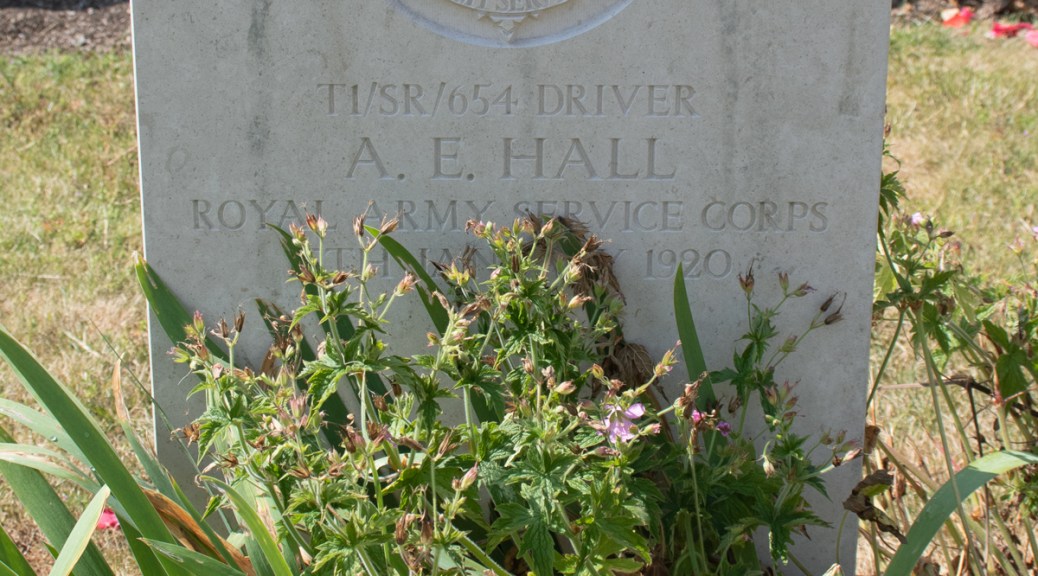
The life of Albert Edward Hall is a challenging one to unpick. His headstone, in Bath’s Locksbrook Cemetery, confirms that he was a Driver in the Royal Army Service Corps, and passed away on 15th January 1920.
Driver Hall’s service records confirm that he enlisted in Gloucester on 21th September 1914, at which point he was 45 years of age. He was born in Bristol, stood 5ft 6.5ins (1.69m) tall and weighed 172lbs (78kg). He had blue eyes and brown hair. The only next of kin that Albert recorded were two brothers, Arthur and Alfred, although their addresses were not known.
Driver Hall was sent to France within a couple of weeks of enlisting. He became attached to the 23rd Field Ambulance Unit, and, barring leave, remained on the Western Front for the next four-and-half years. His service appears to have been impeccable, although in August 1918, he docked a week’s pay when he returned back to the unit a day late following a period of leave.
In June 1919, having been back on home soil for a month, Albert was discharged from the army. This seems to have been partially on medical grounds, as his records suggest he was suffering from heart disease.
At this point, Albert’s trail goes cold. He may well have returned to Bristol, but by the start of 1920 it is likely that his health was failing. He was admitted to the Pensioner’s Hospital in Bath, Somerset, and it was here that he breathed his last. He was 50 years of age.
Albert Edward Hall was laid to rest in the sweeping visa on the city’s Locksbrook Cemetery.
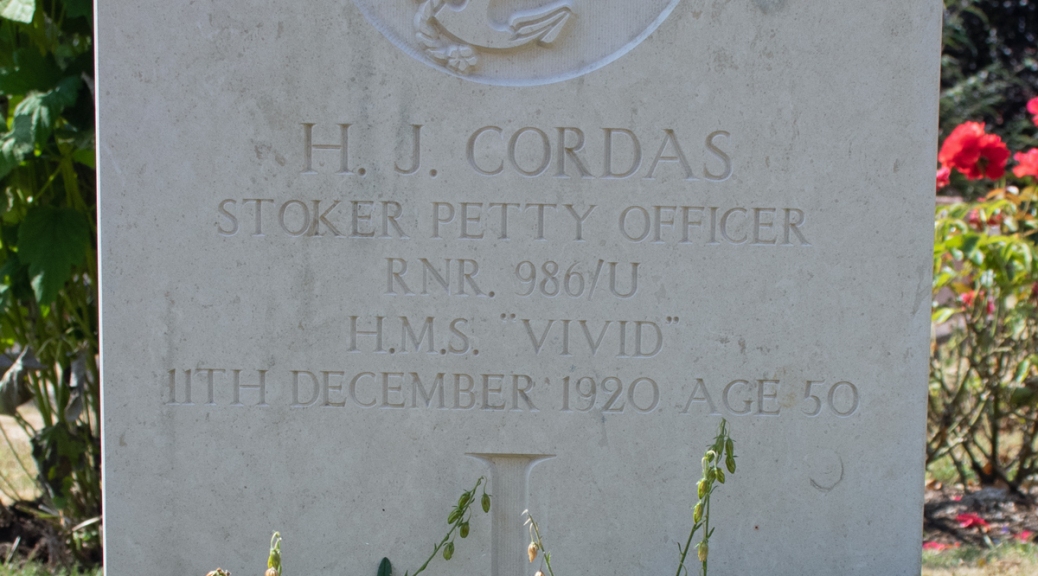
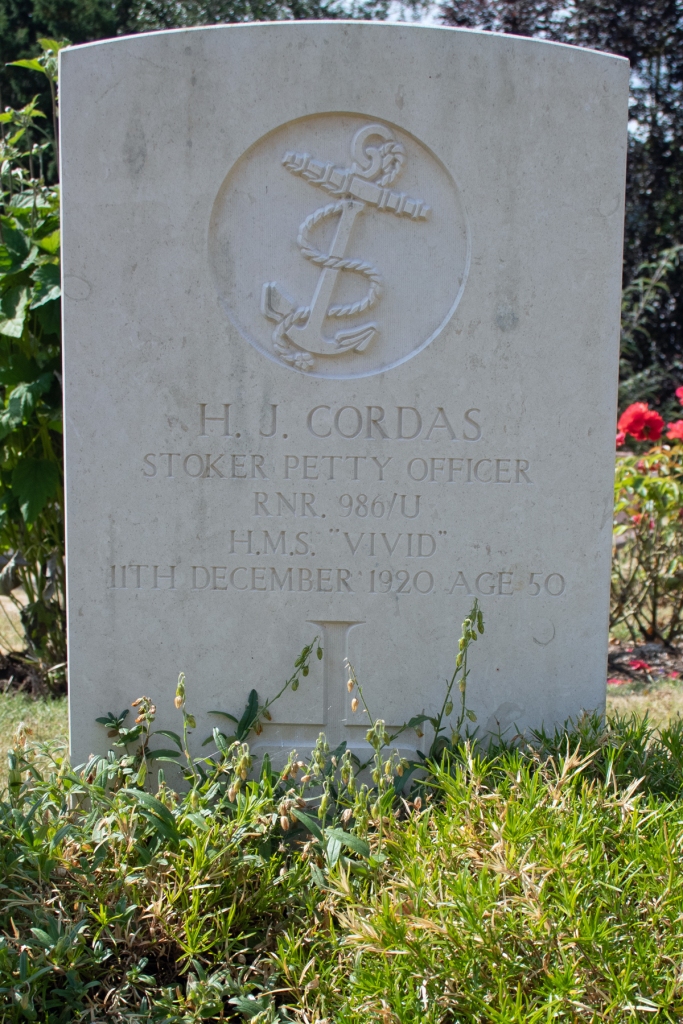
Much of Henry John Cordas’ early life is destined to remain a mystery. The first record for him is the 1881 census, which gives is his address as St Mary’s Orphanage in Heston, Middlesex, where he was one of 650 children.
The 1891 census recorded Henry as living in Humber Street, Grimsby, Lincolnshire, right next to the town’s docks. He is noted as being a fisherman, and is married to a woman called Mary, who was born in Deptford, Surrey.
The next available census record for Henry adds confusion to his story. The document, dating from 1911, confirms that he and Mary are now living in Hotwell Road, Bristol, Gloucestershire, again within spitting distance of the docks. Henry was employed as a marine fisherman in the merchant service. The document suggests that the couple had been married for ten years, and give Mary’s place of birth as Swansea, Glamorganshire.
While the document matches previous information for Henry, it seems unlikely that the Marys in the 1891 and 1911 censuses are one and the same. Either way, the couple were sharing their house with Mary’s niece, Ellen.
Henry seems to have joined the merchant fleet in a more official capacity in the autumn of 1900. His records show that he was 5ft 11ins (1.8m) tall, with blue eyes and a fair complexion. He served out of Bristol and, in the years leading up to the outbreak of war, he was assigned to a number of ships, travelling the Atlantic to Montreal and Jamaica, amongst other far-flung places.
When hostilities commenced, Henry was assigned to the Royal Naval Reserve. Over the next few years, he served on a number of ships, including the armoured cruisers HMS Suffolk and HMS Doris. He worked as a Stoker, but by the end of the conflict had been promoted to Stoker Petty Officer.
In December 1918, Henry’s service came to an end. He was, by now, based at HMS Vivid, the Royal Naval Dockyard in Devonport, but his health was suffering. Medically discharged with a combination of chronic bronchitis and rheumatic pain, he seems to have returned to Bristol.
On 6th December 1920, Henry was admitted to Bath War Hospital in Somerset, as he was coughing up blood. The plan was to transfer him to Greenwich Hospital in Surrey, but he suffered an aneurysm before that move could be made. He passed away on 11th December 1920, at the age of 50 years old.
The body of Henry John Cordas did not travel far for burial. He was laid to rest in the peaceful expanse of Bath’s Locksbrook Cemetery.
Maurice Chapman was born in the summer of 1883 in Newington, Surrey (now in the London borough of Southwark. The younger of two children, his parents were Charles and Jessie Chapman. Charles was a horse collar maker and, by the time Jessie passed away in 1899, Maurice was following in his father’s footsteps.
Maurice sought a bigger career, however, and, on 6th April 1899, he enlisted in the Royal Artillery. His service records show that he was 5ft 6ins (1.68m) tall, and that he weighed 118lbs (53.5kg). In the section relating to any distinguishing marks, it was noted that his eyebrows met, he had a scar on his forehead and two tattoos, one on each forearm.
Maurice’s military career was not to be a lengthy one. He was recorded as being absent without leave on 18th May, and docked 6 days’ pay. Admitted to a hospital in Woolwich on 26th May, he spent a week there, suffering from scabies. On 27th July, Maurice was formally discharged from the army, when it was discovered that he had lied about his age: on his enlistment papers, he stated he was 18 years 7 months old (he was, in fact, just sixteen.
Returning to the family home, Maurice took up his father’s trade once more. Charles remarried in 1905, to a woman called Rosa. The 1911 census found the two living in two rooms in a house in Kennington Lane, but of his children, there is no sign. Maurice does not appear on any of the 1911 census records. It is also not possible to track down his older sister Charlotte either, there are a number of Charlotte Chapmans in the that year’s records, and it is also unclear whether she had married by this point.
Maurice only reappears on 1st March 1916, when he stepped up to serve his King and his Country. Initially signing up for the Labour Corps, he wasn’t formally mobilised for eighteen months. Maurice gave his profession as a barman, but also noted that he had served for two years in the 2nd Battalion of the Dragoon Guards, before being discharged in 1904, although there is no other record to corroborate this.
Private Chapman’s service records provide some, but not a lot of, information. There is no record of him spending time overseas, but he spent ten months with the Labour Corps, before transferring to the Tank Corps on 30th August 1918. Over the next year-and-a-half, he moved between a couple of the regiment’s depots and their reserve unit, and remained on active service long after the Armistice was signed.
Maurice remained on active service with the Tank Corps until November 1920, when he was medically discharged. He had been unwell for a while by this point, and a combination of diabetes and a perineal fistula meant that he was no longer physically fit enough to serve.
It is likely that Maurice was in the War Hospital in Bath, Somerset, when he was discharged, as this is where he passed away, on 22nd December 1920. He was 37 years of age.
Maurice Chapman did not travel far to his final resting place. He was buried in the grounds of the Locksbrook Cemetery in Bath, Somerset.












 Death and Service