Richard Shaw Wood was born in London, Ontario, Canada, in 1891. The middle of three children his parents were Bermudan Benjamin Wood and his Canadian wife, Mary. Benjamin was a farmer, but his son would seek out bigger and better things for himself.
On 12th November 1913, he married Alice Duggan. There is little specific information about her early life, but she had been born and raised in Toronto. They wend to to have a son, Richard Jr, the following year.
With war raging across Europe, Richard felt compelled to play his part. He gave up his job as a car salesman and, on 30th July 1917, he enlisted in the Canadian Royal Flying Corps. As an Air Mechanic 3rd Class, he was soon sent to Britain, but took a commission in the Royal Flying Corps in December of that year.
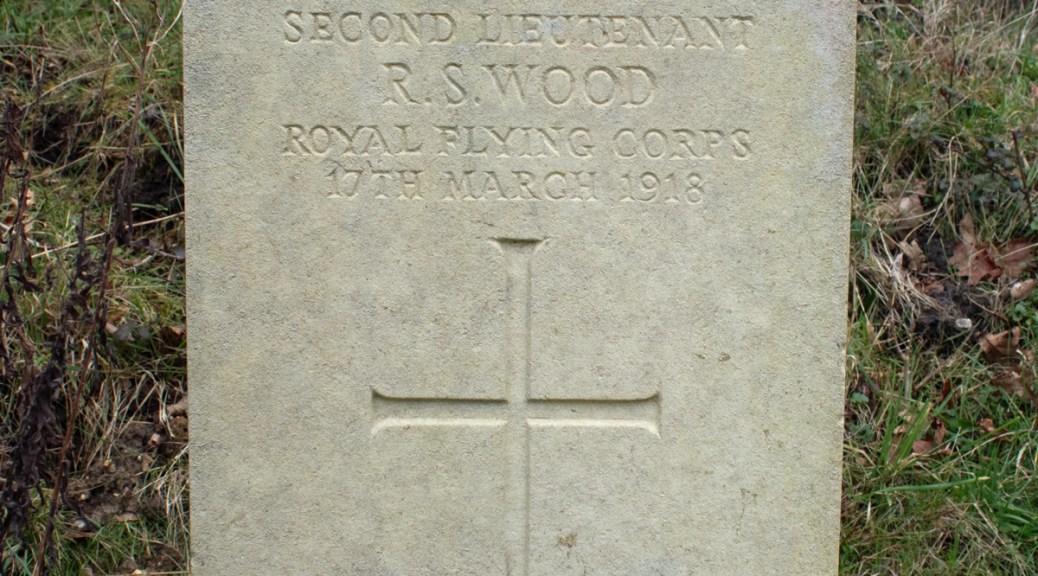
The now Second Lieutenant Wood was attached to No. 1 Training Squadron and was based in East Boldre, Hampshire. On 17th March 1918, after just a few months in the unit, he was flying a Sopwith Camel from the Hampshire airfield, when disaster struck. His aircraft nosedived and crashed to the ground. A subsequent inquest concluded that: ‘the smash was caused by the Pilot losing control of the machine… 2nd Lt R Shaw Wood was a steady [skilful] and reliable pilot. He had performed the manoeuvre… on previous occasions. The Court are of opinion that the Pilot [must have] fainted thus losing control.’
Richard Shaw Wood was 27 years of age when he died on 17th March 1918. He was laid to rest in the tranquil graveyard of St Paul’s Church, East Boldre, not far from the airfield that hat become his home.
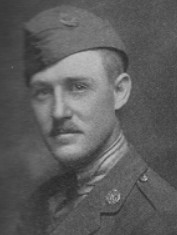
Second Lieutenant Richard Wood (from findagrave.com)
Arthur Rowland Taylor was born on 21st March 1896 in Ilford, Essex. He was the third of five children – all of them boys – to land agent Robert Taylor and his wife, Edith. Robert’s work took the family around the country: the 1901 census found them living in Connah Quay, Flintshire, and this is where Arthur’s two younger brothers were born.
By 1911, the family had moved again, to the 15-roomed Bagle Gate House in Bridlington, Yorkshire. Robert and Edith were living with their three youngest children – including Arthur – and two servants: cook Sarah Leatham and housemaid Lucy Patchett.
At some point after leaving school, Arthur was also drawn to a new adventure. By the time war broke out, he had moved to America and settled in Denver, Colorado.
In June 1917, with war raging across Europe, Arthur had stepped up to play his part. He crossed the border to Toronto, Canada, and enlisted in as an Air Mechanic 3rd Class in the Canadian Royal Flying Corps. Sent to Britain, just three months later, he accepted a commission, taking the rank of Second Lieutenant in the British Royal Flying Corps.
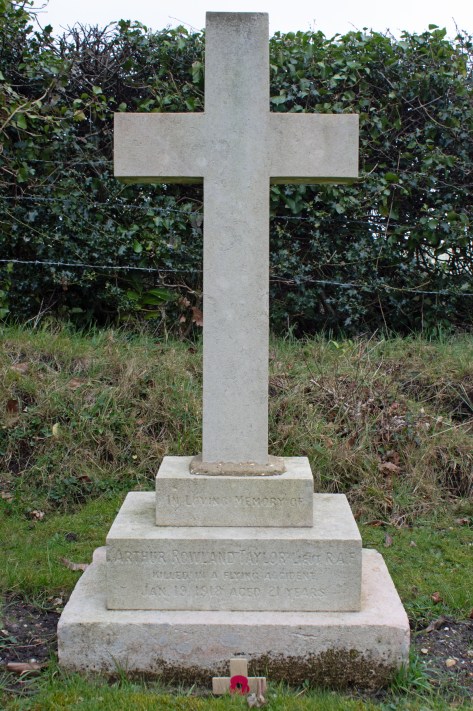
Arthur was based in East Boldre, Hampshire, and was attached to the 79th Training Squadron. On 19th January 1918, he had taken off in his Sopwith 5F1 Dolphin, when the engine stalled. He did not have enough height to try and restart the engine, and the aircraft crashed to the ground, bursting into flames on impact. Second Lieutenant Taylor was killed: he was 21 years of age.
The body of Arthur Rowland Taylor was laid to rest in the peaceful graveyard of St Paul’s Church in East Boldre, not far from the base at which he had served.
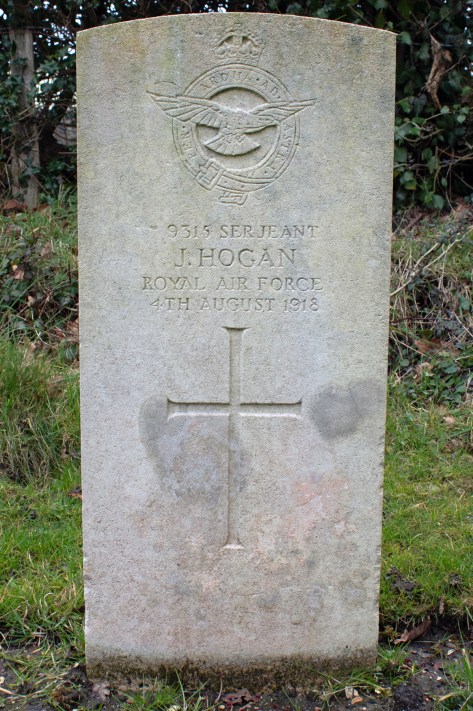
The personal life of Jack Hogan is a challenge to piece together, and much of the information is pulled from his service record. This confirms that he was born in 1890 in Cork, Ireland, and gives his next of kin as his mother, Annie Hogan, who was living in Southsea, Hampshire. He seems to have been born John Hogan, Jack being a common nickname, but there are too many census records with potential matches to narrow down a definite connection.
A Roman Catholic, Jack was 5ft 5.5ins (1.66m) tall. He had dark hair, brown eyes and a fresh complexion. He was also noted as having two small moles on his left cheek. He enlisted in the Royal Flying Corps as an Air Mechanic 2nd Class on 1st October 1915, leaving his job as a motor and cycle fitter to do so.
Jack seemed to have been proficient at what he was doing, and was promoted to Air Mechanic 1st Class less than a year after enlisting. On 5th February 1918 he rose again, taking the role of Acting Sergeant. When the Royal Air Force was formed in April that year, his rank was made permanent.
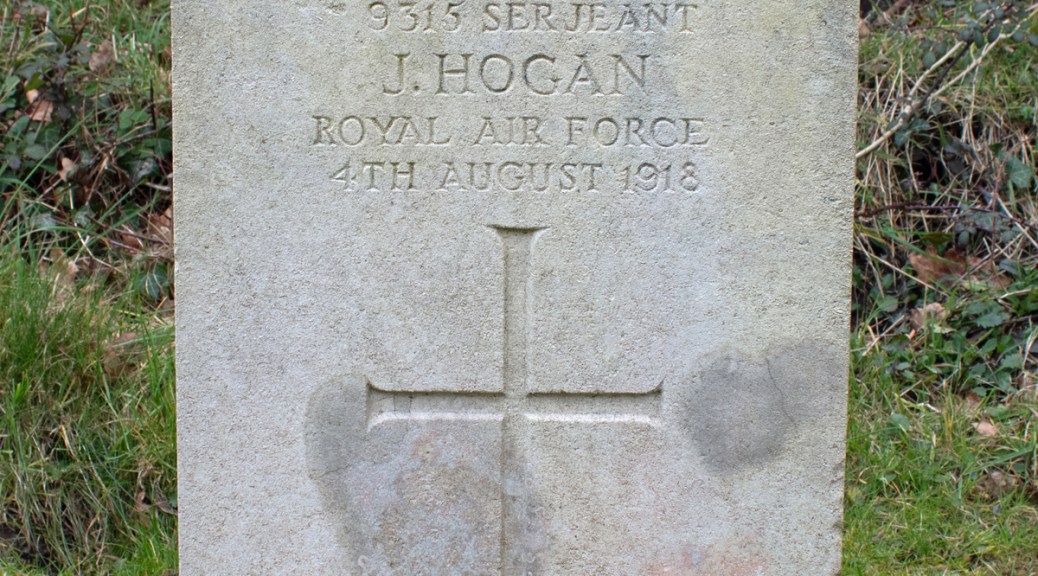
Sergeant Hogan was attached to the 29th Training Depot Station near East Boldre, Hampshire. On 4th August 1918, he was piloting an Avro 504, when it collided with another aircraft. There is little recorded about the incident, and his RAF Casualty Card does not give details of the other vehicle or its pilot. Jack’s biplane fell to the ground and he was killed. He was 28 years of age.
The body of Jack Hogan was laid to rest in the graveyard of St Paul’s Church in East Boldre, not far from the base that had become his home.
Arthur Fred Belyea was born in Penetanguishene, Ontario, Canada, on 21st October 1894. The second of five children, he was one of three sons to John and Sarah. John was a farmer, and local to the area, but Sarah, who was sixteen years her husband’s junior, had been born in Pennsylvania, and lived in Kansas for twenty years before moving to Canada.
By the time of the 1911 census, the family had moved to Calgary, where John had taken up work as a horse dealer. Interestingly, the census also recorded the Belyeas’ racial background, which was German, although John and Sarah were at least second generation North American.
Arthur had finished school by this point, and had found employment as a bookkeeper for the Royal Bank of Canada. He was settled in for a career, and, by 1916 had achieved the role of assistant accountant. War was on the horizon, however, and life was to change.
Full details of Arthur’s military service have been lost to time, but it is clear that he enlisted in the Canadian Royal Flying Corps on 3rd December 1917. His service papers show that Air Mechanic 3rd Class Belyea was 5ft 5.5ins (1.66m) tall, with dark brown hair, hazel eyes and a medium complexion.
Arthur was sent to Britain and stationed at East Boldre, Hampshire. When the Royal Air Force was formed on 1st April 1918, he transferred across. He was obviously proficient at what he did, because at the end of May he earned a commission, and rose to the rank of Second Lieutenant.
Mr A C Hallett, Deputy County Coroner, held inquests on Tuesday, of Lieut. Austin Wyard Blackie, RAF, of California, and Second-Lieut. Arthur Fred Belyea, RAF, of Calgary, Canada, who met thwir deaths while flying. The evidence showed that their machines collided at a great height, and that death in each case must have been instantaneous. Verdicts of “Accidental death” were returned.
[Hampshire Advertiser: Saturday 21st September 1918]
The RAF report card on the incident noted that: “The cause of the accident was in our opinion an error of judgement on one pilot (unknown) in flying his machine into the other machine from the rear, causing the left hand frame of Camel C8322 and the right hand frames of Camel C96 to collapse, thus causing each machine to spin to the ground. The one pilot was probably attempting to obtain good photographs of the other machine.”
Arthur Fred Belyea was 23 years of age when he died on 17th September 1918. He was laid to rest alongside Lieutenant Blackie in the graveyard of St Paul’s Church, East Boldre, not far from the airfield at which he served.
You can read about the life of Lieutenant Blackie here.
Second Lieutenant Arthur Belyea (from findagrave.com)
George Wilson Townsend was born in St Pancras, Middlesex on 13th September 1885. The youngest of three children – although his older brother Joseph had died before George was born – his parents were piano maker Samuel Townsend and his wife, Eliza.
When he finished his schooling, George found work as a clerk for a shipping company. In the summer of 1909 he married Ellen Gibbins: the couple went on to have two children, daughters Kathleen (born in 1910) and Elsie (born in 1912).
The 1911 census found the family in a small cottage at 43 Leighton Road, Kentish Town. George was still working as a shipping clerk, while Ellen was look after baby Kathleen.
When war broke out, George was called upon to play his part. He enlisted on 12th May 1917, and joined the Royal Flying Corps as an Air Mechanic 3rd Class. His service records show that he stood 5ft 9.75ins (1.77m) tall.
When the Royal Air Force was formed in April 1918, George was immediately transferred across. Reclassified as a Clerk 3rd Class, he was quickly promoted to Clerk 1st Class, the skills he had learn in civilian life coming to the fore. Attached to 85 Squadron, then 62 Training Squadron, which was based in Gosport, Hampshire.
By the autumn of 1918, George had returned home, although the circumstances for this are unclear. He may have been on leave or recuperating from an illness. Certainly he passed away from pneumonia while at home on 5th October. He had not long turned 33 years of age.
George Wilson Townsend was laid to rest in Highgate Cemetery, not far from where his family still lived.
Ernest James Dean was born in the autumn of 1898 in St Pancras, Middlesex. The older of two children, he was the only son to Ernest and Caroline Dean. Ernest Sr was a bootmaker, and the family lived at 51 Lismore Road.
Ernest Jr found work as a clerk when he completed his schooling. However, when war broke out, he was keen to play his part. He enlisted on 6th February 1917, joining the Royal Flying Corps as an Air Mechanic 3rd Class. His service record shows that he was 5ft 6ins (1.67m) tall, and he must have proven to be a keen student: within four months he had been promoted to Air Mechanic 2nd Class and was being trained as a wireless operator.
When the Royal Air Force was formed on 1st April 1918, Ernest’s transfer was automatic. It is unclear exactly where Air Mechanic Dean served, but he seems to have been based in Kent by that autumn.
In October, Ernest was admitted to the Lees Court Hospital in Faversham, Kent, having come down with pneumonia. The condition, sadly, was to prove fatal: he passed away on 29th October 1918, at the age of just 20 years old.
The body of Ernest James Dean was taken back to Middlesex for burial, and he was laid to rest in the majestic grounds of Highgate Cemetery.
Jack Wallis Gauntlett was born in Burbage, Wiltshire, in the spring of 1898. The oldest of four children, his parents were George and Florence Gauntlett. On Jack’s baptism record, George gives his trade as a yeoman, while later census records confirm he was a farmer.
Jack was baptised in St Mary’s Church in Stapleford, near Salisbury, some distance south of Burbage, and, given that his parents had no connection to that area, it seems that his father’s work took the family around the county. The 1901 census record found them Gauntletts back in Burbage, but by the time of the 1911 return, they had moved to Middleton Farm in Norton Bavant.
When war broke out, Jack stepped up to serve his country. He enlisted in the Royal Flying Corps in January 1917 and, as an Air Mechanic 2nd Class, was sent to Farnborough, Hampshire, for training.
Much sympathy is felt with Mr and Mrs FG Gauntlett, of Middleton Farm, in the loss they have sustained by the death of their eldest son, JW Gauntlett… He came home three weeks ago on leave before proceeding to France, and was then sickening for measles and had bronchitis. He was taken to Sutton Veny military hospital and died there on Friday from an attack of pneumonia.
[Wiltshire Times and Trowbridge Advertiser: Saturday 19th May 1917]
Jack Wallis Gauntlett was just 19 years of age when he died on 11th May 1917. He was buried in the family plot in All Saints’ Churchyard, Norton Bavant.
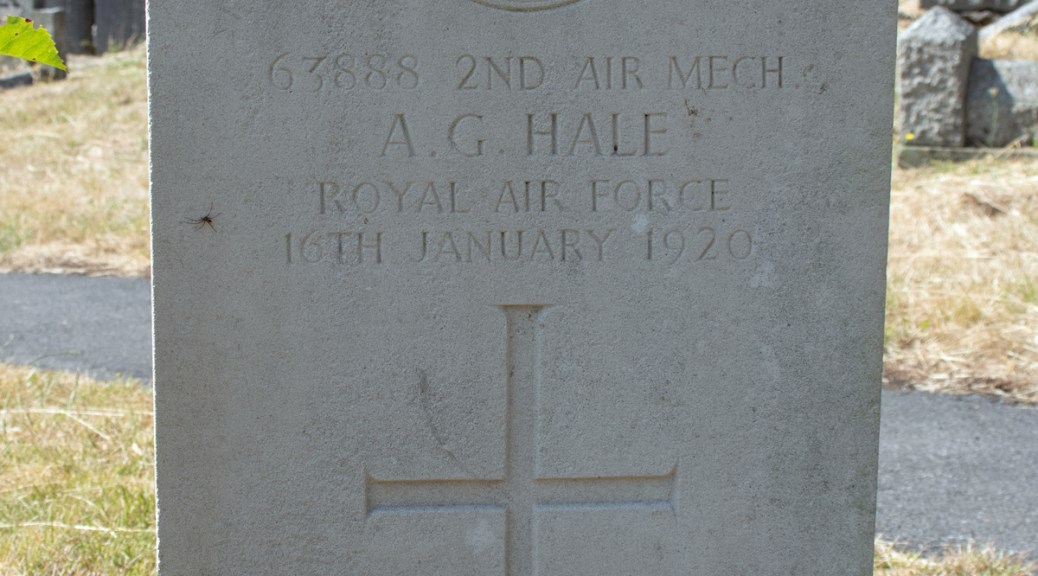
Alfred George Hale was born in Lechlade, Gloucestershire, in the spring of 1891. The youngest of four children his parents were George and Martha. George died when Alfred was just a babe-in-arms, and by the time of that year’s census, Martha was looking after her children alone.
The next census, taken in the spring of 1901, found Martha and the family living in a house on Oak Street in Lechlade. She was taking in laundry to earn a little money, while Alfred’s older brothers, George Jr and James, were employed as house boys. This meant there were three wages coming into the Hale household, but it would still have been a daily struggle for the family.
Tragedy stuck again in 1904 when James also died. Details are unclear, but it seems that he passed away in Headington, Oxfordshire, and was laid to rest in his home town. He was just 16 years of age.
By the time of the 1911 census, Alfred was the only one of Martha’s children to still be living at home. Home was the same four-roomed house on Oak Street, Lechlade. Martha was not noted as having any employment, but her son was working as a journeyman tailor.
On 10th November 1916, Alfred married Elizabeth Smith in Highworth, Wiltshire. There is tantalisingly little information about her, although it seems likely that they met during his travels with work. The couple would go on to have a child, daughter Sylvia, the following October.
1917 proved a year of upheaval for the Hale family. Six months before Sylvia’s birth, Alfred’s sister, Martha Jr, passed away. She had been a patient in the Berrywood Asylum in Northamptonshire, for a while: although the exact dates are unclear, she is recorded as a visitor to the Green family in Reading, Berkshire, in 1911, so her admission would have been after this.
Alfred had enlisted in the Royal Flying Corps by this point. It is likely that his tailoring skills were employed by the service – whose aircraft used canvas in their make-up – , and he was given the rank of Air Mechanic 2nd Class. His service records show that, when he joined up on 28th February 1917, he was 5ft 5.5ins (1.66m) tall.
Air Mechanic Hale transferred to the Royal Air Force on its foundation in April 1918, and within a matter of weeks, he found himself overseas. He remained in France until the end of the year, and was admitted to hospital on 22nd December as a result of an unconfirmed illness. His condition warranted transfer to Britain on 2nd January 1919, and was severe enough for him to be officially discharged from duty on 12th April 1919.
The funeral took place at Locksbrook Cemetery on Wednesday of ex-Private George Hale, formally 2nd Air Mechanic, RAF, who resided at 7 Kensington Gardens, Walcot [Somerset]. Deceased, after serving three years with the Colours, was demobilised in April, 1919, but still suffered from illness, due to active service. His condition grew worse, and he was received at the Pensions Hospital, Combe Park, two days before his death… He was a native of Lechlade, Gloucestershire, but had lived in Bath for about three months.
[Bath Chronicle and Weekly Gazette: Saturday 24th January 1920]
Alfred George Hale was 29 years of age when he died on 16th January 1920. He was laid to rest in the military section of Bath’s sweeping Locksbrook Cemetery. His widow, Elizabeth, and his mother, Martha – who had now outlived her husband and three of her four children – attended the funeral.
Lewis Scott White was born at the start of 1896 in Bath, Somerset. The youngest of four children, his parents were surgeon Edward White and his wife, Fanny. The 1911 census recorded the family living in a substantial property in Green Park: the now medical practitioner Edward, Fanny and Lewis sharing the 12-room house with a servant, Ellen Fry.
As befitting of his station in life, Lewis’ education was a well rounded one: “[he] was educated at Bath College and Kelly College, Tavistock, and was coached for his matriculation examination by Mr Samuel Edwards, of Grosvenor College. He exhibited a fondness for aeronautics when quite a lad. While at Victoria College he evinced much enthusiasm for the art of flying, and made models of flying machines. One of these miniature planes he flew successfully on Lansdown, and we believe showed at an exhibition in London. He was one of the leading spirits in the Bath Aerial Club, which used to meet at the Church Institute.” [Bath Chronicle and Weekly Gazette – Saturday 06 October 1917]
Lewis’s mechanical mind was put to good use in his working life as well. He found employment as a motor fitter, and this is what he was doing when war broke out in the summer of 1914. He felt duty bound to service his King and his Country, and, on 20th October, he enlisted in the Royal Flying Corps as an Air Mechanic. His service records confirm the man he had become: at 18 years of age, he was 5ft 4ins (1.63m) tall and weighed 117lbs (53kg). He had dark brown hair, brown eyes and a fresh complexion.
His skill and daring earned promotion, and he was given a commission… He accomplished many fine feats in actual aerial warfare on the Western Front, and for one of these some months ago he was awarded the Military Cross. He was acting as an observer when the flight occurred; the pilot in the same machine was given the DSO.
While wearing only one wing he came home to England to train as a pilot. He rapidly passed all the tests for this, and obtained the two wings, and was gazetted Captain of the RFC on May 5th last. It was only on Wednesday last week that Captain White attended an investiture at Buckingham Palace and was decorated by the King with the MC. So complete was his mastery of flying machines and so great his initiative that Captain White was appointed Flight Instructor, and for the last two months he had been Flight Commander quartered in Wiltshire.
[Bath Chronicle and Weekly Gazette – Saturday 06 October 1917]
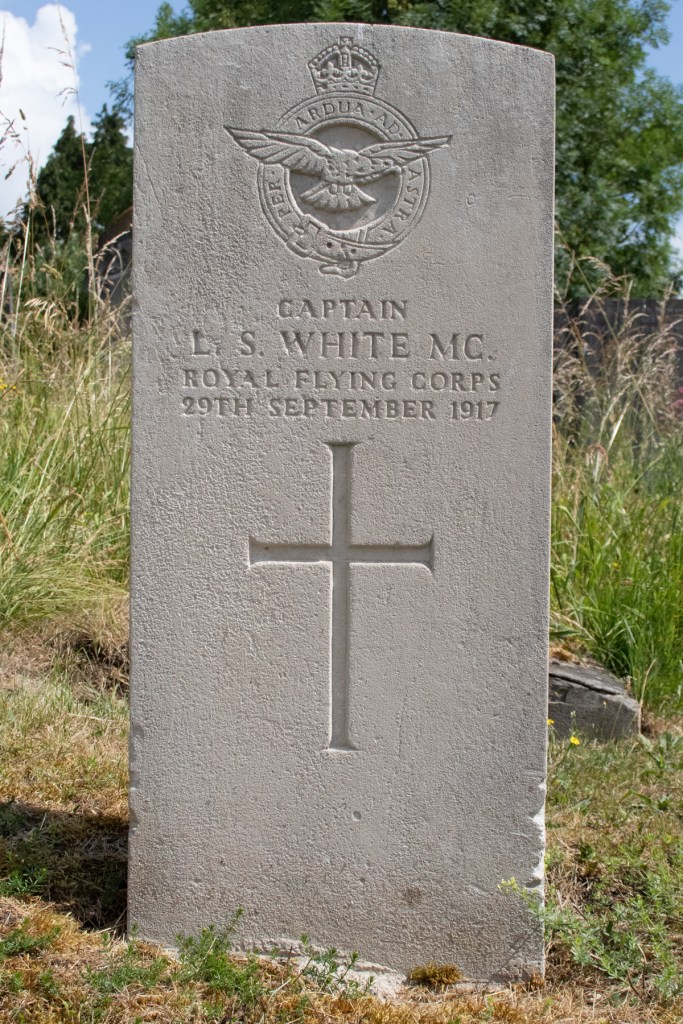
On 29th September 1917, Captain White was piloting a Sopwith Camel from RAF Yatesbury, Wiltshire, when the aircraft failed to pull up from a dive. It crashed into the ground and Lewis was killed instantly. He was just 21 years of age.
It is no secret that the aeronaut whose intrepid feats in the air above Bath of late had caused much notice was Captain White. He would loop the loop with the greatest ease, and his nose-diving was most daring. When questioned why he performed these dangerous acts in the air Captain White would declare that there was no risk from engine trouble unless a man ‘lost his head,’ and apparently he had no idea that is was possible for him to get into difficulties from that cause. It is to be surmised therefore that in the accident which had cost his life, so especially valuable to the country now, something beyond engine trouble must have happened.
To stay-at-home and peacefully minded citizens some of the manoeuvring by aeroplanes in flight savours too much of the sensational, and they are apt to think that it is unnecessarily throwing away chances. But such an impression is as unjust as it is unkind. The strange evolutions described by machines in mid-air are just the kind that have to be executed in actual aerial warfare when seeking to gain an advantage over the foe, and unless this preliminary training were carefully and systematically gone through it would be hopeless to seek to acquire the necessary skill in the moment of crisis. Captain White was absolutely fearless, and his death will be deeply deplored by by many comrades who knew his worth.
[Bath Chronicle and Weekly Gazette – Saturday 06 October 1917]
A subsequent inquest found no immediate cause for the crash, but suggested that Captain White may have misjudged the distance whilst diving and flew into ground.
The body of Lewis Scott White was brought back to Somerset for burial He was laid to rest in the majestic Locksbook Cemetery in Bath, his funeral attracting a full page report in the city’s Chronicle and Weekly Gazette.
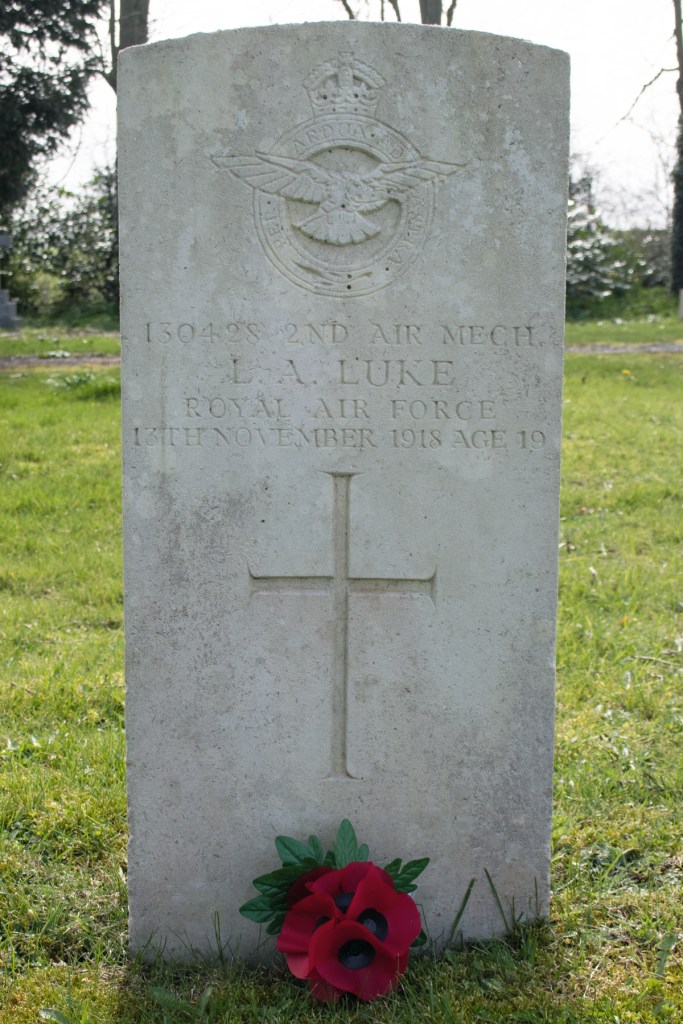
Leonard Arthur Luke was born in the autumn of 1899 in Shepton Mallet, Somerset. He was the fifth of ten children to railway guard George Luke and his wife, Georgina.
By the time of the 1911 census, the family had moved north west, to the village of Wellow, where George continued his employment with the railway. The track and station have now since disappeared, but at the time, it was a busy stopping point for the mining village.
When Leonard left school, he found work as a porter with the Somerset & Dorset Railway, but by now war was raging across Europe, and he was keen to play his part. He initially enlisted in the Somerset Light Infantry on 3rd January 1918, but moved to the Royal Flying Corps after a matter of weeks.
On 1st April 1918, Leonard transferred across to the Royal Air Force. Formally holding the rank of Air Mechanic 2nd Class, he was training to become a wireless operator in Winchester, Hampshire. He was admitted to the Red Cross Hospital in the city, having contracted rheumatic fever. Sadly, this was to take his life, and he passed away on 13th November 1918, two days after the Armistice. He was just 19 years of age.
Leonard Arthur Luke’s body was brought back to Somerset for burial. He was laid to rest in the quiet Wellow Cemetery.
Air Mechanic 2nd Class Leonard Luke (from britishnewspaperarchive.co.uk)
While Wellow Station was a bustling place, it is highly likely that Leonard would have known Edward Bending, one of the clerks at the time he was there. Edward also went off to war, and his story can be found here.










 Death and Service