
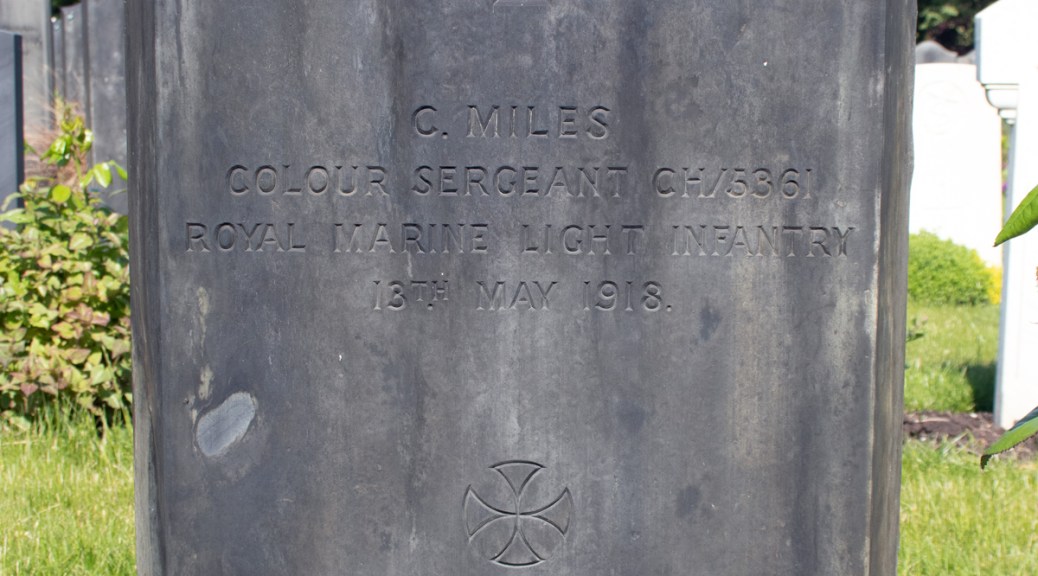

The early life of Charles Miles, whose body lies at rest in the Woodlands Cemetery in Gillingham, Kent, is a challenge to unpick, and the starting point is the last document relating to him.
His military Pension Ledger confirms that he died on 13th May 1918, from empyema, a bacterial infection affecting the lungs. The document cites his next-of-kin as Miss Hilda Miles, of 15 St John’s Road in Gillingham. She is noted as being the guardian of two children – Ada, born in 1905, and George, born the following year – because their mother, Charles’ wife, had passed away on 30th May 1912.
An online search for Ada and George gives an entry in the 1911 census. This finds them as the youngest two of six children to Charles and Elizabeth Miles. The document also gives a clue about their future guardian, Hilda: she is their older sister.
The Miles family were living at 45 Commercial Street in Whitechapel, East London. Charles, at 39, was recorded as a Royal Marines Pensioner and schoolkeeper. His wife, Elizabeth, was assisting with this role, and the couple had two other surviving children, Charles Jr and Walter.
While it is still difficult to piece together Charles’ childhood, his Royal Marine service records do shed a little light onto it. Born in Hampstead on 23rd November 1871, he was working as an ironmonger’s assistant when he enlisted. He joined up on 23rd August 1889, the document showing that he was 5ft 6ins (1.68m) tall, with brown hair, grey eyes and a fresh complexion. He also had a tattoo on his right forearm.
Private Miles had joined up in London but, as with most Royal Marine recruits, he was sent to the base in Walmer, Kent, for his initial training. In the spring of 1890 he moved to the Royal Naval Dockyard in Chatham, Kent, and this would become his regular port for the remainder of his service.
Charles’ service proved to be a committed one. Over the next decade he would serve on five ships, and would rise through the ranks. In October 1894 he was promoted to Lance Corporal, making full Corporal less than a year later. On 1st January 1899 he was promoted to Sergeant, and by the start of 1908, he held the rank of Colour Sergeant. Formally stood down to reserve status on 22nd November 1910, he was noted as having a very good character.
Away from the service, there is no record for Charles and Elizabeth’s marriage. She had been born in Sheerness, Kent, and was a year younger than her husband. It is likely that they were married by 1897, as this is when their oldest child was born. The 1901 census recorded them living on Manor Street in Gillingham, but, once Charles had been stood down, the school keeper’s position in the East End came up.
When war broke out, Charles was called upon to play his part once more. He returned to Chatham, leaving his younger children in Hilda’s care. By September 1914 he had moved to HMS Victory, the Royal Naval Dockyard in Portsmouth, Hampshire, and he would remain there for the next eighteen months. His shore base and naval experience suggest that, at 43 years of age, his was more of a training or mentoring role, although there is nothing in his records to confirm this.
In February 1916, Colour Sergeant Miles returned once more to Chatham, and the naval base there would be his home for the next few years. He was admitted to the Royal Naval Hospital in the spring of 1918, and passed away from the infection on 13th May 1918. He was 46 years old.
Charles Miles was laid to rest in Woodlands Cemetery, Gillingham.
After their father’s death, the Miles siblings found their own way in life.
By the time of the 1921 census, Ada, now 16 years old, was working as a domestic servant for Henry Chapman, a ship’s surveyor, and his family. They were living at 73 Milton Street in Fleetwood, a short stroll from the Lancashire coast.
Hilda, into whose care Charles had given his youngest children, was now 22 years of age. She had married William Swift, a pattern maker for the Admiralty, in the summer of 1918. They would not have any children, and the 1921 census found the couple living at 15 Milner Road, Gillingham. She too was just a short walk from the shoreline, but was also within walking distance from the cemetery in which her father had been buried.



 Death and Service