Tag Archives: Corporal

Corporal Richard Cadenaci

Corporal Richard Cadenaci

Richard Edward Cadenaci was born in Sutton, Surrey, in around 1886. His father, who was also called Richard Edward Cadenaci, was a house painter and, with his wife Maria, had thirteen or fourteen children, of whom Richard Jr was the middle one.

Documentation on the Cadenaci family is scarce. On 5th April 1896, when Richard Jr was 10, he and three siblings were baptised together.

By the turn of the century, the family were living on Merton High Street, in Wimbledon. Richard Sr and Maria were there with their youngest five children.

Richard Jr seemed keen on a life of adventure – the 1911 census lists him as a Private in the 3rd Battalion of the Royal Fusiliers, and that he was based in Mauritius. His full military service records are not available, but it is likely that his term of service with the army was extended as war loomed.

Private Cadenaci was sent to France in January 1915 and, during his time in the Great War, he received the Victory and British Medals and the 1915 Star. At some point during the conflict he was transferred across to the Labour Corps, though the move came with a promotion to Corporal. Again, there is little further information about his service, but records suggest that he was discharged from the army – possibly through health reasons – on 20th September 1918.

Here, Richard’s trail goes cold. He died on 23rd March 1920, just eighteen months after the end of this military service, at the age of 32. There is no record of the cause of his passing and nothing to connect him to the town in which he was buried, Worthing, West Sussex.

It is possible that Corporal Cadenaci left the army for medical reasons, and his move out of London was for cleaner air, but this is only presumption on my part, and there is nothing to confirm this either way.

Richard Edward Cadenaci lies at rest in the Broadwater Cemetery in Worthing.


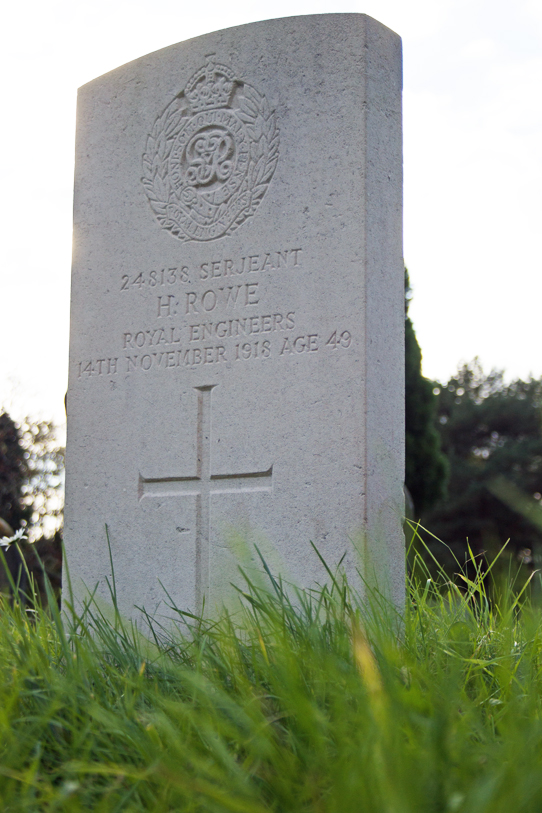
Serjeant Henry Rowe

Serjeant Henry Rowe

Henry Samuel Rowe was born in Shoreditch, London, on 18th August 1873. He was one of three children to Henry and Amelia Rowe. Henry Sr was a stonemason, who died in 1876, when Henry was only three years old.

Amelia moved her and her children to the Sussex Downs, and married again in 1883. Her new husband was John Herrington, and the couple went on to have three further children, Henry’s half-siblings. John was a farm labourer, and his stepson followed in his footsteps when he left school.

Henry soon sought other accomplishments, however, and, in October 1895, he joined the King’s Royal Rifles. During his twelve years’ service, he travelled the world, from Mauritius, to India, South Africa to Sri Lanka. He returned home in December 1903 serving on home soil until the end of his contract in 1907.

On 23rd April 1905, he married a widow, Amelia Routledge, in Brighton. There is no confirmation of the couple going on to have children.

Once demobbed, Henry found employment with the railways, and, by the time of the 1911 census, was working as a signalman. The document records him as boarding in a house in the village of Rudgwick, near Horsham; Amelia, meanwhile, was lodging with a family in South East London.

War was on the horizon, and, in August 1914, Henry volunteered. His time with the King’s Royal Rifles, stood him in good stead; after initially enlisting as a Private in the Royal Sussex Regiment, he was quickly promoted to Corporal and, by November 1914, had transferred to the Royal Engineers and attained the role of Sergeant.

Henry had spent just over a year in France, when he was shot in the right arm on 18th July 1916. Medically evacuated to England, he spent three months recuperating, before heading back into the fray in October the same year.

Henry served another eighteen months on the Front Line, before being admitted to hospital. His medical admission records show that he was suffering from “tremulous speech, confused… conversation, transitory admissions [sic?] of a grandiose type, outbursts of excitement, says he is a man of importance, childish, facile, simpleminded…” His condition was recorded as General Paralysis of the Insane (GPI), more commonly known these days as shellshock, and he was medically discharged from the Army on 4th September 1918.

Sadly, at this point Sergeant Rowe’s trail goes cold. He seems to have been hospitalised following his discharge, but the documents give conflicting suggestions about where he was admitted. Amelia was still living in South London, one record suggests Henry was in the Welsh Metropolitan Hospital in Whitchurch, near Cardiff. But, as he was buried in Worthing, West Sussex, it seems unlikely that he remained in Wales.

The cause of Henry’s passing is not evident either. There is no confirmation that GPI was to blame, but nothing to suggest it was not either. Whatever the cause, Sergeant Rowe died on 14th November 1918, three days after the conflict to which he had given so much had been brought to a close. He was 49 years old.

Henry Samuel Rowe lies at rest in the Broadwater Cemetery in Worthing, West Sussex.


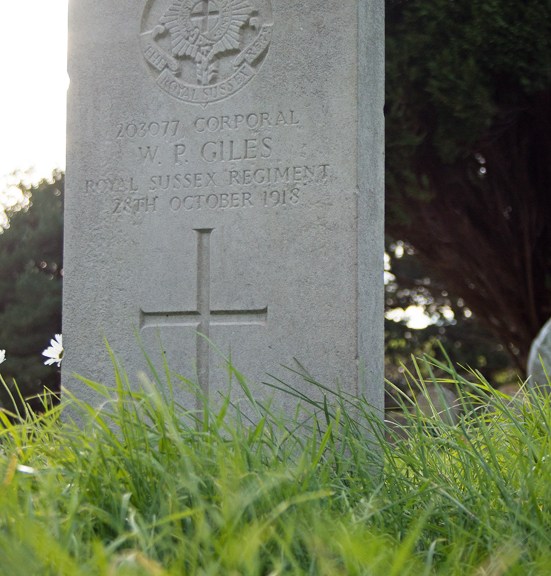
Corporal William Giles

Corporal William Giles

William Percy Giles was born in the autumn of 1879, in the West Sussex town of Storrington. His father was also called William, and his mother was Esther. William Sr was a carpenter, and this was to be a trade that his son followed him into.

In 1905, William married a woman called Ellen; the young couple moved to the seaside town of Worthing, and went on to have a son, Frederick, two years later. William, by this time, was working full time as a carpenter.

War was on the horizon and, while full service details are not available, it is clear that William joined the Royal Sussex Regiment at some point before March 1918. He was assigned to the 4th Battalion, though no further details of his time in the army remain, other than the fact that he reached the rank of Corporal during the conflict.

In the autumn of 1918, Corporal Giles was admitted to the 2nd East General Hospital in Brighton, suffering from nephritis. Sadly, he was to succumb to the condition, and he passed away on 28th October 1918. He was 40 years old.

William Percy Giles’ body was brought back to Worthing for burial. He lies at rest in the Broadwater Cemetery, not far from where his widow and son were living.


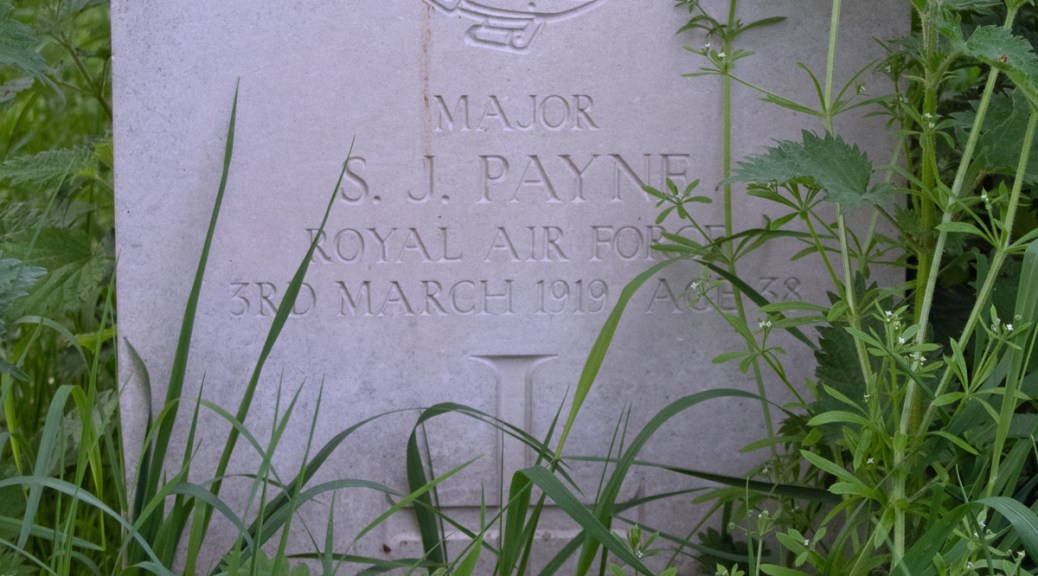
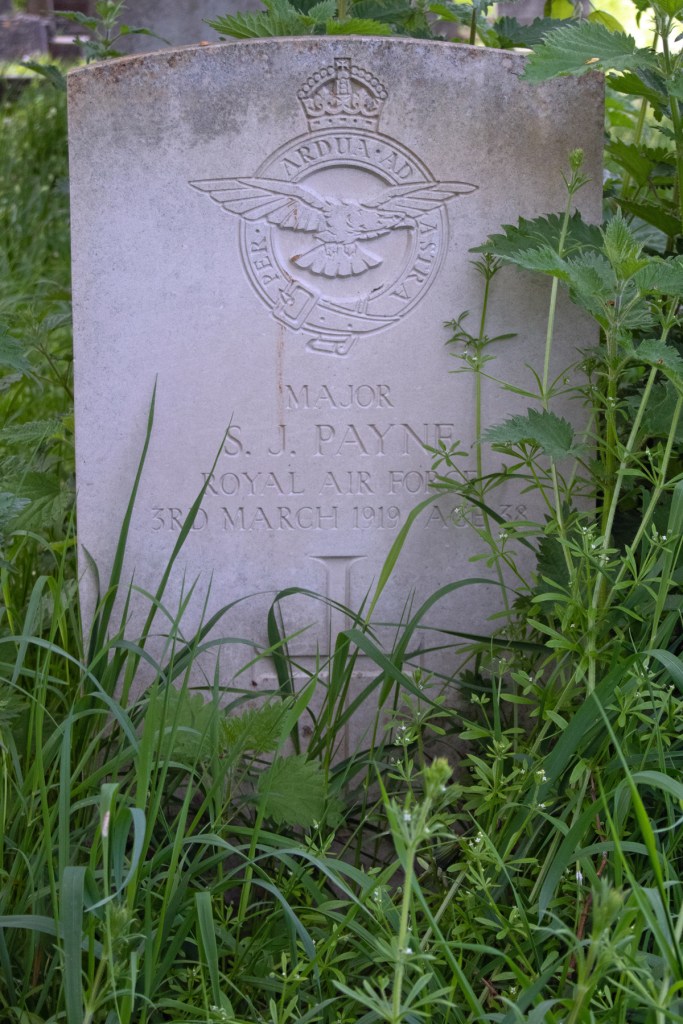
Major Stanley Payne

Major Stanley Payne

Stanley James Payne was born towards the end of 1882, one of eleven children to Stephen and Elizabeth Payne. Stephen was a leather salesman from Essex, who had moved his family to Weston-super-Mare in Somerset in around 1880.

Stanley seems to have been drawn in to a military life from an early age. In January 1900, he enlisted as a Private in the Somerset Light Infantry, and the 1901 census listed him as living at the Raglan Barracks in Devonport, near Plymouth.

Military service took Private Payne to India, where he served for six years. His success and ambition were clear; in 1906 he was promoted to first to Corporal and then to Sergeant. By 1911 – and now back in England – as a Lance Sergeant, Stanley was working as a military clerk at the Royal Horse Artillery Barracks in Dorchester, although he was still attached to the Somerset Light Infantry.

Stanley’s ambition and sense of adventure continued; by July 1912 he had made the transfer over to the newly-formed Royal Flying Corps, as a Sergeant.

It was while he was based in Dorchester that he met Winifred Bell. She was the daughter of a local council worker, and the couple married in the town in September 1912. Stanley and Winifred went on to have a daughter, Doris, who was born in July 1914.

War had arrived in Europe, and on 7th October, the now Warrant Officer Payne was shipped to France. During his nine months on the Western Front, he was mentioned in despatches and received the Croix de Guerre for his gallantry. The local newspaper also reported that he:

…had also the honour of being presented to the King on the occasion of His Majesty’s last visit to the front, and at a home station had also been presented to Queen Mary.

Western Daily Press: Saturday 8th March 1919

Returning to England on 1st June 1915, he was again promoted to Lieutenant and Quartermaster, although here his military records dry up. By this time, he had been in the armed forces for more than fifteen years, but his military records seem to confirm this as the last day of his service.

The next record for Stanley confirms his passing. Admitted to the Central Air Force Hospital in Hampstead with a combination of influenza and pneumonia, he died on 3rd March 1919. He was just 36 years of age.

Brought back to Weston-super-Mare, where his now widowed father was still living, Stanley James Payne was laid to rest in the Milton Cemetery in his home town.


Stanley’s gravestone gives his rank as Major. While there is no documented evidence of any additional promotions after June 1915, the rank is the equivalent of Quartermaster in the Army Reserve. It seems likely, therefore, that the end date of his military service marked the start of his time in the reserves.


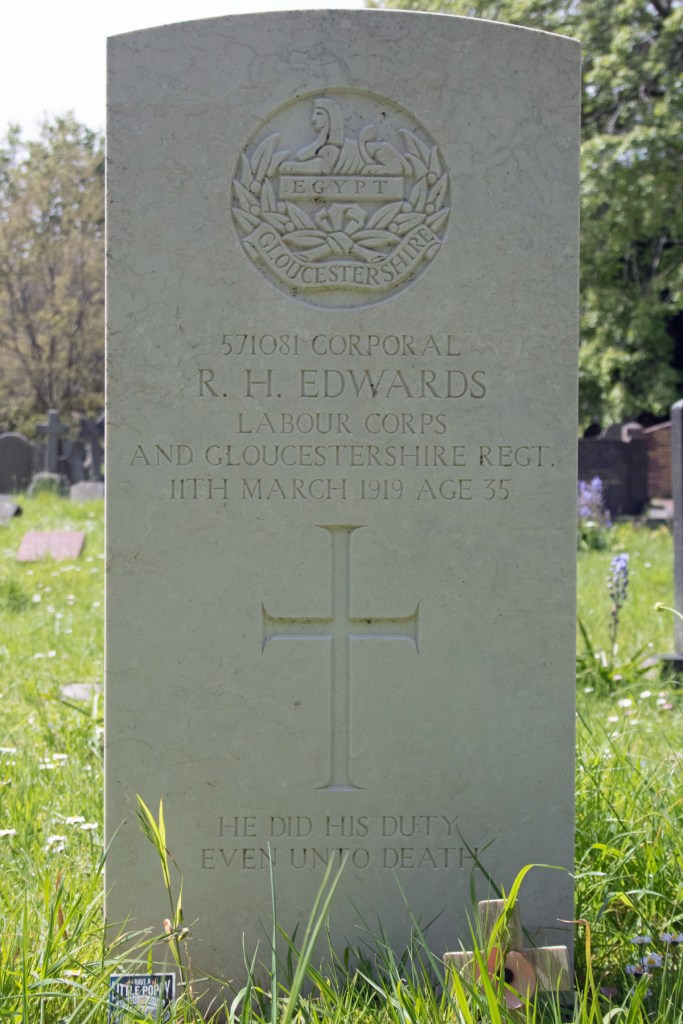
Corporal Ralph Edwards

Corporal Ralph Edwards

Ralph Henry Edwards was born in December 1883, the oldest of six children to Charles and Emma. Charles was a house painter from Somerset, and raised his family in the coastal town of Weston-super-Mare.

When he left school, Ralph followed in his father’s footsteps, taking over the business when Charles passed away in 1909. By the time of the census two years later, Ralph was living with his mother Emma, his two younger brothers and Emma’s brother Harry. Harry was also a house painter, while Ralph’s siblings were working a grocer’s assistants. The family were living in a five-room, semi-detached house within walking distance of the town centre.

War was on the horizon, and Ralph was keen to do his part. Full details of his service are no longer available, but what is certain is that he enlisted in the Gloucestershire Regiment and was assigned to the 8th (Service) Battalion. Initially formed in Bristol, the battalion spent the first year of the war on home soil, before being sent to France in July 1915.

By the middle of the war, Ralph had been promoted to the rank of Corporal. He transferred over to the Labour Corps and was attached to the 106th Prisoner of War Company. Initially, German POWs had been shipped to England, but by 1916 those with useful skills were retained in France and drafted into the Forestry Companies, Army Service Corps and Royal Engineers. Corporal Edwards’ role would have been to oversee such men. (Whether this was in France or back in England is unclear.)

At this point, Ralph’s trail goes cold. He served out the war, passing away back at home on 11th March 1919, although the cause of his death has been lost to time. He was 35 years of age.

Ralph Henry Edwards lies at rest in the Milton Cemetery in his home town of Weston-super-Mare.


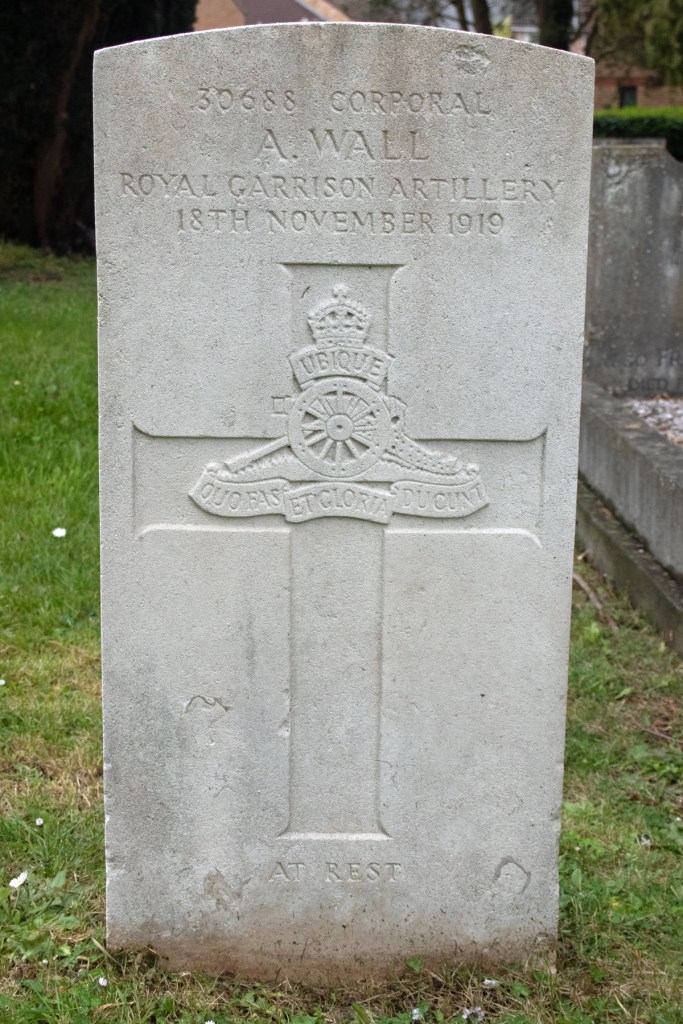
Corporal Albert Wall

Corporal Albert Wall

Albert Wall was born in the spring of 1890, one of eight children to James Wall and his wife Louise. James was a mason’s labourer from Taunton, Somerset, and brought his family up in his home town.

Details of Albert’s life are tantalisingly absent. It appears that he had a sense of adventure, and joined the Royal Garrison Artillery when his age allowed. By 1911, he was stationed at Port Royal in Jamaica, and was listed as a Gunner.

Gunner Wall’s involvement with the Royal Garrison Artillery extended into the Great War. He was sent to Egypt in April 1915, and, as part of his service, gained the Victory and British Medals and the 1915 Star. Albert seems to have been luck in that he saw out the war fairly unscathed, and was promoted to the rank of Corporal.

In the winter of 1918, Albert married Beatrice Salter. The war over, he was subsequently discharged from active service in April 1919.

Life on civvy street was not destined to be a long one, however, as, on 18th November 1919, he passed away from kidney disease. He was just 29 years of age.

Albert Wall was laid to rest in the St James Cemetery in his home town of Taunton.


As a sad footnote to this story, on 5th March 1920, Beatrice gave birth to a little boy, who she called Gordon. Albert was never to see his son.


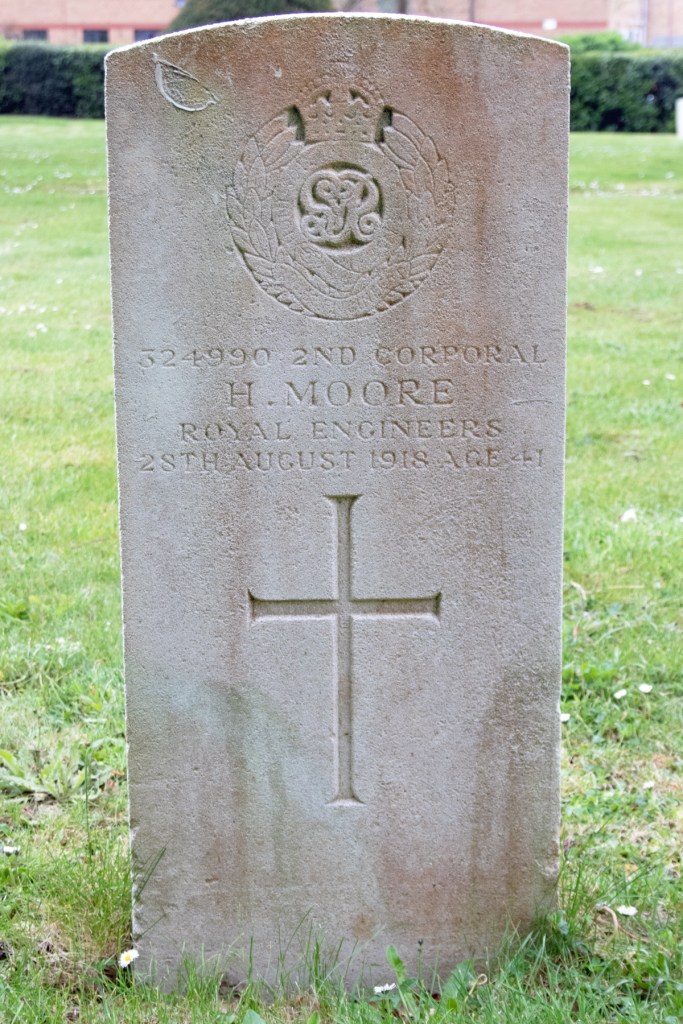
Corporal Harry Moore

Corporal Harry Moore

Harry Moore was born in Tiverton, Devon, in early 1877. He was the fourth of eleven children to James Moore, a railway policeman, and his wife Ann.

By 1890, James had moved the family to Taunton, in Somerset (where his work was now listed as railway porter). Over the next decade, Harry was to encounter tragedy and happiness.

In 1894, his father died from Bright’s disease (a kidney complaint), at the age of just 45 years old.

Three years later, Harry’s mother died, from what appears to have been heart failure. Ann was 49 years of age.

On 13th November 1898, Harry married Alice Mary Larcombe, a dressmaker from Taunton. The young couple set up home together in the north of the town. They went on to have five children, although, sadly, only one would live to reach their 20s.

By now Harry had found employment as an insurance agent, but war was coming to Europe. His military records are lost to time, but he enlisted in the Royal Engineers and was assigned to G Depot Company. (The Depot Battalions received men who had returned from the Expeditionary Force and also those men who had enlisted for Tunnelling Companies, Special Companies and other specialist units.)

The next evidence we have of Corporal Moore is in the Army Register of Soldiers’ Effects. This confirms that he had been admitted to the Southern General Hospital in Bristol with an illness, and that he subsequently passed away on 28th August 1918, at the age of 41.

Harry Moore was laid to rest in the St James’ Cemetery in his home town of Taunton.


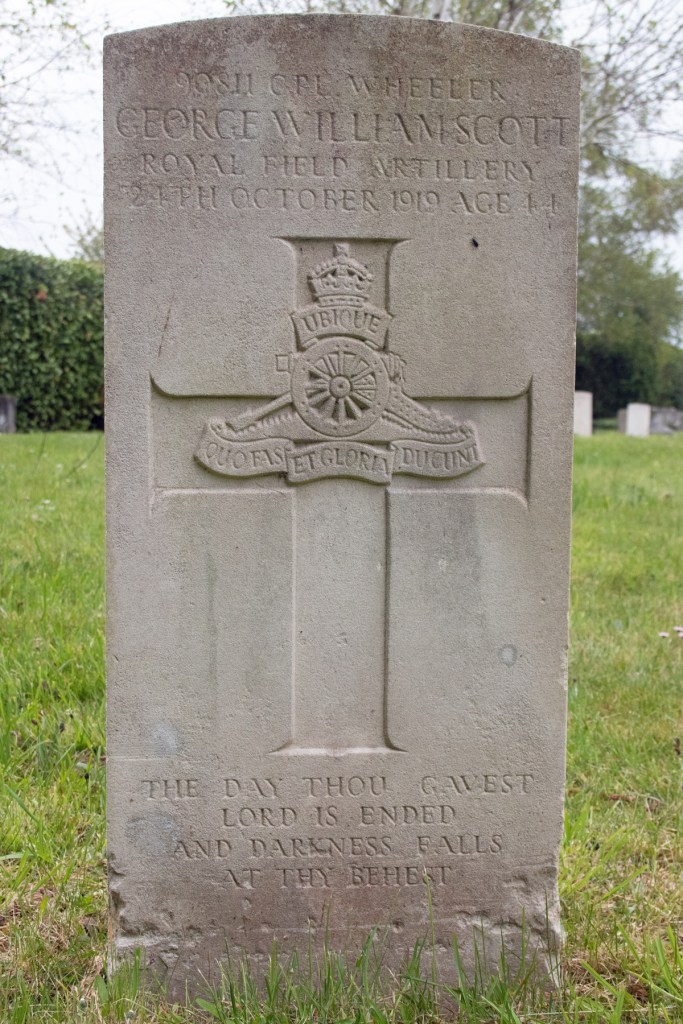
Corporal Wheeler George Scott

Corporal Wheeler George Scott

George William Scott is destined to be one of those names who is sadly lost to time. While there is information relating to him, there is not enough detail to flesh out a concrete history around him.

The facts that we do know about George are that his parents were John and Mary who, at the time that his grave was commemorated, were living in County Tyrone in Northern Ireland.

George enlisted in the Royal Field Artillery in November 1914. He was assigned to the 5th Battery of the 45th Brigade, and given the rank of Wheeler – one of the positions in a team of horses, pulling the artillery.

During his service, George was awarded the 1914 Star, as well as the Victory and British Medals. He seems to have been in a bit of trouble to begin with, however, as he was reverted down to Gunner because of misconduct. This may only have been temporary, as he ended with the rank of Corporal Wheeler.

And that is it, that is all the concrete information available for George Scott. How he died is a mystery, lost to time.

George William Scott lies at rest in St Mary’s Cemetery in Taunton, Somerset.


Corporal Albert Shrubsall

Corporal Albert Shrubsall

Albert Arthur Shrubsall was born in Deptford, South London, in April 1896. He was the youngest of three children – all boys – to ironmonger George Shrubsall and his wife Jessie.

While his brothers continued to live at home after they had left school and got jobs, Albert found live-in work as a pageboy, or servant, for Wilfred Lineham, who was a professor of engineering for a London college. It was while he was working here that his mother, Jessie, passed away. She died in 1913, aged just 43.

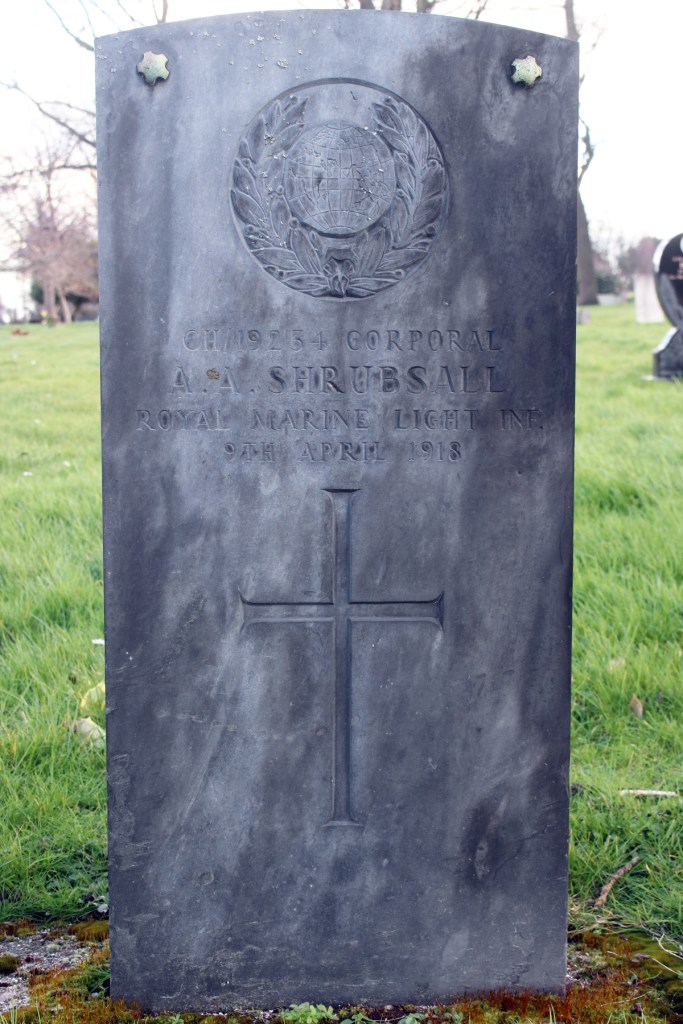
Details of Albert’s military service are a bit scant. He enlisted in the Royal Marine Light Infantry, although I have been unable to confirm when he joined up. He was assigned to the Chatham Division, and was based at the Naval Dockyard in Kent, ultimately being promoted to Corporal.

Albert married Gertrude Spoore – affectionately known a ‘Ginty’ – in Deptford in October 1917. Sadly, the marriage was to las less than six months, as, on 9th April 1918, Albert passed away, having contracted pneumonia and septicaemia. He was just 22 years old.

Albert lies at rest in the Woodlands Cemetery in his adopted home town of Gillingham in Kent.


Albert’s two brothers George and Alfred were also involved in the First World War.


George, had gone on to become a tailor’s assistant when he left school. He married Emily Hawkes in 1911, and the couple went on to have a son, also called George, the following year.

When war broke out, he enlisted in the Machine Gun Corps, and served on the Western Front. Sadly, he was caught up in the fighting, and was killed in action on 22nd August 1917. He was buried at the Tyne Cot Memorial in Flanders.


When he left school, Alfred went on to become a butcher’s assistant. War came along, and he enlisted straight away.

Enrolling in the Royal Field Artillery, Gunner Shrubsall was assigned to the 95th Brigade. Sadly, he had recorded less than six months’ service, as he passed away on 8th January 1915, aged just 21 years old. His brigade did not go to France until the following year, so, while no cause of death is recorded, it is likely that he died from a communicable disease like influenza or pneumonia.

Alfred is buried in the family grave in Deptford, South London.


Within a period of just three years, George had lost all three of his sons to the Great War. Given the previous death of his wife, you can only imagine the heartbreak he was going through.


Corporal Richard Langley

Corporal Richard Langley

Richard Frederick Langley was born in January 1897 in Chatham, Kent. He was one of seven children to Albert Langley, who was a bricklayer, and his wife, Elizabeth.

Richard enlisted almost as soon as he was able to. His papers, dated 18th October 1914, show that he was 17 years and 10 months old, as was working as an apprentice boilermaker. He was assigned to the Royal Engineers.

Sapper Langley’s war service was spent in England. Initially based in Kent, he was promoted to Acting Lance Corporal in October 1915. Transferring to the Royal Engineers Anti Aircraft Battalion in July 1916, Richard was again promoted to Corporal.

Corporal Langley was injured while serving for the Royal Engineers AA; he was admitted to the General Hospital in Tunbridge Wells, and has a hernia operated on. After two months recovering in hospital, he re-joined his battalion.

Richard was transferred again in January 1918, this time being assigned to the London Electrical Engineers. It was here that he saw out the remainder of the war.

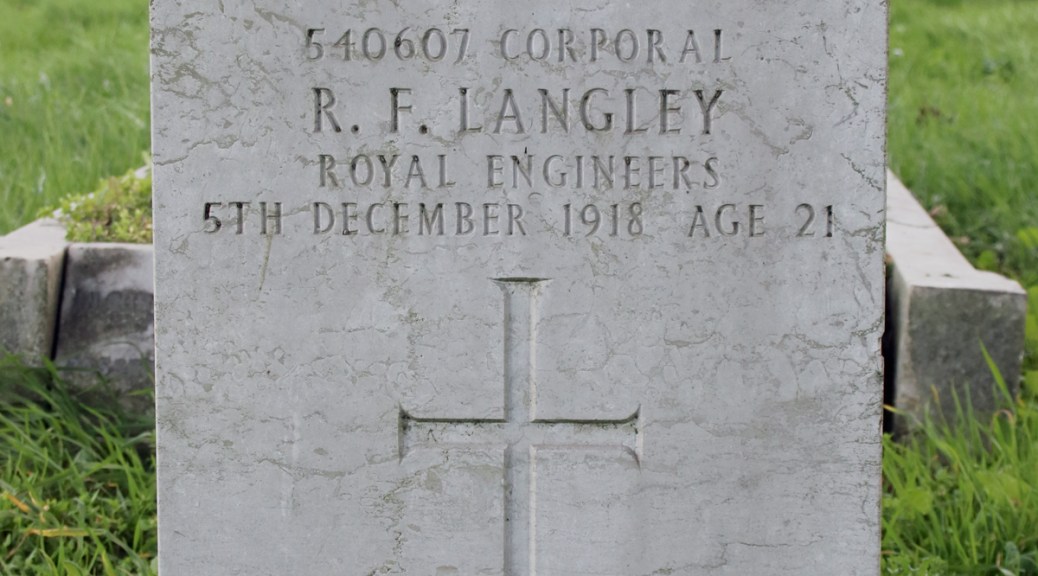
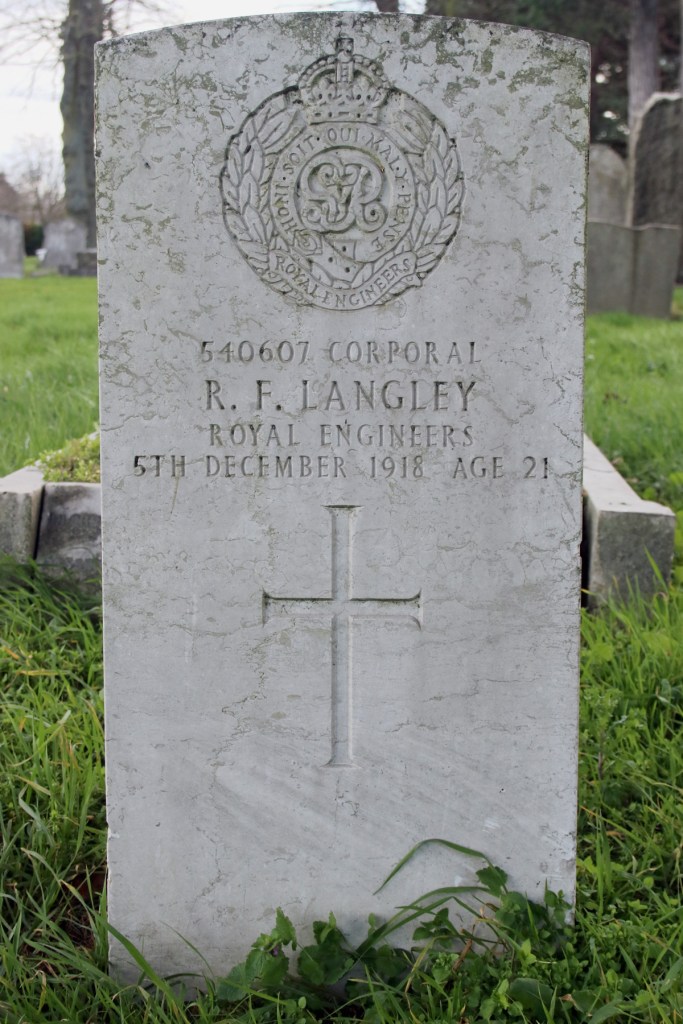
It was while he was serving in Sheerness that Richard contracted influenza. Hospitalised on the island on 28th November 1918, he sadly did not recover. Corporal Langley passed away from pneumonia on 5th December 1918. He was just 21 years of age.

Richard Frederick Langley lies at rest in the Woodlands Cemetery in his home town of Gillingham, Kent.


Richard’s older brother Albert was also involved in war service and was a skilled labourer at Chatham Dockyard. In February 1916, he boarded the SS Maloja, a steamship bound for Bombay with over 400 passengers and crew on board.

At around 10:30am on Sunday 27th February, the ship was sailing through the Straits of Dover when it struck a mine. The vessel sank within 24 minutes. Over 150 people died in the explosion, from drowning or from hypothermia.

Sadly, Albert’s body was not recovered. He was just 21 years old. He is commemorated on the Naval Memorial in Chatham, Kent.