Tag Archives: family

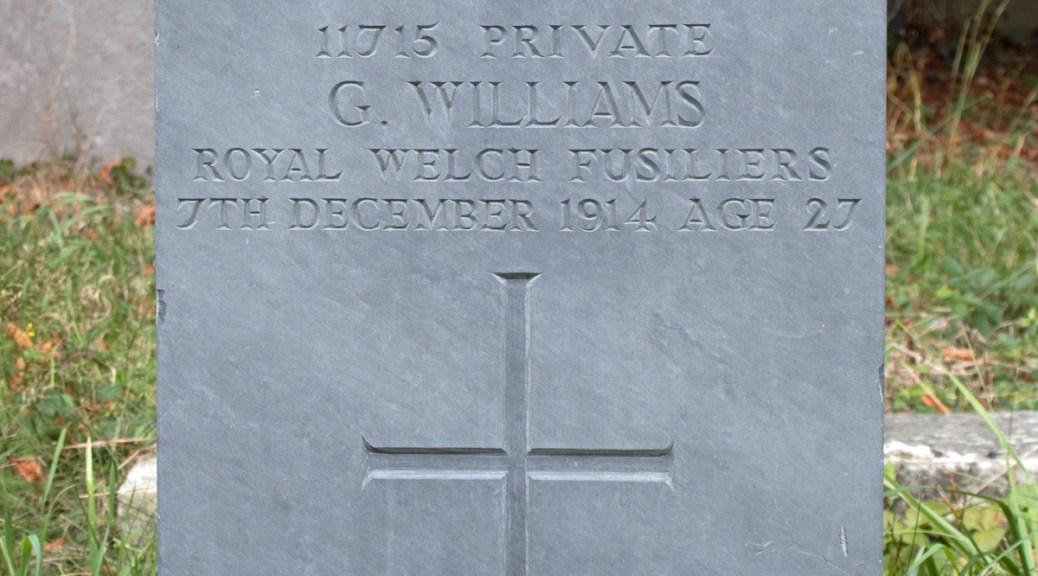
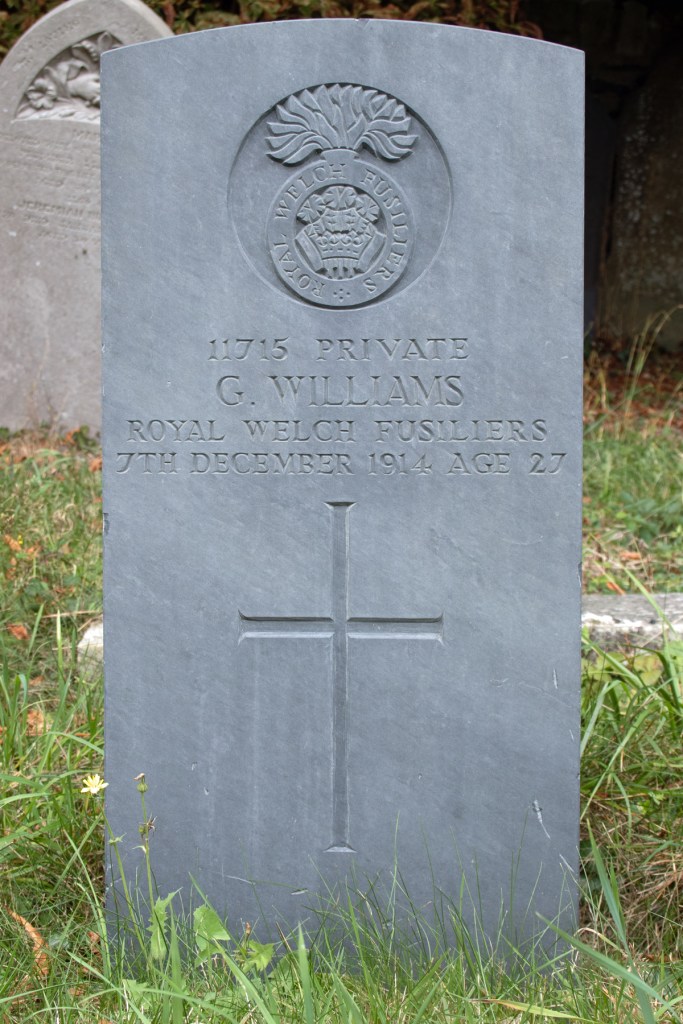
Private George Williams

Private George Williams

George Williams was born in 1887 in Ruthin, Denbighshire. One of thirteen children – of whom sadly only seven survived – his parents were John and Martha Williams. John was a carpenter and joiner and, when the children had grown a little, he and Martha took on the Registered Tramp Lodging House in Church Street, Llangollen.

The 1911 census recorded George living with his parents and working as a carter. His younger brother John was employed as a labourer, while the rest of his siblings were at school. The boarding house was full as Martha’s brother was staying there, along with four lodgers.

George married Catherine Edwards on 27th May 1911. She was an engineer’s daughter, also from Llangollen, and the couple tied the knot in St Collen’s Church, which was on the same street as the Williams’ boarding house. The newlyweds moved to Ruabon, six miles (10km) to the east of Llangollen, and had a daughter, Martha, who was born in 1912.

When war was declared, George was quick to enlist. He joined the 8th (Service) Battalion of the Royal Welch Fusiliers, and was sent to Salisbury Plain for his training. While here, however, Private Williams passed away. The cause of his passing is not readily available, but it seems likely that he succumbed to illness, possibly brought on by the sudden influx of men from across the country suddenly billeted together in the confines of an army camp. He died on 7th December 1914, aged just 27 years of age.

George Williams’ body was brought back to Wales for burial. He was laid to rest in the graveyard of St John’s Church in Llangollen.


Tragically, just six days after George’s death, Catherine gave birth to their second child. George Jr would never know his father.


Private James Jones

Private James Jones

James Ward Jones was born on 17th August 1871 in the Denbighshire town of Llangollen. He was the oldest of eleven children to William and Anne Jones. William was a bricklayer’s labourer, and James followed suit when he finished school.

On 30th April 1898, James married fisherman’s daughter Mary Jones. The couple set up home in Llangollen and went on to have ten children.

When war came to Europe, James stepped up to play his part for King and Country. Sadly, little detail of his military service remains available. but it is clear that he enlisted in the Royal Welch Fusiliers and, as a Private, he was assigned to the 47th Provisional Battalion. The troop was based on home soil, and James found himself sent to Norfolk for his war work.

It is unlikely that Private Jones was in camp for long. On Christmas Day 1915 he collapsed having had a seizure, and passed away. He was 44 years of age.

James Ward Jones’ body was brought back to Wales for burial. He was laid to rest in the graveyard of St John’s Church in his home town of Llangollen.


Mary was left with ten children to bring up on her own. She married again, to a Jack Evans, in the autumn of 1916. The couple had two children of their own. Mary passed away in December 1935, aged just 58 years old.


Private Edgar Bowditch

Private Edgar Bowditch

Edgar George Bowditch was born in the spring of 1887, in the Dorset village of Melbury Osmond. One of seven children, his parents were William and Sarah Bowditch. William was an agricultural labourer turned gamekeeper, and Edgar helped his father out when he left school.

William passed away in 1911, and Edgar fell off the radar until March 1914, when he married local mason’s daughter Rosetta Morris. The couple settled down in her home village of West Coker, Somerset.

When war was declared, Edgar stepped up to serve his King and Country, and enlisted in the Machine Gun Corps as a Private. He was assigned to the 37th Battalion, and certainly saw action overseas. He “came through without a scratch and in good health until demobilised in France.” [Western Chronicle: Friday 21st February 1919]

Private Bowditch was unwell when he arrived back in West Coker on 4th February 1919. While his condition is unclear, it worsened, and he passed away at home ten days later. He was 32 years of age.

Edgar George Bowditch was laid to rest in the graveyard of St Martin’s Church in his adopted home of West Coker.


Rosetta married again in 1921, to a John Axe. The couple remained in the same part of Somerset, John dying in 1947. Rosetta lived on, passing away in Yeovil in 1963, at the age of 77 years old.


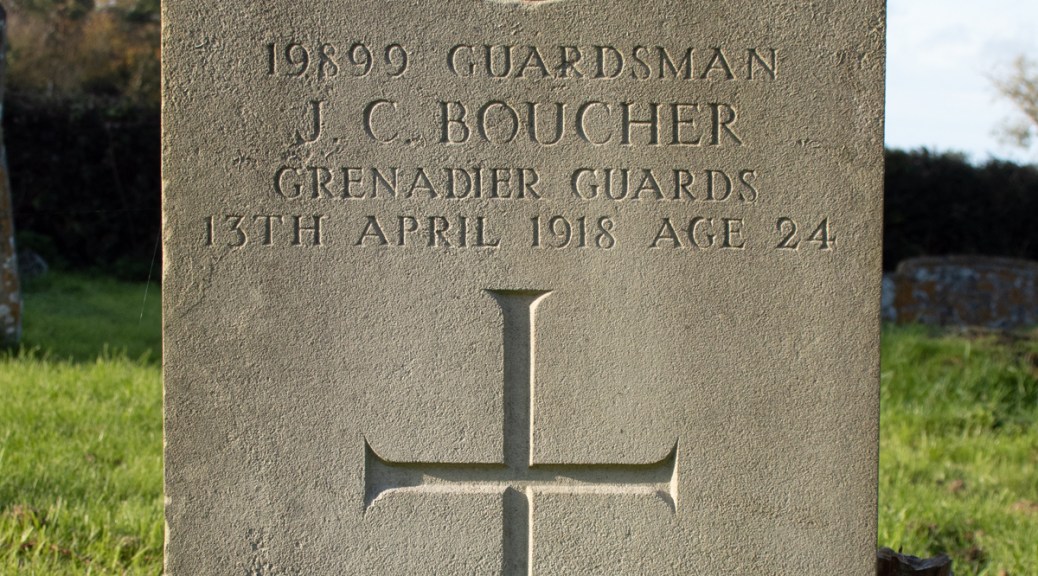
Guardsman John Boucher

Guardsman John Boucher

John Charles Boucher was born in East Coker, Somerset, in the spring of 1894. The youngest of five children, he was the son of Charles and Ann Boucher. Charles worked on the railways as a plate layer, while John found work in a local textile factory as a yarn dyer when he left school. He was a sporty young man, and became a prominent member of the nearby Stoford Football Club.

Ann died in 1914 and, when war was declared, John was keen to play his part. He had enlisted in the Grenadier Guards by the summer of 1917 and was assigned to the 5th Battalion. Full details of Guardsman Boucher’s military service are lost to time, but it is clear that he served abroad, and was wounded twice in the fighting.

John was based at Guards barracks in Kensington, London. It was here that he met Elsie Louise Vaughan, who was the daughter of a local insurance agent. The couple married at the Holy Trinity Church in Paddington on 28th June 1917.

Guardsman Boucher was soon sent to the Western Front again, however, and, in the spring of 1918, he was caught up in the Battles of the Lys. Wounded for a third time, he was medically evacuated to Britain, and admitted to the Military Hospital in Sidcup, Kent. Sadly, it was to be third time unlucky for John: his wounds proved too severe, and he died of his injuries on 13th April 1918. He was just 24 years of age.

John Charles Boucher was brought back to Somerset for burial. He was laid to rest in the cemetery of his home village, East Coker.


Tragically, just three weeks after John’s death, Elsie gave birth to their first, and only, child, a son she named after his father. She went on to marry again in the spring of 1919, to a John Bellamy. The couple would go on to have a child of their own – a daughter called Iris – the following year. John Jr died in 1972, and Elsie followed five years later, at the age of 83 years old.


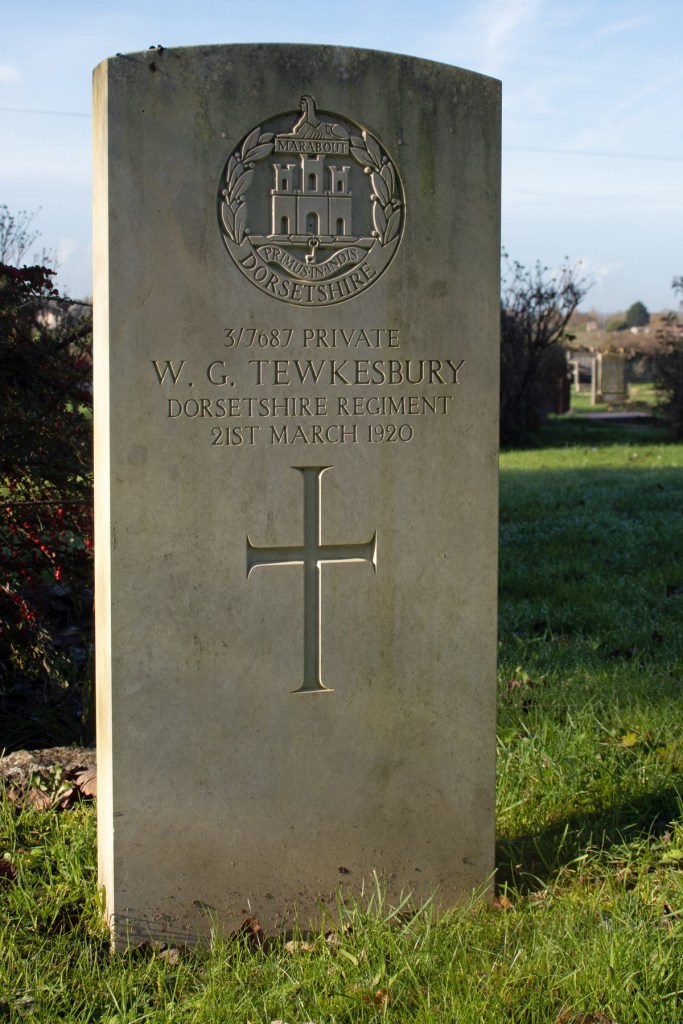
Private William Tewkesbury

Private William Tewkesbury

William Gilbert Tewkesbury was born in Ilchester, Somerset, in the autumn of 1881. The middle of three children (although his older brother died in 1887), his parents were William and Jane Tewkesbury. William Sr was a farm labourer, and this is something that William Jr and his younger brother, Hedley, also went into.

When war arrived on Europe’s shores, William Jr stepped up to play his part. Full details of his military service are, sadly, lost to time, but he enlisted in the Dorsetshire Regiment, and was assigned to the 2nd Battalion. His mother, Jane, passed away in 1915, and it is unclear whether this loss proved to be the catalyst for her son’s enlistment.

Private Tewkesbury’s battalion served in the Middle East for the duration of the conflict.

During the past week we have had three of our local men who have seen active service home for a few days’ leave… Private William Tewkesbury… who has been on active service in Mesopotamia…

Western Chronicle: Friday 8th June 1917

William survived the war, and was awarded the Victory and British Medals for his service. He returned home, and, presumably, took up his previous employment once he was demobbed in February 1919.

The next available record for William is that of his passing, and even this is sketchy. He passed away on 21st March 1920 in Sherborne, Dorset, though the cause is unknown. He was 39 years of age.

William Gilbert Tewkesbury’s body was brought back to Ilchester for burial. He was laid to rest in the village’s parish cemetery. While not recorded, it is likely that this is where Jane had been buried five years earlier, and where William Sr would be laid to rest just months later, when he too passed away.


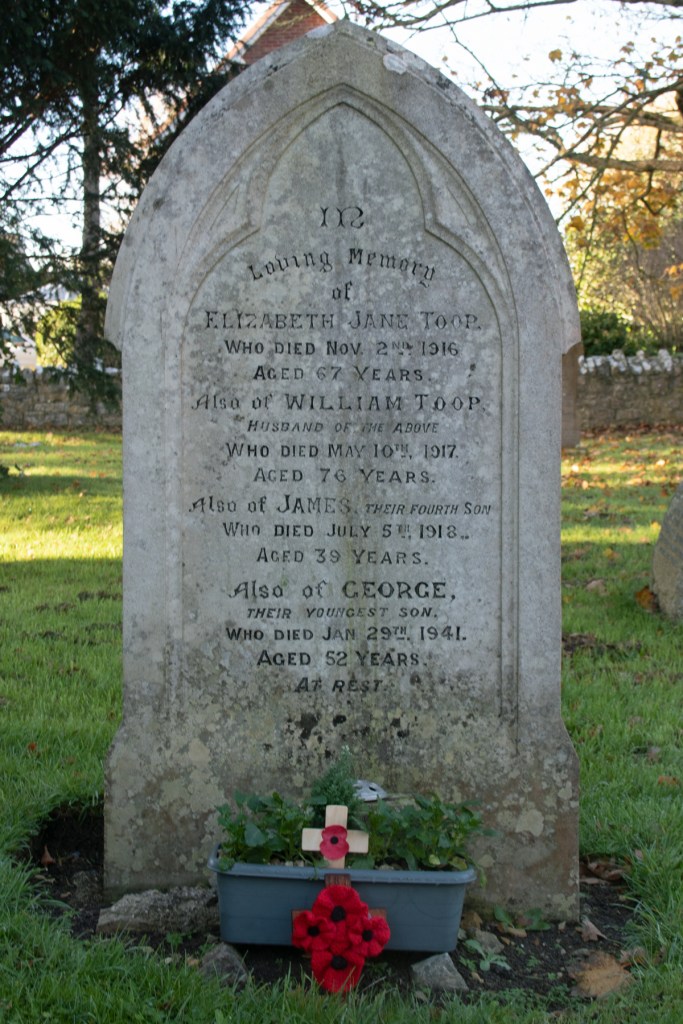
Lance Corporal James Toop

Lance Corporal James Toop

James Toop was born in the Somerset village of Galhampton on 13th January 1879. He was the fifth of eleven children to William and Elizabeth Toop. William was a farm labourer, and James followed his father’s line of work when he left school.

James disappears from documents for a while, only surfacing again in October 1914, when he enlisted for army service. At this point, he was working as a bricklayer, and notes that he had previously served in the Somerset Light Infantry. He is recorded as being 5ft 8ins (1.73m) tall, weighing 136lbs (61.7kg). He had brown hair, grey eyes, and gave his religion as Congregationalist. James also lied about his age, saying that he was 29 years and 9 months when, in fact, he would have been closer to 36 years old when he joined up.

Sapper Toop was assigned to the Royal Engineers, and spent nine months on home soil, during which time he was promoted to Lance Corporal. On 18th July 1915 he went to France, but returned just five days later.

Admitted to the Royal Victoria War Hospital in Netley, Hampshire, James was recorded as suffering the stress of campaign. He was moved to Napsbury War Hospital, near St Albans in Hertfordshire, after a couple of weeks. This institution – formerly the Middlesex County Asylum – was where servicemen suffering from shell shock were sent for rehabilitation, and Lance Corporal Toop joined the near 2,000 other residents.

James’ diagnosis was recorded as being neurasthenia with depression and, in October 1916, he was medically discharged from the army. The medical report noted that he had “had nervous breakdown, complained of vomiting of his food. Had defective memory. Had religious mania 5 years before enlistment.” While his condition was not the result of his war service, the medical board recorded that his mental debility has been aggravated by the strain.

James falls off the radar again at this point. When he recovered, he returned to bricklaying for work. In 1916 his mother died, followed a year later by his father. Both were laid to rest in the family grave in St Mary Magdalene’s Church, Sparkford, Somerset.

James Toop died on 5th July 1918 at the age of 39 years old. He was also buried in the family plot, reunited with his parents far too soon.


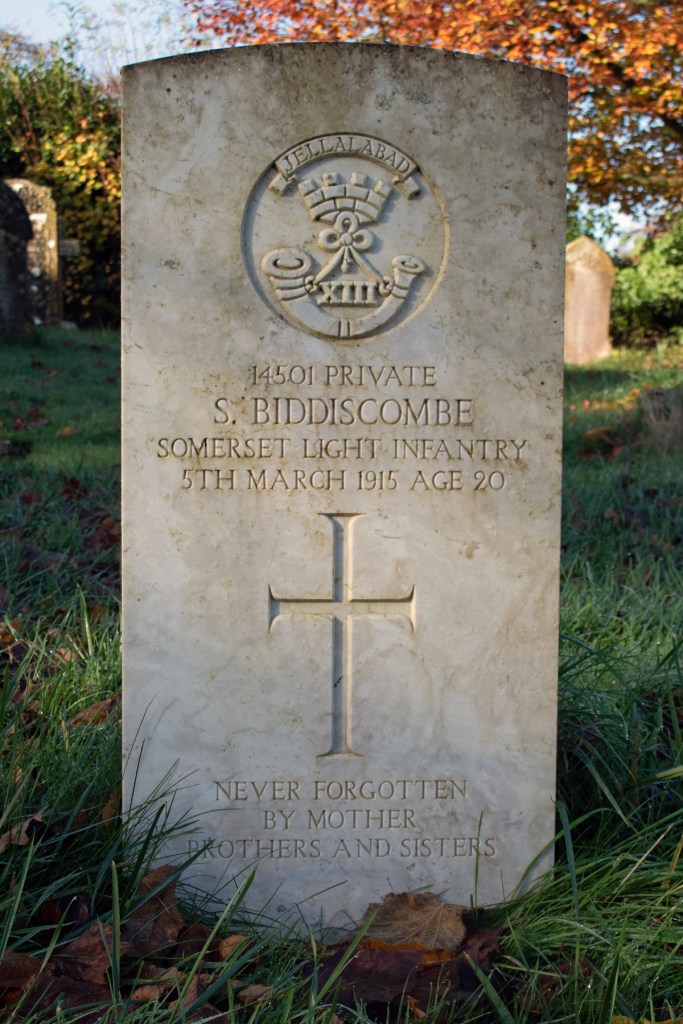
Private Sidney Biddiscombe

Private Sidney Biddiscombe

Sidney William Biddiscombe was born in South Cadbury, Somerset, in the spring of 1895. The eighth of sixteen children, his parents were Thomas and Constance Biddiscombe. Thomas was an agricultural labourer, and this is work that Sidney went into when he finished school.

When war came to Europe, Sidney was quick to enlist. Whether this was out of a sense of duty, a keenness to get involved, a need to follow his older brothers, or as an escape from farm labouring is unclear, though. He joined the Somerset Light Infantry in August 1914, and was assigned to the 7th (Service) Battalion.

There is little information available about Private Biddiscombe’s time in the army. He received his training in Hampshire, and was based at Aldershot. The sudden influx of young men from across the country into small, cramped billets meant that illness ran rife, and Sidney, it seems, was not immune. He contracted measles, and was admitted to the camp’s Isolation Hospital.

Sadly, the infection was to get the better of Private Biddiscombe, and he passed away at the hospital on 5th March 1915. He was just 20 years of age.

Sidney William Biddiscombe was brought back to Somerset for burial. He was laid to rest in the graveyard of St Thomas a Becket’s Church in his home village of South Cadbury.


Sidney’s epitaph notes he is “never forgotten by mother, brothers and sisters”. His father, Thomas, died in 1918, at the age of 62, and so was not commemorated on his son’s headstone, which was erected at a later date.


Rifleman William Locke

Rifleman William Locke

William Thomas Locke was born at the start of 1900 in the Kent village of Eccles. His parents were Thomas and Annie Locke, although it seems that he was orphaned early on. The 1901 census recorded him as living with his grandparents John and Mary Locke. Their daughter Annie is also recorded as living at the property, although there is nothing to confirm whether she was William’s mother or an aunt.

By the time of the 1911 census John Locke had died. Mary was living in the same house, with two of her sons – Frederick and Alfred – and her grandchildren, William and his cousin Gladys. Both of William’s uncles were labourers in the local cement works, and it seems likely that this would be work that he would have followed them into once he had completed school.

William’s trail goes cold at this point, although he would have been too young to join up at the outbreak of the First World War. Records confirm that he had enlisted by March 1918, and it seems likely that he would have done so as soon as he came of age.

Rifleman Locke joined the 5th Battalion of the King’s (Liverpool Regiment), but this is the only detail of his military service that can be confirmed. The next record for him confirms that he passed away on 5th October 1918, having been admitted to hospital in Oswestry, Shropshire, suffering from intestinal problems. He was just 18 years old when he passed.

William Thomas Locke’s body was brought back to Kent for burial. He was laid to rest in the graveyard of St Peter & St Paul’s Church in Aylesford, the parish church for his home village of Eccles.

The specific location of William’s grave is not known, although it is likely that he was laid to rest near his grandfather. Instead, he is commemorated on a joint headstone in the First World War section of the graveyard. William’s grandmother passed away the following year, and records confirm that his next of kin was noted as his aunt, Mary Ann Longley.


Private Charles Grigsby

Private Charles Grigsby

Charles Grigsby was born in Boughton Monchelsea, a village to the south of Maidstone, Kent, in the summer of 1878. His parents were farm labourer William Grigsby and his wife, Elizabeth, and he was one of four children. Charles’ mother passed away when he was just three years old, and William married again – to another Elizabeth. They had six children – half-siblings to Charles.

Charles falls off the radar for a few years – his First World War service records suggest that he had enlisted with the East Kent Regiment, and so may have been serving abroad at the time of the 1891 and 1901 censuses.

In 1904 he was back in Kent, however, where he married Henrietta Harpum. The daughter of a soldier, Henrietta had been born in Shoeburyness, Essex, but the family had moved to Frindsbury, Kent, not long afterwards.

The 1911 census found the Grigsbys living in the village of Eccles, near Aylesford. Charles was working as a blacksmith’s striker at the local cement works, and they had their Henrietta’s nephew, George, living with them at the time the record was taken.

When war was declared, Charles stepped up again to play his part. He enlisted on 24th August 1914, and was assigned to the Queen’s Own (Royal West Kent Regiment). Private Grigsby’s service records confirm that he was 5ft 6.5ins (1.69m) tall, and weighed 129lbs (58.5kg). He had brown hair, blue eyes and tattoos on both arms.

Tragically, Henrietta died not long after her husband joined up, although the exact date and cause of her passing is lost to time. Assigned to the 6th (Service) Battalion, Charles was, by this time, based in Hythe, on the Kent coast.

Private Grigsby’s time back in the army was to be a short one, however. He was admitted to Shorncliffe Military Hospital in January 1915, suffering from bronchial pneumonia, and is was this lung condition that was to take his life just weeks later. He passed away on 22nd February 1915, at the age of 35 years old.

Charles Grigsby was brought back to Aylesford by his siblings. He was laid to rest in the graveyard of St Peter & St Paul’s Churchyard. It is likely that he was buried alongside Henrietta, although the exact location of his grave is not longer known. Instead, he is commemorated on a joint headstone in the First World War section of the graveyard.


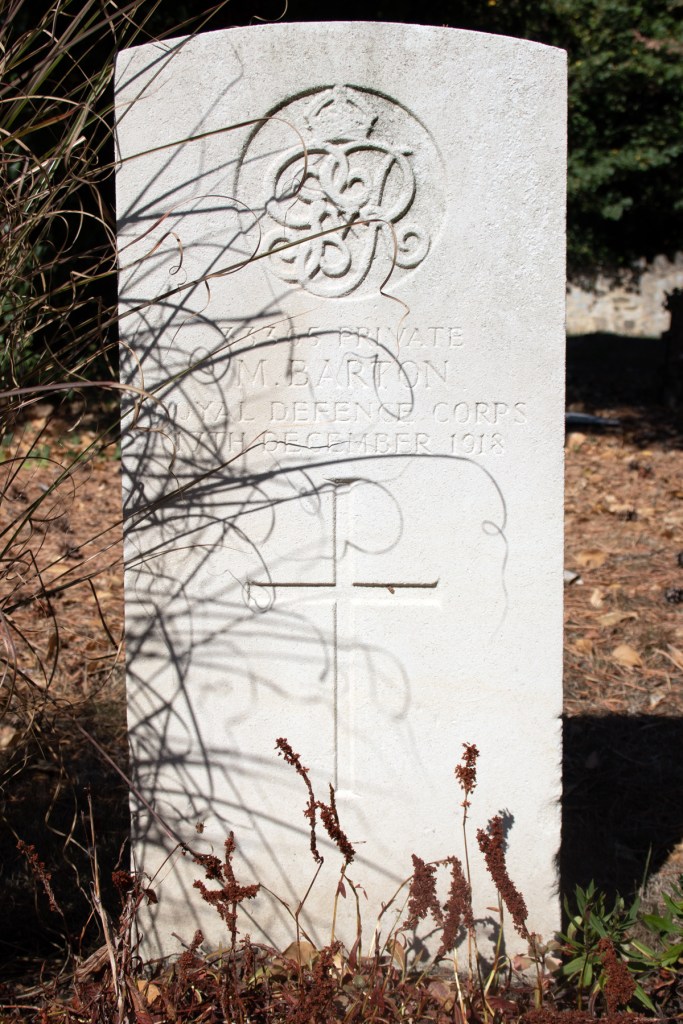
Private Michael Barton

Private Michael Barton

Michael Barton was born in the spring of 1863 in the Kent village of Hadlow. The youngest of three children, his parents were farm labourer William Barton and his wife Annie. Michael became a farm labourer when he left school and, when William died in 1890, he remained at home to support his mother.

Annie passed away in 1905, and this proved a turning point for Michael. By the time of the next census in 1911, he was recorded in the Tonbridge Union Workhouse, one of its 600 inmates.

Michael’s trail is harder to pick up at this point. Despite his age, it seems that he sought a way out of his situation when war broke out and had certainly enlisted in the army by the last year of the conflict. Initially joining the Royal Defence Corps, Private Barton was soon transferred to the Labour Corps, and was assigned to 572nd Agricultural Coy.

The next document relating to Michael is that of his passing. He died on 17th December 1918 at the Preston Hall Military Hospital in Aylesford, Kent, although the cause of his death is not readily available. He was 55 years of age.

Michael Barton was laid to rest in the graveyard of St Peter & St Paul’s Church in Aylesford, not far from the hospital in which he had passed.


The Army Register of Soldiers’ Effects records that Michael’s belongings passed to a Miss Kate Burley when he died. Not one of his immediate relatives, it is likely that she was a friend or other relation.