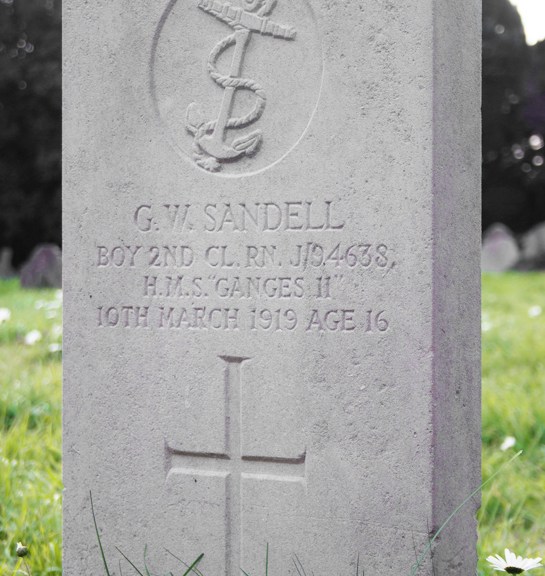
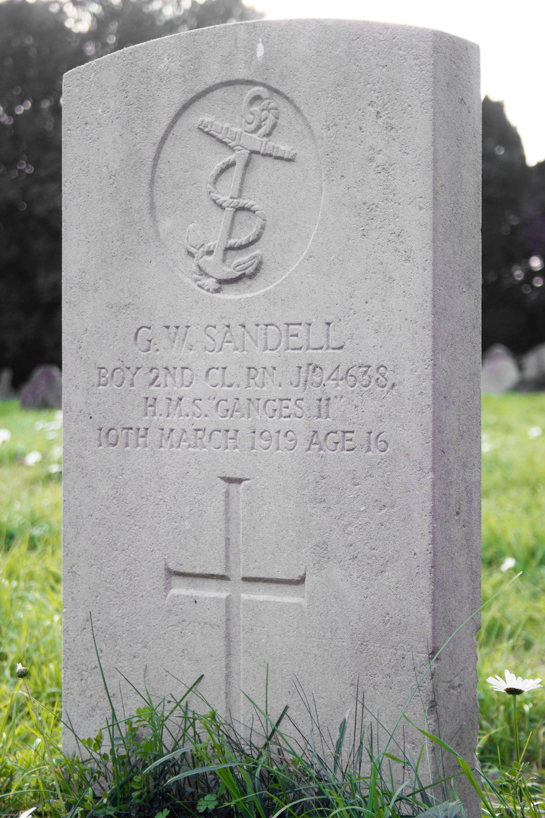
George William Sandell was born on 13th August 1902, the oldest of five children to William and Mary Sandell. While George was born in Chichester, William raised the family in Worthing; he was a carpenter and joiner by trade, and came from a local building family.
When George left school, he found work as a porter on the railways. Too young to be directly involved in the 1914-1918 conflict, he was definitely for adventure, and, on 5th February 1919, he enlisted in the Royal Navy.
Assigned the rank of Boy – because of his age – he was sent to HMS Ganges II, a training establishment in Suffolk. His decision to enlist was set to be young George’s undoing; within weeks he had contracted pneumonia, and he passed away on 10th March 1919. Tragically, he was just 16 years old.
William and Mary brought their boy back to Worthing; he was buried in the Broadwater Cemetery there, within walking distance of their home.
For me, a huge coincidence to this story is that I lived in the house George was brought up in. He was raised at 27 Southfield Road, in Worthing, up until he was sent for training in 1919. I lived at the same address for a number of years in the early 2000s.
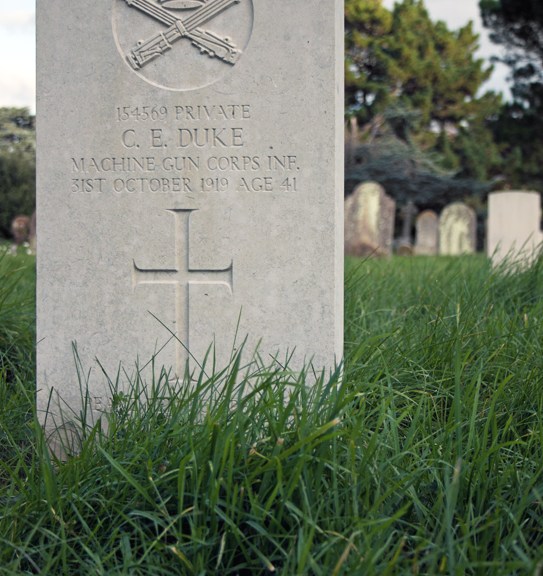
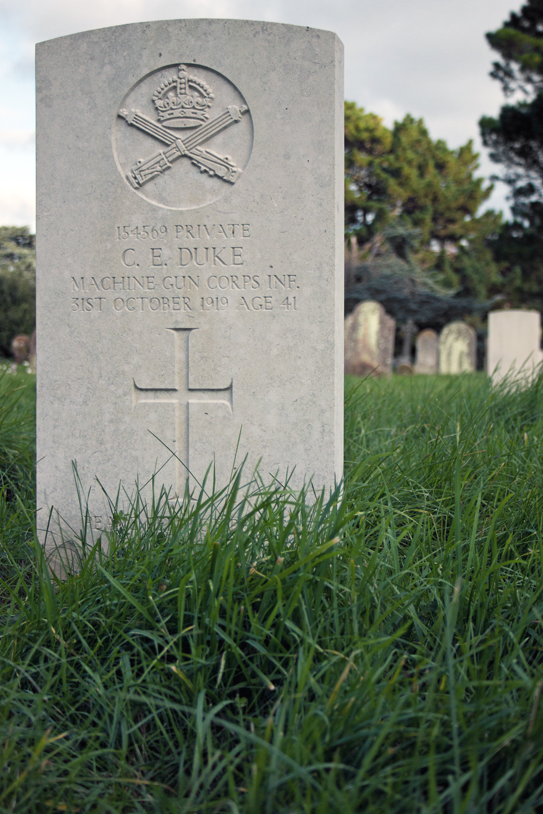
Charles Edward Duke was born in early 1880, the oldest of three children to George and Charlotte Duke. George was a market gardener, but for all of Charles’ childhood censuses – 1881, 1891 and 1901 – his father is absent. Instead, Charlotte is listed as the head of the household, married and working as a launderess. Given that the censuses were all taken in the spring, it is possible that her husband was working away each time the document was recorded, although this is supposition. In every census, though, it is interesting to note that she had taken in lodgers to help pay the bills.
The family lived in Worthing, West Sussex, in a small house near the centre of town. When he left school, Charles found work as an errand boy for a local stationer, before finding more gainful employment as a gardener in one of the multitude of nurseries surrounding the coastal town.
In 1901, Charles married Lucy Barnes, a carter’s daughter from the town; the young couple set up home in Broadwater, to the north of Worthing town centre, and went on to have four children; Alice, Henry, Dorothy and Margaret.
When war arrived on European shores, Charles played his part. Sadly his military records are all but non-existent, but from what remains it’s possible to piece together something of his military life.
Private Duke enlisted in the Machine Gun Corps, and was assigned to the 16th Company. While it is impossible to place him in any specific location, his company was certainly involved in the Battle of the Somme.
Charles survived the war; the next evidence available for him notes that he died on 31st October 1919 in a hospital in Brighton, although o cause is given for his death. The Commonwealth War Graves Commission give his age as 41, although it seems likely he was a couple of years younger than this, based on when his birth was registered.
Charles Edward Duke was buried in the Broadwater Cemetery, a short walk from where his widow and children were living.
Sometimes research into the names of the fallen runs into obstacles. There are graves I have researched that have brought up very little information, either because the soldier concerned is too young to have a lot of documentation about them, or because information on them has subsequently been lost.
On other occasions, it is the sheer wealth of documentation that proves to be the stumbling block. Such is the case with William Frederick Holden, buried in the Broadwater Cemetery in Worthing, West Sussex.
The grave itself gives some information: he was a Private in the Royal Sussex Regiment, with a service number of 8298970, and died on 16th February 1921, at the age of 26. The Commonwealth War Graves Commission archives give some further information: his father was Frederick Charles Holden, and his stepmother was Elena.
The Find A Grave website adds a little further information – he was born in Sidlesham, near Chichester in West Sussex. The site suggests, however, that he was born in 1897, which would suggest he was 23 or 24 when he died.
Researching on Ancestry throws up a wealth of other information, which begins to make it more of a challenge to identify the correct details. Both William and Frederick were common names in the late Victorian era, and Holden was a familiar Sussex name, and had many spelling variations.
Searching for William’s service number on sites like Fold3 does not provide any results, so that does not provide an opportunity to narrow down the information. Nor is there any record of his passing or burial in contemporary newspapers.
To add to the confusion, when I dug a little deeper, it seems that William’s birth name was, in fact, Frederick William Holden, and he was known by his middle name to avoid confusion with his father. His mother was Fanny Warrington (née Walker), and he seems to have had one sister, Annie. Fanny seems to have passed away in 1903, and Frederick Sr went on to marry Louisa.
So, like a patchwork, vague details of William’s life are pieced together. But huge gaps still remain. Private Holden was assigned to the 4th Battalion of the Royal Sussex Regiment, which fought at Gallipoli and served in Egypt and France before the war was done. However, there is no evidence that William fought abroad.
Sadly, William’s passing is lost to time as well. We know when he died, but there is nothing to confirm a cause of death. Given when it was, it seems likely to have been as a result of one of the invasive lung conditions that ravaged Europe after the First World War. But he could just as easily have succumbed to the ongoing effects of wounds received during fighting. Given the lack of supporting documentation, we are unlikely ever to know.
William Frederick Holden lies at rest in Worthing’s Broadwater Cemetery.
John Henry Saunders was born at the end of 1899, in the West Sussex village of East Preston. One of five children, his parents were agricultural labourer John and his wife Louisa. John Sr sadly passed away in 1904, when his son was just 4 years old.
Louisa went on to marry again in 1909, to a man named Charman. While no marriage records remain, it seems that he might have been a widower. The 1911 census finds Louisa living in Worthing with her four surviving children (her eldest, Lilian, having passed away earlier in the year), a stepson of 16 and new babe-in-arms.
With the outbreak of war in 1914, John looked to do his part. Sadly, his military records are not available, but what is clear is that he joined the Cavalry Regiment at some point after September 1917. He was assigned to the 3rd Reserve Regiment, which trained men for the Dragoon Guards, and Northamptonshire, Surrey and Sussex Yeomanry units.
Sadly, Private Saunders’ time in the armed forces was limited. He was admitted to the Military Isolation Hospital in Aldershot and, while it is not clear what the admission was for, it seems likely that he was moved from the main hospital because of a contagious condition like tuberculosis or pneumonia.
John Henry Saunders’ time in hospital was brief. He passed away on 16th March 1918, aged just 18 years of age. His body was brought back to Worthing, and he was buried in the Broadwater Cemetery to the north of the town.
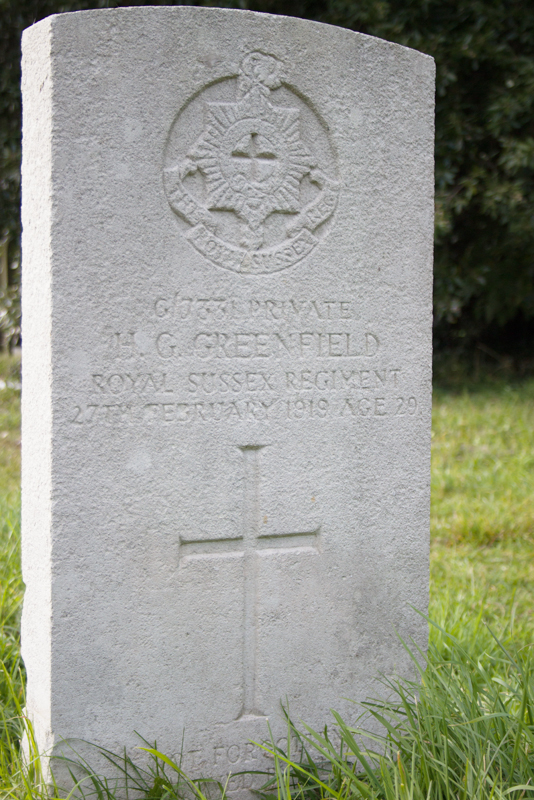
Henry Gordon Greenfield was born in Worthing, West Sussex, in 1890. The fourth of nine children, his parents were Edmund and Caroline. Edmund was a carter from the town, who raised his family in a small terraced house near the station.
By the early 1900s, Edmund had changed profession, becoming a plasterer, and this was employment that his son followed him into. This seems to have been more lucrative for the family, and they moved to a larger property to the north of the town.
In August 1911, Henry married Edith Tombs. Edith was a gardener’s daughter from London, who had moved to Worthing for work. When the couple married, she was employed as a domestic servant for a solicitor and his wife. The young couple would go on to have three sons.
When war broke out, Henry was quick to enlist. He initially joined the Royal Sussex Regiment, serving his time as part of the 10th Battalion. This was a reserve company, that was based on home soil. When hostilities came to an end, Henry was transferred to the Labour Corps, and was billeted in Belfast.
Little further information about Henry’s service can be confirmed; he was admitted to the Military Hospital in Belfast with pneumonia, but sadly died of the condition on 27th February 1919. He was just 28 years old.
Brought back to Worthing, Henry Gordon Greenfield lies at rest in the Broadwater Cemetery there, not far from his parents and widow.
Henry’s younger brother Frederick also served during the Great War. Joining the Royal West Kent Regiment as a horse driver, he fought on the Western Front. He was killed on 17th August 1917, and is buried at the Duisans Cemetery in northern France. He was just 21 years of age.
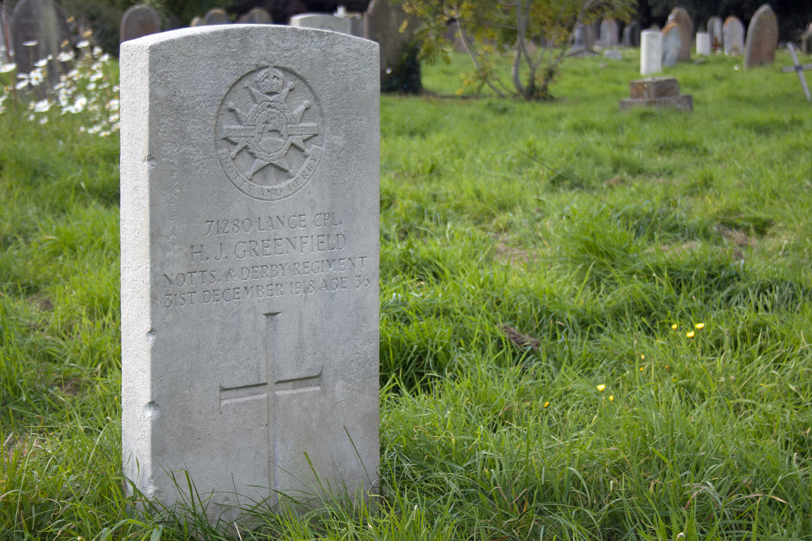
Henry James Greenfield was born in Brighton, Sussex, in July 1878, one of at least seven children to William and Anne Greenfield. Henry’s parents were from Worthing, who seem to have worked their way along the coast to Brighton by the mid-1870s, when his older brother George was born.
William was a bootmaker and, by the early 1880s, had brought his family back to Worthing, where they remained settled.
At this point, it is harder to pinpoint Henry’s life, as documentation becomes scarce and, with Greenfield being a common name in Sussex at the time, it is challenging to confirm that anything written relates to this specific Henry James Greenfield.
There is a 1901 census with a Henry James Greenfield from Brighton on it: this lists him as an Able Seaman aboard HMS Ramillies moored in Valetta, Malta. However, given that the Henry buried in Worthing served with the army, rather than the navy, it seems unlikely to be the same person (although not impossible).
The next document that can by specifically linked to the grave is Lance Corporal Greenfield’s entry on the Army Register of Soldier’s Effects. In addition to giving his rank, this expands on his service during the Great War.
He joined the Sherwood Foresters (Notts and Derby Regiment) at some point before July 1918, and was assigned to the 2nd Battalion. While there is no confirmation of where he fought, his battalion served on the Western Front for the duration of the conflict.
Henry survived the war, but was admitted to a hospital in Leith, near Edinburgh, where he passed away from ‘sickness’ on 31st December 1918. He was 36 years old.
The document stated that his effects were distributed to his six siblings; this suggests that William and Anne had both passed away by this point, and also indicates that Henry himself had not married.
Henry James Greenfield’s body was brought back to Worthing; he is buried at the Broadwater Cemetery to the north of the town.
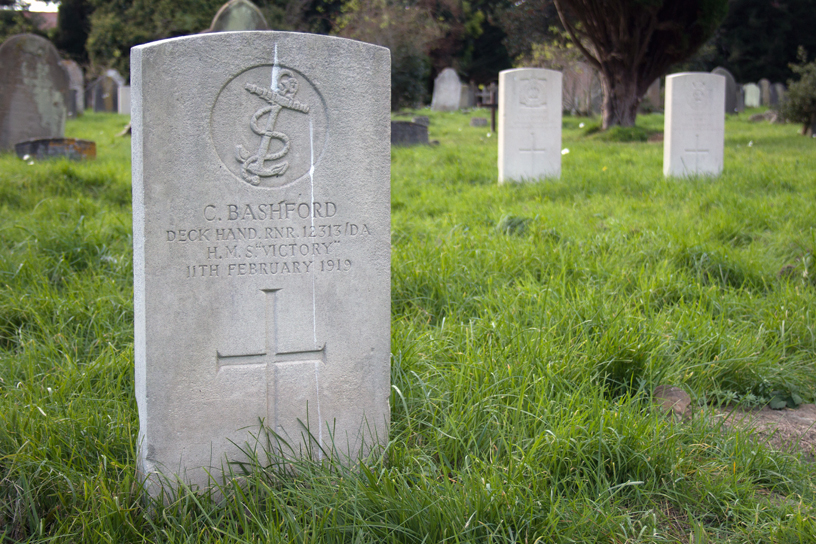
Charles Bashford was born on 10th August 1890, one of fifteen children to James and Mary Ann Bashford. James was a fisherman, and the family lived in Field Row, a narrow lane in the centre of Worthing, West Sussex.
The seaside town was a centre of fishing activity, so it is no surprise that most of James and Mary Ann’s children went into it in some way, and Charles was no exception. The 1911 census list him as the youngest of four siblings still living at home, and three of those gave their trade as fisherman, as well as James. Charles’ older brother William was the only sibling not to, and he was working as a printer.
War was coming to Europe, and, given his seafaring experience, it is no surprise that Charles sought to enlist in the Royal Navy. He joined up on 12th August 1916 and, after six weeks’ training, was assigned to the Royal Navy Reserve (Trawler Section). During his service he would have been involved in minesweeping and anti-submarine activities, using his own boat – or his family’s one – to do so.
Little further information is available for Deck Hand Bashford. He survived the war, but passed away on 11th August 1919 at the Royal Haslar Hospital, where he had been admitted, suffering from pneumonia. He was 28 years old.
Charles Bashford was brought back to his home town of Worthing; he was laid to rest in the Broadwater Cemetery there.
Hubert Stephen Buck was born on 18th October 1887, in Stepney, East London. His father, Edgar Buck, started to use his grandmother’s maiden name – Campbell – from the 1880s, and, by 1901, the family had formally changed their name.
At the time of his marriage to Hubert’s mother Alexandra Stephen in 1885, Edgar was working as a ostrich feather manufacturer. The couple went on to have six children, all boys, of which Hubert was the second oldest.
By the time of the 1901 census, Edgar and Alexandra has moved the family south of the river, from Mile End to Lambeth. By now, Hubert’s father was working as a musician, but there is little further information about his trade.
The next census – from 1911 – found the family living in Lewisham. Edgar was now listed as a band leader, while Hubert, who was the oldest child still living at home, gave his profession as musician, presumably in his father’s band.
War was imminent and, while Hubert was definitely involved, there is little specific information about his military service. He enlisted in the Irish Guards, and was assigned the role of Bandsman.
In August 1917, Hubert married Alice Johnson in Sutton, Surrey. He listed his profession as Musician in HM Irish Guards, so must have enlisted before that point. Interestingly, the same document identifies Edgar’s profession as Bandmaster in the 1st City of London Regiment, so it seems he also enlisted.
The marriage certificate shows Alice was two years older then her new husband, and that she was the daughter of warehouseman Alfred Johnson, who had, by that point, passed away.
Bandsman Campbell survived the war, but there is no indication as to whether he served abroad, or was part of a territorial force. He and Alice moved to Worthing in West Sussex, but there is no confirmation on when the move took place. The 1921 census, taken in June of that year, records the couple as living at 151 Lyndhurst Road in Worthing, where he was noted as being a totally disabled pensioner. There is little further information about him, other than the fact that he died on 4th August 1921, at the age of 35.
Hubert Stephen Campbell was laid to rest in the Broadwater Cemetery in Worthing.
While Hubert’s trail went cold, there is further information on Alice. An advert in the Worthing Gazette offers musical training by her:
Musical Training on Modern Methods
Pianoforte (Matthay), Voice Production, Singing, Theory, Harmony, Aural Culture, Musical Appreciation, and Art of Teaching.
Thorough preparation for all Examinations, Elementary to Diploma Grades, Special Courses for Teachers for the study of the Matthay system and the Art of Teaching.
MADAME ALICE CAMPBELL (Member of the Musical Councils of the London and East London Musical Festivals. Registered Teacher: Teachers’ Registration Council.
Worthing Gazette: Wednesday 31st August 1921
Digging a little deeper, and there are similar advertisements in the newspaper from late 1917, through to at least the 1930s, by which time, Alice was running the Worthing School of Music.
The advert suggests a couple of points. It certainly suggests that a love of music is what brought Hubert and Alice together in the first place. There was a definite musical connection in the household, initially driven by Hubert’s father, and continued with his widow.
Given that the advert above is dated a matter of weeks after Hubert’s death, it also seems likely that his passing was not unexpected. There is nothing in the local media relating to his death, and, with regular students to teach, Alice obviously felt is unnecessary to take any significant time away from her work in grief. It is supposition on my part, but it would suggest that Hubert died from a chronic condition, possibly one of the lung diseases that were rife across Europe in the aftermath of the Great War.
The last advert for the Worthing School of Music ran on 12th September 1934. Beyond that date – when Alice would have been 49 – there is no further clear record of her or the school.
Henry Charles Forrest was born in Bromley, Kent, in the summer of 1893. The youngest of eight children to William and Wilhelmina Forrest, Henry’s father was a police sergeant, who retired not long after his youngest son’s birth, moving his family to Worthing in West Sussex.
Henry was obviously a bright lad; the 1911 census records him as a student teacher. The only one of William and Wilhelmina’s children still living at home, he was, by this point, still just 17 years old. His career continued over the next few years, and he taught at the Ham Road Schools in Worthing.
In the spring of 1916, Henry married Constance Robertson. The young couple had a lot in common and seemed like a perfect match. Constance was the daughter of a retired police constable, and was also a student teacher.
War, by this time, had come to Europe. Full details of Henry’s military service are not available, but it seems that he initially joined the Oxfordshire and Buckinghamshire Light Infantry. Private Forrest was promoted to the rank of Corporal, and subsequently transferred to the Army Cycling Corps, serving in France.
As the war moved on, Corporal Forrest was released to resume his teaching back in Worthing but, in the autumn of 1918, he contracted influenza and pneumonia. The conditions got the better of him, and he passed away on 5th December 1918, at the age of just 25 years old.
Henry Charles Forrest was laid to rest in the Broadwater Cemetery in Worthing; sadly, it seems that Constance was unable to attend – she was represented at the ceremony by her mother.
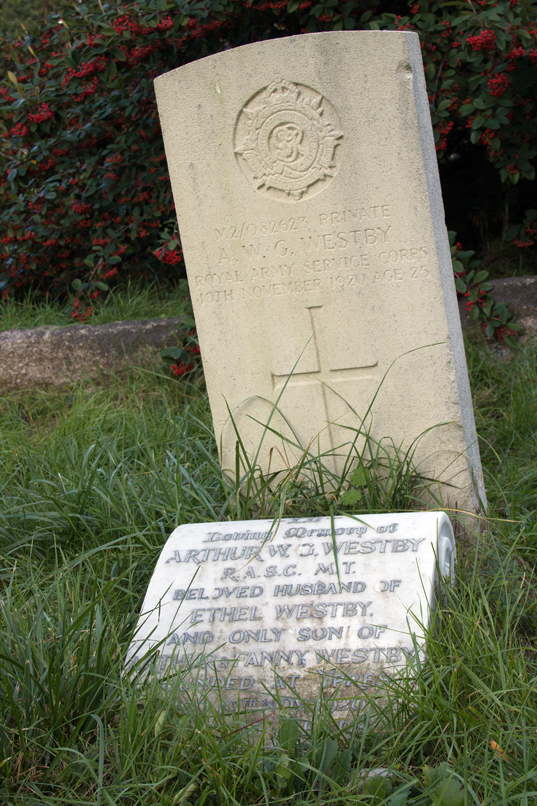
Arthur William George Westby was born in the spring of 1895, the only child to Arthur Henry Westby and his wife, Emma. Arthur Sr was a Corporal in the Scots Guards, but, beyond the fact that his son was born in Clapham, South London, there is little further information about Arthur Jr’s early life.
His father’s military career must have taken him across the country – the 1901 census lists Emma and Arthur Jr living in Bolton, Lancashire, even though there seem to be no connections with the county for them.
The records for Arthur Jr go quiet until 1920. At this point, documents hint at his military service during the Great War.
The death notices in the Sussex newspapers confirm his passing:
On November 19th 1920, at The Cedars, 13 Browning Road, Worthing, Arthur WG Westby (late MT, RASC), beloved husband of Ethel Westby, and only son of Ex-RQM Sergeant and Mrs Westby, 34 Wenban Road, Worthing. Patiently suffered to the end, result of Active Service.
Worthing Gazette: Wednesday 24th November 1920
There is no further information available about Ethel, and no marriage records to confirm a date for their wedding.
From a military perspective, Arthur enlisted in the Royal Army Service Corps, and was attached to the Motor Transport division. Again, there is nothing to evidence when he enlisted or for how long he served. It seems that Private Westby was injured in the line of duty, and was medically discharged in April 1918. The injury appears to have been life-changing, and it affected him until the end of his life.
Arthur William George Westby passed away in Worthing on 19th November 1920, aged just 25 years old. The specific cause of his death is unknown. He was laid to rest in the Broadwater Cemetery in the town, close to his parents and widow.






 Death and Service