Tag Archives: family

Bandsman Hubert Campbell

Bandsman Hubert Campbell

Hubert Stephen Buck was born on 18th October 1887, in Stepney, East London. His father, Edgar Buck, started to use his grandmother’s maiden name – Campbell – from the 1880s, and, by 1901, the family had formally changed their name.

At the time of his marriage to Hubert’s mother Alexandra Stephen in 1885, Edgar was working as a ostrich feather manufacturer. The couple went on to have six children, all boys, of which Hubert was the second oldest.

By the time of the 1901 census, Edgar and Alexandra has moved the family south of the river, from Mile End to Lambeth. By now, Hubert’s father was working as a musician, but there is little further information about his trade.

The next census – from 1911 – found the family living in Lewisham. Edgar was now listed as a band leader, while Hubert, who was the oldest child still living at home, gave his profession as musician, presumably in his father’s band.

War was imminent and, while Hubert was definitely involved, there is little specific information about his military service. He enlisted in the Irish Guards, and was assigned the role of Bandsman.

In August 1917, Hubert married Alice Johnson in Sutton, Surrey. He listed his profession as Musician in HM Irish Guards, so must have enlisted before that point. Interestingly, the same document identifies Edgar’s profession as Bandmaster in the 1st City of London Regiment, so it seems he also enlisted.

The marriage certificate shows Alice was two years older then her new husband, and that she was the daughter of warehouseman Alfred Johnson, who had, by that point, passed away.

Bandsman Campbell survived the war, but there is no indication as to whether he served abroad, or was part of a territorial force. He and Alice moved to Worthing in West Sussex, but there is no confirmation on when the move took place. The 1921 census, taken in June of that year, records the couple as living at 151 Lyndhurst Road in Worthing, where he was noted as being a totally disabled pensioner. There is little further information about him, other than the fact that he died on 4th August 1921, at the age of 35.

Hubert Stephen Campbell was laid to rest in the Broadwater Cemetery in Worthing.


While Hubert’s trail went cold, there is further information on Alice. An advert in the Worthing Gazette offers musical training by her:

Musical Training on Modern Methods

Pianoforte (Matthay), Voice Production, Singing, Theory, Harmony, Aural Culture, Musical Appreciation, and Art of Teaching.

Thorough preparation for all Examinations, Elementary to Diploma Grades, Special Courses for Teachers for the study of the Matthay system and the Art of Teaching.

MADAME ALICE CAMPBELL (Member of the Musical Councils of the London and East London Musical Festivals. Registered Teacher: Teachers’ Registration Council.

Worthing Gazette: Wednesday 31st August 1921

Digging a little deeper, and there are similar advertisements in the newspaper from late 1917, through to at least the 1930s, by which time, Alice was running the Worthing School of Music.

The advert suggests a couple of points. It certainly suggests that a love of music is what brought Hubert and Alice together in the first place. There was a definite musical connection in the household, initially driven by Hubert’s father, and continued with his widow.

Given that the advert above is dated a matter of weeks after Hubert’s death, it also seems likely that his passing was not unexpected. There is nothing in the local media relating to his death, and, with regular students to teach, Alice obviously felt is unnecessary to take any significant time away from her work in grief. It is supposition on my part, but it would suggest that Hubert died from a chronic condition, possibly one of the lung diseases that were rife across Europe in the aftermath of the Great War.

The last advert for the Worthing School of Music ran on 12th September 1934. Beyond that date – when Alice would have been 49 – there is no further clear record of her or the school.


Corporal Henry Forrest

Corporal Henry Forrest

Henry Charles Forrest was born in Bromley, Kent, in the summer of 1893. The youngest of eight children to William and Wilhelmina Forrest, Henry’s father was a police sergeant, who retired not long after his youngest son’s birth, moving his family to Worthing in West Sussex.

Henry was obviously a bright lad; the 1911 census records him as a student teacher. The only one of William and Wilhelmina’s children still living at home, he was, by this point, still just 17 years old. His career continued over the next few years, and he taught at the Ham Road Schools in Worthing.

In the spring of 1916, Henry married Constance Robertson. The young couple had a lot in common and seemed like a perfect match. Constance was the daughter of a retired police constable, and was also a student teacher.

War, by this time, had come to Europe. Full details of Henry’s military service are not available, but it seems that he initially joined the Oxfordshire and Buckinghamshire Light Infantry. Private Forrest was promoted to the rank of Corporal, and subsequently transferred to the Army Cycling Corps, serving in France.

As the war moved on, Corporal Forrest was released to resume his teaching back in Worthing but, in the autumn of 1918, he contracted influenza and pneumonia. The conditions got the better of him, and he passed away on 5th December 1918, at the age of just 25 years old.

Henry Charles Forrest was laid to rest in the Broadwater Cemetery in Worthing; sadly, it seems that Constance was unable to attend – she was represented at the ceremony by her mother.


Private Arthur Westby

Private Arthur Westby

Arthur William George Westby was born in the spring of 1895, the only child to Arthur Henry Westby and his wife, Emma. Arthur Sr was a Corporal in the Scots Guards, but, beyond the fact that his son was born in Clapham, South London, there is little further information about Arthur Jr’s early life.

His father’s military career must have taken him across the country – the 1901 census lists Emma and Arthur Jr living in Bolton, Lancashire, even though there seem to be no connections with the county for them.

The records for Arthur Jr go quiet until 1920. At this point, documents hint at his military service during the Great War.

The death notices in the Sussex newspapers confirm his passing:

On November 19th 1920, at The Cedars, 13 Browning Road, Worthing, Arthur WG Westby (late MT, RASC), beloved husband of Ethel Westby, and only son of Ex-RQM Sergeant and Mrs Westby, 34 Wenban Road, Worthing. Patiently suffered to the end, result of Active Service.

Worthing Gazette: Wednesday 24th November 1920

There is no further information available about Ethel, and no marriage records to confirm a date for their wedding.

From a military perspective, Arthur enlisted in the Royal Army Service Corps, and was attached to the Motor Transport division. Again, there is nothing to evidence when he enlisted or for how long he served. It seems that Private Westby was injured in the line of duty, and was medically discharged in April 1918. The injury appears to have been life-changing, and it affected him until the end of his life.

Arthur William George Westby passed away in Worthing on 19th November 1920, aged just 25 years old. The specific cause of his death is unknown. He was laid to rest in the Broadwater Cemetery in the town, close to his parents and widow.


Petty Officer William Dale

Petty Officer William Dale

William Edmund Dale was born in Worthing, West Sussex on 25th November 1886 and was the older of six children. His father, also called William, was a carman, and he and William’s mother, Eliza, brought the family up in the Sussex town.

William Jr seems to have had a number of jobs, working as a draper’s errand boy, a milkman’s assistant and a gardener. He found his true calling at the age of 12, however, when he enlisted in the Royal Navy.

Initially acting as a Boy 2nd Class, over his initial twelve years’ employ he served on eleven vessels, and rose through the ranks to Boy, Ordinary Seaman and Able Seaman.

It was while serving on HMS Blake in 1910, that he married Mary Williams. The couple went on to have two children, William, born in 1910, and Harry, born the following year. The family set up home in Portsmouth, where the sailor was based.

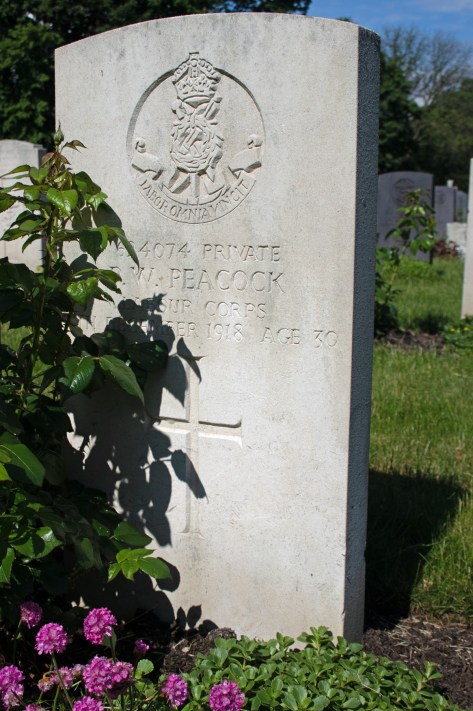
With his initial service complete in 1916, William’s term of duty was extended until the end of hostilities. A promotion to Leading Seaman followed, and he was assigned to HMS Attentive, part of the Dover Patrol guard.

In 1917, William was promoted again, this time to the role of Petty Officer, and was assigned to HMS Royal Sovereign, the Navy’s new battleship. He served on the vessel for the remainder of the way, and through into the summer of 1919.

It was in the last month of his service, that Petty Officer Dale fell ill. He was taken ashore, and sent to the Royal Naval Hospital in Chatham, Kent. He had contracted meningitis, and sadly succumbed to it within days of being admitted. He died on 4th August 1919, at the age of just 32 years old.

William Edmund Dale was brought back to the town of his birth; he lies at rest in a quiet corner of the Broadwater Cemetery in Worthing, West Sussex.


Private Alan Ladd

Private Alan Ladd

Alan Ladd was born in the summer of 1893, and was one of twins. His parents were plumber and gas fitter George Ladd and his wife Mary Ann, who was a midwife. The couple had eight children altogether, of whom Alan and his twin Arthur were the youngest.

George had been born in Exeter, Devon, and Mary Ann in Somerset, which is where they initially based their family. By 1887, however, they had moved to Berkshire, and were living in Knowl Hill, near Maidenhead, when their youngest four children were born.

The 1911 census found the family living in Dunster, Somerset, where everyone seemed to be bringing in a wage. George and Mary Ann had four of their children living with them, who were employed as an engine driver, grocer, baker’s apprentice and, in Alan’s case, a tailor’s apprentice.

War broke out in 1914, and, in November 1915, Alan enlisted. He joined the Royal Army Service Corps as a Private, and his enlistment papers showed he stood 5ft 5ins (1.65m) tall, and weighed in at 130lbs (59kg). He was stationed at the Corps’ Remount Department in Swaythling, Southampton and thus his military service was completed on the Home Front.

Shortly after enlisting, on 16th April 1916, Alan married Ada Westlake. She lived in the village of Long Sutton, near Langport in Somerset, and the couple married at the Wesleyan Methodist Chapel in Somerton. They do not appear to have gone on to have any children.

Further details of Private Ladd’s life are scant. What can be determined is that he was admitted to Netley Hospital in Southampton on 11th October 1918, having had symptoms of pneumonia for a few days. Sadly, his condition worsened, and Alan passed away just three days later, on 14th October 1918. He was just 25 years of age.

Alan Ladd was brought back to Long Sutton for burial. The war may have led him and Ada to adopt more of a Quaker way of life, as he lies at rest in the Friends Burial Ground on the outskirts of the town.


Private Sidney Ford

Private Sidney Ford

Sidney Ford was born in Kent in 1896, the son of Stephen John Ford and his second wife, Elizabeth Ann (née Underdown). The couple had four children – Frederick, Sidney, Ethel and Alice – although it seems that Elizabeth brought them up almost singlehandedly. Sidney’s military records gives his father’s name, although simply notes that he was an imbecile, in the stark way that only Edwardian officials could.

Sadly, little of Sidney’s early life remains documented. By the time war broke out, he was working as a farm labourer in Yalding, close to where he was born. He enlisted at the end of October 1914, joining the Queen’s Own (Royal West Kent Regiment), and was assigned to the 8th (Service) Battalion as a Private.

Joining up in Maidstone, by the end of the year, Private Ford’s battalion was soon billeted in Worthing, West Sussex. Tragically, his service was destined to be a short one, and he passed away after only a month in the town.

The first death from the Red Cross Hospital, Cecil’s, at West Worthing, had to be recorded. Since it has been opened there have been a large number of cases, and many of them have been of a serious nature, but happily all except the one under notice have made progress, thanks to the skill of the Medical Officers and Nursing Staff of the institution.

The deceased in this instance was a Private of the Eighth Battalion of the West Kent Regiment, now stationed locally. His name was Sidney Ford, and he was twenty-five years of age. He died on Friday, and at the funeral, which took place on Monday, full Military honours were accorded him.

Colonel Vansittart (who commands the Eighth Battalion) and Major Bock-Hollinshead attended, as also did other members of the Staff of the Hospital. A large number of the public were also at the Cemetery to witness the last rites, the progress of so long and so imposing a procession through the streets attracting considerable attention.

Worthing Gazette: Wednesday 20th January 1915

Private Ford has died on 15th January 1915, and was actually just 20 years of age, not 25, as had been reported. The Worthing Gazette does not give no mention to Sidney’s family, so it can only be assumed that they were unable to make the journey from Kent to the funeral. I have been unable to uncover details of the cause of his death, but, given that there is no mention of the cause in the newspaper, it is likely to have been following an illness than anything more sensational or unusual.

Sidney Ford lies at rest in the Broadwater Cemetery in Worthing, one of the first in the town to have passed because of the Great War.


Sidney’s older brother, Frederick, was also involved in the Great War. While there is little specific information about his service, it is evident that he was a Private in the Duke of Wellington’s (West Riding Regiment).

Unlike his younger brother, Frederick did see military action, but list his life on the Western Front on 4th November 1915, ten months after Sidney had passed in Worthing.

Frederick lies at rest in the Royal Irish Rifles Graveyard in Laventie, in Northern France.


Chief Petty Officer Charles Clarke

Chief Petty Officer Charles Clarke

Charles Frederick Clarke was born on the 14th April 1869 to James and Jane Clarke. James was born in Suffolk, but moved to London, where he found work as a watchman (guarding the city streets at night). Jane was from Essex, and the couple went on to have five children, of whom Charles was the middle child.

Charles was set on a life of adventure, joining the Royal Navy in 1887, for a period of twelve years. During this time, he served on eleven vessels, working his way up through the ranks from Boy to Ordinary Seaman to Able Seaman, Leading Seaman and eventually Petty Officer.

In October 1895, he married Lydia Rogers, a sailor’s daughter from Portsmouth. The couple would go on to have nine children, eventually settling in Sussex.

When his naval service ended in 1899, Charles enlisted again. Within six years, he had achieved the rank of Chief Petty Officer, and in March 1909, after 22 years’ service, retired from active duty. He was obviously well respected, however, and was selected to serve on the staff of the Royal Naval Recruiting Office in Portsmouth. His service records suggest that he resigned from this role on 14th April 1914.

It seems that Chief Petty Office Clarke took on a role on the vessel HMS Zaria. This was a ship that was requisitioned by the Royal Navy, which acted as a patrol ship, guarding the coastal waters around the UK. While details are scant, Charles certainly served on board for a couple of years, and he died on board, from causes undisclosed, on 16th December 1916, at the age of 47 years old.

Brought back to West Sussex, Charles Frederick Clarke was laid to rest in the Broadwater Cemetery in Worthing. This was where Lydia was now living; she was buried in the same grave, when she passed away eight years after her husband.


Lance Corporal Edgar Godden

Lance Corporal Edgar Godden

Edgar Godden was born in the summer of 1892, one of eight children to John and Alice Godden. John came from Littlehampton, and Alice from Worthing, and this is where they raised their family.

John was a bricklayer, and it was this trade that Edgar went into when he left school. War was coming to Europe, however, and, within weeks of the conflict breaking out, he had volunteered his services.

Edgar joined the Royal Sussex Regiment, and was assigned to the 7th (Service) Battalion. Details of his military service are a little sketchy, but a newspaper article, written after his death, gives a hint about what happened to him.

Mr Edgar Godden… who was twenty-five years of age and leave a widow and a little child, enlisted on the 1st September 1914, and was wounded in the arm in September of the following year. In October 1916 he was blown up and buried by an enemy mine. Last February he was taken out of the trenches and sent to a hospital in France, and last April he came home to England and had an arm amputated. Since his discharge from the Seventh Royal Sussex Regiment, he had been a member of the staff of the Post Office, and was known as “The One-armed Postman”.

Worthing Gazette: Wednesday 10th January 1918.

In the autumn of 1916, and recovering from his injuries Lance Corporal Godden married Emily Owers. They lived with John and Alice, but I have been unable to find details of the child mentioned in the newspaper report.

It seems that his injuries had left Edgar in a weakened state, and, after a ‘short and painful illness’ [Worthing Gazette: 2nd January 1918], he passed away on 22nd December 1917. He was just 25 years of age.

Edgar Godden was laid to rest, finally at peace, in the Broadwater Cemetery in his home town of Worthing, West Sussex.


The newspaper report above gave a little more information about a couple of Edgar’s siblings.

Mr & Mrs [John] Godden had one son killed in action in November 1916; and still another – the eldest – is now in France, as a member of the Royal Engineers.

Worthing Gazette: Wednesday 10th January 1918

Edgar’s oldest brother – also called John – survived the war, but it was his younger brother, Charles, who was killed in action.

A Corporal in the 11th Battalion of the Royal Sussex Regiment, Charles was caught up in the Battle of the Somme. It was while fighting in the Battle of the Ancre on 13th November 1916, that he was killed. He is remembered at the Thiepval Memorial in Northern France, and is also commemorated on Edgar’s own headstone.


One last aside to Edgar’s story is his address in the last few years of his life. John and Alice were living in Worthing, specifically at a house called “Chiswick” in Tarring Road, to the west of the town.

Coincidentally, when researching another soldier, Private Ernest Parsons, this turns out to be the address where he also died, just ten months later on 4th October 1918. There is no apparent other link between the two men.


Rifleman Ernest Parsons

Rifleman Ernest Parsons

Ernest Charles Parsons was born in 1881, and was one of six children to bricklayer Robert Parsons and his wife Mary Ann. Robert was a labourer and bricklayer from Watford, while Mary Ann was born in Arundel, West Sussex. The couple moved to where his work was, having their first children in Hertfordshire and Sussex They finally settled in London, which was where Ernest was born.

Where he first left school, Ernest worked as a painter, but soon found a career as a postman., something he would continue to do through to the outbreak of war.

Ernest married Frances Olive Eynott on 28th February 1904; they went on to have a daughter, Doris, the following year. It seems, however, that their marriage was destined to be a short one; Frances passed away within a couple of years.

With a daughter to raise and a living to earn, Ernest married again. Elizabeth Kate Dew was born in Fulham in 1883, and the couple married in the spring of 1907. Again, however, their happiness was to be short; Elizabeth died eighteen months later.

Widowed twice, and with Doris now a toddler, Ernest moved back in with his parents in Chiswick. He continued his work as a postman, but alongside this had been an active volunteer in the London Regiment (Post Office Rifles) since early 1908.

Rifleman Parsons’ initial year’s service was extended and extended and, by the time of the outbreak of the First World War, had been serving for some six years.

By 1914, Ernest had found love for a third time, and married Lilian Frances Cromie on 25th March that year. With war imminent, his time was take up more with military duties; while part of the territorial force, Rifleman Parsons had been officially mobilised.

The sudden intermingling of men from different parts of the country in small, packed training camps made the perfect environment for illness and disease to circulate. Ernest had initially contracted bronchitis while on service in 1912; this had dogged him intermittently oved the next few years until, in March 1915, it was serious enough for the Medical Examination Board to declare him unfit for military service.

Ernest moved his family to Worthing, in West Sussex, presumably as the air was fresher there than in the bustling capital. He may also had had family in the area, as his mother had been born just up the road in Arundel. Sadly, though, it seems that his health was not to recover sufficiently, and he passed away on 4th October 1918, at the age of 37.

Ernest Charles Parsons was buried in the Broadwater Cemetery in the town, not far from where his widow and daughter were then living.


Coincidentally, when researching another soldier, Lance Corporal Edgar Godden, this turns out to be the address where he also died, just ten months earlier on 22nd December 1917. There is no apparent other link between the two men.

Private Sidney Alner

Private Sidney Alner

Sidney William Alner was born in Shaftesbury, Dorset, in March 1899, one of eleven children to Sidney and Ellen Alner. Sidney Sr was a grocer’s porter, and the family lived on the celebrated Gold Hill in the town.

War was to come when Sidney Jr was only young – he had just turned 15 when it broke out. He saw his older brothers go off to war and was obviously keen to do his bit as well. Until he was old enough, however, he worked as an errand boy for his father’s employers, Stratton Sons and Mead.

His time would come, of course, although dates for Sidney’s enlistment are not clear. A contemporary newspaper record confirms that he arrived in France in January 1918, so it is likely that Private Alner joined up at some point during the previous year.

He joined the Hampshire Regiment, and was assigned to the 1st Battalion. Heavily involved during most of the conflict, the battalion was seen as key to the Final Advance of the autumn of 1918. Private Alner was caught up in the fight to break the Hindenburg Line, fighting on the River Selle and capturing the town of Monchaux.

It was while his battalion was advancing on the village of Préseau on 2nd November, that Private Alner was injured. Shot in the arm, he was evacuated back to England, and admitted to the Cambridge Military Hospital in Aldershot. He would have survived his injuries, had pneumonia not set in, and it was to this that he would succumb on 19th November. He was just 19 years old.

Sidney William Alner’s body was brought back to Dorset. He lies at rest in the Holy Trinity Churchyard in Somerset, within walking distance of his family’s home.


Sidney was the second member of the Alner family to die as a result of the Great War.

His older brother Harry, who had become a chauffeur and went to live in London, joined the Royal Army Service Corps in 1915. Private H Alner had served three years in France when he was killed on the front line just three weeks before his brother. He was 32 years old, and left a widow and two children.


When researching Sidney Alner in newspaper articles, an interesting report surfaced.

An unfortunate accident has happened to a little girl, not quite four years old, the daughter of Sidney Alner, who resides in Gold Hill. Heals’ steam hobby horses visited the town on Friday and Saturday in last week, and on the evening of the former day, Alner took his little girl for a ride on the horses.

Whilst they were in motion, the bolt that kept the horse on which Alner sat with his child attached to the connecting rod came out, and he and the little girl were precipitated to the ground.

Alner escaped without injury, but his daughter had one of her legs fractured above the knee. She was taken home, and Dr Evans set the injured limb. Later in the evening she was removed to the Westminster Cottage Hospital.

Salisbury and Winchester Journal: Saturday 31st October 1891

This Sidney Alner was Private Alner’s father, and the daughter would have been his older sister Sarah. Nothing more is reported of the incident, and Sarah went on to live until 1945, when she was 57 years old.