Tag Archives: family

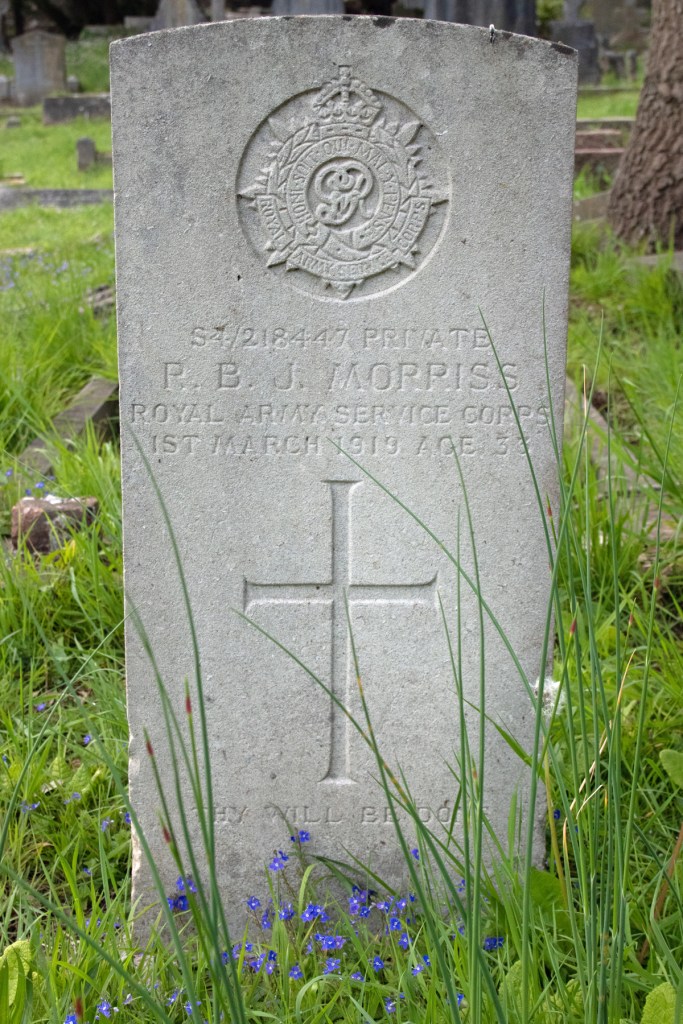
Private Reginald Morriss

Private Reginald Morriss

Reginald Benjamin James Morriss was born in the spring of 1886 and was the youngest of twelve children. His father, Thomas, was a bootmaker from Leeds, who had moved to Somerset and married Mary Ann Pennell. The couple brought their family up in her home town of Weston-super-Mare.

Thomas died in 1901, when Reginald was just 14 years old. Mary Ann, by this point, still had a lot of her family with her, including Reginald, three of his sisters, his brother-in-law and four nieces.

Reginald was about to leave school, and found work as a French polisher in Bristol, eventually moving in with his employer as a lodger. This may not have suited him, however, as, by the time he enlisted, he gave his trade as baker and confectioner, and he was living back with his mother in Weston-super-Mare.

Private Morriss was 30 when he joined up in 1916, and stood 5ft 7ins (1.7m) tall. He joined the Army Service Corps as a baker, and was initially based in Aldershot. He was moved to Kent in September 1918, having been assigned to the 351st Horse Transport Company. The war was drawing to an end, but a new threat was on the horizon.

The following February, Private Morriss was admitted to St John’s Hospital in Hastings, suffering from influenza and pneumonia. Sadly, he was to succumb to the lung conditions, and he passed away on 3rd March 1919. He was just 32 years old.

Reginald Benjamin James Morriss’ body was brought back to Weston-super-Mare, and he was laid to rest in the Milton Cemetery in his home town.

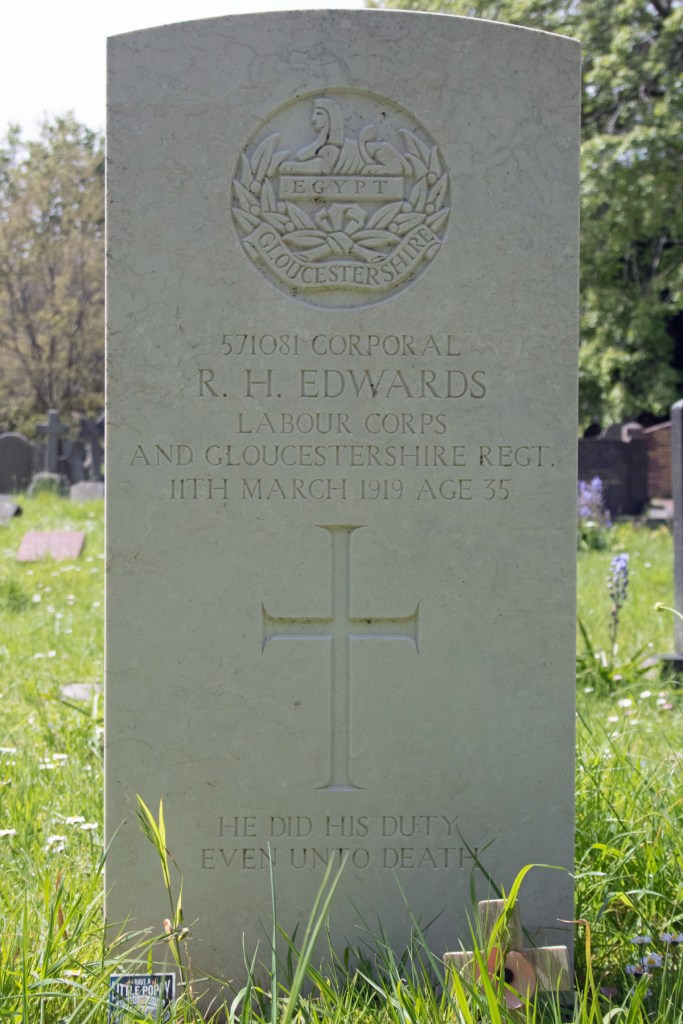
Corporal Ralph Edwards

Corporal Ralph Edwards

Ralph Henry Edwards was born in December 1883, the oldest of six children to Charles and Emma. Charles was a house painter from Somerset, and raised his family in the coastal town of Weston-super-Mare.

When he left school, Ralph followed in his father’s footsteps, taking over the business when Charles passed away in 1909. By the time of the census two years later, Ralph was living with his mother Emma, his two younger brothers and Emma’s brother Harry. Harry was also a house painter, while Ralph’s siblings were working a grocer’s assistants. The family were living in a five-room, semi-detached house within walking distance of the town centre.

War was on the horizon, and Ralph was keen to do his part. Full details of his service are no longer available, but what is certain is that he enlisted in the Gloucestershire Regiment and was assigned to the 8th (Service) Battalion. Initially formed in Bristol, the battalion spent the first year of the war on home soil, before being sent to France in July 1915.

By the middle of the war, Ralph had been promoted to the rank of Corporal. He transferred over to the Labour Corps and was attached to the 106th Prisoner of War Company. Initially, German POWs had been shipped to England, but by 1916 those with useful skills were retained in France and drafted into the Forestry Companies, Army Service Corps and Royal Engineers. Corporal Edwards’ role would have been to oversee such men. (Whether this was in France or back in England is unclear.)

At this point, Ralph’s trail goes cold. He served out the war, passing away back at home on 11th March 1919, although the cause of his death has been lost to time. He was 35 years of age.

Ralph Henry Edwards lies at rest in the Milton Cemetery in his home town of Weston-super-Mare.


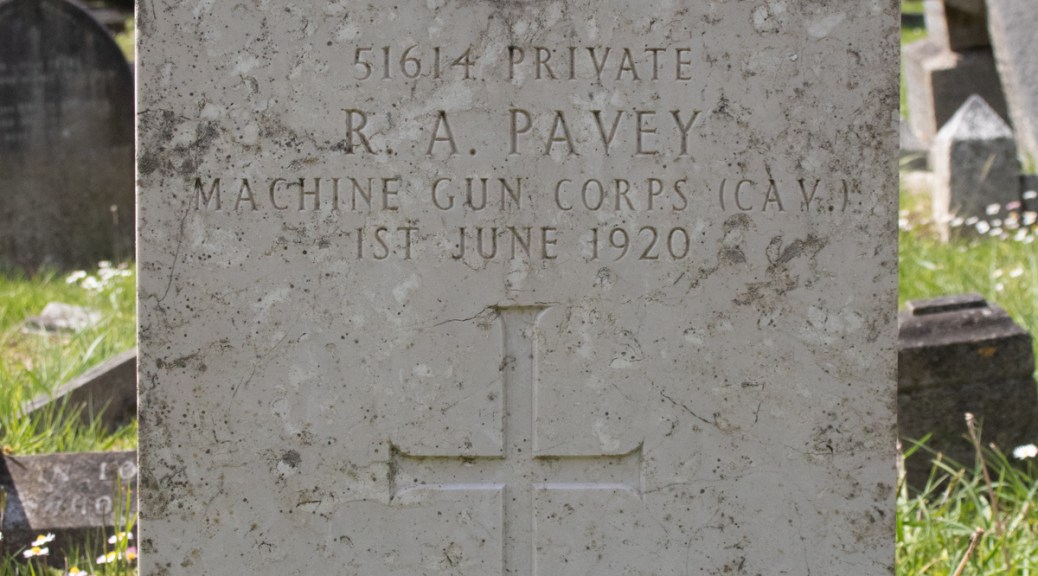
Private Roland Pavey

Private Roland Pavey

Roland Adams Pavey was born in the summer of 1891, the youngest of three children to Anthony Pavey and his wife, Mary. Anthony was a painter, and both he and his wife were born in the Somerset town of Cheddar. Their life took them travelling, though, with their first child, Edward being born in Cheddar, while their middle child, Ada, was born in Oxford, and Roland born in Bath .

Anthony passed away in 1910, leaving Roland living with his widowed mother, earning a living as a draper’s clerk. War was coming, however, and new opportunities lie in store.

Roland enlisted in the army in January 1915. Initially joining the North Somerset Yeomanry, he soon transferred across to the Cavalry Division of the Machine Gun Corps. Sadly, Private Pavey’s military records are lost to time, but he definitely saw action on the Western Front, gaining the Victory and British Medals and the 1915 Star for his efforts.

The next record for Roland comes in the form of a newspaper article from South Wales.

SAD CASE OF NANTYGLO GIRL

Behind the untimely death of Mr Roland A Pavey, a popular young ex-Service man, and secretary of the Weston-super-Mare Federation of Discharged Soldiers and Sailors, lies a pathetic story of the double bereavement of a pretty Welsh girl, Miss Dorothy Morgan of Nantyglo.

Prior to the war, Miss Morgan was engaged to a compatriot of her own, who answered his country’s call and, like so many thousands of others, made the great sacrifice. Time rolled on and the old wound was eventually healed. Then Miss Morgan went on a visit to Weston last year, and there met young Roland Pavey, just demobilised from the Army.

A mutual attraction soon ripened into affection, and the couple became engaged, and they were to have been married towards the end of the present month, but Fate intervened.

Pavey’s long war service impaired his constitution, though how seriously was probably not realised until the damage was done. Returning from a Whitsuntide visit to Exeter, Mr Pavey was so ill that he was compelled to take to his bed. He rapidly became worse, and though his fiancée was hurriedly summoned, he passed away before she arrived at Weston.

Thus, within a short time, Miss Morgan has been twice bereaved as a result of the war.

Merthyr Express: Saturday 12th June 1920

Roland Adams Pavey was just 29 years old when he died. He was laid to rest in the Milton Cemetery in Weston-super-Mare, where his mother then lived.


Sadly, Dorothy Morgan is too common a name in South Wales to confirm much more information on her life. We are unlikely ever to discover if she ever found a lasting love.


Lance Serjeant Frederick Rapson

Lance Serjeant Frederick Rapson

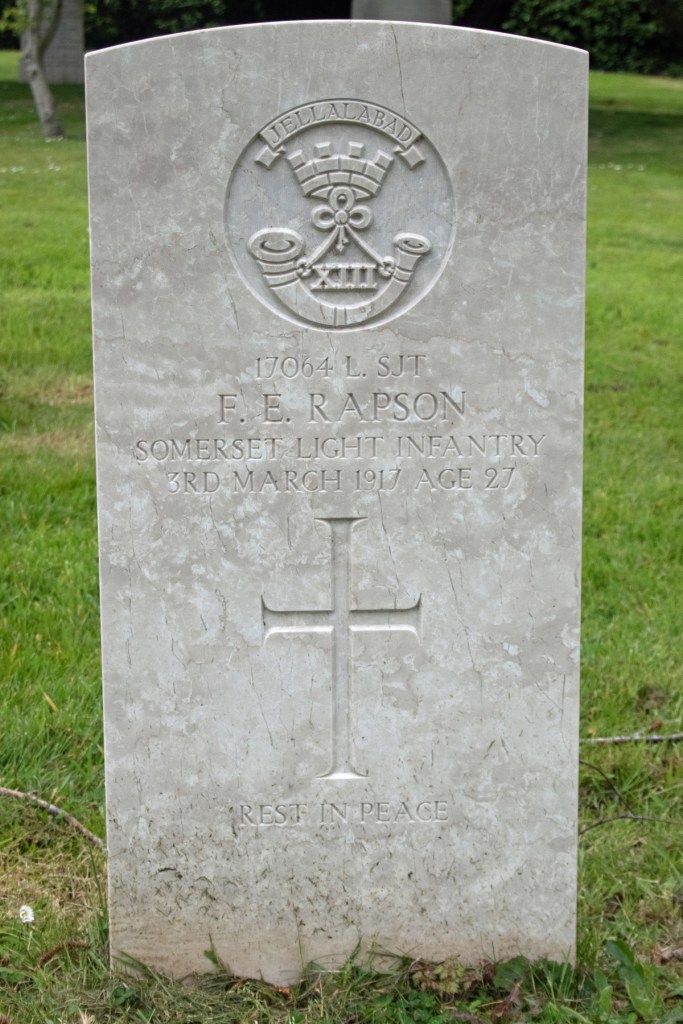
Frederick Ernest Rapson was born in the spring of 1888, one of nine children to Francis and Susan Rapson. Francis was a Serjeant in the 18th Hussars, and the family lived in Dulverton, a village on the edge of Exmoor.

Francis had served in the armed forces for 26 years, but passed away after a short illness in February 1891. According to a local friend and supporter, he had been in charge of the local yeomanry in Dulverton for a number of years and had been ‘in the prime and flower of life’. [West Somerset Free Press: Saturday 28th February 1891]

Susan was left widowed with nine children, the eldest of whom was only 13 years old. Frederick was only three at the time, and had lost his father at a very early age.

In 1895, Susan married a Frederick Howard, who was a painter and carpenter. The family moved to Taunton in Somerset, and Frederick and Susan went on to have three children of their own.

On 6th February 1910, Frederick Rapson married Lucy Knight; by this time, he was working as a compositor for the local newspaper. The couple set up home in the middle of Taunton, and went on to have three children, Francis, Frederick and Ronald.

War was coming, and, while Frederick did not actively seek military service in the same way as his father had done, it was not something he was able to avoid. While his full military records are not available, it’s clear that he enlisted in the Somerset Light Infantry at some point early on in the conflict.

Private Rapson was assigned to the 1st Battalion, who were based on the Western Front for the duration of the conflict. During his time there, he was awarded the Victory and British Medals, but not the 1915 Star, so that would narrow down his enlisting to some point in 1916.

While he was promoted to the role of Lance Serjeant, his service was to be a short one. At the start of 1917, he contracted pneumonia and was admitted to hospital. Sadly, the condition was to get the better of him, and he passed away on 3rd March 1917. He was just 27 years of age.

Frederick Ernest Rapson was buried in a quiet corner of St James’ Cemetery in Taunton, Somerset.


Corporal Albert Wall

Corporal Albert Wall

Albert Wall was born in the spring of 1890, one of eight children to James Wall and his wife Louise. James was a mason’s labourer from Taunton, Somerset, and brought his family up in his home town.

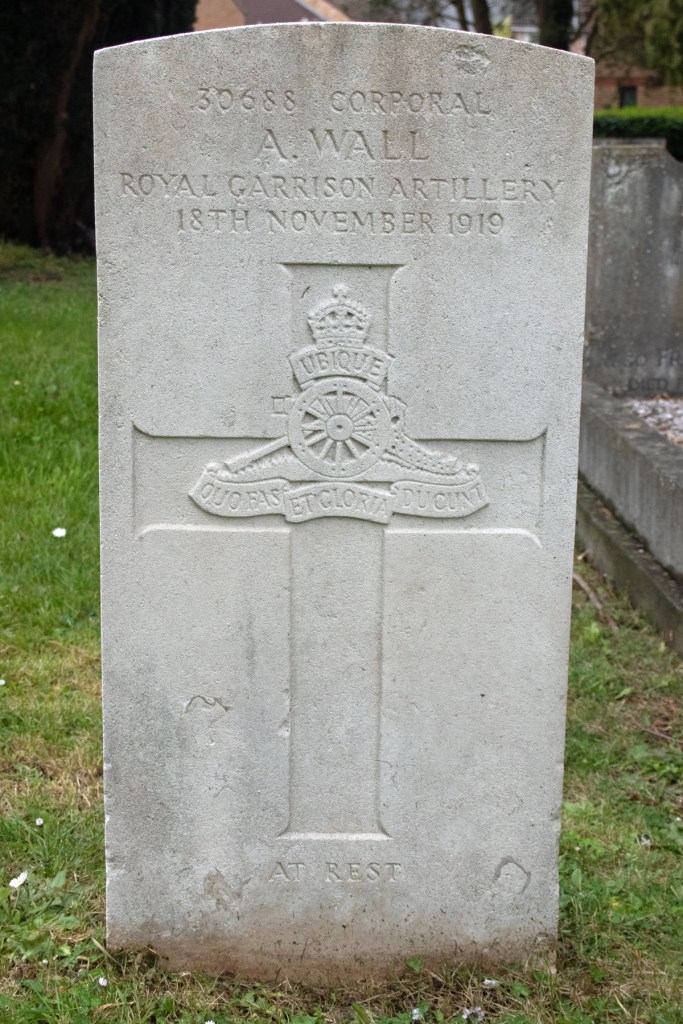
Details of Albert’s life are tantalisingly absent. It appears that he had a sense of adventure, and joined the Royal Garrison Artillery when his age allowed. By 1911, he was stationed at Port Royal in Jamaica, and was listed as a Gunner.

Gunner Wall’s involvement with the Royal Garrison Artillery extended into the Great War. He was sent to Egypt in April 1915, and, as part of his service, gained the Victory and British Medals and the 1915 Star. Albert seems to have been luck in that he saw out the war fairly unscathed, and was promoted to the rank of Corporal.

In the winter of 1918, Albert married Beatrice Salter. The war over, he was subsequently discharged from active service in April 1919.

Life on civvy street was not destined to be a long one, however, as, on 18th November 1919, he passed away from kidney disease. He was just 29 years of age.

Albert Wall was laid to rest in the St James Cemetery in his home town of Taunton.


As a sad footnote to this story, on 5th March 1920, Beatrice gave birth to a little boy, who she called Gordon. Albert was never to see his son.


Leading Stoker Cecil Scribbens

Leading Stoker Cecil Scribbens

Cecil Walter Thomas Scribbens was born on 27th June 1885 in Taunton, Somerset. He was one of five children to George and Ann Scribbens. Sadly, George passed away when Cecil was a toddler, leaving his widow to raise her young family alone.

Ann initially found work as a laundress, and her eldest daughter, Alice, began working at the local silk mill when she left school. This brought in a little money, but with five children to feed and clothe, it must have been a struggle.

In 1894, Ann found love again, and married George Sully, a scull labourer, on Christmas Day 1894. The couple went on to have a child together, a son they called Arthur, and the new family set up home in Taunton.

When he left school, Cecil found work as a labourer, but he had a sense of adventure and a life on the ocean was calling him. In July 1903 he joined the Royal Navy as a Stoker 2nd Class and, after his initial training in Plymouth he was assigned to HMS Russell.

Stoker Scribbens’ term of service was twelve years and, during that time, he served aboard five vessels, and was promoted to Leading Stoker. War had broken out when his initial contract ended, so it was extended until the end of the hostilities.

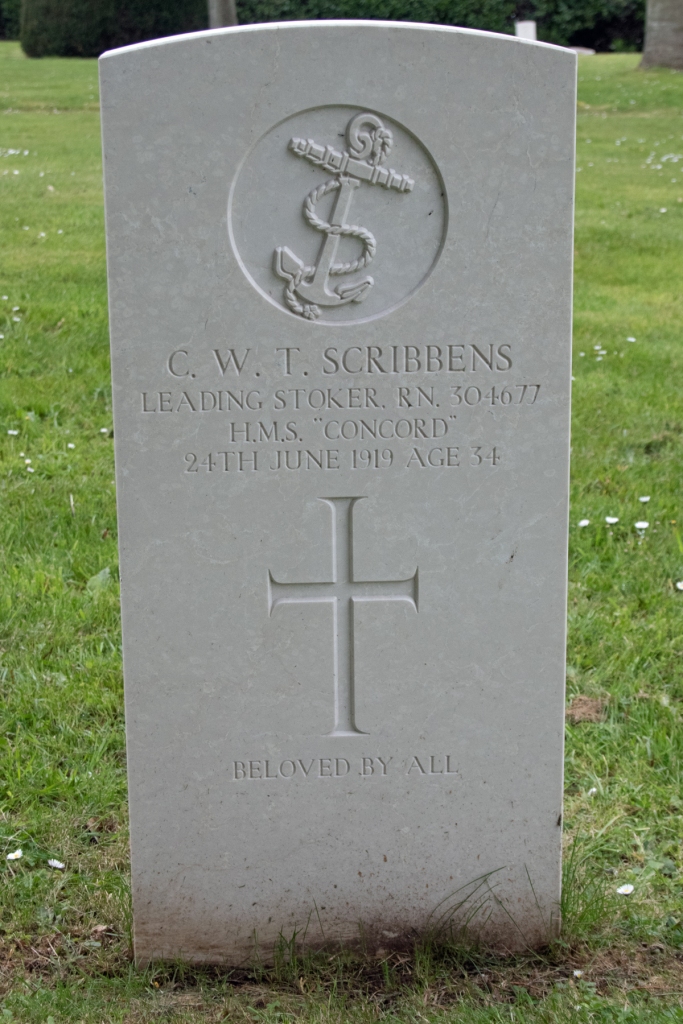
After five years aboard HMS Cornwall and eighteen months on HMS Cleopatra, Leading Stoker Scribbens was assigned to HMS Concord, which would turn out to be his last vessel, in December 1916. He stayed with this ship for nearly three years until falling ill in June 1919.

Brought back to England, he was admitted to the Military Hospital in Taunton with pneumonia. Leading Stoker Scribbens died from this lung disease on 24th June 1919, at the age of 34 years old.

Cecil Walter Thomas Scribbens was laid to rest in the St James’ Cemetery in his home town.


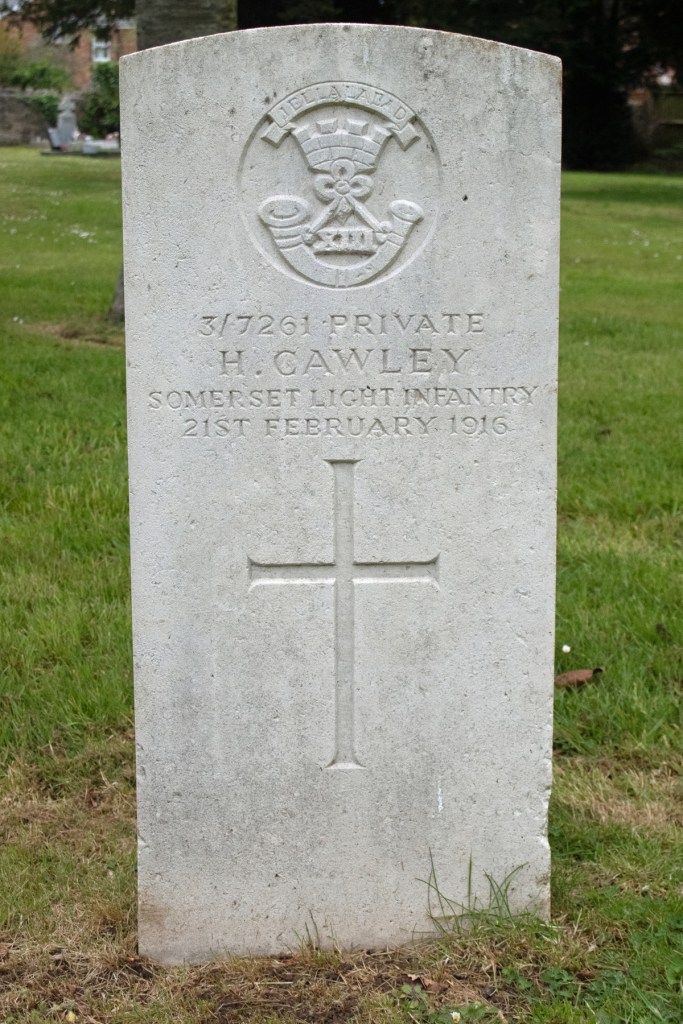
Private Henry Cawley

Private Henry Cawley

Henry Cawley was born in September 1871, one of eight children to John and Ann Cawley. John worked as a blacksmith in the village of Corfe, near Taunton, Somerset, but when Henry left school, he found work as a butcher’s assistant in Bristol.

Henry disappears from the radar for a while. John died in 1884, but the next information available for his son comes in the form of his war medals. This confirms that he enlisted in the Somerset Light Infantry in the summer of 1915, and that he was assigned to the depots as a Private. He was awarded the Victory and British Medals, as well as the 1915 Star, but then fell ill early in 1916.

Private Cawley was medically evacuated back to England, and was admitted to a sanatorium in Taunton. Sadly, whatever illness he contracted, he succumbed to, and he passed away on 21st February 1916, at the age of 45 years old.

Henry Cawley was laid to rest in St James’ Cemetery in Taunton.


Henry’s war pension was given to his mother, Ann. After her husband’s death, she continued to live in Corfe and, based on the available information, lived into her 80s.


Private Ernest Sedgbeer

Private Ernest Sedgbeer

Ernest John Sedgbeer was born in Taunton in the summer of 1891, the second of seven children to Henry and Alice Sedgbeer. Henry worked in a foundry, and his son joined him as a labourer.

By the time of the 1911 census, most of the nine members of the family disappear from the records – it is likely that these were lost – but both father and son are to be found living in South Wales – Henry working as a furnace stoker in the Rhondda, Ernest as a labourer below ground in Llanwonno, near Pontypridd.

Ernest seems to have had an opportunity to find other employment, and started work for Great Western Railways in February 1914. War was imminent, however, and a little over a year later, he had enlisted.

Ernest first joined the Duke of Cornwall’s Light Infantry as a Private, but transferred over to the Dorsetshire Regiment. He was certainly involved in fighting on the Western Front, although full details of his military service are not documented.

His records show that he was awarded the Victory and British Medals and the 1915 Star. Private Sedgbeer was wounded in July 1916 and medically evacuated back to England, where he was admitted to King’s Hospital in Lambeth. Sadly, he was to die of his injuries on 7th July 1916, aged just 25 years old.

Ernest John Sedgbeer lies at rest in the St James’ Cemetery in his home town of Taunton, Somerset.


The local newspaper reported on Private Sedgbeer’s funeral, although it seems to have attributed it to the wrong brother.

The death took place… on Friday last, of Private Charles Sedgebeer of the Dorset Regiment, who was severely wounded in the recent heavy fighting on the Western Front. Deceased was the second son of Mr and Mrs Henry Sedgebeer… and was employed on the railway before the war. His father and three brothers are on active service in France, and one brother in the Navy. The eldest brother has won the DCM.

Taunton Courier and Western Advertiser: Wednesday 19th July 1916

Ernest was indeed the second son of the family, but Charles was the oldest, and survived the war.


Larger memorial image loading...
Ernest John Sedgbeer
(from findagrave.com)

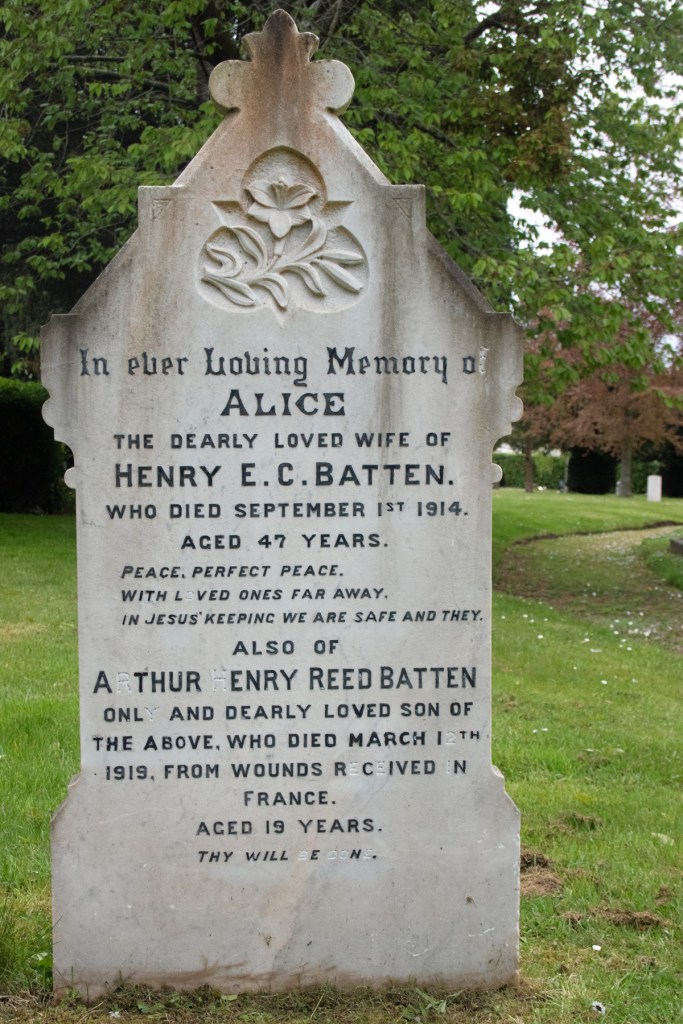
Private Arthur Batten

Private Arthur Batten

Arthur Henry Reed Batten was born in the spring of 1900, the only child to Henry and Alice. Henry was a gardener, and the young family lived in the Somerset town of Taunton.

There is little documentation about Arthur’s short life. When war broke out, he enlisted in the 1st Battalion of the Devonshire Regiment. While there is nothing to confirm the date he joined up, it may well have been a reaction to the passing of his mother, who died on 1st September 1914, at the age of 47 years old.

Private Batten’s battalion initially fought on the Western Front during the war, before moving to Italy in November 1917, then back to France the following April. It seems likely that it was during this second stint in France at some point late in 1918 that Arthur was caught up in the fighting.

He received a gunshot wound, and was shipped back to England for treatment. Admitted to the Military Hospital in Stockport, Greater Manchester, he seems to have suffered for a long time, passing away from his injuries on 12th March 1919, three months after the Armistice was signed. He was just 19 years of age.

Arthur Henry Reed Batten was brought back to Taunton burial, and lies in the family grave in St James’ Cemetery, alongside his mother.


Lance Corporal Joscelin Currey

Lance Corporal Joscelin Currey

Joscelin William Currey was born in the summer of 1897, one of six children to Job Arthur Currey and his wife, Eliza Jane. Job was a shoesmith, and brought his young family up in his home town of Taunton, Somerset.

When Joscelin left school, he worked as an errand boy, before becoming an apprentice with local foundry of Messrs. Rudman, Lancey and Co. But with war on the horizon, things were about to change.

Along with his older brothers, Joscelin enlisted in the army, joining the 3/5th Reserve Battalion of the Somerset Light Infantry in August 1914. Initially based on Salisbury Plain, he was soon transferred to Bath, and attained the position of Lance Corporal.

It was in Bath that he fell ill, and was admitted to hospital with cerebrospinal meningitis. Sadly, Joscelin was to succumb to this condition, and he passed away on 28th June 1915. He was just 18 years of age.

Joscelin William Currey was laid to rest in the St James Cemetery of his home town of Taunton.


Joceslin Currey
(from britishnewspaperarchives.com)

The newspaper report of Lance Corporal Currey’s funeral confirmed that one of his brothers was a prisoner of war in Germany, while another was in the Royal Field Artillery. Joscelin was the only one of the three to die during the conflict.


Joscelin’s name is spelt variously as Jocelyn and Joslin across the documents relating to him, and his surname is also spelt Curry. For the purposes of this post, I have chosen to use the spelling cited on the Commonwealth War Graves Commission records.