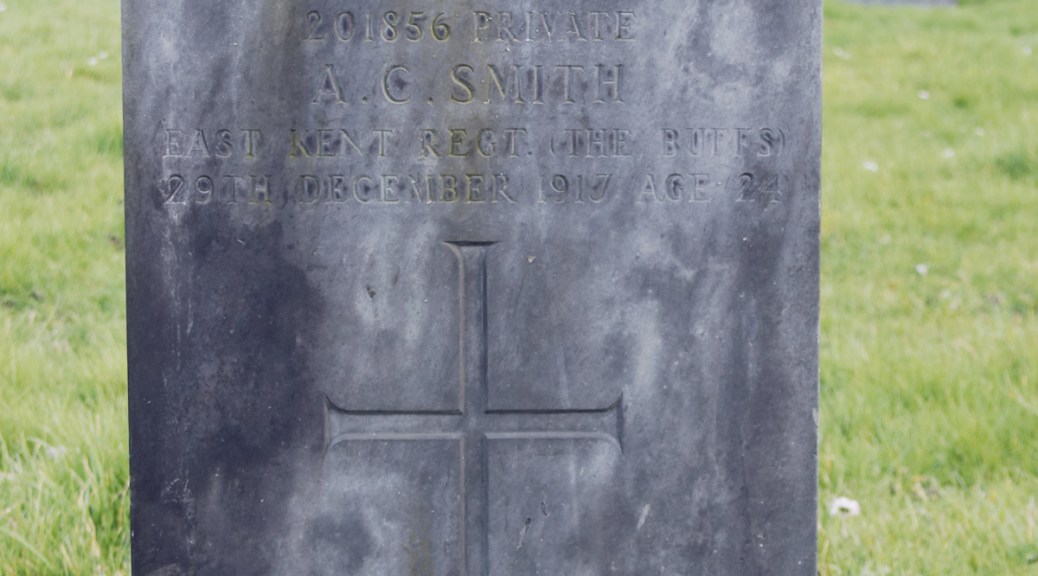
Aubert Charles Smith was born in 1893, the eldest of eight children to Charles and Mary Ann Smith. Charles worked at the Naval Dockyard in Chatham, and the family lived not far away in Gillingham, Kent.
When he left school, Aubert found work as a labourer in a ‘provision warehouse’, which may have been connected to the dockyard at which his father worked.
In July 1915, aged 22, he married Lucy Cox, who was the daughter of a mess cook at the naval base. The young couple went on to have a son, also called Aubert, in 1917.
At this point, the First World War was raging, but little documentation remains of Private Smith’s service. He enlisted in the East Kent Regiment (also known as The Buffs), but there is nothing to confirm when he enrolled or where his duty took him.
The next record for Private Smith shows that he was admitted to Fulham Military Hospital, suffering from testicular cancer. Sadly, he succumbed to the condition, and he passed away on 29th December 1917. He was just 24 years old.
Aubert Charles Smith lies at rest in the Woodlands Cemetery in his home town of Gillingham, Kent.
Herbert Stevens was born in Lincolnshire in 1873. Little record of his early life remains, but his mother, Rachel, was born in Cambridgeshire.
Herbert had at least two siblings; Arthur was ten years older than him, and had been born in Liverpool. Alice, who was six years Herbert’s junior, was also born in Lincolnshire.
By the time of the 1891 census, Rachel had been widowed. She was living with her three children in Chatham, Kent, and working as a laundress. Arthur was a labourer in the Naval Dockyard, which may be what brought the family so far south. Herbert, aged 18 by this point, was a stable hand, while Alice was still at school. To help make ends meet, the family had also taken in two lodgers, Joan Kitteridge, who was a tailoress, and her daughter, two-year-old Florence.
On Christmas Day 1898, Herbert married Sarah Beed. Her father was a ship’s carpenter, based in the Dockyard, and the couple set up home in neighbouring Gillingham. The young couple went on to have seven children.
Herbert went on to become a labourer in the Dockyard, but then found employment for the local council, working as a carman, or carter (presumably his work in the stables and his affinity with horses stood him in good stead).
War was on the horizon, however. He enlisted in May 1915, enrolling in the Royal Army Service Corps, and gave his trade as a groom. Private Stevens was assigned to the Remount Depot in Romsey, Hampshire, where he would have been partly responsible for the provisioning of horses and mules to army units both in England and abroad.
Split across ten squadrons, at times there were as many as 4,000 horses and mules stables at the Romsey Remount Depot, so Herbert’s life would have been a busy one. It seems, however, to have been a strenuous life too an, on 23rd March 1918, after nearly three years’ service, Private Stevens died of heart failure. He was 45 years old.
Herbert Stevens lies at rest in the Woodlands Cemetery in his adopted home of Gillingham, Kent.
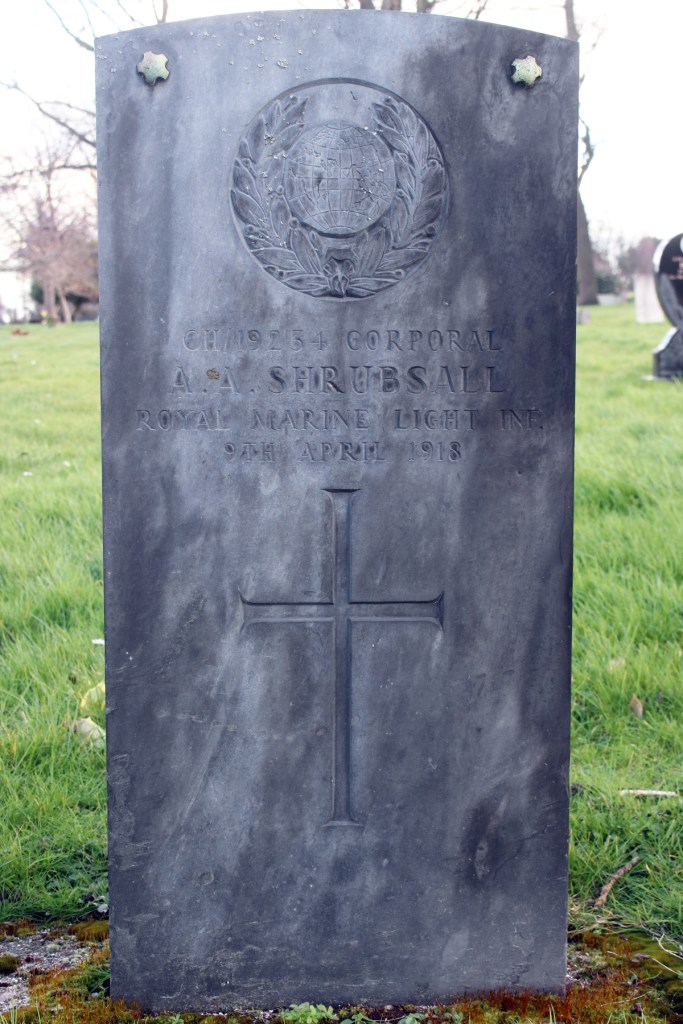
Albert Arthur Shrubsall was born in Deptford, South London, in April 1896. He was the youngest of three children – all boys – to ironmonger George Shrubsall and his wife Jessie.
While his brothers continued to live at home after they had left school and got jobs, Albert found live-in work as a pageboy, or servant, for Wilfred Lineham, who was a professor of engineering for a London college. It was while he was working here that his mother, Jessie, passed away. She died in 1913, aged just 43.
Details of Albert’s military service are a bit scant. He enlisted in the Royal Marine Light Infantry, although I have been unable to confirm when he joined up. He was assigned to the Chatham Division, and was based at the Naval Dockyard in Kent, ultimately being promoted to Corporal.
Albert married Gertrude Spoore – affectionately known a ‘Ginty’ – in Deptford in October 1917. Sadly, the marriage was to las less than six months, as, on 9th April 1918, Albert passed away, having contracted pneumonia and septicaemia. He was just 22 years old.
Albert lies at rest in the Woodlands Cemetery in his adopted home town of Gillingham in Kent.
Albert’s two brothers George and Alfred were also involved in the First World War.
George, had gone on to become a tailor’s assistant when he left school. He married Emily Hawkes in 1911, and the couple went on to have a son, also called George, the following year.
When war broke out, he enlisted in the Machine Gun Corps, and served on the Western Front. Sadly, he was caught up in the fighting, and was killed in action on 22nd August 1917. He was buried at the Tyne Cot Memorial in Flanders.
When he left school, Alfred went on to become a butcher’s assistant. War came along, and he enlisted straight away.
Enrolling in the Royal Field Artillery, Gunner Shrubsall was assigned to the 95th Brigade. Sadly, he had recorded less than six months’ service, as he passed away on 8th January 1915, aged just 21 years old. His brigade did not go to France until the following year, so, while no cause of death is recorded, it is likely that he died from a communicable disease like influenza or pneumonia.
Alfred is buried in the family grave in Deptford, South London.
Within a period of just three years, George had lost all three of his sons to the Great War. Given the previous death of his wife, you can only imagine the heartbreak he was going through.
Walter Vaine Bromley was born in March 1877, one of seven children to Frederick and Jane Bromley. Frederick was a gardener, and the family lived in Maidstone, Kent. Sadly Jane died when Walter was only two years old; while the cause of her death is not noted, she passed away in the Barming Lunatic Asylum in Kent.
Things must have been tough for Frederick; his maternal aunt, Sarah, came to live with the family to help raise his children, but further support seems to have been needed and, by the time of the 1891 census, Walter was a student at the Kent County Industrial School, which was, in effect, a boys home, near Ashford.
By the end of that year, having left school, he enlisted in the army, joining the Royal West Kent Regiment. He served most of his twelve years’ enrolment in India, although he suffered numerous hospital admissions for dysentery, ague and orchitis (a swelling of the testicles, often brought about by a sexually transmitted bacterial infection), amongst other ailments.
On being demobbed, Walter became a postman; he moved to Gillingham, and was given a round serving the Eastcourt area of the town. A year later, he married Rose Brenchley, and the couple went on to have four children; Ada, Violet, Frederick and Hilda.
Hostilities began, and, in July 1915, Walter enlisted in the 8th (City of London) Battalion, The London Regiment (Post Office Rifles). Rifleman Bromley served as part of the Territorial Force for his first year, before being sent to France in August 1916.
His time there was cut short, however, as he received a gunshot wound in the left ankle. William was repatriated to England for treatment, and was eventually medically discharged from the army on 22nd August 1917.
Surprisingly, it seems not to have been the ankle wound that led to Rifleman Bromley’s passing, however. His pension records, instead, give his cause of death as a goitre contracted whilst on active service. Either way, he passed on 9th July 1918, at the age of 41 years old.
Walter Vaine Bromley lies at rest in the Woodlands Cemetery in his adopted home town of Gillingham in Kent.
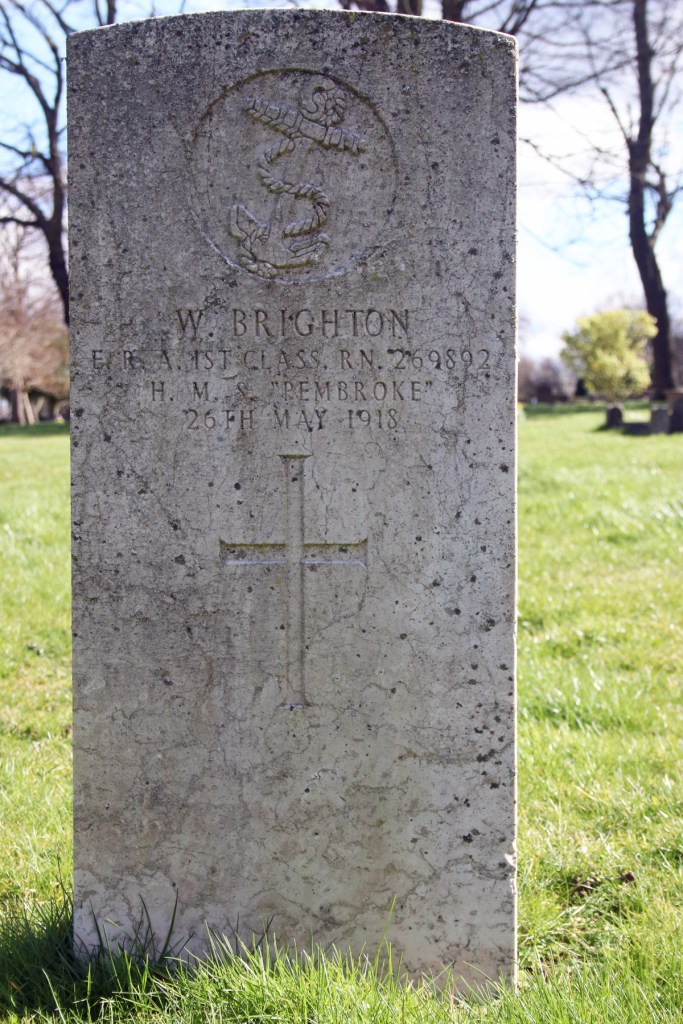
William Brighton was born on 13th August 1877 in Peterborough, Northamptonshire. Sadly, details of his early life are lost to time, so his parents’ names, and details of any siblings are a mystery.
William chose a military life early on; he enlisted in the Royal Navy in October 1899 for twelve years’ service. Working as an Engine Room Artificer, he was an engine fitter and repairer on a number of vessels in his time, including the battleship HMS Repulse and the cruisers HMS Andromache and Scylla.
William married Lily Franklin in the autumn of 1904, and the couple went on to have three children; Mona, Lily and John. With William away at sea a lot of the time, Lily set up home in Gillingham, Kent, close to the shore facility – HMS Pembroke – where her husband was based.
The uncertainty around potential conflict meant that William extended his service when it initially came to an end in November 1911. He continued to serve on a number of vessels during the war and was based on a ship off the Scottish coast when he fell ill in May 1918.
William was transferred to the US Hospital in Strathpeffer, near Inverness, suffering from an abdominal aneurysm. Sadly the treatment did not work, and he passed away on 26th May 1918. He was 40 years old.
William Brighton lies at rest in the Woodlands Cemetery in Gillingham, Kent.
Henry McCahearty was born in Glasgow in October 1864, one of four children to Henry and Bridget McCaherty. Sadly, few records remain, but it seems that Henry Sr, who had been born in Northern Ireland, was a soldier.
Henry falls off the radar quite quickly; from later records we can determine that he worked as a skilled labourer at the Naval Dockyard in Chatham, although it is not certain what particular skills he had.
He married Alice Radford on 3rd September 1901 in Walmer, on the Kent coast, although the couple subsequently moved to Gillingham. They went on to have four children – Reginald, James, Leonard and Alfred.
Henry was 49 when war broke out. While over the initial recruitment age, he did enlist – becoming a Private in the Royal Marine Light Infantry – although it is not certain exactly when he joined up.
Sadly Private McCahearty’s passing is also a mystery. There is nothing in the newspapers of the time to suggest anything out of the ordinary, so I can only assume that he died as a result of one of the illnesses that were rife at the time. Either way, he died on 14th November 1916, at the age of 51.
Henry McCahearty lies at rest in the Woodlands Cemetery in Gilingham, Kent.
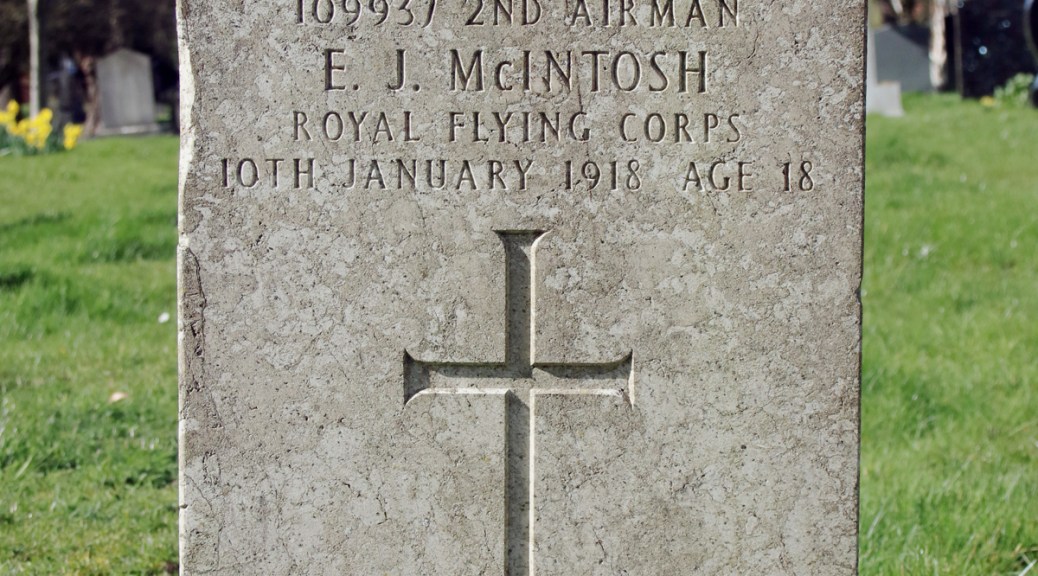
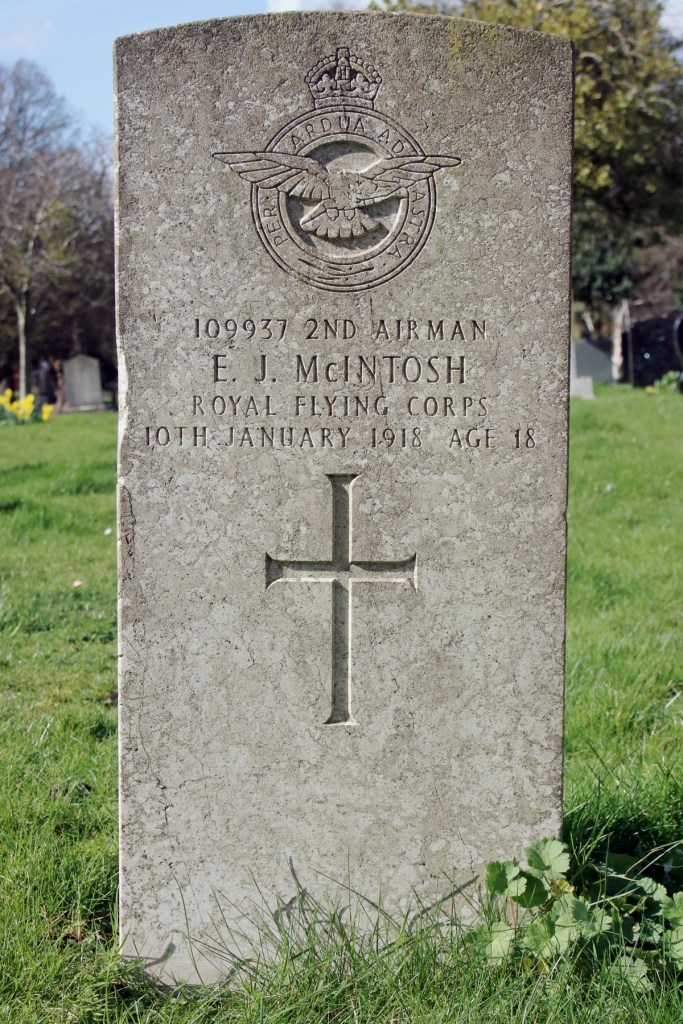
Edward James McIntosh was born in January 1899, the youngest of four children to Henry and Caroline McIntosh from Gillingham in Kent. Henry and Caroline ran a greengrocer’s and their eldest son, Harry, followed them into the business when he left school. One of Edward’s sisters Beatrice became a dressmaker, while the other, Gertrude, became a servant for the secretary to an engineering company.
Sadly, little else remains of young Edward’s life. He enlisted in the Royal Flying Corps when war broke out; given his age, it is unlikely that he signed up before 1917, although there is no record to confirm this.
Edward achieved the rank of Air Mechanic 2nd Class (although his gravestone gives his rank as Second Airman), but there is little more documentation to flesh out his military service.
Edward was admitted to the Military Hospital in Aldershot in January 1918, suffering from meningitis. Sadly this was to take his life, and he passed away on 10th January 1918, having just turned 18 years old.
Edward James McIntosh lies at rest in the Woodlands Cemetery in his home town of Gillingham, Kent.
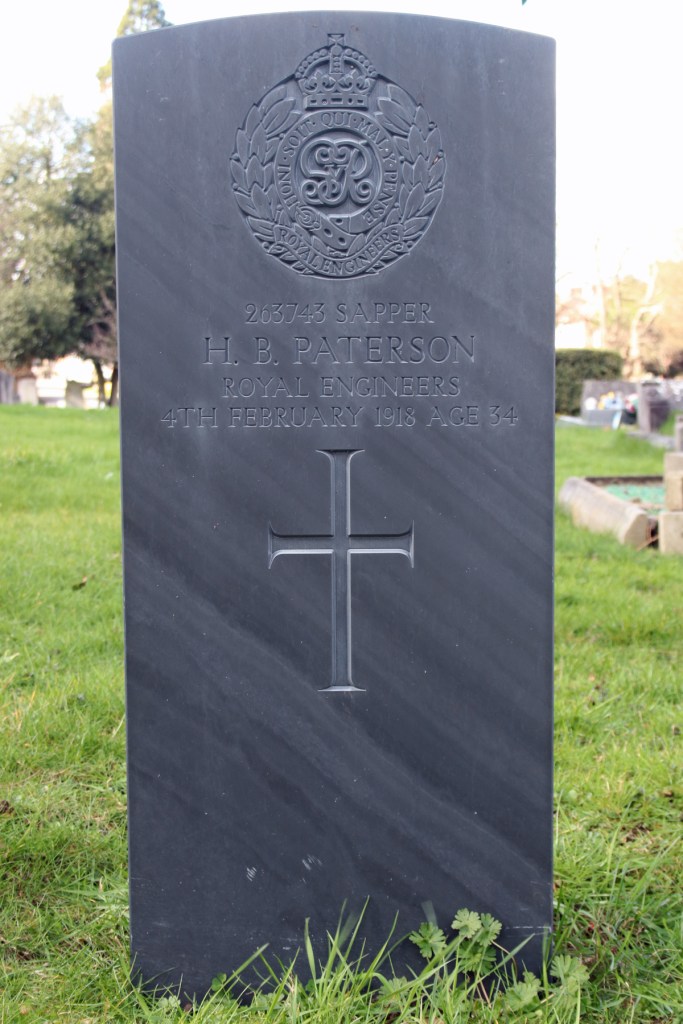
Harry Bruce Paterson was born towards the end of 1893, one of two children to John and Jane Paterson. John worked at Chatham Dockyard fitting ships’ engines, and the family lived in a small terraced house close to the centre of Gillingham in Kent.
When Harry left school, he became a plumber’s apprentice, soon qualifying as a full plumber.
He married Ellen Keeler in 1906, and the couple lived a short walk away from his parents’. They went on to have four children, Lilly, Harry Jr, Mabel and Kathleen.
War was on the horizon, but Harry’s military service records are a bit sketchy.
He enlisted as a Sapper in the Royal Engineers on 14th July 1915, and served in France. He attained the Victory and British Medals as well as the 1915 Star.
Sadly, Sapper Paterson’s health seems to have been impacted by his service. In January 1918 he was invalided back to England and admitted to the military hospital at the army camp in Thetford, Norfolk. Diagnosed with pulmonary tuberculosis, he quickly succumbed to the disease, and passed away on 4th February 1918. He was 34 years old.
Harry Bruce Paterson lies at rest in the Woodlands Cemetery, Gillingham, just a few minutes’ walk from both his parents and his widow and children.
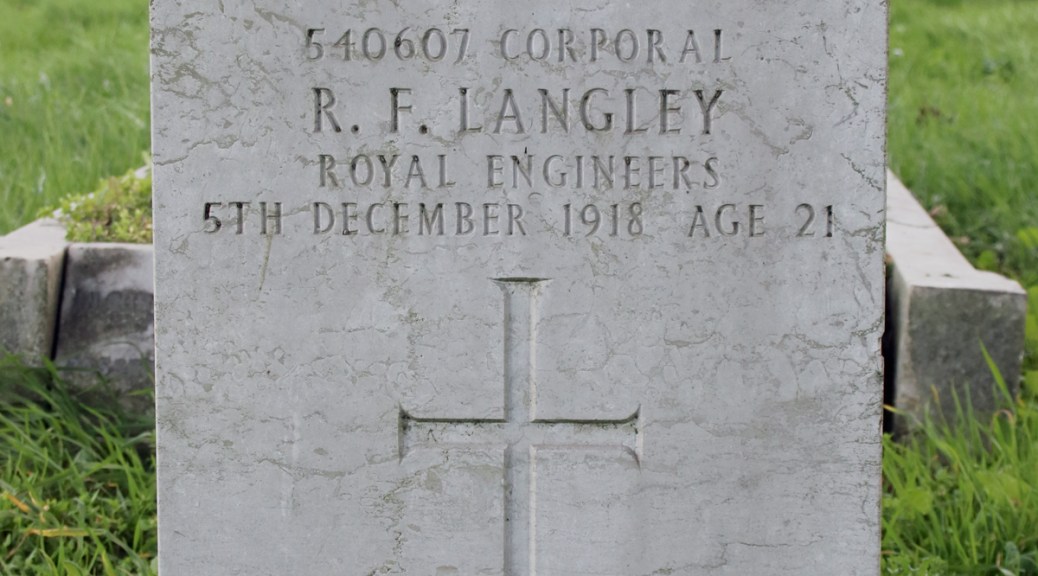
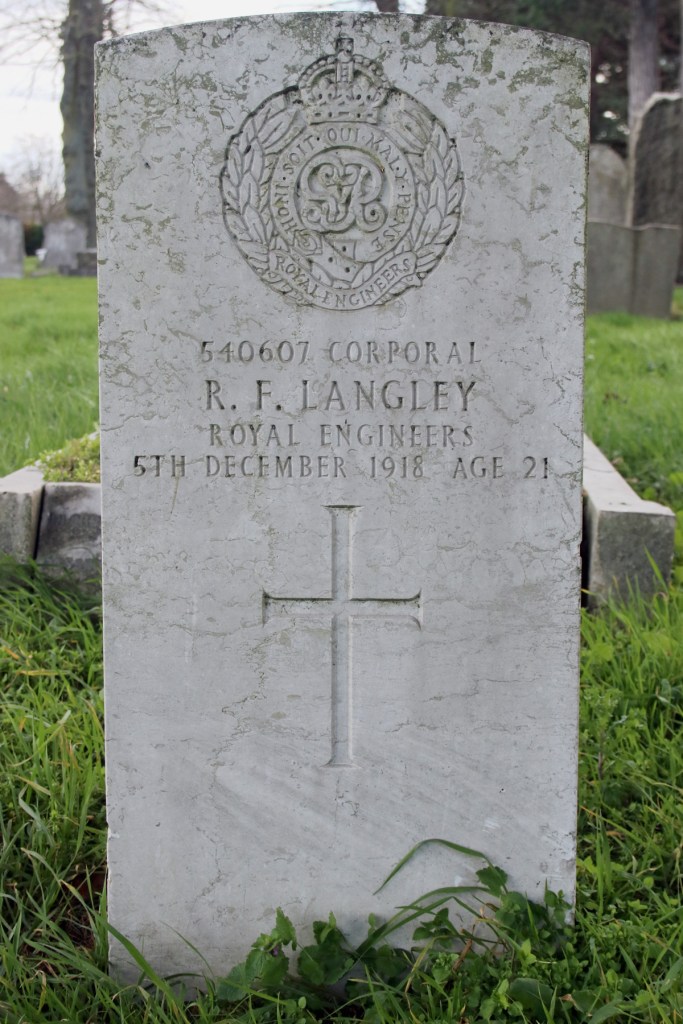
Richard Frederick Langley was born in January 1897 in Chatham, Kent. He was one of seven children to Albert Langley, who was a bricklayer, and his wife, Elizabeth.
Richard enlisted almost as soon as he was able to. His papers, dated 18th October 1914, show that he was 17 years and 10 months old, as was working as an apprentice boilermaker. He was assigned to the Royal Engineers.
Sapper Langley’s war service was spent in England. Initially based in Kent, he was promoted to Acting Lance Corporal in October 1915. Transferring to the Royal Engineers Anti Aircraft Battalion in July 1916, Richard was again promoted to Corporal.
Corporal Langley was injured while serving for the Royal Engineers AA; he was admitted to the General Hospital in Tunbridge Wells, and has a hernia operated on. After two months recovering in hospital, he re-joined his battalion.
Richard was transferred again in January 1918, this time being assigned to the London Electrical Engineers. It was here that he saw out the remainder of the war.
It was while he was serving in Sheerness that Richard contracted influenza. Hospitalised on the island on 28th November 1918, he sadly did not recover. Corporal Langley passed away from pneumonia on 5th December 1918. He was just 21 years of age.
Richard Frederick Langley lies at rest in the Woodlands Cemetery in his home town of Gillingham, Kent.
Richard’s older brother Albert was also involved in war service and was a skilled labourer at Chatham Dockyard. In February 1916, he boarded the SS Maloja, a steamship bound for Bombay with over 400 passengers and crew on board.
At around 10:30am on Sunday 27th February, the ship was sailing through the Straits of Dover when it struck a mine. The vessel sank within 24 minutes. Over 150 people died in the explosion, from drowning or from hypothermia.
Sadly, Albert’s body was not recovered. He was just 21 years old. He is commemorated on the Naval Memorial in Chatham, Kent.
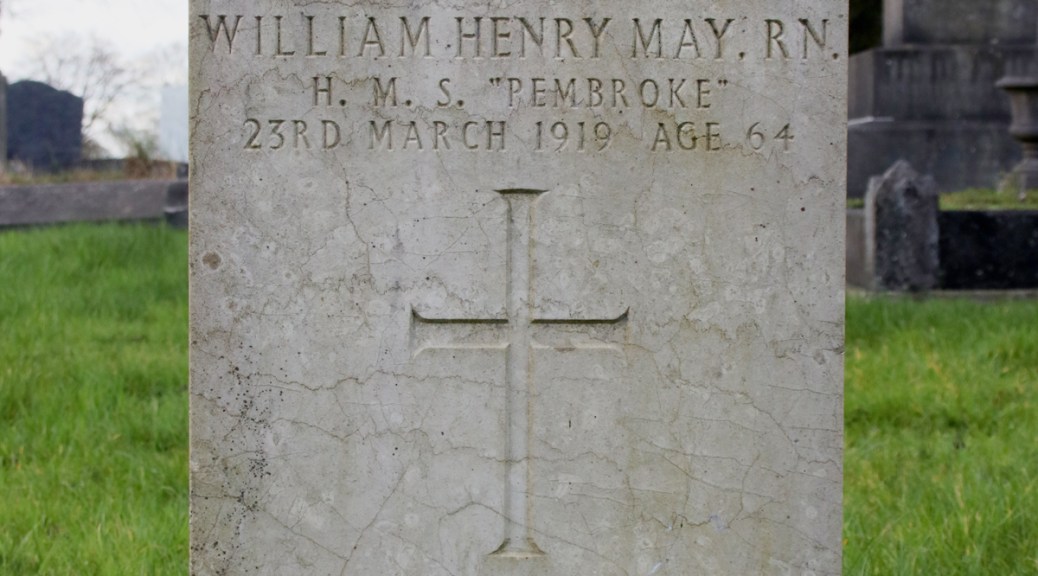
William Henry May was born on 10th August 1854, the oldest of three children to James and Selina May. James was a carpenter’s mate from Plymouth, and the family lived in the Stonehouse area of the city, right next to the dockyard.
Maritime adventure was obviously going to be in William’s blood; by the time of the 1881 census, at the age of 25, he is working as a gunner’s mate and instructor for the Royal Navy. He married a Mary Jane Channing, the daughter of a labourer and fishmonger, in 1879; the coupe were living in their home town of Plymouth.
There are definite gaps in the William’s trail; this may be because he was abroad, or because the documentation relating to him has been lost or destroyed. He next appears on the 1901 census.
By this point, William was a Warrant Officer in the Royal Navy. He is married to Kate Doling, from Gosport in Hampshire, and the couple were living in Sheerness, Kent.
William continued to live close to port; ten years on, and aged 56, he and Kate had moved along the Kent coast to Gillingham, not far from the dockyards at Chatham. The couple had been married 23 years by this point, but had had no children.
By this point, William’s naval service had come to an end. He had served for twenty years, and had reached the rank of Lieutenant, but the census lists him as retired.
War arrived, however, and William’s services were called upon once more. He was assigned to HMS Pembroke, the shore-based naval barracks in Chatham, and served with the rank of Lieutenant Commander.
From this point, however, William’s trail goes cold. His gravestone confirms that he passed away on 23rd March 1919, at the age of 64, but I have been unable to find a cause of death. His entry on the Commonwealth War Graves Commission site confirms he was the husband of the late Kate Emily May, so she too must have passed away at some point after 1911.
William Henry May lies at rest in the Woodlands Cemetery in his adopted home of Gillingham, Kent.











 Death and Service