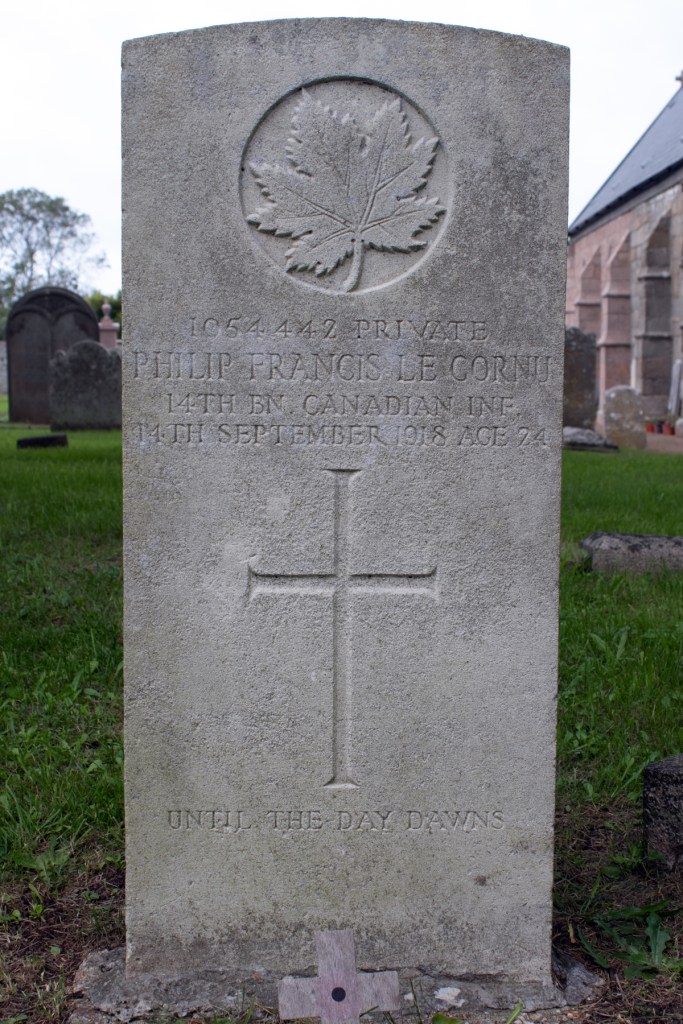
Philip Francis le Cornu was born on 29th July 1894 in St Peter’s, Jersey. The youngest of five children, his parents were Philip and Mary le Cornu. Philip Sr was a farmer, but it seems that both he and Mary passed away not long after his youngest son’s birth. By the time of the 1901 census the children had been split between family members, and Philip Jr was living with his maternal grandparents.
Philip finished his schooling, and seems to have sought a purpose in life. He emigrated to Canada and, by the time war broke out, was living in Grande-Mère, Quebec. He found employment as a clerk, but with conflict raging on the other side of the Atlantic, he responded to the call to arms.
Philip enlisted in the Canadian Expeditionary Force on 12th September 1916. His service records show that he was 22 years and 2 months old and stood 5ft 6ins (1.68m) tall. He had black hair, blue eyes and a dark complexion. Private le Cornu sailed to Britain, and arrived there on 7th April 1917.
Billeted in Shoreham, West Sussex, Philip was attached to the 14th Battalion of the Canadian Infantry. Within weeks he was sent to France, and, on 15th August 1917, was caught up in the Battle of Hill 70 near Lens.
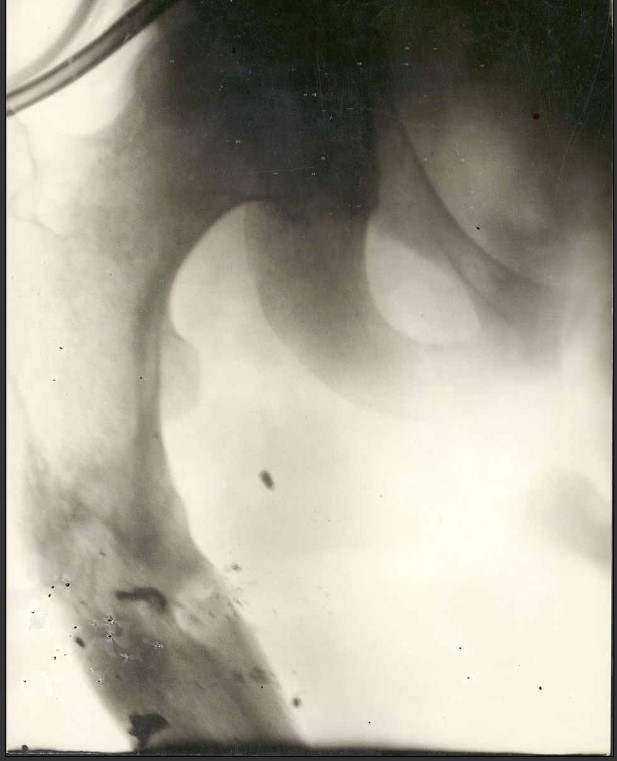
During the skirmish, Private le Cornu was badly wounded in the thigh and sent to the 58th Casualty Clearing Station. Within days he was moved to the 4th General Hospital in Camiens, but his condition necessitated medical evacuation to Britain.
Over the next year, Philip had three operations on his leg, and spent time at the 3rd Southern General Hospital in Oxford, the Manor War Hospital in Epsom, Surrey, and the 16th Canadian General Hospital in Orpington, Kent. Tragically, all of the medical treatment was to prove to no avail. Private le Cornu passed away from his injuries on 14th September 1918, more than a year after Hill 70. He was 24 years of age.
Philip Francis le Cornu’s body was taken back to the Channel Islands for burial. He was laid to rest in the quiet graveyard of St Mary’s Church on Jersey.
X-ray of Private Philip le Cornu’s left femur (from uk.forceswarrecords.com)
John Renouf was born in Bedminster, Bristol, on 26th June 1875. Hiss parents, Charles and Emily Renouf, had been born in St Helier, Jersey, and had moved to the mainland with their older children in around 1874. Charles was a blacksmith, initially working on naval vessels in Jersey, he continued his smithing when the family had settled in Bedminster.
John was one of seven children and became apprenticed to his father when he finished his schooling. Charles’ trade offered him an opportunity for a career, however, and, on 23rd September 1893, he enlisted in the Royal Navy as a Blacksmith’s Mate. His service records show that he was 5ft 7.5ins (1.71m) tall, with black hair, grey eyes and a fresh complexion.
John signed up for a 12-year contract, and was primarily based out of HMS Vivid, the Royal Naval Dockyard in Devonport. His records confirm that he was not shore-bound, however, and he spent time on eleven ships up to 1905. At this point, his contract came to an end, and he chose not to re-enlist.
At this point, John’s trail becomes a little hazy. He returned to Bristol, and seems to have continued working as a blacksmith. The 1911 census recorded him as being one of a number of residents at the city’s Salvation Army Hostel on Tower Hill. According to the same census, Charles, now 71 and a widower of three years, was living with his youngest son, Ernest, and family.
When war came to European shores, John’s skills as a blacksmith were to be called upon once again. His service records are no longer available, but it is clear that he chose not to re-join the navy, instead enlisting in the Royal Engineers as a Sapper.
Sapper Renouf’s trail goes cold again: he was assigned to one of the Waterways and Railway Troops, but it is unclear whether he spent his time on home soil or overseas. Either way, he survived the conflict, and was back in Britain soon after the Armistice.
The next record for John Renouf is that of his passing. He died in Bath, Somerset, on 30th December 1919, at the age of 44 years old. John was laid to rest in the sweeping grounds of the city’s Locksbrook Cemetery.
Andrew Michael Fox was born on 25th May 1871, the oldest of six children, to Michael and Eliza Fox. Michael was a Private in the 40th Regiment of Foot, and was based in Curragh Camp, Kildare, Ireland, when Andrew was born.
The family travelled where Michael’s work took him: Andrew’s oldest siblings were born in Uttar Pradesh, India, and the family were in England by the time of the 1881 census.
Given Michael’s military connections, it is no surprise that Andrew followed him into the army. He enlisted in August 1884, joining the South Lancashire Regiment. His service records give his age as 14 – he was, in fact, just 13 years old – and note his height as 4ft 9ins (1.44cm) and his weight as 73lbs (32.7kg). Andrew was recorded as having hazel eyes, brown hair and a fair complexion: his religion was also confirmed as Roman Catholic.
Andrew’s service records have become damaged over time, and a lot of his details are illegible. Because of his age when he enlisted, he was initially given the rank of Boy. In July 1887, he was formally mobilised, with the rank of Private. He remained on home soil for the next ten years, with the 1891 census listing him as being barracked in Fort Regent, Jersey.
It was in the Channel Islands that Andrew met Kathleen Dooling. The couple married on 7th January 1892, and went on to have ten children. Over the next couple of years, Andrew progressed through the ranks, achieving Lance Corporal in September 1892, Corporal in June 1894 and Lance Serjeant in August 1897.
In 1899, the Second Boer War led to the newly-promoted Serjeant Fox being posted overseas. He remained in South Africa for six months, while the conflict raged on. Andrew returned to Britain in April 1900, and was officially stood down from the army on 31st December that year, as he was deemed no longer fit for military service.
The 1901 census found Andrew and Kathleen still living in family barracks in Aldershot with their three eldest children, Andrew Margaret and Edith. Andrew was recorded as being an officer’s valet, likely now in a civilian role. The family remained in Aldershot until 1910, with five more of their children being born there.
Another change came at that point, however, as the following year’s census found the family living in Brighton Street, Warrington, Lancashire. Andrew was, by this point, working as a salesman for the Singer Sewing Machine Company, and the family were cramped into a four-roomed end-of-terrace house.
War came to Europe in the summer of 1914, and Andrew stepped up to play his part once more. Again, full details have been lost to time, but he took up the rank of Serjeant once more, and was attached to the Somerset Light Infantry. This necessitated another relocation for the family, and they moved to Cannington, near Taunton, Somerset.
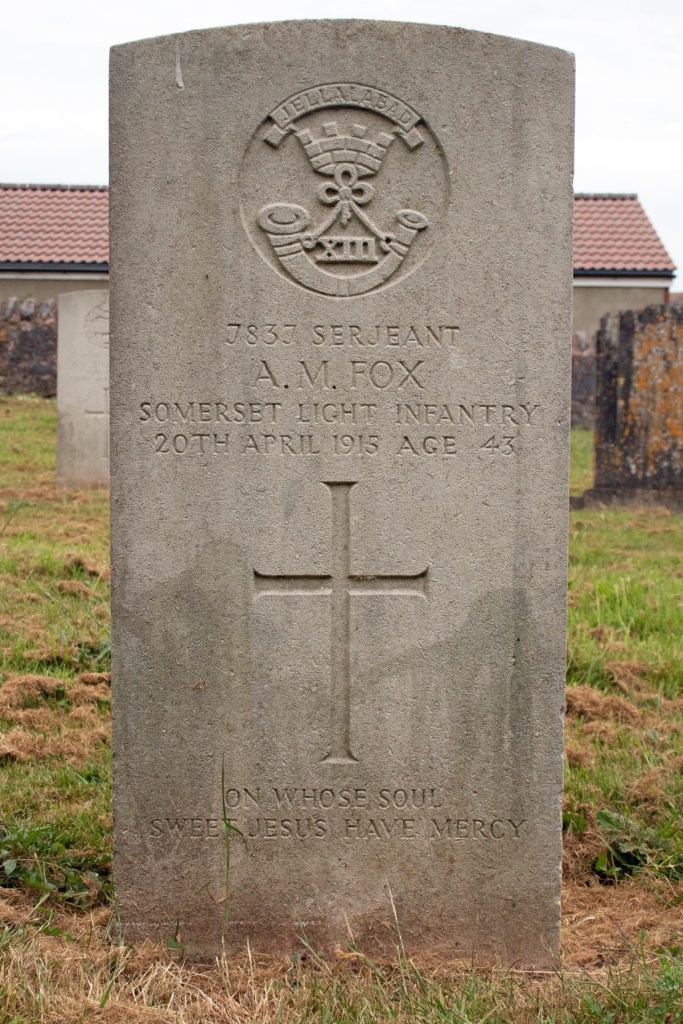
Serjeant Fox was assigned to the 7th (Service) Battalion, but was not to remain in his role for long. He contracted phthisis, or tuberculosis, and passed away from the condition on 20th April 1915, just weeks before his regiment departed for the Western Front. He was 43 years of age.
Andrew Michael Fox was laid to rest in the peaceful Cannington Cemetery, not far from the family home.
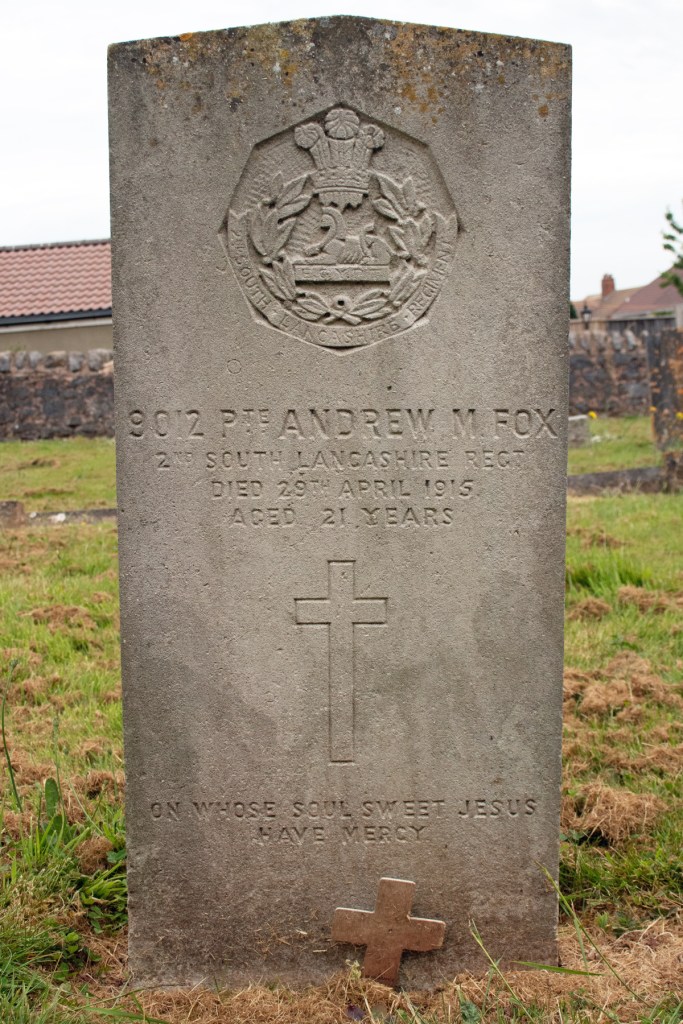
Private Andrew M Fox
In the plot next to Serjeant Andrew Fox is another, similar headstone. Not quite having the same form as the Commonwealth War Grave Commission headstone that Serjeant Fox has, this is dedicated to a Private Andrew M Fox, of the 2nd South Lancashire Regiment.
Andrew Moyse Fox was the eldest son of Andrew and Kathleen. Born on 31st March 1894 in Ireland, he wanted to follow his father and grandfather into the army.
Andrew Jr enlisted in the South Lancashire Regiment in August 1908. His service records confirmed that he was just 14 years of age, standing 5ft (1.52m) tall, and weighing 5st 2lbs (32.7kg). He was noted as having dark brown hair, hazel eyes and a fresh complexion, and that he has a scar on his right buttock.
As is the case with his father, there is limited information about Andrew Jr’s army career. He spent just under six years serving with the regiment, and was formally mobilised when he came of age in 1912. On 27th March 1914, however, Private Fox was discharged from the army on medical grounds, for reasons unclear. The next record available for him is that of his passing, just nine days after his father. He was 21 years of age.
Andrew Fox Jr was laid to rest next to his father in Cannington Cemetery. The heartbreak for Kathleen, to have lost husband and oldest boy within two weeks, must have been indescribable. While her son’s headstone is similar in design to her husband’s, he was not subsequently entitled to an official Commonwealth War Grave, as he had left the army before the outbreak of war: the Commission’s qualification dates (4th August 1914 to 31st August 1921).
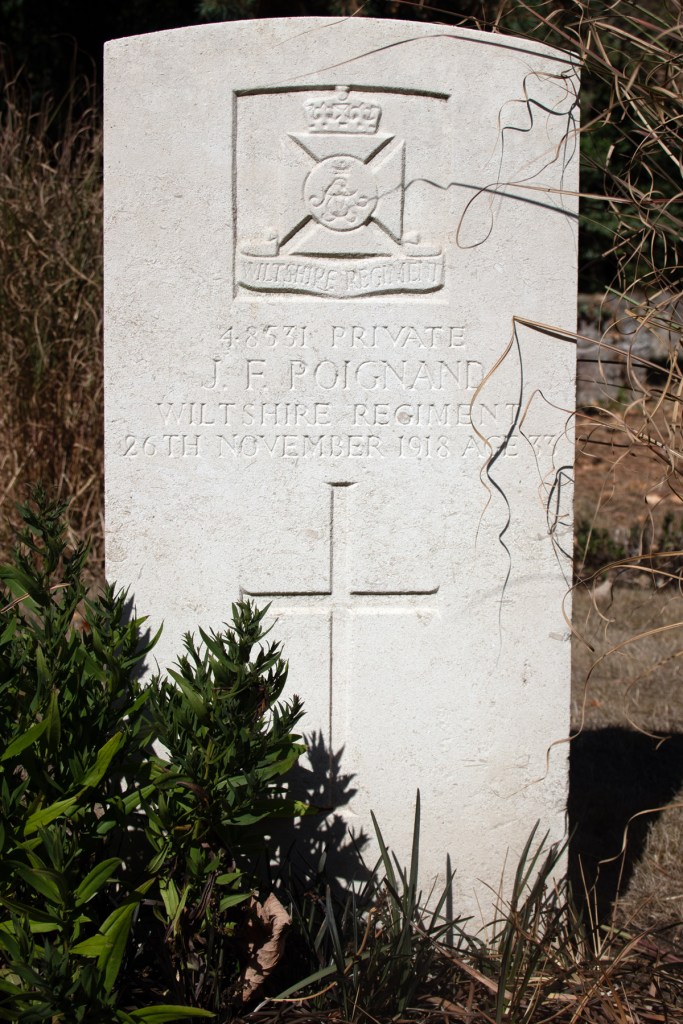
John Francis Poignand was born in St Brelade, Jersey in 1885. The oldest of four children, his parents were farmers Jean and Louisa Poignand. John followed his parents into farming and moved to nearby St Lawrence.
It was here that he met and married farmer’s daughter Lydia Helleur. The couple set up home in St Lawrence, and went on to have two children, John and Clarence.
War was closing in on Jersey’s shores and, when the call came, it seems that John was keen to play his part. Sadly, full details of his military service have been lost to time, but what remains confirms that he had enlisted in the Wiltshire Regiment by the spring of 1918.
Private Poignand was assigned to the 3rd (Reserve) Battalion, a territorial force that remained on the British mainland. He was to be based in Kent, his troop forming part of the Thames and Medway Garrison.
The only other records of John’s service are that of his passing: he had been admitted to the Preston Hall Military Hospital, suffering from a combination of influenza and pneumonia, and these are what were to take his life. Private Poignand died on 26th November 1918, at the age of 33 years old.
John Francis Poignand was laid to rest in the graveyard of St Peter and St Paul’s Church in Aylesford, not far from where he had died.
Lydia went on to marry a man called Robinson. Her trail goes cold, but her and John’s younger son, Clarence, does appear in later records.
Flight Sergeant Poignand served with the Royal Air Force in the Second World War, and was based at Seletar in Singapore. He was taken as a Prisoner of War by the Japanese on 11th March 1942, but there is no other record for him. His PoW record confirms that he was married and living in Romford, Essex, at the time of his capture.





 Death and Service