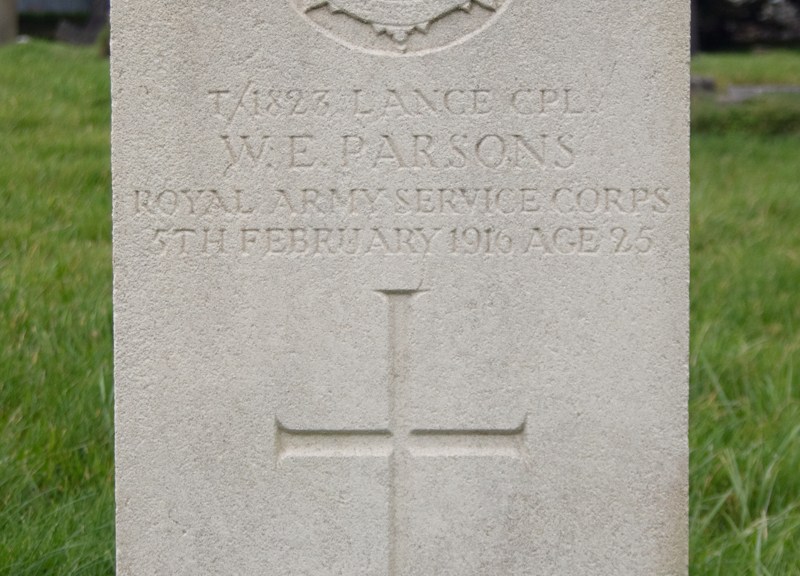
William Edward Parsons was born in 1890, one of six children to John and Prudence Parsons. John found work in a number of fields, working as a blacksmith, porter, dock labourer and a hobbler (towing boats along the River Parrett) in his time. Throughout this, he lived with his family in the Somerset town of Bridgwater.
William found work as a collar cutter in a local shirt factory, and went on to marry Matilda Mary Temblett on Christmas Day 1913. The young couple went on to have a son – Leslie William – who was born in February 1915. William was teetotal, and played full back for the local rugby football club, Bridgwater Albion.
Sadly, Lance Corporal Parsons’ military records are sparse; he had enlisted in the Royal Army Service Corps and was based in Fovant, to the west of Salisbury.
It was while he was on leave that William met his sad fate. On the evening of 5th February 1916, he had seen his parents and had set out to organise a football match in the town. He was walking over the town bridge, when a passer-by heard a splash. He saw a man in the water, who was crying for help, and then disappeared.
William’s body was found in the river a fortnight later close to a local brickyard. He was just 25 years old.
William Edward Parsons lies at rest in St John’s Cemetery in his home town of Bridgwater.
Wilfred Allen Gillson was born in 1888, the fourth of nine children – and one of eight boys – to George and Emma Gillson. George was a coachbuilder from Cornwall; Emma, whose maiden name was Allen, came from Derbyshire. The family were living in Torquay by the time Wilfred was born.
In 1895, George had moved the family to Bridgwater in Somerset, presumably as railway works had dried up in the coastal Devon town. By this time his oldest son, also called George, was working as a compositor, keying text for a printer. Wilfred was still at school, but his other two older siblings – William and Albert – were both working with their father, working on railway coaches.
Wilfred was also to follow in his father’s employment, and the 1911 census found him living in Bristol, boarding with the Cridland family, earning his keep a a carriage painter.
He joined up within weeks of war breaking out, enlisting in the Worcestershire Regiment on 20th September 1914. Private Gillson readily proved his worth, and was promoted to Lance Corporal after three months, and Corporal within a year of enlisting.
Corporal Gillson’s promotion coincided with his shipment abroad, and he served on the Western Front for eight months. Returning to England in March 1916, he subsequently transferred to the Devonshire Regiment, before being moved to the 4th Reserve Battalion in the spring of 1917.
Things were not right for Wilfred; he was reprimanded for neglecting his post on the night of the 26th May that year, before being medically discharged with neurasthenia in August.
The root of the matter is detailed in his discharge report; he was hospitalised at Neuve Chapelle in February 1916, suffering from shellshock, and it seems that he never really fully recovered.
Sadly, at this point Wilfred’s trail goes cold. He passed away on 10th November 1918, aged 30 years old.
Wilfred Allen Gillson lies at rest in St John’s Cemetery in Bridgwater, Somerset.
There are a couple of additional notes to Wilfred’s life.
During the war, Wilfred’s youngest brother, Thomas, fought with the Oxfordshire & Buckinghamshire Light Infantry. He was involved in the fighting in France, but died from wounds on 10th June 1918. He was just 18 years old, and is buried at Aire-sur-la-Lys, not far from Boulogne.
Given that Wilfred was one of eight brothers, all of whom would have been of fighting age during the war, it is lucky – although still a tragedy – that only he and Thomas died as a result of the conflict.
Sadly, Wilfred’s mother, Emma, passed away in the autumn of 1914, at 57 years of age. It might be a blessing, however, that she was not alive to see two of her sons suffer so.
Stanley James Southwood was born in 1896, the oldest of six children to John and Florence Southwood from Bridgwater, Somerset. John was a labourer and ship’s mate, while Stanley, who was the only boy in the family, started work loading barrows in a brickyard.
Military life was pulling Stanley, however. According to another researcher, he enlisted in the Special Reserves of the Somerset Light Infantry in October 1912. Six months later he joined the regular army, and was there when the war began.
While I have not been able to corroborate this information, it appears that Southwood was reported missing on 11th September 1915, after being wounded in the chest. He was taken prisoner of war, and, while being held, he developed tuberculosis in both lungs.
After his release (no documents confirm when this was) he was discharged from the army as medically fit to continue. He was in a military hospital at the time – the beginning of November 1918 – suffering from tuberculosis, which had been exacerbated by the chest wound he had received three years earlier. At the time he was discharged, he had the rank of Lance Corporal.
Sadly, it seems that Stanley never fully recovered from his wartime experience. He died on 8th September 1919 from consumption (tuberculosis), aged just 23 years old.
Stanley James Southwood lies at rest in the Wembdon Road Cemetery in his home town of Bridgwater in Somerset.
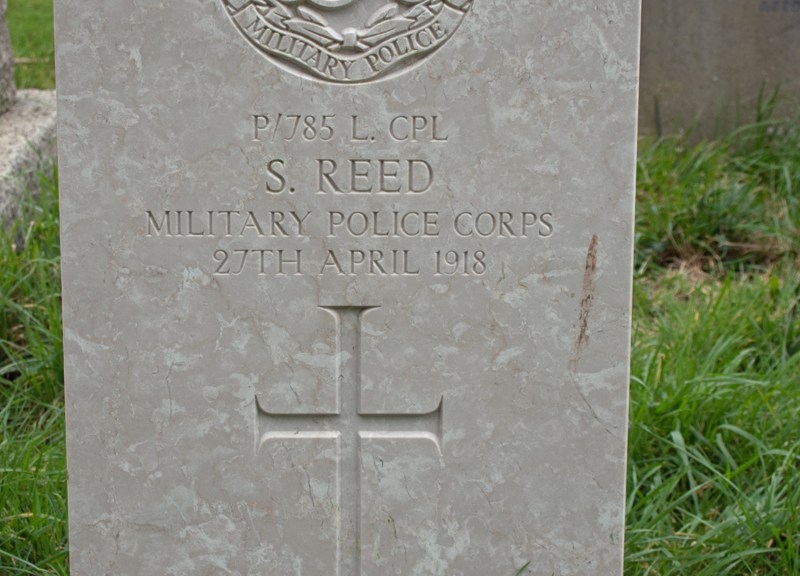
Stephen Reed was born in August 1887, one of seven children to Stephen and Eliza Reed from Bridgwater, Somerset. Stephen Sr was a labourer, eventually working as a carter for the local council.
Stephen Jr sought bigger and better things, however. After initially working as a butcher, he enlisted in the army in January 1907. He served a term of three years in the Coldstream Guards, before being stood down to reserve status in 1910.
Stephen had by then, found his calling in life and joined the police force. Standing at 6ft 1in (1.84m) tall, he would have cut an imposing figure. By the time of the 1911 census, he was boarding at the barracks in Dorchester, where he was listed as a police constable.
In May 1913, Stephen, by now aged 25, married Emily Maud Bower, in their home town. By March of the following year, the young couple had settled back in Swanage, Dorset, and had had a child, Stephen George.
War was on the horizon, however, and Private Reed was re-mobilised in August 1914, finding himself overseas within weeks. He was quickly promoted to Lance Corporal, and, after a couple of years – including fighting at Mons and receiving a subsequent gunshot wound to his hand – was transferred to the Military Police Force.
In April 1918, Lance Corporal Reed contracted tuberculosis, and was ill enough to be evacuated back to England for treatment. He was admitted to the Royal Victoria Hospital in Netley, Hampshire, but passed away within a day of arriving. Sadly, his records show that a telegram was sent to Emily summoning her to the hospital, but, as this was dated the same day he passed away, it seems unlikely that she would have arrived in time.
Lance Corporal Reed died on 27th April 1918. He was 31 years old.
Stephen Reed lies at rest in the Wembdon Road Cemetery in his home town of Bridgwater.
A sad addition to Stephen’s military records is a latter to his widow in September 1918, asking for acknowledgement of receipt of his belongings. The items in question boiled down to: pair of braces; button stick; shaving brush; 2 boot brushes; comb; pipe lighter; handkerchief; pocket knife; safety razor; towel; flannel vest; waistcoat; identity disc; wrist strap; pair of scissors; tie clip; mirror; pipe; cigarette holder; 4 cap badges; card case; wallet and photos; wallet and correspondence; cigarette care; cigarettes; tobacco.
We can assume that these items – especially the photographs and correspondence – gave some level of comfort to Emily, but seeing her late husband’s life summed up in a bagful of belongings must also have been heart-breaking.
William Collard was born in August 1891, the youngest of two children to William and Agnes Collard from Wedmore in Somerset. William Sr was a carter for a local miller and his son followed him into labouring when he left school.
William’s life seems to have been a tragic one. His mother died in 1910, while his sister Mabel passed a year later.
William married Eva Heal, a woman from the same village, in April 1914. The couple didn’t go on to have any children.
There is limited information relating to William’s military service. What is apparent is that he enlisted in the Royal Army Medical Corps, presumably at some point after the start of the Great War.
Private Collard’s battalion, the 3rd South Midlands, were based in Essex and were shipped to France in March 1915. There is, however, no evidence that William went with his troop. His training must have gone well, however, and he was promoted to Lance Corporal.
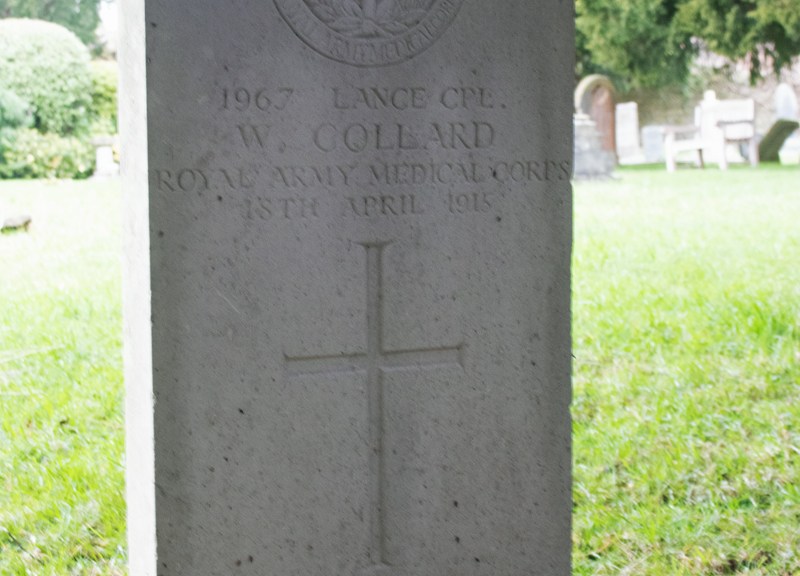
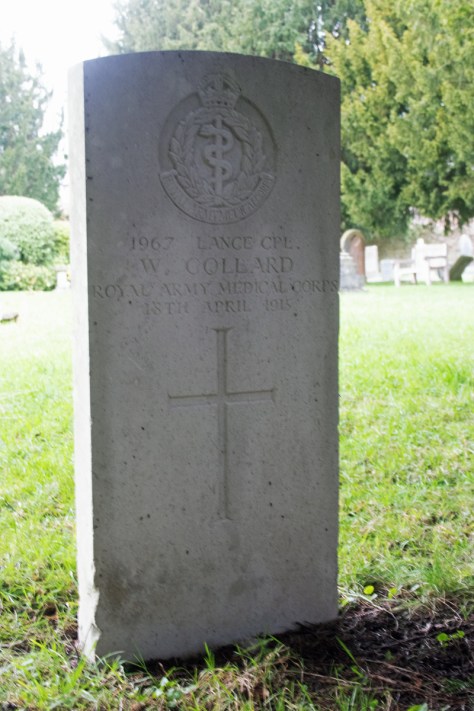
Details of his death are vague; William’s gravestone confirms he passed on 18th April 1915; the cause of his death was not reported. He was 23 years of age.
A brief notice in a local newspaper gives a little more information:
Mr W Collard [Senior], of Wedmore, one of the patients at the Country Sanatorium, received last week the news of the death of his soldier son. The funeral took place on Thursday at Wedmore in the same grave as the mother and only other member of the family, a sister of the deceased.
Shepton Mallet Journal: Friday 30th April 1915
William Collard lies at rest in the churchyard of St Mary’s Church in his home village of Wedmore, Somerset.
William is remembered in on a plaque in Bristol Cathedral; this commemorates the fourteen members of the 3rd South Midland Field Ambulance who fell during the war.
Comment should also be made of William’s father. In the space of four and a half years, he had lost his wife and both his children. He was already in a sanatorium when his son died. He too passed away, in December 1924, at the age of 58.
William’s widow, Eva, never remarried. She went on to live the age of 96, and passed away in Poole, on the Dorset coast.
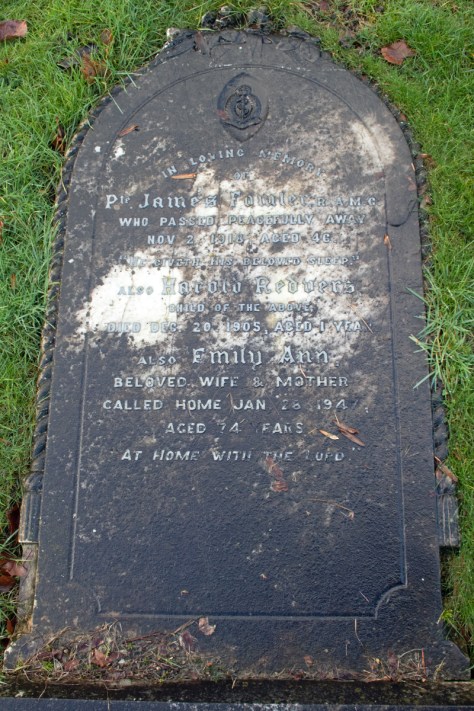
Thomas James Buckley Fowler – known as James – was born in 1872, the eldest of eleven children to Tom and Ellen Fowler.
Much of his early life is lost to time, but we do know that James married Emily Ann Gregory on December 26th 1898, and the couple went on to have four children – Wilfred, Harold, Violet and Ivy.
On his marriage certificate James lists himself as a shoemaker and, given the family were living in the Somerset town of Street, it is likely that he was employed at the Clark’s factory there. By 1911, however, the family had moved to Glamorgan, where he had taken work as a timber man in the coal mine in the village of Nelson.
Private Fowler enlisted when war broke out, joining the 10th Battalion of the Welch Regiment in October 1914. During his time with the regiment, he was promoted, first to Lance Corporal and then to Acting Sergeant.
He transferred to the Royal Army Medical Corps just under a year later. In November 1915, he was admitted to hospital with enteritis, which led to him being shipped back to England for treatment.
Once he had recovered, Private Fowler was enlisted in the Provisional Company of the RAMC, transferring again to the 7th Company in 1916. He then operated on home soil for the next few years.
James was admitted to the Royal Military Hospital in Bristol on 28th October 1918 with influenza and bronchial pneumonia. He sadly passed away a few days later, on 2nd November 1918. He was 46 years old.
James Fowler lies at rest in the cemetery in Street, Somerset.
Quinton Charles Wyatt was born in the Gloucestershire town of Northleach in 1893 to William and Elizabeth. His mother died when he was a toddler, leaving William to look after Quinton and his older sister Agnes.
By the time war was declared, Quinton was working as a farm labourer and waggoner in the Gloucestershire village of Hampnett.
Quinton enlisted in the 8th Battalion of the South Staffordshire Regiment on 22nd November 1915. Appointed Lance Corporal just two months later, he was posted to France in March 1916.
Neglect of duty in June meant that Lance Corporal Wyatt was demoted to Private four months later. His battalion was caught up in a German gas attack in the autumn of 1917, and he was injured; ultimately, he was medically discharged from the Army on Boxing Day 1917.
Quinton Charles Wyatt finally succumbed to his injuries on 11th November 1918 – Armistice Day. He was 25 years old.
He is buried in St Mary’s churchyard in the village of Charlton Mackrell in Somerset.
William Henry Warne was born in Walworth, South London, in March 1892. His father is not named, but his mother was Ellen Warne (or Gould), who was “living on her own means”. He had two older siblings, Fred – whose surname is listed as Gould – and Gertie Warne.
By the time of the 1911 census, William was a law clerk in West Coker, near Yeovil in Somerset. The record shows him living with his mother and sharing her surname – which was now listed as Gould. Again, Ellen’s occupation was “private means”.
William’s full military service records are not available, but various sources produce a little information.
Private William Warne had enlisted in the Dorset (Queen’s Own) Yeomanry by April 1915, as this is when he was dispatched to Egypt. August 1915 saw his battalion shipped to Gallipoli; William survived this horrendous battle and returned to Egypt by the end of that year. As a result, he earned the 1915 Star medal.
When the Dorset Yeomanry was retitled, Private Warne became part of the Corps of Hussars. After Egypt, the battalion moved to Palestine, where they saw out the war. He was appointed Lance Corporal at some point during this time.
The exact details of his passing are lost to time; he passed away on 9th October 1918 at the British Red Cross Hospital in Netley, and his records suggest that he died of wounds. He was 26 years old.
Lance Corporal Warne’s life was an intriguing one from start to finish.
The Army Register of Soldiers’ Effects is a document that shows how much was paid out to the relatives of soldiers who have passed away in service; in the research I have carried out over the last few months, this amount has generally ranged between £2 and £8, rarely reaching double figures.
William’s mother and sister, however, received a significant amount. The initial payment was £31 13s 8d, and this was followed by a second figure of £19 10s. There may be various reasons for this – the campaigns William fought in, the prestigious regiment, the appointment to Lance Corporal – but again this is another mystery that will remain such.
Lance Corporal William Warne lies at rest in Sherborne Cemetery.
William Larkin was born in 1863, the eldest son of Alfred and Frances Larkin from Cranbrook in Kent.
He disappears off the radar for a few censuses – there are too many variations on his surname to identify exactly where he was on the 1881 and 1891 documents.
From later documents, however, we can identify that he married Eliza in around 1886; the couple had no children. By the 1901 censes the couple were living to the north of Maidstone; ten years later, they were running the Fox & Goose pub in Weavering, Kent.
Private Larkin’s military service is also lacking in documentation, but some information can be pieced together.
Originally enlisting in the Royal West Kent Regiment, he (was) transferred over to the Royal Defence Corps, and served on home soil.
On Sunday 2nd April 1916, Lance Corporal Larkin was on guard at a gunpowder factory in Faversham, Kent. As the Ministry of Munitions reported at the time:
During the weekend a serious fire broke out in a powder factory in Kent, which led to a series of explosions in the works.
The fire, which was purely accidental, was discovered at midday and the last of the explosions took place shortly after two in the afternoon.
The approximate number of casualties is 200.
Thanet Advertiser: Saturday 8th April 1916.
William was not killed during the Faversham Explosion, but Boxley Parish Council (who covered the Weavering area) carried out research on the names on the village war memorial. According to that research, William “developed cancer after the ‘Faversham Powder Works’ explosion”. He died two months later, on 8th July 1916. He was 53 years of age.
Lance Corporal William Larkin lies at rest in the graveyard of St Mary & All Saints Church in Boxley, Kent.
More details of the Faversham Explosion, along with the servicemen who died there, can be found here.
Charles Frederick Stubbles was born in Tottenham in 1892. One of eleven children to Richard and Mary Ann Stubbles, by the time of the 1911 census, the family were living in Edmonton. Charlie and his brother had found employment painting gas stoves, while his father was a building foreman.
Charles enlisted in the army in 1916, aged 25 years and 11 months. His service records show that he stood at 5ft 2ins, weighed in at 69lbs; his health was classified as C2 – Free from serious organic diseases, able to stand service in garrisons at home, able to walk 5 miles, see and hear sufficiently for ordinary purposes.
Joining the Labour Corps of the West Surrey Regiment, Private Stubbles initially served on the home front, before being transferred to France as part of the British Expeditionary Force in March 1917.
Charlie seems to have been a bit of a character and was pulled up a few times during his service. On 10th April, he was charged with “committing a nuisance in the barrack room”, for which he was confined to camp for eight days. On 21st August he went AWOL for nearly a day; he was docked eight days’ pay. On 28th October he appeared unshaven and dirty for the 7:15am parade; he was confined to barracks for seven days.
On 4th January 1918, Charles was admitted to a field hospital with diarrhoea; while there he was diagnosed with tuberculosis; he succumbed to this two days later, dying on 7th January 1918. He was 26 years old.
Lance Corporal Charles Stubbles is buried at the Haringhe Bandaghem Military Cemetery in Poperinge, Belgium.
Charles Frederick Stubbles was my great great uncle.