Tag Archives: Lance Corporal

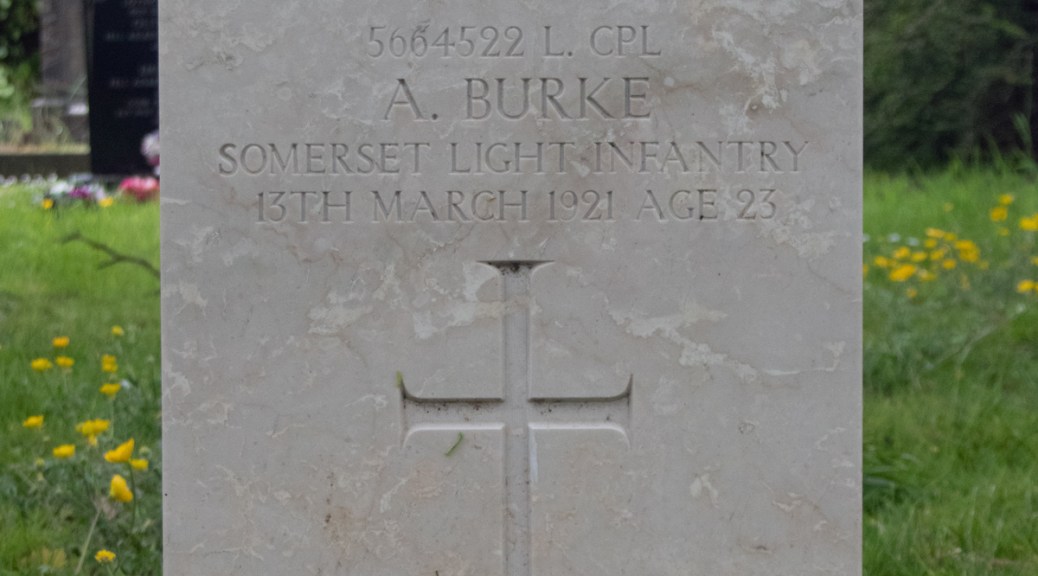
Lance Corporal Albert Burke

Lance Corporal Albert Burke

Sometimes, researching war graves can throw a bit of a curve ball, and the things you uncover can make you stop in your tracks. Such is the story surrounding Lance Corporal Albert Burke, and a media report surrounding his death in March 1921.


SCHEME OF VENGEANCE

Taunton Suicide’s Amazing Last Letter

Toll On Young Women

A sensational affair has occurred at Taunton Barracks. On Sunday morning, Albert (or Alfred James) Burke, aged 23, a Lance Corporal in the Somerset Light Infantry, was found to have taken his life by inhaling chloroform, his dead body being found on a bed at the military hospital, where he was employed as an orderly.

On Saturday night, according to the evidence, deceased appeared to be in his usual health and spirits. The next morning, a comrade found his dead body with a chloroform bottle by its side and near his face a large piece of cotton wool which he had evidently used for the purpose of inhaling the poison.

Some light was thrown on the tragedy by a letter addressed to a Taunton young woman, found on his clothing, and which was read at the inquest yesterday.

It was of an extraordinary character, and began “You wish to know what my intentions are in regard to you. Well, in the first place let me tell you I am not, as the coroner who holds the inquest will adjudge me, insane. In fact I don’t think I was ever so rational or level-minded as at the present moment, although I have had a glass or two.

“Well, Beatrice, mine is a rather long and interesting story. I married Louisa Wills some time in 1917, and I think the least said about her the better, but I wish to say this, that I have never knocked across a beast to equal her for violence. I am afraid the people around Brentford, Middlesex, could give you a far better account of her than I can.”

The writer went on to make certain allegations against the woman, and then referred to other towns where, he said, he had ruined girls before coming to Taunton and joining the Somerset Light Infantry. He added that he spent Friday night, when he was supposed to go out with Beatrice, with another girl in the barracks.

He said his father committed suicide owing to a “thing” who called herself a woman, and he (deceased) got a feeling with him that he would like to pay it back on a few girls. In conclusion, Burke expressed his satisfaction at knowing the condition Beatrice was in, and that he had been able to add another to the list of those on whom he wished to have his revenge.

Evidence was given by Alec Treeby, civilian orderly at the Barracks, who found deceased. In reply to the coroner, witness said that he knew the man was keeping company with a girl, but was not aware that there was any trouble about her.

PC Carter stated that the police had made enquiries, and a telephone message had been received that nothing was known of the man or of a wife and family of the name at Brentford…

[The] medical officer at Taunton Barracks said deceased was a steady, hard working man, and, so far as he knew, perfectly sane.

The jury returned a verdict of “suicide while of unsound mind”.

Western Times: Wednesday 16th March 1921

The newspaper report confirms the Lance Corporal’s name as either Albert or Alfred James Burke; the coroner also went on to say that he had also used the aliases of Povery and Pavey. Sadly, research around these names – and that of Louisa Wills – have either led to frustrating dead ends, or to results too vague to concretely connect them to Lance Corporal Burke.

The life and loves of Lance Corporal Burke are destined to remain a mystery. All that can be confirmed is that he took his own life on 13th March 1921; he was 23 years old.

Albert Burke lies at peace in St Mary’s Cemetery in Taunton, Somerset. He was accepted for commemoration as war dead on 27th May 2016 and was afforded a gravestone by the Commonwealth War Graves Commission.


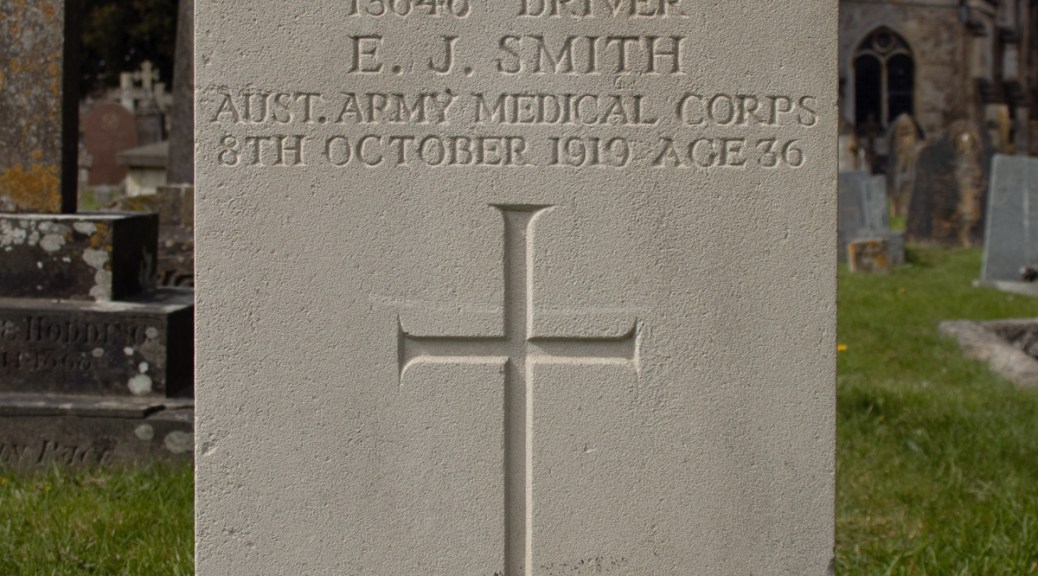
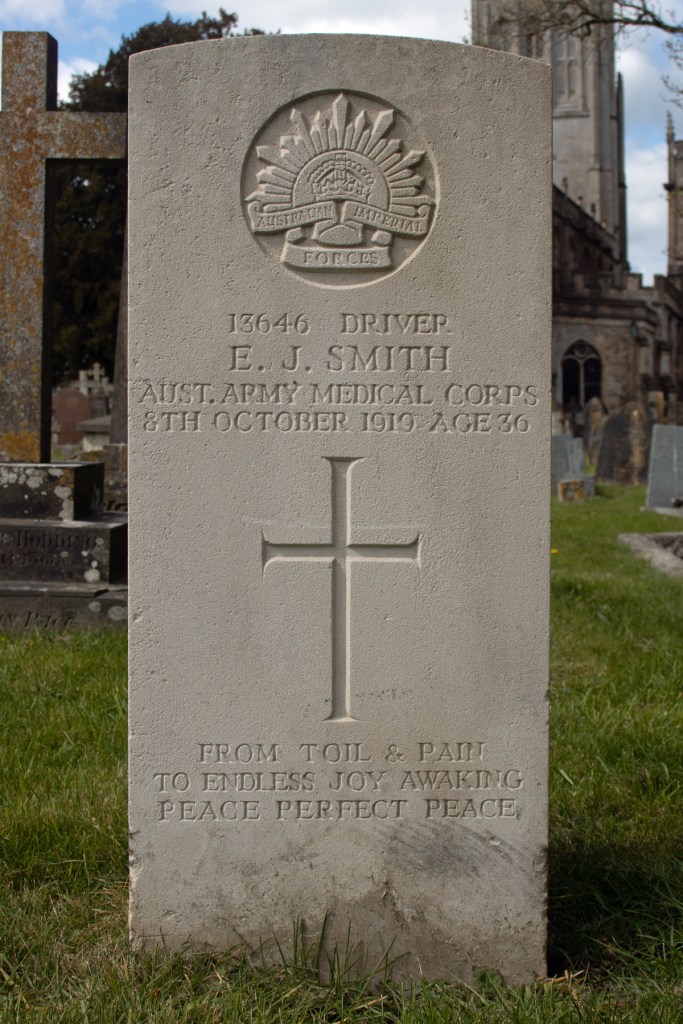
Driver Ernest Smith

Driver Ernest Smith

Ernest John Smith was born in 1883, one of seven children to John Smith and his wife Sarah Jane. John was a coal merchant, and the family lived in the Somerset town of Bruton. When Ernest initially left school, he worked as a farm labourer, but at some point, a sense of adventure caught him, and he emigrated to Australia. Sadly, details of his travels are not available, but he left England at some point before 1915.

When war broke out, however, he was still keen to do his bit. He was living in Queensland when he enlisted on 26th October 1915, and was assigned to the Australian Army Medical Corps.

Driver Smith’s battalion left Australia for Europe in March 1916, and served in France for the duration. He was dogged by ill health, catching pleurisy a couple of times, and had a number of fibromas operated on.

In October 1918, he was appointed Lance Corporal, but was shipped back to England later that year with ongoing fibroma issues. He was admitted to Torquay Hospital as dangerously ill in December of that year, and spent most of the next nine months in hospital, initially in Torquay, but then when he was able to be moved, he was transferred to the 1st Australian General Hospital near Warminster.

Sadly, the cysts Driver Smith has developing were malignant, and he passed away on 8th October 1919. He was just 36 years old.

Ernest John Smith was brought back to his home town for burial, and lies at rest in the graveyard of St Mary’s Church in Bruton.


Sergeant Christopher Faulkner

Sergeant Christopher Faulkner

Christopher William Thomas Faulkner was born in 1881, one of five children to William and Harriet Faulkner. There is little information about Christopher’s early life, but the 1891 census shows him living with his mother and siblings in the St George’s Barracks in St Martin in the Fields in central London. William is not listed, so it can only be assumed that he was away on duty when the census was completed.

Christopher attended the military school; his record confirms that he was born on 17th June 1881, and spent four months at the school when he was ten years old. William is listed as a Sergeant and the family were living at the St George’s Barracks, which were located in the site now occupied by the National Portrait Gallery.

The military life was indelibly in Christopher’s life by this point. Whilst the records are sparse, he had certainly enlisted by the time he was 25. On Boxing Day 1904 he married a woman called Essie Brant, the daughter of a tailor from Croydon.

On the marriage certificate, Christopher was listed as a Lance Corporal in the Royal Marine Light Infantry and was based at the barracks in Chatham, Kent.

The young couple went on to have four children together and, by 1911, Essie was living in Gillingham, not far from the naval base in Chatham. The majority of Christopher’s career was served here, although when war broke out, he also saw conflict overseas.

By 1916, he was promoted to Sergeant and was assigned to HMS Dominion, which patrolled the North Sea. Ill health must have taken hold, however, and by the end of 1917, Sergeant Faulkner was reassigned to Chatham, before being medically discharged at the beginning of the following year.

Sadly, there is no record of the cause of his release from duty, but it appears to have been something to which he would eventually succumb. The next record is of Sergeant Faulkner’s death, on 5th January 1920, at the age of 39 years old.

Christopher William Thomas Faulkner lies at rest in the Woodlands Cemetery in Gillingham, Kent.


Christopher’s grave also acts as a memorial to his son.

Leslie Albert Gerald Faulkner was born on 9th June 1910. On leaving school, he sought military service like his father, and enlisted in the Royal Navy for a period of twelve years’ service.

Unusually, details of his service appear to end after just three years, in January 1929. However, later records confirm that he continued to serve at HMS Pembroke, the on-shore vessel in Chatham, through to the Second World War, achieving the rank of Chief Petty Officer.

Chief Perry Officer Faulkner’s military records did thrown up some further information, though. Surprisingly, his death records give specific details of the cause of his passing, stating that it was a “rupture of the liver due to secondary neoplasm of the liver, due to primary seminoma of testis”. In effect, Leslie had suffered testicular cancer, which then spread to his liver.

Leslie Albert Gerald Faulkner died on 28th November 1945, at the age of just 35 years old. He was buried in the same grave as his father, in Woodlands Cemetery, Gillingham.


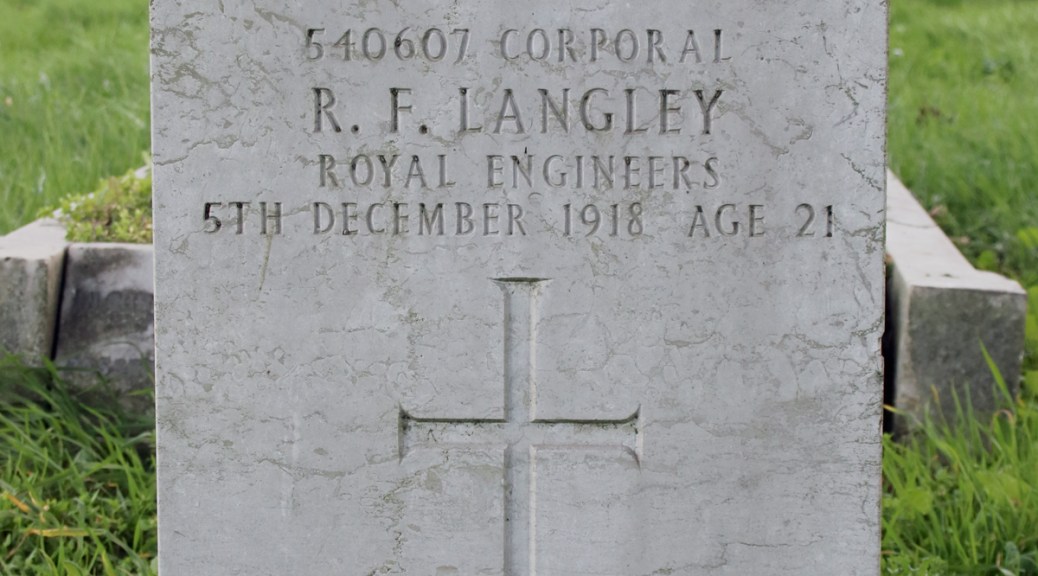
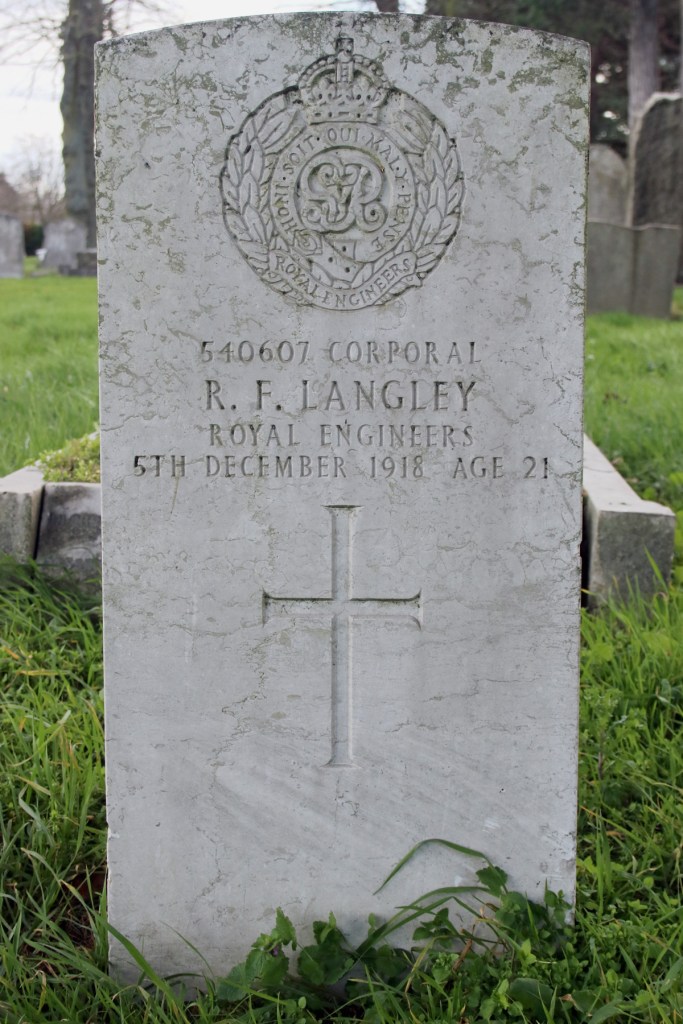
Corporal Richard Langley

Corporal Richard Langley

Richard Frederick Langley was born in January 1897 in Chatham, Kent. He was one of seven children to Albert Langley, who was a bricklayer, and his wife, Elizabeth.

Richard enlisted almost as soon as he was able to. His papers, dated 18th October 1914, show that he was 17 years and 10 months old, as was working as an apprentice boilermaker. He was assigned to the Royal Engineers.

Sapper Langley’s war service was spent in England. Initially based in Kent, he was promoted to Acting Lance Corporal in October 1915. Transferring to the Royal Engineers Anti Aircraft Battalion in July 1916, Richard was again promoted to Corporal.

Corporal Langley was injured while serving for the Royal Engineers AA; he was admitted to the General Hospital in Tunbridge Wells, and has a hernia operated on. After two months recovering in hospital, he re-joined his battalion.

Richard was transferred again in January 1918, this time being assigned to the London Electrical Engineers. It was here that he saw out the remainder of the war.

It was while he was serving in Sheerness that Richard contracted influenza. Hospitalised on the island on 28th November 1918, he sadly did not recover. Corporal Langley passed away from pneumonia on 5th December 1918. He was just 21 years of age.

Richard Frederick Langley lies at rest in the Woodlands Cemetery in his home town of Gillingham, Kent.


Richard’s older brother Albert was also involved in war service and was a skilled labourer at Chatham Dockyard. In February 1916, he boarded the SS Maloja, a steamship bound for Bombay with over 400 passengers and crew on board.

At around 10:30am on Sunday 27th February, the ship was sailing through the Straits of Dover when it struck a mine. The vessel sank within 24 minutes. Over 150 people died in the explosion, from drowning or from hypothermia.

Sadly, Albert’s body was not recovered. He was just 21 years old. He is commemorated on the Naval Memorial in Chatham, Kent.


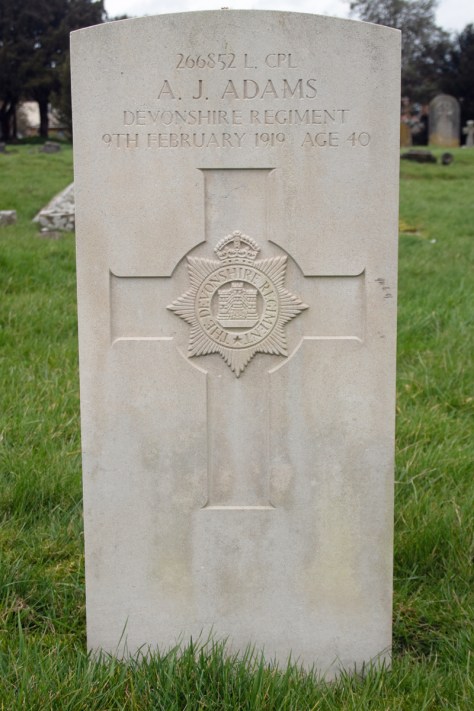
Lance Corporal Albert Adams

Lance Corporal Albert Adams

Albert James Adams was born in Somerset in September 1878, the fifth of ten children to Robert and Mary. Robert was a mason, who sadly passed away when Albert was only 11 years old. Mary lived on as the head of the household, and by the 1901 census, she had four of her five sons living with her, three of them also stone masons.

Albert had taken a different route in life, and found work as a postman. He married Annie King, a young woman from Taunton, in 1910, and they set up home in the village of Selworthy near Minehead. Albert was the village postman, and the young couple lived there with their sons – Albert and Robert – and Mary.

When war came, Albert enlisted, joining the 6th Battalion of the Devonshire Regiment. While his military records are scattered, his battalion served in India and Mesopotamia; during their three years in the Middle East, the 6th Battalion lost twice as many men to illness – influenza, pneumonia, malaria – as to enemy action.

Lance Corporal Adams was not immune to sickness; while I have been unable to unearth exact dates for his military service, his cause of death is recorded as malaria and pneumonia. He passed away on 9th February 1919, at the age of 40 years old.

Albert James Adams lies at rest in St John’s Cemetery in Bridgwater, Somerset.


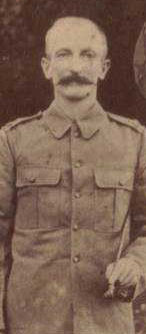
Albert James Adams from Ancestry.com

Lance Corporal Sidney Turner

Lance Corporal Sidney Turner

Sidney Joseph Turner was born in 1888, the oldest of four children to Sidney and Matilda Turner from Bridgwater in Somerset. Sidney Sr was a carter, while his son became a labourer in a local cement works. Sadly, Sidney Sr died in 1903, when Sidney Jr was 15, leaving Matilda with three other children, one of whom was only 18 months old.

Sidney Jr travelled to get work, and had moved to South Wales to work as a miner by 1909. Here he married Rose Shattock, who was born in Bristol, although within a couple of years the young couple had moved back to Somerset.

Sidney and Rose had a son, also called Sidney, although sadly he died when he was only a couple of months old. Tragically for Sidney, the records seem to suggest that Rose may have died in childbirth, or shortly after, as her passing was registered in the same quarter as her son’s birth.

By this time, Sidney was living in Bailey Street, Bridgwater, a short distance from some railway sidings. This might have driven some determination in him as, by the following year, he was listed as an engine driver. In December 1913 he married his second wife, Bessie Sharman. She was the daughter of a mariner, who had become a machinist in a shirt factory by the time of their marriage. The couple went on to have a son, also called Sidney, in April 1914.

When war broke out, Sidney enlisted in the Highland Light Infantry, initially in the 12th (Service) Battalion. They landed in France in July 1915 and were there for the remainder of the war. At some point, Lance Corporal Turner transferred to the 53rd (Young Soldier) Battalion. Very much a training brigade, it seems that Sidney’s experience of the front line may have proved useful for the upcoming recruits.

Lance Corporal Turner was demobbed on 21st March 1919; his pension record shows that, during the course of his service, he had fractured his tibia and had contracted bronchitis. The 1921 census found Sidney back in Bridgwater. He was listed as being a gas engine driver for John Board & Co., although he was, at that point, out of work. He, Bessie and Sidney Jr were living at 1 Price’s Buildings.

Sidney’s health conditions were to prove his downfall, as, within a months of the census return, he had succumbed to pulmonary tuberculosis and exhaustion. He died on 2nd July 1921, aged just 32 years old.

Sidney Joseph Turner lies at rest in St John’s Cemetery in his home town of Bridgwater, Somerset.

Lance Corporal William Parsons

Bridgwater (St John’s)

William Edward Parsons was born in 1890, one of six children to John and Prudence Parsons. John found work in a number of fields, working as a blacksmith, porter, dock labourer and a hobbler (towing boats along the River Parrett) in his time. Throughout this, he lived with his family in the Somerset town of Bridgwater.

William found work as a collar cutter in a local shirt factory, and went on to marry Matilda Mary Temblett on Christmas Day 1913. The young couple went on to have a son – Leslie William – who was born in February 1915. William was teetotal, and played full back for the local rugby football club, Bridgwater Albion.

Sadly, Lance Corporal Parsons’ military records are sparse; he had enlisted in the Royal Army Service Corps and was based in Fovant, to the west of Salisbury.

It was while he was on leave that William met his sad fate. On the evening of 5th February 1916, he had seen his parents and had set out to organise a football match in the town. He was walking over the town bridge, when a passer-by heard a splash. He saw a man in the water, who was crying for help, and then disappeared.

William’s body was found in the river a fortnight later close to a local brickyard. He was just 25 years old.

William Edward Parsons lies at rest in St John’s Cemetery in his home town of Bridgwater.


Corporal Wilfred Gillson

Corporal Wilfred Gillson

Wilfred Allen Gillson was born in 1888, the fourth of nine children – and one of eight boys – to George and Emma Gillson. George was a coachbuilder from Cornwall; Emma, whose maiden name was Allen, came from Derbyshire. The family were living in Torquay by the time Wilfred was born.

In 1895, George had moved the family to Bridgwater in Somerset, presumably as railway works had dried up in the coastal Devon town. By this time his oldest son, also called George, was working as a compositor, keying text for a printer. Wilfred was still at school, but his other two older siblings – William and Albert – were both working with their father, working on railway coaches.

Wilfred was also to follow in his father’s employment, and the 1911 census found him living in Bristol, boarding with the Cridland family, earning his keep a a carriage painter.

He joined up within weeks of war breaking out, enlisting in the Worcestershire Regiment on 20th September 1914. Private Gillson readily proved his worth, and was promoted to Lance Corporal after three months, and Corporal within a year of enlisting.

Corporal Gillson’s promotion coincided with his shipment abroad, and he served on the Western Front for eight months. Returning to England in March 1916, he subsequently transferred to the Devonshire Regiment, before being moved to the 4th Reserve Battalion in the spring of 1917.

Things were not right for Wilfred; he was reprimanded for neglecting his post on the night of the 26th May that year, before being medically discharged with neurasthenia in August.

The root of the matter is detailed in his discharge report; he was hospitalised at Neuve Chapelle in February 1916, suffering from shellshock, and it seems that he never really fully recovered.

Sadly, at this point Wilfred’s trail goes cold. He passed away on 10th November 1918, aged 30 years old.

Wilfred Allen Gillson lies at rest in St John’s Cemetery in Bridgwater, Somerset.


There are a couple of additional notes to Wilfred’s life.

During the war, Wilfred’s youngest brother, Thomas, fought with the Oxfordshire & Buckinghamshire Light Infantry. He was involved in the fighting in France, but died from wounds on 10th June 1918. He was just 18 years old, and is buried at Aire-sur-la-Lys, not far from Boulogne.

Given that Wilfred was one of eight brothers, all of whom would have been of fighting age during the war, it is lucky – although still a tragedy – that only he and Thomas died as a result of the conflict.

Sadly, Wilfred’s mother, Emma, passed away in the autumn of 1914, at 57 years of age. It might be a blessing, however, that she was not alive to see two of her sons suffer so.


Lance Corporal Stanley Southwood

Lance Corporal Stanley Southwood

Stanley James Southwood was born in 1896, the oldest of six children to John and Florence Southwood from Bridgwater, Somerset. John was a labourer and ship’s mate, while Stanley, who was the only boy in the family, started work loading barrows in a brickyard.

Military life was pulling Stanley, however. According to another researcher, he enlisted in the Special Reserves of the Somerset Light Infantry in October 1912. Six months later he joined the regular army, and was there when the war began.

While I have not been able to corroborate this information, it appears that Southwood was reported missing on 11th September 1915, after being wounded in the chest. He was taken prisoner of war, and, while being held, he developed tuberculosis in both lungs.

After his release (no documents confirm when this was) he was discharged from the army as medically fit to continue. He was in a military hospital at the time – the beginning of November 1918 – suffering from tuberculosis, which had been exacerbated by the chest wound he had received three years earlier. At the time he was discharged, he had the rank of Lance Corporal.

Sadly, it seems that Stanley never fully recovered from his wartime experience. He died on 8th September 1919 from consumption (tuberculosis), aged just 23 years old.

Stanley James Southwood lies at rest in the Wembdon Road Cemetery in his home town of Bridgwater in Somerset.


Lance Corporal Stephen Reed

Lance Corporal Stephen Reed

Stephen Reed was born in August 1887, one of seven children to Stephen and Eliza Reed from Bridgwater, Somerset. Stephen Sr was a labourer, eventually working as a carter for the local council.

Stephen Jr sought bigger and better things, however. After initially working as a butcher, he enlisted in the army in January 1907. He served a term of three years in the Coldstream Guards, before being stood down to reserve status in 1910.

Stephen had by then, found his calling in life and joined the police force. Standing at 6ft 1in (1.84m) tall, he would have cut an imposing figure. By the time of the 1911 census, he was boarding at the barracks in Dorchester, where he was listed as a police constable.

In May 1913, Stephen, by now aged 25, married Emily Maud Bower, in their home town. By March of the following year, the young couple had settled back in Swanage, Dorset, and had had a child, Stephen George.

War was on the horizon, however, and Private Reed was re-mobilised in August 1914, finding himself overseas within weeks. He was quickly promoted to Lance Corporal, and, after a couple of years – including fighting at Mons and receiving a subsequent gunshot wound to his hand – was transferred to the Military Police Force.

In April 1918, Lance Corporal Reed contracted tuberculosis, and was ill enough to be evacuated back to England for treatment. He was admitted to the Royal Victoria Hospital in Netley, Hampshire, but passed away within a day of arriving. Sadly, his records show that a telegram was sent to Emily summoning her to the hospital, but, as this was dated the same day he passed away, it seems unlikely that she would have arrived in time.

Lance Corporal Reed died on 27th April 1918. He was 31 years old.

Stephen Reed lies at rest in the Wembdon Road Cemetery in his home town of Bridgwater.


A sad addition to Stephen’s military records is a latter to his widow in September 1918, asking for acknowledgement of receipt of his belongings. The items in question boiled down to: pair of braces; button stick; shaving brush; 2 boot brushes; comb; pipe lighter; handkerchief; pocket knife; safety razor; towel; flannel vest; waistcoat; identity disc; wrist strap; pair of scissors; tie clip; mirror; pipe; cigarette holder; 4 cap badges; card case; wallet and photos; wallet and correspondence; cigarette care; cigarettes; tobacco.

We can assume that these items – especially the photographs and correspondence – gave some level of comfort to Emily, but seeing her late husband’s life summed up in a bagful of belongings must also have been heart-breaking.