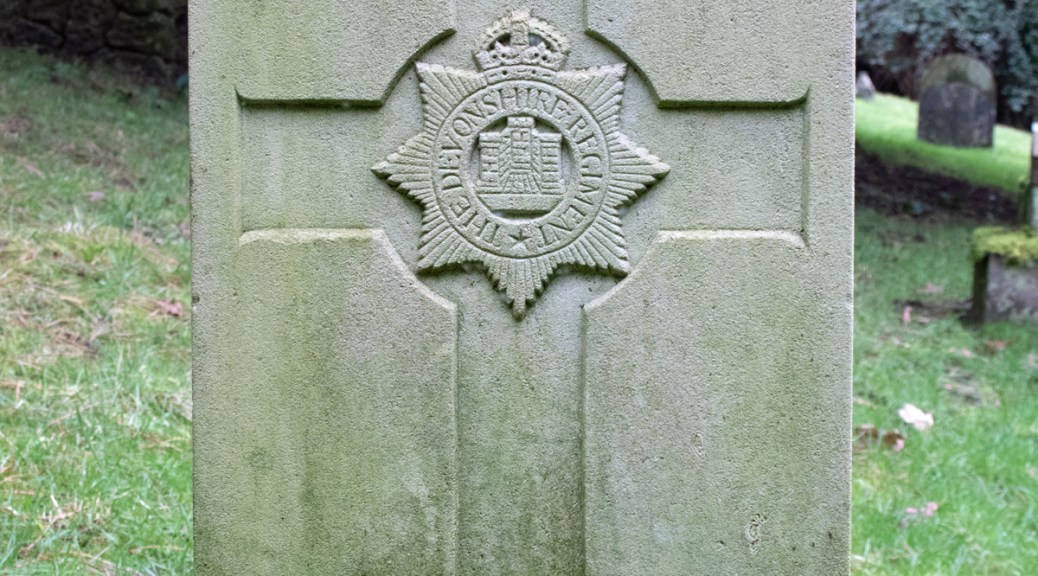
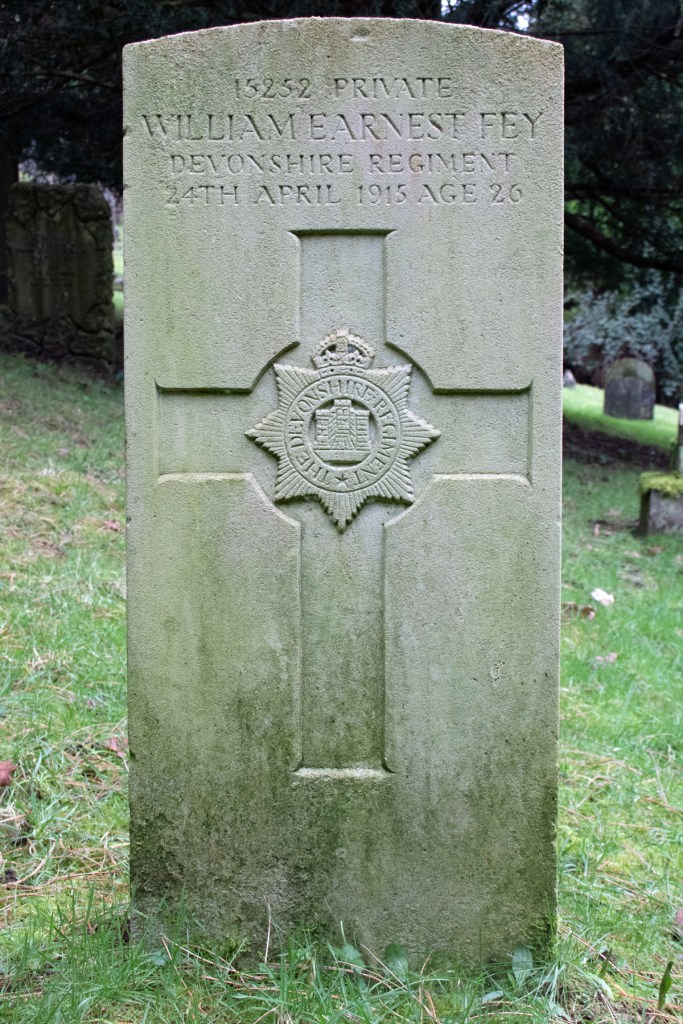
William Ernest Fey was born in Harburton, Devon, in the spring of 1889. The oldest of eight children, his parents were John and Margaret Fey. John was a farm labourer and, when he left school, William also took up work on the farm. By the time of the 1911 census he was listed as a horseman.
When was came to Europe, William was one of the first to step up and play his part. He enlisted in the Devonshire Regiment in the autumn of 1914, and was assigned as a Private in the 10th (Service) Battalion.
For part of his training, he was billeted in Bath, Somerset, and it was here, in April 1915, that he contracted meningitis. Private Fey was admitted to the city’s Red Cross Hospital, but the condition was to prove too much. He passed away on 24th April 1915, aged just 26 years of age.
Financial restraints may have limited John and Margaret’s ability to bring their boy back to Devon. Instead, William Ernest Fey was laid to rest in the quiet and picturesque Smallcombe Vale Cemetery on the outskirts of the city where he died.
William Hearn Moore – who became known as William Ernest Moore – was born in Churchstanton, Devon, in the summer of 1883. His mother, Mary, was only eighteen at the time but, when she married Henry Westcott in August 1891, he treated William as his own.
Henry found work as a coachman in Ilminster, Somerset, and, when he left school, William took on work as a gardener. In October 1903, he married carter’s daughter Charlotte Tucker: the couple set up home in the centre of the town, and went on to have three children – Gladys, Ethel and Henry.
William was working as a foreman for the Chard Lace Company when war broke out. While his full service records are lost to time, it is clear that he enlisted in the Royal Engineers, and was given the rank of Driver.
Driver Moore was in Aldershot, Hampshire, by the autumn of 1915, when he fell ill. He contracted cerebrospinal meningitis, a condition which took his life on 18th October 1915. He was just 32 years old.
William Ernest Moore was brought back to Somerset for burial. He was laid to rest in the cemetery in Ilminster, where Charlotte and the family were still living.
With three children to raise, Charlotte married again, to a William Dean, on 21st October 1916. They did not have children of their own and lived in Chard. Charlotte passed away in the winter of 1941, at the age of 57 years old.
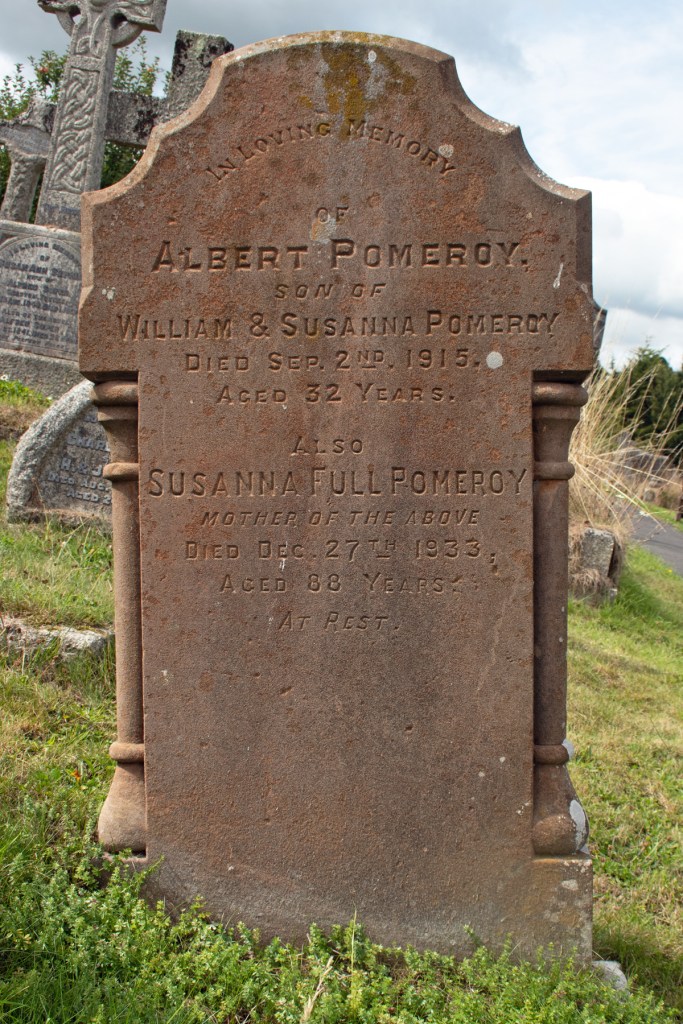
Albert Pomeroy was born on 22nd May 1882 in Totnes, Devon. The tenth of thirteen children, his parents were William and Susanna Pomeroy. William was a labourer at a cider store, and his son found work as a page when he left school. However, it is clear that he lusted after a life of adventure.
On 2nd September 1897, Albert enlisted in the Royal Navy. Aged just 15 years old, he was initially given the rank of Boy 2nd Class, and sent to HMS Impregnable, a training ship based in Devonport. He remained on board for just over a year, rising to Boy 1st Class in the process.
Boy Pomeroy moved to HMS Vivid, the Royal Naval Dockyard in Plymouth, in December 1898, and remained there until he was given his first formal sea-faring post nine months later. The cruiser HMS Terrible was to be his home from September 1899 until the spring of 1902.
On 22nd May 1900, during his time on board Terrible, Albert came of age, and he was formally enrolled into the Royal Navy. His service records confirm that he was 5ft 3in (1.60m) tall, had dark brown hair, grey eyes and a fresh complexion.
Albert was given the rank of Ordinary Seaman, but seems to have been well thought of as, just over a year later he was promoted to Able Seaman. Over the next eleven years, he served on a further ten ships, returning to HMS Vivid between voyages. On 21st May 1912, having completed the twelve years of his naval contract, Able Seaman Pomeroy was formally stood down to reserve status.
Albert’s trail goes cold for a few years. His father had passed away in 1910, so it seems likely that Albert returned home to Totnes to support his mother.
His time on reserve was not to be long, however, and, in August 1914, he was called back into duty. He received a promotion – to Leading Signalman – and assigned to the troop ship HMS Tamar. He moved to another troop ship – HMS Hardinge – in March 1915, but returned to Devonport a couple of months later.
In September, Leading Seaman Pomeroy was back in Totnes, possibly on leave, but had fallen ill. He contracted meningitis, and this was to prove fatal. Albert passed away at his mother’s home on 2nd September 1915, at the age of 33 years old.
Albert… was one of six brothers serving King and country, while another brother, who died some years ago, was in the 20th Hussars, and his late father was a naval pensioner. Albert Pomeroy saw service with Sit Percy Scott in South Africa, went to Pekin [sic] with the Naval Brigade, was engaged in operations in Somaliland, and until a few weeks ago was on active service with the British fleet.
Western Times: Tuesday 7th September 1915
Albert Pomeroy was laid to rest in the cemetery of his home town, Totnes, Devon.
Susanna went on to live into her eighties. Remaining in Totnes, when she passed away, on 27th December 1933, at the age of 88, she was reunited with her son in Totnes Cemetery.
Thomas Daniel Woodman was born on 17th March 1892 in the village of Oldland, Gloucestershire. One of sixteen children, his parents were Daniel and Ruth Woodman. Daniel was a fireman, stoking furnaces at a local paper mill, but Thomas wanted bigger and better things.
On 20th April 1910, not long after he turned 18, Thomas enlisted in the Royal Navy. His service records show that, when he joined up, he was 5ft 6ins (1.67m) tall, had brown hair, brown eyes and a fresh complexion. It was also noted that he had a long scar on his left wrist, and a tattoo of a cross on the same spot.
Stoker 2nd Class Woodman was to be based at HMS Vivid, the Royal Naval Dockyard in Devonport. From here he undertook his training, and it was from the Devon port that he began and ended his seafaring. In June 1911, while on board HMS Caesar, he was promoted to Stoker 1st Class.
When war broke out, Thomas continued his naval service. During the course of the conflict, he served on three vessels – HMS Blake, HMS Diligence and HMS Woolwich – returning to Devonport in February 1919.
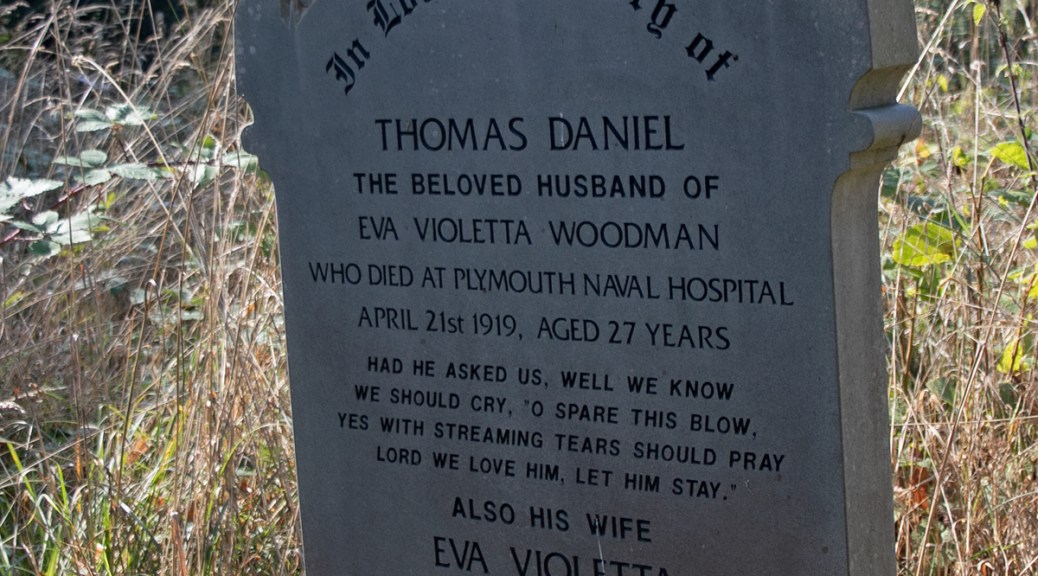
On 8th March 1919, while on leave, Thomas married Eva Paget at St Barnabas’ Church in Warmley. She was the same age as Thomas and daughter of a sexton. Tragedy was to strike the couple, however as, within a matter of weeks, the young groom contracted meningitis. He passed away at the Royal Naval Hospital in Plymouth on 21st April 1919. He was just 27 years of age.
Brought back to Gloucestershire for burial, Thomas Daniel Woodman was laid to rest in the graveyard of St Barnabas Church, where, just 44 days earlier, he had married his beloved Eva.
Eva herself went on to lead a remarkable life. After the loss of Thomas, she never remarried, and, by the 1930s, was living with her sister, and doing unpaid domestic duties.
On 2nd May 1998, at the age of 105, she became the oldest person in the world to go supersonic, by flying on Concorde on a 90-minute flight around the Bay of Biscay. This was the first time she had ever left Britain, and only the second time she had ever left Bristol.
Eva Woodman passed away in her Bristol nursing home on 17th October 1999. She was 107 years old.
She was buried with her late husband, finally reunited after 80 years apart.
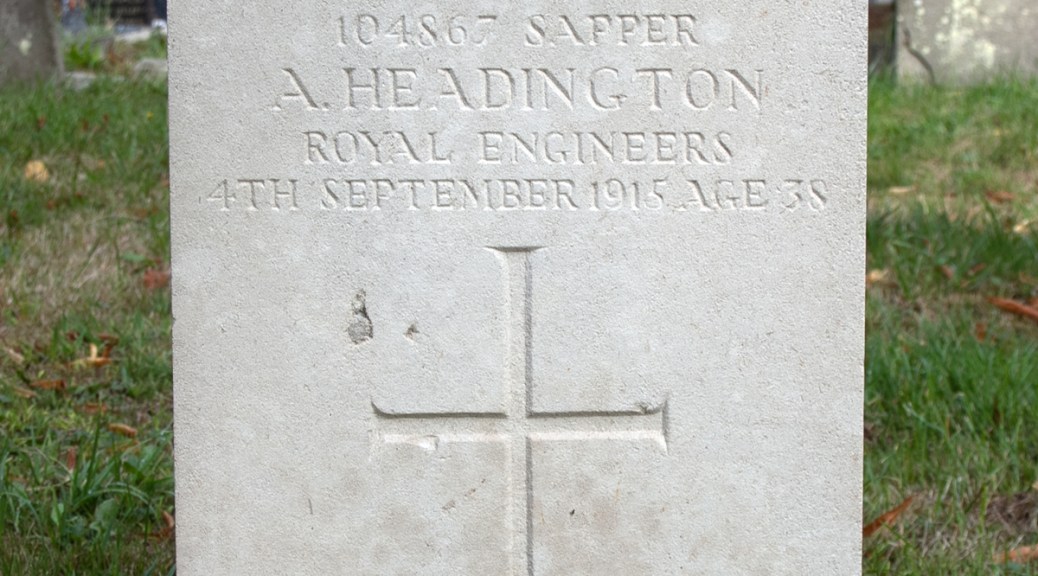
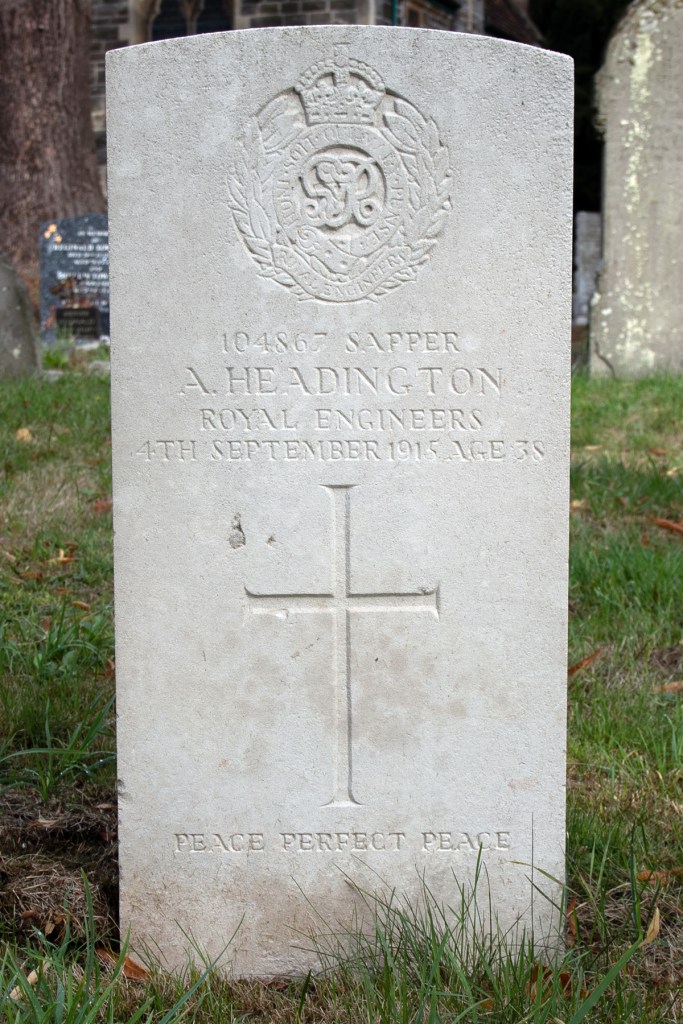
Albert Edward Headington was born on 5th December 1876 in Keynsham, near Bristol, in Somerset. The ninth of eleven children, his parents were Joseph and Jemima Headington. Joseph was a stonemason and, while he seems not to have had his father’s talents, Albert worked with the same material, becoming a bricklayer’s labourer when he left school.
On 29th May 1899, Albert married Ellen Gray. She was a mason’s daughter from Semley in Wiltshire, and it seems that he was either working there or had some connection with the family through his father’s work. The couple settled down in Keynsham, and went on to have two children, Harold, who was born in 1900, and Edith, who was born in 1912.
By the time of the 1911 census, the family had settled in a small house in the middle of Keynsham. Albert had, by this point, found other employment, and was working for Great Western Railways as a packer.
When war broke out, Albert stepped up to play his part. He enlisted on 22nd June 1915, joining the Royal Engineers as a Sapper. Sent for initial training in Chatham, Kent, he returned home on leave at the end of August. Tragically, he had fallen ill by this point, and died at home on 4th September 1915, having contracted cerebrospinal meningitis. He was 38 years of age.
Albert Edward Headington was laid to rest in the quiet cemetery of his home town of Keynsham.
Ellen went on to live a full life. She and Edith emigrated to Canada in 1921, following Harold, who had made the same move a year earlier. They all settled in the town of Welland, Ontario, not far from Niagara Falls.
Both of Albert and Ellen’s children married and had children of their own. Ellen never remarried, and passed away on 4th November 1956, at the age of 80 years old. She was laid to rest in the Holy Trinity Anglican Cemetery in Welland.
Harry Etherton was born in Ansty, near Cuckfield, West Sussex on 3rd April 1872. The oldest of five children, his parents were Edwin and Louisa Etherton. Edwin was an agricultural labourer, and this was work in which his son followed his father.
On 29th April 1899, Harry married Annie Eliza Pennifold, a labourer’s daughter who was also from Ansty. The couple set up home in Cuckfield, and went on to have five children. Harry was, by this point, working as a road labourer for the local council, and this was a job he was to continue doing until the outbreak of the war.
Harry enlisted in 1915, joining the Royal Sussex Regiment as part of the National Reserve. As Private Etherton, he was then transferred across to the Labour Corps, and was assigned to the 409th Labour Coy. which was based at the Infantry Depot in Lincoln.
It was while Private Etherton was here, in the spring of 1918, that he contracted meningitis, and was admitted to the Northern General Hospital in the city. Sadly, he was to succumb to the disease, passing away on 30th June 1918, at the age of 46 years old.
Harry Etherton’s body was brought back to West Sussex for burial. He was laid to rest in Cuckfield Cemetery, not far from where his widow and children still lived.
Frederick William Best was born in Wellington, Somerset, early in 1898 and was the middle of three children to factory worker Frederick Best and his wife, Bessie. When he left school, he found work as a delivery boy for a local baker, unlike his father, who was a long-time working in the local woollen factory.
War was closing in on Europe, however, and Frederick Jr was soon keen to play his part. Full details of his military service are not available, but it appears that he enlisted in the Worcestershire Regiment as soon as he was able, Private Best was assigned to the 15th (Transport Workers) Battalion, and served on home soil, initially in Swindon, and then in Southampton.
It was while he was billeted in Hampshire that Frederick contracted meningitis. He was admitted to a hospital in the city, but the condition was to get the better of him, and he passed away on 2nd January 1918, aged just 19 years old.
Frederick William Best’s body was brought back to Somerset for burial. He was laid to rest in the cemetery in his home town, Wellington, where his parents were both buried in the 1930s.
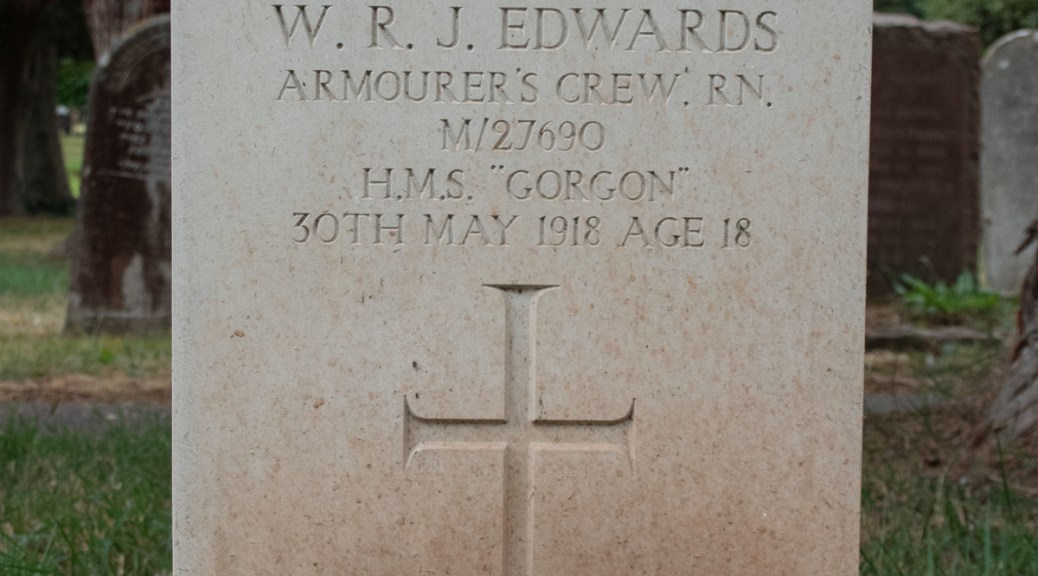
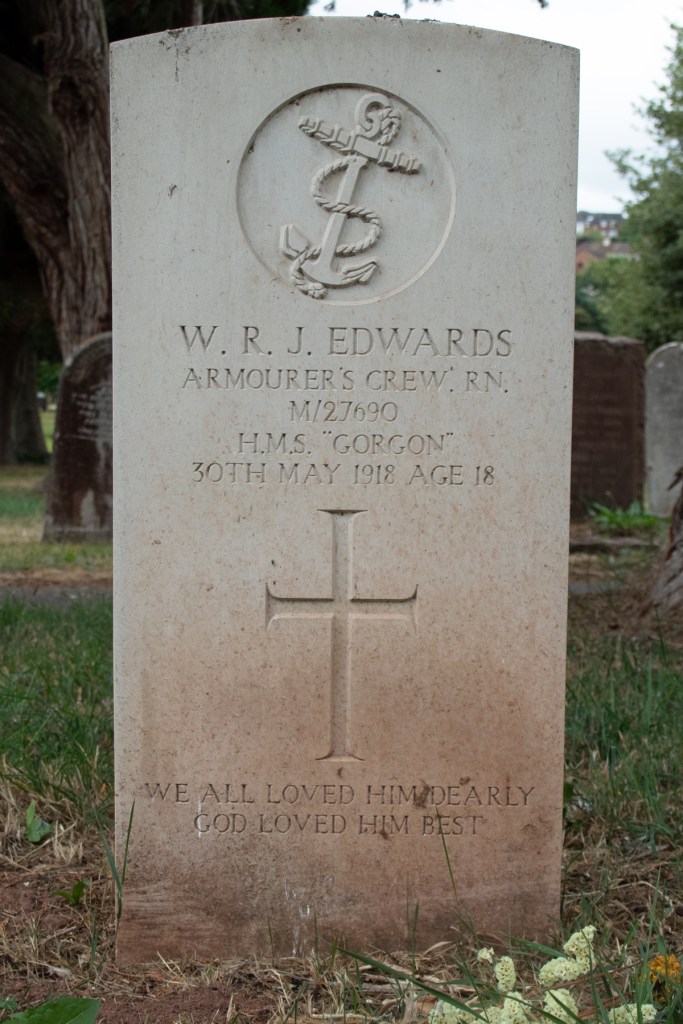
William Robert John Edwards was born on 10th July 1899, one of fourteen children to engine fitter William Edwards and his wife Bertha. Both of William Jr’s parents had been born in Devon, but, by the time of his birth, they had moved to the Somerset town of Wellington.
William followed in his father’s footsteps when he left school, but with war raging across Europe, he was keen to play his part as soon as he was able to do so. He enlisted in the Royal Navy on 7th September 1917, his engineering background making him perfect for a member of the Armourer’s Crew.
William’s service record show that he was 5ft 5ins (1.65m) tall, had brown hair, hazel eyes and a fresh complexion. He was initially sent to HMS Vivid – the Royal Naval Dockyard at Devonport – for training, and was given a posting on board HMS Gorgon, a coastal defence ship on 1st May 1918.
Tragically, this first assignment was to be Armourer’s Crew Edwards’ last. Within a matter of weeks, he was taken back to HMS Vivid, suffering from tubercular meningitis. Back at base, the condition proved too much for the young man: he passed away on 30th May 1918, days shy of his 19th birthday.
Brought back to Somerset for burial, William Robert John Edwards was laid to rest in the cemetery of his home town, Wellington.
Arthur Wellman was born in the spring of 1891 and was one of nine children. His parents – road builder Thomas and collar machinist Eliza – were both born in Somerset, and it was in Chard that they married and raised their family.
Arthur and his siblings found work in the local lace industry – the 1911 census recorded him living with his family in Chard, working as a lace hand, minding the machinery in the mill.
In the summer of 1915, Arthur married Daisy Jane Slade, the daughter of an agricultural labourer from North Curry, Somerset. They went on to have a daughter, Beryl, who was born in May 1916.
By May 1916, Arthur had seen two of his brothers serve and die in the war: Private Bert Wellman had been killed serving with the Somerset Light Infantry in Mesopotamia, while Gunner William Wellman died from tuberculosis having served with the Royal Field Artillery. Whether through a sense of duty or a sense of guilt, he put his name forward to play his part. Full details are not available, but he enlisted in the Somerset Light Infantry that autumn.
Private Wellman was assigned to the 4th (Reserve) Battalion, and was sent for training. Sadly, while in barracks, he contracted cerebrospinal meningitis; he died in hospital on 20th March 1917, at the age of just 25 years old.
Arthur Wellman’s body was brought back to Somerset for burial. He was laid to rest in Chard Cemetery, not far from his brother, William.
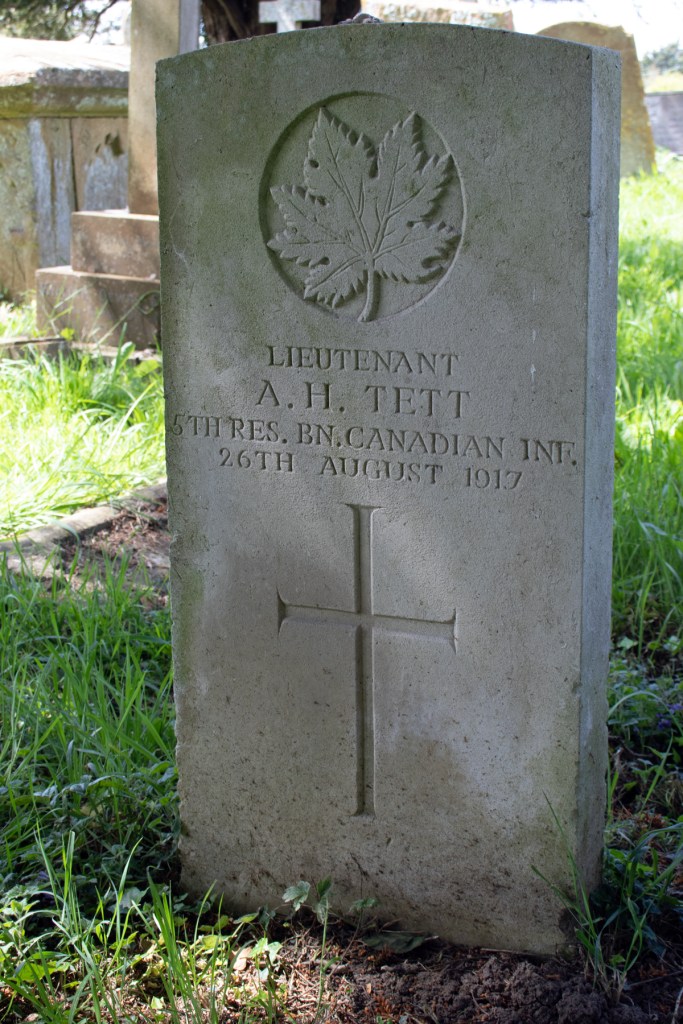
Arthur Hopkins Tett was born on 22nd August 1881 in Bedford Mills, Ontario, Canada. He was one of six children to lumberjack John Tett and his wife, Harriet. Both sets of Arthur’s grandparents had moved to Canada in the 1830s – John’s from Somerset, Harriet’s from Ireland – and his paternal grandfather had gone on to represent the county of Leeds in Ontario’s first parliament.
Arthur wanted to see the world, and viewed the army a a way to do that. After leaving school, he attended the Royal Military College, and was subsequently appointed a Signaller in the 3rd Canadian Mounted Rifles. He spent time in South Africa and, on returning to his home country, he took work as a bank clerk with the Union Bank, where he worked his way up to Head Office in Winnipeg.
He soon sought another challenge, and set up business in Outlook, Saskatchewan. In January 1913, Arthur married Bessie Kearns, an artist from back in Westport, Ontario. The couple settled in a detached property on Bagot Street, Kingston, Ontario and went on to have a son, John, who was born in 1917.
Arthur was still active in military circles at this point, playing a part in the local 14th Regiment. When war was declared, he again stepped forward to play his part, taking up a role of Lieutenant in the 253rd Battalion of the Canadian Expeditionary Force: this was a regiment made up mainly of students from the Kingston area, and it is likely that Arthur’s expertise would have been welcomed.
Having initially enlisted on 1st November 1916, Lieutenant Tett was declared fit a few months later and sent to Europe in May 1917. Based in Somerset, Arthur was not far from where his paternal grandparents had come from, nor where his cousins still lived. Sadly, however, his time in England was not to be a long one.
Lieutenant Tett was admitted to the Military Hospital attached to Taunton Barracks, suffering from pneumococcal meningitis. Sadly, this was to get the better of him, and he passed away on 26th August 1917, days after his 36th birthday.
Arthur Hopkins Tett was brought to the village of Kingstone in Somerset for burial. He was laid to rest in the graveyard of his second cousin George’s local church, St John and All Saints.
Bessie Tett did not marry again after her husband’s passing. She remained in Ontario for the rest of her life, passing away in October 1974, at the age of 89.
Arthur and Bessie’s son, John, was a babe-in-arms when his father died. He also remained in Ontario for much of his life, although he served in Europe during the Second World War. He married Sylvia Bird in September 1941; the couple went on to have two children. They returned to Canada when the war was over, and remained in Ontario until August 1974, when he passed away.








 Death and Service