Walter Stone was born at the start of 1880 in Lympsham, Somerset. The middle of three children, his parents were coal merchant George Stone and his wife, Ellen.
When he finished his schooling, Walter found work as a painter and plumber. In January 1902 he married Alice Charman. Eighteen years older than Walter, she was the widow of a milkman from Bristol, and had raised her son, Edgar, since her husband had passed away a few months before. The couple settled in the village of Brent Knoll, and went on to have three children of their own: Albert, Florence and Alice.
When war came to Europe, Walter was called upon to play his part. He enlisted after June 1916, and joined the Royal Engineers as a Sapper. He was attached to the Inland Waterways and Docks division, but, as no documentation remains to confirm his service, it is not possible to confirm whether he saw any action overseas
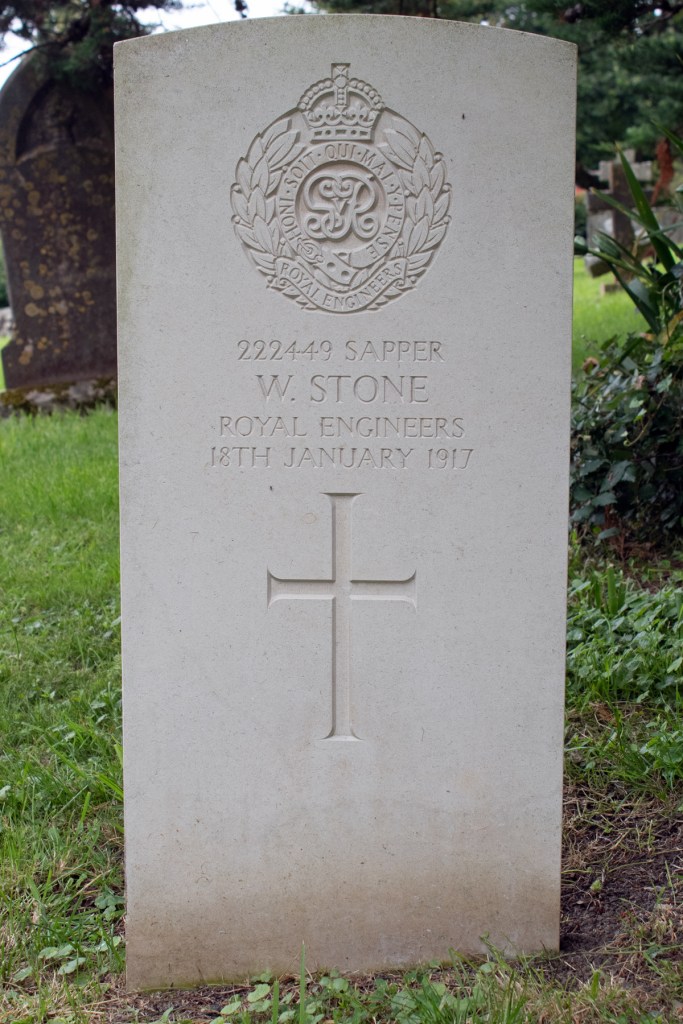
Sapper Stone’s time in the army was not to be a long one. The next record for him is that of his admission to a military hospital in Herne Bay, Kent. He was suffering from pneumonia, and this would take his life on 18th January 1917. He was 36 years of age.
Walter Stone’s body was brought back to Somerset for burial. He was laid to rest in the tranquil graveyard of St Michael’s Church in Brent Knoll.
Further tragedy was to strike Walter’s widow, Alice. Edgar, her son from her first marriage, enlisted in the Somerset Light Infantry when war broke out. Attached to the 7th (Service) Battalion, he found himself on the Front Line by the end of July 1915.
Private Stone is reported to have been accidentally killed on 1st May 1917. No other detail is given, but he was just 24 years of age when he passed. He was buried at the Thiepval Memorial at the Somme.
Alice had lost her husband and her oldest child within a matter of months.
Lot Evans was born in Street, Somerset, on 30th October 1895. The second of two children, his parents were George and Elizabeth Evans. Lot’s mother had four children from a previous marriage and, by the time of the 1901 census, the family had set up home in the coastal village of Brean. George was employed as a farm labourer there, as were Lot’s older half-brothers.
When Lot completed his schooling, he also found work as a farm labourer. The next census return, in 1911, recorded the family of four still living in Brean. George had eased up on the manual work – he was 67 by this point – and was employed as a domestic gardener. Lot’s older brother Ben was a bricklayer’s labourer, so there were three wages – albeit probably meagre ones – coming in to support the household.
When war came to European shores, both Lot and Ben stepped up to play their part. Lot enlisted on 10th November 1915, but was not actually mobilised until January 1918. He joined the Royal Garrison Artillery as a Gunner, and was assigned to the 4th Siege Battery.
On 28th March 1918, Lot married his sweetheart, Hester Puddy. Theirs was to be a brief honeymoon, as he was sent to France just three days later.
Gunner Evans remained overseas until the end of the year, returning home on 5th February 1919 in advance of being demobbed.
He was very ill with influenza. He went to bed and we had the Doctor. It developed into pneumonia and he died last night [13th February 1919].
Letter from Private Ben Evans to the Royal Garrison Artillery
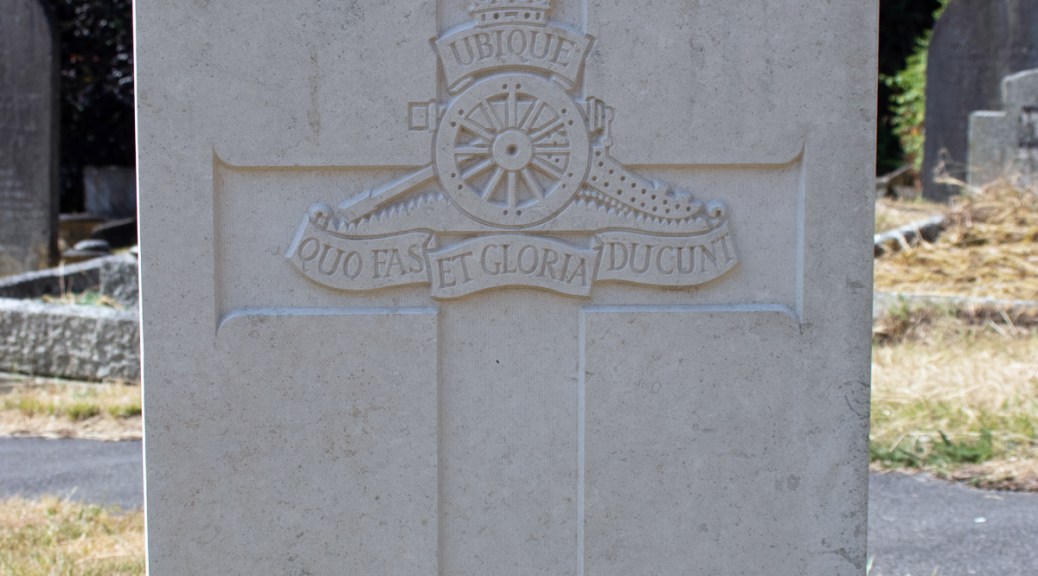
Gunner Evans was just 23 years old when he died. The letter sent by his brother – who was also at home and waiting to be demobbed from the Wiltshire Regiment – explained that Hester was living with their family and his question to the regiment concerned how to claim his brother’s pension.
Lot Evans was laid to rest in the graveyard of St Bridget’s Church in Brean. Now surrounded by caravan parks and holidaymakers, at the time, this would have been a place of sanctuary bordering the Somerset coastline.
Jeremiah West was born in the spring of 1892, the oldest of eight children to John and Laura West. John was an agricultural labourer from Somerset, and it was in the village of Bleadon that the family were born and raised.
When he finished his schooling, Jeremiah followed in his father’s footsteps. By the time of the 1911 census, he was working as a servant on the nearby Shiplette Farm, where he was employed by Kate Poole.
War came to Europe in 1914, and Jeremiah stepped up to play his part. He enlisted in the Somerset Light Infantry in 1915, and was assigned to the 4th Battalion. Private West set sail for India that August, and seems to have remained overseas for some time.
Records are not clear, but it would appear that Jeremiah returned to Britain at some point, and became attached to the 3rd Battalion of the Bedfordshire Regiment. This was a garrison troop, based in Harwich, Essex, and Jeremiah found himself part of the battalion’s Labour Corps.
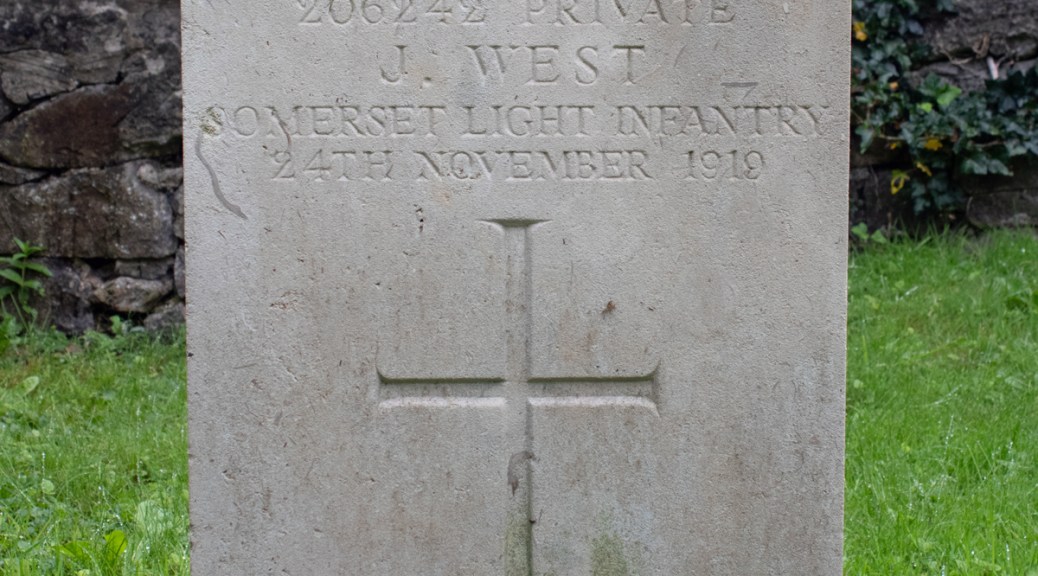
Private West survived the war, but came down with pneumonia in the autumn of 1919. He passed away on 24th November 1919: he was 27 years of age.
Jeremiah West was brought back to Somerset for burial. He was laid to rest in the peaceful graveyard of St Peter and St Paul’s Church in his home village of Bleadon.
Walter John Greedy was born in the spring of 1889, the eighth of nine children to Theophilus and Mary Greedy. Theophilus was an agricultural labourer from Wiveliscombe in Somerset, and it was here that the Greedy family were born and raised.
When he finished his schooling, Walter found work as a carter for a brewery. In 1906 his oldest sister, Charlotte, was widowed, and he moved in with her and her children to help provide some additional support. He soon found alternative employment, however, and within a couple of years was employed by Great Western Railways as a plate-layer.
On 26th December 1913, Walter married Irene Hobbs. She was a blacksmith’s daughter from nearby Fitzhead, who was working as a domestic servant when the couple wed. They went on to have three children: Frederick, Winifred and Dorothy.
When war was declared, Walter stepped up to play his part. Full details of his military service no longer remain, but he had certainly enlisted by the summer of 1918. Walter joined the Royal Engineers, and, based on his previous employment, was assigned to the 278th Railway Company.
Sapper Greedy served in Northern France, and was based in and around Boulogne. He survived the war, and was back on home soil by December 1918. This may have been because of illness: Walter was admitted to Exeter War Hospital in Devon, having contracted influenza and pneumonia. Sadly, the combination of conditions was to prove a fatal one: he passed away on 22nd December 1918, at the age of 29 years old.
Walter John Greedy was brought back to Somerset for burial: he was laid to rest in the peaceful graveyard extension of St Nicholas’ Church in Brushford, where Irene and their children were now living.
Albert Edward Farvis Packer was born in Bristol, Gloucestershire, in 1890. The middle of three children, his parents were Francis and Eliza. Francis was a grocer, and when Albert finished his schooling, he worked as his father’s assistant.
Albert went on to work as a butcher’s manager for Messers. John Lewis and Sons in Midsomer Norton. By the time of the 1911 census, he was living in Batheaston with his parents and younger sister, Elsie. When war broke out, Albert stepped up to play his part, following in his older brother’s footsteps. He enlisted in Taunton on 9th December 1915: his service records showed that he was 5ft 10.5ins (1.79m) tall.
Gunner Packer was assigned to the Royal Garrison Artillery. Initially posted to a depot in Cornwall, he was soon assigned to the 173rd Siege Battery, and found himself in France by the beginning of October 1916. Albert remained overseas for the next fourteen months and, in March 1917, was appointed Acting Bombardier.
On 12th December 1917, Albert returned home on leave and, five days later, he married his sweetheart, stationery shop assistant Dorothy Flower, in St Paul’s Church, Bath. The couple made their way to Bristol, to stay with Dorothy’s parents, but Albert fell ill. He was admitted to the 2nd Southern General Hospital in Bristol, suffering from pleurisy and double pneumonia. The condition was to prove too much for his body, and he passed away, while still admitted, on 27th December 1917. He was just 27 years of age.
Albert Edward Farvis Packer was taken back to Bath for burial. He was laid to rest in the sweeping vista of the city’s Locksbrook Cemetery.
In less than a fortnight, Dorothy had become the blushing bride and a widow. She was to go on and find happiness, however. On 20th February 1920, she married Sapper Sidney Bethell, of the Royal Engineers. Their wedding was in Jamaica, where he was based, and the couple went on to have a daughter, Phyllis, the following year.
Sidney and Dorothy eventually settled in Hertfordshire. He died in 1953, at the age of 59: Dorothy passed the next 38 years as a widow again, passing away on 26th December 1991 – almost exactly 74 year after Albert – at the age of 93.
Albert’s older brother, Francis Packer, also fought and died in the First World War. His story can be found here.
Richard Francis Gould was born in the autumn of 1893 in Wraxall, Somerset. One of fifteen children, his parents were Devon-born farm labourer and carter John Gould and his wife Mary, who came from Bristol.
When he left school, Richard found work as a domestic gardener, and this is what he was doing when he met Ada Archer. She was a nurse from Bristol, and the couple married in Knowle on 17th August 1908. They set up home in Bedminster, and went on to have three children: Edith, born late in 1909; Richard Jr, born in 1915; and Ronald, who was born the following year.
When war broke out, Richard was drawn to serve his country. Sadly, most of his service records have been lost to time, so it’s impossible to piece together a complete record of his time in the army. He was initially attached to the 36th Training Reserve Battalion, but was soon transferred. Attached to the 599th Agricultural Company of the Labour Corps, Private Gould was based in Somerset.
It was while serving in the autumn of 1918, that Richard fell ill. Having contracted pneumonia, he was hospitalised, but the condition proved too much, and he passed away on 19th October, at the age of 34 years old.
Ada and the children were living in the Somerset village of Long Ashton by this point, but it was in the graveyard of the local church – All Saints’ – that Richard Francis Gould was laid to rest.
William Reginald Hunt was born in the Somerset village of Butcombe on 14th September 1900. The youngest of six children, his parents were farmers Walter and Bertha Hunt.
Little information about William – who was known in the family as Reggie – is available. He was still at school at the time of the 1911 census and enlisted in the army in the summer of 1918. His service papers no longer exist, and his life in between these points is lost to time.
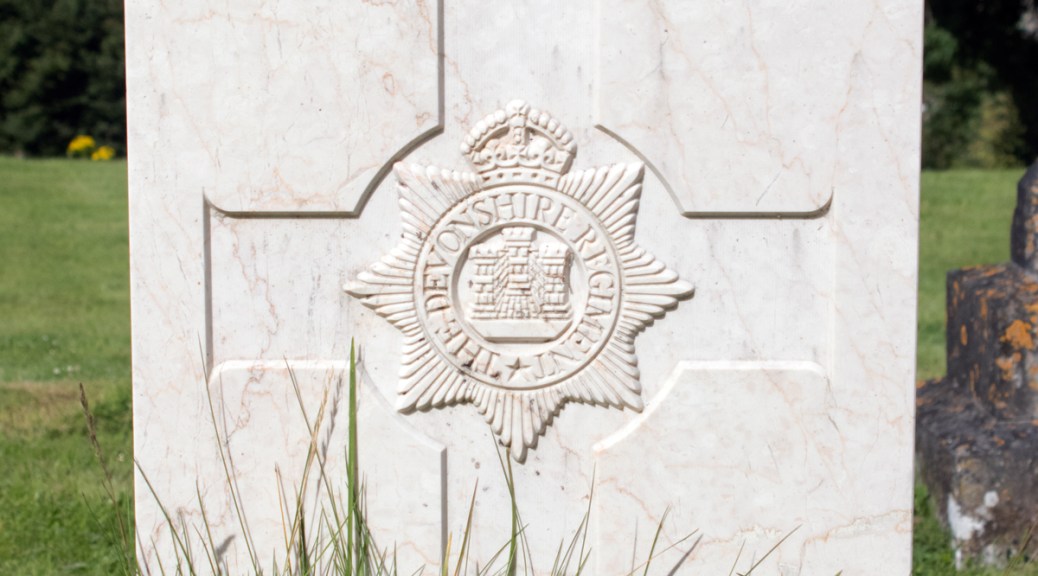
Private Hunt joined the Devonshire Regiment, and was attached to the 53rd (Young Soldier) Battalion. He was based at Rolleston Camp in Wiltshire and, while billeted there, in the cramped and overcrowded conditions of the army barracks, he contracted pneumonia.
William was admitted to the camp’s hospital, but the condition was to prove too much. He passed away on 23rd November 1918, aged just eighteen years old.
The body of William Reginald Hunt was brought back to Somerset for burial. He was laid to rest in the graveyard of St Michael’s Church, in his home village of Butcombe.
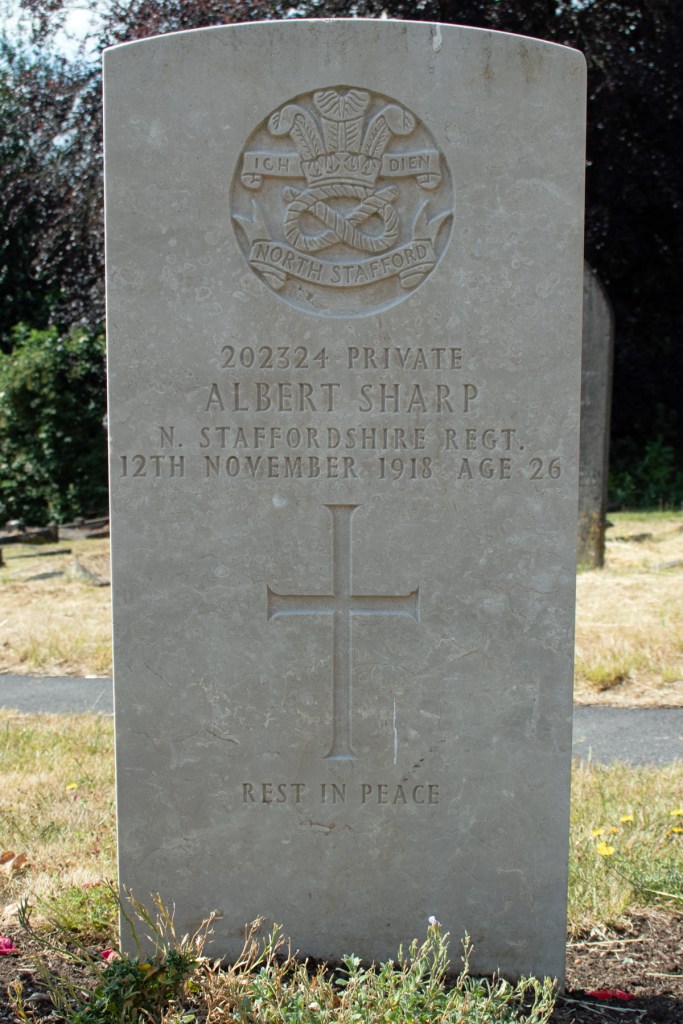
Albert Sharp was born in Rugeley, Staffordshire, in the summer of 1894. One of six children, his parents were George, who was a house painter, and Janet Sharp. When he left school, Albert found work as a bricklayer’s labourer, but, when war was declared, he sought a new adventure.
Albert enlisted in the army on 21st February 1916. Assigned to the North Staffordshire Regiment, he was initially attached to the 5th Battalion. His medical records show that Private Sharp was 5ft 6ins (1.6m) tall, and weighed 122lbs (553kg).
By November 1916, Albert found himself in France. Unusually, his life over the next couple of years is pretty well documented. His battalion saw action at the Hindenburg Line, the Third Battles of Ypres, Cambrai and the Third Battles of the Somme, but Private Sharp’s service records shed more light onto his life than simply where he fought.
Albert seems to have been a bit of a character, and this got him into trouble on more than one occasion. On 9th November 1916, he was confined to barracks for two days, for having untidy bedding and no towel on his bed. The following day, he was punished with another two days’ confinement for not attending his battalion’s role call.
On 18th December 1916, Private Sharp found himself in trouble again. This time, he was confined to barracks for five days for appearing dirty on parade, and committing a nuisance. Four days later, Albert was admitted to the camp hospital for reasons that are unclear. He returned to his unit just under a week later.
At the end of February 1917, Private Sharp transferred to the 31st Light Railway Operating Company of the Royal Engineers. He remained with the battalion for just under a year, although again his time there was not without incident. On 31st August 1917, Albert was confined to barracks for seven days for being absent from parade. The same punishment was meted out for the same offence on 8th January 1918.
Later that month, Private Sharp re-joined the North Staffordshire Regiment, and was this time attached to the 9th Battalion. He remained on the Western Front and was caught up in some of the fiercest fighting of the closing months of the conflict.
On 12th May 1918, Albert was caught up in a gas attack. Seriously injured, he was medically evacuated to Britain for treatment and admitted to the Bath War Hospital on 29th May. The next six months saw a slow and steady decline in his health. He passed away at 5:45am on 12th November 1918, the day after the Armistice was signed, from a combination of pneumonia and emphysema that was directly attributable to his injuries in France. Albert was 24 years of age.
It seems likely that Albert’s family were unable to pay for his body to be taken back to Staffordshire for burial. His service records give only his mother, Janet, as a next of kin, so it would seem that George had passed away by the time Albert enlisted. For some reason, however, while the British Register of Army Effects note that Private Sharp has effects to the value of £39 10s (£2250 in today’s money), this amount does not appear to have been paid. Janet passed away in the early 1920s, and Albert’s brother continued to try and obtain this gratuity on her behalf, but seems to have been unsuccessful.
Albert’s family did get his belongings when he died, however, which came to a postal order for 2s (around £3 today), 50 French centimes, a leather purse, two combs, two jack knives, a razor, a shaving brush, a toothbrush, two briar pipes and a pouch of tobacco, a nickel cigarette case, a text book, a wallet containing his pay book, his cap badge and six letters.
Unable to afford to bring Albert Sharp’s body back to his home town, he was, instead, laid to rest in the sweeping vista of Bath’s Locksbrook Cemetery, not far from the hospital in which he had breathed his last.
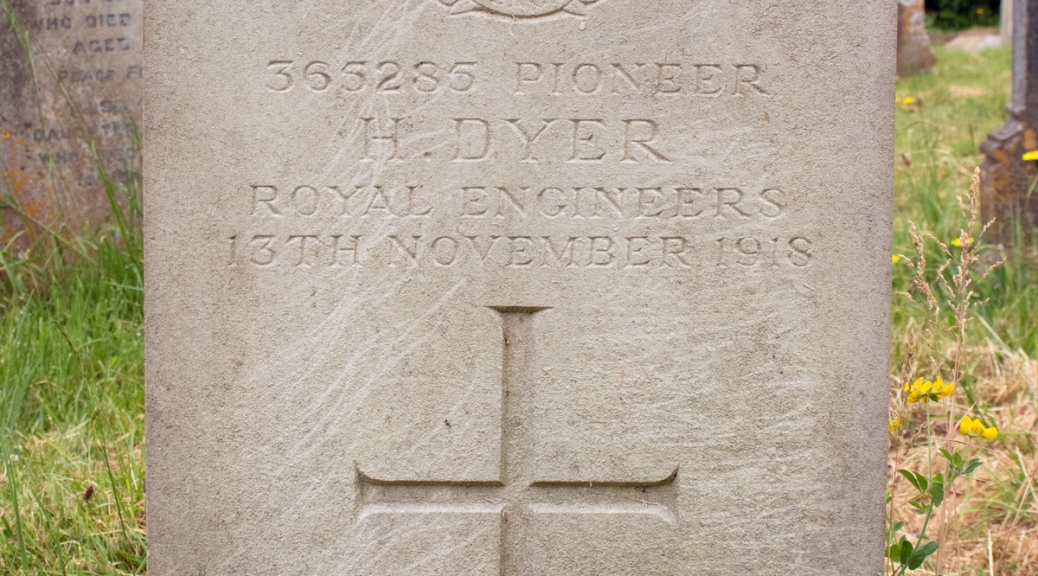
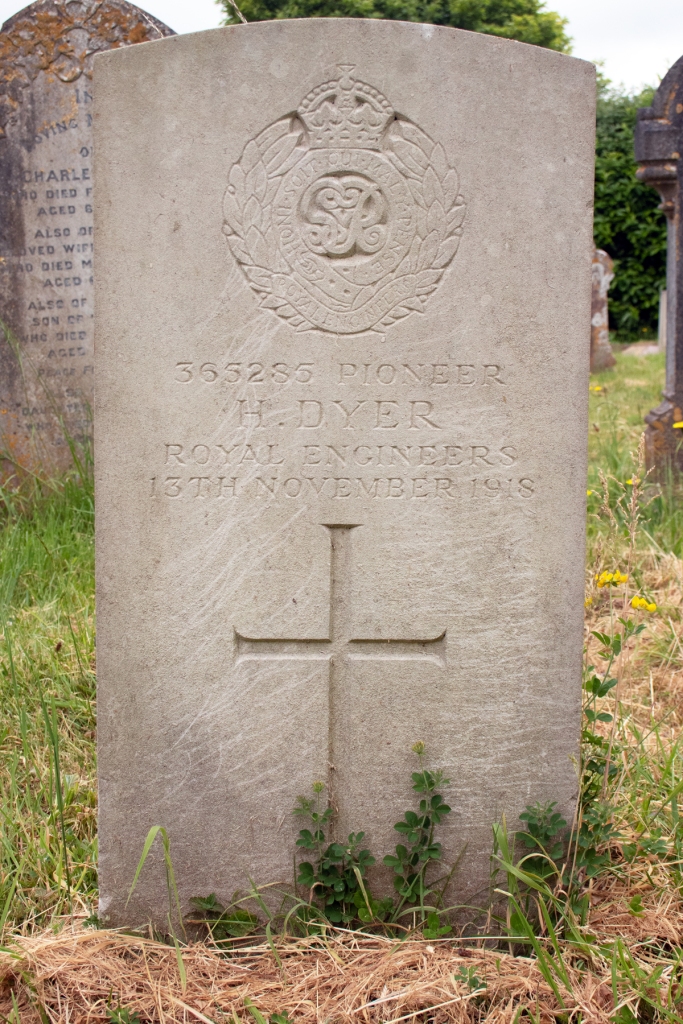
Charles Herbert Dyer was born in the Somerset village of West Monkton in the spring of 1890. One of eight children, his parents were farm labourer Charles Dyer and his wife Mary.
By the time of the 1911 census, Charles Jr had set out on his own, settling in Briton Ferry, near Port Talbot, Glamorganshire. He found work as a gardener and, from this point on, he went by his middle name, Herbert.
Over the next few years, Herbert continued his employment in Wales, although he did make a move to Newport, Monmouthshire. When war came to Britain, Herbert stepped up to serve King and Country, enlisting in the South Wales Borderers on 10th January 1916. Less than two weeks later, he married Ethel May Andrews, in All Saints’ Church, Newport.
Private Dyer was formally mobilised on 2nd March 1916. His service records show that he was 5ft 10ins (1.78m) tall and weighed 141lbs (64kg). Details of his service are a little scrambled, but it appears that Herbert was initially assigned to the 3rd (Reserve) Battalion, and remained on home soil throughout the conflict.
Herbert was based in Bottesford, Leicestershire, in December 1916, where he was put on report and docked 14 days’ pay for being absent from his post, and refusing to obey a superior’s order. Six months later, he had moved camp, and was confined to barracks for two weeks, and docked two days’ pay for being absent without leave for a day and ten hours.
By the summer of 1918, Herbert had transferred across to the Royal Engineers where, with the rank of Pioneer, he was assigned to the 15th Anti-Aircraft Company. Full details of his time in his new regiment have been lost, but he was certainly based in Essex as the war came to a close.
Pioneer Dyer’s health was, however, beginning to suffer by this point. He had a bout of influenza, which developed into pneumonia. He was admitted to the Warley Military Hospital in Brentwood, on 10th November 1918, but, by this point, his body had seemingly had enough. He passed away at 11:20am on 13th November 1918, at the age of 28 years old.
The body of Herbert Dyer was brought back to Somerset for burial. Ethel had moved in with her in-laws in West Monkton by this point, and was a couple of months’ pregnant. Herbert was laid to rest in the peaceful graveyard of St Augustine’s Church. His son – who Ethel named Herbert – was born on 6th June 1919, never to know his father.
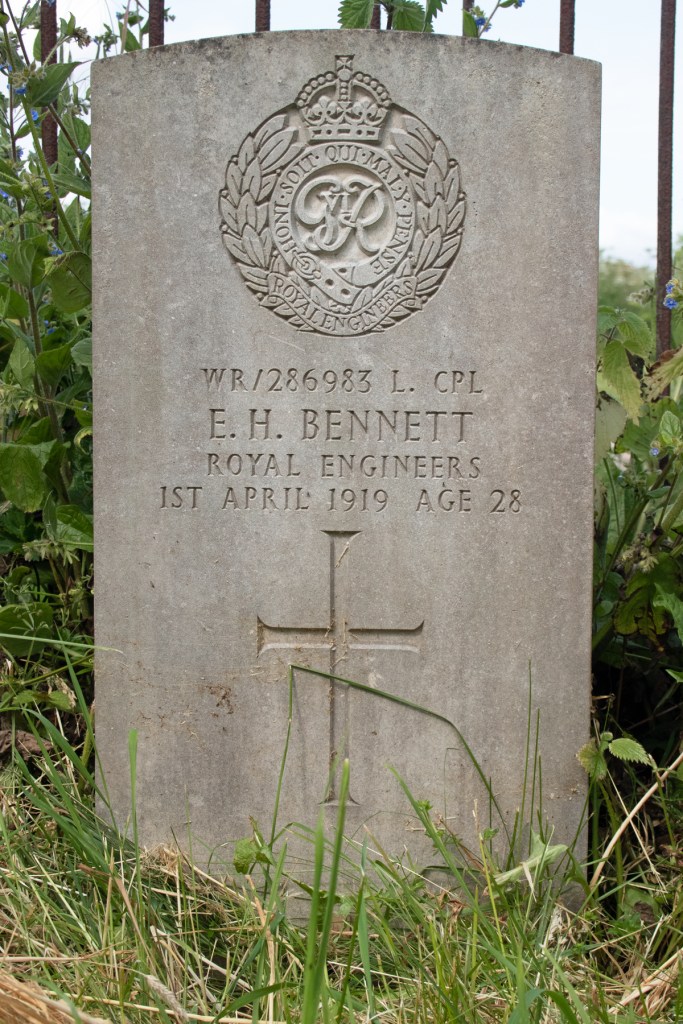
Ernest Harry Bennett was born in the summer of 1890, he third of ten children to Harry and Caroline – or Carrie – Bennett. Harry was a journeyman mason from the Devon village of Chagford, and this is where the Bennett family were raised.
When he finished his education, Ernest found work as a general labourer, and it this work that likely took him across the border to Somerset. He found work as a platelayer for the Great Western Railway in Taunton, and settled in Rowbarton, to the north west of the town.
On 28th September 1912, Ernest married Gertrude Alice Bennett in her local parish church, St George’s in Ruishton. A few months later, the couple had a son, Frederick, and almost exactly two years later, a daughter, Gladys, was born.
By this point, war was raging across Europe, and in July 1915, Ernest received the notice to enlist. Assigned to the Royal Engineers, he was attached to the 53rd Railway Company, probably to make use of his civilian trade. By the end of 1915, Ernest found himself in Egypt, and remained there for the rest of the war.
In July 1918, the now Lance Corporal Bennett was posted to the Railway Operating Division, but continued his service in North Africa. On 8th March 1919, he sailed from Port Said, heading back to Britain to be demobbed.
Returning to Somerset, Ernest fell ill, contracting pneumonia, probably on the journey home. He was admitted to the Taunton Military Hospital, but passed away from the condition just ten days after reaching England’s shores, on 1st April 1919. He was just 28 years of age.
The body of Ernest Harry Bennett was laid to rest in the graveyard extension to St George’s Church in Ruishton, not far from where his widow and children lived.