Tag Archives: Private

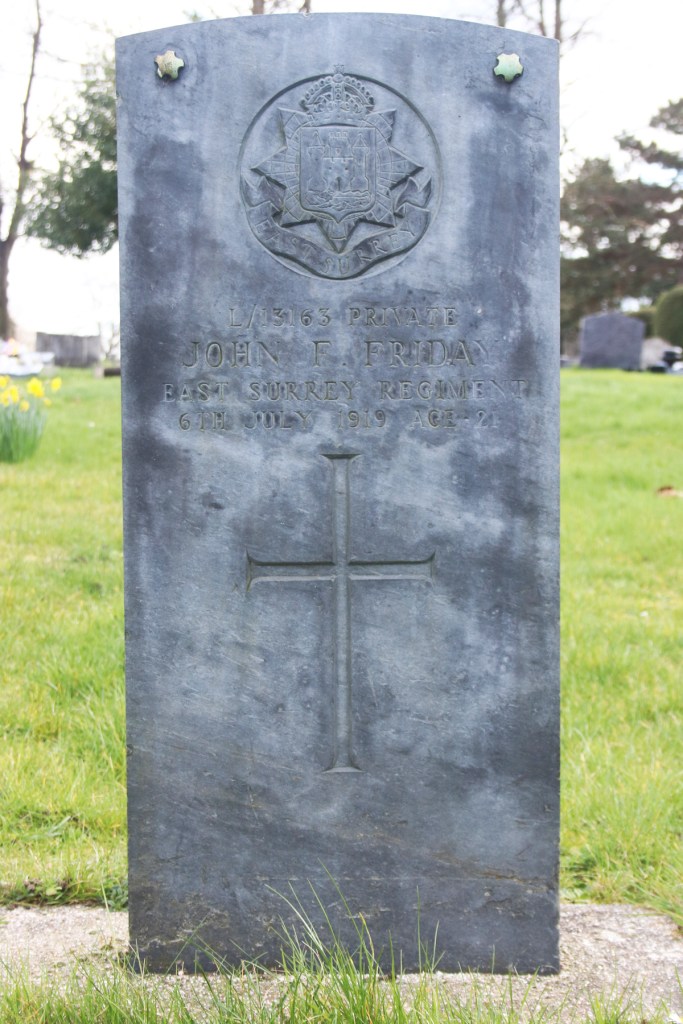
Private John Friday

Private John Friday

John Francis Friday was born in June 1898 to John and Laura Friday from Gillingham in Kent. Laura passed away when John Jr was only ten years old, and his dad remarried, meaning John Jr had eight full and half siblings. John Sr was a farm labourer, and the family lived on the river front in Gillingham, Kent.

John’s military service seems a bit of a challenging one. A letter to Gillingham Police Station dated November 1916 stated that he had not received his call up papers, but that he would present himself that day for enlistment.

John eventually enlisted on 27th December 1916; his joining records show that he was 18 years and six months old, and stood at just under 5ft 3ins (1.57m) tall. He also noted that his preference was to be assigned to the Royal Engineers.

Private Friday initially joined the Manchester Regiment, and, while serving on the Western Front, seemed to have a bit of a rebellious streak in him. He was pulled up on misdemeanours such as neglect of duty on at least five occasions before being admitted to hospital in Calais in December 1917, suffering from trench foot. After serving some further time in England, he again found himself in France in the summer of 1918.

On 11st March 1919, he was transferred to the East Surrey Regiment, and was shipped back to England at the beginning of April. Sadly, it looks like John was stricken by poor health; he passed away on 6th July 1919, having contracted pneumonia. He was just 21 years old.

John Francis Friday lies at rest in the Woodlands Cemetery in his home town of Gillingham in Kent.


Private Alfred Lowes

Private Alfred Lowes

Alfred William Lowes was born in 1893, one of eight children to George and Ann. George was a railway porter from Kent, Ann was born in Berkshire, and the couple had settled in Gillingham, Kent, by the time they started a family.

The naval dockyard in Chatham was one of the main employers in the Medway area of Kent, and Alfred was drawn there for work. After leaving school, he found a job there as a messenger, following his older brother George, who was a labourer there.

In the spring of 1916, Alfred married Edith Kennett, and it seems like the timing was due to his military service. Private Lowes joined the Prince of Wales’ Own Civil Service Rifles (also known as the 15th Battalion London Regiment) and by the beginning of August his troop was bound for France.

Full details of Private Lowes’ military service is not available, although it seems not to have been a lengthy one. He would have fought on the front line, and was wounded as a result. Repatriated back to England for treatment, Alfred passed away at home on 12th November 1916. He was just 23 years of age.

Alfred William Lowes lies at rest in the Woodlands Cemetery in his home town of Gillingham.


Private John Wride

Private John Wride

John Wride was born in 1891, one of eleven children to William and Kate Wride from Cheddar in Somerset. William stared as an agricultural labourer, but went on to become a market gardener, a trade at least four of his sons, John included, also went into.

Sadly, little of John’s life before the outbreak of war is documented. He enlisted on 12th February 1915, and was assigned to the Royal Scots Fusiliers. There is little information about whether he served abroad, although a number of battalions remained based in the UK.

When he enlisted, Private Wride was noted to have an enlarged thyroid and dental deficiencies. He seems to have suffered with his health during the conflict, and the medical report that accompanied his discharge from the army showed that he suffered from VDH – valvular disease of the heart – although the doctor did not attribute this to his military service.

This decision was appealed, and a subsequent report identified that John’s heart and kidney disease were in fact aggravated by his time in the army. He was medically discharged due to these conditions in February 1919.

By the time of the 1921 census, taken in June that year, John was back home in Cheddar. He was living with his parents and two siblings, and seemed to be working alongside his father in the market garden business. Sadly, however, his heart condition was to prove fatal. He passed away on 27th July 1921, aged 30 years old.

John Wride lies at rest in the Baptist Burial Ground in his home town of Cheddar.


Private Ernest Painter

Private Ernest Painter

Ernest Hart Painter was born in December 1884 one of eight children to Alfred and Elizabeth from Devon. Alfred moved the family to Cheddar, Somerset to work at a paper mill in but sadly passed away when Ernest was only eleven years old.

The family rallied round Elizabeth, however, and, by the time of the 1901 census, she was living on the outskirts of the town with her six younger children. Elizabeth worked as a domestic cook; Ernest was an agricultural labourer; his two older sisters were shirt machinists; his 13 year old brother Albert was listed as a gentleman’s servant.

Ernest, by this point, seemed to have taken on the role of head of the family; he continued work as a farm labourer, while Elizabeth earned money as a housekeeper. Alfred became a mechanic for a car dealer and, at the 1911 census, the three of them lived with the youngest member of the family, Ernest’s sister Emily, who had followed in her older sisters’ footsteps as a machinist.

As with many of the fallen men and women of the Great War, a lot of Ernest’s military service records have been lost to time. He enlisted in the Army Veterinary Corps in December 1915, his work as a farm labourer presumably having involved animals and livestock.

Private Painter must have been on the front line as, on 30th May 1918, he was shot in the ankle. Shipped back to England for treatment, he was eventually discharged from service on 19th November, a week after the Armistice. The ankle wound continued to give him trouble, however, and over the following couple of years, he had a number of operations on it.

Sadly, the last of these procedures resulted in an infection, and sepsis took hold. Private Painter passed away from blood poisoning on 15th April 1921. He was 36 years old.

Ernest Hart Painter lies at rest in the graveyard of St Andrew’s Church in Cheddar, Somerset.


Private Frank Perrett

Private Frank Perrett

Frank Herbert Perrett was born in January 1880, the tenth of thirteen children. He was the son of Thomas and Thirza Perrett, bakers and grocers from Bridgwater in Somerset.

When he left school, Frank worked as a chemist’s assistant, and boarded with the chemist – a Frank Sanguinetti – in Ealing, London.

In around 1908, having moved back to Somerset, he married Bessie Hutchings, who was also from the Bridgwater area. The couple went on to have a son, Douglas, who was born in 1910. A year later, the census sees him working as a commercial traveller for a chemist.

War was on the horizon and, although exact details of his military service are not available, it is evident that Frank enrolled in the Dorsetshire Regiment.

Assigned to the 6th Battalion, Private Perrett’s troop would have been involved in the Battles of Ypres, Arras and Passchendaele, amongst others (although I have not been able to find confirmation of how involved he was in these skirmishes).

At some point, Private Perrett fell ill and he was admitted to the Tidworth Military Hospital near Andover. Sadly, he succumbed to the condition, and he passed away on 13th July 1918. He was 39 years old.

Frank Herbert Perrett lies at peace in the St John’s Cemetery in his home town of Bridgwater in Somerset.


Private Sidney Warren

Private Sidney Warren

Sidney John Warren was born in January 1890, one of eleven children to shipwright George Warren and his wife Elizabeth. The family lived in Salmon Parade, on the riverside in Bridgwater, where George would have plied his trade. By the time of the 1911 census, Sidney had found work as a grocer’s assistant, and was living with his parents and the youngest of his brothers, Edward.

While exact details of Private Warren’s military career are not available, documents confirm that he enlisted in the Somerset Light Infantry. Assigned to the 4th Battalion, he was based in India and Mesopotamia during the conflict. No details are available of his time there, but at some point, he transferred to the Labour Corps back in Somerset.

And there Sidney’s trail goes cold. He survived the war, but passed away on 27th November 1918, suffering from pneumonia. He was just 28 years old.

Sidney John Warren lies at rest in the family grave at St John’s Cemetery in his home town of Bridgwater in Somerset.


Private Charles Dibble

Private Charles Dibble

Charles Lang Dibble was born in 1890, one of nine children to Evan and Eliza Dibble from Bridgwater in Somerset. Evan was a labourer in a brickyard, and clay must have been run through the family’s veins, as Charles found employment as a kiln hand in a local tile maker when he left school.

By the 1911 census, Charles was boarding with William Rainey and his family in Bridgwater; whether there was a connection before he moved in or not, I don’t know, but the following year he married one of William’s daughters, Constance. The young couple wed on Christmas Day 1912 and went on to have one child, Charles, who was born in 1915.

Full details of Charles’ military service are not available. However, when he enlisted, he initially joined the Somerset Light Infantry, before transferring to the Devonshire Regiment and finally the Oxfordshire and Buckinghamshire Light Infantry. During his service, he was awarded the Victory and British Medals, but there is little further information about Private Dibble.

Charles survived the war, but his pension records confirm that he passed away on 7th May 1921; the cause of death was noted as exhaustion and sarcoma of the rectum. He was 31 years old.

Charles Lang Dibble lies at rest in St John’s Cemetery in his home town of Bridgwater.


Private Oliver Chubb

Private Oliver Chubb

Oliver Job Chubb was born on 3rd December 1884 in the village of Smallbridge in Devon. He was one of six children to Job Chubb, who was an agricultural labourer, and his wife Louisa. Oliver did not seem to be one for settling down; after his parents had moved the family to Ilminster in Somerset when he was just a child, by 1901 he was living in Lyme Regis, working as a carter in a market garden.

In 1902, at the age of 17, Oliver enlisted in the Somerset Light Infantry. Eighteen months later he transferred to the Royal Navy, serving as a Stoker on a number of ships during what would become twelve years’ service, including the Royal Oak, Skirmisher and Newcastle.

In 1906 he married Rosina Keirle, a brickmaker’s daughter from Somerset. The wedding was in Bridgwater, and the couple went on to have three children, Olive, Albert and Cecil.

There is a sense that Oliver either had perpetually itchy feet, or that he was always running from something. The 1911 census found him aboard HMS Suffolk in the Mediterranean, where he listed himself as single. By the end of his naval service in November 1915, however, Stoker Chubb disembarked in the port of Victoria, British Colombia, and immediately signed up for military service with the Canadian Expeditionary Force.

Again, however, indecision seems to have set in. He listed his marital status as ‘single’ and confirmed his next of kin as his sister Elsie, but on his military will, he left everything to Rosina.

Private Chubb was assigned to the 29th Battalion of the Canadian Infantry; they served on the Western Front from early in 1915 through to the end of the war. He was involved in the fighting at Ypres, and, in September 1916, was treated in England for an inguinal hernia. After three months’ recover, he returned to the front.

While Private Chubb seems to have had a good overall manner, there were blips in his character. In May 1917, he was sentenced to three days’ field punishment for being absent without leave for 21hrs. In March 1918, he was sentenced to another five days’ field punishment for going AWOL for 48 hours. On 11th April 1918, Private Chubb received 14 days’ field punishment for drunkenness on duty.

In December of that year, Oliver was invalided back to England for medical treatment; he was admitted to the Fort Pitt Military Hospital in Chatham with lymphatic leukaemia. Sadly, Private Chubb passed away shortly after being admitted, dying on 17th December 1918. He was 34 years old.

Oliver Job Chubb lies at rest in St John’s Cemetery in Bridgwater, where his family still lived.


Private William Woodbury

Private William Woodbury

William Alfred Woodbury was born in the Somerset village of Nether Stowey in April 1899, the oldest of four children to Alfred and Nellie Woodbury. Alfred was a farm labourer, and, by the time William was a couple of years old, he had moved the family to the town of Bridgwater to work as a carter.

After leaving school, William found work at Barham Brothers’ Brickworks in the town. When war broke out, he enlisted in the Somerset Light Infantry almost as soon as he was able to, at the beginning of 1916.

Assigned to the 6th (Service) Battalion and Private Woodbury was sent out to the Western Front in April. He would almost certainly have seen action at the Battle of Delville Wood – part of the Somme offensive – and was wounded in the shoulder and arm on 18th August 1916.

Shipped back to the UK for treatment, William was admitted to the Western General Hospital in Cardiff, but tragically died from his wounds less than a fortnight later on 30th August 1916. He was just 17 years old.

His funeral was reported in both the Shepton Mallet Journal and the Central Somerset Gazette; his father, who had been serving in France as part of the Army Veterinary Corps, managed to return home for his son’s funeral.

William Alfred Woodbury lies at rest in the St John’s Cemetery in his home town of Bridgwater.


Private Samuel Roberts

Private Samuel Roberts

Samuel Roberts was born in April 1875, one of seven children to William and Harriet Roberts from Bridgwater in Somerset. William worked as a labourer in a timber yard, though sadly he died young, when Samuel was only a child.

In the spring of 1899, Samuel married Rosina (or Rose) James, and the couple went on to have six children. Samuel was supporting his family working as a wicker chair maker, a roaring trade in a part of the county where reed beds were in plentiful supply.

Samuel’s war grave suggests that he enlisted in the Somerset Light Infantry, and that this must have been early in the First World War, given that he passed away in October 1914. His pension records paint a slightly muddier picture, however. They give the cause of Private Roberts’ death as Hodgkin’s disease and mania, but suggest that:

As is has not been possible to establish that Private S Roberts actually joined for service or was paid as a soldier during the war, Mrs Roberts’ claim to [a] pension cannot be admitted.

WW1 Pension Ledger: Private Samuel Roberts

Whether Samuel ever enlisted, or whether he only told Rose that he had, or whether, through his mania, he believed that he had, will likely never be uncovered. Either way, what can be established is that he passed away on 19th October 1914, at the age of 39 years old.

He lies at rest in the St John’s Cemetery in his home town of Bridgwater.