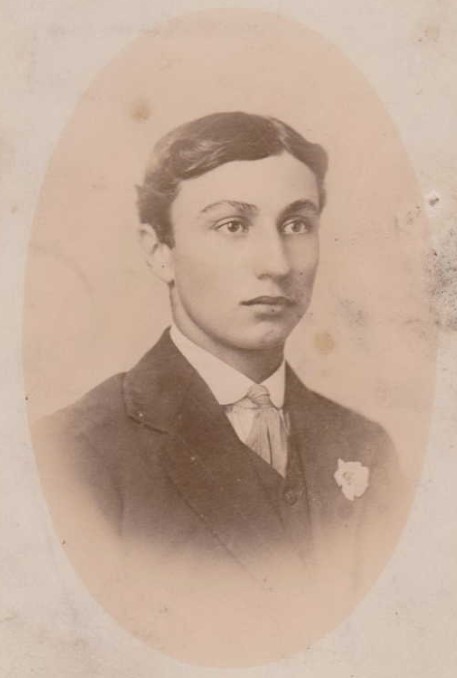
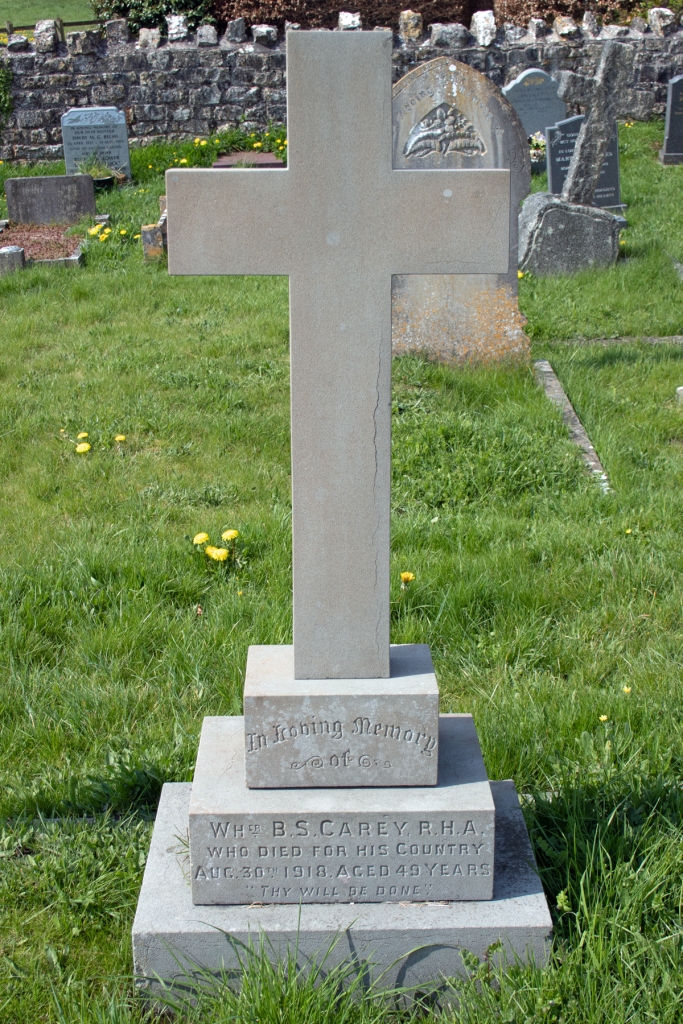
Banfield Sidney Carey – who was also known by his middle name – was born in 1868 in Farmborough, Somerset. His father, Abel, was a wheelwright, and both he and Sidney’s mother, Hannah, came from the village.
Sadly, little of Sidney’s life remains documented. He married Janet Morgan in Blackburn, Lancashire, in the autumn of 1912; they had had a daughter, Dorcas, five years before, and Janet had another daughter, Viola, from a previous relationship.
War came to Europe and Sidney enlisted in the Royal Horse Artillery as a Gunner (Wheeler), at some point before February 1918. By that year he was based at the regiment’s cadet school in St John’s Wood, London.
On 30th August Gunner Carey suffered a ruptured aneurysm and, despite being rushed to the nearby Hampstead Military Hospital, he died. He was 49 years old.
Sidney Carey was brought back to Somerset for burial in the family plot. He was laid to rest in the graveyard of All Saints’ Church in his home village of Farmborough.
Harold William Cornall was born on 16th August 1890 in Kingsteignton, Devon. He was the oldest of six children to William and Elizabeth Cornall. William worked as a carter and labourer for a tannery in the town, and, when he left school, this was where Harold also went for work.
In the autumn of 1912, Harold married Hilda Potter, from nearby Newton Abbot. The couple set up home and went on to have one child, a daughter called Winifred.
War broke out and, on 29th August 1914, Harold enlisted in the Royal Field Artillery. He was assigned to the A-Battery of the 90th (Howitzer) Brigade and was given the rank of Bombardier. He soon found himself in the thick of battle, as the brigade was sent to The Somme.
Bombardier Cornall was injured in the spine by some shrapnel, and medically evacuated to England in June 1916. Sadly, his injuries led to him becoming paralysed, and he passed away at the King George’s Hospital in London on 20th August 1916. He was just 26 years of age.
Harold William Cornall’s body was brought back to Devon; he was laid to rest in the graveyard of St Michael’s Church in his home town of Kingsteignton.
Thomas Greenslade was born in Alcombe, on the outskirts of Dunster in Somerset, in the spring of 1894 and was one of ten children. His parents were Devon-born cab proprietor Richard, and his wife Emma, who passed away in 1905, aged 38 years old.
When he left school, Thomas helped his father with his business; the 1911 census recorded him and his older brother Charles as drivers, his younger two sisters as housekeepers for their father, and his youngest two siblings as still being at school.
Storm clouds were approaching Europe and, in the summer of 1915, Thomas signed up to play his part for King and Country. He joined the Royal Field Artillery, and was assigned as a Bombardier to C Battery of the 74th Brigade. His troop was one of the Howitzer Brigades, and it seems likely that his knowledge of horses stood him in good stead.
Little information on Bombardier Greenslade’s military service survives. His regiment saw conflict at Loos, the 1916 Battles of the Somme and the Third Battle of Ypres, and it is likely that he was involved in these skirmishes.
What can be confirmed is that, by July 1917, Thomas was in the War Hospital in Bristol. The reason for his admission is unclear, but it led to his demise. Bombardier Greenslade passed away on 11th July 1917: he was just 23 years of age.
Thomas Greenslade’s body was brought back to Dunster. He was laid to rest in a quiet corner of the village’s cemetery.
Cecil George Lunell Pearse was born in the spring of 1883, one of seven children to George and Elizabeth Pearse. George was a schoolmaster from Devon, who moved the family to Weston-super-Mare in Somerset in the the 1870s to take up a post at the National School in the centre of the town.
Cecil and at least two of his siblings also went on to become teachers. By the time of the 1911 census, he was living in Plumstead, South East London, with his brother and sister-in-law, and teaching locally.
War was about to descend on Europe, and it is at this point that Cecil’s trail begins to go cold. He enlisted in the Royal Field Artillery, serving as part of the 8th London Howitzer Brigade. During his time, he rose to the rank of Lieutenant, and it seems that he remained part of the Territorial Force, but there is little more information available about his time in the army.
Nor is there much detail around Lieutenant Pearse’s death. He passed away on 20th October 1918, at the age of 35 years old, through causes unrecorded.
Cecil George Lunell Pearse was laid to rest in the Milton Road Cemetery in Weston-super-Mare, the town of his birth.
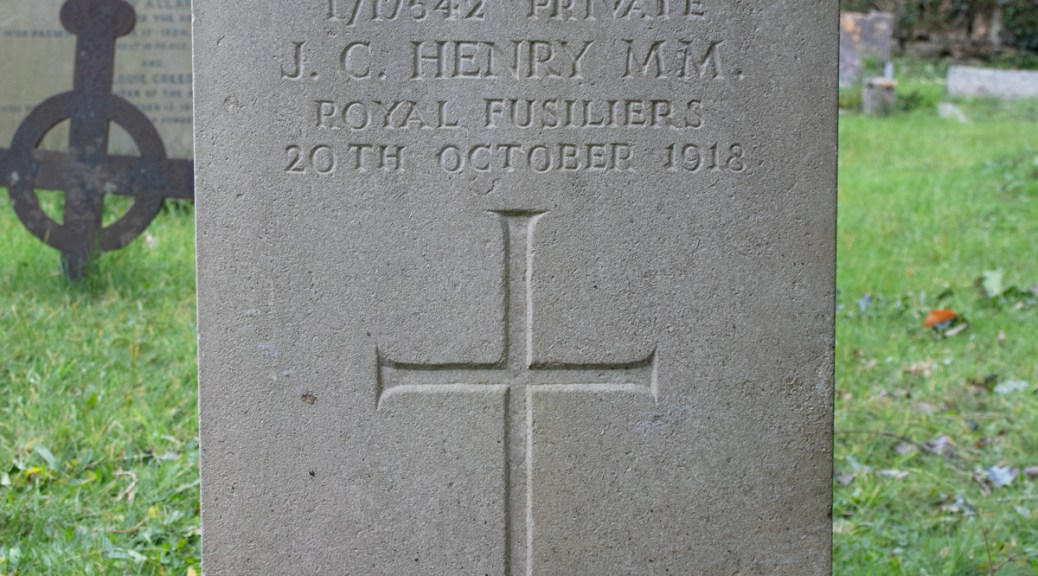
A lot of Joseph Charles Henry’s life is lost to time, and the majority of the information available about him comes from the newspaper report of his funeral.
The funeral with military honours of Private Joseph Charles Henry, Military Medallist, took place at Holy Trinity Church on Saturday afternoon. The case was a very sad one.
Deceased was a gunner in the Royal Field Artillery, and it was there that he won the Military Medal, in June of last year, but had been transferred to the Royal Fusiliers, and posted to the 30th London Regiment.
He was formerly employed as a miner in Lancashire, and married Lucy, daughter of Edward Reddick, of Coleford [Somerset]. In the clear out of the miners for the urgent needs at home he received his discharge on the 20th October, having ten days previously been handed the medal awarded him at the close of last year for bringing in wounded under heavy fire in June. He was very ill when he returned home on Sunday… and became rapidly worse, passing away on Wednesday. He was about 23 years of age.
His wife and two children were also lying seriously ill, and but for the kindness of friends and of the Salvation Army captain, it might have been even more distressing…
There is sad sequel to the death, Mrs Cullen, sister of Mrs Henry, having been bereaved in like manner by the death of her husband within the week.
Somerset Standard: Friday 1st November 1918
There are no documents to specifically connect Joseph to Lancashire, nor to give insight into his family. He died at home, from a combination of acute pneumonia, delirium and heart failure.
Joseph Charles Henry was laid to rest in the graveyard of Holy Trinity Church in Frome, Somerset.
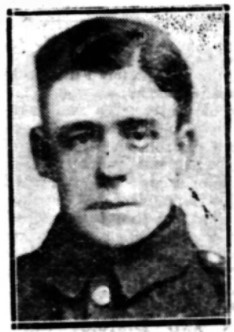
Private Joseph Henry (from britishnewspaperarchive.co.uk)
For Joseph’s widow, Lucy, this was further heartbreak to suffer. The two children mentioned in the article were, in fact, Joseph’s stepchildren; Lucy’s first husband, Charles Futcher, had died at Ypres in January 1916.
William Henry Merrifield was born on 29th December 1893, in Newton Abbot, Devon. One of six children to Henry and Kezia Merrifield, his father was an agent for the removal company Pickford’s.
When William left school, he found work as a labourer for a local tannery. War was, by this time, on the horizon, and William soon found himself caught up in it. Full details of his military service are not available, but it is clear that he had a varied career.
William initially worked for the British Red Cross as a cook, and was sent to France in October 1914. He Subsequently joined the Royal Field Artillery as a Gunner, before transferring across to the Royal Garrison Artillery. By June 1915, he had made the move again, and was recorded as a Sapper in the Royal Engineers. During this time, he had been awarded the Victory and British Medals and the 1914 and 1915 Stars for his war efforts.
By this point, William had seen a fair amount of tragedy in his life. Kezia had died in 1905, at the age of 44, and his sister Evelyn had passed away in 1914, aged just 25 years old. The following year, Henry also died, aged 52 years of age.
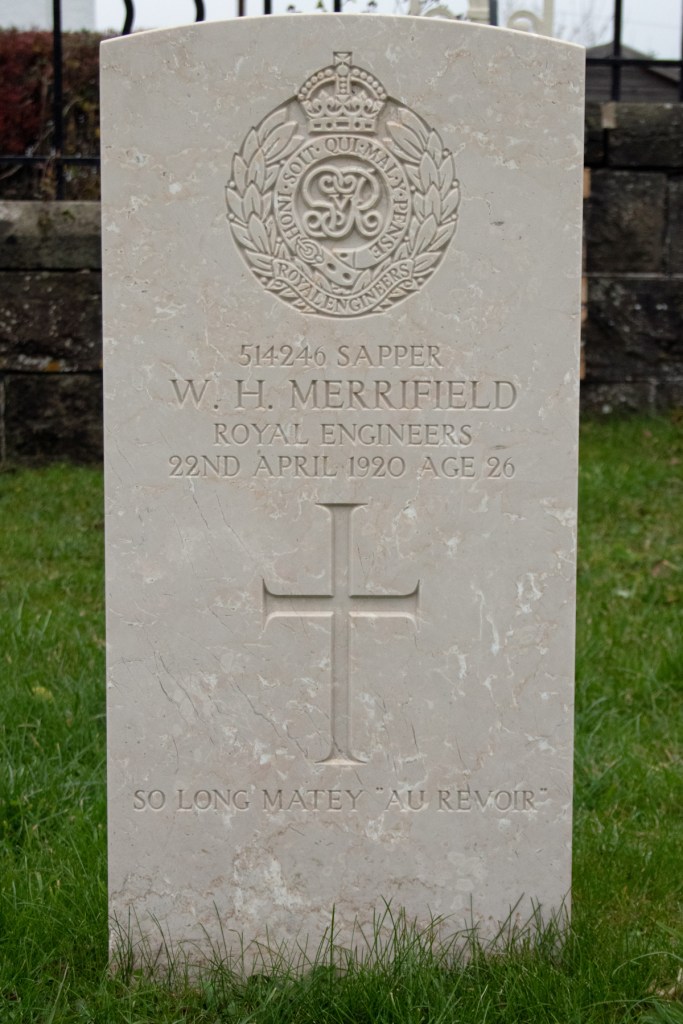
Sapper Merrifield survived the war and was demobbed in February 1919. At this point, his trail goes cold. He returned to Newton Abbot, and passed away just over a year later, on 22nd April 1920. He was 26 years old.
William Henry Merrifield was laid to rest in Newton Abbot Cemetery; his gravestone marked with the message ‘SO LONG MATEY “AU REVOIR”.
Arthur Heathfield was born in Shefford, Bedfordshire, early in 1897, the oldest child to Ellen Grace Heathfield. Ellen married William Lewis in 1903, and went on to have four children in total.
When he left school, Arthur found work as a farm labourer, but by this time, war was coming to Europe. Full details of his military career are not available, but he enlisted in the Royal Field Artillery at some point towards the end of 1914.
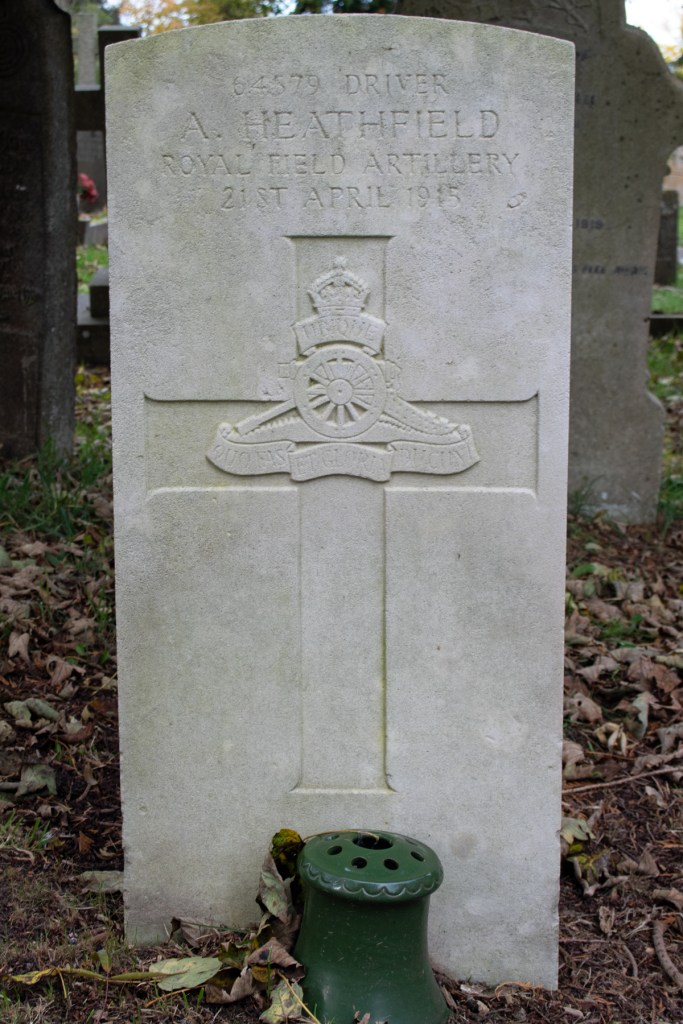
Driver Heathfield was assigned to the 14th Brigade, which saw fighting on the Western Front, although it is not possible to determine whether Arthur himself went overseas. What is certain is that, by the spring of 1915, he was admitted to hospital in Frome, Somerset, suffering from meningitis. Sadly, he was to succumb to the disease on 21st April. He had not long turned 18 years old.
Arthur Heathfield was laid to rest in the graveyard of Christ Church, in the town in which he died.
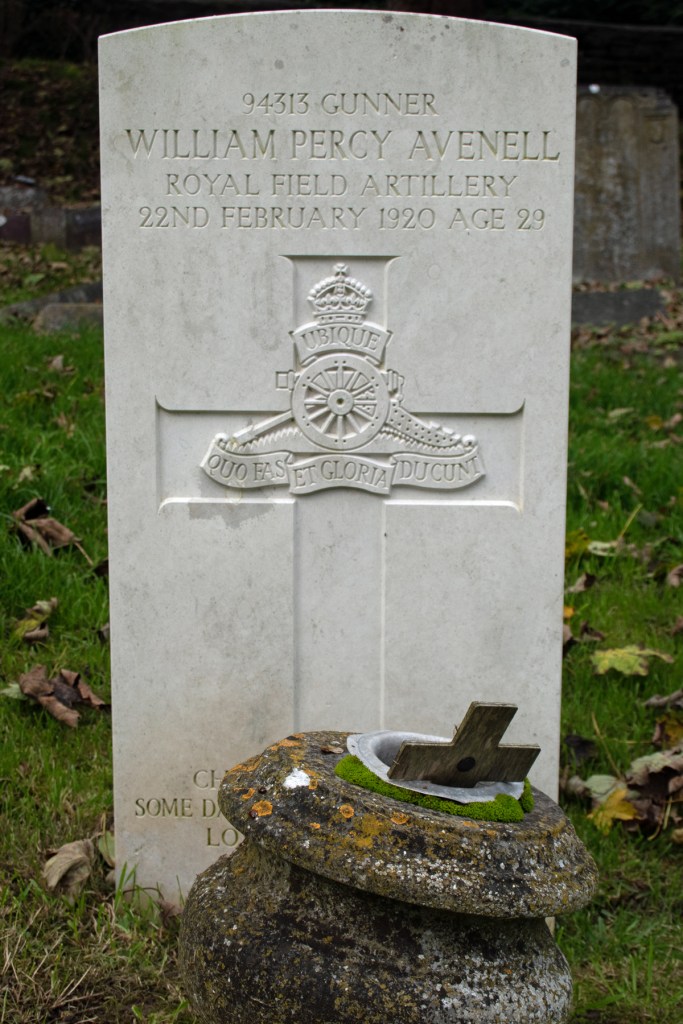
William Percy Avenell seems destined to remain lost to time, and there is little documentation about his life.
He was born in around 1891, and enlisted in the Royal Field Artillery as a Gunner in the summer of 1915, serving in France and earning the Victory and British Medals and the 1915 Star in the process. Gunner Avenell subsequently transferred to the 861st Employment Company of the Labour Corps.
William survived the war and returned to England. He had settled in the Somerset town of Frome (he may have been from the town, but there is nothing to evidence this) with his wife, Lily Beatrice.
Gunner Avenell’s passing is as lost in time as the rest of his life. He died on 22nd February 1920, at the age of just 29 years old.
William Percy Avenell lies at rest in the graveyard of Christ Church in Frome.
Daniel Mcauley was born in Belfast in around 1883, one of six children to John and Margaret Mcauley. John was a farmer, and when Daniel – who was named after his uncle – left school, he found labouring work to help the family bring in an income.
In January 1909, Daniel married Annie Fittis, the daughter of a linen tenter (stretching cloth on a loom while it was drying and maintaining the machines). The couple had had a son, John, eighteen months before, and would have another child, Sarah, later that year.
The 1911 census for Northern Ireland found the young family living with Annie’s mother and two sisters in Dayton Street, near the middle of Belfast. Annie and her sisters were working as flax spinners, while Daniel was a labourer. Tellingly, the document lists inhabitants’ religion – Daniel is the sole Roman Catholic amongst a family of Presbyterians.
War was coming to Europe, and Daniel was called on to do his bit. Sadly, full details of his military service are not available, but what is clear is that he enlisted as a Bombardier in the Royal Field Artillery towards the end of 1914. He was shipped to England, and barracked in Somerset, near Frome.
Sadly, the next evidence of Daniel’s life comes in a wealth of newspaper articles that report on the accident that led to his death.
One soldier was killed and another seriously injured as the result of a horse attached to a Royal Field Artillery wagon bolting at Frome Saturday morning. The wagon was on its way to the stables when the horse got out of control and ran along Christ Church Street West.
One man, who was riding in the wagon, in jumping clear was seriously cut about the head and body, and was taken to the hospital. The other, Bombardier Daniel MacAulay, belonging to Glasgow [sic], remained in the wagon trying to pull up the horses, but the vehicle swerved across the road and he was thrown out, his head coming into contact with a street lamp.
He was taken to the hospital on the police ambulance, but died before admission. He was a married man, about 34 years of age, and was to have gone on leave Saturday in order to visit his sick child. In the morning he received a letter from his wife saying that the child had been seriously ill and had gone blind.
Mr Douglas Mackay, deputy coroner, held an inquest at Frome on Tuesday on the body of the deceased. The verdict was “Accidental death.”
Shepton Mallet Journal: Friday 19th March 1915
Other newspapers reported similarly, a couple stating that Daniel was father to three children. There is no evidence that this was the case and, given that all of the reports state that he came from Scotland, when he was Irish, it is likely that this too was an error. Each newspaper give variations of the spelling of his surname too, evidence that spelling was often at the mercy of the person documenting it, even in the media.
Daniel was buried in Somerset and Annie travelled to England to attend the funeral. Again, newspaper reports suggest that Daniel’s brothers also attended, although he had only one male sibling.
Bombardier Daniel Mcauley died on 13th March 1915, aged around 33 years old. He was laid to rest in the Vallis Road Burial Ground in Frome, also known as the Dissenters’ Cemetery (for those who did not follow the English Protestant faiths.
Harold Henry Lean was born in Gillingham, Kent, in the summer of 1890. The youngest of eight children, his parents were tailor Robert Lean and his wife Sarah. His siblings followed a variety of trades – coachman, painter, shoemaker – but Harold was keen to follow a more long-term career.
When he left school (and after his father’s death in 1901), he enlisted in the army, becoming a Gunner in the Royal Horse Artillery. Little remains of his service documents, but at the time of the 1911 census, he was firmly ensconced in the Artillery Barracks in Leeds.
The next record for Harold comes, sadly, in the form of a news report, detailing the inquest surrounding his death:
SUICIDE OF A SERGEANT AT TOPSHAM BARRACKS
Mr Hamilton Brown, Deputy Coroner for Exeter, held an inquest at Topsham Barracks last evening touching the death of Acting-Sergt. Harold Henry Lean, 26, of the [Royal Field Artillery], who died on Saturday as a result of a self-inflicted wound in the throat.
The evidence given by Bombardier JE Driscoll, of the [Royal Military Police], Trumpeter Sydney Russell, deceased’s batman, Bombardier Biddlescombe and Corporal J Williams signalling instructor was that Sergeant Lean, who had some time ago been ill, on Saturday morning was in his room with Russell, but did not speak all the morning.
Shortly after eleven o’clock he took his razor from a shelf in the corner of the room where he kept his shaving materials. Going to his bed he lay across it with his knees nearly touching the floor and drew the razor across his throat. Russell ran to him and caught him by the shoulders, but deceased pushed him away. Russell then called the assistance of Driscoll and Biddlescombe from an adjoining room.
Williams, who was a personal friend and worked with deceased as a signaller, said that deceased worried about the illness from which he had suffered, and two days previously said he thought he was going insane. He had never threatened to take his life.
Captain RW Statham, [Royal Army Medical Corps], said deceased joined that unit in October 1916, and a month later he reported sick. He was sent away to a military hospital, but was returned this year cured and reported for full duty. The illness had a tendency to create mental depression.
On Saturday morning had entered his name on the sick list, but did not attend the sick parade at 9am. At 11:10 when witness was called to him he found him dead. Witness described the wound, which was a very severe one.
The jury returned a verdict of “Suicide during temporary insanity”.
Wester Times: Tuesday 15th May 1917
Serjeant Harold Henry Lean’s body was brought back to Kent from Devon. He was laid to rest in the Woodlands Cemetery in Gillingham.