Tag Archives: Royal West Kent Regiment

Private Horace Welch

Private Horace Welch

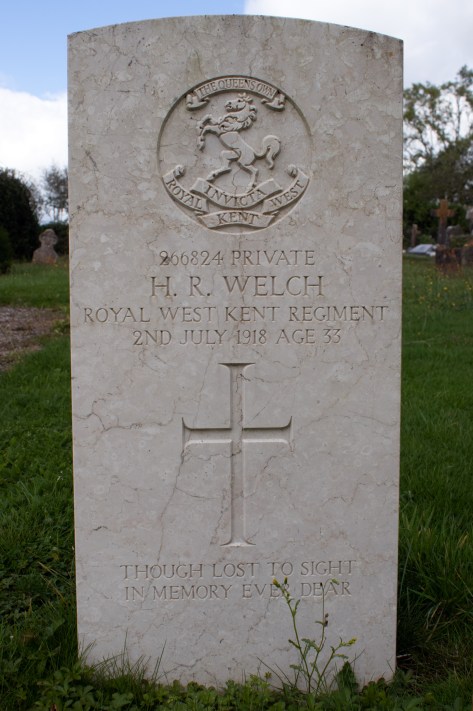
Horace Ralph Welch was born in Mere, Wiltshire, in the autumn of 1884. The middle of seven children, his parents were John and Ellen Welch. John was a silk drier, and the family lived in Water Street, close to the town centre.

John died in 1895, and Ellen was left to bring up the family on her own. Her older children found work, and Horace was employed by John Runtz, stock broker and Justice of the Peace. The family lived at 131 Lordship Road, Stoke Newington and employed two live-in servants other than Horace, who worked as a page.

On 11th November 1916, Horace married Beatrice Batchelor. Born in Watford, Hertfordshire, she was the daughter of an engine driver and, at the point she exchanged vows, she was working as an assistant in a boot shop. Horace was now employed as a butler, and the couple set up home in Watford. They went on to have a daughter, Eileen, in the summer of 1917.

By this point, Horace has stepped up to play his part in the conflict that was raging across Europe. He enlisted on 12th December 1916 – just four weeks after marrying Beatrice – and was initially assigned to the Kent Cycle Corps.

Private Welch would spend the best part of two years on home soil, before being shipped off to France in April 1918. By now he had been transferred to the Queen’s Own (Royal West Kent Regiment).

Horace was only overseas for a matter of a fortnight, before he became unwell. Medically evacuated to Britain for treatment, he was admitted to the Voluntary Aid Detachment Hospital in his home town, Mere. Suffering from appendicitis, he was operated on, but died from peritonitis soon afterwards. Private Welch passed away on 2nd July 1918: he was 33 years of age.

Horace Ralph Welch was laid to rest in Mere Cemetery, on the outskirts of the town.


Private Walter Lane

Private Walter Lane

Walter Frederick Lane was born in Sidcup, Kent, in the early part of 1893. The younger of two children, his parents were Frederick and Caroline Lane. Frederick was a carman and the transient nature of his work meant that the family moved on a regular basis.

The 1901 census found them in Eltham, Kent, while ten years later the family of three – Walter’s older sister having moved on – were boarding in Harton Street, Deptford. By this point, Walter was 17 years of age, and he was also working as a carman. (It is interesting to note that the earlier census recorded Walter’s parents by their first names, while the 1911 document used their middle names – Walter and Kate: transient work allowing for reinvention, perhaps?)

Walter sought a more permanent career, and, on 17th March 1913, he enlisted in the army. Full details of his military career have been lost to time and, in fact, most of his service details come from his discharge papers.

Walter enlisted in the Queen’s Own (Royal West Kent Regiment), although, as Private Lane, he was not formally mobilised until March 1914. When war broke out, his battalion, the 1st/5th, was sent to India, and he remained there for the duration of the war.

Private Lane’s time in the army was not without incident. He contracted malaria in 1915, and while he initially recovered, the condition was to continue to dog him over the following years.

By 1917 Walter’s troop was based in Jabalpur, Madhya Pradesh, but in December that year, the battalion set sail from Bombay for Basra, Mesopotamia.

While in Iraq, he had a couple of run-ins with his superiors. On 22nd December 1917 he was stopped a week’s pay for ‘disobeying an order: putting his equipment on a transport waggon’ and ‘losing by neglect his equipment.’ On 18th February 1918, a further 28 days’ pay was deducted for ‘making away with regimental necessaries (1 towel)’ and ‘neglecting to obey an order.’

During this time, though, Walter’s health was regularly impacted when malaria caught up with him. His discharge documents recorded that he had an attack about once a month, which lasted four or five days each time. In the end, he was released from active service, and left the army on 19th February 1919.

Walter had been discharged while admitted to the Dispersal Hospital in Brighton. His health did not improve, however, and he was soon moved to Somerset for respite care. It was here that he passed away on 7th August 1919. He was 26 years of age.

Walter Frederick Lane was laid to rest in the Holy Trinity Churchyard, Newton St Loe, Somerset.


My thanks go to Liz at the local parish office for her help in unpicking the details of Walter’s passing.

Thanks also go to Tim Hill, who has been researching the graves in the Newton St Loe churchyard.


Private Charles Grigsby

Private Charles Grigsby

Charles Grigsby was born in Boughton Monchelsea, a village to the south of Maidstone, Kent, in the summer of 1878. His parents were farm labourer William Grigsby and his wife, Elizabeth, and he was one of four children. Charles’ mother passed away when he was just three years old, and William married again – to another Elizabeth. They had six children – half-siblings to Charles.

Charles falls off the radar for a few years – his First World War service records suggest that he had enlisted with the East Kent Regiment, and so may have been serving abroad at the time of the 1891 and 1901 censuses.

In 1904 he was back in Kent, however, where he married Henrietta Harpum. The daughter of a soldier, Henrietta had been born in Shoeburyness, Essex, but the family had moved to Frindsbury, Kent, not long afterwards.

The 1911 census found the Grigsbys living in the village of Eccles, near Aylesford. Charles was working as a blacksmith’s striker at the local cement works, and they had their Henrietta’s nephew, George, living with them at the time the record was taken.

When war was declared, Charles stepped up again to play his part. He enlisted on 24th August 1914, and was assigned to the Queen’s Own (Royal West Kent Regiment). Private Grigsby’s service records confirm that he was 5ft 6.5ins (1.69m) tall, and weighed 129lbs (58.5kg). He had brown hair, blue eyes and tattoos on both arms.

Tragically, Henrietta died not long after her husband joined up, although the exact date and cause of her passing is lost to time. Assigned to the 6th (Service) Battalion, Charles was, by this time, based in Hythe, on the Kent coast.

Private Grigsby’s time back in the army was to be a short one, however. He was admitted to Shorncliffe Military Hospital in January 1915, suffering from bronchial pneumonia, and is was this lung condition that was to take his life just weeks later. He passed away on 22nd February 1915, at the age of 35 years old.

Charles Grigsby was brought back to Aylesford by his siblings. He was laid to rest in the graveyard of St Peter & St Paul’s Churchyard. It is likely that he was buried alongside Henrietta, although the exact location of his grave is not longer known. Instead, he is commemorated on a joint headstone in the First World War section of the graveyard.


Private William King

Private William King

William Samuel King was born in the summer of 1880, and was one of four children to Richard and Elizabeth King. Richard was a railway worker from Totnes, Devon, and this is where the family were born and raised.

When he left school, William found work as a house painter, and this is a job he continued to do through to the outbreak of the Great War. On 8th June 1908 he married Minnie Edmunds: the couple went on to have a son, Leslie, who was born in 1912. William and Minnie had, by this point, moved to Swansea, West Glamorgan, presumably as work was more plentiful here than in their Devon home. His work as a decorator seems to have been recognised, and he was admitted to the National Association Partnership, Swansea South.

On 1st December 1915, William enlisted and his service records show that he was 5ft 2ins (1.57m) tall. While it is clear that he spent his time on home soil, his service seems a bit disjointed.

Private King wasn’t formally mobilised until September 1916, when he was assigned to the 2nd/2nd Battalion of the Monmouthshire Regiment. In December he was transferred to the Royal West Kent Regiment before returned to his original battalion in February 1917. A month later, he moved to the Bedfordshire Regiment, before moving to the Middlesex Regiment a few weeks later. This also seems to have been a temporary move as, three weeks later, he was assigned to the 337th Works Company of the Labour Corps (although this was still part of the Middlesex Regiment).

The potential reason behind Private King’s haphazard service seemed to become a little clearer when, in September 1917, he was referred to Fort Pitt Hospital in Rochester, Kent. He was noted as being “very talkative, noisy [and] in a state of mental disease… he has… exalted and grandiose ideas and is difficult to restrain.” His mental health was obviously suffering, and he was discharged from military service in December 1917.

William returned home, although it was not to be for long. He passed away on 13th April 1918, at the age of 37 years old. While no cause of death is evident, it seems likely to have been connected to his ‘mania’, which had been exacerbated by his army service.

William Samuel King was laid to rest in Totnes Cemetery, not far from his parental home.


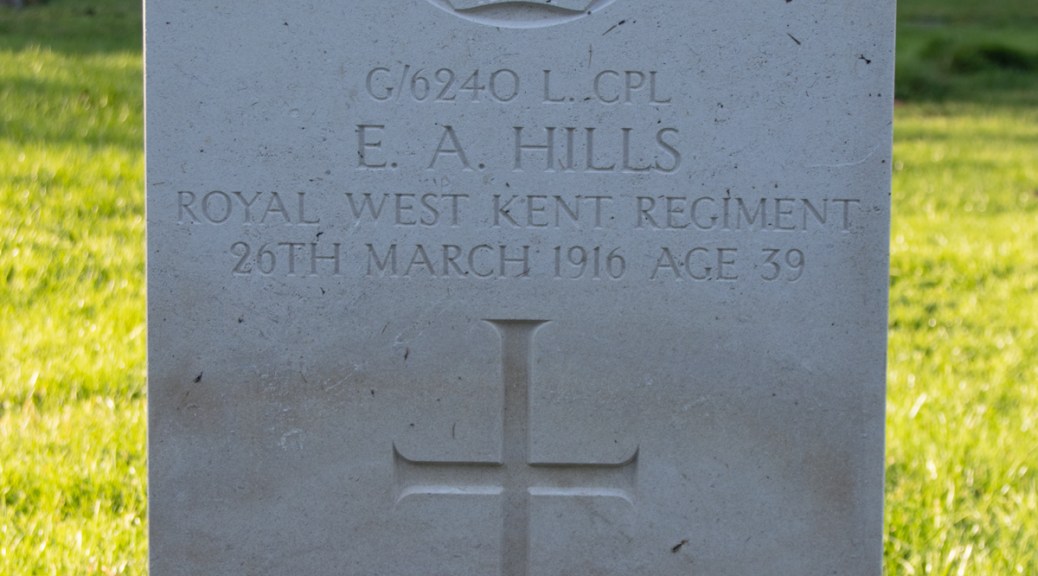
Lance Corporal Ernest Hills

Lance Corporal Ernest Hills

Ernest Albert Hills was born in December 1877, and was the fifth of ten children to Benjamin and Elizabeth Hills. Benjamin was a labourer for a brick maker from the Kent village of Upnor, but it was along the coast in Faversham that he and Elizabeth were to raise their young family.

When he left school, Ernest followed in his father’s footsteps, working in the local brick kiln. By the time of the 1911 census, however, he had moved to South East London and was boarding with his younger brother, William, working with him as a stoker for a Greenwich gas company.

War came to Europe, and Ernest wanted to play his part. On 20th April 1915, he enlisted, joining the Queen’s Own (Royal West Kent Regiment) as a Private. His service records give his height as 5ft 9.75ins (1.77m) and note that he had a scar on the right side of his abdomen.

Private Hills’ service was carried out on home soil: he was assigned to the 3rd (Reserve) Battalion, which was based in Maidstone and Chatham. Ernest was obviously well thought of: within six months of enlisting, he was promoted to Lance Corporal.

His good fortune was not to last for long, however, in the spring of 1916, he fell ill and, while at his family home in March, he passed away, having been suffering from Addison’s disease, a rare disorder of the disorder of the adrenal glands. He was 39 years of age.

Lance Corporal Ernest Albert Hills was laid to rest in the Faversham Borough Cemetery, not far from his family home, and where his father – who had passed away in 1903 – had also been laid to rest.


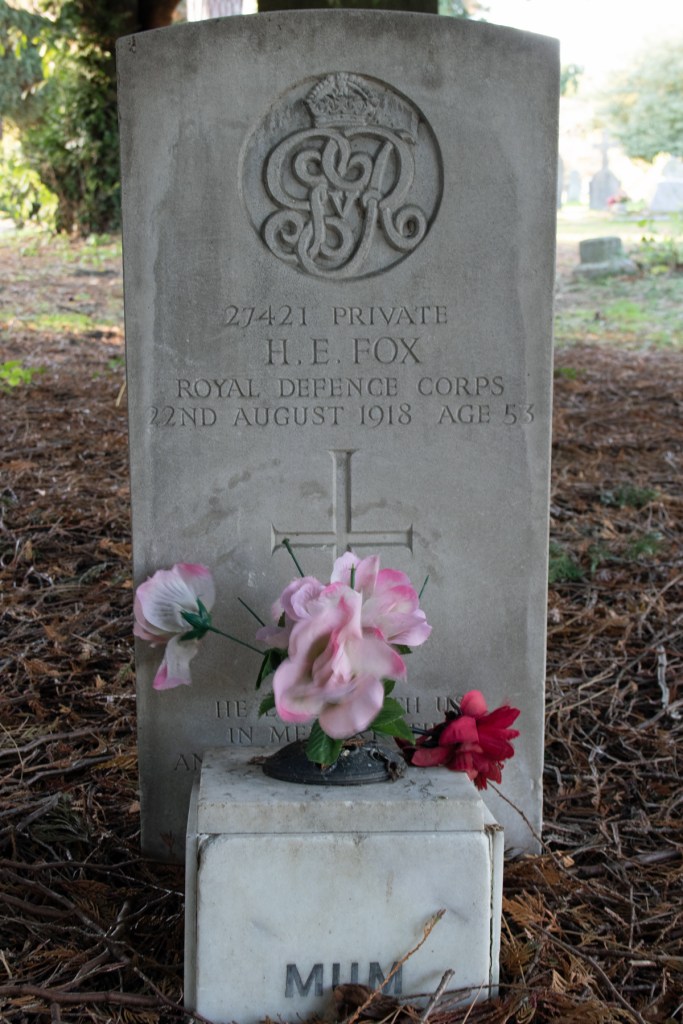
Private Hubert Fox

Private Hubert Fox

Hubert Edward Fox was born in the spring of 1865, the youngest of five children to Alfred and Eliza Fox. Alfred was a baker, from Faversham, and it was in the town that he and Eliza raised their young family.

When he finished school, Hubert found work as a carter and labourer. He served in the King’s Royal Rifles for eight years, spending two of those stationed in Egypt.

In 1894 John married Elizabeth Rebecca Harris in their home town. The couple set up home in the Abbey Road, to the north of the town, and went on to have six children between 1896 and 1909.

When war broke out, Hubert enlisted to play his part once more. He joined up in 1915, and was assigned to the Royal Defence Corps. Private Fox was on guard duty at the Uplees Munitions Factory on 2 April 1916, when a series of explosions ripped through the base. The loss of life was horrific – more than 100 men and boys were killed – and Hubert was fortunate enough to escape serious injury.

In May 1918, Private Fox was invalided out of the army on medical grounds. He was sent to a hospital in Reading, Berkshire, returning to Kent after around six weeks. He was treated in the town’s nursing home, but never fully recovered from his illness: he passed away on 22nd August 1918, at the age of 53 years of age.

Hubert Edward Fox was laid to rest in the Borough Cemetery of his home town, Faversham, not far from the family home in Abbey Road.


At the time of Hubert’s funeral, his eldest son, also called Hubert, was reported as missing in action.

Hubert Jr had enlisted in the 10th Battalion of the Queen’s Own (Royal West Kent Regiment) in August 1915, embarking for France the following May. After two years, Private Fox Jr moved to Italy with his division, but returned to the Western Front just a few months later.

In April 1918, Hubert was reported missing in action; he was later confirmed to be a Prisoner of War, and was eventually released and repatriated home in December 1918.

Hubert found work as a labourer and night watchman; the 1939 Register records him living in his Abbey Road home with his mother. He died the summer of 1968, at the age of 71 years old.


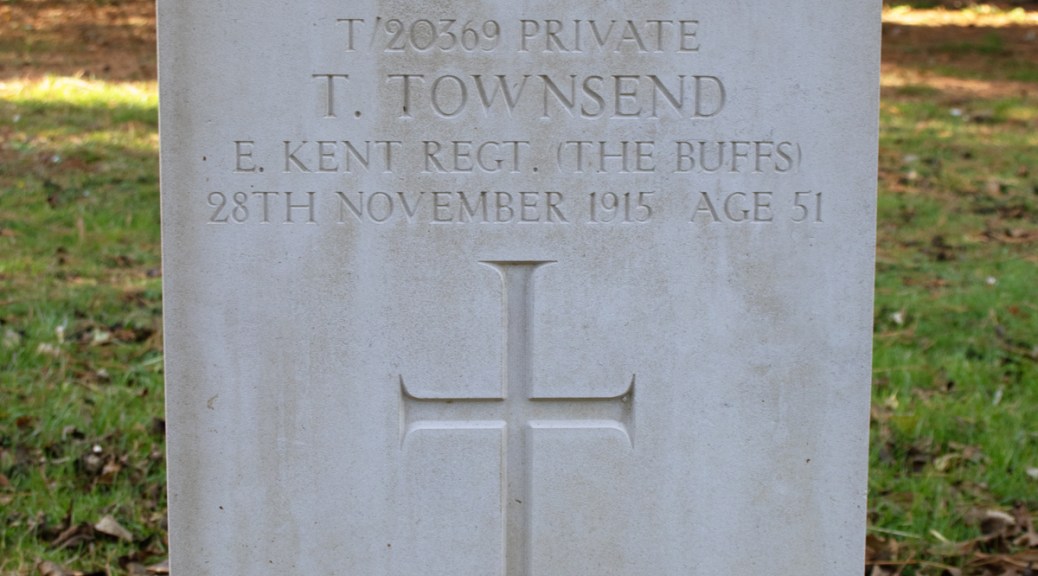
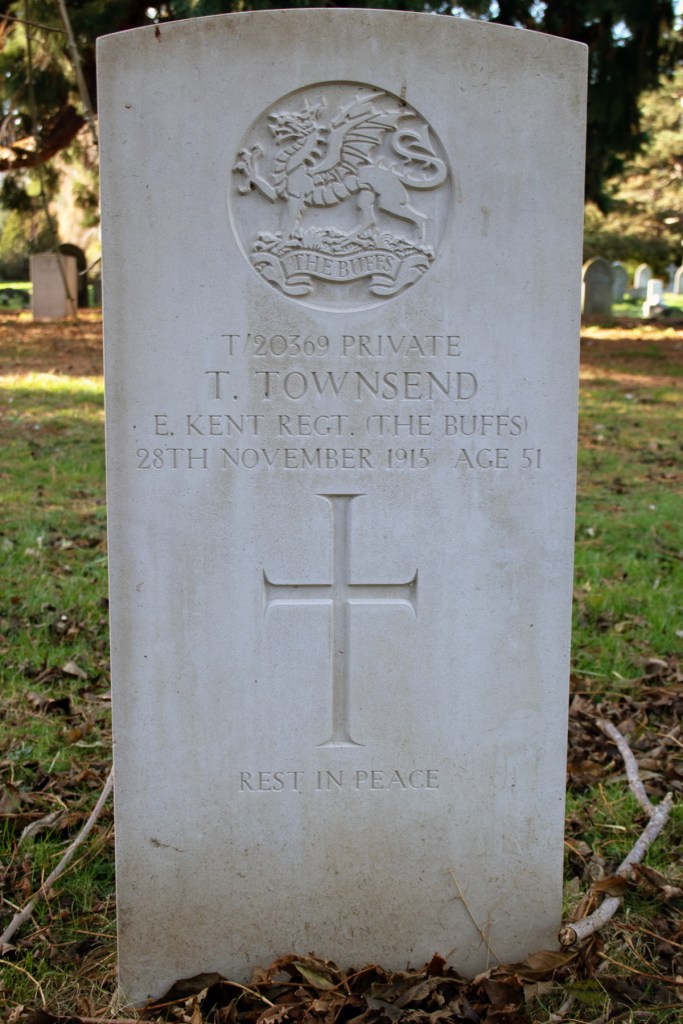
Private Thomas Townsend

Private Thomas Townsend

Thomas Townsend was born in Maidstone, Kent, in around 1864. Details of his early life are sketchy, but his mother was Mary Townsend, and he had an older brother, Henry.

Thomas worked as a labourer, mainly in brickyards, and, at the turn of the century, was living in to the north of Maidstone. The 1901 census records him as sharing his home with his wife, Lydia Townsend, her son, George Andrews, and a visitor, seven-year-old John Lassam.

The next census, in 1911, Thomas and Lydia are both shown as living in the same house, although it notes they had been married for eight years. John Lassam is still living at the property, by now as a boarder, while he was also working as a labourer.

Conflict was closing in on Europe and, despite being 50 when war was declared, Thomas was keen to play his part. He initially enlisted in the Queen’s Own Royal West Kent Regiment, but soon transferred across to The Buffs (East Kent Regiment). Full details of his service as unclear, but it seems he was assigned to the National Reserve Guard at Faversham, Kent.

Private Townsend’s role was guard duty, possibly at the munitions factory in the town. While carrying out this role in the autumn of 1915, he caught a chill, which then became pneumonia. He was admitted to the Faversham Military Hospital, but the lung condition was to get the better of him, and he passed away on 28th November 1915. He was 51 years of age.

Thomas Townsend was laid to rest in Faversham Borough Cemetery, not far from where he carried out his military role.


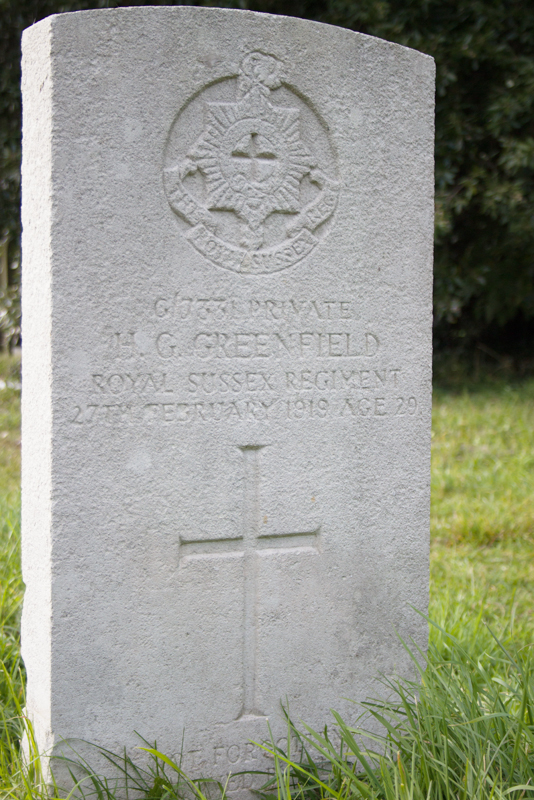
Private Henry Greenfield

Private Henry Greenfield

Henry Gordon Greenfield was born in Worthing, West Sussex, in 1890. The fourth of nine children, his parents were Edmund and Caroline. Edmund was a carter from the town, who raised his family in a small terraced house near the station.

By the early 1900s, Edmund had changed profession, becoming a plasterer, and this was employment that his son followed him into. This seems to have been more lucrative for the family, and they moved to a larger property to the north of the town.

In August 1911, Henry married Edith Tombs. Edith was a gardener’s daughter from London, who had moved to Worthing for work. When the couple married, she was employed as a domestic servant for a solicitor and his wife. The young couple would go on to have three sons.

When war broke out, Henry was quick to enlist. He initially joined the Royal Sussex Regiment, serving his time as part of the 10th Battalion. This was a reserve company, that was based on home soil. When hostilities came to an end, Henry was transferred to the Labour Corps, and was billeted in Belfast.

Little further information about Henry’s service can be confirmed; he was admitted to the Military Hospital in Belfast with pneumonia, but sadly died of the condition on 27th February 1919. He was just 28 years old.

Brought back to Worthing, Henry Gordon Greenfield lies at rest in the Broadwater Cemetery there, not far from his parents and widow.


Henry’s younger brother Frederick also served during the Great War. Joining the Royal West Kent Regiment as a horse driver, he fought on the Western Front. He was killed on 17th August 1917, and is buried at the Duisans Cemetery in northern France. He was just 21 years of age.


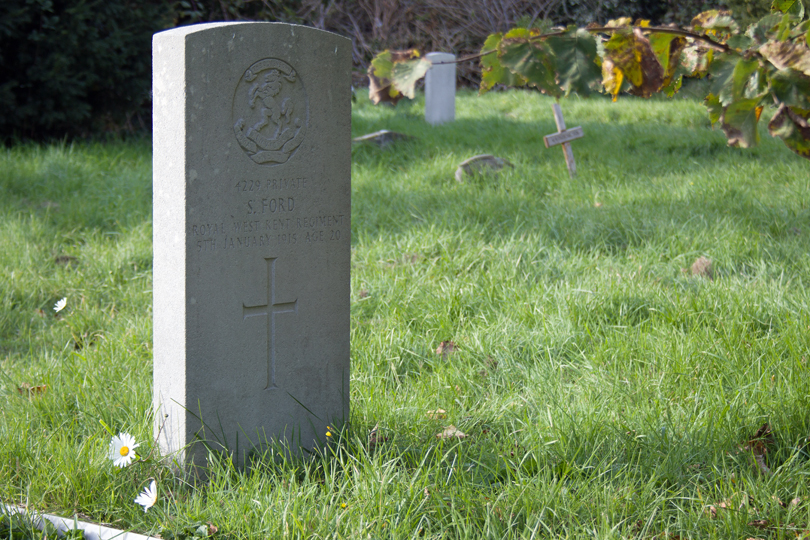
Private Sidney Ford

Private Sidney Ford

Sidney Ford was born in Kent in 1896, the son of Stephen John Ford and his second wife, Elizabeth Ann (née Underdown). The couple had four children – Frederick, Sidney, Ethel and Alice – although it seems that Elizabeth brought them up almost singlehandedly. Sidney’s military records gives his father’s name, although simply notes that he was an imbecile, in the stark way that only Edwardian officials could.

Sadly, little of Sidney’s early life remains documented. By the time war broke out, he was working as a farm labourer in Yalding, close to where he was born. He enlisted at the end of October 1914, joining the Queen’s Own (Royal West Kent Regiment), and was assigned to the 8th (Service) Battalion as a Private.

Joining up in Maidstone, by the end of the year, Private Ford’s battalion was soon billeted in Worthing, West Sussex. Tragically, his service was destined to be a short one, and he passed away after only a month in the town.

The first death from the Red Cross Hospital, Cecil’s, at West Worthing, had to be recorded. Since it has been opened there have been a large number of cases, and many of them have been of a serious nature, but happily all except the one under notice have made progress, thanks to the skill of the Medical Officers and Nursing Staff of the institution.

The deceased in this instance was a Private of the Eighth Battalion of the West Kent Regiment, now stationed locally. His name was Sidney Ford, and he was twenty-five years of age. He died on Friday, and at the funeral, which took place on Monday, full Military honours were accorded him.

Colonel Vansittart (who commands the Eighth Battalion) and Major Bock-Hollinshead attended, as also did other members of the Staff of the Hospital. A large number of the public were also at the Cemetery to witness the last rites, the progress of so long and so imposing a procession through the streets attracting considerable attention.

Worthing Gazette: Wednesday 20th January 1915

Private Ford has died on 15th January 1915, and was actually just 20 years of age, not 25, as had been reported. The Worthing Gazette does not give no mention to Sidney’s family, so it can only be assumed that they were unable to make the journey from Kent to the funeral. I have been unable to uncover details of the cause of his death, but, given that there is no mention of the cause in the newspaper, it is likely to have been following an illness than anything more sensational or unusual.

Sidney Ford lies at rest in the Broadwater Cemetery in Worthing, one of the first in the town to have passed because of the Great War.


Sidney’s older brother, Frederick, was also involved in the Great War. While there is little specific information about his service, it is evident that he was a Private in the Duke of Wellington’s (West Riding Regiment).

Unlike his younger brother, Frederick did see military action, but list his life on the Western Front on 4th November 1915, ten months after Sidney had passed in Worthing.

Frederick lies at rest in the Royal Irish Rifles Graveyard in Laventie, in Northern France.


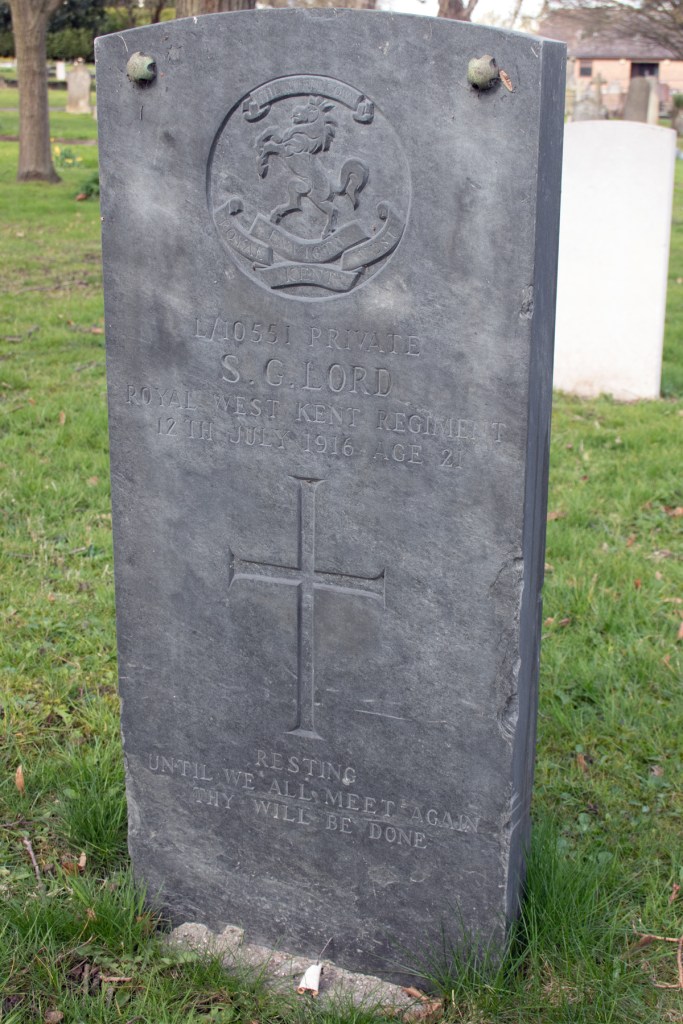
Private Sidney Lord

Private Sidney Lord

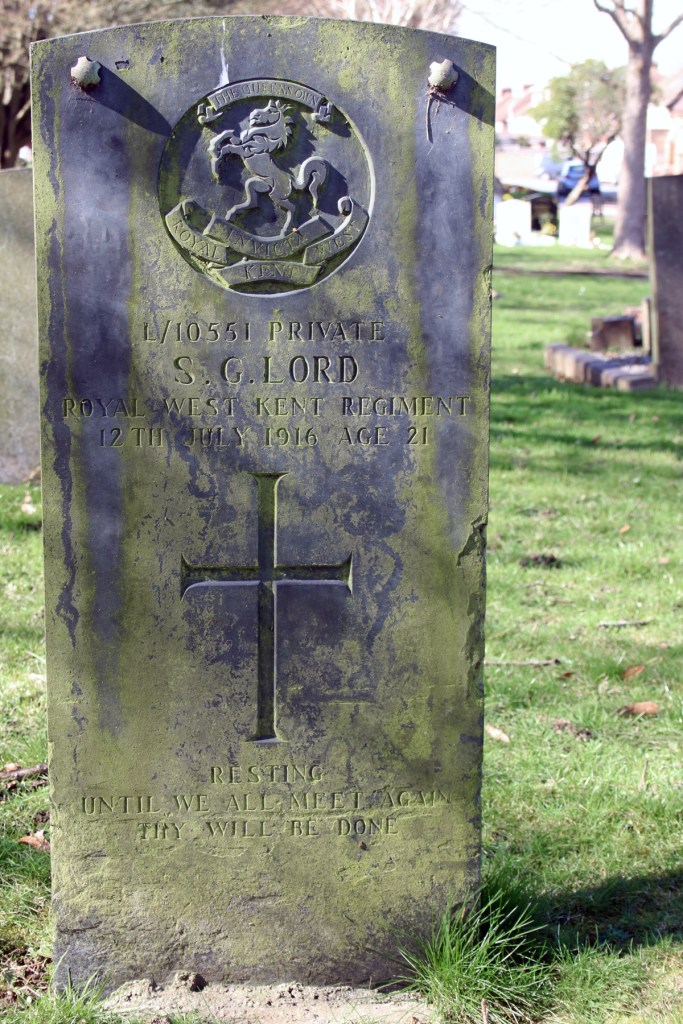
Sidney George Lord was born on 29th March 1895, one of six children to Sidney and Clara Lord. Sidney Sr was a shipwright from Bideford in Devon, and he brought the family to Kent, presumably for work at the Naval Dockyard in Chatham.

Sidney Sr passed away in 1912 and his son left school, finding work as a plumber’s apprentice. War was on the horizon, however and he was keen to do his bit as soon as possible. Sidney Jr enlisted in November 1914, joining the Queen’s Own Royal West Kent Regiment.

After his initial training, Private Lord was sent to the Front on 22nd April 1915, serving in France with his regiment for just over a year. Towards the end of this time he became anaemic, and was shipped back to England for treatment.

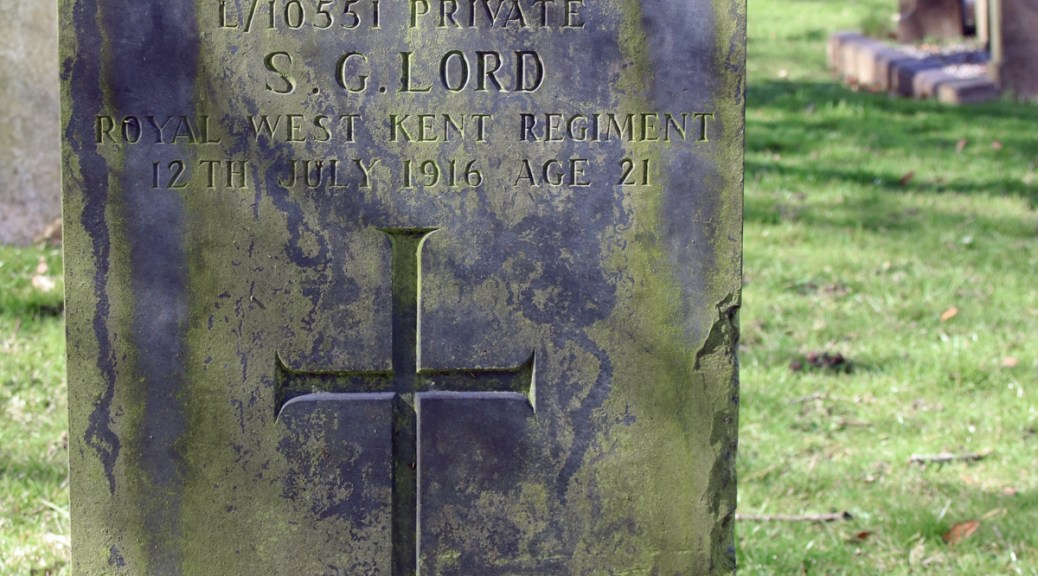
Private Lord was admitted to the Yeatman Hospital in Sherborne, but sadly succumbed to his anaemia a matter of weeks later. He passed away on 12th July 1916, having not lung turned 21 years of age.

Sidney George Lord was laid to rest in the Woodlands Cemetery in Gillingham, Kent, close to where his father was buried.


Private Sidney Lord