Tag Archives: Sergeant

Serjeant Bertie Moody

Serjeant Bertie Moody

Bertie Richard Moody was born in Warminster, Wiltshire in April 1885, one of ten children to Joshua and Mary Moody. Joshua was a navy pensioner, who was twenty years older than his wife, and they raised their family in a small house to the west of the town centre.

When he left school, Bertie found work labouring for a man with a traction engine, but, after his parents died – Mary in 1901 and Joshua two years later – he had more need of a trade. The army offered him a life of adventure, and so he enlisted in the 1st Battalion of the Wiltshire Regiment. Full details of his military career are lost to time, but by the 1911 census, Private Moody was based in Pietermaritzburg, South Africa.

War in Europe was looming, and Bertie’s regiment was called back home. By December 1914, however, he was on the front line in France, and, over the next couple of years, earned the Victory and British Medals, the 1915 Star and a promotion to Serjeant for his service.

As time wore on, it was evident that illness was playing a bigger part in Serjeant Moody’s life. He was suffering from diabetes, and the condition led to him being medically discharged from the army in October 1916. Bertie moved to Frome, Somerset, and found work as a labourer.

He still wanted to play his part, and after making something of a recovery, he tried to enlist again, this time in the Royal Air Force. They rejected Bertie because of his condition too, however, so his time in active service came to an end.

At this point, Bertie’s trail goes cold. He died in Frome on 13th December 1918, at the age of 33, and was laid to rest in the graveyard of Holy Trinity Church in the town.


Sergeant Archibald Mills

Sergeant Archibald Mills

Archibald Henry Mills was born in the summer of 1895, the oldest of six children to John and Edith. John was a commercial traveller, selling veterinary wares around the country; he was born in Derby, Edith was from Leicester and, for the for the first seven years of their married life they lived in Edith’s home town – this is where Archibald was born. By the turn of the century, however, they had relocated to Somerset, and set up home in Weston-super-Mare.

When he left school, Archibald found work as an errand boy for a local tailor, but change was on the horizon. By the summer of 1914, he had based himself in Nottingham – the reason is lost to time – and this is where he was when he volunteered for military service.

Archibald enlisted as a Private in the Notts and Derby Regiment – the Sherwood Foresters – and was assigned to the 7th Battalion. He was sent to France as part of the 46th Division and, over the next couple of years, he evidently served his regiment well.

In August 1915, Private Mills was promoted to Lance Corporal; three months later he was again promoted, to Corporal. By May the following year, he received another rise, this time to Serjeant. These promotions were against the backdrop of some fierce fighting – the Sherwood Foresters were involved at Hooge, Hohenzollern and Gommecourt, and were briefly sent to Egypt.

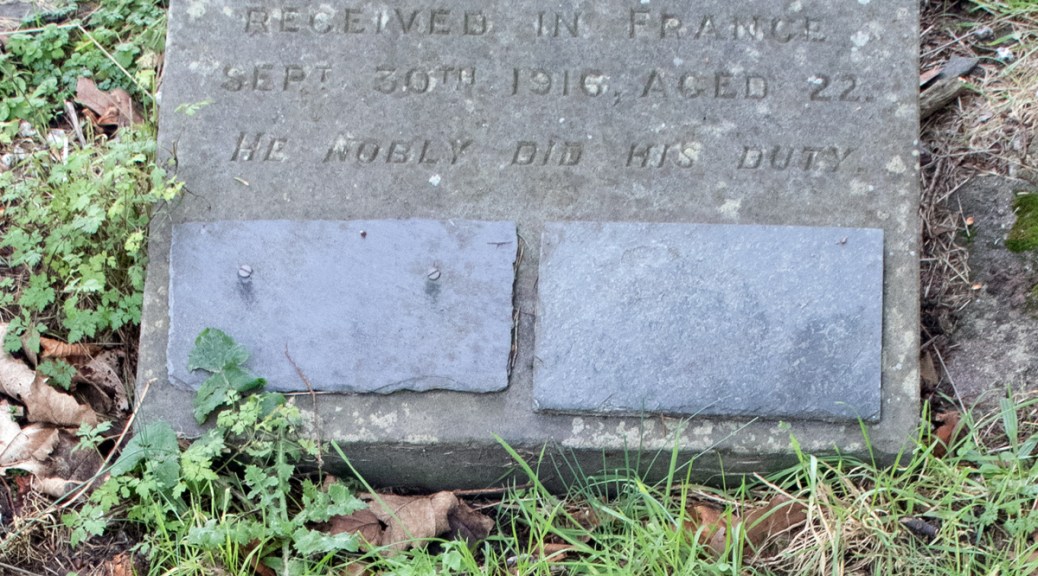
At some point during the summer of 1916 – possible at Gommecourt – Archibald was injured, and medically evacuated to the No.2 Western General Hospital in Manchester. Sadly, however, his wounds were to prove too much: Serjeant Mills passed away on the night of 30th September 1916. He was just 21 years old.

The body of Archibald Henry Mills was brought back to Somerset; he was laid to rest in the Milton Road Cemetery of his adopted home town of Weston-super-Mare.


Sergeant John Foxworthy

Sergeant Joh Foxworthy

John James Foxworthy was born in the South Devon village of East Allington in 1867. He was the middle of five children to carpenter Roger Foxworthy and his wife Ann.

When he left school, John found work on a local farm, but he had bigger plans and, in July 1887, he enlisted in the Royal Marine Light Infantry. His service records show that he stood 5ft 8ins (1.73m) tall, had dark brown hair, brown eyes and a fresh complexion.

John had a varied military career that lasted for more than two decades. During this time, he served on nine ships, and was based at HMS Vivid – the Royal Naval Dockyard in Plymouth – for significant periods of time. He began as a Private, but rose through the ranks to Corporal (in 1894) and Sergeant (in 1900). He was wounded in April 1899, when he was shot in the leg, but recovered from this and continued his career.

In 1895, John married Maria Woodley, the daughter of a railway labourer from Totnes. The couple went on to have four children, Minnie, Gladys, Alice and William.

In 1908, Sergeant Foxworthy left the Royal Marine Light Infantry after 21 years’ service. By now the family home was in Prospect Terrace, Newton Abbot, just a short walk from the town centre. The 1911 census records him as being a Royal Marine pensioner and caretaker of the Miniature Rifle Club.

When war broke out, John was called back into duty and, by September 1914, he found himself in a Royal Marine Depot in Belgium. His service overseas was fairly short, and he had returned to England by the spring. He was working as a recruiting sergeant in Northampton on 30th March 1915, when he suddenly collapsed and died. He was 47 years of age.

John James Foxworthy’s body was brought back to Devon; he lies at rest in the family grave in Newton Abbot Cemetery.


Serjeant John Bunclark

Serjeant John Bunclark

John Bunclark was born in the village of Lustleigh, near Bovey Tracey in Devon in 1888. His father is lost to time, but his mother was farm labourer’s daughter, Elizabeth Bunclark. Elizabeth worked as a kitchen maid for a local solicitor, so John’s grandparents – John and Mary – raised him as their own.

In 1894, Elizabeth went on to marry William Wright – they went on to have four children of their own, while John remained with his grandparents. Tragically, in 1907, Elizabeth died in childbirth; the boy also died.

In 1906, John was longing for bigger and better things, and a military career appeared a good option. He joined the Devonshire Regiment as a Private and, while full details of his service are no available, it seems that John made a good impression.

In 1912, John married Emma Jane Horrell. She was the daughter of an agricultural labourer from Tavistock, who was working as a domestic servant when they met. The couple went on to have four children, between 1912 and 1918.

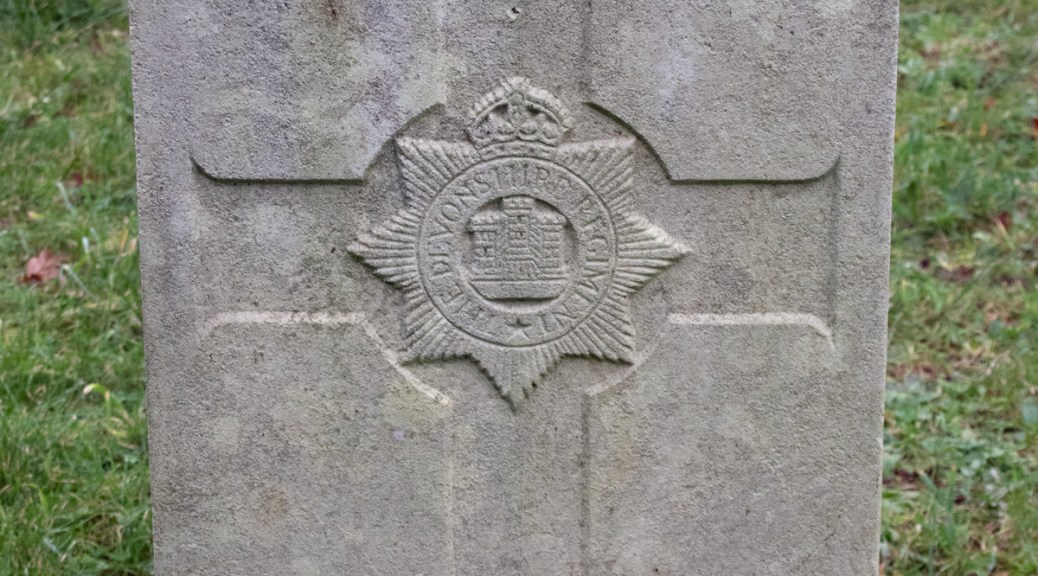
When war broke out, Private Bunclark was posted to France; his battalion – the 2nd – served in many of the key battles of the conflict, including Neuve Chapelle, The Somme, Ypres and Arras. At some point during the war, however, John transferred to the 641st Employment Company of the Labour Corps; this meant work on the Home Front, and a promotion to Serjeant came with it.

It was while John was on leave back in Newton Abbot that he fell ill. His specific ailment is lost to time, but he was admitted to the Temporary Hospital at the Institution in the town. He passed away on 7th November 1918, at the age of 30 years old.

John Clark was laid to rest in Newton Abbot Cemetery.


Colour Sergeant John Paulin

Colour Sergeant John Paulin

John Duncan Paulin was born in January 1885 in Liverpool, the youngest of two children. His parents – John Robert (known by his middle name) and Jane Paulin – were born in Scotland, but seemed to have moved to the Lancashire port by the late 1870s.

When he left school, John – who became known as Jack – found work as a clerk, but a life of adventure – and a more reliable career – beckoned. On 14th August 1904, he enlisted in the Border Regiment as a Private for a period of seven years. During that time, he served in barracks across the country – from Carlisle to Plymouth – and, by the time he was put on reserve in 1911, he had reached the rank of Corporal.

When war was declared, those servicemen on reserve were called back into action, and Jack found himself reposted with an increased rank of Sergeant. Over the next few years, he remained based in England and seemed to take on more of a training role, transferring to the Middlesex Regiment and, by the end of 1917, attaining the rank of Colour Sergeant.

At some point Jack met Ethel May Smith, who lived in Frome, Somerset. She was the same age as Jack, and was the daughter of the foreman of one of the cloth manufacturers in the town – she also went on to work in the factory. The couple married in St John’s Church in the town on 1st June 1916, but did not go on to have any children.

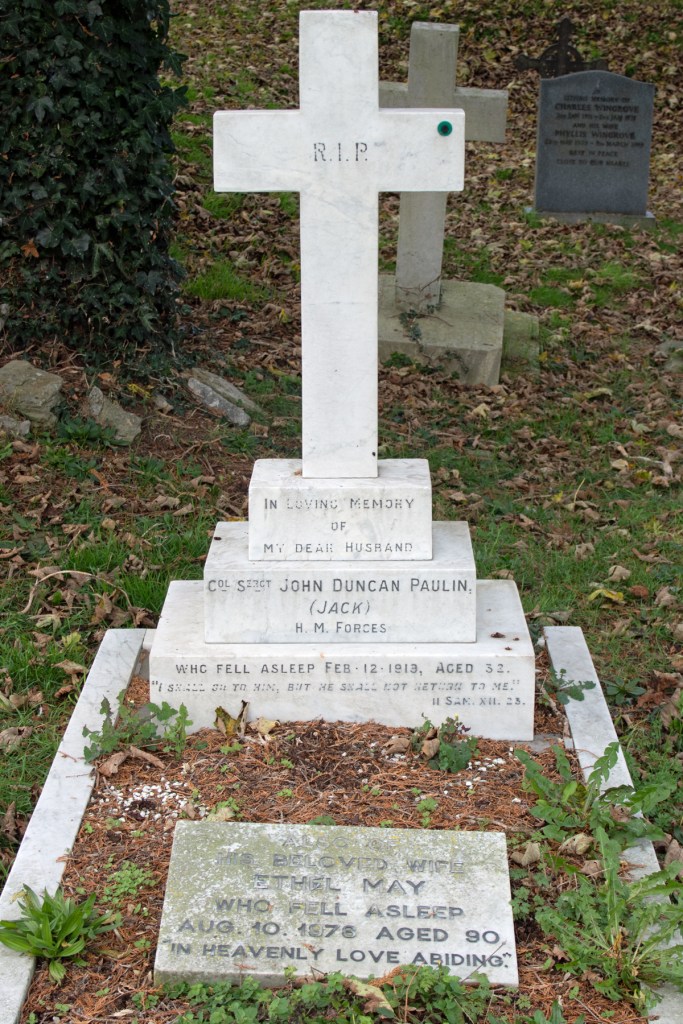
Colour Sergeant Paulin’s military career was free of any medical issues or hospital admissions until February 1919. He had not been demobbed by this point, even though the war was over. However, as with many other servicemen at the time, Jack fell ill with influenza, and was admitted to Grove Military Hospital (now St George’s Hospital) in Tooting, South London. Pneumonia set in, and Jack passed away on 12th February 1919, at the age of 34 years old.

Jack Duncan Paulin’s body was brought back to Somerset, and he was laid to rest in the graveyard of Christ Church, Frome. Ethel lived on until 1978; she was laid to rest with her husband.


Corporal Cyril Allen

Corporal Cyril Allen

Cyril Starr Allen was born on 15th June 1891 in the village of Baughurst, near Tadley in Hampshire. He was the second youngest of five children to Charles and Martha Allen. Charles was a rate collector, and the family moved around the county during Cyril’s early years.

By the time Cyril left school, Charles had become an assistant bursar in Wootton, near Basingstoke. Cyril, meanwhile, had found similar administrative employment and was working as a clerk for a local land agent.

At the start of 1911, Cyril enlisted in the British Army. He joined the 4th Battalion of the Wiltshire Regiment as a Private and was soon based on Salisbury Plain. His service records confirm that he was 19 years and 7 months old, and stood at 5ft 5ins (1.65m) tall. Private Allen served for his initial term of four years, before being remobilised.

In November 1915, Cyril married Mabel Young. She was a printer’s daughter from Wiltshire, and the couple married in Salisbury, before settling down in Frome, Somerset. They went on to have a child, a daughter they called Kathleen.

Remobilised in the autumn of 1915 Private Allen received a series of promotions – to Lance Corporal, Corporal, Lance Sergeant and Sergeant, and, by June 1917, he found himself at the Front.

On 22nd April 1918, Cyril was injured, sustaining gunshot wounds to his shoulder and left arm. He was invalided back to England for treatment, and was hospitalised in the north of the country. He was then transferred to the Royal Welch Fusiliers with the rank of Corporal and sent to Ireland to continue his recovery and work light duties.

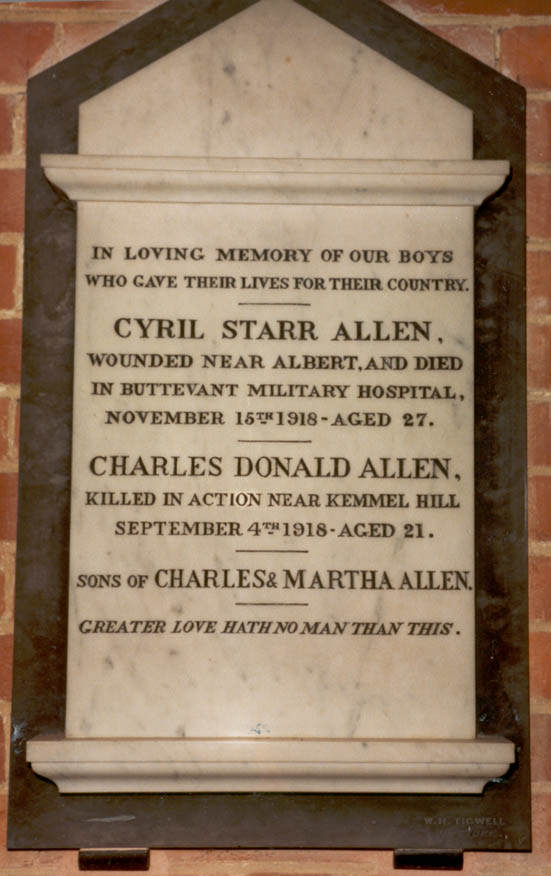
While in Ireland, Corporal Allen contracted influenza and was admitted to the Buttevant Hospital in County Cork. Sadly, in his weakened state, it was something he was to succumb to, and he passed away, with Mabel at his bedside, on 15th November 1918. He was just 27 years of age.

Cyril Starr Allen’s body was brought back to England; he was laid to rest in the graveyard of Christ Church in Frome, Somerset.


Corporal Cyril Allen (from ancestry.co.uk)

After the loss of her husband, Mabel went on to live her life. In 1923, she married James Burr, a draughtsman from Frome; they went on to have a child – a brother for Kathleen – called James.


Cyril’s two brothers, Winthrop and Charles, also fought in the First World War.

(from ancestry.co.uk)

Winthrop had emigrated to North America in 1911, but returned to Europe as part of the Canadian Expeditionary Force when war broke out.

Lance Corporal Charles Allen served with the 15th Battalion of the Hampshire Regiment. He fought on the Western Front and was killed near Kemmel Hill in Belgium on 4th September 1918. He was just 21 years old. Charles is commemorated at the Tyne Cot Memorial in Zonnebeke, Belgium.


Quartermaster Serjeant Percy Macey

Quartermaster Serjeant Percy Macey

Percy George Macey was born in Frome, Somerset, in the autumn of 1889. He was the oldest of six children and the only son to Arthur and Susan Macey. Arthur was a general labourer and domestic gardener from Wiltshire, whose family had moved to Somerset in the 1870s.

When he left school, Percy found work at a local foundry, and, by the time of the 1911 census, was listed as a brass fitter. By this point he had met Winifred Rowe, a labourer’s daughter from Wiltshire, who had found work as a servant to a Frome butcher. The couple married at the start of 1913, and went on to have a son – who they called Arthur, after Percy’s recently deceased father – later that year.

War was coming, and Percy joined the Somerset Light Infantry. Full details of his military service are not available, although at some point during the conflict he was promoted to Serjeant and transferred to the Labour Corps under the Devonshire Regiment. He was awarded the Victory and British Medals, but does not appear to have seen any service overseas.

By the end of the war, Percy had risen to the rank of Quartermaster Serjeant. The end of his life is, however, shrouded in a bit of mystery. He passed away on 15th March 1921 in Cheltenham, Gloucestershire; although no cause for his death is evident, it seems likely to have been from an illness of some sort, as there are no contemporary newspaper reports to suggest anything out of the ordinary. He was just 31 years old.

Percy George Macey was brought back to Frome; he was laid to rest in the Dissenters’ Cemetery in Vallis Road.


Serjeant Edwin Lloyd

Serjeant Edwin Lloyd

Edwin Lloyd was born at the start of 1885 and was the youngest of ten children. His father, Henry, was from Bristol; while his mother, Mary, had been born in Ireland.

Henry had been a Serjeant in the armed forces, and his postings are reflected in the places where Edwin and his siblings were born. Henry and Mary’s oldest two children were born in Aden, Arabia (now Yemen), but by 1875, the family were back in England and their next oldest child was born in Dover, Kent. Sarah, the youngest of Edwin’s sisters, was born in Colchester, Essex the following year, but by 1879, Henry had left the army, and had moved the family to Frome, Somerset.

In his retirement, Henry took a job as a grocer, the family living above the shop on the main thoroughfare into the town. Edwin did not follow his father’s trade when he left school; instead the 1901 census lists him as a metal engineer, one of only two of the siblings still living above Henry’s shop.

Henry died in 1907 – a lot of the documentation about his life suggests he was a bit free about his age. The notice in the Somerset Standard announcing his passing gives his age as 69, although it is likely that he was closer to 80.

The following year, Edwin married Florence Emily Letchford in St Matthew’s Church, Bristol. Florence was the daughter of a travelling salesman, but their marriage record sheds more light onto Edwin’s life by this stage and he was recorded as a police constable.

Edwin’s time in the police seems to have been short-lived, however, as, by the census three years later, his role had reverted to memorial brass engraver.

War was coming to Europe, and, while Edwin’s full service records are not available, it’s possible to piece together some of his life in the army. He enlisted in 1915, joining the Dorsetshire Regiment, and was assigned to the 5th (Service) Battalion.

Edwin’s battalion fought at Gallipoli and served in Egypt, moving finally to France in the summer of 1916. He was obviously a diligent soldier, as, by the end of the conflict, he had made the rank of Serjeant.

A local newspaper reported on the end of his army life:

He had served with the forces for about four years, and on his way home from France he was taken ill, and was, when he arrived at home, in a somewhat critical condition. The fatigue of the journey told still further upon him, and he passed away three days after his arrival.

Somerset Standard: Friday 7th March 1919

Serjeant Lloyd’s pension record gives the cause his passing as influenza, pneumonia and syncope, sadly none of which were uncommon for soldiers returning from the front. He was just 34 years old when he died on 25th February 1919.

Edwin Lloyd was laid to rest in the Vallis Road Cemetery (also known as the Dissenters’ Cemetery) in Frome.


Sergeant Herbert Rendell

Sergeant Herbert Rendell

Herbert George Rendell was born in the summer of 1886, the oldest of six children to George and Catherine Rendell. George was a twine maker from West Coker, near Yeovil in Somerset, and it was in this village that he and Catherine raised their young family.

While he initially found work as a labourer when he left school, the lure of a better life and career proved too much for Herbert and, in June 1905, he enlisted in the Royal Engineers as a Sapper. He spent three years spent on home soil, working hard and earning a Good Conduct medal for his service. During his tour of duty, he contracted pneumonia, spending five weeks in hospital in Chatham, Kent, over Christmas 1905, but fully recovering.

In September 1908, Herbert was sent to Singapore for a three-year tour of duty with the 21st Company. His body was not accustomed to the different environment, and he was hospitalised three times for malaria and myalgia, as well as two bouts of gonorrhoea in 1908 and 1910.

In December 1911, Sapper Rendell returned home, where he served for a further three years before war broke out in the summer of 1914. Having been promoted to Lance Corporal, and after a short bout in hospital following a reaction to his cowpox vaccination, he was sent to Egypt.

Assigned to the 359th Water Company, he would have been charged with constructing and maintaining the supply pipes to and from the Front Line and for his work was soon promoted to Corporal.

In the spring of 1918, the now Sergeant Rendell was transferred to the 357th Water Company, and found himself in Palestine, where he stayed until the end of the war. He came home on leave in April 1919, and it was here that, once again, he contracted pneumonia.

Sadly, Sergeant Rendell was not to recover from the lung condition for a second time; he passed away at his parents’ home on 9th April 1919, at the age of 32 years old.

Herbert George Rendell was laid to rest in Yeovil Cemetery, not far from the village where he was born.


Serjeant Albert Romain

Serjeant Albert Romain

Albert William Romain was born in Gillingham, Kent, at the start of 1888, the middle of three children to Henry and Florence. Henry was a Sergeant in the Royal Engineers and is seemed inevitable that his son would follow suit.

Henry died in 1896, and was buried in the Grange Road Cemetery, Gillingham (now a public park). The 1901 census recorded Albert as a pupil at the Duke of York’s Royal Military Asylum in Chelsea. This was, in fact, a school for the children of soldiers, and it is likely that Albert was sent there to be educated when his father died.

The Royal Engineers obviously proved too great a lure for the young Albert. While full details of his service are not available, he had definitely enlisted early on, and was listed as a Lance Corporal in the Tempe barracks in Bloemfontein, South Africa in the 1911 census.

When war broke out, he was called back to Europe, as was on the Western Front by November 1914. Little further information on Albert is available – during the conflict he was assigned to D Company of the Royal Engineers, but the end of the war, he had become a Sergeant in the 1st Reserve Battalion.

In November 1918, back on UK soil, he was admitted to the Fort Pitt Military Hospital in Chatham, Kent. His condition is unclear, but sadly it was to be one to which he would succumb. Sergeant Romain died on 8th November 1918; he was just 30 years old.

Albert William Romain was laid to rest with his father in the Grange Road Cemetery. He is commemorated in the Woodlands Cemetery in his home town of Gillingham, Kent.