Edwin Reginald Barber was born on 26th November 1864 in Martock, Somerset. The oldest of three children, his parents were William and Julia Barber. William was a tailor by trade, but Edwin sought bigger and better things.
On 3rd March 1885, Edwin enlisted in the Border Regiment. Sadly, there are no further details of his military service, although a later report suggests that he spent seven years with the King’s Royal Rifle Corps.
By 1898, Edwin was back in civilian life. He married a woman called Gertrude and, according to the 1901 census, they were living in Wrexham, Denbighshire, where he was employed as a labourer.
Somerset beckoned Edwin home, and he and Gertrude took up residence as landlords of the Stapleton Cross Inn in Martock. They remained there for more than ten years, although the army wasn’t completely done with them as yet.
When war came to Europe, Edwin felt the need to step up and serve once more. Despite approaching his 50th birthday, he joined the Somerset Light Infantry on 15th November 1914, although he soon transferred to a less physical role in the National Defence Corps.
This seemed to have proven to strenuous for Private Barber’s body, however, and he was formally discharged from military service on 2nd October 1916. Edwin returned to Martock, and once again took up his landlord duties.
From here on, Edwin was dogged with poor health. He passed away at home on 18th May 1921, after a long illness. He was 56 years of age.
Edwin Reginald Barber was laid to rest in the graveyard of All Saints’ Church in Martock.
Alfred Pollard was born in the spring of 1869 in Hinton Charterhouse, Somerset. His early life seems to have been a little disjointed. The son of Harriett Pollard, who had him out of wedlock, his baptism record gives no details of his father.
The 1871 census found him living with his mother and her widowed father, Thomas Pollard. Ten years later, Harriett is living with her husband, Walter Hayden, and four children, including Alfred – who has also taken the name of Hayden. Thomas is also recorded as living with the family.
Alfred is missing from the 1891 census return. Harriett, however, is now listed as married and the head of the household. She and Walter had a further three children – their youngest, Percy, being just three months old. Times must have been tough for her: the same census recorded Walter as being an inmate of the Somerset and Bath Asylum, where he is listed as being a lunatic.
Harriett died at the start of 1892, aged just 46 years old: Walter died three years later, at the age of 55. Both are buried in the graveyard of St John the Baptist Church, Hinton Charterhouse.
The passing of his mother and the diminishing health of his stepfather seems to have spurred Alfred into building a career to support his siblings. Having been working as an engine driver, on 7th December 1892, he enlisted in the Somerset Light Infantry.
Alfred’s service records give his height as 5ft 7ins (1.7m) and his weight as 137lbs (62kg). He was noted as having black hair, bark eyes and a coarse complexion. He also had a number of tattoos, including a cross on his right forearm; a circle of dots on his right wrist; crossed flags, an anchor and Jubilee 1887 VR and crown on his left forearm; and a bracelet on his left wrist. The records also noted the loss part of the middle finger on his right hand.
Private Pollard quickly became a career soldier. Over 21 years, he rose through the ranks to Lance Corporal (July 1902), Corporal (April 1906), Lance Sergeant (November 1907) and Serjeant (June 1911). He spent more than 14 years in India, and was involved in the Mohmand Campaign of 1897. He was formally discharged on 6th December 1913, having served as a signaller for eleven years, and a Provost Sergeant for three. His discharge papers confirmed his exemplary character, and that he was “thoroughly hardworking, sober and reliable.“
Back on civvy street, Alfred found work as a labourer in an iron foundry. This was not to last long, however, as he stepped up once more when war was declared in the summer of 1914. Joining the Somerset Light Infantry on 12th October, he retook his previous rank of Serjeant.
Alfred served on home soil during this second period in the army. Initially attached to the 3rd (Reserve) Battalion, his unit was based in Devonport, Devon. In September 1916, Sergeant Pollard was transferred to the 2nd Garrison Battalion of the Devonshire Regiment, which was based in nearby Plymouth. In January 1917, he moved again, to the Hampshire Regiment. He spent most of the year with 18th (Home Service) Battalion in Aldershot, Hampshire, and by December had moved to the 3rd (Reserve) Battalion, which was based in Gosport.
Sergeant Pollard remained on active service until the end of February 1919, when he was formally demobbed. At this point, his trail goes cold, although he seems to have settled in Bath, Somerset. He went on to marry, although details of his wife are limited to the name Mrs AE Pollard and her date of birth, 15th March 1879.
Alfred Pollard died of cardiac failure on 7th March 1921: he was 52 years of age. He was laid to rest in the army section of Bath’s Locksbrook Cemetery.
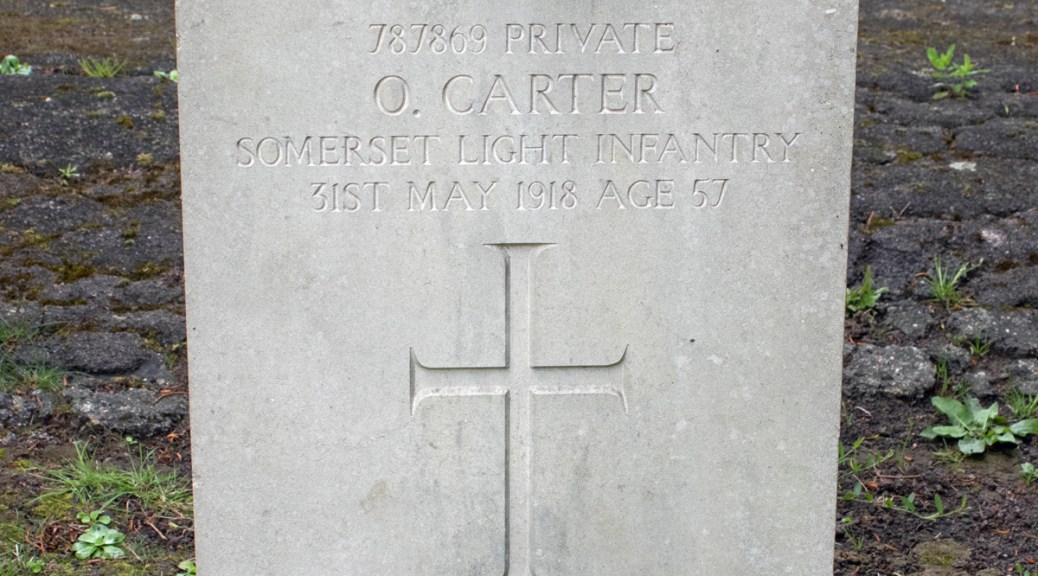
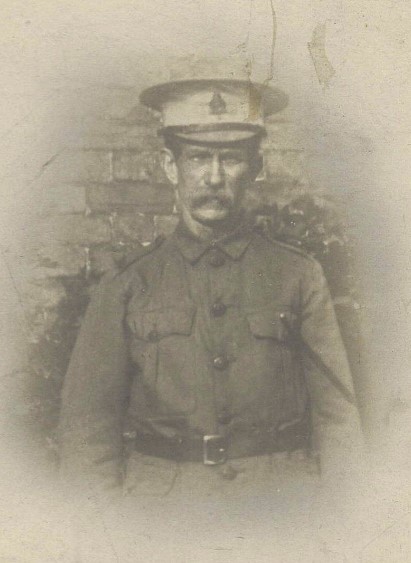
Oliver Carter was born in the spring of 1861 in East Budleigh, Devon. The youngest of four children, his parents were Ellis, who was a farm labourer, and Jane Carter.
As the years passed, Oliver’s older siblings left home and, by the 1881 census, he was the last of Ellis and Jane’s children to remain living with them. He was employed as a baker by this point, although he seemed to want more permanent employment.
On 9th February 1883, Oliver enlisted in the army. His service records show that he was 5ft 6.5ins (1.69m) tall and weighed 120lbs (54.4kg). He had a sallow complexion, with brown hair and grey eyes. The document confirmed no distinguishing marks (in the event that his body needed to be identified) and that his religious denomination was Church of England.
Private Carter was assigned the Commissariat and Transport Corps – a forerunner to the Royal Army Service Corps – for a period of twelve years. After eighteen months on home soil his unit was sent to South Africa, where he remained until December 1885. On returning to Britain, he spent the next nine years on reserve status, and was formally stood down from army service un February 1895.
The 1891 census return found Oliver back in Devon, where he working as a general labourer alongside his army commitments. Ellis, meanwhile, was employed as a miller’s waggoner, while Jane had also started taking in lacemaking jobs.
In the autumn of 1893, Oliver married Elizabeth Morrish. Eight years his senior, she was a widow with eight children of her own. The 1901 census recorded the couple living in a cottage near the King’s Arms Hotel in East Budleigh. They shared their home with three of Elizabeth’s children and their own daughter, Hilda. Oliver had changed jobs again, and was employed as a cowman on a farm.
Life continued on for the Carters. A chance of more regular employment as a labourer for the local council brought a move to Highbridge in Somerset. Elizabeth had her own account as a dressmaker, Hilda was keeping house and the family also had a boarder, Charles Smith, who was a butcher’s assistant. While they had made the move to a new county, they did not forget their roots: their house was called Budleigh.
When war broke out, Oliver seemed to be drawn to serve his country again. Full details of his second period of army service are lost to the mists of time, but some things can be gleaned from a contemporary newspaper report of his passing:
Death of a Volunteer
Much regret was expressed at Highbridge on Saturday when it became known that Mrs Carter, of Newtown Road, had received a telegram containing the news that her husband, Mr Oliver Carter, a member of the Somerset Volunteer Regiment, had died while undergoing training with his company under canvas.
Central Somerset Gazette: Friday 7th June 1918
Oliver had been assigned to the 1st (Volunteer) Battalion of the Somerset Light Infantry. His death was registered in Wiveliscombe, and the canvas reference would suggest that he was being trained on nearby Exmoor.
Given he was being trained at the time of his passing, Private Carter is likely to have been a new recruit to the Somersets. As he was 57 years of age when he passed, it is no surprise that he had volunteered for service. His age was to act against him, however: he passed away having contracted pneumonia.
Oliver Carter was brought back to Highbridge for burial. He was laid to rest in the town’s cemetery, a short walk from where his widow and daughter lived.
The early life of John Hookway seems destined to be lost to time. He was born in 1876 or 1877 in Lancashire, and the only surviving 1881 census featuring that name would suggest his parents were James, who was a shoeing smith, and Leah Hookway.
The next census on which John appears is in 1911. This confirms that John had married a widow called Rose Ash the year before. They were living in Huntspill, Somerset, with Rose’s three children – daughters Rose, Violet and Lily – and her sister, Emily. John was employed as an ‘improver in grocery trade’, while Violet, who was 17 years old, was noted as being a ‘servant on the Isle of Wight’. Violet’s sister, Rose, the census recorded, was ‘feebleminded’, while Emily was identified as an ‘imbecile’.
When war broke out, John stepped up to enlist. His age may have excluded him from any compulsion to join up – he was nearly 40 years old when he signed his attestation papers in December 1915. This may suggest that he had served in the army before, hence the absence from the 1891 and 1901 census records.
Private Hookway’s service records noted that he was a grocer, and that he had been born in Devon, although this is at odds with other, earlier, documents. He was 5ft 4ins (1.64m) tall and weighed 137lbs (62.1kg). He was assigned to the Somerset Light Infantry, and he joined the 13th (Home Service) Battalion. As the name suggests, John saw no action overseas, and his time appears to have been split between Somerset and Suffolk.
John’s time in the army was not without issue. In September 1916, he was admitted to a local Volunteer Aid Detachment Hospital with appendicitis, which saw him laid up for more than six weeks. In November 1918, the war having come to an end, Private Hookway was sent to the 2nd Southern General Hospital in Bristol, Gloucestershire, with an aneurysm of the abdominal aorta. This was, understandably, severe enough for him to be discharged from the army, and he was formally stood down on 12th March 1919.
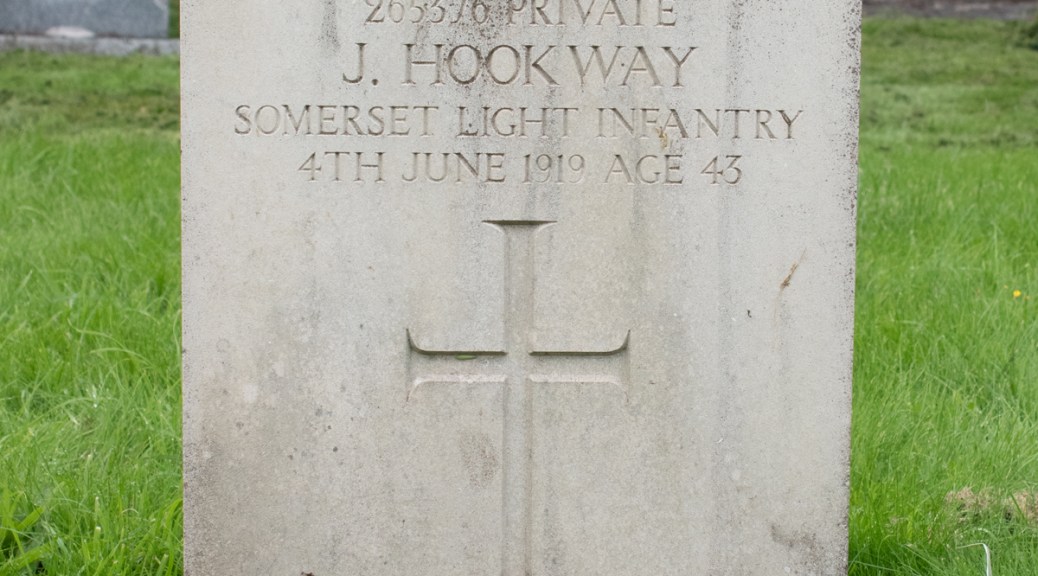
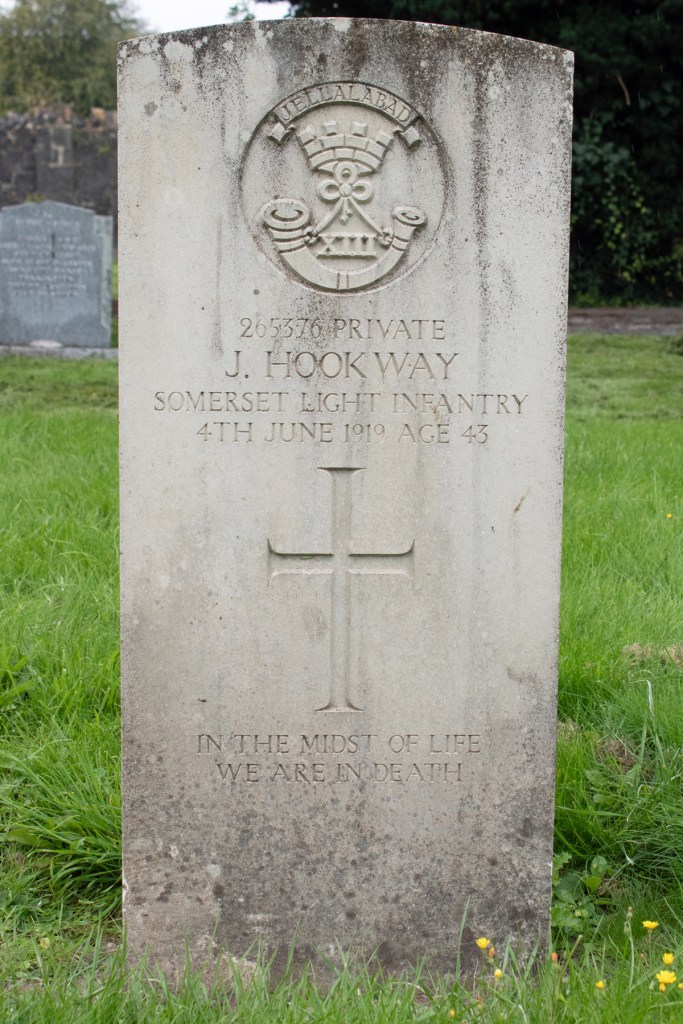
John returned home to be with his family. The next record for him is that of his passing, on 4th June 1919. He was around 43 years of age.
John Hookway was laid to rest in Highbridge Cemetery, Somerset. Rose, who had now been widowed twice in ten years, never remarried. She was laid to rest near her second husband when she passed in 1946.
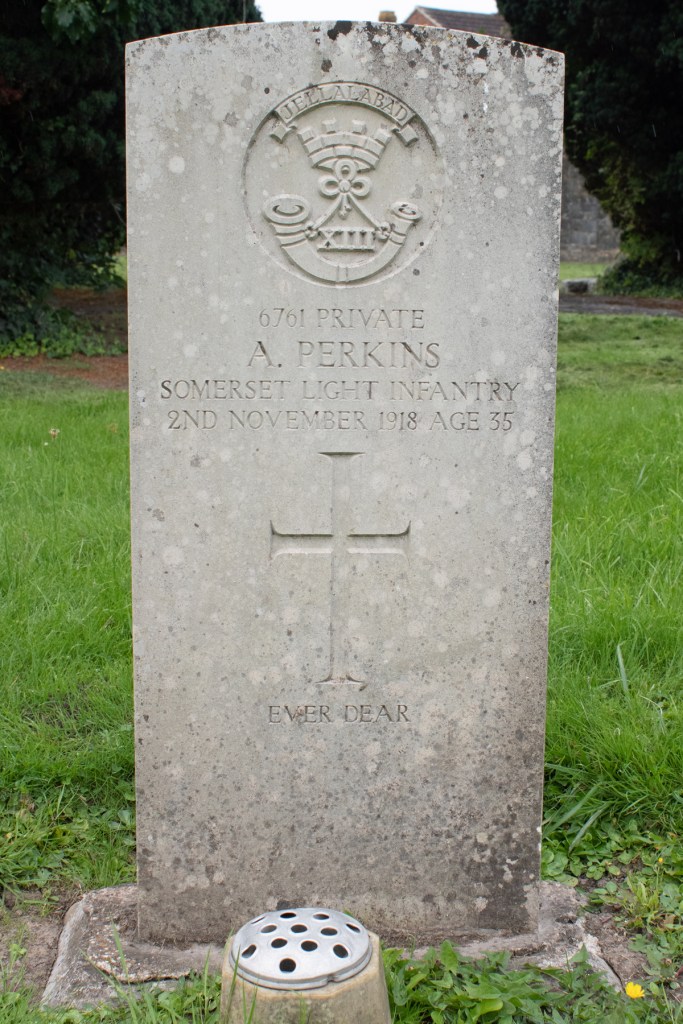
Arthur Perkins was born on 22nd April 1883, the seventh of eight children to James and Jane Perkins. James was a farm labourer who subsequently found work on the railways. The family were all born in Huntspill, Somerset, moving the few miles north to Highbridge when James’ work changed.
Arthur initially took on labouring work, but sought a more reliable career. On 26th February 1903, he enlisted in the army, joining the Somerset Light Infantry, for whom he had previously been a volunteer. His service records show that he was 5ft 7ins (1.7m) tall and weighed 122lbs (55.3kg). He had brown hair, hazel eyes and a fresh complexion, and his medical records note that he had a scar above his right eye.
Private Perkins was initially attached to the 2nd Battalion, remaining on home soil until September 1904. At this point, Arthur was moved to the 1st Battalion and, as a result, was sent to a unit in Quetta, India. He remained overseas for more than eighteen months, and, during his army career had a number of spells in hospital. He was admitted for bronchial catarrh in March 1904, a swollen stomach in December, a blistered foot in January 1905, syphilis in April and dyspepsia in September.
Arthur returned to Britain in May 1906, and at this point was stood down to reserve status. He returned to Somerset and, by the time of the 1911 census, was living with his older brother Harry and his family.
The Perkinses shared a small cottage in Benedict Street (at the time known as Station Road), Glastonbury. Arthur and Harry both laboured in a timber yard, while one of the yard’s engineers, William Webb, boarded with the family to bring an extra income in.
By the time war broke out in 1914, Arthur had moved back to Highbridge. He had taken up employment as a butcher, but this came to an end when he was mobilised on 5th August. Attached to the 1st Battalion of the Somersets again, Private Perkins was sent to France with his unit within weeks of the conflict being declared.
On the 18th September, Arthur was caught up in the Battle of the Aisne. He was wounded in the arm, and subsequently knocked unconscious by a shell burst nearby. From that point on, Private Perkins was dogged by a persistent tremor, which resulted in him being medically evacuated to Britain, and ultimately discharged from active service. “He had a functional tremor of the whole body. He he typically neurasthenic and depressed and convinced he will never be any better. No treatment is of the slightest avail.” [Medical discharge papers for Private Arthur Perkins: 26th June 1915]
Following Arthur’s discharge from the army, his trail goes cold. It is likely that he returned to Highbridge, although it is also likely that he spent periods of time – or longer – hospitalised because of his condition. He married a woman called Florence, although details of her are also scarce.
Arthur Perkins died through causes unknown on 2nd November 1918: he was 35 years of age. He was laid to rest in the cemetery of his home town, Highbridge.
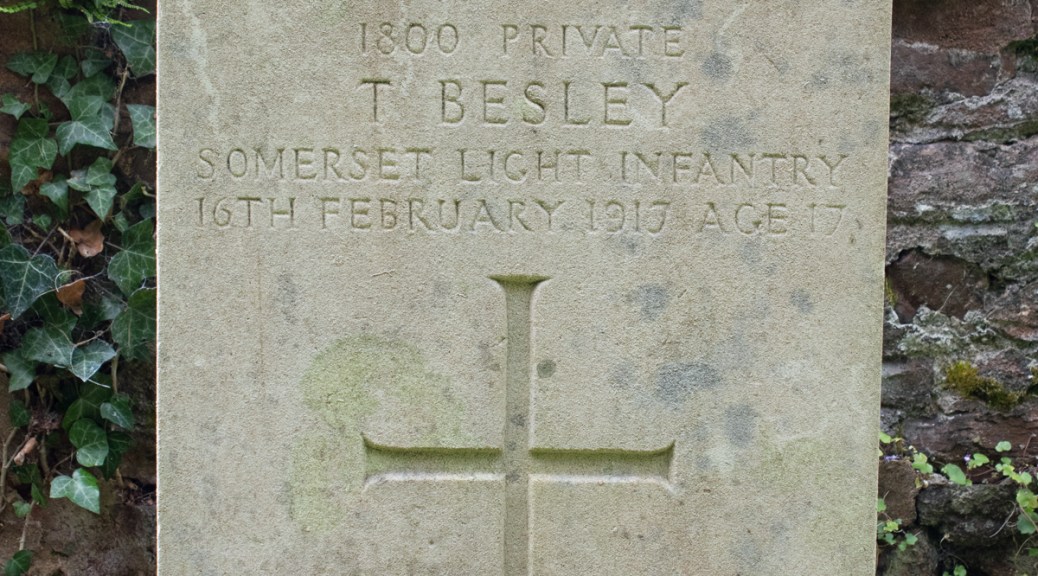
The short life of Thomas Besley is a challenge to unpick. He was born in Bampton, Devon, early in 1896, one of ten children to farm labourer Steven Besley and his wife, Fanny.
Steven’s work took the family around the region, and the 1901 census found the Besleys living on Cordings Farm in Wiveliscombe, Somerset. The document records Thomas as being 5 years of age, sharing the accommodation with his parents and six of his siblings.
The 1911 census records Thomas working as a live-in labourer at Manor Farm in Huish Champflower, a village just three miles outside of Wiveliscombe.
Meanwhile, his family are still recorded as living in Wiveliscombe itself, Steven and Fanny residing with four of their children. Now, however, another Thomas is listed with them: seven years old, he is the only child of their oldest son, William and his late wife, Elizabeth. She had died in 1904, around the same time as young Thomas’ birth, and it would appear that Steven and Fanny adopted their grandson (he is listed on the census as their ‘son’). William went on to marry again, but his new wife, a widow called Hannah, had seven children from her first marriage. The couple would go on to have a son of their own, but it was a crowded house, and so Thomas lived permanently with his grandparents.
The older Thomas Besley signed up almost as soon as war was declared in 1914. While his service records are sparse, he joined the 3rd/5th Battalion of the Somerset Light Infantry.
What can be determined from the records is that Private Besley drowned. His death certificate – which mistakenly records his surname as Beasley – confirms that Thomas’ body was found in the River Tone in Taunton on 16th February 1915, and the cause of death noted as ‘found drowned’.
While research for Besley draws a number of blanks about the circumstances of his death, the misspelled surname featured in a contemporary newspaper report:
On Tuesday afternoon, around four o’clock, MJ Chapman… while passing the Locks at Firepool, Priory, Taunton, observed what appeared to be the body of a man floating in the swirl caused by the overflow of the Locks into the pool. The police were immediately informed… and proceeded to the spot with the ambulance and recovered the body of a man, dressed in khaki uniform. The body had evidently been in the water for a considerable time and was much decomposed. The deceased was subsequently identified as Thomas Beasley, son of Mr Stephen Beasley, of Langley Marsh, Wiveliscombe. He was a private in the 5th Battalion of the Somerset Light Infantry, and was 40 years of age. He had been in ill-health for a considerable period, and latterly had been depressed. He disappeared on January 16th, and despite all enquiries his whereabouts remained a mystery until Tuesday…
[At the inquest] Stephen Beasley, a farm labourer… gave evidence of [Thomas’] identification. He said that his son had lately been ill. Three months ago he was taken from Salisbury Plain to Bristol Hospital, where he remained for about a month. After his discharge from Hospital he went home, where he remained about a fortnight, and for the last two months he had been quartered at Taunton. In this time witness had seen his son twice, but he could not say that he had been well since he came out of Hospital. He was low-spirited, but never told witness that anything troubled him.
Florence Beasley… sister of deceased, said she last saw her brother about a month ago in Taunton. He seemed very strange and low and would not speak unless spoken to first. He seemed to be troubled, and would not shake hands with her when she left him. He seemed to be always ‘studying.’ There was no suicidal tendency in the family…
Captain Burridge stated that deceased was sent to hospital from the Plain about September. About the middle of October he had a wire from Bristol Infirmary informing him that he was dangerously ill and dying. However, he got over that, and he was discharged on October 28th. He was sent for 22 days’ furlough to his home and returned to duty on November 22nd. Ever since that time he had not been in the best of health, but nothing had been noticed of his mental condition. He believed at one time there was a talk of his being discharged as medically unfit. He disappeared on January 16th.
The Coroner asked [how] long deceased had been in the service, and witness answered that he joined on June 1st, 1913. His complaint when removed to Bristol Hospital was double pneumonia.
On the suggestion of the Coroner, the jury returned an open verdict.
Taunton Courier and Western Advertiser: Wednesday 24th February 1915
In addition to the Besley/Beasley surname, the report features a couple more discrepancies. Thomas’ father’s name is given as Stephen, when it was Steven. The deceased is also recorded as being 40 years old when he died, when he was actually half that age.
Thomas Besley was laid to rest in the peaceful graveyard of St Andrew’s Church in Wiveliscombe. It gives his age as 17 years old and the date of his death as 16th February 1917.
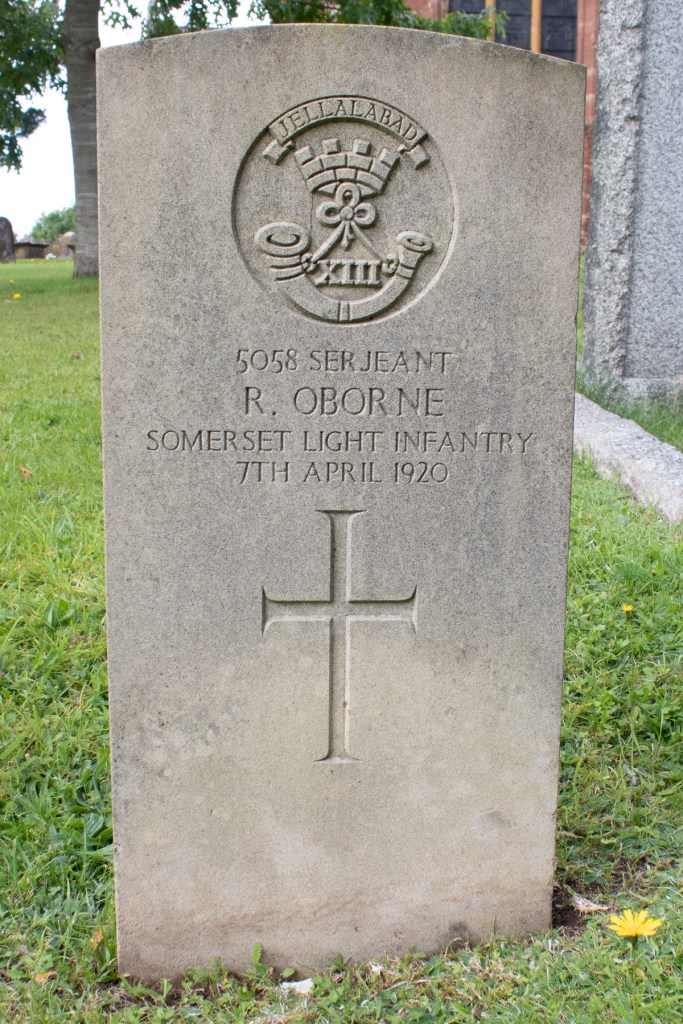
Robert Oborne and his twin, William, were born in the summer of 1880, two of ten children to John and Elizabeth Oborne. John was an agricultural labourer, and the family were raised in Bishop’s Lydeard, Somerset.
Death was to surround Elizabeth Oborne: William died when he was only three years old and John also passed away in 1886. This was around the time that she gave birth to their last child, who she also named William. The 1891 census recorded Elizabeth as living in the centre of Bishops Lydeard with four of her children: John, who was a farm labourer, Elizabeth, an errand girl, and Robert and William, both of whom were still at school.
When he completed his schooling, Robert found work as a coal hewer. He moved to South Wales, and boarded with the Hampshire family, in Ystradyfodwg, Glamorganshire. Further details of his life before the outbreak of war are scarce, although it seems that he changed career, taking up work as a groom. Known as Bobbie, later reports suggest that he was a genial young man, and had a large number of friends.
1915 proved a pivotal year for Robert: that summer he married Amy Lyons in Taunton. Elizabeth died in October, and his next oldest sibling, a sister also called Elizabeth, passed away just weeks later.
“Just before the war he joined the Somerset Light Infantry [Territorial] and went through the Gallipoli campaign, and then went to Egypt… he acted [in the capacity of a groom] to his officer commanding, and whilst in Egypt had the misfortune to get thrown from his horse, which caused internal trouble.” [Taunton Courier and Western Advertiser: Wednesday 14th April 1920]
The now-Serjeant Oborne was medically discharged from 3rd/4th Battalion on 21st August 1916, and returned to Somerset. He took up employment with Colonel Dennis Boles MP, acting as his groom from him from Watts House, on the outskirts of Bishops Lydeard.
Robert appears to have continued with this life for the next few years, but his wartime injuries continued to dog him.
…on Tuesday, March 2nd [1920], he gave up work and went to the doctor, who advised his removal to the hospital, where he was taken the following Friday, and underwent an operation the same evening. Hopes were held out for his recover, and he lingered until 1:30 on Wednesday morning [7th April], when he passed away.
Taunton Courier and Western Advertiser: Wednesday 14th April 1920
Robert Oborne was 39 years old when he died. He was laid to rest in the grounds of St Mary’s Church in his home village, Bishops Lydeard.
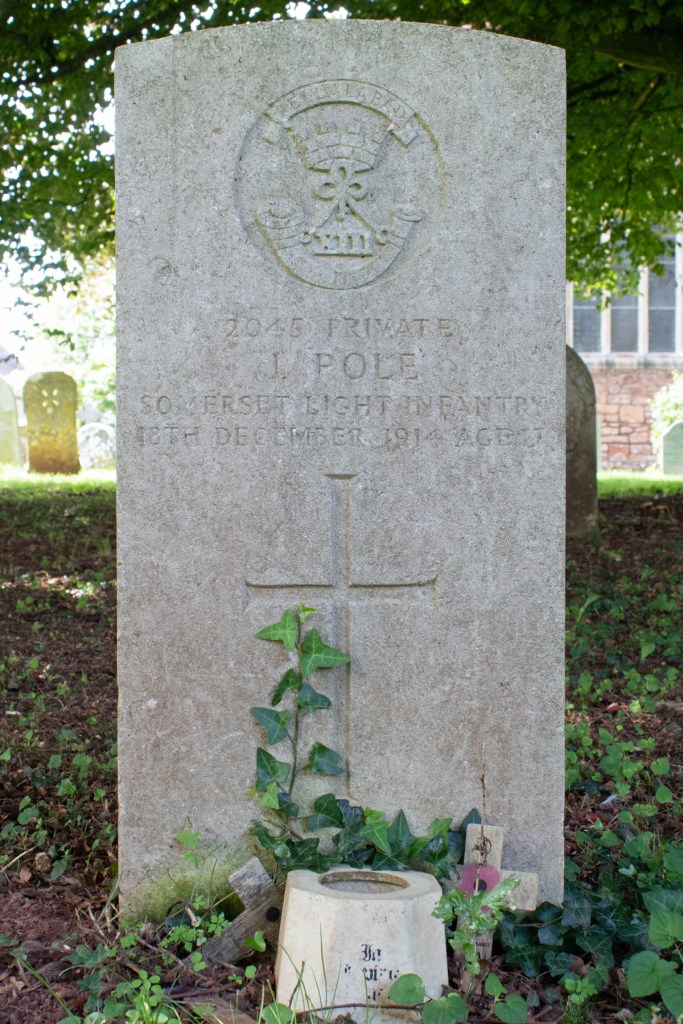
John Pole was born in Halse, Somerset, early in 1897. He was one of eleven children to Robert and Martha Pole. Robert was a basket weaver, and the family had moved to nearby Fitzhead by the time of the 1901 census.
Martha died in 1911, at the age of 51. John had finished his schooling by this point, and had found employment as a gardener. When war came to Europe, he gave that up to serve his King and Country. Details are scarce, but it is clear that he enlisted in the Somerset Light Infantry, and was attached to the 5th Battalion.
Private Pole was sent to Taunton for training, but his time in the army was not to be a lengthy one. His unit was sent to Southampton in September 1914, but it seems that he did not go with them. John contracted pneumonia, and seems to have been admitted to a military hospital in the town – possibly connected to his barracks. He died from the condition on 18th December 1914, aged just 17 years old.
John Pole’s body was brought back to Fitzhead for burial. He was laid to rest in the tranquil surroundings of St James’ Churchyard, close to where his father and siblings still lived.
Herbert Snook was born in the spring of 1895 in the village of Thurlbear, Somerset. The fourth of nine children, he was the second son of Henry and Clara Snook. Henry was employed as a stockman and cowman and by the time of the 1911 census, the family had moved to Bishop’s Lydeard, to the west of Taunton.
When Herbert completed his schooling, he found work as a postman. When war broke out, Herbert stepped up to play his part. Sadly, full details of his time in the army are no longer available, but the documents that remain give an indication about what he did.
Private Snook enlisted in the Somerset Light Infantry, and was assigned to the 8th (Service) Battalion. His unit served in France, but there is no evidence that Herbert went with them. During his time with the regiment, however, he was promoted, reaching the rank of Corporal.
In the summer of 1918, Herbert married Alice Webber. There is little information about her, but the wedding took place in Taunton. That winter, Herbert fell ill, contracting a combination of influenza and pneumonia. His health deteriorated quickly, and he passed away at his in-laws’ home on 3rd March 1919. He was just 24 years of age.
Herbert Snook’s body was taken to Ash Priors, near Bishop’s Lydeard, for burial. He was laid to rest in the tranquil graveyard of Holy Trinity Church, not far from where his family were living.
William Eric Tyler was born in the spring of 1888 in Carhampton, Somerset, the older of two children to farmers William and Nina Tyler. The details of William Jr’s early life are a bit sketchy: he was sent to a private school in Minehead, where he boarded for a while.
William Sr died in 1908, and Nina re-married, to farmer George Risden a couple of years later. Of William Jr there is no trace in the 1911 census, and the next record for him relates to his military service. He enlisted in the Somerset Light Infantry when war broke out, but transferred to the Machine Gun Corps in May 1918, receiving a commission to Second Lieutenant when he did so.
Again, details of Second Lieutenant Tyler’s time in the army are scarce. The only other document relating to him is that of his passing. He died, on 28th October 1918 at Belton Park Military Hospital near Grantham, Lincolnshire. He was 30 years of age.
Belton Park was primarily a facility to treat wounded soldiers returning from the Front Line, but it was also treated Machine Gun Corps personnel connected to the neighbouring camp. It is not possible, therefore, to identify the cause of his death.
William Eric Tyler’s body was taken back to Somerset for burial. He was laid to rest in the family plot in the graveyard of St John the Baptist Church in his home village, Carhampton. Buried alongside his father, he was reunited with his mother, when Nina died in 1946.










 Death and Service